
Civic Studies call for APSA 2021

The Civic Studies Group of the American Political Science Association (which I co-chair) has a call for proposals for papers, panels, workshops, roundtables, and other formats. The deadline is Jan 14. The call says:

The Civic Studies Related Group invites proposals for panels, round tables, and individual papers that make a significant contribution to the civic studies field; articulate a civic studies perspective on some important issue; or contribute to theoretical, empirical, or practical debates in civic studies.

We especially encourage proposals that emphasize actual or potential civic responses to the social and political crises of 2020, their origins, and possible consequences.

Civic studies is a field defined by diversity yet connected by participants’ commitments to promoting interdisciplinary research, theory, and practice in support of civic renewal: the strengthening of civic (i.e., citizen-powered and citizen-empowering) politics, initiatives, institutions, and culture. Its concern is not with citizenship understood as legal membership in a particular polity, but with guiding civic ideals and a practical ethos embraced by individuals loyal to, empowered by, and invested in the communities they form and re-form together. Its goal is to promote these ideals through improved institutional designs, enhanced public deliberation, new and improved forms of public work among citizens, or clearer and more imaginative political theory. The civic studies framework adopted in 2007 cites two ideals for the emerging discipline: “public spiritedness” (or “commitment to the public good”) and “the idea of the citizen as a creative agent.” Civic studies is an intellectual community that takes these two ideals seriously. Although new, it draws from several important strands of ongoing research and theory, including the work of Elinor and Vincent Ostrom and the Bloomington School, of Juergen Habermas and critical social theory, Brent Flyvbjerg and social science as phronesis, and more diffuse traditions such as philosophical pragmatism, Gandhian nonviolence, the African American Freedom Struggle. It supports work on deliberative democracy, on public work, on civic engagement and community organizing, among others.

You can submit proposals here. (Once you click to “submit,” choose “Submit A Division, Related Group, or Partner Association Proposal,” then scroll down to “Related Groups,” and then find “Civic Studies” on the list.)
putting the civic back in civil service

Problem 1: Donald Trump has left the federal civil service demoralized and denuded. The Partnership for Public Service reports:

The Department of Education, for example, which has championed many controversial policies, lost more than 14% of its career workforce, while employment at the Department of Agriculture fell by almost 8%. … Non-foreign-service employment at the State Department fell by nearly 9% from December 2016 to December 2019, a period that saw nine senior positions turn over at least once. Currently, more than one-third of the assistant secretary or undersecretary positions are vacant or filled by acting officials, leaving career diplomats and civil-service staff without direction and many initiatives adrift. 

Problem 2: new and recent college graduates need jobs, yet few (at least in my experience) look to the federal civil service. That was true even when they admired the president. Note that the federal government employs 2.1 million civilians, so it is a big part of the labor market. It is ironic that many college students favor a larger role for the government but wouldn’t think of working for it.

Problem 3: many people do not trust the federal government or see it as their friend. As I wrote yesterday, “Maybe progressives are wrong about the advantages of government; maybe white working-class people are wrong about the drawbacks of government; but either way, it is hard to build a party of the left if the largest racial group in the lowest income stratum wants less government.” (Support for government among other racial and class groups is not very impressive, either.)

Problem 4: Affective polarization (meaning hatred of people from the other party) is a real threat to democratic institutions, and specifically to any chance of progress during the Biden Administration.

There might be one solution to all four problems. Federal civil servants can be, and often have been, very capable organizers and supporters of local collaborations. They have helped Americans to come together and address problems that communities define. See Carmen Sirianni’s Investing in Democracy: Engaging Citizens in Collaborative Governance (Brookings Institution Press, 2009) and his Sustainable Cities in American Democracy (University Press of Kansas, 2020) for good examples. Although the latter book is about cities, see p. 37 and elsewhere for the constructive role of federal agencies.

To strengthen this federal role requires leadership at the cabinet level, professional development for civil servants at all levels, conferences and other gatherings to share best practices, awards for excellent work, and other concrete steps. It does not require congressional action.

The objective would be to repopulate the federal civil service with capable civic actors who strengthen communities, bring people together across lines of difference, make government actually work better, and help people to feel that it is their instrument.

See also from government to collaborative governance; welcome to CivicGreen; public participation helps environmental policy; the path not taken (so far): civic engagement for reform; investing in democracy: the case of CARE, etc

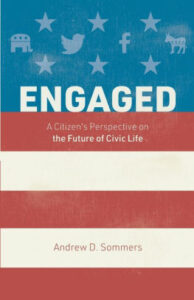
Join Virtual Book Club Discussion with Author of Engaged

The McCourtney Institute for Democracy, an NCDD member org invites you to an exciting discussion with the author of Engaged: A Citizen’s Perspective on the Future of Civic Life. The event will take place via Zoom on Monday, December 7,  at 4 pm Eastern, 1 pm Pacific. Register for the call here!

On the call, author and Penn State alumnus Andrew Sommers, will be available for a group Q&A session, and then participants will have the option to break out into smaller groups for further discussion. You don’t need to read the book to join the event – check out the additional resources provided in the post below to get an understanding of the book’s contents and be able to better participate in the conversation. Read more below and find the original announcement for this here.


Virtual Book Club
Engaged: A Citizen’s Perspective on the Future of Civic Life

By Andrew D. Sommers

Discussion with the author
Monday, December 7th, 4:00 pm ET

Purchase the book from Bookshop

Written by Penn State alumnus Andrew Sommers, Engaged provides a unique perspective on the state of our civic life today and why it matters to democracy. It explores key aspects of engagement through personal stories, vignette’s from the Shaw neighborhood in Washington, DC, and inspiring examples of those who are trying to make a difference. The book speaks to all Americans — veterans, entrepreneurs, religious leaders, community organizers, educators, parents, and everyday citizens — who want to make a difference in the country we all love.

Andrew has a B.A. from Penn State and an M.A. from the University of Pennsylvania. He has over a decade of experience, primarily as a management consultant working with federal agencies, bringing innovation to their business and technology programs. Andrew has been an active member of numerous Washington, D.C. non-profit and civic organizations — most notably, as a board member of DC Social Innovation Project (DCSIP) and member of the Sons of the American Revolution. When he’s not playing with his son, he’s an avid soccer and chess player.

Andrew will join us for a virtual book club discussion on Monday, December 7.  The first half of the event will be a large group Q&A session, followed by optional smaller group discussions in Zoom breakout rooms.

Register for the discussion

Additional Resources

As with any book club, reading the book is not required to attend the book club discussion. Here are some additional resources to help you understand its main ideas:

You can find the original version on this on the McCourtney Institute for Democracy site at www.democracy.psu.edu/virtual-book-club/.

who wants less government?

The General Social Survey asks respondents whether the government should do more or whether it already does too much. Here are the responses over time for representative samples of Americans (omitting those who place themselves halfway between those two views):

The balance of opinion swings back and forth. Sometimes, more people want to expand government; sometimes, more people think it already does too much. Obama saw a rise in government skepticism; Trump saw the opposite trend, culminating in the strong Democratic year of 2018.

And here are the results for two groups that are much debated right now.

First, white members of the working class, here defined as white people with family incomes in the bottom quintile.

These are the people who, according to progressives, would benefit from more government but don’t see things that way. Maybe progressives are wrong about the advantages of government; maybe white working-class people are wrong about the drawbacks of government; but either way, it is hard to build a party of the left if the largest racial group in the lowest income stratum wants less government.

Note, however, that the anti-government stance of this group is not hard-wired. In several years, a plurality of them have wanted more government. That was clearly true in 1975, and the next year, Jimmy Carter won the whole of Appalachia and the whole Gulf Coast. Instead of (only) complaining about the tilted electoral map, Democrats should be asking–as some are–why they aren’t the majority party in the country’s poorest states.

And here is the trend for African Americans. Combining all the years together would suggest that Blacks are more favorable than other Americans to government. But note their rising level of support for “government does too much.” I wouldn’t read much into the zigzag pattern; given the number of African American respondents, the margin of error for each year is +/- 8 points. But pretty clearly, African Americans were more favorable to government until ca. 1992 than since.

Finally, I should acknowledge that the question is very simplistic. The government should do more of what? Banning abortions? Stopping-and-frisking? Sending me checks? Covering the cost of seeing private-sector physicians? Curing cancer? I’m treating the results as proxy measures of support for social welfare, but that is not necessarily accurate.

See also: white working class alienation from government; what do the Democrats offer the working class?

Civvys Nominations Accepted Until Friday December 4th

ICYMI The 2020 American Civic Collaboration Awards (The Civvys) are accepting nominations until Friday, December 4th. The Civvys, celebrate best practices in civic collaboration that put community and nation before party, ideology and narrow interests. These annual awards are organized by NCDD member org, The Bridge Alliance Education, Big Tent Nation, and the National Conference on Citizenship. Read the details in the post below and find more information on the main website; and most importantly, make sure you nominate those outstanding efforts of civic collaboration making impacts in local, national and youth communities!


THE CIVVYS: The American Civic Collaboration Awards

Celebrating Partnerships that Strengthen America

The 2020 Civvys are here – submit nominations here!

In its fourth year (and what a year!) the American Civic Collaboration Awards will continue to highlight outstanding initiatives working to collaborate across divides at the national, local and youth levels. In light of the events of this year that have gripped our nation – from the spread of a deadly virus to the murder of George Floyd to a highly polarized election season – the 2020 Civvys Awards will focus more pointedly on those efforts at the national, local and youth levels that work toward greater equity, diversity and inclusion.

An esteemed panel of civic leaders will review the submissions to designate finalists and winners. The 2020 Civvys Winners will be announced in a livestreamed, virtual ceremony in March 2021.

Sign up for our email list so you don’t miss any updates!

The Civvys celebrate best practices in civic collaboration that put community and nation before party, ideology and narrow interests.

Since its inaugural year, the Civvys have highlighted outstanding efforts of civic collaboration making impacts in National, Local and Youth communities.

Award Categories

National: These projects are nationwide in scope and audience.

Local: These projects are designed to serve a local, state or regional community.

Youth: These projects have a focus on children, teenagers or young adults.

Criteria

We are looking for a range of projects, programs and people that use civic collaboration best practices to achieve real results in facilitating dialogue, enabling cross-partisan action, or putting civility and community above ideology. Here are our core criteria:

Collaborative practices. To what extent does this work use civic collaboration best practices to achieve results? What groups, expertise or areas are they bringing together afresh?

Impact. Who has this work had an impact on, and in what ways?

Scalability. Is this work something that can easily be expanded to have a greater impact? Is it something that can appeal across geographic regions, or be used to effect change in other civics topics or challenges?

Equity and Inclusion: Does this initiative make strides toward creating a more just, equitable and inclusive America?

In addition, the Civvys celebrates programs and people that:

  • Engages a representative and diverse set of stakeholders
  • Cultivates civility and mutual respect
  • Creates meaningful shared goals for those involved, using the process of co-creation
  • Provides effective facilitation and supports dialogue throughout the process
  • Develops or utilizes metrics to measure outcomes

You can read the original version of this information on the Civvy’s site at www.civvys.org/.

The Educating for Democracy Act of 2020

Senator Chris Coons (D-DE) and Senator John Cornyn (R-TX) have introduced the Educating for Democracy Act of 2020. It would significantly increase federal investment in civic and history education. It is the Senate companion to the U.S. House version of the Educating for Democracy Act that was introduced on September 17th by Congresswoman Rosa DeLauro (D-CT) and Congressman Tom Cole (R-OK). 

Note those D’s and R’s–this is bipartisan legislation with support from influential Members on both sides of the aisle.

The Act would authorize $1 billion in federal investment in civic and history education, including research, innovation and teacher professional development. Funds would go to state and local education agencies to strengthen and improve civic and history education; to non-profit entities to develop or expand access to curricula, instructional models, and other programs; and to colleges and universities to educate future elementary and secondary school teachers. The bill would also require the National Assessments of Educational Progress (NAEPs) in civic and history education to be conducted every two years at grades 4, 8 and 12, with state level results made publicly available so that states can be tracked and assessed.

The full bill summary is available here

Senators Coons and Cornyn and Representatives DeLauro and Cole will reintroduce this legislation in the new congress in January, but it is important to persuade U.S. Senators to co-sponsor the bill now. Please be in touch with your own Senators.