Engaging Ideas – 8/4/2017
Reply

Even though Creative Commons licenses have been around for more than a decade, I am always surprised to learn that many progressive-minded activists, artists and academics – the people who should be most enthusiastic about the licenses – know nothing about them or at least don’t use them.
A big welcome, then, to a new book Made with Creative Commons, by Paul Stacey and Sarah Hinchcliff Pearson. The book – subtitled “A guide to sharing your knowledge and creativity with the world, and sustaining your operation while you do” – explains the licenses to a new generation of users. It also offers two dozen case studies about the legal sharing of textbooks, music, data, art and other works, thanks to CC licenses. There is a short video that introduces the themes of the book.
CC licenses are widely used elements of many popular platforms these days, including Wikipedia, the Internet Archive, the video sites YouTube and Vimeo, the scientific journals published by the Public Library of Science, MIT’s OpenCourseware, and Europeana, among many others.
For newcomers to Creative Commons licenses: They are standard public licenses that a copyright holder can use to alert people that their works can be copied, re-used, and modified (depending upon the license) without permission or payment. They are free to use and easily used. Since the suite of licenses was released in 2003, it has been adapted to the legal systems of more than 170 countries in the world. An estimated 1 billion works have been tagged with CC licenses, as of 2015.
Made with Creative Commons chronicles the benefits of using the licenses and illustrates those points with profiles of an individual musician (Amanda Palmer), a university textbook publisher (Knowledge Unlatched), an electronics manufacturer (Arduino), and a global community of furniture designers (Open Desk), among many others.
As Stacey and Pearson explain, the licenses speed the dissemination of creative works and information because they ensure access to everyone. They maximize participation and collaboration in creating new works. They spur innovation because more people can build on existing ideas with new twists. CC licenses also boost the reach and impact of works because there are no artificial market or distribution constraints.
Because each re-use of a work adds value to the shared pool of knowledge and creativity, CC licenses are generative to our culture, not extractive, as conventional copyright tends to be. Finally, there is a social solidarity that the licenses tend to encourage by enabling groups of people to create and manage their own knowledge commons.
Made with Creative Commons discusses how using the licenses can help a creative newcomer get discovered. “You can stop thinking about ways to artificially make your content scarce, and instead leverage it as the potentially abundant resource that it is,” write Stacey and Pearson. Thus the makers of Arduino printed-circuit boards make their designs openly available under a CC license, enabling Arduino to build a different sort of revenue model around an open community of tinkerers and innovators. The science-fiction writer Cory Doctorow has used CC licenses on his commercially successful books for years. It has helped him attract a wider audience while also boosting sales for the physical copies of his books.
Creative Commons, the organization, has come a long way since its founding, and this book reflects some new thinking. For example, the book situates the commons within the larger spheres of the market and state, contrasting the different logic and roles played by each. The beginnings of a critical analysis of the political economy are evident.
When first introduced, the CC licenses focused on the emancipation that come with openness, which was indeed a significant advance over the closed, proprietary publishing world of the 20th century. But as open networks have become dominated by Google, Facebook, Amazon and other digital giants, the upside of openness per se has diminished – and the appeal of self-managed commons has grown.
That’s because big tech companies often make significant profits by becoming default platforms for user-generated content and social sharing. They in effect monetize social sharing without rewarding the communities or original authors. They make social collaboration a vulnerable resource that the biggest market players see as “free for the taking.” Made with Creative Commons implicitly acknowledges the limitations of openness, suggesting that perhaps the organization is ready to move beyond some of its libertarian, Silicon Valley roots.
Made with Creative Commons is published under a CC Attribution-ShareAlike license, and available in many formats, including a printed book.
There have been several new resources recently released in the D&D field that have crossed the path of NCDD staff and we wanted to share a few of the key resources with you here on the blog. These resources will also be catalogued in the NCDD Resource Center and you can learn more about them over there. We know there are many more resources in the NCDD network out there, so let us know what else you are hearing about in the comments below!
NCDDers John Gastil and Katherine Knobloch, along with Justin Reedy, Mark Henkels, and Katherine Cramer wrote the recently published research article, Assessing the Electoral Impact of the 2010 Oregon Citizens’ Initiative Review. The report of how the Oregon’s CIR has impacted the electoral politics and voter behavior since it became part of the process in 2010. You can read the article here.
We are excited to let you know the Center for Public Deliberation at Colorado State University recently published the report, Inclusion Around the Cycle, written by Samantha Maldonado a grad student of NCDD Board Member Martín Carcasson. The report offers strategies for inclusivity of non-dominant voices before, during, and after deliberative processes. You can read Samantha’s report here.
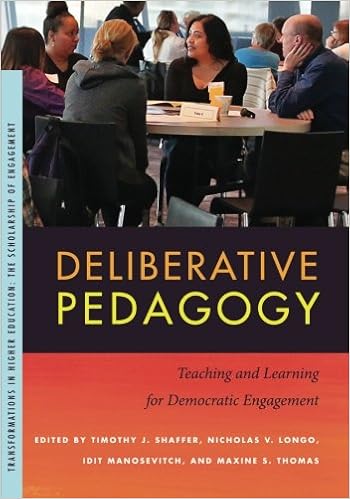 The book, Deliberative Pedagogy: Teaching and Learning for Democratic Engagement was edited by Timothy Shaffer, Nicholas Longo, Idit Manosevitch, and Maxine Thomas. This volume is written for faculty members and academic professionals involved in curricular, co-curricular, and community settings, as well as administrators who seek to support faculty, staff, and students in such efforts. The authors build upon contemporary research on participatory approaches to teaching and learning while simultaneously offering a robust introduction to the theory and practice of deliberative pedagogy as a new educational model for civic life. The book is available on AmazonSmile here and remember when you shop AmazonSmile, they will donate to NCDD on your behalf when you select for donations to go to “The National Coalition for Dialogue & Deliberation, Inc”!
National Civic League released their All-America Conversations Toolkit. All-America Conversations are designed to help cities and other groups understand residents’ aspirations for the community, the divisions facing the community and, most importantly, the small, specific actions that give people a sense of confidence that we can work across dividing lines. The toolkit can be found at: www.nationalcivicleague.org/all-america-conversations/.
We hope you will check out these great resources as part of your summer reading! We’re always impressed with the rich content coming from the D&D community.
Did we miss something? Let us know in the comments what other resources, reports, books, articles, etc. you are reading this summer, or anything you have published recently!
The Florida Council for the Social Studies (FCSS) would like to invite you and your colleagues and friends to attend the 60th Annual FCSS Conference at Innisbrook Resort in Palm Harbor, Florida on October 20 – 22, 2017. You can register for the conference here.
This is going to be an excellent conference with some great sessions.

The Preconference sessions will, no doubt, be really good, and you are encouraged to sign up early for what we expect will be a well-attended series of events!

You can register for the conference here. We look forward to seeing you in October!


I’m in Philadelphia for the Action Civics Initiative Summer Convening, a gathering of students, educators, and NGO leaders who are working to make civic education more action-oriented. From the closing plenary tomorrow, I’m heading to Ukraine to participate in the third annual European Institute of Civic Studies, this year at the Chernivtsi National University. The Institute draws practitioners, scholars, and activists involved with strengthening democracy in Ukraine and its neighbors. On my way home, I’ll stop in Kiev to talk with civic educators who work at the high-school level.
I predict some consistent themes (polarized societies, fragile democratic norms, inequalities of power and agency) as well as some important differences. I plan to blog periodically as I travel, or at least on my return.
See also: action civics goes mainstream and gets controversial, lessons from a large youth service program, creating good citizens, and the European Summer Institute of Civic Studies.