On Politics and Blame

Perhaps one of the few things that can be widely agreed upon these days is that the state of U.S. politics is less than ideal. Whether your side is winning or losing, it seems, the fight sure is ugly.

Of course, hindsight bias makes it challenging to accurately quantify the depravity of current affairs relative to past political struggles. Things seem pretty bad now, sure, but our vice president hasn’t shot any political rivals, and this isn’t even the first time the world has found itself on the brink of a nuclear showdown.

So perhaps things have always been terrible.

It is both interesting and depressing to read older political science literature; to see the long history of fake news documented by digital humanities scholars, or to read Lippmann’s blistering arguments for why the public will never be capable of taking on the tremendous task democracy has set out for them.

It is remarkable how little has changed; how much those old arguments still ring true.

Lippmann, for example, decried people’s steadfast commitment to their stereotypes – a word he coined. These mental short cuts may serve many useful functions, but they cause deep disfunction in the political domain, as people cling desperately to their fabricated understandings.

Stereotypes offer such familiar comfort, Lippmann argues, that “any disturbance of the stereotypes seems like an attack upon the foundations of our universe, and where big things are at stake, we do not readily admit that there is any distinction between our universe and the universe.”

Lippmann would hardly be surprised by the current state of political polarization.

Perhaps most remarkable in all this is that the critiques of our democracy have remained relatively stable over time. The details have changed and the voracity of certain view points ebb and flow, but, in the broadest sense, the contours of the critiques stay the same.

If our democracy doesn’t work as well as we might hope, there is always someone to blame.

We could join with Lippmann in being skeptical of the average person’s capacity to carry out this work. Perhaps the great majority are simply too lazy, stupid, or distracted to properly engage in democracy.

We could blame the media – they are too caught up in ratings, too interested in sensation and not interested enough in the truth.

We could blame the school system – why haven’t they better prepared their students for the work of democracy?

We could blame whichever Others we find most distasteful. Perhaps people like us and the institutions we’re a part of are smart, capable, and doing everything right. It’s just those Other people, the people not like us, who hold us back from achieving the full vision of our democracy.

Note that these criticisms could come from any portion of the political spectrum – no party has a corner on this market.

And the truth, I would argue, is that all these actors and institutions are to blame. If our democracy is broken – and it certainly seems to be less than ideal – it is a collective challenge which we all must address and which we all must accept responsibility for.

Blame gets us nowhere.

Habermas argues in favor of what he calls “discourse theory” as a middle ground between systems theory and rational discourse theory. Our society is neither a hierarchical network of institutions nor an unstructured blob of autonomous individuals. It is something in between.

As Habermas describes:

The lifeworld forms, as a whole, a network composed of communicative actions. Under the aspect of action coordination, it’s society component consists of the totality of legitimately ordered interpersonal relationships. It also encompasses collectivities, associations, and organizations specialized for specific functions. Some of these functionally specialized action systems become independent…spheres integrated through values, norms, and mutual understanding.

“The media” and “the public” – even “the left” and “the right” – are such spheres, internally cohesive with their own norms and grammar, but still very much integrated into the entire deliberative system. We can’t just tell one sphere to go fix itself – the solution requires a more holistic perspective that considers broader network.

The solution requires all of us.

I am not interested in blame. I’m not interested in post-mortems on political campaigns or past policy initiatives. We can learn a lot from history, of course, but ultimately I more interested in the future.

Like it or not, we’re all stuck on this earth together. We have to find ways to work together, to co-create our world together. We can’t put all our energy into passing blame. “Fixing” politics begins with each one of us.

…Or, perhaps, we’re all going to die.

facebooktwittergoogle_plusredditlinkedintumblrmail

Ukraine means borderland

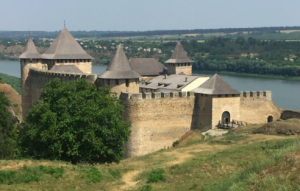
This isn’t a travel blog, and my photos aren’t very good, but here are some images that hint at Ukraine’s history as a borderland (which is its very meaning).

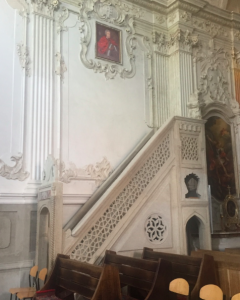
For instance, a minbar (the staircase a preacher ascends in a mosque) is preserved inside the rococo church of St Nicholas in Kamyanets-Podilsky.
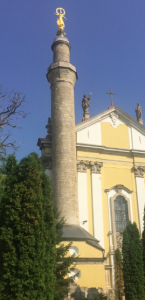

The same city’s cathedral preserves a minaret. The Ottomans had built towers all around this building, as at Aya Sofya in Istanbul. When the Poles regained the city, they removed the other minarets but had to retain this one for structural reasons. They surmounted it with a gold Madonna.

At Khoytn, the border is symbolized by a massive fortress, built and partially leveled in sequence by Christian, Muslim, Christian, and modern totalitarian armies.


In Chernivtsi, while it was still Austro-Hungarian Czernowitz, each “nation” had a handsome cultural house of its own: the Romanians, the Ukrainians, the Germans, the Poles, the Jews. The Ukrainian house made space for the first international Yiddish conference in 1908, because the city’s Jewish leadership favored German and Hebrew.

Today, the former Jewish People’s House still sports Atlas-type sculptural figures, two of whom are unusual in that they look upward.

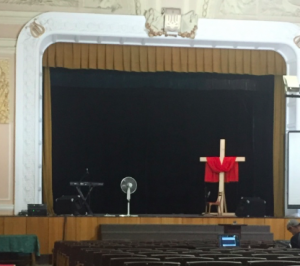
In the old auditorium on the third floor, where the stair-rail still shows a Star of David, the stage was set with a cross when I wandered in. The building is understandably used for various community functions today, in a city that is overwhelmingly Christian. This sight was nevertheless a bit disconcerting. (I suspect the Nazis smashed the other Jewish symbols in this room.)

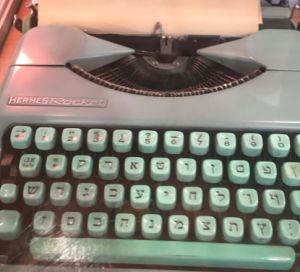
But downstairs is a fine museum celebrating and mourning the annihilated Bukovinian Jewish community, including this mass-produced Hebrew typewriter from the interwar period.

Here is a raffish Art Nouveau/Orientalist building called the “Sorbonne,” in the University area of Chernivisti. I saw it at dusk, when the sunflower’s face had sagged.

That could be an elegy for the faded elegance of Austria-Hungary. But the sunflower must have turned upward again the next morning, because there’s always a dawn. Half a century after the “Sorbonne” opened, Chernivtsi’s now-Soviet citizens could take off from their space-age airport under a frieze of Sputniks and ICBMs.

History didn’t stop then, either. Since I was last in Chernivtsi in 2015, a cheerful new 24/7 pharmacy has opened across the street from the “Sorbonne.”

The Sleep of Reason

I recently ran across Francisco Goya’s 1799 etching, El sueño de la razón produce monstruos: “the sleep of reason produces monsters.”

The piece is housed by the Met, where it is described as follows:

This is the best known image from Goya’s series of 80 aquatint etchings published in 1799 known as ‘Los Caprichos’ that are generally understood as the artist’s criticism of the society in which he lived. Goya worked on the series from around 1796-98 and many drawings for the prints survive. The inscription on the preparatory drawing for this print, now in the Prado Museum in Madrid, indicates that it was originally intended as the title page to the series. In the published edition, this print became plate 43, the number we can see in the top right corner. Nevertheless, it has come to symbolise the overall meaning of the series, what happens when reason is absent. Various animals including bats and owls fly above the sleeping artist, and at the lower right a lynx watches vigilantly alerting us to the rise of monstrous forces that we are able to control when sleep descends.

It feels deeply appropriate for modern times, an apt critique of our current world.

The sleep of reason produces monsters.

facebooktwittergoogle_plusredditlinkedintumblrmail

NCDD Sponsor Shares Nevins Fellow Experience

NCDD has been part of the ongoing effort by Penn State’s McCourtney Institute for Democracy, to connect students from their Nevins Democracy Leaders Program to internships with individuals and organizations in the D&D, public engagement field. Which is why we are excited to share this blog piece from NCDD sponsor org The Jefferson Center about their recent intern’s experience working on the Minnesota Community Assembly Project. The Nevins Democracy Leaders Program is an incredible opportunity to host a D&D-trained student at no cost for two months during the summer.  You can learn more about the Nevins Democracy Leaders Program by checking out our earlier write-ups on the blog here and by listening to the Confab Call recording here.

We encourage you to read the Jefferson Center blog post below and you can find the original version on their site here.


The Minnesota Community Assemblies: Red Wing

This June and July the Jefferson Center hosted a Penn State student, Emma Rohan, made possible by Penn State’s Nevins Fellows program. Emma’s academic work focuses on education policy, and she came to us with experience in the field of deliberative democracy. While she was here, we were grateful for Emma’s support in the first of three Minnesota Community Assemblies — Red Wing. Below is Emma’s reflection on the experience.

It’s been an exciting and engaging start to the Minnesota Community Assembly Project (MNCAP)! This project, part of our Democratic Innovation Program, began in Red Wing over the course of three weekends. On Friday, June 9, participants gathered in the Red Wing Ignite event room, brimming with expectation and more than a little caffeine.

Eight full days of deliberation is a lot of work and commitment, but the thirty-six Red Wing citizens were in it for the long haul. Before they got down to business, participants had the chance to introduce themselves to their neighbors by sharing what they are sacrificing in order to be present at the Citizens Assembly. Taking care of children, enjoying free weekends with family, and going to work are just a few of the activities that participants agreed to forgo for this eight-day project, acknowledging that engaging in citizen-led democracy sometimes involves personal sacrifice.

These participants, randomly selected to reflect the demographics of their community, set out to learn about local government, discuss strengths and areas for improvement, identify the values underpinning good local government, and explore and recommend opportunities to ensure their local government reflects these values.

Participants learned about local government structures from experts around the globe – from Minnesota to Australia. Each equipped with a tablet, participants could vote on their preferred alternatives while visual representations of the results revealed themselves on the big screen. Bonds were forged as citizens helped each other navigate the digital voting system on their tablets.

During the second weekend, June 23-25, two guests joined the assembly in Red Wing to observe, though neither were new to the process. In the case of Ned Crosby, the founder of the Jefferson Center, this was an opportunity to see old processes in a new setting. As the creator of the Citizens Jury process in the United States, Dr. Crosby took the backseat this time, taking note of participation dynamics and exchanging ideas with our other guest observer, Neall Ireland.

A participant in a Canadian province-wide Citizens Assembly in British Columbia in 2004, Neil was captivated by the experience and makes it a habit to seek out opportunities to watch other assemblies in action around the globe: “I really enjoyed observing the Citizen’s Jury; found it particularly interesting to see how there is a common theme for in this type of process for the participants. It is my thought when educated to the issues and empowered, citizen participation truly is the most effective method of engagement and means to making impactful decisions for a constituency. I admire each of the individuals who have come forward to donate their time and contribute to their communities in a meaningful way. I am certain that each of the three communities engaged in the this process will move forward from it in a positive way and be a great example for other communities in the future.”

As the process moved along, time revealed that even cohesive and unified communities carry underlying tension. Discussions on participation responsibilities and representation in local government sparked contention, and the facilitated conversation unearthed divergent expectations and assumptions between community members. With careful attention paid to group dynamics and how a deliberation space may advantage some and silence others, it was refreshing to notice participants sort out their disagreements themselves over a snack break.

Citizens Juries aimed at the prospect of equipping people to evaluate the structure of their local governments and the platform to recommend changes is an undertaking which requires special consideration toward the role of the facilitator. As outsiders in a tight-knit community, the Jefferson Center team realizes the value of presentation of unbiased materials, giving participants space to share and respond to each other, and knowing when to step in to move the conversation along. Even so, navigating uncharted territory comes with miscalculations and oversights. End-of-the-day surveys gave participants the opportunity to share their feedback on the content and process of the event from a facilitation standpoint, and changes were incorporated in order to steer the group in the right direction.

The final weekend in Red Wing presented some of the largest challenges yet, while simultaneously inspiring some of the greatest displays of individual hard work and collective responsibility. With the deadline for the final recommendation by the Community Assembly fast approaching, participants worked together to craft their final recommendations and supporting statements, the report representing the culmination of their work together. Decisions about the presentation of the report were far from unanimous, and even after eight-hour days of deliberation, citizens in Red Wing stayed overtime to continue the discussion.

The Red Wing Community Assembly’s vision statement highlights some of the qualities of local government participants agreed were indispensable: “Our community needs a clear strategic vision, with leadership committed to working toward that vision. We’d like to see broad community participation, engagement, and communication – all aspects of transparency – to ensure community members are informed and engaged in developing and implementing our strategic vision and holding leadership accountable.” To accomplish this vision, the assembly advocated for a few alternatives to the status quo, such as ranked-choice voting, stronger financial disclosure requirements , better public meetings, and digital public engagement. It is important to note that support for these recommendations was not unanimous, and citizens had the opportunity to express their personal dissent or further recommendations by submitting a personal statement attached to the final report. See the final report in its entirety here.

By the end of our time in Red Wing, we couldn’t help but notice a renewed sense of ownership and personal stake in many of the citizens toward the governance of their communities. Several people shared new commitments they have undertaken since the Community Assembly got underway: people described their conversations with family and friends about the work they’ve done, several participants mentioned applying for local boards and commissions for the first time, and one participant even wrote a Letter to the Editor in the local newspaper. Regardless of the outcome, the value of forging these types of relationships between communities and their local governments cannot be overstated.

We are enthusiastic about the ways Red Wing will carry on this work beyond the formal process of the Community Assembly and into the community as a whole. One down, with Willmar and Brooklyn Park on deck!

You can find the original version of the Jefferson Center blog post at www.jefferson-center.org/red-wing-summary/.

Freedom of Speech

While I was offline for most of the weekend, there was a bit of excitement generated by a 10-page, misogynist manifesto published internally by a male employee at a certain well-known tech company. The employee has since been fired.

I’ll admit that I haven’t read the entire controversial post. Quite frankly, I’m not sure I need to. I’ve heard it all before and I have better things to do with my time than read 10 pages of arguments for why I’m unfit to do the type of work that I do.

The short version of his argument is that women aren’t cut out for STEM fields, but the strategic message of his post is that we collectively shouldn’t silence “uncomfortable” arguments just because we happen to disagree with them. A virtuous society should welcome dissenting opinions whether they are distasteful or not.

I have no interest in engaging with the misogynist message of his post. I flatly reject his arguments, and others – such as in this post by Yonatan Zunger – have already done detailed refutations of his point.

But I study citizens and civil society; I am interested in the ways we work together or don’t work together to co-create the world around us. So I am much more interested in the broader questions: in a society (or company) with many different people with many different views, what is the role of dissent? To what extent must speech be safeguarded? What social or institutional responses are appropriate regulators of speech, if any?

These are all important questions with non-obvious answers. I certainly don’t have any simple answers today.

I am inclined to agree with J. L. Austin, though, that words can be actions. Performative speech acts or rhetic acts are not mere sounds or words without meaning: they have real impact. As Austin writes:

Saying something will often, or even normally, produce certain consequential effects upon the feelings, thoughts, or actions of the audience, or of the speaker, or of other persons: and it may be done with the design, intention, or purpose of producing them…

Words have consequences, and thus we must take them seriously.

Words can do real harm.

So I think it’s unfair to say that anyone who feels harmed by another’s words should simply toughen up; they are not just words.

But the power of words to do harm also emphasizes why their freedom is so essential: words and ideas can be dangerous to corrupt, authoritarian regimes. Words have real power for harm and for good and their silencing should not be taken lightly.

But here’s the thing that’s struck me about this particularly case – the details of which are obscured and a bit fuzzy:

Was this employee a good worker and teammate who got a long just fine until one day he unleashed 10-pages of thought he knew his colleagues would hate?

That’s entirely possible, but I imagine a somewhat different scenario.

In his post, Zunger expresses pure distain at the views of the employee, writing “What I am is an engineer, and I was rather surprised that anyone has managed to make it this far without understanding some very basic points about what the job is.”

How did someone make it this far, indeed? I can’t help but wonder: was this really the first sign that the employee held so many of his colleagues in such low esteem? Was it the first indication that he had an entirely backwards view of what engineering really is?

I suspect not.

I have to admit I am disappointed, though not surprised, that he was so quickly fired. It just feels petty. It feels small.

It feels like the action to take to clean up a PR mess which comes at the same time your company is being investigated for systematically underpaying female employees.

And that’s the thing – words do matter. Pretending they don’t exist doesn’t wish the thoughts away. Sure, this one employee whose notable outburst went public can be swept under the rug and tidied up for a discerning public; but his words don’t go away. The culture that spawned those words, which allowed them to flourish, doesn’t change much as a result.

That’s not to say all vitriol should be labeled speech and allowed to run rampantly free; as noted, these words do harm and that harm should be taken seriously. But that’s why it’s important to have allies. Real allies, who will speak out when they hear something, who won’t laugh at bad jokes, who will pick up on the small things and provide constructive criticism.

We can’t pretend that a misogynist manifesto is the product of one guy at one company and we can’t pretend that his wrong and offensive views will just go away. The misogyny in tech is rampant, the misogyny in our culture unbearable. We should talk about these news scandals, sure, but the real work must be done at the ground level, every day. The real work begins long before it escalates to 10-page manifestos.

facebooktwittergoogle_plusredditlinkedintumblrmail

Union for Unemployed Graduates (UCD) – Tunisia

Author: 
The UDC is the oldest and most important organization that groups unemployed persons in Tunisia under one umbrella.The purpose of the UDC was to fill the vacuum in representation created between the UGET (L'Union générale des étudiants de Tunisie) student’s union and the UGTT (L'Union générale tunisienne du travail) labor...

Global Shapers Tunis Hub (GSTH)

Author: 
The Global Shapers Community is “a network of Hubs developed and led by young people who are exceptional in their potential, their achievements and their drive to make a contribution to their communities” (Global Shapers World Economic Forum website). Since its inception, the GSTH has identified a number of themes...

The Good Society 25.1

Featuring:

  • The Emergency Manager: Strategic Racism, Technocracy, and the Poisoning of Flint’s Children” by Jason Stanley
  • Laudato Si’, Civic Studies, and the Future of Democracy” by Harry C. Boyte
  • Paradoxes of Public Participation in Climate Change Governance” by Leah Sprain
  • The Impact of Ghanaian Peacekeeping on Domestic Civil-Military Relations” by Daniel H. Levine
  • Articulation and Concordance: A Dialogue on Civil-Military Relations in Fiji” between Teresia Teaiwa and Raijeli Nicole
  • A Review of Christopher H. Achen and Larry M. Bartels, Democracy for Realists: Why Elections Do Not Produce Responsive Government by Celia Paris

The Good Society 25.1

Featuring:

  • The Emergency Manager: Strategic Racism, Technocracy, and the Poisoning of Flint’s Children” by Jason Stanley
  • Laudato Si’, Civic Studies, and the Future of Democracy” by Harry C. Boyte
  • Paradoxes of Public Participation in Climate Change Governance” by Leah Sprain
  • The Impact of Ghanaian Peacekeeping on Domestic Civil-Military Relations” by Daniel H. Levine
  • Articulation and Concordance: A Dialogue on Civil-Military Relations in Fiji” between Teresia Teaiwa and Raijeli Nicole
  • A Review of Christopher H. Achen and Larry M. Bartels, Democracy for Realists: Why Elections Do Not Produce Responsive Government by Celia Paris