Diving into Public Philosophy, or maybe Belly-Flopping Into It
This spring has been BUSY. In Moving to Lexington, KY, I decided that among my key aims would be to dive deeper into the waters of public philosophy, public intellectual engagement. So far, a number of related activities have kept me busier than I could have imagined. They’ve also been hugely rewarding.
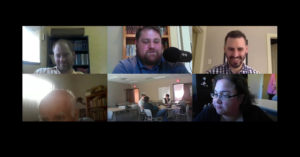 Organizationally, I’ve been working a great deal on projects for and leadership of The Society of Philosophers in America (SOPHIA, on Twitter & Facebook). Last fall, we held an online video symposium on “Trigger Warnings,” which was a lot of fun, and we need to hold more of them. We haven’t gotten back to that yet, but we need to, I think. We should probably think of that kind of work as a program, one with a name, and that should happen with some frequency, as well as an officer leading the charge for how and when we’ll hold the next one. We’ve certainly learned a great deal about the need for and steps for better audio quality in recording such events. The next one will be better and we’ll keep on growing our archive of material and gatherings.
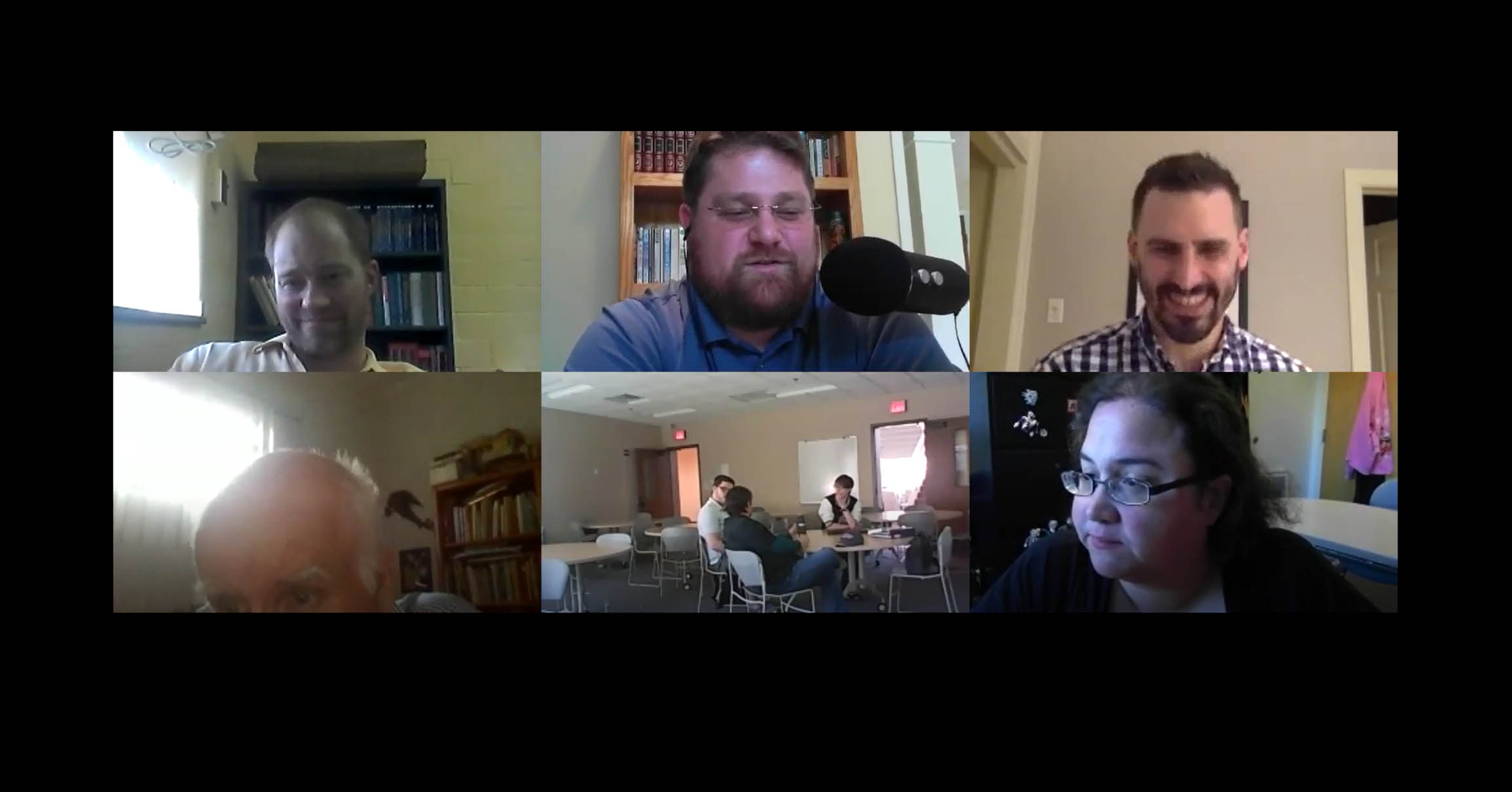
 In work for SOPHIA, we’ve also returned to a project I started in 2015, which was my Philosophy Bakes Bread podcast. Instead of it being solo and only a podcast, we’ve welcomed Dr. Anthony Cashio of the University of Virginia’s College at Wise as a co-host on the show, which is now centered on interviews about how and why philosophy matters in real life and leadership. We’ve been very fortunate to get a spot on WRFL Lexington, 88.1 FM. The program is now a weekly radio talk show and then a podcast after that, the Philosophy Bakes Bread radio show and podcast (on Twitter and Facebook too). We started in January of 2017 and have been very busy ever since. The podcast, when I worked on it alone, only came to 4 episodes in 18 months. Since committing to the weekly radio show, we’ve aired 32 episodes, 27 hour-long programs and 5 short “breadcrumb” episodes. It has been considerably more work than I could have imagined, but it’s also been a great deal of fun. More importantly, it’s been some of the most engaging public philosophical work I’ve done to date. We’ve got listeners in 67 countries and the show has been downloaded over 9,000 times to date. We’re excited about approaching the early milestone of 10K downloads, which we hope to see happen in the next 10-14 days, or less, as far as our present trends appear to be going. That’s super exciting.
We also have a logo for the show now, that isn’t just my lame effort to put a text over an image in Photoshop… We’re finally getting around to putting the word out in efforts beyond social media posts. We’re WAY overdue on a few requests for interviews. To give you a sense of why, for each episode, we need to: 1) think about who’ll be on, 2) invite the person(s) on the show, giving info about what we do, how, etc., 3) schedule the interview, 4) meet to prep to give the interview, 5) meet and record the interview, 6) edit the interview for airing as an episode, 7) go to the station and air the episode, 8) announce the show on social media before and as it’s airing, 9) get the files after airing from the station and perform final mastering on them, 10) prepare language, images, and social media posts to accompany the podcast episode release, 11) post the show and announcements on Facebook, Twitter, LinkedIn, and Google Plus, then 12) secure and make final tweaks to transcripts of the show that the great Drake Boling, UKY Philosophy undegraduate student, has been doing for us, and finally, 13) post the transcript on our site, as a PDF, and on Academia.edu. Ok, now do that 31 more times… to date (no, we’re not up to date yet with all the transcripts). To say it’s been a lot of work is an understatement.
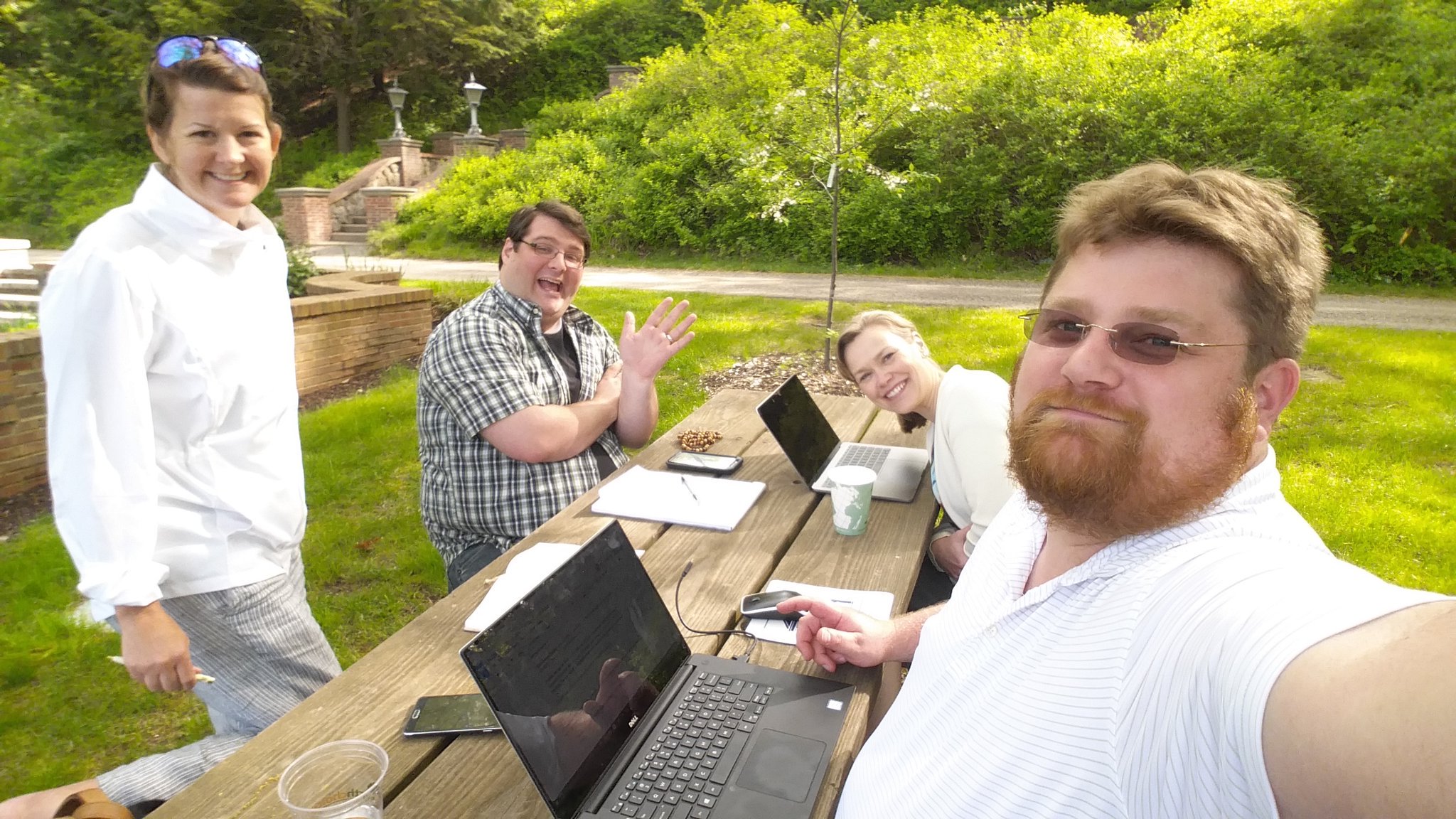
 This means that I’ve not had a chance to do as much of my own (single-author) writing, but the good news is that I’ve been doing considerably more coauthoring. In the academic world of Philosophy, people tend to think of meaningful writing as single-authored work, at least much of the time. That’s a mistake. There have been excellent philosophical works that are coauthored. Among them, I’m thinking of a number of projects by Scott Aikin and Robert Talisse. But they’re uncommon in the field. I’m glad to have had the chance to do some coauthoring, and one of these opportunities was a very special one. Again related to SOPHIA, I and three scholars put together a project that we pitched for the Public Philosophy Journal. The idea is that some theorizing has been needed for SOPHIA to pursue its mission: to build communities of philosophical conversation. To that end, Andrea Christelle, Sergia Hay, James William Lincoln, and I ventured to Michigan with grant support from the journal and the Mellon Foundation, ultimately, to write together a “Groundwork for Building Communities of Philosophical Conversation.” I’ve experienced coauthoring only a few times, and it’s not always been easy. This case went very smoothly. We’re not done with our project, and getting together remotely to finish the project is taking time, but the pay off has been great. We’re researching needs and methods for building communities of philosophical conversation, because we believe there’s a great need for a more philosophical culture in the United States and elsewhere.
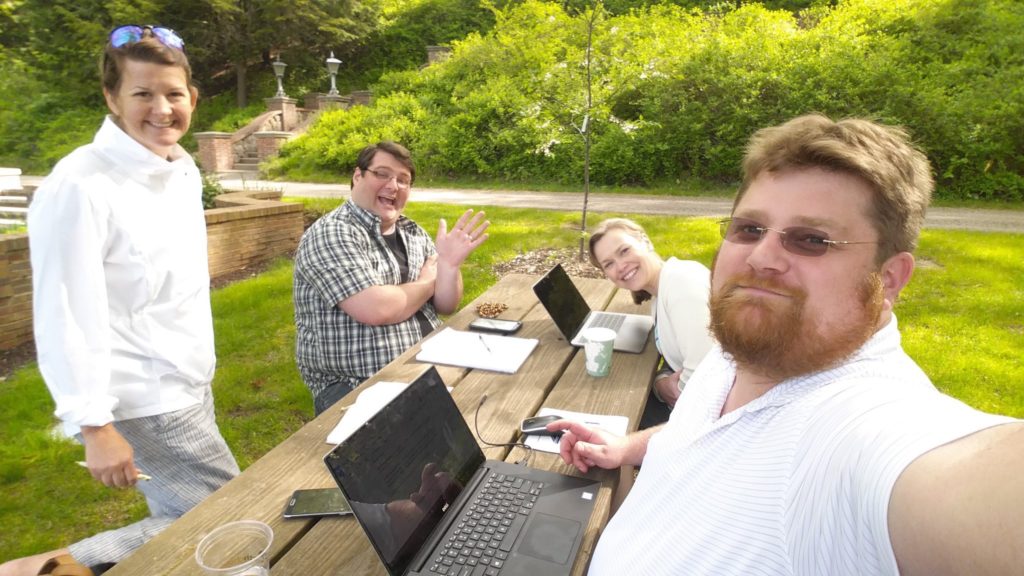
SOPHIA’s group at the PPJ’s 2017 Collaborative Writing Workshop.
Beyond that, I committed to coauthoring a paper for the Summer Seminar on the Future of Philosophy at UNC Ashville this July, which I’ll be driving to this afternoon. I’m also giving my own individual paper there, but have been very happy to coauthor a paper with my Philosophy Bakes Bread co-host Dr. Anthony Cashio as well. We’re looking to finish a longer paper a little later this summer for the journal, Dewey Studies, and this is a step in that direction. The paper is called “Lessons Learned Baking Bread: Taking Philosophy to Radio and Podcast.” We had a blast writing it, and were inspired in relation to that to answer some of our interview questions that we’ve received (and have been way late in answering them) in the last few months. Anthony is not only great to talk to on the show, but also to write with. I’m hoping that my future includes more and more coauthoring, because it’s very rewarding and makes for a superior project, I believe, when we can draw from more minds and from encouraging and sympathetic thinking and dialogue.
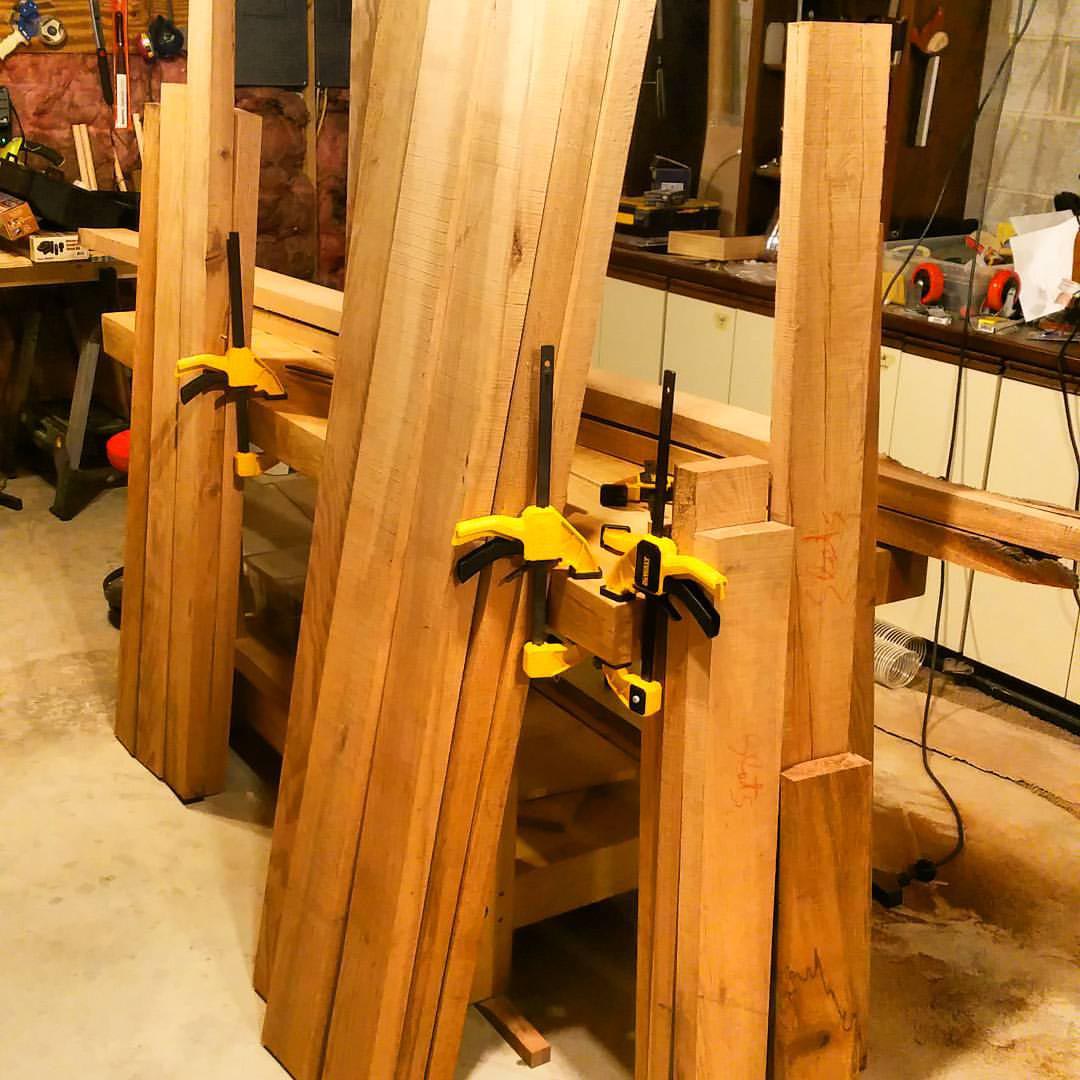
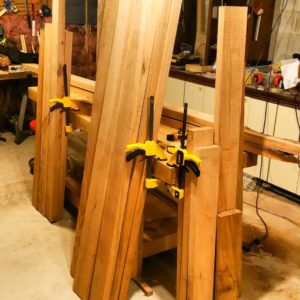 Last but not least, I’m finishing work finally on my edited collection of John Dewey’s public writings. That’s been a long-time coming. I keep thinking it’ll be done soon, and it will be soon now… I’m also working to finish my next book, which I’ve been developing longer than any before, called A Culture of Justice. That’s the other topic I’ll be talking about tomorrow in Asheville. These projects would have been done far sooner if I hadn’t committed to an intensive radio show, but I don’t regret a thing. It’s all been super rewarding. I feel as though I’m constantly working and getting more and more behind, but I think it’s more likely that progress is just advancing slowly on the huge projects, bit by bit, and that I’ll be excited to see them at the end. That’s a lot like a big bed project, which I’ve completed in my new hobby of woodworking. I milled the lumber for it in late November and December of 2016. Big projects sometimes creep along, but eventually, if you keep making little bits of progress, they come together, like this:

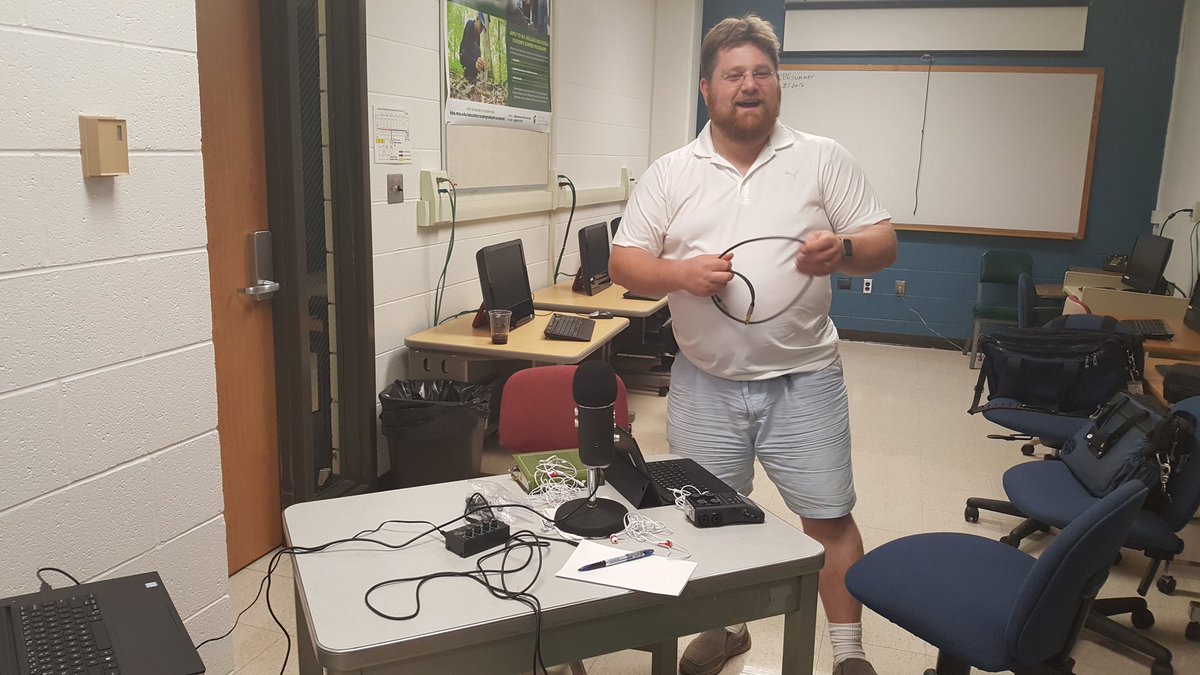
I need a nap… Nah, coffee will help. I’m excited to be headed to Ashville, to meet up with some great philosophers. And, while there, to do a number of interviews for Philosophy Bakes Bread! When we can record in person, it’s awesome, like in these two cases from my trip to Michigan (photos below). Thanks to Chris Long for the great photo with typewriter in the foreground, and thanks to Naomi Hodgson and Amanda Fulford (I don’t recall who took the picture, of the two) for the pic of our setup in the less attractive computer room in Michigan. The rooms were quite different, but the conversations were both substantive and fun.
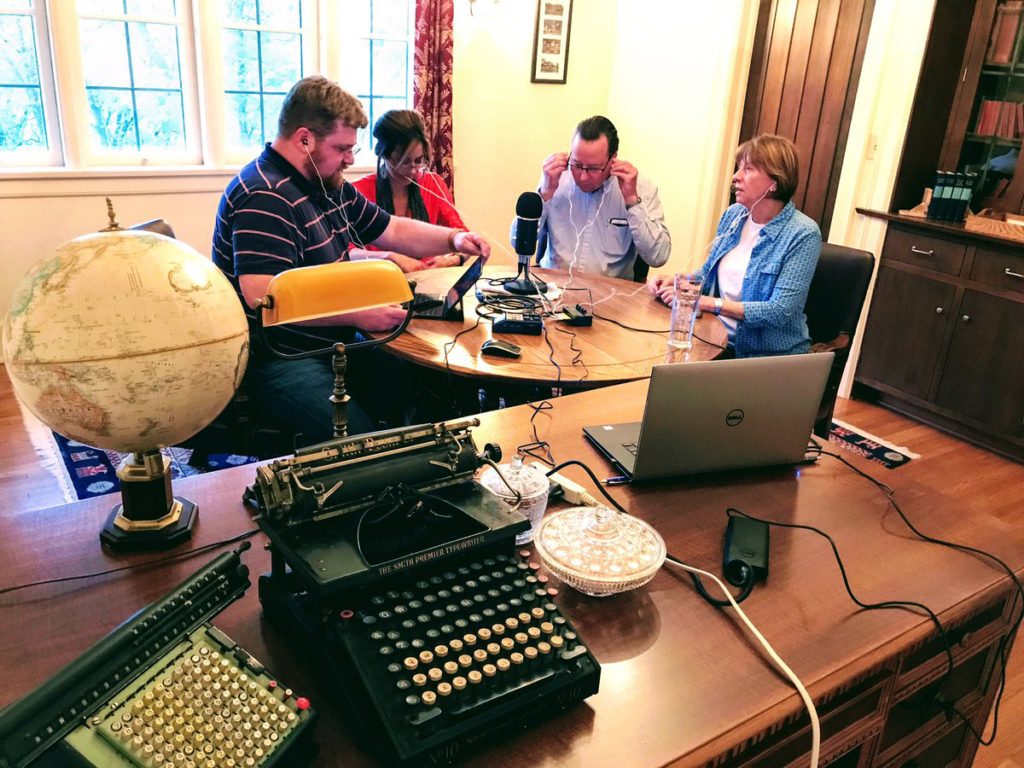
Photo courtesy of Dr. Christopher P. Long, 2017.
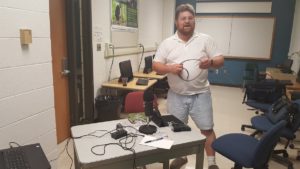
Photo courtesy of Naomi Hodgson and Amanda Fulford, 2017.
I don’t know how interesting this post is or has been for people, but it felt good to sit down and write it out. It may be of interest to a few people who’ve been kindly following and engaging with me on social media. In fact, I should mention a bit of a celebratory moment: I’ve hit 100,000 “likes” on my Facebook author page! That’s super cool and deeply gratifying. Thanks to everyone who’s been following my work. It’s really rewarding to write about and advocate for things that others care about too, making however small a contribution to dialogue about issues so many of us care about. It’s impossible to measure real impact, but we shouldn’t let difficulty in measuring something meaningful keep us from diving into it, or from belly-flopping into it as the case may be.
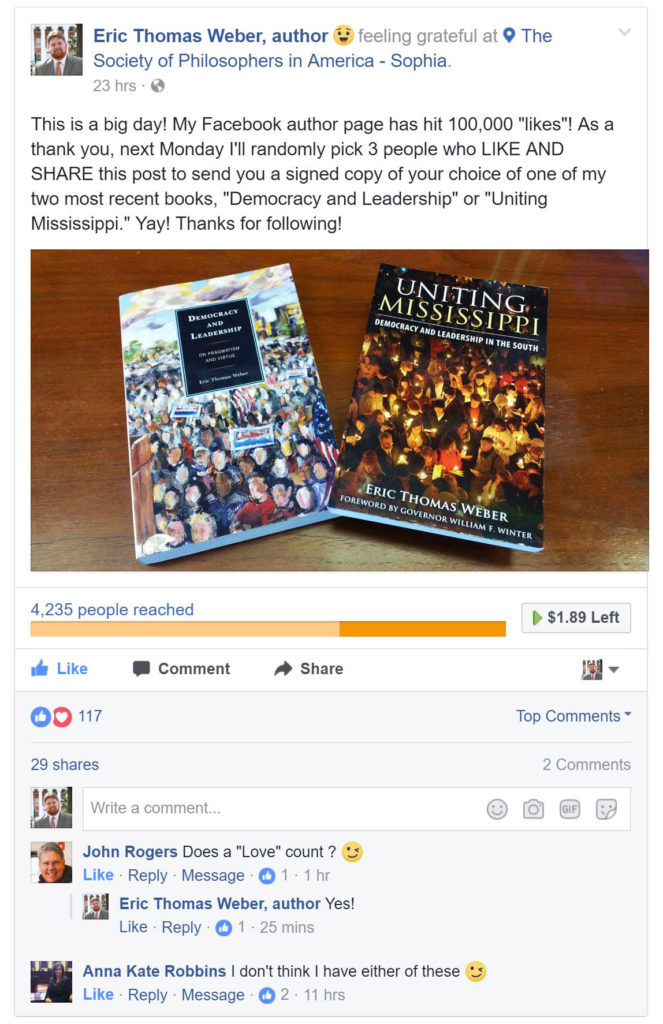
Image of a post from my Facebook page about a signed-copy giveaway for my latest books.
If you’ve read this far, thanks for your interest! If you’re not yet following me on Twitter or on Facebook, get to it!
The post What's New? first appeared on Eric Thomas Weber.