Pope Francis and Citizen Politics
Reply
We need a Copernican Revolution in political thinking. Pope Francis can help.

I remember vividly how weird a morning it was on September 11, 2001. At the time, I was living in Nashville, heading to work at a downtown law firm. I learned that year why I didn’t want to be a lawyer. That morning was unusual, because I didn’t usually turn on the radio until I got in the car on my way in to work. That morning I did, though. I couldn’t believe what I was hearing. It was something confusing about New York City.
Never before had I felt America stand still. It was eerie. Not knowing yet quite what was going on, I went to work, still feeling concerned and confused.

I grew up in the New York City area. People there were and are friends of mine. They’re not just American friends. The United Nations in the U.S. is centered in New York, not D.C. So diplomats from all over the world are there and were threatened too. New York City is also the landing pad for so many people who come to the United States, furthermore. It is a place that for so long was unique. It is such an icon for the country, as we are not a land of one ethnicity, race, or religion. America is an idea about how different people who want freedom can live together and govern themselves.
I don’t want to be too romantic. I live in a town that was the last battleground of the Civil War, resisting the integration of my university. People around this state were lynched in large numbers for the sake, explicitly stated, of white supremacy. Still, New York City is a symbol. It is a place people want to be. The best of so many things are or go there. It is a port. It has been an entryway into freedom for so many people. My own mother came to the U.S. through New York. It wasn’t to flee the tyranny of the French, of course, but even I am just a first generation American — on my mother’s side, at least.
One of my early memories from growing up was visiting the Twin Towers when my grandparents had come to visit from Iowa. There were a few generations of Americans in my family on Dad’s side. To many, the towers symbolized trade, given their name and purpose. They were also seen negatively by others as a symbol of American expansion around the world, and of modernism that radical conservatives rejected. A “radical conservative” sounds like an oxymoron, like an impossibility. If only it were.

White House photo by Eric Draper.
I wanted to take a moment to think about that day, to think about all the people who were killed. I want to think about all the people who gave their lives trying to save others. I also want to remind people on the Right and on the Left of the highest point that I admire most in President George W. Bush’s presidency. When people think about 9/11 and it’s aftermath, many people are still furious at Bush. I am not talking about any of those causes or conflicts. I am no defender of torture and I find base the attempt to deny some of what Americans did as something other than torture years later.
At the same time, we need to notice not only when people do wrong, but also when there are shining moments that get covered up, justifiably or not. Attending to high points reminds us what to strive for. The New York Times reported on Bush’s speech at a mosque a few days after September 11th, calling his words “eloquent.” Here’s their piece on Bush’s speech. If you haven’t read it, here is the transcript of Bush’s speech.
When President Obama says similar things, apparently he’s wrong about them, according to an op-ed in the Denver Post. Nonsense. There’s a nice PBS piece asking which President said it, Bush or Obama, about Islam. We need cooler heads, especially today.
If my title for this post is confusing, that’s because I’m not being very silent now. Actually, the point of it is to encourage others to do what I did with my class yesterday. The thing about September 11th is that no part of America said “New York was attacked,” to then go about their business, as if it had nothing to do with them. We can be so divided as a nation, and polarization can be one of our biggest problems. On September 11th, however, not only did all Americans feel for one another as a nation attacked. The rest of the world felt solidarity and felt attacked. “We are all Americans,” said Le Monde (“Nous Sommes Tous Américains“). It is important to remember how and when people felt extraordinary solidarity with the victims of a brutal attack.
Yesterday in my Philosophy of Leadership class, we took a few moments to be silent, to think about that day. Some prayed. All were thoughtful. We were silent together and we remembered.
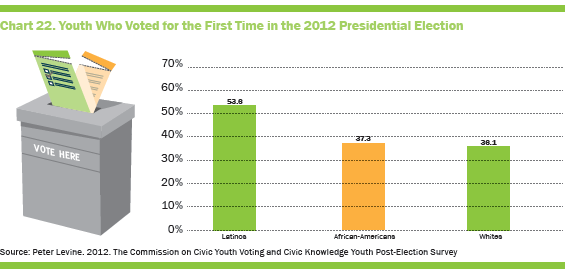
The National Conference on Citizenship (NCoC) released the Latinos Civic Health Index today. My colleague Kei Kawashima-Ginsberg is a co-author and the Tisch College of Citizenship and Public Service at Tufts collaborated with NCoC. Overall, the report points to challenges: Latinos are less engaged than non-Latinos in a wide range of civic and political activities. But there are signs everywhere that rates of engagement are rising. For instance, Latinos’ voter turnout is lower, but their turnout rates are improving. As a result, of all young Latinos who voted in 2012, an outright majority were voting for the first time. Meanwhile, their population share is growing. It seems apt, then, to describe the Latino population as a waking giant. The report provides much more detail, including information on non-political forms of engagement and data on differences among the major subgroups of Latinos.
Steve Earle & the Dukes, in collaboration with the Southern Poverty Law Center, have written & released a beautiful and moving song telling Mississippi “It’s Time.” Beyond writing a great tune, Earle has also done something he’d probably be too humble to admit. Through a work of art, he has contributed to moral leadership. He has creatively called Mississippi officials to change a policy. He leans heavily and justifiably on a number of Southern and Mississippi values. He’s right. Mr. Earle & the Dukes, thank you.

I’m working on a book called A Culture of Justice. It’s about the cultural conditions necessary for justice. It’s also about the cultural forces that can lead to oppression and its maintenance or to justice and its preservation. When journalists started reporting to the world with photos of the injustices in the American South, southerners were shamed. The rest of the world was also appalled and demanded change and the observance of the law.
 When it comes to Mississippi, some folks are right when they say that just changing a flag alone won’t change much. However, the things that need to change are impeded by attitudes and moral injuries that prevent progress. I wrote elsewhere about “What a Flag Has to Do with Justice.” In short, it can do harm, even if indirectly or in a roundabout way, in its contribution to the maintenance of an unjust culture.
The wonderful thing about culture and its artifacts, however, is that they also include solutions. Earle’s song is a great example of a way to show pride in one’s family and home, while recognizing the mistakes from society’s past. The song is complex. It weaves in norms and sounds that many Mississippians love, even if they were painful in their own ways too. To understand Earle, you have to recognize that he’s trying to reach people in Mississippi and wants reasonably to be proud of what we should be and not of what he shouldn’t be.
I find the video moving and brilliant. I hope you’ll share it widely and tell our public officials: “it’s time.”
One of the topics that I’m interested in as I delve into my Ph.D. program involves using networks to model a community’s interactions. A critical first question in this process is simply: what is a community network a network of?
Social network analysis and it’s face-to-face equivalent focus on networks of individuals. Each person is a node in the network, linked to the individuals they know or communicate with. This is a robust and helpful way of looking at communities.
It allows for mapping information flows and exploring community dynamics. Do most people know most other people? Are there segments of the community that are isolated from each other, like cliques in the high school cafeteria? How diverse is the average person’s network?
These are valuable ways of looking at a community, but this approach doesn’t tell the full story.
There is also great work being done looking at the network of institutions within a community. Can the characters of a community’s institutional network predict how well that community will fare during an economic crisis?
This approach is often not devoid of interest in the individual – asking, too, questions of how strong institutional networks can build social capital, benefiting the community as a whole as well as the individuals who comprise it.
Again, this is a valuable approach that can yield many interesting and helpful results.
But somehow, I find myself unsatisfied with either approach.
Communities are complex systems of individuals and institutions. An institution may be comprised of individuals, but it’s ultimate character is more than the sum of its parts: individuals can change institutions and institutions can change individuals.
And there may be yet more factors that influence how communities function: policies, norms, historical sensibilities, regional or even international networks.
So for now, the question I’m pondering is this: what would a detailed, robust, network model of a community look like? What are its nodes and connections, and is there some fundamental unit which could be used to model all these complex layers together?


