Dynamics of Online Social Interactions

I had the opportunity today to hear from Chenhao Tan, a Ph.D. Candidate in Computer Science at Cornell University who is looking at the dynamics of online social interactions.

In particular, Tan has done a great deal of work around predicting retweet rates for Twitter messages. That is, given two tweets by the same author on the same topic, can you predict which one will be retweeted more?

Interestingly, such pairs of tweets naturally occur frequently on Twitter. For one 2014 study, Tan was able to identify 11,000 pairs of author and topic controlled tweets with different retweet rates.

Through a computational model comparing words used as well as a number of custom features, such as the “informativeness” of a given tweet, Tan was able to build model which could correctly identify which tweet was more popular.

He even created a fun tool that allows you to input your own tweet text to compare which is more likely to be retweeted more.

From all this Twitter data, Tan was also able to compare the language of “successful” tweets to the tweets drawn from Twitter as a whole; as well as compare how these tweets fit into a given poster’s tone.

Interestingly, Tan found that the best strategy is to “be like the community, be like yourself.” That is – the most successful tweets were not notably divergent from Twitter norms and tended to be in line with the personal style of the original poster.

Tan interpreted this as a positive finding, indicating that a user doesn’t need to do something special in order to “stand out.” But, such a result to also point to Twitter as an insular community – unable to amplify messages which don’t fit the dominant norm.

And this leads to one of Tan’s broader research questions. Studies like his work around Twitter look at micro-level data; examining words and exploring how individual’s minds are changed. But, as Tan pointed out, the work of studying online communities can also be explored from a broader, macro level: what do healthy, online environments look like and how are they maintained?

There is more work to be done on both of these questions, but Tan’s work an intriguing start.

facebooktwittergoogle_plusredditlinkedintumblrmail

the 10 places where youth voters will have the most impact

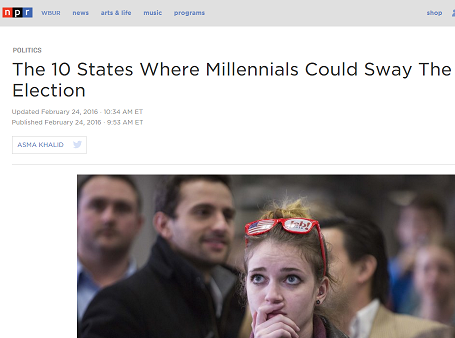
The current homepage of NPR news is a feature article by Asma Khalid about CIRCLE’s Youth Electoral Significance Index (YESI). My CIRCLE colleagues have identified the top 10 states and 10 congressional districts where the youth vote will matter most in Nov. 2016.

Politicians, campaigns, educators, and civic leaders should reach out to young people everywhere. But we recognize that political actors with limited resources will want to invest where they can have the biggest impact, and reporters may want to cover the youth vote where it counts for the most in electoral terms. Hence the YESI.

YESI

10 Ways to Make Your Materials More Inclusive

The article, 10 Ways to Make Your Materials More Inclusive, from Everyday Democracy provide tips to make your materials (and events) more inclusive when engaging the community. These guidelines recommend ways to take into consideration diverse human experiences and expressions, in order to have better designed dialogue and deliberation processes. You can find the article below and in full on Everyday Democracy’s site here.

From Everyday Democracy…

As diverse as we are racially, ethnically and culturally, we are also very diverse in how we learn. When we train, facilitate or write guides, we should pay attention to different learning styles. For example, some people need graphs and charts to understand information, and others need a written explanation. Still others need to hear a presentation. Some people thrive in a group setting, while others need time for self-reflection. There may also be various levels of literacy or English-language skills within groups.

To develop discussion materials that will make your dialogues more inclusive of varying learning styles and literacy levels:

1. Add color and graphics to highlight important information.

Your materials are probably filled with a lot of text, so using color and graphics can help highlight the important points. Also, plenty of white space can help people digest the information more quickly.

2. Use simple language.

It’s always good practice to avoid run-on sentences, but you should also watch out for difficult terms and jargon. Think to yourself, “How would I explain this to my 10-year-old neighbor?” Using simple language will help everyone better understand the process, especially people with lower literacy levels or for whom English is not their first language.

3. Define vocabulary.

If you can’t avoid using certain terms, create a glossary or define difficult words in the sidebars. For concepts that may be hard to define or that may have multiple definitions, you can invite dialogue participants to have a discussion about the terms if there is disagreement among the group.

4. Include an audio option as a guide supplement.

Since some people absorb information more quickly through hearing the information instead of reading it, you might want to consider including an audio CD or links to podcasts with your guide. The entire guide doesn’t need to have an audio component, but having an audio component for the introduction and key concepts for each session would be a useful addition to your guide.

5. Use an animated visual, like a comic strip, to explain the process.

This helps visual learners to quickly understand key concepts and helps cut down the time needed for explanations.

6. Provide alternatives for visual information.

Whenever you present a graph or chart, also include a verbal explanation for the information you are presenting. This allows people to absorb the information in a way that’s easiest for them.

7. Translate materials.

In your dialogue groups you may have people who don’t speak any English. If you have the resources, consider translating materials into the most widely used language(s) in your community. If you can’t translate the entire discussion guide, another option is to create handouts for each session that could be translated into other languages.

8. Include activities that allow for physical movement.

This increases interactivity, but also helps take into consideration learning styles that call for more physical interaction.

9. Include activities in which participants can role play/switch roles.

These activities not only help make the discussions more interactive, but they also help participants experience an issue from a different perspective.

10. Allow time for reflection.

Set aside a few minutes at the end of a session for journaling or self-reflection for those people who need a few moments to process information.

About Everyday Democracy
Everyday Democracy
Everyday Democracy (formerly called the Study Circles Resource Center) is a project of The Paul J. Aicher Foundation, a private operating foundation dedicated to strengthening deliberative democracy and improving the quality of public life in the United States. Since our founding in 1989, we’ve worked with hundreds of communities across the United States on issues such as: racial equity, poverty reduction and economic development, education reform, early childhood development and building strong neighborhoods. We work with national, regional and state organizations in order to leverage our resources and to expand the reach and impact of civic engagement processes and tools.

Follow on Twitter: @EvDem

Resource Link: http://everyday-democracy.org/tips/10-ways-make-your-materials-more-inclusive

New Teaching Primaries and Caucuses Lesson Plan

In this height of the election season, we are all looking for ways in which we can approach instruction concerning the sometimes confusing primary and caucus process. Recognizing this, our own Dr. Terri Fine has crafted a 4 day lesson plan that provides students an opportunity to engage students in an exploration of those elements of an election. And if any election begged for help in understanding it, it is this one for sure! The lesson plan is aligned with the Florida high school civics benchmarks: SS.912.C.2.14 Evaluate the processes and results of an election at the state or federal level, and SS.912.C.2.2 Evaluate the importance of political participation and civic participation. That does not mean, however, that you couldn’t use this to teach it in other grade levels or states! You can find the lesson plan on our website, and we are, as always very interested in feedback!


Citizen Professionals as Democratic Patriots

Last week in our Education Week blog conversation, "Bridging Differences," Deborah Meier described the five democratic habits of mind and heart that formed the basis of the highly successful public schools she led in East Harlem (Central Park East) and in Boston (Mission Hill).

I agree with her idea of "democratic habits" as the goal of education. I'd also bring in the skills and habits of civic agency. A topic for another day: how to assess civic agency?

Her emphasis on "habits of mind and heart" is a lot better than the simple cognitive focus on "mind" in higher education which dominates these days.

Richard Levin, president Emeritus of Yale, gave a talk last fall at the University of Illinois Urbana Champaign where I'm going tomorrow. His title was "education for global citizenship." He made interesting points about the need to revisit older ideas about what are "furniture" and the "disciplines" of the mind, drawing on Yale curricular changes. But Levin neglected "heart," the way education cultivates affections. He also neglected "hand," work in the world. I am glad Meier also mentioned developing work habits, like being mutually accountable, as part of the purpose.

There is a growing sense of crisis among educators in higher education that we've lost control over the huge changes occurring (there also seems to a feeling of loss of agency in K-12 but it takes somewhat different forms). Colleges and universities face rising costs, growing student debt, political attacks, and technological transformations. Educators usually feel powerless.

Emphasizing (and assessing) democratic habits of civic agency is not only good for students but also good for educators. Faculty and staff need skills and habits of democratic action and reflection to move from being objects and victims of change to being agents and architects of change.

Here are two "polarities" which disempower higher education's educators by greatly weakening relationships with larger publics and the world outside higher education. One is the tension between "education for global citizenship," widely advanced as the aim of liberal education, and inward-looking nationalism. Reflecting the culture of detachment in research I described last week, educators tend to see themselves as "outside" the society, partnering with citizens -- not as citizens themselves.

The other is the tension between preparation for careers and liberal education.

Adding heart and hand involves two ways to rethink things. In the civil rights movement I learned "democratic internationalism," different than either "America 1st" nationalism or global citizenship.

I worked for the Citizenship Education Program of the Southern Christian Leadership Conference, King's organization. Our "Citizenship Workbook" put it this way. "We love our land - America!" It also affirmed the right of other peoples in the Western Hemisphere to the identity of "American." And it welcomed the emergence of new nations in Africa and Asia "where people of color are demanding the freedom to decide their destiny."

Democratic internationalism challenges distinctions between "advanced" democracies and "emerging" democracies. In a time of grave threats to democracy in the US and across the world, we need to learn from each other.

Democratic internationalism is grounded in patriotism which sees citizens not defined by legal status but rather by citizens as co-creators of open and dynamic societies, refreshed by each wave of immigrants and new generations. We need to love our society, warts and all, and its great democratic possibilities.

The culture of being "outside" has spread to all the professions. Professionals who talk about civic engagement see it as meaning working with citizens. They don't see themselves as citizens. Adding "hand" to heart and mind brings together liberal arts together with career preparation.

This means new focus on "citizen professional" (and "citizen worker") in many fields, graduates who understand and engage the world as it is but also are effective agents of change, who see institutions not as places to fit in but rather as sites for democratic transformation.

Citizen professional schooling requires equipping students and educators with capacities to create empowering schools and businesses, congregations and clinics, nonprofits and public agencies -- foundations for democracy as a way of life not simply a trip to the ballot box.

Shouldn't a democratic, open patriotism and civic agency begin in K-12 schools? And shouldn't K-12 schools make strong connections between learning and work with public purpose and impact?

The tag line of the Minneapolis public schools is "education for global citizenship."

I'm sure it's meant to welcome new immigrants. But my experience is that like most African Americans in the civil rights movement, immigrants "love our land - America!"

They also want to be co-creators, builders of democracy as a way of life.