Martin Olav Sabo and the Spirit of Democracy

Martin Olav Sabo, who served as a Democratic Congressman from Minnesota for 28 years and became chairman of the powerful House Budget Committee, died on March 16, from respiratory ailments. Sabo is well known in Minnesota for his leadership in the Legislature, when it effected, often with bipartisan support, a series of major innovations -- balanced budgets, a fairer formula for school funding, and transparency in state and local governments. Partly as a result of these, Time magazine touted the "Minnesota Miracle" on its cover in 1971.

Sabo took his knack for breaking partisan gridlock and getting things done to Washington. As chair of the Budget Committee he was principle architect of the 1993 federal budget and deficit reduction package which resulted in a budget surplus in 1998, for the first time in 30 years.

Sabo is remembered in public life for his devotion to a politics of respect across partisan divides and its potential for productive results. The New York Times obituary quotes him on this theme. "I've tried to treat my colleagues with respect," he said. "I don't recall ever making a public statement critical of my colleague, whether it's Democrat or Republican." The Times described Sabo as a man of "quiet Scandinavian demeanor [who] conveyed a sense of civility during increasingly partisan times." There is a backstory.

I first met Sabo when I was beginning the Reinventing Citizenship initiative in 1993 with the White House Domestic Policy Council, just after Bill Clinton had become president. Barb Rohde, Washington liaison from the University of Minnesota's Humphrey Institute where I directed civic engagement efforts, took me around to meet the Minnesota Congressional delegation. I was excited about the meeting.

The Reinventing Citizenship effort built on Bill Clinton's campaign speech to the National Bar Association in July 1992, arguing that "America needs to restore the old spirit of partnership." Clinton had called for "visionary leaders throughout this nation, willing to work in their communities to end the long years of denial and neglect and divisiveness and blame."

I had interacted several times with the campaign and knew that President Clinton was serious about a renewed spirit of partnership between citizen leaders outside of government and as well as across departments and party divides within government. Martin Sabo embodied the spirit.

This spirit of democratic partnership infused his family background in the Norwegian farmer cooperative movements of North Dakota that birthed the Nonpartisan League which reshaped Midwestern politics. It also reflected the culture of Augsburg College, where he had graduated cum laude.

Augsburg, a small liberal arts college in Minneapolis, is in what can be called "the democracy college tradition" in American higher education. With roots in the Norwegian free church and Scandinavian folk schools, Augsburg's founding statement was chiefly written by Georg Sverdrup, grandson of Jacob Liv Borch Sverdrup, the founding figure in Norwegian schools for the peasantry who spent time in Denmark and was a contemporary of N.F.S. Grundtvig, the Danish philosopher of folk school education. Augsburg's statement challenged traditional university education which held up "the cultivated gentlemen" as the ideal type, disputed pedagogies which produced professionals separated from the people, and argued, in a folk school vein, that learning should be connected with living experience rather than preoccupied with "glossaries, citations, and crammed memories."

Sverdrup, the college's second president, in a talk to graduates in 1884 said that at many colleges "the aim appears to be the stuffing of knowledge into youth as one pours peas into an empty sack...where the teachers are eloquent and the students inarticulate...where everything is communicated but little or nothing is absorbed." At such schools, the rule was "Never think! Learn instead to conform to the prevailing code and you will succeed."

Augsburg was founded as a democratic alternative. Sabo exemplified its values in extraordinary ways, believing in the positive role of government and also the need for a much bigger environment of civic interaction.

Throughout our two years of work with the White House Martin Sabo was a regular source of counsel and helpful connections. His work to create the Sabo Center at Augsburg and his continuing involvement in its work was a major incentive for our moving the Center for Democracy and Citizenship to the college in 2009, where the two centers are now merged in the Sabo Center for Democracy and Citizenship.

Martin was enthusiastic about our work to "bring the public in," working with the Kettering Foundation and other partners to create public discussions on the purpose and future of colleges and universities that can reframe what is now often a polarized and narrow debate. He was, once again, also full of insight, ideas and relationships.

Martin Olav Sabo was full of the democratic spirit. His life and legacy are a vital resource for a nation which has never needed it more.

Harry C. Boyte, founder of the Center for Democracy and Citizenship at the Humphrey Institute, is now Senior Scholar in Public Work Philosophy at Augsburg College.

Civic Tech Tool Helps NYC Residents Address Local Issues

The Davenport Institute recently shared a post on their Gov 2.0 Watch blog about a neat civic tech tool that can help citizens identify and vote on issues that need to be addressed in their areas. It’s a thought-provoking idea that is being tried out below, so we wanted to share it here too. We encourage you to read more below or find the original post here.


Calling Out the Public

DavenportInst-logoA central purpose of civic engagement is to figure out what matters to citizens, so they can be empowered to achieve their goals.

Sometimes the best way to know is to ask.

Anyway, that’s part of the John Deweyian theory behind IdeaScale, which now complements CompStat in New York City, the data platform Commissioner William Bratton and then-Mayor Rudy Giuliani introduced in 1994, which tracks crime by location. Stephen Goldsmith at Government Technology writes that IdeaScale invites citizens to identify and vote on quality of life issues they find most pressing:

The program, which is part of the city’s broader efforts to amplify citizen engagement in new neighborhood policing models, creates action items for the everyday issues people actually care about. In the 100th Precinct, for instance, community members used IdeaScale to voice concern over late-night noise coming from a local bar. The police, in this instance, enabled the community to act in its own interest by coordinating a meeting between concerned constituents and the bar owner, who together reached a mutually acceptable agreement on their own terms.

Learn more about IdeaScale – and the theory of public engagement upon which it is based – here. Could this apply in other spheres of public engagement?

You can find the original version of this Gov 2.0 Watch blog post at http://gov20watch.pepperdine.edu/2016/03/calling-out-the-public.

how talking about Millennials obscures injustice

(Washington, DC) Generational analysis often conceals power and inequality and justifies the status quo. A great example is The New York Times‘ article yesterday about Mic.com, entitled, “What Happens When Millennials Run the Workplace?” Mic’s staff of 106 employees is described as “trim 20-somethings, with beards on the men and cute outfits on the women, who end every sentence with an exclamation point and use the word ‘literally’ a lot.” These folks like to “ride hoverboards into the kitchen for the free snacks. ” The challenges for the managers (who are also under 30) include handling “a sense of entitlement, a tendency to overshare on social media, and frankness verging on insubordination.”

All of this is presented as if it were typical of “millennials.” But the Bureau of Labor Statistics estimates that only 10,000 Americans between the ages of 20 and 24 (and another 28,000 between 25 and 34) are employed as “news analysts, reporters and correspondents.” Very few of those work for hip web startups. Meanwhile, 529,000 Americans between the ages of 20 and 24 work in “healthcare support occupations,” such as nurse’s aides, dental assistants, and vet techs. The fastest growing occupation of all in the US today is personal care aides, who help elderly and disabled clients with bodily (as well as social) needs. These aides earn about $20,000/year and need no preparation other than “short-term on-the-job training.” I guarantee that they never ride hoverboards into the kitchen or talk back to their employers, or else their highly contin[g]ent positions will cease within the hour.

Nearly two million people between 20 and 24 work in food service, of whom just 2.3% are chefs or head cooks. If you’re one of the 101,000 fast food counter-service workers in that age range, you are scrutinized closely to make sure that you are always perfectly deferential to customers, regardless of the situation. Talking back to anyone on the other side of the counter can get you immediately terminated.

So what does the Mic.com workplace represent? I would say: nothing distinctive about Millennials. I bet the Village Voice newsroom had a similar vibe in 1975. These are situations in which the workers have very high market value and lots of options, the management is not very distant from them in terms of market value, social status, or financial stake, and the culture of the occupation is informal.

If you own a piece of a startup whose value lies entirely in its skilled workforce, you’d better to be nice to those workers. If you sit in the headquarters of a multinational fast food empire, your only concern about your line workers is how to weed out the least efficient and deferential 50 percent of them and control labor costs. Since for each employee of Mic, there are about 20,000 food service workers of the same age, this is not an article about Millennials. It’s a timeless tale of how people act when they are worth a whole lot in a labor market.

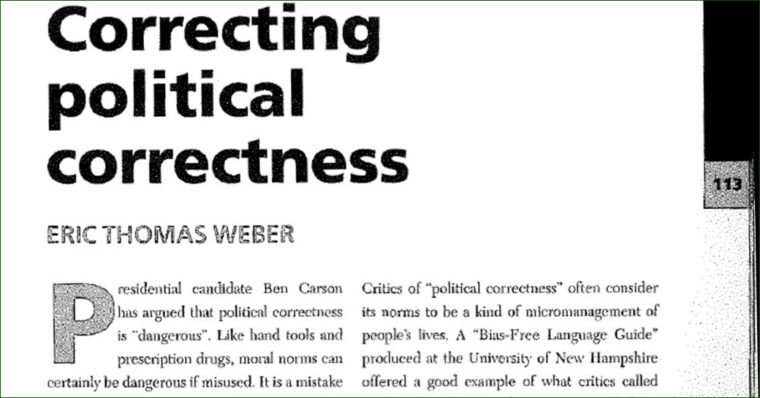
“Correcting Political Correctness”

Published in "The Philosophers' Magazine," issue 72, 1st Quarter 2016, 113-114.

I had the pleasure of receiving a request to write for The Philosophers’ Magazine, which was planning an issue on “50 New Ideas.” My proposal was to revisit and rethink an old idea that people have been criticizing quite a lot lately: political correctness. Click here or on the photo of the piece here to open a PDF of my article:

Thumbnail photo of my piece in The Philosophers' Magazine, with a link to the PDF file.

Cover of The Philosophers' Magazine, issue 72, 1st Quarter 2016.This piece is a short, op-ed snippet of the larger project I’m working on, called A Culture of Justice. It’s an example that shows clearly how and why culture matters for policy, such as in trademark registration, free speech, and the cultural responsibilities of leadership and symbolism. Check it out.

If you enjoyed the piece, connect with me by “liking” my Facebook author page and “following” me on Twitter.

The Confidence Man

In 1849, the New York Herald reported on the arrest of a gentleman by the name of William Thompson.

I use the term ‘gentleman’ here broadly. As the Herald reported:

For the last few months a man has been traveling about the city…he would go up to a perfect stranger in the street, and being a man of genteel appearance, would easily command an interview. Upon this interview he would say after some little conversation, “have you confidence in me to trust me with your watch until to-morrow;” the stranger at this novel request, supposing him to be some old acquaintance not at that moment recollected, allows him to take the watch, thus placing “confidence” in the honesty of the stranger, who walks off laughing and the other supposing it to be a joke allows him so to do. In this way many have been duped…

To those who had heard of these strange interactions, Thompson was known as the “Confidence Man.”

He was, in fact, the first “confidence man” – a term which has sense been colloquially shortened to “con man.”

facebooktwittergoogle_plusredditlinkedintumblrmail