New Paper: Participatory Budgeting Improves Civic Voices and Tax Revenues

NCDD member organization The Participatory Budgeting Project recently shared a new research paper on how participatory budgeting (PB) has been linked to improved civic engagement and increased tax revenue. PB is a process where community members vote on how to spend a portion of public dollars and is increasingly being attributed to bolstering peoples’ faith and practice in local governance. The article written by Loren Peabody shares the research of Michael Touchton, Brian Wampler, and Tiago Peixoto, who found that when people have the opportunity to give input on government spending, they are also more willing to pay their taxes. You can read the article below and find the original on the PBP’s blog here.


New Studies: PB Increases Tax Revenue as it Grows the Number of Voices in Government

New ideas often get a skeptical response, and participatory budgeting (PB) is no exception. One common doubt: while PB may be admirable, unfortunately governments just can’t afford it.

A new World Bank working paper by Michael Touchton, Brian Wampler, and Tiago Peixoto concludes just the opposite — PB and participatory institutions actually improve government balance sheets by boosting residents’ willingness to pay taxes. While most strategies for improving tax compliance rely on tougher enforcement or easier filing processes, these researchers provide evidence that people more readily pay their share of taxes when they feel they have a voice in the policy-making process and when they believe that governments are more transparent and deliver better services.

The study investigates a database of 5,570 Brazilian municipalities over a 13-year period, an ideal setting to see if participatory institutions have an impact on tax collection for several reasons. First, Brazilian cities have more legal autonomy and greater responsibility for delivering public services than municipal governments in the United States. One outcome of this autonomy was participatory budgeting itself–first developed in Porto Alegre in 1989 before spreading across the country. What’s less well known is that Brazil has also been a leader in developing public policy councils, which are co-governance institutions made up of officials and members of the public that formulate policy and oversee government performance.

Finally, Brazilian cities vary widely in the quality of their governance and their ability to collect tax revenue. Some municipalities have received considerable acclaim for their public administration. Curitiba, for example, has won awards for its sustainability and transportation planning. Others display a dynamic that is all-too-common in developing countries: poorly functioning governments lose public legitimacy, making individuals reluctant to pay their taxes and leading to a downward spiral as the government can’t obtain the revenue needed to improve performance.

Touchton, Wampler, and Peixoto find that both forms of participatory institutions — policy councils and participatory budgeting — have a positive and statistically-significant association with collecting more tax revenue. Municipalities with higher-than-average use of policy councils collect 27% more tax revenue than cities without the councils (averaged across different measures of tax collection). The relationship is even stronger with participatory budgeting: “On average, municipalities with PB have tax outcomes that are 34% greater than those without PB… [and] municipalities with PB for over 8 years have tax outcomes that are 39% greater than those without PB.”

Causation? Or Coincidence?

A skeptical reader would wonder exactly how the causation works here. It could be that some unobserved factor improves tax collection practices and simultaneously prompts governments to adopt PB and policy councils — rather than the participatory institutions being the cause of the improvement. To minimize this possibility, the researchers used a statistical technique called matching that pairs up cities that are similar in terms of their local economic and political conditions and in terms of proxy measures for their administrative capacity, but that differ with respect to whether or not they implemented participatory institutions.

In contrast to surveys or lab experiments, a strength of this research design is the ability to show that a link between public participation, good governance, and tax compliance can be observed in the real world. On the other hand, the study’s real-world setting could also mean that the findings only apply to the Brazilian context. To investigate the generalizability of these relationships, Tiago Peixoto teamed up with Fredrik M. Sjoberg, Jonathan Mellon, Johannes Hemker, and Lily L. Tsai for an additional study that performed an online survey experiment involving 65,000 respondents from 50 different countries. It found that across widely disparate contexts, individuals were more likely to report a stronger commitment to tax compliance when they are given an opportunity to voice their preferences about government spending (a simple simulation of taking part in PB).

Of all PB’s positive impacts that researchers have been documenting–including increased public investment in low-income communitiesmore active civil societyhigher voter turnoutimproved public health and well-being — improved tax collection may have the most impact of all, by increasing the total revenue available to address public needs. It can also help buttress the argument that deep, equitable democratic participation is valuable in itself by showing it is also a practical solution to some key problems cities face. As Touchton, Wampler, and Peixoto put it, “Governments that adopt participatory institutions make investments in democratic accountability and legitimacy that pay dividends in tax revenue. In turn, more revenue can increase the capacity to deliver better services, which begets still more legitimacy.”

You can find the original version of this article on the Participatory Budgeting Project’s blog at www.participatorybudgeting.org/pb-and-tax-revenue/.

how to improve the civil society of a school

Students learn to be citizens by joining, forming, leading, and influencing extracurricular groups in their own schools. A school’s whole array of groups is its “civil society.” The number, diversity, reach, purpose, vitality, and interconnection of these groups is important for youth development, generally, and for civic education, in particular.

Discussing this topic with teachers this morning, I received an excellent question. How should we encourage all students to participate? What should we do about the fact that 9th-graders sign up for many groups but membership trails off fast? How about the students who are too busy because they work? And what about the kid who wears headphones all day and just doesn’t want to connect?

I think I began my reply with two caveats. First, I don’t know how to motivate teenagers nearly as well as teachers do. And second, some kids really may face serious barriers to membership, no matter how hard you try to include them.

That said, the challenges of a school’s civil society are like those of any civil society. Like teenagers, adults exhibit different degrees of commitment. They drop out when they lose interest or as a response to disagreements. Many free-ride, staying in a group to get its benefits without doing a fair share of the work. Some work extra hard and well but aren’t noticed.

Addressing these problems constitutes Alexis de Tocqueville’s “art and science of association.” It’s never easy but there are good practices. Impose regular penalties for non-contribution but make initial penalties very light so that they are actually enforced and violators can recover easily from being penalized. Keep a clear and public list of who belongs and who doesn’t and clarify what constitutes membership versus exit. Rotate responsibilities. Incorporate low-cost methods of monitoring compliance, such as sign-in sheets. Implement efficient mechanisms for conflict-resolution. (For these principles, see, among other sources: Ostrom, Elinor. “Design principles and threats to sustainable organizations that manage commons.” Santiago, Chile, March. 1999.)

Learning these practices is a core task of civic education. We traditionally learn them only from experience, but it is possible to learn some of them from texts and discussion. Students who learn to lead groups are better placed than any adults to actually generate viable groups in their own schools. Thus I would recommend teaching strategies for recruitment and group-management explicitly, and then encouraging student leaders to be primarily responsible for the vitality of their own civil society.

See also a portrait of American teenagers’ out-of-school life; and class disparities in extracurricular activities.

Ben Franklin Circles Announces Free Online Course Series

Our friends at Ben Franklin Circles shared this announcement with us about an exciting new online course they are launching at the end of July! This free course series will offer the opportunity to learn with a cohort about how to start and convene your own Ben Franklin Circle. Classes will be online every Thursday and registrants will receive a copy of Priya Parker’s book, The Art of Gathering. Registration closes July 19th, so don’t delay! If you do participate, we encourage you to share with us how it goes in the comments section below or by reaching out to keiva@ncdd.org! We’d love to hear about it and potentially share it on the blog. You can learn more about the Circle class in the post below and find the original information on the BFC site here.


Free class helps you start your own Circle

We are excited to announce that we will be kicking off something new this July – an online course in starting a Ben Franklin Circle! (New to Ben Franklin Circles? Visit our homepage.)

Have you considered hosting but first want to familiarize yourself with the format? Or want a little more guidance on how to make it a success? Join us for this opportunity to go through the process with a small cohort of other hosts who are also just beginning. Over six sessions, you’ll assemble your group, plan and hold your first meeting, and get real-time feedback along the way. By the end, you’ll have your Circle up-and-running and have a community of peers to turn to for support and inspiration as you go.

Like everything BFC, you can think of what is offered like an outfit that you try on, keep what you like, let go of the rest, and as always, include your own style.

How will it work? Starting Thursday, July 25th, 6 one-hour zoom video sessions will walk participants through the process of starting a circle. Led by experienced Ben Franklin Circle Host, Kim Crowley, each session is a chance to share your progress, workshop questions and exchange feedback on everything from location to the plan for your first meeting.

Who is it designed for?
This course is for those who:

  • Have decided to start a Ben Franklin Circle.
  • Will organize their Circle as we go.
  • Will host a first meeting in the Fall of 2019. The class will set you up to do this. Those with earlier start dates are also welcome!
  • Plan to attend all 6 sessions.
  • Are open to receiving and giving thoughtful feedback.

Start a Ben Franklin Circle Over six sessions, you’ll assemble your Circle, plan and hold your first meeting, and get real-time feedback along the way. By the end, you’ll have your Circle up-and-running and have a community of peers to turn to for support and inspiration as you go. Led by experienced Ben Franklin Circle Host, Kim Crowley, each session is a chance to share your progress, workshop questions and exchange feedback on everything from location to the plan for your first meeting.

Participants receive a free copy of The Art of Gathering: How We Meet and Why It Matters. Author Priya Parker explores how to create a meaningful gathering with helpful tips and a wide range of examples.

Schedule
Every other Thursday from 7:00-8:00 pm EST (6:00 CT, 5:00 MT, 4:00 PT)

  • Session 1: July 25th.                     Talking about BFC and recruiting members
  • Session 2: August 8th                   Outreach and invitations
  • Session 3: August 22nd                 Location, scheduling & engagement
  • Session 4: September 5th             Recruitment check-in
  • Session 5: September 19th           Plan for 1st meeting
  • Session 6: Nov 7th                        Check-in, recap and celebrate!

Registration
Complete an application and sign up HERE

Registration deadline: Friday, July 19th.
Space is limited. This is a free course.

Direct questions or inquiries to Danyel Addes at daddes@92y.org

You can find the original version of this announcement on the BFC blog at www.benfranklincircles.org/tips-advice/online-class.

Wednesday Webinar Roundup for Dialogue & Deliberation

Summer is a great opportunity to build your skill toolbox and this week’s roundup features many opportunities coming up! We encourage you to check out these events from NCDD sponsor org The Courageous Leadership Project, NCDD member organizations MetroQuestLiving Room Conversations, and National Issues Forums Institute (NIFI), as well as, from the International Associate for Public Participation (IAP2) and the Tamarack Institute.

NCDD’s online D&D event roundup is a weekly compilation of the upcoming events happening in the digital world related to dialogue, deliberation, civic tech, engagement work, and more! Do you have a webinar or other digital event coming up that you’d like to share with the NCDD network? Please let us know in the comments section below or by emailing me at keiva[at]ncdd[dot]org, because we’d love to add it to the list!


Upcoming Online D&D Events: The Courageous Leadership Project, MetroQuest, Living Room Conversations, NIFI, IAP2, Tamarack Institute

Online Living Room Conversation: The America We Want to Be – 90-Minute Conversation w/ Optional 30-Minute Bonus Round!

Wednesday, July 3rd
4 pm Pacific, 7 pm Eastern

When the Declaration of Independence was written, not everyone was included in the famous statement about “pursuit of Life, Liberty and the Pursuit of Happiness.” And while the aspirations expressed in our founding documents resonate for some more than others, there are many views regarding the degree to which we have advanced these aspirations for everyone. Some focus more on the great strides we have made; others point to how far we still need to go. Some believe that focusing on the past prevents forward progress; others think we still need to come to terms with our shadow side. Here is the conversation guide.

REGISTER: www.livingroomconversations.org/event/the-america-we-want-to-be-90-minute-conversation-w-optional-30-minute-bonus-round/

July CGA Forum Series: Coming to America: Who Should We Welcome? What Should We Do?

Saturday, July 6th
3 pm Pacific, 6 pm Eastern

Please join us for a Common Ground for Action (CGA) online deliberative forum on Saturday July 6th at 6pm ET/3p PT on the issue of “Coming to America: Who Should We Welcome? What Should We Do?” If you haven’t had a chance to review the issue guide, you can find a downloadable PDF copy at the NIF website: https://www.nifi.org/es/issue-guide/coming-america

REGISTER: www.nifi.org/en/events/july-cga-forum-series-coming-america-who-should-we-welcome-what-should-we-do

Tamarack Webinar – Bridging the Gap: Repairing Relationships for Stronger Community Engagement

Tuesday, July 9th
9 am Pacific, 12 pm Eastern

Can online meetings be as engaging and productive as face-to-face meetings? Maggie Chumbley believes the answer is absolutely yes! Maggie’s experience is that, in fact, online meetings can actually be better than meeting in person if they are designed and hosted skillfully. In this webinar, Maggie will highlight helpful tools and online platforms that she relies on to ensure the virtual meetings she facilitates foster connection, create shared learning and generate results. Participants will learn tactics, tips and advice for overcoming common challenges of engaging everyone; sharing visuals; perceiving subtle social cues and getting real work done together.

REGISTER: http://events.tamarackcommunity.ca/webinar-hosting-great-virtual-meetings

Online Living Room Conversation: Communicating with Care – 90-Minute Conversation w/Optional 30-Minute Q&A w/Hosts!

Tuesday, July 9th
10 am Pacific, 1 pm Eastern

We may want to communicate with others in such a way that we gain knowledge and bridge divides, but those conversations don’t always come naturally. Most of us struggle to self-evaluate our communication skills and we might be unaware of words and actions that shut down healthy dialogue when discussing divisive issues. In this conversation, we will actively share and explore what works and what doesn’t, and we will reflect on ways that we can improve our interactions with others. Here is the conversation guide.

REGISTER: www.livingroomconversations.org/event/communicating-with-care-90-minute-conversation-w-optional-30-minute-qa-w-hosts/

IAP2 Monthly Webinar: Victoria Encore – “Not Just Dragons”: A Model For Inclusive Engagement With Communities Of Colour

Tuesday, July 9th
11 am Pacific, 2 pm Eastern

Once again, we’re excited to present one of the session presentations at the 2018 IAP2 North American Conference, that attendees told us would make a good Learning Webinar. In this, Miranda Eng, senior consultant at Context Research, will share recent collaborative work with community members from Vancouver’s Chinatown to co-create a model to guide culturally respectful planning and design of engagement processes. Engaging cultural communities is crucial yet complex. When public processes have failed to be inclusive, we’ve seen civic distrust and a loss of community support for projects and plans. So what can inclusive engagement in cultural communities look like? How might we go beyond platitudes of ‘diversity and inclusion’? How might some tactics that we typically rely on be considered disrespectful?

REGISTER: https://iap2usa.org/event-3167679

The Courageous Leadership Project webinar – Brave, Honest Conversations™

Wednesday, June 10th
9 am Pacific, 12 pm Eastern

Some conversations are hard to have. Fear and discomfort build in your body and you avoid and procrastinate or pretend everything is fine. Sometimes you rush in with urgency, wanting to smooth things over, fix them, and make them better. Sometimes you go to battle stations, positioning the conversation so you have a higher chance of being on the “winning” side. NONE OF THIS WORKS. Instead, it usually makes a hard conversation harder; more divided, polarized, and disconnected from others. The more people involved, the harder the conversation can be. I believe that brave, honest conversations are how we solve the problems we face in our world – together.

In this webinar, we will cover: What is a Brave, Honest Conversation™? Why have one? What can change because of a brave, honest conversation? How do you have one? What do you need to think about and do? How do you prepare yourself for a brave, honest conversation?

REGISTER: www.bravelylead.com/events/bhcfreewebinar

Online Living Room Conversation: Digital Dialogue – 90-Minute Conversation w/ Optional 30-Minute Bonus Round!

Thursday, July 11th
4 pm Pacific, 7 pm Eastern

We are in an age of wonder and amazement with technology. It can go anywhere with us and we can be reachable at any time. We use technology to order our groceries, navigate our cities, keep up with breaking news, family members living away and in some cases remain connected to our politicians and faith-based communities. So many of us are reachable and can respond immediately to beeping, buzzing, and ringing of texts, emails and phone calls. We like what we feel when our phones ring or ping us with a new message and that makes us want more. Some experts have suggested that technology is controlling us, that we have lost control of it…like an addiction. Is technology our friend, the life-saving tool of the 21st Century or a manipulator of our minds and master of our time? Who is in charge? Hereis the conversation guide.

REGISTER: www.livingroomconversations.org/event/tribalism-101-90-minute-conversation-w-optional-30-minute-bonus-round/

SPECIAL Online Living Room Conversation: Race and Ethnicity Conversation Series

Tuesday, July 16th
10 am Pacific, 1 pm Eastern

Please join us for a 3-conversation series on Race & Ethnicity taking place over the course of three weeks (July 16, 23, & 30, 2:00 – 3:30pm ET / 11:00 am – 12:30 pm PT). Check out this four-minute video from a previous Race & Ethnicity Conversation Series to get a taste of this conversation! In this series of three in-depth conversations, participants explore the complexities of the concepts of Race, Ethnicity, and their impacts on people from all walks of life. We will cover new questions from the three Race & Ethnicity conversation guides found here.

REGISTER: https://www.livingroomconversations.org/event/special-online-living-room-conversation-race-and-ethnicity-conversation-series-2/

MetroQuest webinar – Beyond Fear:
Public Views on Emerging Transportation Technologies

Wednesday, July 17th
11 am Pacific | 12 pm Mountain | 1 pm Central | 2 pm Eastern (1 hour)
Educational Credit Available (APA AICP CM)
Complimentary (FREE)

Technologies are transforming the future of transportation, but are your residents ready for innovations like self-driving vehicles? It’s time to go beyond the hype and fears by uncovering true public priorities. Join NCDOT on July 17th as its forward-thinking team reveals what 10,000+ residents in North Carolina want for the future of their transportation system.

Jamille, Nastasha, and Colin will share the input they captured online. Should tax credits or infrastructure be prioritized to support an electric vehicle boom and achieve zero emissions? Are citizens more concerned with tech failures causing accidents or ensuring equitable access to mobililty innovations? Effective public engagement was critical to getting answers.

REGISTER: http://go.metroquest.com/NCDOT-Beyond-Fear-Public-Views-on-Emerging-Transportation-Technologies.html

July CGA Forum Series: Shaping Our Future

Wednesday, July 17th
5 pm Pacific, 8 pm Eastern

Please join us for a Common Ground for Action (CGA) online deliberative forum on Wednesday July 17th @ 8pm ET/5p PT on ” Shaping Our Future: How Should Higher Education Help Us Create the Society We Want?”

Please join us for a Common Ground for Action (CGA) online deliberative forum on Saturday July 6th at 6pm ET/3p PT on the issue of “Coming to America: Who Should We Welcome? What Should We Do?” If you haven’t had a chance to review the issue guide, you can find a downloadable PDF copy at the NIF website: https://www.nifi.org/es/issue-guide/coming-america

REGISTER: www.nifi.org/en/events/june-cga-forum-series-climate-choices-how-should-we-meet-challenges-warming-planet

the ethics of playing hardball with the federal budget

Congress must pass appropriation bills by late September and must raise the debt limit by about Oct. 1 to allow the government to pay its bills. Failure to do either will have substantial economic impact. Neglecting to raise the debt limit could be catastrophic, since the federal government has never defaulted before.

A solution could either be a real agreement or a mere patch–a bill that continues current spending levels for a few months and raises the debt limit enough to get us to the next short-term deal.

Since the economy seems fragile, and federal (and state) elections are a mere 16 months away, the political stakes are high. In fact, I think the negotiation over the budget and debt limit is the most important political story of the present moment.

Conventional wisdom holds that an incumbent president has more to lose from a sudden recession than members of Congress do. Thus Donald Trump is probably most at risk if there is no deal. Although most Americans disapprove of his economic policies, I still think his popularity would fall further if we entered a recession.

For their part, the Democrats must decide how hard to bargain. That is an ethically complex question, and it confronts not one actor (an imaginary, monolithic party) but many Democratic members of Congress who have disparate values and interests.

Democrats have good ethical reasons to play hardball. They have policy goals (spending, immigration, climate) that they can advance by forcing Trump to swallow compromises. By pushing hard, they risk a government shutdown or a default, but the moral responsibility for a crisis would be shared. Whatever happens, we are headed for a recession at some point, and the country may be better off if it comes in time to unseat Trump rather than late enough that we must weather the downturn during his second term.

On the other hand, Democrats shouldn’t intentionally drive Trump into an impasse because they are happy to hasten a recession. To see that that is wrong, apply Immanuel Kant’s test of publicity. It is unethical to do something unless you can admit you are doing it. That is especially true of political leaders in a republic, because it is definitive of republics that everyone must explain their actions to everyone else. I don’t think the Democrats could face the electorate saying that they had intentionally driven the economy into recession.

But there is a fine line between: (a) driving a hard bargain for good causes while not worrying overly about the collateral risk to the economy and (b) actively pushing a breakdown in order to cause a recession and win the next election. I would drive right up to the edge of (b) but not over that line.

A subtler question is what to do about raising the domestic discretionary spending limits. Democrats believe that raising these caps will truly help people. However, increasing spending without raising taxes is a fiscal stimulus. As such, it has some potential to forestall a recession. Thus raising the domestic spending limit is win/win for Trump and the congressional Democrats (although an ideological loss for congressional Republicans). The problem is that a win/win deal could get Trump re-elected. I think I would bargain hard on immigration and climate regulation and give way on domestic spending for this year.

See also: on playing hardball with the shutdown (2019); should Democrats play constitutional hardball in 2019-20?; avoiding arbitrary command

the First Ibero-American Meeting of Civic Studies

This week is the 11th annual Summer Institute of Civic Studies at Tufts’ Tisch College, and we are discussing such topics as identities versus interests and opinions and Gandhi versus Jinnah on means and ends. (The links are to my personal ruminations, but in the seminar, we discuss original texts.)

Coming up soon is the First Ibero-American Meeting of Civic Studies, which two of my friends explain in the video:

According to my translation from the website:

Improving a society requires the commitment of its citizens. Based on this conviction, the Camilo José Cela University Foundation presents the First Ibero-American Conference on Civic Studies, following the trail of the pioneering institution of this academic discipline, the Jonathan M. Tisch College of Civic Life of Tufts University (USA).

The objective is to create a theoretical and methodological framework to promote active citizenship. Civic Studies tries to answer the question “what should we do?” Combining ethical reflection (what is good and right?), analysis of the facts (“what is happening”?) and strategies (” What could work? “). Based on this eminently practical call, Civic Studies tries to make civic education in colleges and universities have a transformational purpose.

The First Ibero-American Meeting of Civic Studies is an initiative of the Camilo José Cela University Foundation. It aims to promote this understanding of civic education in the Ibero-American context. Despite the social and cultural diversity of the countries convened [Argentina, Brazil, Colombia, Ecuador, Guatemala, Mexico, and Spain], the UCJC Foundation believes that the development of this academic discipline can serve to cultivate active citizenship that contributes to the creation of more stable and just societies.

In this first edition, the theme of the meeting will be “The university as generator of citizenship.” We believe in a conception of the university in which both learning and research in any discipline is marked by the civic commitment of its environment. The meeting will involve a week of work between academics and experts with experience in citizenship training: through discussion and deliberation formats, attendees will work from a daily challenge posed by a guest expert, and exchange their own experiences when implementing civic education.”

Online D&D Events Coming Up Ft Tamarack, IAP2, & More!

This week’s roundup features events from NCDD member orgs Living Room Conversations and National Issues Forums Institute (NIFI), as well as, from the Tamarack Institute and International Associate for Public Participation (IAP2).

NCDD’s online D&D event roundup is a weekly compilation of the upcoming events happening in the digital world related to dialogue, deliberation, civic tech, engagement work, and more! Do you have a webinar or other digital event coming up that you’d like to share with the NCDD network? Please let us know in the comments section below or by emailing me at keiva[at]ncdd[dot]org, because we’d love to add it to the list!


Upcoming Online D&D Events: Living Room Conversations, NIFI, IAP2, Tamarack Institute

Living Room Conversations Training (free): The Nuts & Bolts of Living Room Conversations

Thursday, June 27th
2 pm Pacific, 5 pm Eastern

Join us for 60 minutes online to learn about Living Room Conversations. We’ll cover what a Living Room Conversation is, why we have them, and everything you need to know to get started hosting and/or participating in Living Room Conversations. This training is not required for participating in our conversations – we simply offer it for people who want to learn more about the Living Room Conversations practice.

Space is limited to 12 people so that we can offer a more interactive experience. Please only RSVP if you are 100% certain that you can attend. This training will take place using Zoom videoconferencing. A link to join the conversation will be sent to participants by the Wednesday before this training.

REGISTER: www.livingroomconversations.org/event/free-training-the-nuts-bolts-of-living-room-conversations/

Online Living Room Conversation: Tribalism 101 – 90-Minute Conversation w/ Optional 30-Minute Bonus Round!

Thursday, June 27th
4 pm Pacific, 7 pm Eastern

Inspired by the podcast Next Door Strangers, this Living Room Conversation begins with a 15-minute podcast: http://www.kuer.org/post/1-tribalism-101-pick-side. We invite you to listen and then begin your Living Room Conversation. Tribalism: the behavior and attitudes that stem from strong loyalty to one’s own tribe or social group. People on the left and right may disagree on many things, but they generally agree that “tribalism” is bad for our politics and our country. Although most people want communities where all people have dignity and respect, respectful interactions are often not what we see modeled in the media and in politics. How do we build strong and unified communities in a divisive time? Here is the conversation guide.

REGISTER: www.livingroomconversations.org/event/tribalism-101-90-minute-conversation-w-optional-30-minute-bonus-round/

Online Living Room Conversation: Forgiveness – 90-Minute Conversation w/ Optional 30-Minute Bonus Round!

Sunday, June 30th
12:30 pm Pacific, 3:30 pm Eastern

For many of us, forgiveness can be very challenging. There are so many ways that we are hurt by others and that we hurt others in our lives. How we manage those hurts is a key part of shaping our lives internally and externally. How can forgiveness help us to become the person we want to be? Here is the conversation guide.

REGISTER: www.livingroomconversations.org/event/forgiveness-90-minute-conversation-w-optional-30-minute-bonus-round/

Online Living Room Conversation: The America We Want to Be – 90-Minute Conversation w/ Optional 30-Minute Bonus Round!

Wednesday, July 3rd
4 pm Pacific, 7 pm Eastern

When the Declaration of Independence was written, not everyone was included in the famous statement about “pursuit of Life, Liberty and the Pursuit of Happiness.” And while the aspirations expressed in our founding documents resonate for some more than others, there are many views regarding the degree to which we have advanced these aspirations for everyone. Some focus more on the great strides we have made; others point to how far we still need to go. Some believe that focusing on the past prevents forward progress; others think we still need to come to terms with our shadow side. Here is the conversation guide.

REGISTER: www.livingroomconversations.org/event/the-america-we-want-to-be-90-minute-conversation-w-optional-30-minute-bonus-round/

July CGA Forum Series: Coming to America: Who Should We Welcome? What Should We Do?

Friday, July 6th
3 pm Pacific, 6 pm Eastern

Please join us for a Common Ground for Action (CGA) online deliberative forum on Saturday July 6th at 6pm ET/3p PT on the issue of “Coming to America: Who Should We Welcome? What Should We Do?” If you haven’t had a chance to review the issue guide, you can find a downloadable PDF copy at the NIF website: https://www.nifi.org/es/issue-guide/coming-america

REGISTER: www.nifi.org/en/events/june-cga-forum-series-climate-choices-how-should-we-meet-challenges-warming-planet

IAP2 Monthly Webinar: Victoria Encore – “Not Just Dragons”: A Model For Inclusive Engagement With Communities Of Colour

Tuesday, July 9th
11 am Pacific, 2 pm Eastern

Once again, we’re excited to present one of the session presentations at the 2018 IAP2 North American Conference, that attendees told us would make a good Learning Webinar. In this, Miranda Eng, senior consultant at Context Research, will share recent collaborative work with community members from Vancouver’s Chinatown to co-create a model to guide culturally respectful planning and design of engagement processes. Engaging cultural communities is crucial yet complex. When public processes have failed to be inclusive, we’ve seen civic distrust and a loss of community support for projects and plans. So what can inclusive engagement in cultural communities look like? How might we go beyond platitudes of ‘diversity and inclusion’? How might some tactics that we typically rely on be considered disrespectful?

REGISTER: https://iap2usa.org/event-3167679

Tamarack Webinar – Hosting Great Virtual Meetings

Tuesday, July 9th
9 am Pacific, 12 pm Eastern

Can online meetings be as engaging and productive as face-to-face meetings? Maggie Chumbley believes the answer is absolutely yes! Maggie’s experience is that, in fact, online meetings can actually be better than meeting in person if they are designed and hosted skillfully. In this webinar, Maggie will highlight helpful tools and online platforms that she relies on to ensure the virtual meetings she facilitates foster connection, create shared learning and generate results. Participants will learn tactics, tips and advice for overcoming common challenges of engaging everyone; sharing visuals; perceiving subtle social cues and getting real work done together.

REGISTER: http://events.tamarackcommunity.ca/webinar-hosting-great-virtual-meetings

Online Living Room Conversation: Digital Dialogue – 90-Minute Conversation w/ Optional 30-Minute Bonus Round!

Thursday, July 11th
4 pm Pacific, 7 pm Eastern

We are in an age of wonder and amazement with technology. It can go anywhere with us and we can be reachable at any time. We use technology to order our groceries, navigate our cities, keep up with breaking news, family members living away and in some cases remain connected to our politicians and faith-based communities. So many of us are reachable and can respond immediately to beeping, buzzing, and ringing of texts, emails and phone calls. We like what we feel when our phones ring or ping us with a new message and that makes us want more. Some experts have suggested that technology is controlling us, that we have lost control of it…like an addiction. Is technology our friend, the life-saving tool of the 21st Century or a manipulator of our minds and master of our time? Who is in charge? Here is the conversation guide.

REGISTER: www.livingroomconversations.org/event/tribalism-101-90-minute-conversation-w-optional-30-minute-bonus-round/

what the student debt proposals convey

Elizabeth Warren proposes to pay off $50,000 of college debt for everyone with household income under $100,000. Bernie Sanders proposes to pay off all $1.5 trillion of today’s student debt. They also offer proposals for making college more affordable later.

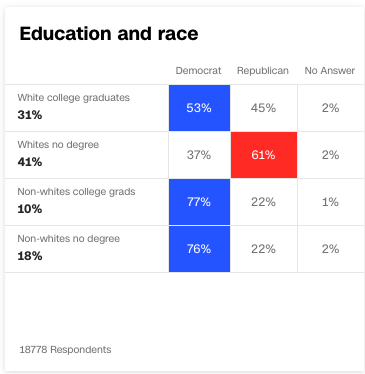
I am worried that both of these proposals–especially Sanders’–convey the message that Democrats and liberals represent high-status people who hold and value formal education. The reality is close to that: Democratic voters in 2018 were a coalition of whites with lots of education plus people of color from across the educational spectrum.

2018 national exit poll results

Directing financial support to higher education–and specifically retiring the debt of people who have already accumulated college debt–is an indication of the candidates’ priorities. I fear they will alienate people who don’t have or necessarily want advanced formal education. One of the major political cleavages of our age (also seen in Europe) divides knowledge-workers from people who work with their hands. The risk here is placing liberals and Democrats firmly on the knowledge-workers’ side. Or, as Antonio Gramsci would say, the “organic ideology” of a governing class dominated by the intelligentsia will favor spending money on education above almost anything else.

I do understand the following arguments. Education should be understood as a public good, not just an investment in the income prospects of the individual student. We already treat k-12 education as a public good and an entitlement. Since college now confers the same advantage that high school did half a century ago, it should be treated the same.

Furthermore, programs without means tests tend to be protected and reasonably well funded, whereas programs for the poor tend to be poor programs. Examples of successful universal programs include Social Security and Medicare here and most of the European welfare state.

Finally, even when a program covers wealthy people, federal income taxes (as opposed to other taxes) are collected in a pretty progressive way, so most of the cost falls on the wealthy.

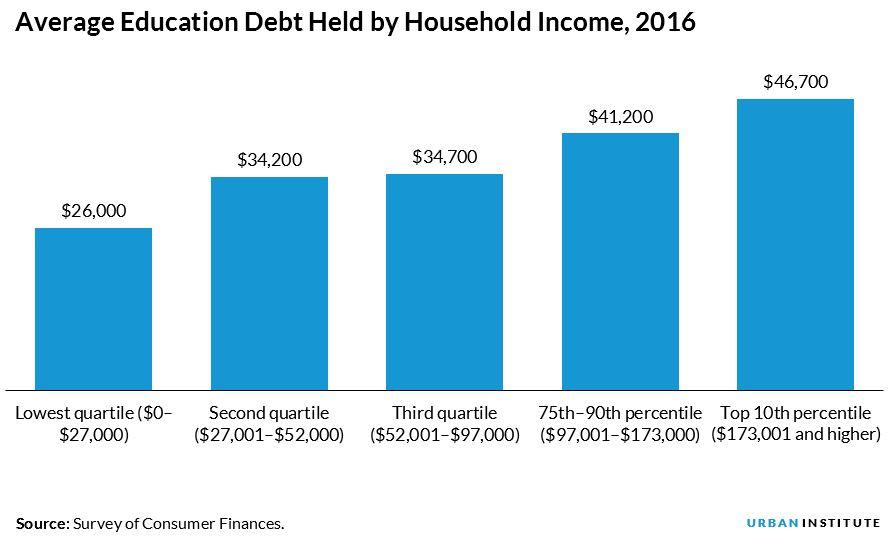
On the other hand, as Jordan Weissman notes, one-time debt cancellation is not an entitlement or a program built for sustainability. Moreover, Sanders’ plan involves truly regressive spending. Families earning $173k or more hold an average debt of nearly $50k, which the federal government would hand them as tax-free income under his plan.

You could counter that families in the bottom quartile–who have real need–hold an average of $26k in college debt, usually more than their whole annual household income, and forgiveness would make the most difference to them. But it would also cost $1.5 trillion that could be spent on other things. And yes, even if the President of the United States calls himself a socialist, he’ll have limited resources and will have to choose. For instance, that’s $1.5 trillion that could have been added to a Green New Deal.

These proposals have a communicative goal. They convey that education is a public good and that we should all benefit from government support. The proposals are very unlikely to pass as written, and if they fail, they will prove to be mainly symbolic. Even if they pass, they will still have symbolic elements. For instance, the message that they cover everyone is meant to change opinions about government.

So I worry about what these ideas–especially Sanders’–actually convey. Democrats, especially White Democrats, have typically benefited from formal education and value it in everything they say and do. They admire science, professionals, credentials. If a Democratic president and Congress spend $1.5 trillion to subsidize higher education for people like themselves, that will cement the party’s class position.

See also college and mobility; what does the European Green surge mean?; working-class people versus elites on education; and why the white working class must organize

Early Bird Ends June 30th for IAP2 N. American Conference

In case you missed it, The International Association for Public Participation (IAP2) – an NCDD member organization, is holding their 2019 North American Conference from Sept 4-6 in Charlotte, North Carolina. The conference will be a three-day opportunity to dig deeper into public participation with fellow practitioners and highlight the theme, “Leveraging P2 to Create Thriving Communities”. Follow the hashtag #IAP2NAC for extra conference happenings. Early bird registration is open for just another 5 days (until June 30th), so make sure you purchase your tickets at this great rate! You can read the announcement from IAP2 below or find the original on their site here.


 2019 IAP2 North American Conference – Leveraging P2 to Create Thriving Communities

Join us in Charlotte, North Carolina for the 2019 IAP2 North American Conference September 4 – 6, 2019! Charlotte is a city rich in history and diversity, having almost 200 neighborhoods radiating from the central Uptown neighborhood.

Read the Schedule-at a-Glance featuring over 50 professional Development opportunities including sessions, field trips, workshops and more! This is your opportunity to learn from presenters from around the globe. We have presenters from 14 States, 9 Canadian Provinces, and 4 Countries including Finland and Australia.

Never been to an IAP2 North American Conference? Check out materials from our 2018 Conference held in Victoria, BC!

Timing is EVERYTHING! Register on or before June 30, 2019 to get $100 savings on your conference registration! Check out our 2019 Schedule-at-a-Glance to preview speakers, sessions, themes, and SO much more!

Full conference registration covers most pre-conference events, opening reception, Thursday and Friday activities including breakfast, lunch, and the Core Values Awards Gala and dinner.

Stay close to the action by reserving your room at the Sheraton Charlotte Hotel! All conference attendees are eligible to receive our conference discount starting at only $149.00 USD per night! You must book by August 4th to receive the IAP2 discount.

IAP2 Core Values Awards Gala
Join us as we celebrate the best of the best in P2 in North America. We will be celebrating and learning about the amazing projects that have been taking place from the northern tips of Canada to the southern corners of the United States.

Each year, IAP2 Affiliates around the world celebrate excellence in the profession through the IAP2 Core Values Awards. The awards go to projects and organizations which best demonstrate IAP2’s Core Values.

If you are registered for the 2019 IAP2 North American Conference as an attendee, your admission is part of your conference registration. Bring a guest to the festivities! Gala tickets cost $80 USD.

You can find the original announcement from IAP2 at: https://iap2usa.org/2019nac

Gandhi versus Jinnah on means and ends

(Posted while leading the 11th annual Summer Institute of Civic Studies, on questions like this one.)

A major theme in Gandhi’s thought it the primacy of means over ends.

In 1924, some Indian political leaders proposed the immediate creation of a new, independent “Federated Republic of the United States of India.” They argued that this end justified a wide range of strategies. They wanted to “delete the words ‘by peaceful and legitimate means’ from the Congress creed, so that men holding every shade of opinion may have no difficulty in joining” the independence struggle. That would have expanded the range of means employed to achieve the goal of home-rule.

Gandhi replied, “They say ‘means are after all means’. I would say ‘means are after all everything’. As the means so the end.” The “only universal definition to give it is ‘that status of India which her people desire at a given moment.’ If I were asked what India desires at the present moment, I should say I do not know.” For Gandhi, the means used to pursue swaraj (independence in its deepest sense) had to be good ones. “As the means so the end. Violent means will give violent swaraj. That would be a menace to the world and to India herself.”  

Drawing on Karuna Mantena, I would suggest the following Gandhian reasons to focus on means rather than ends. Human beings are cognitively limited and cannot see justice far beyond our own present circumstances. Human beings are motivationally flawed and highly susceptible to various distorting and destructive impulses. Therefore, we must choose modes of politics that channel our impulses in beneficial rather than harmful directions. Forming too sharp a definition of justice (or any of its components, such as national sovereignty) can simply excuse bad behavior. Consequences are always difficult to predict and control, and trying to pursue elaborate ends is foolish. We disagree, and what we decide about justice right now is contingent on how we are organized, so it is crucial to get the organization right. Finally, how we participate in politics helps to constitute the world. By acting, we don’t merely bring about a result (usually an unpredictable one); we immediately create a new reality just in virtue of our action.

A focus on means and a reluctance to specify ends does, however, pose a risk. A person might (whether intentionally or inadvertently) select and defend means that generate a foreseeable outcome or that foreclose the outcome that others prefer. That could be a back-door strategy for getting the ends that the person wanted in the first place. To claim that you are too humble and aware of your own limits to know the best goals is disingenuous if it’s clear what ends your favored means will lead to.

This was essentially Muhammad Ali Jinnah’s quarrel with Gandhi. Gandhi insisted that the social movement for Indian independence must involve close collaborations among Hindus, Muslims and adherents of other faiths. Immediately after saying that he did not know what India wanted, he added that he only endorsed a few values, including “truthful relations between Hindus and Mussalmans.” (“Truthful,” for him, would imply a close, sincere, and interactive relationship.) For Gandhi, the means of political action in India must incorporate interfaith dialogue and cooperation.

Although Gandhi insisted that “Congress leaves swaraj undefined,” Jinnah could see that if Hindus and Muslims won independence together, they would found a democracy with a large Hindu majority. This new country might be secular, or it might be Hindu-dominated, but it couldn’t be an Islamic republic–simply because of demographics. Jinnah identified the Congress as a Hindu organization and created the Muslim League as an alternative. He objected when Congress tried to place its Muslim President, Maulana Azad, in the provisional cabinet for British India, arguing that the Muslim League should name all Muslim members. After Gandhi’s assassination, Jinnah eulogized him as “one of the greatest men produced by the Hindu community and a leader who commanded their [sic] universal confidence and respect.” Jinnah regretted Gandhi’s death “so soon after the birth of freedom for Hindustan [his term for India] and Pakistan.” Thus, although Gandhi claimed that “means are after all everything,” Jinnah saw that Gandhi’s means would prevent Jinnah’s goal, a sovereign Pakistan. And he charged Gandhi with having an implicit goal of his own: the creation of a “Hindustan.”

The broader, theoretical question is how to think about means and ends when sometimes the means that we choose for good intrinsic reasons have foreseeable ends that are subject to debate. Yet, if we propose a clear vision of our goal, how can we know that it is right, and who gets to evaluate it? Surely, that requires a process that is not simply designed to yield a given outcome.

For what it’s worth, this is my verdict on the case at hand. Gandhi joined and then led an interfaith party for swaraj that encouraged debates about both means and goals. Jinnah was a member of that party, albeit mostly before Gandhi’s arrival from South Africa. Jinnah and others had the right to quit the party and movement. Exit is a legitimate choice in movements and party politics. As a result of Jinnah’s exit, Gandhi’s means failed: Congress ceased to be a forum for dialogue and cooperation that included the kinds of people who preferred the Muslim League. But Gandhi’s failure doesn’t invalidate his general advice to focus on means rather than specific ends.

Drawing here on Karuna Mantena, “Another Realism, the Politics of Gandhian Nonviolence,” American Political Science Review, vol. 106, no. 2 (May 2012) and various original passages from Gandhi’s works that Mantena’s article led me to. Also drawing on Ramachandra Guha, Gandhi: The Years that Changed the World, 1914-1948 (New York: Knopf, 2018)