On the Passing of Dr. David Colburn

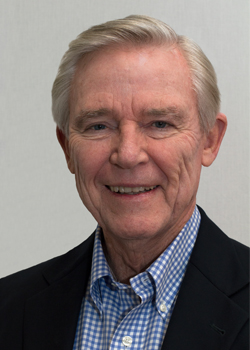
david coburn

We here at the Florida Joint Center for Citizenship at the Lou Frey Institute were saddened to learn of the passing of the wonderful Dr. David Colburn, former director of UF’s Bob Graham Center (among many other roles played at the University of Florida). Dr. Colburn was a fantastic colleague, a strong friend, a good teacher, an effective and well-known scholar, and a wonderful advocate for civic education. He was a friend of the Joint Center and the Institute, and he will be missed. Our deepest condolences to Dr. Colburn’s family and friends, the Bob Graham Center, and the broader University of Florida community.

We encourage you to read this fond remembrance of Dr. Colburn shared by our friends at the Graham Center.  

His family suggests that expressions of sympathy may be made in the form of donations through the Graham Center’s David Colburn Student Advancement Fund, c/o the UF Foundation, P.O. Box 14425, Gainesville, 32604-2425, or to Holy Trinity Episcopal Church, 100 NE 1st Street, Gainesville 32601.

Services are scheduled for Sunday, Sept. 22, at Holy Trinity Church, 100 NE 1st Street, Gainesville 32601 at 2 p.m. The university plans a public service later this fall.

college student turnout more than doubled in 2018

My colleagues at the Institute for Democracy and Higher Education here at Tisch College have released their national report on the 2018 election and sent detailed specific reports to each of the roughly 1,031 colleges and universities that participate in our National Study of Learning, Voting, and Engagement (NSLVE). This research is based not on surveys (which have errors in sampling and self-reporting), but on official voting records for about 20 million people.

As reported in today’s Washington Post, the headline is that college student turnout more than doubled between 2014 and 2018 (the last two midterm elections). It’s true that everyone’s turnout grew in 2018, but college students far surpassed the national trend. My favorite statistic is that turnout rose on 99% of all the NSLVE campuses. Now that is a significant pre-/post- change.

The full report has much more detail on demographic groups, profiles of selected colleges, and suggestions for maintaining the momentum. As always, the actual result (40% of college students voted in 2018) remains too low, but the only way forward is by raising engagement one step at a time, and doubling it is a good step.

Jefferson Center on Making Our Democracy More Meaningful

NCDD Sponsor organization, The Jefferson Center, share a piece written by Annie Pottorff called “Americans are ready for more meaningful democracy”. The article lifts up the recent report published by Public Agenda that explored what Americans think about the current state of our democracy. We encourage you to read the article below and find the original version on JC’s site here.


Americans are ready for more meaningful democracy

Last week, the nonpartisan research and public engagement organization Public Agenda released new findings about what Americans thought about the state of democracy. The results weren’t exactly surprising: 39% say America’s democracy is “in crisis” and 42% say it’s facing serious challenges.

But on a more hopeful note, most believed that ordinary individuals can make a difference, especially if enough people get involved. They were excited about efforts just like ours, including participatory budgeting, community events, public surveys, online forums, and civics education.

When asked what would make them more likely to participate in one of these programs, they outlined a few key criteria. We couldn’t help but notice how our Citizens Juries and broader civic engagement hit the mark:

Respondents wanted programs that…

Seem genuine and likely to have real impacts

Participants in Citizens Juries, assemblies and community panels we conduct know from the outset their recommendations are going somewhere. Their findings are shared with the project sponsors, published online, and amplified through traditional and social media. We help advance local actions and guide policy development based on the recommendations.

Allow people to contribute their own skills and experiences to solving a problem

We recognize all participants as experts, and invite them to share their stories, experiences, and expertise with the group, a key supplement to the presentations and research supplied by expert witnesses. We also recognize communities we engage have existing resources and strong networks we can support to drive change.

Invite public officials to listen, contribute, and respond

Public officials are invited to contribute to the conversation in meaningful ways. In some cases, officials give stakeholder presentations and answer questions, like at the Flats Arterial Community Panel. At the Winona County Energy Dialogue, city council members and local energy leaders participated as Citizens Jurors, co-creating recommendations with their community. And at the Willmar Community Assembly, the mayor observed the event, listened to the recommendations, acknowledged their importance, and pledged to integrate into city practices.

One of our participants summed it up this way:

I would recommend [participating in a Citizens Jury] on three levels. One, the Jury’s made up of everyday people, not just professional people, but a wide demographic of people. Two, it was very fair, and everybody had a chance to participate, and three, you know, from what’s being said, that your input is being recorded and may play an important part in the final outcome in the future.

Reading the Public Agenda research, it’s clear that people like you are ready to get involved if genuinely meaningful opportunities are available. With your help, we’re doing just that by engaging individuals around the world to face our biggest challenges. Thank you for being part of the future of democracy!

Over the next few months we will be exploring ways to build awareness of and support for how governments and public officials can incorporate deliberative practices in their work and engagement practices. We look forward to sharing what we’re learning with you on the blog and in our newsletter.

You can find the original version of this post on The Jefferson Center site at https://jefferson-center.org/americans-are-ready-for-more-meaningful-democracy/

Elizabeth Warren in a tradition of radical American progressivism

A lively and valuable debate is underway about whether Senator Sanders or Warren should carry the flag of the left. Considering that Sanders calls himself a “socialist,” and Warren says she’s pro-“market,” it’s worth thinking about what each means by these words and how their words relate to their policies and their political strategies or theories-of-change. For instance, if both use the New Deal as a positive reference point–Sanders to illustrate socialism and Warren to show how capitalism can be saved–then maybe the difference is merely semantic. Or maybe not.

I would contribute one observation. Elizabeth Warren may belong in a specifically American tradition of progressive politics that is distinctive from socialism and that lacks a crisp name of its own, so far as I know. But it has these features:

  1. Enthusiasm for truly competitive markets that are free of monopolies. Competition is supposed to lower profits to minimal levels and make companies accountable to consumers and prospective workers. For instance, Louis Brandeis argued in 1912 that “our people appreciate better than they did before, the great economic truth which was embodied in the Sherman Law”: “the value of competition.” “The Democratic position … is that private monopoly in industry is never permissible; it is never desirable, and is not inevitable; competition can be reserved, and where it is suppressed, can be restored.”
  2. An understanding of the public as consumers. In 1912, the Progressive thinker Walter Weyl wrote that the office of “consumer is most universal, since even those who do not earn wages or pay direct taxes consume commodities. In America to-day, the unifying economic force, about which a majority, hostile to the plutocracy, is forming, is the common interest of the citizen as a consumer of wealth” (The New Democracy, New York, 1914, pp. 248-50)
  3. Related to the last point, a preference for universal identities over special interests and particular identities.
  4.  An ideal of the government as the protector of consumers. Robert M. La Follette said in 1906: the “welfare of all the people as consumers should be the supreme consideration of the Government.” Often this is extended to workers as well.
  5. Related to the last point, a defense of democracy (with reforms like referenda and publicly finance campaigns) as the system that makes government most accountable to all the people, not to special interests.
  6. A theory that citizens should mainly monitor their own rights and choose leaders and officials to protect them. For their part, prospective leaders should offer detailed proposals for solving problems. “I have a plan for that” is exactly this approach.
  7. A belief in transparency and access to information as tools of reform, captured in Brandeis’ famous line that “sunlight is the best disinfectant.” Brandeis also wrote that the Sherman Antitrust Act would remain inadequate without stronger enforcement, better “administrative machinery,”and “comprehensive, accurate, complete knowledge” of the behavior of businesses (mandatory transparency).

Note that this is not socialism. That word can be defined in many ways, but surely it would stretch the term to use it for a political philosophy that prizes competition and consumer identities.

But it can be radical, and it’s a deeply American tradition. Roger Taney, while Secretary of the Treasury under Andrew Jackson, said, “it is proper that [banking] should be open as far as practicable to the most free competition and its advantages shared by all classes of society.” A century-and-a-half later, Ralph Nader also championed deregulation of selected industries, consumer rights, transparency, and popular sovereignty.

To illustrate Senator Warren’s adherence to this tradition, I would cite (for example) her interview with Franklin Foer in The Atlantic:

I believe in markets and the benefits they can produce when they work. Markets with rules can produce enormous value. So much of the work I have done—the Consumer Financial Protection Bureau, my hearing-aid bill—are about making markets work for people, not making markets work for a handful of companies that scrape all the value off to themselves. I believe in competition.

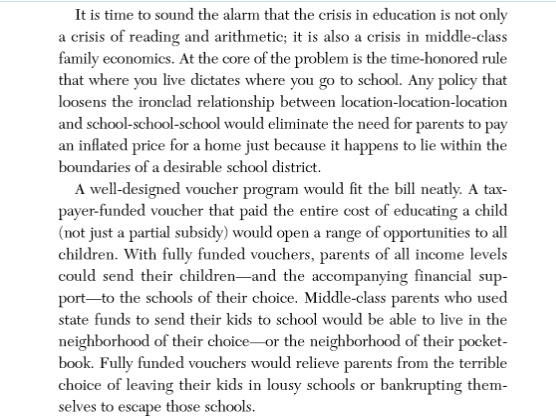
Or consider her endorsement of school vouchers in The Two-Income Trap: Why Middle-Class Parents are Going Broke (2003):

Warren’s specific position on vouchers has changed, but not her deeper philosophy.

Her stance deserves very serious consideration, and a case can be made that it is the best path forward for the American left. But I would raise these questions:

Should the consumer identity satisfy us? What about criticisms (cultural, environmental, and spiritual) about consumerism? Would it be better to see us all as producers? And what about other identities that differentiate Americans, such as race and ethnicity?

Should the implicit role left for citizens satisfy us? Is our job to critically evaluate candidates’ plans for solving our problems, or must we take deeper action?

Do competition and transparency work? (I think Warren herself would say: only sometimes.)

(Most quotes from my book The New Progressive Era. See also: citizenship in the modern American republic: change or decline?; transparency is not enough

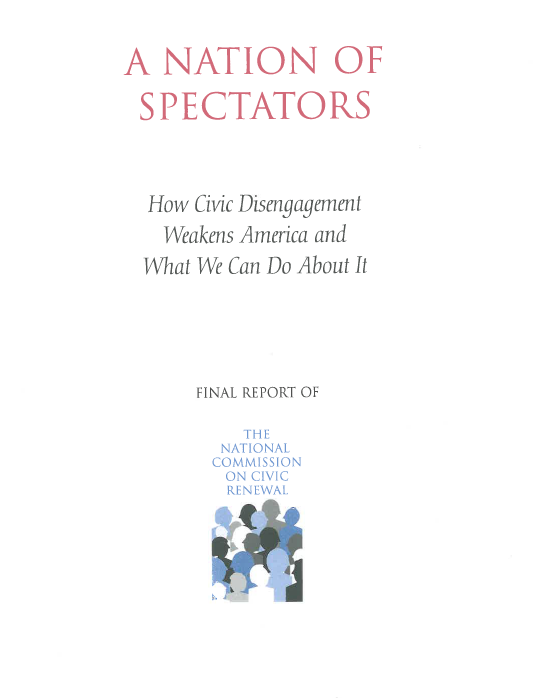
The National Commission on Civic Renewal, A Nation of Spectators

In 1997, the National Commission on Civic Renewal published its report, A Nation of Spectators: How Civic Disengagement Weakens America and What We Can Do About It. The Commission was partly a response to Robert Putnam’s 1995 article, “Bowling Alone.” The Pew Charitable Trust funded and convened it, and Bill Galston directed it, with me as the research director. My main contribution was an Index of National Civic Health (INCH), which is one ancestor of today’s Civic Health Index.

There may have been an echo of the report in George W. Bush’s Inaugural Address: “I ask you to be citizens. Citizens, not spectators. Citizens, not subjects. Responsible citizens, building communities of service and a nation of character.” (Quoted without comment on what followed.)

One of the recommendations was a research center on youth civic engagement, which we founded in 2001 as CIRCLE.

In 1997, the Internet was up and running, and we maintained a website for the Commission and its report. But that is long gone and the report is hard to find. So here it is, scanned as a PDF, as one record in the history of professional efforts to strengthen civic engagement in the USA.

Florida Council for the Social Studies Annual Conference: Session Highlights!

agenda

A reminder, dear friends and colleagues, that the Florida Council for the Social Studies Annual Conference is fast approaching (and you can register here!). So let’s take a look at some of the sessions on the docket for the conference! We’ll be doing this over the next few weeks, highlighting 3 to 5 interesting sessions that are likely to draw your interest.

Saturday, October 19

It’s a Bird, it’s a Plane, it’s Propaganda! 

Supermanshorttitle

This looks fantastic! The approach taken here to this session is simply really cool.

Is Superman simply a tool for wartime propaganda or a reflection of national identity? This session will engage the participants through the use of original Superman comic books and cover art to answer this question. The participants will be provided with a brief background about Superman, where they will receive a copy of his “origin” from the 1940s comics. Using the propaganda analysis tool and a list of propaganda techniques, the participants will engage in an analysis of the cover art from the 1940s Superman comic books. These will then be compared to the cover art of the Wonder Woman comics, through analysis and evaluation. Additionally, the participants will read a comic about Superman that is titled, “How Superman would end the war” as well as the German response to the comic in order to determine if Superman is being used more for propaganda or if he is a reflection of national identity.

Be sure to check out this session. I know I will try to be there!

Historical Thinking With Cinderella


What an interesting approach to using primary sources with elementary kids!

Using different sources from the Library of Congress, we plan to show our participant how to compare the history of Cinderella using Dr. Sam Wineburg’s Historical Thinking Skills. The Cinderella story we know today seems to have started it’s journey as early as 1697 in Paris. The original story then travels throughout Europe and the world, turning into culturally influenced branches of the original Cinderella story.

This integrates Wineburg’s work with fairy tales! Another session that should attract a good crowd!

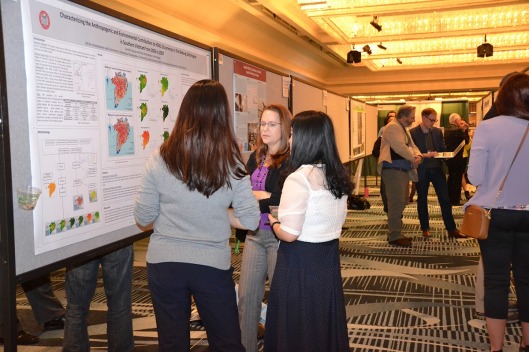
Accountable Talk in the Civics Classroom (Poster Session)
posters

We will be featuring a number of poster sessions at the conference this year, and this one looks good, especially if you are as civics-obsessed as your humble bloghost!

Because of how polarized our political world is today, many teachers (ourselves included!) have shied away from engaging students in discussion-based activities, despite all of the research regarding the importance of student ownership in and discovery-based learning. In order to overcome this fear, we have implemented accountable talk during student-led conversations in order to keep the students engaged in the content, thinking critically about the material, and expressing their opinions- all while being respectful of their fellow classmates and differing opinions. In our presentation, we will give teachers a playbook for how to utilize accountable talk in their classrooms. We will discuss how to prepare the class to use accountable talk, we will provide examples of statement stems that will help teachers implement the accountable talk, and we will discuss potential challenges and solutions that we have discovered ourselves while using accountable talk in the classroom. We will also provide specific examples/lesson plans we have used in our classrooms that have centered around using accountable talk (appropriate for both for middle and early high school aged students.)

I look forward to checking this out!

Sunday October 20 (80 Minute Sessions)

Formative Assessments to the Rescue
i said I taught him

Formative assessments are so very important in the social studies and oh there are so many! What are the best ones to use? How can we think about formative assessments that we can use in our different content areas?

Do you need a quick check for understanding from your students but you don’t want to grade another piece of paper? Come and join this interactive workshop on formative assessments and how you can use them in your social studies classroom. All social studies disciplines are welcome. Participants will be shown a variety of formative assessment strategies to help them in their social studies classroom. We want to get away from the paper-based quizzes and more toward “quick checks” that are engaging and more interactive for students but give valuable, immediate feedback for teachers. The presentation is adaptable for all social studies curriculums. Some strategies include SWAT, Agreement Lines, Value Line or Human Spectrum, Odd One Out, Inside/Outside Circles, ABC Graffiti, Grafitti Review, Shower Curtain Review, and many more. We would like to give some time in between strategies for teachers to think how they would use each strategy in their own classroom.

So these are just some of the cool sessions we will be having at the conference. Why don’t you go ahead and register for this now! 

American Founders Month: Thomas Jefferson!

FMimage

Check out the National Constitution Center’s biographies of the Founding Fathers! https://constitutioncenter.org/learn/educational-resources/founding-fathers

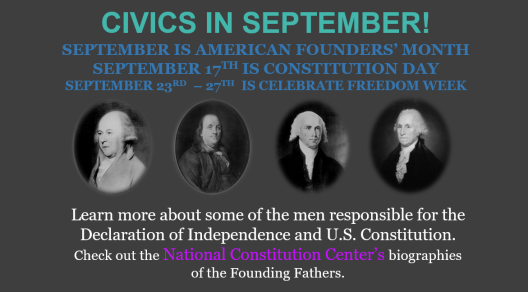
It’s Founders Month here in Florida! According to the Florida Department of Education,

Section (s.) 683.1455, Florida Statutes (F.S.), designates the month of September as American Founders‘ Month and s. 1003.421, F.S., recognizes the last full week of classes in September in public schools as Celebrate Freedom Week.

So what does this mean for our schools and kids and teachers? Basically, it’s time to do some learning about the men and women who have helped shape this state and this country. Here on our Florida Citizens blog, we’ll be doing at least two posts a week with a brief overview of a particular Founder, Framer, thinker, or shaper of this state or this nation and how they made an impact.

Sept 25 Jefferson

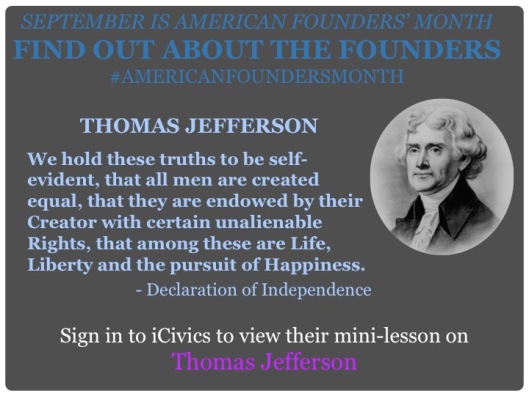
American Founders’ Month continues in Florida. Today, we look at Thomas Jefferson. Out of all of the Founders’, it may be Thomas Jefferson that most schoolchildren are most familiar with. They know him, of course, as the author of the Declaration of Independence. The Declaration, of course, is considered on of the clearest rebukes of tyranny ever written, and it remains to this day a symbol of the pursuit of liberty the world over.

Like many of his peers, however, Jefferson was a man of massive contradictions. An advocate for liberty who owned a great many slaves, a slaveowner who recognized the evils of slavery (‘the rock upon which the Union would split’) but never freed his own slaves (unlike his colleague and friend George Washington, who freed his own upon his death), an opponent of an activist and strong central government who nevertheless used his power to purchase vast swathes of land from the French (despite his doubts about whether the Constitution gave him that power), and a believer in the importance of civility and comity in politics and life who was involved in one of the most brutal presidential campaigns in American history.

Thomas Jefferson was indeed many things, some good, some bad, but all important to the legacy of freedom and the Founders of this country. As one of his successors as president, John F. Kennedy, once said while hosting a dinner for Nobel Prize winners,

I want to tell you how welcome you are to the White House. I think this is the most extraordinary collection of talent, of human knowledge, that has ever been gathered together at the White House, with the possible exception of when Thomas Jefferson dined alone.
Someone once said that Thomas Jefferson was a gentleman of 32 who could calculate an eclipse, survey an estate, tie an artery, plan an edifice, try a cause, break a horse, and dance the minuet.

Log in and learn more about Thomas Jefferson from this excellent lesson provided by our friends at iCivics! 

You can grab the PowerPoint featured at the top of this post here: Thomas Jefferson AFM

It’s Constitution Day!

us-constitution

Good morning, friends! It’s Constitution Day today! September 17th celebrates that day back in 1787 when the Framers and Founders gave us our Constitution. It is, to this day, the oldest written and codified national constitution still in force. Yes, it has flaws and weaknesses, but it has also given us a government of the people, by the people, and for the people, and allowed for the growth of liberty and freedom over time in these United States. The fact that it is so very adaptable to the times is important, and it has allowed the nation to work towards those founding principles of life, liberty, and the pursuit of happiness, even if it has not always been able to reach them.

Now, if you ask me, every day should be Constitution Day! So where can you find some resources for teaching about Constitution Day?

Students Investigating Primary Sources 

On the Florida Citizen website, you will find a number of primary source-oriented lessons built around the founding documents, targeting grades 3-12 and exposing students to the principles of our founding and the documents that create the framework for the liberties we enjoy today. These were developed in collaboration with the National Archives and with teachers from across the state of Florida. There are lessons there that cover the entire Freedom Week! Our elementary and middle school lesson plans elsewhere on the website also address different aspects of the Constitution and our other founding documents. Be sure to check out these free resources! 

The Civics Renewal Network

How about some resources shared through our friends at the Civics Renewal Network ? Of course, we need to begin with the Preamble Challenge!

Preamble Challenge

CRN PRAMBLE

Find terrific classroom activities and lessons for all grade levels with the free online Teacher Toolkit. Take the Preamble Challenge, and today, share your videos and photos on Twitter and Instagram using #renewcivics and #preamblechallenge. Let’s see all sorts of creative ideas for learning about the Preamble.

Check out some more CRN-linked resources on the Constitution here! 

For more CRN-linked resources from the FJCC, go here.

Schoolhouse Rock

Well, it IS a classic, isn’t it?


Join September Confab about Purple Project for Democracy

We are excited to announce our September Confab Call, featuring a new initiative that is preparing for  November launch – Purple Project for Democracy. Purple is a non-partisan coalition, campaign and movement to rediscover and recommit to democratic values and institutions.  The folks behind the project are building momentum for their November launch, and on this Confab we’ll learn more about how dialogue and deliberation can play a role in it.

This free call will be on Monday, September 30th from 1-2 pm Eastern, 10- 11 am Pacific. Register today so you don’t miss out on this exciting opportunity!

reg-button-2

Purple is aiming to help people recommit to democratic values, but also to stimulate civic engagement. This is where the dialogue and deliberation field might be able to help most!

It begins this November with a media and education campaign that will “illuminate and dramatize the many glories of American democracy.” Participants in this campaign will include media outlets, schools, libraries, and other organizations committed to sharing the message of the importance of democracy and our participation in it. Their vision is to gain visibility and build a movement for civic participation and democracy across differences, that then leads to increased action, including volunteering, voting, serving, and participating in civic life.

During the month of November, Purple hopes to have local conversations which can help to stimulate the national effort. The hope of the organizers is that members of NCDD will participate in this effort by hosting conversations in their communities. To learn more about this aspect of the project, please take a look at this document from Purple.

On the call, we will be joined by Bob Garfield, one of the key organizers for this movement. Bob is co-host of public radio’s On the Media. He is also the founding co-host of Slate’s podcast on language, Lexicon Valley, and Amazon Channels’ The Genius Dialogues. Bob will share with us the vision for Purple, and discuss opportunities for the dialogue and deliberation field to contribute to the November campaign and the next phases following this launch.

Please be sure to check out the Purple Project for Democracy website, and bring your questions and ideas for how dialogue & deliberation can contribute to this effort. Make sure you register today to secure your spot!

About NCDD’s Confab Calls

Confab bubble imageNCDD’s Confab Calls are opportunities for members (and potential members) of NCDD to talk with and hear from innovators in our field about the work they’re doing and to connect with fellow members around shared interests. Membership in NCDD is encouraged but not required for participation. Confabs are free and open to all. Register today if you’d like to join us!

Founders Month 2019: Judith Sargent Murray

FMimage

Check out the National Constitution Center’s biographies of the Founding Fathers! https://constitutioncenter.org/learn/educational-resources/founding-fathers

It’s Founders Month here in Florida! According to the Florida Department of Education,

Section (s.) 683.1455, Florida Statutes (F.S.), designates the month of September as American Founders‘ Month and s. 1003.421, F.S., recognizes the last full week of classes in September in public schools as Celebrate Freedom Week.

So what does this mean for our schools and kids and teachers? Basically, it’s time to do some learning about the men and women who have helped shape this state and this country. Here on our Florida Citizens blog, we’ll be doing at least two posts a week with a brief overview of a particular Founder, Framer, thinker, or shaper of this state or this nation and how they made an impact.

image of JSM

Judith Sargent Murray was born in pre-Revolutionary Boston, the daughter of a well-to-do merchant family. It as fortunate for us, as it was for her, that her parents believed in educating their daughters as well as their sons. Unfortunately, this education was limited to reading and writing; Sargent Murray had little opportunity for advanced education. Instead, she took advantage of her father’s vast library and educated herself in history, civics, philosophy, literature, and so much more. This education, so much of it self-taught, she put to work as a writer and thinker and, most importantly, advocate for the rights of women and the equality of the sexes.

For Judith Sargent Murray, the way in which we consider the roles and educations of boys and girls was unjust, stifling, and wrong. In her seminal work, ‘On the Equality of the Sexes‘ (1790), she raises doubts about the argument that men are inherently the intellectual superiors to women:

“Yet it may be questioned, from what doth this superiority, in thus discriminating faculty of the soul proceed. May we not trace its source in the difference of education, and continued advantage?…As their years increase, the sister must be wholly domesticated, while the brother is led by the hand through all the flowery paths of science”

In other words, the only reason men can claim superiority to women is because we do not give women the same education and opportunities as men! This theme would reappear throughout her work over the years, and she never ceased believing that America offered a great opportunity for a reconsideration of the role and education of girls. The new nation, after all, needed women who would raise the next generation to believe in and understand the American spirit and model, a ‘Republican motherhood‘ that required educated, passionate, and (to a degree for its day) liberated women.

Sargent Murray practiced what she preached, educating the children in her house as she believed they deserved and as was right. She also wrote hundreds of essays and letters and articles, many of which were published under pen names in such a way as to hide the fact that she was a woman, for she feared her arguments would be automatically rejected. She was a ‘Founding Mother’ of the pursuit of equal rights, an advocate for the American project, and someone who encouraged the new nation to live up to the ideals it promised. You can learn more about the wonderful Judith Sargent Murray from this excellent lesson.

Grab the PowerPoint featured at the top of this post: JSM 2019

And of COURSE this Freedom Month don’t forget the Preamble Challenge from our friends at the Civics Renewal Network! Check it out today!

Next up: Thomas Jefferson!