The Summer Institute of Civic Studies is an intensive interdisciplinary seminar that brings together faculty, advanced graduate students, and practitioners from many countries and diverse fields of study. In 2020 it will take place from the evening of June 18 until June 26 at Tufts University in Medford, MA, and Boston.
To apply: Applications are now being received and should be submitted by March 31 for best consideration. The application consists of a resume, a cover letter about your interests, and an electronic copy of your graduate transcript (if applicable).
The Summer Institute was founded and co-taught from 2009 to 2018 by Peter Levine, Associate Dean of Academic Affairs at Tisch College, and Karol Soltan, Associate Professor in the Department of Government and Politics at the University of Maryland. Since 2019, it has been led by Peter Levine. Each year, it features guest seminars by distinguished scholars and practitioners from various institutions and engages participants in challenging discussions such as:
How can people work together to improve the world?
How can people reason together about what is right to do?
What practices and institutional structures promote these kinds of citizenship?
How should empirical evidence, ethics, and strategy relate?
The 2019 syllabus can be found here. You can read more about the motivation for the Institute in the Civic Studies Framing Statement by Harry Boyte, University of Minnesota; Stephen Elkin, University of Maryland; Peter Levine, Tufts; Jane Mansbridge, Harvard; Elinor Ostrom, Indiana University; Karol Soltan, University of Maryland; and Rogers Smith, University of Pennsylvania.
The seminar discussions follow a public conference, Frontiers of Democracy, which will take place in downtown Boston from June 18 (evening) until June 20. Participants in the Summer Institute are expected to participate in the conference (free of charge) and then the Institute.
Practicalities: Daily sessions take place on the Tufts campus in Medford, Massachusetts. Tuition for the Institute is free, but participants are responsible for their own housing and transportation. One option is renting a Tufts University dormitory room. Credit is not automatically offered, but special arrangements for graduate credit may be possible.
You can sign up here to receive occasional emails about the Summer Institute.
So what does this amendment say? Well, let’s take a look:
The Equal Rights Amendment
Section 1. Equality of Rights under the law shall not be denied or abridged by the United States or any state on account of sex.
Section 2. The Congress shall have the power to enforce, by appropriate legislation, the provisions of this article.
Section 3. This amendment shall take effect two years after the date of ratification.
Essentially, this amendment would ban through constitutional prerogative, discrimination against anyone based on sex. While this is certainly covered through various civil rights acts, supporters argue that this would enshrine in the Constitution the importance of equality between the sexes , as a law is a great deal easier to repeal than an amendment to the Constitution.
Arguments against the Equal Rights Amendment
As with everything, there has historically been significant opposition to the Equal Rights Amendment. Activist Phyllis Schlafly led much of the opposition to the amendment, and the argument is simple: sex-neutral treatment in law could potentially harm women. Schlafly argued that:
“What that amendment would do is to make all laws sex-neutral. Well, the typical, classic law that is not sex-neutral is the draft registration law. And we were still in the Vietnam War in 1972.
“I had sons and daughters about age 18. My daughters thought this was the craziest thing they ever heard. You’re going to have a new amendment for women? And the first thing is they’ll have to sign up for the draft like their brothers. Now, that was an unsalable proposition.”
Thanks to the efforts of activists and opponents like Schlafly, the amendment fell short of approval, gaining only 35 of the 38 it needed to by 1982, that year already a Congressionally approved extension of the limited time for ratification the amendment had already exceeded.
So What’s Next?
What’s next? Good question. It’s unclear at this point whether or not Virginia ratifying the Equal Rights Amendment actually means it is ratified and in our Constitution, simply because of that expiration date. We can likely expect court challenges from both sides on this issue, without a doubt.An interesting paper from the Congressional Research Service is worth a read! It explores questions around ratification in great detail.
This topic is certainly something that would be good fodder for discussion in the classroom, tying into civics, government, history, and current events!
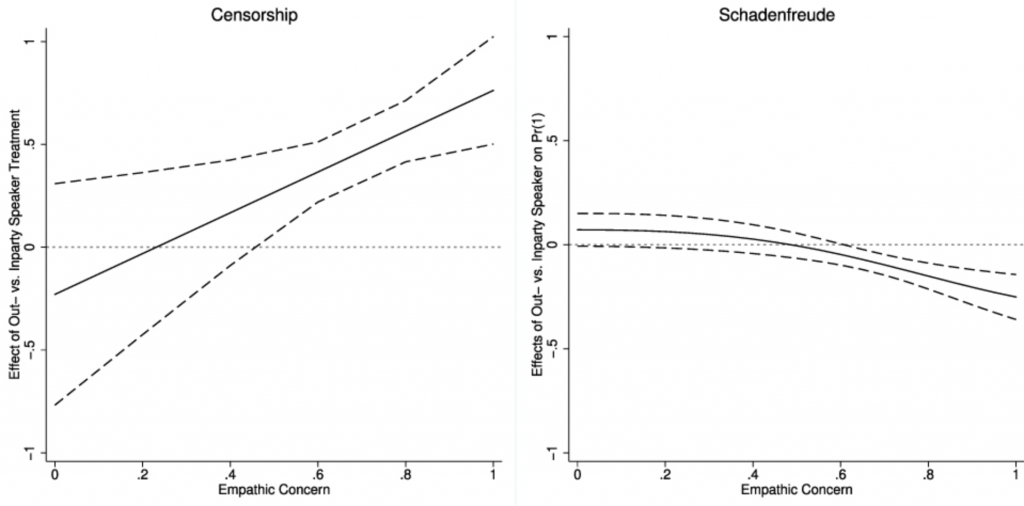
In a new article,* Elizabeth Simas, Scott Clifford, and Justin Kirkland provide evidence that empathy is not a solution to partisan polarization in the US. Quite the contrary: people who demonstrate more “empathic concern” are more likely to blame the opposite party for the suffering that they see in the world, hence more likely to decry the other party, to favor censoring it, and to exhibit Schadenfreude (pleasure at others’ pain) when members of the opposing party lose out.
Part of the article involves an experiment with undergraduate subjects. Students are shown a story in which “campus police had to shut down a group of partisan students who were protesting a speech to be given by an individual known for making inflammatory comments about that party. In both versions, a bystander who was attempting to hear the speech was struck by a protestor. And in both versions, the protestors succeeded in getting the speech canceled.” Students were assigned to see versions of the story that randomly varied the partisan identities of the speaker, the protesters, and the bystander.
Students who scored higher on a general measure of empathetic concern were more likely to favor censoring the inflammatory speaker, and more likely to be glad that the bystander was hurt. These results were the same for Democratic and Republican students.
It rings true for me that deep emotional concern is associated with anger and a distancing of intellectual and political opponents, a refusal to hear their arguments.
I’ve posted concerns about empathy several times before.** The main problem is its susceptibility to bias. Usually, empathy is felt for individuals (or concrete categories of people), and it can easily promote injustice against others. There is such a thing as universal, undifferentiated empathy, but it looks more like an ethical principle than a concrete emotion. The Buddhist objective is not empathy (as measured by questions from the Interpersonal Reactivity Index, such as: “When I see someone being taken advantage of, I feel kind of protective toward them”). Instead, Buddhism prizes equanimity, which is calm and detached.
I do not take for granted that political polarization is bad. Sometimes it is right to blame political opponents for others’ suffering. And although Schadenfreude should always be avoided, it can be welcome news when a political enemy suffers defeat. These emotions of blame and satisfaction are appropriate if and when the opponent is actually at fault. To find out whether someone is actually wrong requires engagement with that person’s arguments and reasons. Censorship defeats such engagement and is almost always a mistake. It’s troubling that more empathy means more support for censorship, especially if that exemplifies a deeper problem with empathy. Perhaps empathy discourages us from hearing alternative views by fixing our attention on concrete suffering.
Happy New Year to you all! Below is the first D&D webinar roundup of 2020 and we encourage you all to put these exciting opportunities on your calendars! NCDD sponsor org The Courageous Leadership Project will be holding their “Brave, Honest Conversations” webinar next Wednesday. On the same day, our friends at the National Civic League will be holding their webinar, “Collaborations to Address Mental Health” and NCDD member org MetroQuest’s webinar, “How SCDOT Engaged 13,000+ Residents on a Tiny Budget”.
NCDD’s online D&D event roundup is a weekly compilation of the upcoming events happening in the digital world related to dialogue, deliberation, civic tech, engagement work, and more! Do you have a webinar or other digital event coming up that you’d like to share with the NCDD network? Please let us know in the comments section below or by emailing me at keiva[at]ncdd[dot]org, because we’d love to add it to the list!
– Upcoming Online D&D Events –
From Our Sponsors & Partners
The Courageous Leadership Project webinar – Brave, Honest Conversations
Wednesday, January 22nd
9 am Pacific, 12 pm Eastern
Some conversations are hard to have. Fear and discomfort build in your body and you avoid and procrastinate or pretend everything is fine. Sometimes you rush in with urgency, wanting to smooth things over, fix them, and make them better. Sometimes you go to battle stations, positioning the conversation so you have a higher chance of being on the “winning” side. NONE OF THIS WORKS. Instead, it usually makes a hard conversation harder; more divided, polarized, and disconnected from others. The more people involved, the harder the conversation can be. I believe that brave, honest conversations are how we solve the problems we face in our world – together.
In this webinar, we will cover: What is a Brave, Honest Conversation? Why have one? What can change because of a brave, honest conversation? How do you have one? What do you need to think about and do? How do you prepare yourself for a brave, honest conversation?
National Civic League AAC Promising Practices Webinar – Collaborations to Address Mental Health
Wednesday, January 22nd
10 am Pacific, 1 pm Eastern
“If you want to go fast, go alone. If you want to go far, go together.” This webinar will highlight two community programs that are addressing mental health issues through collaborations and unique partnerships. Registrants will hear about Somerville, MA’s Teen Empowerment Youth Mental Wellness Ambassador program and the Behavioral Health Consortium in El Paso, Texas.
As the title of this post says, democracy is not a spectator sport. In order to serve as active and knowledgeable members of the civic community of this great state and the broader representative democratic republic in which we live, it is necessary for those who are learning what it means to be a part of it all to actually have the chance to practice in their roles as ‘citizen apprentices.’
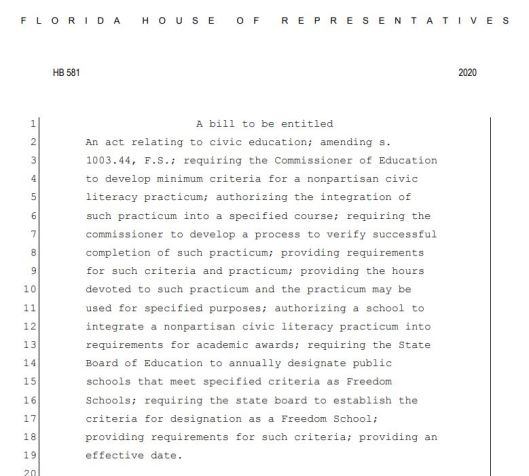
In order to successfully complete a civic literacy practicum, students will have to:
identify a civic issue that impacts the community
research the issue from multiple perspectives
develop a plan for being involved with the issue
Create a portfolio to evaluate and reflect upon the experience and the outcomes or likely outcomes
include research, evidence, and a written plan of involvement
The practicum itself must be non-partisan, focus on addressing at least one community issue, involve multiple perspectives, and give the student an opportunity to engage in civil discourse with someone who holds a differing perspective on the issue.
Community Service Hours
The hours outside of classroom instruction that a student devotes to the nonpartisan civic literacy practicum to implement his or her plan of involvement may be counted toward meeting community service requirements for participation in the Florida Bright Futures Scholarship Program. School districts should include and accept nonpartisan civic literacy practicum activities and hours in requirements for academic awards,
especially those awards that currently include community service as a criterion or selection factor.
Freedom Schools
This is an interesting incentive for schools to encourage students to take part in this practicum: schools can be officially designated by the state as ‘Freedom Schools’. In order to be a Freedom School, schools must:
demonstrate that they have integrated proven practices of civic learning and engagement into the classroom
extend those same practices across the broader curriculum
engage in high quality professional learning community work around student achievement and best practice
a certain percentage of students graduating with a regular diploma, service learning hours, AND success in the civics literacy practicum.
As a reminder, Rep. Diamond put forward a similiar bill last year. That one died in committee, in part because it put more expectations and mandates on schools and districts as far as course development and implementation, as well as some of issues with language choice. This bill, however, may see more success than we might think of otherwise. We here at LFI/FJCC certainly hope so!
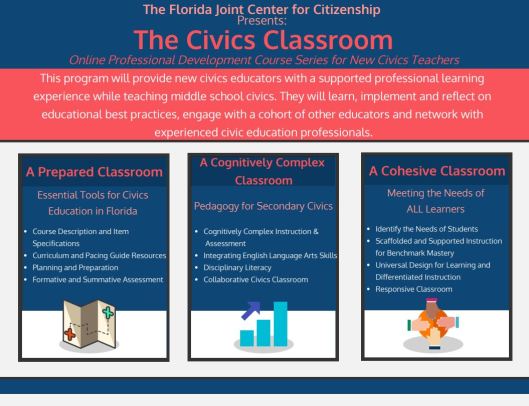
Friends, as you may be aware, we have been offering a free online course series, The Civics Classroom, open to all teachers but primarily targeting new and early career civics teachers in Florida.
“I just wanted to thank you for offering the online Civics Modules, I learned so much during the first one and can’t wait to implement some of the things I learned.” —A beginning civics teacher “Thank-you also for the course- I learned quite a bit about how to teach Civics in Florida and to especially to 7th graders.” —An experienced teacher new to civics in Florida
After much reflection, review of data, and discussion with teachers, we are going to be relaunching the course series later this spring with a new approach. The original iteration of the course featured a heavily interactive component where participants would engage with each other to discuss particular aspects of civics teaching and learning. The goal was to build a PLC of civics teachers that could work together and get to know each other, serving as a resource for each other no matter what district they were in.
Unfortunately, this did mean that we required folks to work on a specific timeline in each course; it was hard to feel successful in the course when you had to wait an extended period of time for someone to respond to your posts!
We believe that this course can improve instruction in civics. We think it can make a difference in the experiences and practices of civics teachers, and help hold the hand of new and beginning civics teachers as they find their way. So we want folks to find it beneficial, and to complete it. We want folks to feel success. As such, we are revising the course series in its entirety. What does this mean? Well, the videos and extra resources will remain, as will the expectations of a pre-test and post-test and submission of student data in order to get recertification points. The most significant change will be the replacement of the discussion boards and any timeline/deadline expectations.
The discussion boards are being replaced with a quiz at the end of each module, to ensure that you did learn about the focus of the module and are coming away with a greater sense of what is necessary to succeed.
You will be able to work at your own pace and not rely on others for successful completion of the course.
We expect to relaunch the course series later this spring, and we believe that the revisions we are making based on your feedback and the data we have reviewed will make the course series far more accessible and beneficial to civics teachers across the state and beyond.
Watch this space for more information about the relaunched course series! Questions can be directed to Dr. Steve Masyada.
In case you missed it, NCDD member organization The Davenport Institute, in partnership with the Pepperdine School of Public Policy, is offering their next professional Certificate in Advanced Public Engagement for Local Government [non-academic] from February 7-9 in Malibu, CA. Excellent for anyone involved or working with local government, or in graduate school for local government/public policy. NCDD members receive a 20% discount off the tuition if you sign by tomorrow, January 15th, so make sure you register ASAP to receive this great benefit. They are accepting applications until the class is full, so sign up while you still can! You can read the announcement below or on the Pepperdine School of Public Policy’s website here.
Become a Certified Public Engagement Champion
The Davenport Institute for Public Engagement and the Pepperdine School of Public Policy invite you to become part of the 6th cohort to receive your Professional Certificate in Advanced Public Engagement for Local Government on February 7-9, 2020 at the Pepperdine campus in Malibu, CA.
During this three-day intensive program, you will be prepared to lead a publicly-engaged organization by gaining a deep understanding of the context, purpose and best practices for engaging residents in the decisions that affect their lives and communities.
The cost is $1990 which includes instruction, materials, and meals. NCDD members get a 20% discount if they apply by January 15. You can find out more and apply here.
No other program harnesses the collective knowledge of frontline leaders quite like the Davenport Institute. My cohort helped me develop solutions to programs and introduce new strategies to fuel collaboration across my organization. I implemented what I learned the same week I got back ~ Yvonna Cazares, Director of Community Engagement, Office of the Mayor, City of Oakland.
I’m teaching Public Policy Analysis to undergraduate this spring–a new course. I’ve pasted the working syllabus (minus the grading rubric, rules about technology, and other practicalities) below. As always, comments and suggestions are welcome. I don’t think this design is a very unusual, but it may lean more toward institutional analysis (per Elinor Ostrom) than is common.
Objectives
To learn to analyze institutions and develop strategies that improve the world by changing these institutions or creating new ones. A good strategy must be just (which requires normative argument), effective, and politically viable.
Summary of Content
The class will first investigate one policy question together. That question is: Which students should attend which k-12 schools in the USA, and who should decide that matter? Concrete policy options include mandatory assignment to neighborhood public schools, school choice, charter schools, vouchers, etc. Every student will write a short paper on that topic.
Each student will then select one policy issue and write three 5-7-page essays that connect to produce one policy memo on that issue. As students conduct research for their individual papers, in class, we will discuss methods and theories of policy analysis.
Our overall framework will the Institutional Analysis and Design (IAD) framework developed by Elinor Ostrom and colleagues. We will use it both for the k-12 school example and for each student’s individual project.
Working with this framework, we will pose these questions:
What is the institution? What is its name? How would you define it uniquely, and which people, resources, locations, etc. does it involve?
What problem or set of problems interests you about it? This problem may be a failure (the institution doesn’t yield the intended results) or an injustice (it has bad results), or it could be the intellectual problem posed by its success: why does this institution work and can we replicate it?
What other institutions are closely related to it, and how?
Which institutional form(s) does it reflect, e.g., a government, a firm, a market, a network, an association, a community?
What are important relevant biophysical conditions? What natural resources does it use, and which natural processes come into play? What characteristics of these resources and processes are relevant to the institution: e.g., scarcity, fragility, adaptability, ability to reproduce and grow, interdependence, tendency to move?
What are important technological conditions, where “technology” means the relevant affordances and limitations that have been created–or will predictably be created–by human beings?
What cultural meanings (in the sense of Geertz 1973) are involved? Are these meanings shared or disputed?
What official, formal, usually written rules govern the institution? What are its rules-in-use? (These may diverge from the official rules.)
Are the rules grounded (Links to an external site.)in phenomena beyond the institution? For instance, an institution might use a currency whose value is determined by other institutions. Tufts runs on an academic calendar related to the solar calendar, which is grounded in the motion of the earth. (Grounding is different from causation.)
What goods are relevant? Who has which kinds of ownership over which goods? Are the goods subtractable? Are they excludable?
Who are the relevant actors?
What choices confront each actor? What does each actor know about the available choices?
What does each actor value, and why?
Under what conditions do the actors choose (e.g., with or without discussion, once or repeatedly, simultaneously or in turn, with or without knowledge of what the others are choosing)?
What are the consequences of the most important or most likely combinations of choices made by all the actors?
Are these consequences desired by the actors?
Are these outcomes desired by people who are not among the actors?
Are the outcomes fair or just by various normative criteria?
Are they sustainable–meaning a) literally repeatable many times, and/or b) good for nature?
How do the outcomes affect the issues raised in questions 1-15? In other words, do the outcomes of the institution change the institution itself, in a feedback loop?
What deliberate changes in institutional forms (4), technologies (6), meanings (7), rules (9-10), or values (13) would produce preferable outcomes according to the criteria raised in questions 18-20?
How can we go about altering the institution in the light of 22?
Book to purchase
Sigal R. Ben-Porath and Michael C. Johanek, Making Up Our Mind: What School Choice is Really About (University of Chicago Press, 2019)
Robert Pondiscio, How The Other Half Learns: Equality, Excellence, and the Battle Over School Choice (Avery 2019)
These will be in the bookstore but you are welcome to purchase electronic versions instead.
Criteria for assessing class participation:
Attendance.
Engaging in a discussion that is informed by the assigned texts.
Focusing on the topic and the texts, which does not preclude drawing connections beyond them.
Being responsive to other students. Responsiveness needn’t always be immediate, verbal, or occur within the class discussion itself.
Building on others’ contributions, and sometimes making links among different people’s contributions or between what they have said and the text.
Demonstrating genuine respect for the others, where respect does not require agreement. In fact, sometimes respect requires explicit disagreement because you take the other person’s ideas seriously.
Taking risks, trying out ideas that you don’t necessarily endorse, and asking questions that might be perceived as naive or uninformed.
Seeking truth or clarity or insight (instead of other objectives).
Exercising freedom of speech along with a degree of tact and concern for the other people.
Demonstrating responsibility for the other students’ learning in what you say (and occasionally by a decision not to speak).
Wed. Jan 15
Introductions. Some preliminary discussion of school choice based on our own experiences
Sigal R. Ben-Porath and Michael C. Johanek, Making Up Our Mind: What School Choice is Really About, pp. vii-81
(Johanek will visit class via videoconference.)
Mon., January 29
Values: What are We Trying to Acccomplish?
Sigal R. Ben-Porath and Michael C. Johanek, pp. 83-129
Monday, February 3: no class (instructor is traveling)
Wed. Feb 5
Does Choice Work? Qualitative evidence
Robert Pondiscio, How the Other Half Learns: Equality, Excellence, and the Battle Over School Choice (2019); especially recommended pages: 3-51, 77-104, 111-113, 156-163, 175-179, 184-194, 210-219, 257-267, 271-279, 295-311, 320-340.
Meira Levinson, “Is Pandering Ethical? Power, Privilege, and School Assignment,” in Levinson and Jacob Fay, Dilemmas of Educational Ethics: Cases and Commentaries, pp. 143-78
(Feb 17: no class; President’s Day)
First paper due: 4-6 pages about school choice
Part II: Other Issues
Wed., February 19
Policy analysis: mainstream approaches
Bardach, E. A Practical Guide for Policy Analysis. (2000), excerpts
(Feb 17: no class; President’s Day)
Mon, Feb. 24
Unpacking institutions
In class, we will build and operate an extremely simple institution by playing a “tragedy of the commons” game. We will apply the IAD framework to it.
Ostrom, Elinor. 1987. “An Agenda for the Study of Institutions.” Public Choice 48:3-25. Reprinted in McGinnis (2000), Chapter 3.
Monday, March 2
Rules
Toulmin, Stephen. 1974. “Rules and Their Relevance for Understanding Human Behavior.” In Understanding Other People, ed. Theodore Mischel, 185-215. Oxford: Blackwell. Excerpts: pp. 189-214.
Wednesday, March 4
Attributes of community: Example # 1, the community’s social capital
Coleman, James S. “Social capital in the creation of human capital.” American journal of sociology 94 (1988): S95-S120.
Monday, March 9
Attributes of community: Example #2, the community’s culture
Geertz, Clifford. “Deep Play: Notes on the Balinese Cockfight.” Culture and Politics. Palgrave Macmillan, New York, 2000. 175-201.
Wednesday, March 11
Games: players, situations
Avinash K. Dixit and Barry J. Nalebuff, Thinking Strategically: The Competitive Edge in Business, Politics, and Everyday Life: Competitive Edge in Business, Politics and Everyday Life, excerpts
Second paper due: 4-6 pages presenting a public policy issue in terms of “players,” choices, and outcomes.
Monday, March 9
Exit Voice and Loyalty
Albert O. Hirschman, Exit, Voice, and Loyalty (1970), excerpts
Wednesday, March 11
Evaluative Criteria: 1) Cost-benefit analysis
Richard Layard and Steven Glaister, eds., Cost-Benefit Analysis, second edition: chapters on Safety and the saving of life: The theory of equalizing differences, pp 272-289; by Sherwin Rosen; The environment: The environment and emerging development issues pp 319-348, by Partha Dasgupta, Karl-Göran Mäler ); Regulation and deregulation: Enhancing the performance of the deregulated air transportation system, pp 375-395 by Steven A. Morrison
(March 16-19 is Spring Break)
Monday, March 23
Evaluative Criteria: 2) Rule of law
Scalia, Antonin. “The rule of law as a law of rules.” U. Chi. l. reV. 56 (1989): 1175.
Wednesday, March 25: no class (instructor is traveling)
Monday, March 30
Evaluative Criteria: 3) Rights
Dworkin, Ronald, and Jeremy Waldron. “Rights as trumps.” Arguing about the Law (1984): 335-44.
Third paper due: 4-6 pages analyzing the value conflicts and choices raised by your policy issue
Wednesday, April 8
Types of institution
Aligica, Paul Dragos, and Vlad Tarko. “Co-production, polycentricity, and value heterogeneity: the Ostroms’ public choice institutionalism revisited.” American Political Science Review 107.4 (2013): 726-741.
Feedback loops
Mettler, Suzanne, and Mallory SoRelle. “Policy feedback theory.” Theories of the policy process 3 (2014): 151-181.
Complexity and Wicked Problems
Rittel, H., M. Webber, “Dilemmas in a General Theory of Planning,” Policy Sciences 4(1) (1973) 155-169
Monday, April 13
How policy gets made
Sabatier. P.A. and C.M. Weible. The Advocacy-Coalition Framework: An Assessment. 189-220
Schlager, E., C.M. Weible (2013). New Theories of the Policy Process. Policy Studies Journal, 41(3), 389-396.
Fourth paper due: 4-6 pages presenting and defending a policy recommendation on your issue.
Scholars in many disciplines are grappling with how to produce rigorous scholarship that addresses significant social challenges in collaboration with communities, organizations, and agencies. They strive to learn from those working outside of academia, to benefit from the insights of all kinds of groups and institutions, and to give back to communities rather than extract value from them. Although political scientists offer models of excellence in civically engaged research, relevant methods and strategies are not yet widely taught in the discipline’s graduate programs or sufficiently valued in the profession as a whole.
In 2019, in an effort to address this need, the APSA Presidential Task Force on New Partnerships launched the now-annual APSA Institute for Civically Engaged Research (ICER). ICER is intended for advanced graduate students in political science and political scientists at any stage of their careers who wish to shift to using civically engaged research. (It is not meant for scholars who are already experienced in that approach.)
To apply, please complete this form. Application deadline: March 1, 2020.
Content of the Institute
Topics covered will include:
Expertise: what do political scientists uniquely contribute? What are the limitations of scholarly expertise? What types of expertise do those outside of academia have?
The ethics of collaboration: sharing of credit, funds and overhead, navigating IRB, dealing with disagreements.
Communicating results: to partners, relevant communities, the press, and directly to the broader public.
How to navigate common social science values and norms while doing civically engaged work
Career considerations: publication and credit, tenure and promotion, funding your research.
Mapping the different and varied ways that political scientists engage through research and beyond.
We will explore these issues by discussing relevant readings, by analyzing specific examples of civically engaged research from political science and cognate disciplines, and by considering the research plans and ideas of institute participants.
People
Speakers and visitors are currently being finalized. Confirmed speakers include: Anjuli Fahlburg (Tufts University), Michelle Fine (CUNY), Samantha Majic (John Jay College/CUNY), Jamila Michener (Cornell University), Pearl Robinson (Tufts), and Ethel Tungohan (York University).
The Institute Directors are Amy Cabrera Rasmussen (California State University Long Beach) Peter Levine (Tufts University), and Valeria Sinclair Chapman (Purdue University). If you have further questions about the institute, please contact APSA’s Centennial Center at centennial@apsanet.org.
Practicalities
The Institute will take place on the campus of Tufts University, in the Boston area, from June 15-18, 2020. Approximately twenty participants will meet each day for intensive discussions and workshops. Thanks to support from the Ivywood Foundation, participation in the Institute for Civically Engaged Research is free, and scholarships are available to defray costs of travel, food, and housing on the Tufts campus. Applicants are expected to seek financial support from their home institution, but admission to the Institute for Civically Engaged Research will not be affected by financial need.
ICER participants are invited to attend the Frontiers of Democracy conference immediately following the institute, from the evening of June 18 until noon on June 20 in downtown Boston. Frontiers offers the opportunity to engage directly with over 120 activists, policymakers, and engaged scholars from across multiple disciplines, to present one’s work to and learn from potential partners about their interests and best practices for collaboration. ICER participants will have the Frontiers’ conference fee waived and be provided lodging assistance.
Applicants to ICER will be notified of decisions by late March.
Frontiers of Democracy is now accepting applications for its upcoming 2020 conference happening from June 18th until June 20th! The conference will be held at Tufts University in downtown Boston, following the American Political Science Association’s Institute for Civically Engaged Research, and preceding the Summer Institute of Civic Studies. Frontiers will be an opportunity to connect with members from these programs, as well as, practitioners and professionals working in democratic social movements, political reform, civic engagement, dialogue and deliberation, and more! Applications for sessions will be accepted until April 1st and we encourage members from the Coalition to submit an application and/or attend the conference. You can read the announcement below and find the original version on Peter Levine’s blog here.
Frontiers of Democracy: June 18-20, 2020
Frontiers of Democracy is an annual conference hosted by the Jonathan M. Tisch College of Civic Life at Tufts University since 2009.
In 2020, the conference will take place from June 18 (5 pm) until June 20 (noon) at the downtown Boston campus of Tufts University: Tufts Center for Medical Education, Room 114; 145 Harrison Avenue, Boston. You are invited!
You can propose a concurrent session for Frontiers using this form. Proposals will be accepted until April 1, 2020
The agenda is still in development but will include short plenary talks, concurrent sessions, and interactive activities for the large group. Among other whole-group activities, we will experience Pre-Texts (“pedagogical acupuncture”) and will use several new “teaching cases” to prompt intensive discussions in small groups. (Teaching cases are short narratives about real events that conclude at a moment when the protagonists must make a difficult choice.)
Frontiers will follow the American Political Science Association’s Institute for Civically Engaged Research and precede the Summer Institute of Civic Studies and will convene members of those two programs plus about 100 others: activists and practitioners in the public, private, and nonprofit sectors; scholars, educators, students; and others. Participants will come from many countries and many streams of work related to democracy–social movements, community organizing, civic education, arts and media work, political reform, civil liberties, dialogue and deliberation, political theory, and more.
A major objective is to build relationships among people who work in diverse ways at the frontiers of democracy in the United States and around the world.





 Wednesday, January 22nd
 Wednesday, January 22nd
 MetroQuest –
 –
–  Zehr Institute for Restorative Justice –

 The Davenport Institute for Public Engagement and the Pepperdine School of Public Policy invite you to become part of the 6th cohort to receive your Professional Certificate in Advanced Public Engagement for Local Government on
  Frontiers of Democracy is an annual conference hosted by the Jonathan M. Tisch College of Civic Life at Tufts University since 2009.