The following event was shared by our friend Sterling Speirn, who has served on the Commission on the Practice of Democratic Citizenship along with NCDD Members Martha McCoy and Carolyn Lukensmeyer. Register to attend at the link below!
Our Common Purpose: Reinventing American Democracy for the 21st Century
Join us for the release of the final report of the Commission on the Practice of Democratic Citizenship. Hear from the Commissioners, dedicated Americans, and organizations who came together to make these recommendations. Learn more about the steps we can take to improve the resilience of our democracy by 2026, our nation’s 250th anniversary.
This event takes place Thursday, June 11th at 1:00 PM Eastern/10:00 AM Pacific. Please register to join us via Zoom videoconference at amacad.org/events/our-common-purpose.
The event features Commission Co-chairs:
Danielle Allen, Director, Edmond J. Safra Center for Ethics, Harvard University
Stephen B. Heintz, President, Rockefeller Brothers Fund
Eric Liu, President and CEO, Citizen University
Moderated by Judy Woodruff, Anchor, PBS NewsHour
With Remarks by:
David Brooks, Columnist, The New York Times
and David Oxtoby, President, American Academy of Arts & Sciences
The Commission on the Practice of Democratic Citizenship, a project of the American Academy of Arts & Sciences, will deepen the national dialogue around democracy, citizenship, and community, by exploring civic engagement and political participation in the United States today and will set out a plan of action for promoting the values and behaviors that define effective citizenship in a diverse 21st century democracy. Read more about the Commission here.
This clip from Eyes on the Prize* shows the first and only moment in the career of Dr. Martin Luther King, Jr. when a march that he led involved violence. He had to be ushered away in a car and left Memphis. When he returned, he gave perhaps his greatest speech, “I’ve Been to the Mountaintop” (April 3, 1968) in which he prophesied his own death.
In this, his final speech, he describes the historical moment: “The nation is sick, trouble is in the land, confusion all around. That’s a strange statement. But I know, somehow, that only when it is dark enough can you see the stars.”
He decries media coverage of the movement:
Let us keep the issues where they are. (Right) The issue is injustice. The issue is the refusal of Memphis to be fair and honest in its dealings with its public servants, who happen to be sanitation workers. [Applause] Now we’ve got to keep attention on that. (That’s right) That’s always the problem with a little violence. You know what happened the other day, and the press dealt only with the window breaking. (That’s right) I read the articles. They very seldom got around to mentioning the fact that 1,300 sanitation workers are on strike, and that Memphis is not being fair to them, and that Mayor Loeb is in dire need of a doctor. They didn’t get around to that. (Yeah) [Applause]. Now we’re going to march again, and we’ve got to march again
He lays out a strategy that includes boycotting white-owned companies and “strengthen[ing] black institutions.” He says, “I call upon you to take your money out of the banks downtown and deposit your money in Tri-State Bank.”
And he makes the case that a massive nonviolent protest movement–in which the sheer number of nonviolent protesters overwhelms both the police and any citizens who use violence–is powerful. It is not (I would say) powerful in the sense of being moving and rhetorically effective, like a “powerful” song or speech. It is powerful in the sense that it seizes the ability to determine outcomes. The Birmingham movement compelled the Civil Rights Act; Selma compelled the Voting Rights Act. “And there was a power there which Bull Connor couldn’t adjust to, and so we ended up transforming Bull into a steer, and we won our struggle in Birmingham.”
King gave this speech in the evening of April 3, despite a thunderstorm and his own deep qualms about speaking in Memphis. The next day, he was murdered. Riots, uprisings, insurrections (or whatever you want to label them) began across the country. And on Nov. 5., 1968, Richard M. Nixon won a national election that has been attributed to white backlash.
A few observations:
– The backlash was in no way the responsibility of the Civil Rights Movement. The causes included King’s assassination, the police and the FBI, media frames, and a racially biased majority. In Memphis and elsewhere, the Civil Rights Movement was doing what it had to do. To take a phrase from the “Letter from Birmingham Jail,” blaming the protesters for the backlash would be “like condemning a robbed man because his possession of money precipitated the evil act of robbery.” As King wrote in The Atlantic in 1967, “Let us say it boldly that if the total slum violations of law by the white man over the years were calculated and were compared with the lawbreaking of a few days of riots, the hardened criminal would be the white man.” We must “keep the issues where they are”: on the injustice, not responses to it. On the other hand, 1968 was a year of defeat, and it’s important to strategize about how to win instead of losing.
– Mass nonviolent movements are miraculous. They defy predictions about human behavior based on self-interest, limited information, and powerful emotions. They are also fragile–easy to disrupt with agents provocateurs, misinformation, and violent responses. King fully grasped that a mass nonviolent uprising is a kind of rupture in ordinary history. It is a moment when a better future suddenly becomes visible in the present. That is why delaying it can easily kill it. In the “Letter,” he writes that time can be made “an ally of the forces of social stagnation.” Therefore, “We must use time creatively, in the knowledge that the time is always ripe to do right. Now is the time to make real the promise of democracy and transform our pending national elegy into a creative psalm of brotherhood.”
– 2020 seems similar to 1968, yet different in important ways. Nixon was a far more skillful than Trump at exploiting backlash. He made the maintenance of racial hierarchy appear respectable by acting like a sober statesman. Trump is the face of white supremacy but happens to be grievously wounded by the pandemic, which would have been a threat to him even if he hadn’t grotesquely bungled it. (Sheer chance often determines outcomes in human events.) The country has also become more diverse: whites constituted 88% of the US population in 1970 versus 72% in 2020. On the other hand, the virus does make it harder to sustain nonviolent protests that are big enough to marginalize the police and violent individuals. People who would be relatively likely to maintain nonviolent discipline are also relatively likely to stay home to avoid the pandemic. Finally, the media landscape is far more fragmented, so that some Americans can see police rioting against innocent protesters while others see a nation devolving into crime. It is hard even to assess who is seeing what, let alone change the balance.
*Shearer, J. Stekler, P. (Director). (1990). The Promised Land [Video file]. PBS. Retrieved June 3, 2020, from Kanopy.
Last week NCDD hosted our May Confab Call, led by NCDD Board Member Lori Britt. On the call, over 60 participants identified topics their communities are discussing or will need to discuss in planning for the future after COVID. Thanks again to all who participated, and to those who shared report-outs and notes at the end, so we could capture these conversations!
During this event twenty topics were identified by participants as important to their communities in envisioning a more intentional future. Of these twenty, twelve were discussed by small groups and notes were taken to capture these conversations, including sharing opportunities, ideas, and potential actions. The full list of topics, as well as the notes from the small groups have been captured in the Google Doc accessible here. NCDD hopes this is the start of many conversations, so we encourage those interested to use to document to connect with one another and continue these conversations. You can also use our listservs as applicable – learn more about that here.
In addition to the notes, the event recording includes report-outs from each of these groups on their discussions. Check out the recording here.
Our sincere appreciation to Lori for leading this conversation, and for all participants for engaging thoughtfully with one another! We hope this conversation was the start of many to come, and NCDD will reach out in the future to follow-up about some of these conversations and how they have progressed as our communities begin to reopen and plan for the future. In the meantime, feel free to share what your community is grappling with or what you are working on in the comments below.
To learn more about NCDD’s Confab Calls and hear recordings of others, visit www.ncdd.org/events/confabs. We love holding these events and we want to continue to elevate the work of our field with Confab Calls and Tech Tuesdays. It is through your generous contributions to NCDD that we can keep doing this work! That’s why we want to encourage you to support NCDD by making a donation or becoming an NCDD member today (you can also renew your membership by clicking here). Thank you!
Language is surely one of the greatest political weapons ever invented because it invisibly defines the world in narrow ways and can impair our capacity to see and think clearly. This is one of the takeaways I had after looking through Sian Sullivan’s new website, “The Natural Capital Myth and Other Stories,” which collects twelve years of her writing (2008 to present) on this theme.
Sian has long brought laser-beam clarity to the ways in which capitalism redefines the more-than-human world in financial terms. The investor class has not just introduced a handful of words; they have invented an entire worldview that erases nature and turns it into an essential element of capitalist production and profit. The natural world is re-interpreted through the scrim of money. That may not be pernicious in and of itself, but now that this perspective informs how the market/state order relates to the natural world, well….that’s a serious problem.
By “financialization,” Sullivan means the “revisioning and rewriting of the natural world in terms of financial terms and concepts.” She also means that banks and financiers regard “environmental conservation activities as new possibilities for speculative investments and products” – a new zone for profiteering and capital accumulation.
This is deeply concerning because, as conservation itself becomes a way to make money, the line between “nature” and “capital” is starting to blur. The Orwellian term “natural capital” has become a way to justify a relentless extractivism, in the name of preserving nature!
In a 2008 essay on “Bioculturalism, shamanism and unlearning the creed of growth,” Sullivan suggests that modern economics suffers from a perpetual hunger that can never be sated. This affliction resembles one that the Greek god Demeter gave to a greedy king who refused to respect a scared grove of trees. Sullivan writes:
Permanent dissatisfaction and unfulfilled desire similarly are a zeitgeist of the freedom to produce and consume that is the hallmark of the creed of growth of state-corporate capitalism. And with indicators everywhere of decline and collapse in both global economy and ecology – from housing and finance markets, to disruptions in the dance of the seasons, the wake-up call of imminent ‘peak oil’ productivity, monstrous inequalities in the distribution of material wealth and resources, and reductions of cultural and biological diversity – perhaps we now are experiencing the inevitable inability of contemporary structures to sustain that hunger.
It's not just that we, or the king, try to consume too much. It is that we have conceptually divorced ourselves from nature. The problem is that we see nature as "some thing to be measured, mapped, modeled, commodified, conserved, used. It is not felt, celebrated, danced, or given gifts.” We moderns don’t have a “bioculturalism” that links biological diversity with a diversity of cultural knowledge, languages, and practices.
Sullivan has many other essays that speak to the ways in which our language, technologies, and desires have separated us from the more-than-human world, while paradoxically promising to emancipate and enrich us.
While the financialization of nature may seem like a niche topic, it is really part of a larger cultural phenomenon. A few weeks ago, senior White House advisor Kevin Hassett told CNN that America’s “human capital stock” is ready to get back to work as the pandemic (supposedly) recedes. Er, yeah...but most of us regard ourselves as human beings, not machines for driving ROI.
Other Administration officials have famously opined that old people should be willing to risk death by Covid-19 for the sake of reopening the US economy. As President Trump himself tweeted, “WE CANNOT LET THE CURE [shelter-at-home restrictions] BE WORSE THAN THE PROBLEM ITSELF.”
Of course, this money-obsessed sensibility is not confined to our ethically challenged president. For several decades, with the ardent backing of corporate America, the US Government has used a calculation known as Value of a Statistical Life, or VSL, to assign a value to a person’s life. The current value is $10 million. Under cost-benefit analysis protocols, a new regulation is considered too expensive if it requires an industry to spend more than $10 million per estimated life saved.
How did we get to this amoral immersion into the financial worldview? How did we forget the primary sensuous experience of life itself and appreciation for its intrinsic, priceless value?
Read poets like Wendell Berry to rediscover the embodied joys of living. But for a more clinical, archeological dissection of what’s gone wrong with modernity and economics, check out Sian Sullivan’s outstanding oeuvre. Her writings are a refreshing forensic account of how we have financialized our understanding of nature, warping our souls in the process -- and how we need to rehumanize ourselves with a new vocabulary of value.
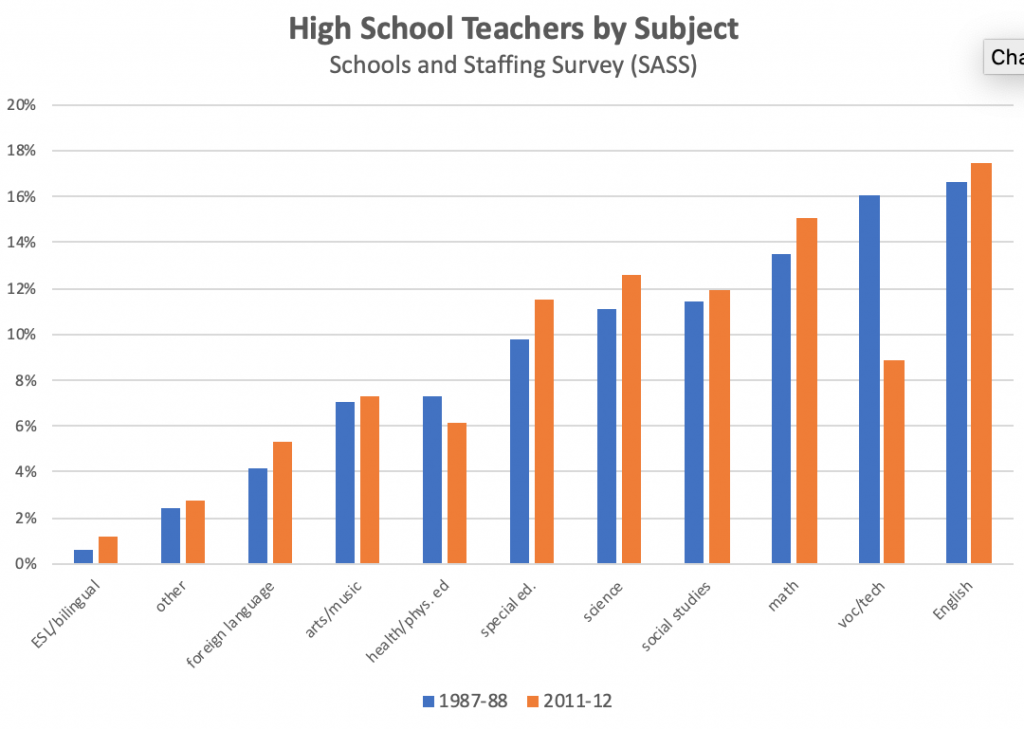
What subjects do you think have become more or less prevalent in US high schools since the late 1980s?
If we measure the percentage of all high school teachers who are assigned to each major subject, this is the pattern:
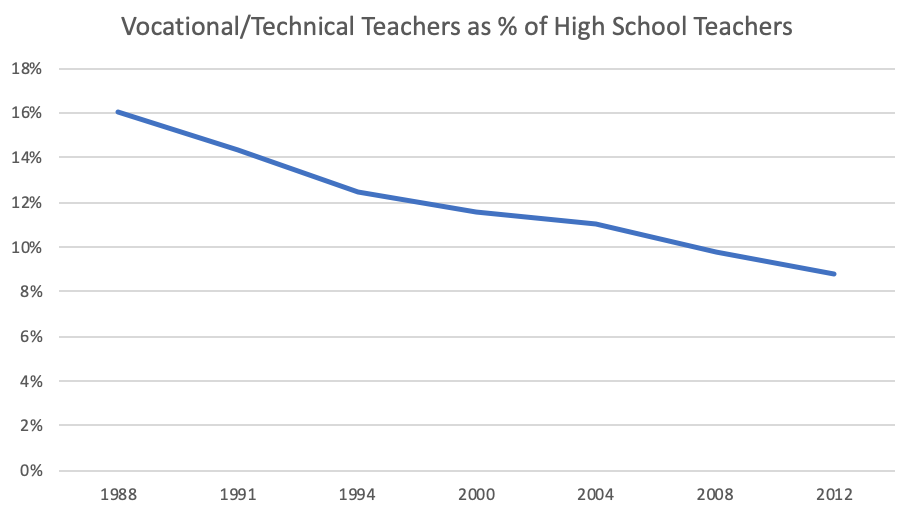
Almost all the subjects were similar in 1988 and 2012, except that vocational education dropped a lot and health/physical education shrank by a bit. The other subjects all gained about the same amounts at the expense of those two.
It isn’t worth showing the trends for most of those subjects by year, because the lines would be pretty flat. But here is the proportion of vo-tech teachers for all the years in the survey.
Posted without a comment, except to say that this may surprise people who think that some of the arts and sciences have expanded at the expense of others.
My analysis of U.S. Department of Education, National Center for Education Statistics, Schools and Staffing Survey (SASS), “Public School Teacher Data File,” 1987-88 through 2011-12; “Private School Teacher Data File,” 1987-88 through 2011-12; and “Charter School Teacher Data File,” 1999-2000.
Good afternoon, friends in Civics. You may recall that we had previously offered a free online course series for civics teachers. While we remain proud of that initial iteration and are pleased with the outcomes, our most important goal is to always respond to the needs and desires of our stakeholders. As such, we are excited to announce that we are now enrolling folks into the newly revised and completely self paced The Civics Classroom Course Series! The course has been redesigned based on feedback from participants, and we believe it meets the needs of teachers much better.
Courses begin June 15, 2020. A certificate of completion, for 5 hours of professional development, will be issued for each course successfully completed. While the first course, The Prepared Classroom, is especially designed for Florida civics teachers, the courses are free and open to all civics and government educators throughout the country.
Courses open on June 15th, and you can enroll in any of the courses at any time! To learn more about each course (including access to the syllabi), or to enroll, head over to Florida Citizen. Questions? Shoot us an email!
Thanks to the Former Members of Congress Association, I joined Former Member Dennis Ross (R-FL) and mayors Nan Whaley (D-Dayton), Francis Suarez (R-Miami) and Marty Walsh (D-Boston), for a discussion of civic engagement during the pandemic.
I particularly appreciated Mayor Walsh’s eloquence about respecting poorly-paid work. His point expanded into a broader discussion of how to get everyone involved in the “public work” of rebuilding our community and country. On that topic, see “War Is a Poor Metaphor for This Pandemic” by Harry Boyte and Trygve Throntveit in Yes!.
I learned a lot from the mayors. I ended up thinking that the attitudinal effects of the pandemic may well be positive. We may care more about each other and feel more motivated to work together on public goals. The fact that the crisis is widely (although inequitably) shared will provide an opportunity to bring Americans together. However, the economic impact on civic life is very worrying.
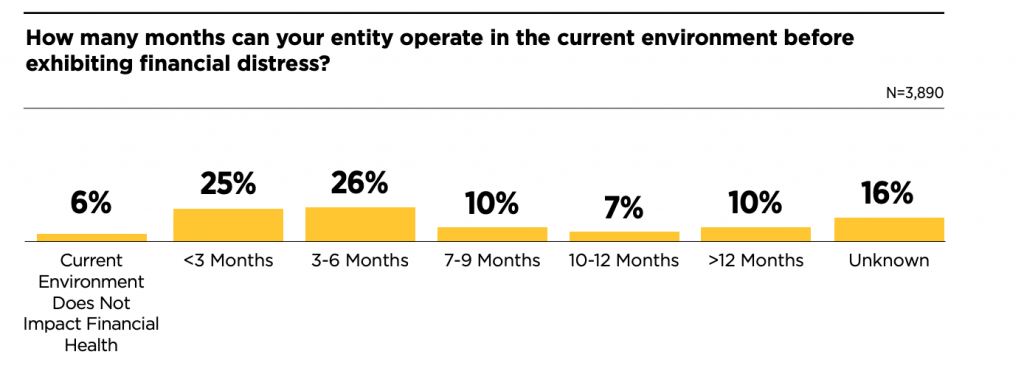
To that last point, the Federal Reserve system recently surveyed a mix of local organizational leaders (two thirds of them from nonprofits) about the impact of the pandemic. “Nearly 2 out of 3 respondents (66%) indicated demand for their services has increased or is anticipated to increase, and more than half of the respondents (55%) noted a corresponding decrease or anticipated decrease in their ability to provide services.”
This chart from the Fed. paper is particularly significant:
In Wired, Natalie Chyi offers an excellent list of ways that people are fighting misinformation–and promoting reliable and useful information–during the pandemic:
Neighborhoods are creating Slack groups and communities are coming up with mutual aid spreadsheets to coordinate aid and support each other. … Local geographies have been reconstructed in online spaces, most notably as students are rebuilding their universities within Minecraft. … . Volunteers on Wikipedia have been working tirelessly to ensure that the site serves reliable and up-to-date information, especially surrounding the virus. Students are compiling master lists of summer internship updates, cancellations, and opportunities across various industries. Groups are creating crowdsourced libraries of resources tailored to the unique needs of everyone from mourners to remote workers to policymakers. New online platforms have been created for specialists like doctors, engineers, and scientists to find and contribute their expertise to ongoing relief projects. Thousands of Covid-19 related open-source projects are popping up, with the source code and documentation freely available to enable their use. Some focus on software, like code for a hospital impact model developed by the University of Pennsylvania; others on hardware, like instructions for 3D printing medically-approved masks and other critical supplies.
Finally, knowledge previously locked behind paywalls or intellectual property protections has been made available to the public for the purposes of fighting the pandemic.
Chyi credits Elinor Ostrom and Charlotte Hess for the idea of an information commons (itself an application of Lin Ostrom’s ideas to the special case of information), and she cites me to the effect that “this form of collective action and participation of place-based knowledge strengthens communities by giving them a shared sense of identity, understanding, and trust.” Incidentally, the whole book by Ostrom and Hess, Understanding Knowledge as a Commons (2007) in which my chapter appears is–fittingly–online and free.
NCDD’s May Confab call is happening TODAY and we are looking forward to digging in with participants on envisioning an intentional future! Register now to join us for this call at 1:00 PM Eastern/10:00 AM Pacific. Courtney will present this session with NCDD Board Member Lori Britt.
Earlier in the pandemic, NCDD hosted conversations to help the dialogue, deliberation, and public engagement community explore how to respond to the needs arising immediately in our own communities. These conversations primarily focused on how to continue our work in a virtual format and how to help our communities stay connected while physically distanced. Now, two months into this experience, we would like to launch a conversation on what we are learning about our communities, and how we might help community members recognize what they see as important to sustain or nurture going forward.
In this interactive session, which is free and open to all, participants will share what they are noticing about their communities during the pandemic and what topics they want to engage around further. More specifically, we’ll discuss: What are you noticing about your community that you want to make more space for as you go forward? What are you noticing that is essential and needs support going forward? We’ll share some of our reflections as a group, and then break into smaller groups to discuss different topics of importance to our communities.
We hope that this session will be a jumping-off point for many of us to engage our own communities around the issues that matter most to them. We’ll keep in touch to see how things go, and how we might learn from each other!
Join us to share what you’re observing and what you’re hoping for in your own community! Let’s plan for what comes next. Don’t miss this opportunity – register today to secure your spot!
About NCDD’s Confab Calls
NCDD’s Confab Calls are opportunities for members (and potential members) of NCDD to talk with and hear from innovators in our field about the work they’re doing and to connect with fellow members around shared interests. Membership in NCDD is encouraged but not required for participation. Confabs are free and open to all. Register today if you’d like to join us!

 Join us for the release of the final report of the Commission on the Practice of Democratic Citizenship. Hear from the Commissioners, dedicated Americans, and organizations who came together to make these recommendations. Learn more about the steps we can take to improve the resilience of our democracy by 2026, our nation’s 250th anniversary.





 Earlier in the pandemic, NCDD hosted conversations to help the dialogue, deliberation, and public engagement community explore how to respond to the needs arising immediately in our own communities. These conversations primarily focused on how to continue our work in a virtual format and how to help our communities stay connected while physically distanced. Now, two months into this experience, we would like to launch a conversation on what we are learning about our communities, and how we might help community members recognize what they see as important to sustain or nurture going forward.