we should be debating the big social and political paradigms

[The following post is inspired by Rogers Smith’s recent APSA presidential address, and I believe is consistent with it, but I incorporate some additional elements.]

Consider a sample of articles about politics, or society more generally. One might be an interpretation of some remarks by Thomas Jefferson. Another reports an experiment in which people are more likely to vote when contacted one way rather than another. A third is a critique of a prevalent word (say, “security”) from the perspective of Michel Foucault. A fourth shows that rational agents in a certain situation are better off when rules are externally imposed on them.

Each of these articles presumes, and contributes to, a larger paradigm that combines values, causal theories, and methods. Perhaps the interpreter of Jefferson believes that the United States is still founded on its written Constitution and that the intentions of the founders matter today. The experimentalist presumes that voting in a regime like the modern USA is a consequential act, and it would be good to increase voting by several percentage points if possible. The critic of “security” sees a world of pervasive injustice sustained by ideology, in the sense of distorting views that preserve the status quo. The rational-choice modeler thinks that all (or many) institutions can be analyzed as the interactions of utility-maximizing individuals.

(For the sake of space, I have omitted a classical Marxist, a deep feminist, a post-colonial theorist, a Prospect Theorist, a radical environmentalist, and many others who deserve places on the list.)

In these articles, you will not see much about their larger paradigms, worldviews or schemata. Their paradigms may not even be mentioned. Instead, you will see evidence in support of the specific claims of each article (whether in the form of statistics, quotations, or equations).

Of course, journals offer limited space, and there may not be room to present a whole paradigm. In addition, citing your scheme may only hurt you in the review process. Reviewers who happen to oppose your overall paradigm may be alienated, when they would have been persuaded by your detailed findings if presented alone.

For instance, imagine that you discover that texting people increases their turnout more than emailing them. That is more persuasive as a bare finding than as part of an argument for the significance and value of voting in a mass democracy within a capitalist market economy.

A certain form of positivism (or verificationism, or empiricism) is still widely influential. It holds that facts can be verified directly. Larger mental constructs are fashioned by us and are only valid to the extent that they match all the facts. If big, general ideas influence our beliefs, they are sources of bias. Therefore, we may need to disclose our paradigms as caveats, but we don’t want to focus on them.

Some people would hate to be described as positivists but end up in a similar place for a different reason. They presume that they have a right to their fundamental views as a matter of identity. “As a migrant from the global south, I explore the colonization of indigenous spaces …” This is not a disclosure of bias, nor a defense of a thesis; it is a claim to be recognized as a member of the scholarly community. To disagree is to deny the author’s place in the community.

I believe that the really important task is to select our worldviews, our big normative/conceptual schemes. It matters which of the available choices we adopt, and maybe we can create better ones. Therefore–as I think Rogers Smith argued–it is a real weakness in any intellectual community if the paradigms are implicit or merely stated, rather than explained, justified, and put into competition.

Within political science, many contrasting worldviews are available. You can walk down the hall of the APSA Annual Meeting past rooms in which everyone accepts the basic normative principles of contemporary electoral democracy, and other rooms in which people are quoting Slavoj Žižek about ideology.

It is hard to compare such worldviews or paradigms, because they have different normative, epistemic, and sometimes metaphysical premises. A finding within one paradigm does not disprove a different paradigm. A certain kind of relativism interferes with comparative assessment.

However, we can consider a whole body of specific findings along with their shared overall claims. We can ask whether this whole literature is coherent, whether it generates persuasive specific findings by its own lights, whether it informs practice in any useful way, whether it makes sense of other literatures, how it handles criticisms and rival views, whether it is responsive to new evidence and events, and whether its normative implications are defensible when fully articulated. Each paradigm has points of relative strength and weaknesses.

It would be helpful if people had that discussion in print, instead of always only writing within paradigms (at least for journal articles.)

See also trying to keep myself honest, how philosophy is supposed to work

Moral Foundations theory and political processes

Moral Foundations theory is an important body of research that has generated significant findings. It belongs to a somewhat larger category of research about morality that has these features:

  • Many individuals are asked for their moral judgments of hypothetical or historical cases. (See this test, for example.)
  • The data from these individuals is analyzed to identify latent factors that statistically predict many people’s specific answers. Respondents may not be aware of the latent factors or even endorse them when they hear them, yet these factors are said to explain (statistically, and maybe causally) their actual judgments.
  • Some factors are found to be common across cultures and to have adaptive value for human beings as a species that evolved through natural selection. These factors are named “foundations.”
  • Variation among human beings depends on which of the foundations are more important for different groups. This is a structuralist theory, akin to Claude Levi-Strauss or Noam Chomsky. For structuralists, surface-level diversity results from variation in a finite set of underpinnings.
  • In ambitious versions of this method, morality is the list of foundations. Morality is what we think it is because of how we evolved. To debate the value of the various foundations or to argue for a different principle is pointless. There is no way to know the truth of moral claims, but science can reveal the foundations of our moral psychology, so those alone are real.

Despite my interest in learning from the specific findings of Moral Foundations research, I harbor many objections, summarized here. In this post, I would like to elaborate on one concern.

We human beings make individual judgments about cases and decisions. That’s what the data-collection of Moral Foundations Theory models. But we do many other things that also shape values. For instance, we buy things, which causes more of those things to be made and sold. We participate in bureaucratic institutions that manage themselves through chains of command, policies, and files. We join and quit groups. And we govern by making laws and policies at all levels.

As Owen Flanagan writes in The Geography of Morals (2016), “Moral stage theory conceives moral decision-making individualistically. The dilemmas are to be solved by singleton agents. This is ecologically unrealistic. Committees at hospitals decide policies on organ allocation; government agencies deliberate about monetary policy; officers deliberate about costs and benefits of military operations; and friends talk to friends about tough decisions.”

I’ll focus on political decisions, although we should also consider markets, bureaucracies, friendships, scientific disciplines, and other social forms.

People make laws and other rules to prohibit, regulate, tax, subsidize, and mandate various behaviors. These rules directly influence how we act and may also affect our values, if only because many of us display the Moral Foundation of “Authority.”

One might think that rules and laws are made by people who implement their moral judgments, which are influenced by their individual Moral Foundations. Laws would then simply be aggregated Moral Foundations.

Not so, for these reasons:

  1. An important determinant of the actual law is the choice of who gets to make it. That choice is often made by people other than those who do the governing. Millions of voters choose a president. A president plus 51 US Senators decides who sits on the Supreme Court (one opening at a time, spread over decades). In making these choices, people are not focused on the specific cases or controversies that come before the Court. Top of mind for a president may be finding a justice who can be confirmed, who impresses the electorate, and who is young enough to serve for a long time. These are different considerations from moral judgments about cases, but they shape the actual law. (Here I use a democratic example, but a dictator is also chosen, often by a military junta or by party cadres.)
  2. When multiple people make laws, they don’t do so by judging in isolation and then aggregating their votes. A secret vote may mark an important moment in a political process, but it is almost never the only moment. It usually follows argument, persuasion, and mobilization; and sometimes groups decide without voting at all. Communication plays an important role. But when we communicate, we are not merely expressing our moral judgments of concrete cases. We may be doing many other things: trying to go along with the group, trying to stand out, trying to look (or be) impartial or moderate, trying to waste time on a point of disagreement to prevent attention to a different topic that we fear (filibustering), trying to set a precedent for other topics, supporting someone else so she’ll help us later (logrolling), saying something to irk someone in particular, enjoying the sound of our own voices, and so on. Our moral judgment of concrete issues may be an input, but only one among many.
  3. The procedures for making collective decisions influence the outcomes. For instance, almost all procedures favor the status quo because it takes energy and agreement to shift it. Therefore, a group can live with a law or policy that every individual would prefer to change. This is common and it implies that law often fails to reflect the private opinions of the majority–even when everyone has an equal say, which is vanishingly rare.
  4. One way that laws and policies shift is that subgroups successfully advocate for changes, based not on abstract judgments but self-interest. I don’t think that attitudes toward sexual orientation changed over the past half century because the broad public decided to reconsider their views. I think sexual minorities felt compelled to take their struggles into the streets, the ballot booth, and the courts and won some significant victories. The resulting policies then began to change attitudes. (A different kind of example: girls’/women’s sports got a huge boost from Title IX, which originated when Congress rejected a mischievous amendment to exclude sports from civil rights legislation–a backdoor way to enact a policy that has changed everyday attitudes toward gender.)
  5. Often the subject of political or legal debate is not whether individuals should do specific things: marry, steal, take drugs. It is about our collective stance toward social constructs: the United States (or Russia), Christianity, the family, a forest. These things have histories, they are complex and internally inconsistent, and they reflect laws or norms that people have formed over time. Often we are not asked to assess concrete actions but big abstractions that embody, among other things, many previous concrete actions taken by many people for many reasons. A major question is what story we should tell about a large construct.

For these reasons, empirical moral psychology cannot stand on its own without institutional/political analysis. Moral Foundations Theory is strongest when it aims to predict how people will individually react to a situation that raises issues so general that it resembles the problems that confronted our prehistoric ancestors on the savanna. The theory is least helpful for explaining why the same group of people might change its stance toward a specific topic, as we see with sexual orientation since 1969.

See also Jonathan Haidt’s six foundations of morality; an alternative to Moral Foundations Theory; moral thinking is a network, not a foundation with a superstructure; and against methodological individualism.

[VIDEO]: Why You Should Take my Philosophy of Education Course this Fall

EPE 640 is offered this fall, 2019

Graduate students and advanced undergraduates at the University of Kentucky, watch this VIDEO (4m29s) about why you should take my EPE 640 course this fall on the Philosophy of Education.

If you can’t see this video in your RSS reader or email, then click here.

Photo with students at the University of Mississippi.Advanced undergraduates, if you’d like to take this course, email the instructor at eric.t.weber@uky.edu.


Why study the Philosophy of Education?

a) Educators and leaders are expected to have a meaningful grasp of their own philosophies of education;

b) All research is rooted in frameworks of ideas that support and contextualize our work and thought, and that can clarify and help us to focus or be conflicted and confuse us if not carefully considered;

c) Everyone working in educational administration contributes to a system that functions with respect to or in conflict with underlying philosophical ideas. That calls for appreciating and always keeping in mind what we ought to be doing in education.

What you’ll get out of it / create:

Eric Thomas Weber, author of "Uniting Mississippi: Democracy and Leadership in the South" speaks at Sturgis Hall October 19, 2015. Photo Credit: Jacob Slaton

Photo Credit: Jacob Slaton

1) A short “teaching statement,” “Statement on Philosophy of Education,” or related document commonly requested in academic job applications, as well as for administrative positions that often involve teaching courses or otherwise supporting them;

2) A book review for possible publication;

3) A conference-length paper ready for submission to professional calls for papers;

4) A full-length research paper suitable for submission to journals and that could support your other projects;

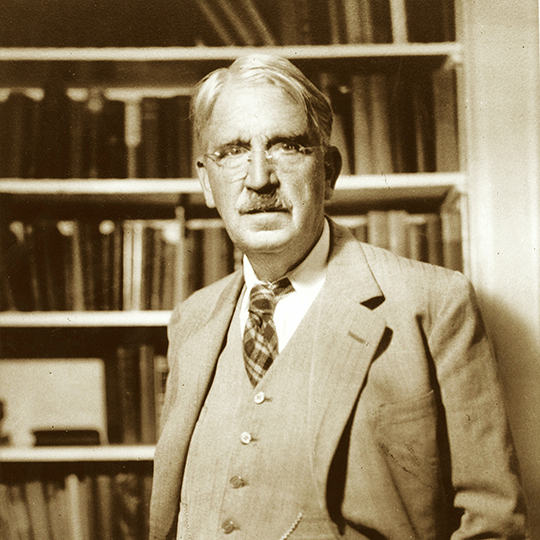
John Dewey, standing.

John Dewey, concerned that you’re not yet signed up for the course.

5) An op-ed-length version of the research paper for possible submission to newspapers or educational periodicals;

6) Credits that can contribute to the Graduate Certificate in College Teaching and Learning.


When & Where?

It’ll be on Wednesdays from 11am-1:30pm in Dickey Hall rm 127.


Questions? Email me at eric.t.weber@uky.edu. You can also connect with me on Facebook, Twitter, LinkedIn, & Academia.edu.

The post [VIDEO]: Why You Should Take my Philosophy of Education Course this Fall first appeared on Eric Thomas Weber.

trying to keep myself honest

(Madrid) This summer–which is not over yet–has already been full of rich and challenging discussions for which I am grateful.

In June, I spent several days discussing some lesser-known works of Friedrich Hayek with a group of mostly classical liberals/libertarians.

In late June and early July, more than 160 experienced scholars, practitioners, and activists from many countries visited Tisch College for a series of linked events: the American Political Science Association’s Institute for Civically Engaged Research, a convening of city staff from 15 Cities of Service, a gathering of Bridge Alliance members, the eleventh annual Summer Institute of Civic Studies, Lead for America’s summer institute, and the Frontiers of Democracy Conference. These people certainly held diverse ideological views, but a strong voice came from participants whom I would associate with intersectional movement politics–people who favor bottom-up, extra-institutional movements to confront white supremacy, patriarchy, and related “-isms.”

And now I am in Madrid for the Ibero-American Meeting on Civic Studies. I am very much enjoying my academic colleagues from Argentina, Colombia, Ecuador, Guatemala, Mexico, Spain and Venezuela who hold diverse views. While here, I have also visited a traditionally “red” working class Madrid neighborhood and met with radical Spanish architects and have heard a senator from the PSOE (socialist) party lecture. They have given me a dose of European social democratic politics. In contrast to intersectional movement politics, this is largely about building mass institutions (unions and parties) for “the people,” understood as singular.

I remain basically an American center-leftist. Barack Obama is my favorite president and have sent a little money to Kamala Harris. But since I fear intellectual complacency and clichés, I am always grateful to have my presumptions challenged. Libertarianism, intersectional movement politics, and social democracy feel like a triangle of ideas that keep me (somewhat) honest from three directions.

I think I hear the classical liberals saying, “Society is too complex to be modeled, let alone regulated or planned, because it is a function of countless individual choices, and the millions of agents can react to any effort to constrain or guide them by changing their behavior. Opportunity costs are ubiquitous and especially difficult to measure. Talk of ‘social justice’ arrogantly replaces what individuals want in their own circumstances with a specific theory of what they should want and implies that someone has the right to enforce that. Instead, policy should be maximally general, durable, and predictable so that individuals can form and implement their own plans in their contexts.”

I think I hear intersectional activists saying, “People are dying as a result of racism and transphobia and sexual violence. That is because other people hold deeply seated world-views that categorize their fellow human beings into hierarchies and create boundaries. These world-views are fundamental causes of injustice and must be challenged. There is no substitute for the people at the top of the hierarchies [people like me] acknowledging their advantages and changing their own lives accordingly.”

And I think I hear the social democrats say, “When large numbers of ordinary people have organized themselves into unions, parties, and social movements, they have countered corporate capital and negotiated mixed economies that have generated equity and security along with prosperity. But such organizations require substantial discipline (constraining individual choice) and broad identities, such as ‘worker’ or ‘citizen.'”

See also: on hedgehogs and foxes; The truth in Hayek; identities, interests, and opinions

on hedgehogs and foxes

“A fox knows many things, but a hedgehog knows one important thing” — Archilochus

This proverb is in the news lately because Philip Tetlock has shown that foxes (flexible and curious generalists) are much better at predicting events than hedgehogs (specialists who hold deep expertise). See David Epstein’s Atlantic article on Tetlock, and see Axios for a current competition funded by the US intelligence agencies to test his theories.

Tetlock draws from Isaiah Berlin’s 1953 essay, which is light but offers some insights, I think, about specific authors. Berlin argues that Tolstoy was psychologically a fox but believed–for theological/ideological reasons–that we should all be hedgehogs. Our one big idea should be the Imitation of Christ. This tension was at the heart of Tolstoy’s books and life. I also endorse Peter Hacker’s view that Wittgenstein was temperamentally a hedgehog who forced himself self-consciously to become foxlike in his late work.

If you take the proverb literally, it seems more impressive to be a fox. The fox uses its brain to hunt and escape, whereas the hedgehog just instinctively rolls up to take advantage of its best physical asset, its spines. But the metaphor is loose. Human hedgehogs are among our deepest, most original thinkers. They are the ones with the discipline to construct whole, coherent worldviews. They don’t merely employ a strategy but create it.

In contrast–and I write this as very much a fox–foxes can be ad hoc and derivative, eclectic in a bad way. A fox can employ the available ideas that seem to fit the situation without generating any new frameworks for others to use. A fox can be a jack of all trades, master of none. We foxes need hedgehogs to develop new ways of thinking, from which we borrow superficially and pragmatically.

But it is interesting that the hedgehogs are so consistently wrong about what will happen next. They are more likely to suffer from confirmation bias. They can make any data fit their theory. And they are worse than foxes at recognizing exceptions, tradeoffs, and zones of uncertainty. They lack phronesis, practical wisdom.

I therefore think it’s a problem that hedgehogs have an advantage in the competition for attention. If you are associated with one big idea and you keep hammering away at it, you have a “brand.” People turn to you to say that one thing, even if they don’t agree with it, and so your fame rises. You must compete with the other people who say the same thing, but if you’re first or more effective at communicating it, you can own the space.

So as not to offend anyone alive, I’ll use the case of my late colleague Ben Barber, who was early to revive the idea of “strong democracy.” (More democratic engagement is always better; the good life is lived in public; liberalism is too individualistic; etc.) He wrote several best-sellers, and I attribute his success in part to his capturing a particular brand. For courses, debates, conferences, etc., you may need someone to say, “More democracy!” Barber cornered that market.

Temperamentally, I am with the foxes. As soon as I write an argument for anything, I immediately become fascinated by the arguments against it. I have a limited attention span and jack-of-all-trades tendencies. I frequently disappoint practitioners and advocates, who know that I have written in favor of campaign finance reform, public deliberation, service, or civic education and want me to say it again to a new audience with more conviction. In fact, I am almost always on the verge of apostasy and retraction.

I really do admire the hedgehogs. But I’ll say a few things in favor of foxes.

First, the moral world is immensely complex, because it emerges from myriad human interactions and takes the form of communities, cultures, and institutions that overlap, interrelate, and become loaded with historical resonances. Thus an adequate moral theory is almost certainly partial, inconsistent, and ad hoc.

Second, acting like a fox keeps you mentally alive. It may be a self-indulgent concern, but I fear ceasing to think. Even the greatest hedgehogs, it seems to me, have stopped their quest for knowledge. They already know, and know that they know, and are done.

I’ll also say one thing against foxes. At least in folkore, a fox is a solitary hunter. What if you also like people and feel loyalty to groups of peers who share goals and missions? Then you cannot simply act like a fox.

To switch metaphors, Keats admired the “quality” that forms a “Man of Achievement especially in Literature and which Shakespeare possessed so enormously—I mean Negative Capability, that is when man is capable of being in uncertainties, Mysteries, doubts, without any irritable reaching after fact and reason.” I also admire Negative Capability, but it is a virtue of the poet, not the ally. Negative Capability is good for writing fiction that explores many different perspectives; it is not so helpful for co-writing a mission statement for an organization and then following through.

So I would like to be a fox who is helpful in a pack. The question is to what degree that’s possible.

See also: the politics of negative capability; loyalty in intellectual work; in defense of Isaiah Berlin; structured moral pluralism (a proposal); and Tolstoy, Shakespeare, Orwell

an expressivist critique of our criminal justice system

(Disclaimer: this post is the result of reading some work by Tommie Shelby and Erin Kelly but not yet wrestling with either author’s views sufficiently or examining the larger literature on expressivism in law. If you were a peer-reviewer, you should reject this post.)

A society has a right and an obligation to express what is just through the criminal law. One reason is that public statements about what is permitted and forbidden can influence behavior for the better. But sometimes laws are not effective means of shaping behavior. Even then, it is important for a community to express justice as accurately and completely as it can, and the criminal law is a valuable vehicle of expression.

Public expressions of justice must often be accompanied by penalties. Otherwise, laws can reasonably be interpreted as mere lip-service. If, for example, the law says that everyone must pay taxes, but oligarchs routinely get away with tax evasion, then the law is saying that oligarchs don’t have to pay taxes. The failure to punish them conveys a view of justice that is unfair.

Many things are wrong but should still be legal. Awful but constitutionally protected speech is an example. The scope of the law should be limited both because of the fallibility of any government and because individual liberty is a great value. (We’re not free if we’re only allowed to do good things.) Nevertheless, there remains a large domain of actions that are bad enough that the state should express their wrongness by prohibiting them and enforcing the prohibition with penalties.

Even a partially unjust regime can and must express justice through the criminal law. Its failures do not invalidate laws that it enacts and enforces, if those laws are just. An exception may be a pervasively evil regime. For instance, a Nazi law court could render the correct decision in a case of rape or murder, but the very existence of that court is so offensive as to render all of its verdict moot. The victims of even real crimes cannot get justice from Nazi judges. But that reasoning does not apply to courts in societies, like ours, that harbor a great deal of injustice.

Public statements about justice must be deliberated. This is not because deliberation equals justice (a proceduralist view). Justice is justice. Rather, we must deliberate because hearing and responding to alternative views is our best method of discovering what justice demands. Also, the legitimacy of a public (as opposed to an individual’s) statement of justice depends on whether each of us had a chance to influence it with our voice.

Our legal system violates the expressivist principles summarized so far. The features that violate this theory are: racialized mass incarceration, rampant plea-bargaining, degrading punishments (prison uniforms, refusal to provide education, tolerance for sexual violence, stripping prisoners of civil rights), frequent imprisonment of people with mental illness, and a tendency to hide the whole system away from public view.

Mass incarceration of people who are racial minorities and/or poor and/or mentally ill clearly expresses a view that is incompatible with justice–that those people are not equal. We wouldn’t have the same system if most of the prisoners were middle-class and white.

Racialized mass incarceration also blocks a satisfactory national discussion of justice. In some communities, incarceration is common, and in others, it is virtually absent; but since they are separated by race and class and have unequal amounts of political power, they are very unlikely to deliberate together.

Replacing jury trials with plea-bargains removes any public deliberation about particular cases and prevents each verdict from saying anything at all. The outcome of a case is a function of the perceived likelihood of conviction, the defendant’s tolerance of risk, the prosecutor’s interest in conviction, and the cost of a trial, not anyone’s view of what is deserved.

Hiding the whole system away excuses the public from deliberating about particular cases and about policy. You can easily turn a blind eye to the criminal justice system even though our prisons house a population as big as a state.

I would not go so far as to claim that an expressivist theory of criminal law is completely adequate. We can imagine a system that does a good job of expressing justice but fails other tests, such as the utilitarian criterion of doing the most good for the greatest number. For instance, maybe it would be better to cancel trials that don’t affect behavior and use the money saved for prevention. I’m sufficiently pluralist (or wishy-washy) to suspect that utilitarianism, contractarianism, classical liberalism, Foucault, and other views all offer valid insights.

But I would submit that an expressivist theory explains some of what is so badly wrong with our system.

See also: mass incarceration, the jury, and civic studies; why we are choosing to abolish the jury system; civic engagement and the incarceration crisis; if we are going to put millions in prison, WE should make millions of decisions

youth, midlife & old-age as states of mind

This post is inspired and informed by Kieran Setiya’s Midlife (Princeton, 2017), but I didn’t review it recently because I wanted space to develop my own views.

Here are three definitions that are not tied to chronological age. They could–in principle–describe a person who has lived for any number of years:

  • Youth: You believe that you have important choices to make, or that you will face such choices in the future. You see your current situation mostly as the result of others’ decisions. You’ve been formed by your parents, your community, or the whole society, but you expect to make a mark through your own agency and choice.
  • Old age: You think that all the important choices involving you have already been made. You made choices in the past, or perhaps you never had much choice, but now the die is cast. If you expect to confront any decisions in the future, you assume that they will be mere Hobson’s choices: what to give up, which medical risks to take.
  • Midlife: You think that your current situation is partly the result of your own past choices, which you may either regret or recall proudly. You expect to make additional decisions in the future. You’re not starting from scratch–and not, perhaps, from where you would want to start–but you still have more moves to make.

Teenagers and young adults who enter YouthBuild USA estimate that they will live to an average age of 40 (Hanh et al 2004). They think that their lives are about half over. If Cathy J. Cohen’s analysis of African American youth applies to these teenagers (Cohen 2010), they will explain their own situations as a result of their own agency (they made mistakes, such as dropping out of high school) and structural injustices (their high schools were bad). Their mentalities are middle-aged or even old. YouthBuild, however, causes them to raise their own life-expectancies by almost 30 years. It makes them appropriately youthful by teaching them that structural factors explain their current situations but that they will have good decisions to make in the future, including decisions that can prolong their lives.

Something similar happens when a certain kind of hyper-serious 7-year old feels that she has made momentous decisions. Her “life is ruined” because of what she did. Adults should persuade her that her situation is adults’ responsibility and that her life is just beginning.

Now consider a person in his 40s who decides to start over and live his own life, because so far everything has been determined by others: parents, authority figures, then a disappointing spouse and demanding kids. For him, the past is others’ responsibility; the future will shaped by his agency. This is either a commendable move to reclaim his youth or a sign of immaturity, a failure to accept that he actually shaped who he is. In either case, it is tinged with sadness because he should have been youthful when he was chronologically young instead of now.

Or consider a person who is chronologically old and whose doctor tells her she is close to death. Yet she gains satisfaction in the way that the Stoics recommended, by planning how to spend her last weeks and how to die with dignity. She has put herself in midlife even though she is old.

For those of us who are actually in our middle years, this framework affords some satisfaction. Young people should be youthful. But midlife is maturity. It combines a recognition of limits–we have made choices that we cannot undo–with a sense of agency. We are what we have made ourselves, but we aren’t done.

Sources: Cathy J. Cohen, Democracy Remixed: Black Youth and the Future of American Politics (Oxford 2010); Hahn, A., Leavitt, T. D., Horvat, E. M., & Davis, J. E. (2004). Life after YouthBuild: 900 YouthBuild graduates react on their lives, dreams, and experiences. Somerville, MA: YouthBuild USA. See also Kieran Setiya on midlife: reviving philosophy as a way of life; and to what extent do you already know the story of your life?

what constitutes coordination?

[W]e addressed the factual question whether members of the Trump Campaign “coordinat[ed]”-a term that appears in the appointment order-with Russian election interference activities. Like collusion, “coordination” does not have a settled definition in federal criminal law. We understood coordination to require an agreement–tacit or express–between the Trump Campaign and the Russian government on election interference. That requires more than the two parties taking actions that were informed by or responsive to the other’s actions or interests. We applied the term coordination in that sense when stating in the report that the investigation did not establish that the Trump Campaign coordinated with the Russian government in its election interference activities.

— from the Mueller Report

That faint sound you hear is hundreds of philosophers paging through their thumb-worn copies of seminal books and articles about shared agency and collective intentionality and revving up their word processors to write lecture notes and articles.* I have not investigated this literature sufficiently to have useful views, but it is a rich topic of current investigation that bridges ethics, metaphysics, and philosophy of language and mind.

What does it mean to say, “We are doing something?” Is the “we” a real thing or just a shorthand for several “I’s”? If a bunch of people all run for shelter at the sound of thunder, are they coordinating? What if they take exactly the same actions as part of a dance? Does the “we” mean something different in the sentences “We all ran for shelter” and “We all performed a dance”? (This is from Searle.)

What if I say to you, “Let’s go for a walk”? Do I then have an ethical obligation to coordinate my itinerary and pace with you? (From Gilbert). Is the obligation just the usual one to honor a promise, or does it stem from my new relationship to you?

Let’s say that all the members of the Supreme Court believe that something is unconstitutional and issue a unanimous ruling to that effect. Later, the same nine people all think that dinner was awful. In one case, did the Supreme Court make a judgment, whereas in the other case, nine people made separate judgments? What if the nine issued a ruling and then found out that it was invalid because they weren’t properly in session at the time? Did they incorrectly believe that they were acting as a group? (Inspired by Epstein).

Robert Mueller says that whether the Trump campaign and Russia coordinated is a “factual question.” But it requires a definition of coordination. Apparently, the legal definition of that word (from statutes and/or precedents) is unsettled. But in any case, the deeper issues are philosophical–and not simple to resolve.

*e.g., Brian Epstein, The Ant Trap: Rebuilding the Foundations of the Social Sciences (Oxford Studies in Philosophy, 2015); Margaret Gilbert, “Walking Together: A Paradigmatic Social Phenomenon” in her 1996 book Living Together: Rationality, Sociality, and Obligation, pp. 177–94; Larry May, Sharing Responsibility (Chicago: University of Chicago Press, 1992); Philip Pettit and David P. Schweikard, “Joint Actions and Group Agents,” Philosophy of the Social Sciences, vol. 36, no 1, 2006, 18–39; John Searle, “Collective Intentions and Actions,” in P. Cohen, J. Morgan, and M.E. Pollack (eds.), Intentions in Communication (Cambridge, Mass. MIT Press, 1990); Raimo Tuomela, “We Will Do It: An Analysis of Group Intentions;” Philosophy and Phenomenological Research, vol. 51, no. 2 (1991), pp. 249–77; David J. Velleman, “How to Share an Intention,” Philosophy and Phenomenological Research, vol 57 (1997), pp. 29–51; and other such papers.

how much of a theory of justice do activists need? (a dialogue)

Some students are on their way to occupy their university’s central administration building to demand a minimum wage of $17 for all employees. They are surprised to encounter the ghost of John Rawls (JR):

JR: I see your signs and determined faces and presume that you are engaged in an act of civil disobedience. What is your demand?

Students: Social justice!

JR: Hmm, what does that require?

Students: A living wage!

JR: Which is?

Students: $17/hour.

JR: Is that your ideal outcome? Does social justice entail that every employee be paid no less than $17? Every employee of this university? Every American? Everyone in the world? Is there a maximum just salary? For instance, does your college president make more than justice permits?

Students: Look, we don’t get to write the rules. We’re just trying to boost the take-home pay of some people in our community. We’d go higher if we thought it was realistic.

JR: Would you go higher if that required cuts in financial aid?

Students: We are just applying pressure for one aspect of social justice. Figuring out the right balance is not our job.

JR: OK, but you also have other jobs. For instance, voting. If you think $17/hour constitutes justice, you should vote for a moderate Democrat or perhaps a liberal Republican. If you want much more equity, you should join Democratic Socialists of America.

The ghost of Mohandas K. Gandhi [MHK] emerges, to the surprise of everyone except John Rawls, who is Gandhi’s roommate in Purgatory. (Everyone goes to Purgatory.)

MHK: Don’t let him to deter you with these questions about ultimate ends. None of us has sufficient knowledge, wisdom, or moral rectitude to know what social justice entails. Our job is to make ourselves the best agents of change that we can be.

You plan to put yourselves at some risk. That is good; as I’ve written, “a life of sacrifice is the pinnacle of art, and is full of true joy.” However, you will also impose some costs and inconvenience on the university, and your demand might not be right. Are you sure that you have purified your own motives?

Students: Well, we’ve acknowledged our positionality and checked our privilege.

MHK: Awkward terminology, but it sounds like what I’d advocate. Have you created a group that represents all, and do you live together truthfully?

Students: Could you clarify?

MHK: For me, the main issue was making sure that the movement for Indian swaraj (independence, in the spiritual as well as the political sense) incorporated Muslims, Harijans, women, and others, and that we related to each other appropriately. If we organized ourselves right, we were already making the world better. The political consequences were beyond our control. As Krishna teaches in the Baghavad Gita, “Motive should never be in the fruits of action.”

JR: I’m Kantian enough to agree that a good action is one that has the right motives, not one that turns out to make the world better. But surely you need a North Star, a sense of what the goal should be?

MHK: Only in the vaguest sense, because–again to quote myself–“man is not capable of knowing the absolute truth.”

JR: Well, I agree with that and would leave much to be decided in a just society by deliberating citizens and their elected representatives. But surely we can propose provisional theories of justice?

Students: Um, this is interesting and all, but we have got like a building to occupy?

[Exeunt]

See also: Gandhi on the primacy of means over ends; a real alternative to ideal theory in political philosophy; why study social justice?; Abe Lincoln the surveyor, or the essential role of strategy; and how to think about other people’s interests: Rawls, Buddhism, and empathy.

Empathy and Justice

My remarks at a conference entitled “Empathy …. or Ways of Caring,” Harvard Department of Romance Languages and Literatures, March 15, 2019. (Apologies for some cutting and pasting from previous posts.)

Doris Sommer mentioned that Barack Obama popularized the notion of an “empathy deficit.” In a 2004 interview with Oprah Winfrey, while he was still a State Senator, Obama said:

I often say we’ve got a budget deficit that’s important, we’ve got a trade deficit that’s critical, but what I worry about most is our empathy deficit. When I speak to students, I tell them that one of the most important things we can do is to look through somebody else’s eyes. People like bin Laden are missing that sense of empathy. That’s why they can think of the people in the World Trade Center as abstractions. They can just crash a plane into them and not even consider, “How would I feel if my child were in there?”

Here Obama links empathy to moral judgment. In a 2006 commencement address, he also implies that the level of empathy in a society as a whole is a precondition of social justice. Our “empathy deficit” explains why we accept that “Americans … sleep in the streets and beg for food,” that “inner-city children …. are trapped in dilapidated schools,” and that “innocent people [are] being slaughtered and expelled from their homes half a world away .”[2]

To suggest that this argument is problematic, I would quote then-President Obama in Jerusalem on March 21, 2013:

I — I’m going off script here for a second, but before I — before I came here, I — I met with a — a group of young Palestinians from the age of 15 to 22. And talking to them, they weren’t that different from my daughters. They weren’t that different from your daughters or sons.

I honestly believe that if — if any Israeli parent sat down with those kids, they’d say, I want these kids to succeed. (Applause.) I want them to prosper. I want them to have opportunities just like my kids do. (Applause.) I believe that’s what Israeli parents would want for these kids if they had a chance to listen to them and talk to them. (Cheers, applause.) I believe that. (Cheers, applause.)

It is not so much the speech as the applause that I find problematic, because I believe that the Israeli electorate supports policies that are unjust, and their political behavior is compatible with a fair amount of actual empathy.

The word “empathy” is a modern coinage. It is not attested before 1895, and it gained its current meaning only in 1946. Many wise people have thought about moral psychology and justice without using this word at all, so we should consider whether it does us any good.*

I’d posit the following definitions:

  • Empathy: Feeling a similar emotion in response to someone else’s emotional state. Your friend is mad at her boss because he treated her unfairly. That makes you mad at her boss. Your anger is probably different in texture and intensity from hers, but it’s the same in kind, an imperfect reproduction of her mental state.
  • Sympathy: Feeling a supportive emotion in response to someone else’s emotional state that is not the same as that person’s original emotion. She is mad at her boss, so you become sorry for her, or committed to fairness, or sad about the state of the world, or nostalgic for better times–but not angry at her boss. Then you are sympathetic. (NB You can be both sympathetic and empathetic if you feel several emotions.)
  • Compassion: A species of the genus sympathy. Another person’s negative emotion causes you to have a specific supportive feeling that is not the same as her emotion: you sincerely wish that her distress would end without blaming her for it.
  • Justice: A situation or decision characterized by fairness, goodness, rightness, etc. (These are contestable ideas and may be in tension with each other.) The English word “just”–like dikaios in classical Greek–can be applied either to a situation or to a person who cares and aims for justice.

There is an old and rich debate about which character traits and subjective states are best suited to pursuing justice. One answer is that you should be a just person, one who tries to decide what is fair or best for all (all things considered), who desires that outcome, and who works to pursue it.

A different response is that we are not well suited to defining and pursuing justice itself. We lack the cognitive and motivational qualities that would allow us to grasp justice and reliably act on it.

Justice is an abstract idea that takes the form of words: it is discursive. According to a mainstream view in contemporary moral psychology, we first form emotional opinions about concrete situations and then we select the ideas that will justify those opinions, post-hoc. Justice doesn’t guide us; it justifies and excuses us.**

In that case, it might be better to cultivate emotions, such as empathy, sympathy, compassion–or loyalty, aversion to harm, or commitment to specific rules–in order to deliver more just outcomes, all things considered.

In her remarks, Marina Amelina noted that developed countries built social welfare systems between ca. 1880 and 1970. That could because their publics became more empathetic. But it also be because less-wealthy people gained power and used it to protect themselves. Equal power plus self-interest might generate justice more reliably than empathy. John Rawls famously modeled justice as the decisions that self-interested parties would make if they were rendered perfectly equal by a Veil of Ignorance that blocked them from knowing their own situations. In the real world, we can approximate the Veil of Ignorance by assuring that everyone has equal rights and powers. This is a clear alternative to the view that justice should be built on empathy.

Paul Bloom and others argue that empathy is particularly unreliable guide to justice, more likely to mislead than to inform. For instance, Donald Trump can make people feel empathy for a small number of individuals whose families were allegedly victimized by undocumented aliens, and then use that emotion to build support for deporting millions of people who have harmed no one. A famous example is Edmund Burke’s outrage at the mistreatment of Marie Antoinette, which obscured any concern for the countless people tortured, executed, or “disappeared” by the ancien regime that she represented. (By the way, I respect Burke–and I don’t think it was fair or smart to execute the Queen–but this passage is still a good example of misplaced empathy.)

Empathy can also substitute for justice, as the transcript from Jerusalem that I quoted earlier suggests. You congratulate yourself for feeling some version of a suffering person’s emotion and excuse yourself from fixing the problem.

Compassion may be better than empathy. Instead of feeling the same emotion as the other person, you feel a combination of beneficence and equanimity that may be a more reliable guide to acting well. But it’s possible that compassion only clears the deck for reasoning about what you should actually do.

Other candidates for emotional states that might be more reliable than empathy include solidarity, responsiveness, openness, and intellectual humility.

For its part, justice can be emotional. You can feel a powerful urge to make the world more just. That is helpful insofar as the feeling motivates you and insofar as people obtain genuine insights from our emotions; but it is dangerous because the emotion of desiring justice can be misplaced. You can feel great about improving the world when you are actually harming it.

In the end, I think we must wrestle with these questions:

  1. Can we human beings reason explicitly about justice in ways that improve upon our strictly affective reactions to particular situations? Can we put into words what is good or fair, and why, and make ourselves accountable for that position? Or is this always special-pleading, mere rhetorical justification for what we have already decided based on our emotions?
  2. Does an improvement in social justice indicate an improvement in empathy?
  3. If we should cultivate an emotional stance toward others as a buttress of—or an alternative to—justice, should that stance be empathy, or rather compassion, responsiveness, solidarity, humility, or something else?

*Buddhism is perhaps most widely associated with the virtue that Obama calls “empathy”—in his terms, “the ability to put ourselves in someone else’s shoes; to see the world through those who are different from us” (Northwestern Commencement speech). But Emily McRae notes that “empathy” has no direct translation in Sanskrit or other languages that have been used to express the Indo-Tibetan Buddhist tradition. Key words from that tradition are better translated as “compassion” and “sympathetic joy.” McRae derives a theory of empathy from Buddhist texts, but she focuses on phrases like “exchanging self and other” rather than any single word that corresponds to “empathy.” McRae, “Empathy, Compassion, and ‘Exchanging Self and Other’ in Indo-Tibetan Buddhist Ethics” in Heidi Maibom , ed., The Handbook of Philosophy of Empathy (Routledge, 2017).

**Jonathan Haidt, The Righteous Mind: Why Good People Are Divided by Politics and Religion(New York: Vintage, 2012), pp. 27-51; Ann Swidler, Talk of Love: How Culture Matters (Chicago: University of Chicago Press. 2001); pp. 147-8; Leslie Paul Thiele, The Heart of Judgment: Practical Wisdom, Neuroscience, and Narrative Cambridge University Press, 2006) and Jesse Graham, Brian A. Nosek, Brian A., Jonathan Haidt, Ravi Iyer, Spassena Koleva, & Peter H. Ditto, “Mapping the Moral Domain. Journal of Personality and Social Psychology, vol. 101, no. 2  (2011)., p. 368)

See also: empathy, sympathy, compassion, justice; empathy: good or bad?; “Empathy” is a new word. Do we need it?; how to think about other people’s interests: Rawls, Buddhism, and empathy