nature includes our inner lives

(posted in Montreal)

For natural philosophy everything perceived is in nature. We may not pick up and choose. For us the red glow of the sunset should be as much part of nature as are the molecules and electric waves by which men of science would explain the phenomenon.

Alfred North Whitehead, The Concept of Nature (1920), pp. 28-9

Here are three widely-held presumptions:

  1. All truth is scientific truth. Any claim that isn’t scientific is an opinion.
  2. Nature is everything that science investigates, including the human or social world.
  3. Science means a suite of methods that strive to represent nature without influence from the observer. A scientific truth is one that would obtain even if there were no scientist. This is an aspiration; any given scientific claim is actually subject to bias. But the goal is to remove subjectivity to understand nature.

Whitehead disputes these assumptions (as have many since him). I came across the quoted sentence in an article by Bruno Latour entitled, “Why Has Critique Run out of Steam? From Matters of Fact to Matters of Concern.”* Latour’s provocative article sent me to Whitehead’s original text, which elaborates his argument. A little later in The Concept of Nature, Whitehead writes:

What I am essentially protesting against is the bifurcation of nature into two systems of reality, which, in so far as they are real, are real in different senses. One reality would be the entities such as electrons which are the study of speculative physics. This would be the reality which is there for knowledge; although on this theory it is never known. For what is known is the other sort of reality, which is the byplay of the mind. Thus there would be two natures, one is the conjecture and the other is the dream.

Another way of phrasing this theory which I am arguing against is to bifurcate nature into two divisions, namely into the nature apprehended in awareness and the nature which is the cause of awareness. The nature which is the fact apprehended in awareness holds within it the greenness of the trees, the song of the birds, the warmth of the sun, the hardness of the chairs, and the feel of the velvet. The nature which is the cause of awareness is the conjectured system of molecules and electrons which so affects the mind as to produce the awareness of apparent nature. The meeting point of these two natures is the mind, the causal nature being influent and the apparent nature being effluent

I acknowledge that we have often made progress in understanding specific phenomena (in the social world as well as what we call “nature”) by employing techniques that isolate the object from the perceiving human subject. An astronomer wants to know how the universe works regardless of how people perceive it, uncovering truths that would apply even if there were no sentient observers at all. Many methods that we label scientific aim for that kind of understanding. Quantification and blind experiments are two rather different examples.

Meanwhile, we have learned about human beings’ subjectivity. We have studied people’s experiences, their causes, and how they differ. Sometimes we treat subjectivity as another phenomenon that we can study objectively. And sometimes we express or convey our own subjectivity in first-person terms.

The problem that Whitehead decries is the bifurcation. When the earth rotates so that the line of sight between a human observer and the sun becomes partially obscured, molecules and waves are involved in the process. But you, the human observer, also truly see something that you call a “red sunset.” It has formal qualities and significance, even symbolism, for you as a human observer. It is not true that only the molecules and waves are “nature,” hence that only they can be understood using science. Your reaction to the sun’s setting is also part of reality, even if you phrase it as idiosyncratically as Edith Wharton did:

Leaguered in fire
The wild black promontories of the coast extend
Their savage silhouettes;
The sun in universal carnage sets ...

-- Wharton, "An Autumn Sunset"

*Critical Inquiry, Vol. 30, No. 2 (Winter 2004), pp. 225-248. See also introspect to reenchant the inner life and is all truth scientific truth?

“The Pragmatist’s Call to Democratic Activism in Higher Education” is now out

Published in Essays in Philosophy 21, Issue 1/2 (2020): 29-45.

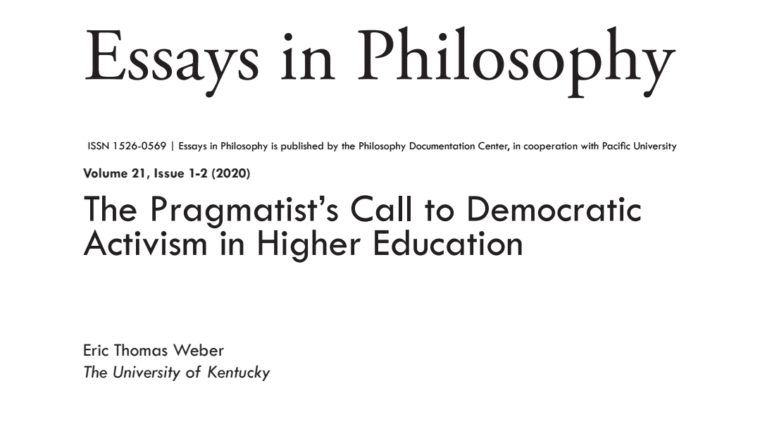
I’m excited to announce that my latest paper has been published in the journal, Essays in Philosophy, volume 21, issue 1/2, in 2020. If you want to read the paper, you can click on the image below or click here.

Image of the top of my paper, 'The Pragmatist's Call to Democratic Activism in Higher Education,' published in Essays in Philosophy.

My abstract for the paper reads as follows:

This essay defends the Pragmatist’s call to activism in higher education, understanding it as a necessary development of good democratic inquiry. Some criticisms of activism have merit, but I distinguish crass or uncritical activism from judicious activism. I then argue that judicious activism in higher education and in philosophy is not only defensible, but both called for implicitly in the task of democratic education as well as an aspect of what John Dewey has articulated as the supreme intellectual obligation, namely to ensure that inquiry is put to use for the benefit of life.

I’m very grateful to Dr. Ramona Ilea for her excellent work as editor of the journal.

The post “The Pragmatist’s Call to Democratic Activism in Higher Education” is now out first appeared on Eric Thomas Weber.

some thoughts on natural law

Those RULES of old discover’d, not devis’d,
Are Nature still, but Nature methodis’d;
Nature, like liberty, is but restrain’d
By the same laws which first herself ordain’d.

– Pope, An Essay on Criticism (writing here of aesthetic laws)

… the Laws of Nature and of Nature’s God  …

The Declaration of Independence

How does one determine whether a law is just or unjust? A just law is a man made code that squares with the moral law or the law of God. An unjust law is a code that is out of harmony with the moral law. To put it in the terms of St. Thomas Aquinas: An unjust law is a human law that is not rooted in eternal law and natural law. Any law that uplifts human personality is just. Any law that degrades human personality is unjust. All segregation statutes are unjust because segregation distorts the soul and damages the personality. It gives the segregator a false sense of superiority and the segregated a false sense of inferiority.

Martin Luther King, Jr., Letter from Birmingham Jail

As I begin to teach a course on Martin Luther King–and while thinking about how to teach civics at all levels–I am giving renewed consideration to the idea of natural law. This is a matter for debate (and should be presented as such), but here are some personal thoughts:

A substantial part of any concept of natural law is a set of rights. Rights impose obligations. If I have a right to life, you have an obligation not to kill me. If I have a right to an education, someone has an obligation to pay for my schooling. These obligations fall on both individuals and institutions. For instance, my right to life implies not only that you may not kill me but that some kind of state must protect me.

To honor and protect others’ rights is obligatory. It is a moral and not merely a legal duty.

Governments do not create rights and obligations, because we can and must assess any given government by asking whether it protects the rights that people deserve.

Other animals have rights because people have obligations to treat them ethically. But non-human animals do not have rights in relation to each other. In that sense, rights are human, although they extend to humans’ treatment of other species.

Rights are linked to the organism’s characteristics as a natural species. For instance, we human beings are born helpless, remain interdependent, yet develop unique goals and desires that are rooted in our private mental lives. Our rights would be different if we had no need for each other, or no private lives at all–or if we differed in other fundamental ways from actual homo sapiens.

Rights are connected to happiness, which means–not the balance of pleasure over pain–but some deeper form of flourishing or self-realization. Flourishing for human beings is natural in the same way that a mouse or an apple tree has certain natural ways of flourishing.

At the same time, one of the unusual and fundamental features of human beings is our ability to flourish in many different ways, and so we have a right to choose our own paths or be the authors of our own lives. This right to choose is based on our ability and desire to choose, which is a natural characteristic.

I have suggested that fundamental interests, needs, and goods are rooted in nature. However, it is not a natural principle that anyone has an obligation to protect or provide for the needs of anyone else. An individual rabbit has a profound interest in not being eaten, yet a fox does not have an obligation to refrain from eating rabbits. Nature is red in tooth and claw.

We are obligated to honor everyone else’s rights, which are based in their natural interests, but this obligation is not natural. It comes from somewhere else. If you think it comes from God, that is fine, but the obligation is then divine and supra-natural, not (merely) natural.

Perhaps we have an instinct to universal beneficence that emerges from our everyday sympathy for other people and animals. That instinct could be seen as the natural (not divine) basis for our commitment to universal rights. Mengzi puts it very well:

Humans all have hearts that are not unfeeling toward others. Suppose someone suddenly saw a child about to fall into a well: everyone in such a situation would have a feeling of alarm and compassion—not because one sought to get in good with the child’s parents, not because one wanted fame among their neighbors and friends, and not because one would dislike the sounds of the child’s cries. [F]?rom this we can see that if one is without the heart of compassion, one is not a human. If one is without the heart of deference, one is not a human. The heart of compassion is the sprout of benevolence. The heart of disdain (shame/disgust) is the sprout of righteousness. The heart of deference is the sprout of propriety. The heart of approval and disapproval is the sprout of wisdom.” (2A6; see also 6A6)

Quoted in Owen Flanagan, The Geography of Morals (p. 57). Oxford University Press. Kindle Edition.

However, we have many instincts, including warlike, competitive, and cruel ones. Universal beneficence seems a subtle and rare sprout in the wild garden of our instincts. To select and cultivate that particular sprout may be wise and right, but it is a choice that’s not itself directed by nature.

Nature can be understood as everything that science can explain (and science is any valid explanation of nature). So defined, “nature” offers no basis for obligations. A purely empirical study of nature would suggest that members of any species, including homo sapiens, are unequal in capacity, frequently selfish, and fully determined by physical processes rather than choice. We can broaden our understanding of nature to encompass things like obligations, purposes, and goods–for instance, happiness as the purpose of human beings, and non-domination is a good required for happiness. But then nature is not exhausted by positivist science.

Partly because positivist science does not comprehend things like rights, it is very hard for people to know the ideal list of rights and their correlative obligations. All of our ancestors were wrong about some rights–according to us–which means that we ought to be humble about our own ability to know the ideal list.

The best we can do is to decide, in reasonably fair and reflective forums, which rights and obligations ought to apply to whom. That means that although governments do not create rights, people must identify and determine rights through politics and in institutions such as governments. We should expect their outcomes to vary over time and space, not because rights are mere matters of opinion, but because the only way we can know real rights is to exchange and test our opinions.

In conclusion, I feel comfortable speaking of law that is importantly connected to nature, and especially to the nature of human beings. Understanding it requires reflection on our natural circumstances. But I wouldn’t call it “natural law” if that implies that it is part of, or determined by, nature, because it has sources other than nature itself.

See also: is science republican (with a little r)?; science, law, and microagressions; my self, your self, ourselves; the moral significance of instinct, with special reference to having a dog; is everyone religious?; is all truth scientific truth?; latest thoughts on animal rights and welfare; and Korsgaard on animals and ethics.

how to think about the self (Buddhist and Kantian perspectives)

I. Buddhist arguments

A Buddhist argument for “no self” goes like this: Look inward–as hard as you want–for some unchanging “I” or “self.” You cannot find it. All you’ll find are physical sensations, feelings, perceptions, volitions, and consciousness, coming one after another, free from your control, and constantly changing. The Buddha himself says, “mind, intellect, consciousness, keeps up an incessant round by day and by night of perishing as one thing and springing up as another” (quoted in Mark Siderits, Buddhism as Philosophy, p. 41). This stream cannot be you if “you” means some durable, controlling thing. But since that is all that you can find within, there is no you.

The idea of a durable, independent, yet fragile self is evidently not “Western” or “modern,” because Buddhists have been working assiduously against it for more than two millennia. It seems to have been endemic in their various cultural contexts. Buddhagosa (a 5th-century thinker) implies that the sense of self arises automatically from having sensations.

When there is rupa [physical sensation], O monks, then through attachment to rupa, through engrossment in rupa, the persuasion arises, ‘This is mine; this am I; this is my self.’

When there is feeling … when there is perception … when there are volitions … when there is consciousness, O monks, then through attachment to consciousness, through engrossment in consciousness, the persuasion arises, ‘This is mine; this am I; this is my self.’

Buddhagosa, in Siderits, p. 37.

Even if this is a universal human phenomenon, it is still bad and worth trying to combat, according to Buddhists. We should not think, “This is mine; this am I; this is my self.’” That thought has two ethical drawbacks (where “ethical” is defined very broadly, to mean anything concerned with thinking and acting well and living a good life).

First, a theory of the self as real but fragile encourages selfishness and love or regard of self at the expense of compassion and altruism.

Second, this theory causes avoidable discomfort or even suffering. For me, a common example is nostalgia. I remember an earlier stage of life–say, being a young parent with a toddler in my arms. I experience a desire to be that person again, or to have that experience directly instead of as a memory. As a result, my memory is infused with loss. But this is a mistake. The memory is an experience, just like any other impression. I can have the memory now, which is a blessing. There is no “I” that could possibly possess the object of the experience more directly, transcending time. The past doesn’t exist; all experience is current. Recognizing that truth spares me loss.

The same is true of fears of death or great old-age. I can imagine those states, but there is no reason to tie them to my present state. I am not old or dying. The idea that those states attach to me is based on a false sense of the self.

A third example is a kind of envy. I see a person who is a young parent now, with a child in arms. I want to have that experience instead of just observing it. Envy is not very virtuous in any circumstance. In this case, it also reflects a metaphysical error. The young parent’s experience is real, and I can see it. But, as a logical matter, it cannot attach to me. I should be glad for the existence of the experience and drop the nonsensical idea that the experience should (or could) somehow be mine. The root of that mistake is a false view of self.

The crucial point is that a spiritual or ethical failing derives from a metaphysical error. Truly believing the metaphysical truth of no-self would prevent or cure the spiritual and ethical fault.

II. Kant’s defense of the self

Kant was aware of the argument that the self is not real, because we cannot find it when we introspect. All we find is a set of specific experiences. He got this from David Hume.

But Kant argued that experiences are logically structured. Consciousness is not like a big screen with lots of disconnected pixels that change color randomly. I perceive three-dimensional objects moving through space, interacting with each other, and having sounds, weight, and smell as well as shape. The fact that I perceive such things implies that I (= my self) must have categories like space, time, and causality. These categories are built into what Kant calls “reason,” which we might more comfortably call human cognition.

Kant calls his conclusion the “transcendental unity of apperception.” That phrase is certainly a mouthful, but we can break it down. “Apperception” means perception with an element of understanding and self-awareness. You apperceive something as a 3-D object moving toward you. That can be a true belief about the world. “Unity” refers to the fact that our apperceptions are coherent across time and space. And “transcendental,” in Kant’s specialized vocabulary, refers to something that is a necessary explanation of something that we know from direct experience.

Could a creature inhabit our universe and have different categories from ours? God might, or Michael on “The Good Place.” But to say that such a creature has different categories is basically empty, because we have no inkling of what that is like. For us, our categories are logical necessities. The best way to think about metaphysics is to begin by understanding what we must believe, and then believe that. We must believe in space, time, and the self, which is tantamount to saying that these things are real. That is a transcendental argument.

III. Should we try to shake the idea of the self?

One aspect of the question is empirical/psychological. Is it possible–by means of concerted introspection, philosophical argument, sudden enlightenment, practice, or some other means–to rid ourselves of the idea of the self as a durable, independent agent? I am not sure, but I am open to the possibility that this happens.

A different aspect of the question is metaphysical. By ridding ourselves of the idea of the self, are we coming closer to the truth? That is a central point of disagreement between some Buddhist thinkers and Kant. But maybe it’s not a gap between the Buddha and Kant, since it’s possible that the Buddha is only interested in the good life. (“Buddhism in both its classical and contemporary forms is first and foremost a theory of personal flourishing.” – Owen Flanagan, The Bodhisattva’s Brain: Buddhism Naturalized, p. 122. MIT Press.)

That brings us to the third aspect of the question: Is it virtuous or ethical or otherwise a good idea to strive to rid ourselves of the idea of the self? Here I am inclined to a Middle Way.

On the one hand, Kant is right that the concept of the self is logically prior to many ordinary thoughts. At a minimum, it would be an arduous task to escape from this concept. That would take a lot of time and effort and probably involve a lot of wavering and backsliding. I am not convinced that it’s likely to accomplish the ethical goals of reducing selfishness and improving equanimity. There is a risk that it might promote narcissism (excessive interest in moulding one’s own cognition) or even avoidance of ethical responsibility. It is an empirical question how trying to attain non-self affects the character. Even if its net impact is positive, maybe there are better paths to virtue.

However, we should try to shake certain theories of the self that are not only false but also ethically problematic. It is wrong (both logically and ethically) to feel nostalgia, existential dread, or envy. These feelings are not only harmful but also reflect a mistaken theory of the self.

The mistake is not to believe in anything called a self. The mistake is to imagine that the self could time-travel or jump from one body to another. Reminding oneself of these mistakes might help to prevent or address certain spiritual ailments.

Kant tells us that time is a necessary aspect or component of cognition. But we don’t jump from an awareness of time to a possessive attitude toward time. We don’t think, “Time is mine; I want to hold it forever.” We do make that jump in the case of the self, and that’s our mistake. We move from relying on the concept of a self to loving the self possessively. This is something we could teach ourselves not to do.

IV. The relationship between ethics and metaphysics

An underlying issue here is how metaphysics should connect to ethics. Owen Flanagan writes (p. 116), “Buddhists claim a connection between understanding one’s own self, paradoxically as anatman—as no-self—and an ethic of compassion and lovingkindness. …. Diminishing the grip of the illusion of metaphysical egoism is causally connected to being good. What sort of connection is there—might there be?”

One answer is that we are obliged to believe whatever happens to be true. The truth is independent of our good,; and perhaps it is a virtue to recognize the truth whatever it may be.

Kant begins the section on the Transcendental Deduction with a legal analogy. He says that law professors distinguish “the question of right (quid juris) from the question of fact (quid facti).” They call a demonstration of right a “deduction.” In a similar way, we go around making lots of “empirical conceptions” without checking whether we have a right to them. Some of these are fine, but some are “usurped conceptions, such as fortune, fate.” Although these words are used by almost everyone, they “are occasionally challenged by the question, ‘quid juris?’” Kant wants to ask whether the concepts of space, time, causality, and self are used by right or are more like “fortune” and “fate”–unjustified ideas. (Critique of Pure Reason, trans J. M. D. Meiklejohn, A84=B116.) He concludes that they are in fact obligatory.

A Buddhist might respond that it’s actually a choice whether to remain wedded to standard conceptions of time and the self, or else to devote energy to trying to shake these conceptions. Kant says we “must” use these categories, and that is the basis for his claim that they are true or right. A Buddhist might challenge the ethical sense of that “must.” If it is possible–through concerted effort–not to think with the category of self, then Kant’s argument fails. It is then not necessary to use this category; and if it’s not necessary, it doesn’t have a transcendental basis for being true.

In the following passage, the Buddha moves from making a metaphysical claim (there is no self), to offering an existence-proof (a person can avoid believing in the self), to actually liberating his followers (they lose faith in the self and become free):

“the correct view in the light of the highest knowledge is as follows: “This is not mine; this am I not; this is not my self.”

“Perceiving this, O monks, the learned and noble disciple conceives an aversion for rupa, conceives an aversion for feeling, conceives an aversion for perception, conceives an aversion for volitions, conceives an aversion for consciousness.

“And in conceiving this aversion he becomes divested of passion, and by the absence of passion he becomes free, and when he is free he becomes aware that he is free; and he knows that rebirth is exhausted, that he has lived the holy life, that he has done what it behooved him to do, and that he is no more for this world.’”

Thus spoke The Blessed One, and the delighted band of five sramanas applauded the speech of The Blessed One. Now while this exposition was being delivered, the minds of the five sramanas became free from attachment and delivered from the depravities.

[Samyutta Nikaya III.66–68], in Siderits, pp. 38-9

This is a different way from Kant’s to put metaphysics together with ethics. But it depends on an existence-proof: actual examples of people who have become “free from attachment and delivered from the depravities.” The question is whether that happens.

See also: nostalgia for now; the grammar of the four Noble Truths; you have a right and a responsibility to attend to your own happiness; on philosophy as a way of life

judgment in a world of power and institutions: outline of a view

  1. Judgment or practical reason (i.e., deciding what is right to do) means forming beliefs about facts, values, and strategies. It is sometimes worth trying to isolate the factual beliefs in order to test them empirically. But no claims are purely empirical, and the goal of distinguishing facts, values, and strategies is ultimately misplaced. (See right and true are deeply connected.)
  2. Individuals hold many opinions at once, and often some of our opinions are connected logically, causally, or in other ways. This means that we have structures of opinions. The form of our structures matters as well as their content. For instance, a structure can be too scattered or too centralized. These structures are better modeled as networks than as foundations plus superstructures. Only some networks of beliefs have nodes that function like foundations. (See an alternative to Moral Foundations Theory.)
  3. Individuals develop their opinions in constant interaction with other human beings, living or dead. We start with no explicit views of the social world and borrow most of what we think from other people. Whenever a person influences us, that reflects a link in a social network. And those who influence have their own networks of opinions that are linked by logic, causality, or in other ways. Therefore, developing judgments is a matter of participation in a network of people and their networked ideas. (See what makes conversation go well: a network model.)
  4. A culture is a name for a cluster of individuals with overlapping networks of ideas. It is a useful simplification for a world in which each individual at each moment has different ideas from the same individual at another time and from all other individuals. Some cultures hold foundational beliefs about some questions (e.g, monotheism is a foundational belief in a monotheistic culture); but in general, it is misleading to define a culture in terms of its foundations. (See everyone unique, all connected.)
  5. Often, we must judge institutions as opposed to concrete acts. (See Moral Foundations theory and political processes). For instance, we may need to assess the United States or marriage rather than an individual statement or action. Institutions also generate the material for our judgments, including most of what we take to be facts. (See decoding institutions.) Institutions exhibit patterns that are not intended or designed. (See the New Institutionalism.)
  6. Institutions are not best modeled as networks of individuals, because they have salient features–such as rules, incentives, and boundaries–that are not like nodes and links. (See a template for analyzing an institution.)
  7. The whole system of networked individuals, networked beliefs, and institutions is dynamic, not static. Individuals develop over their lives; institutions are founded, decay, and change; social networks form and shift; and networks of ideas change. (cf. Dewey’s pragmatism.)
  8. Power operates at all points in this system: e.g., when one individual influences another, when one person is put in contact with or separated from another person, when an institution is designed, and when its norms change. (See decoding institutions.) Power is not intrinsically bad; it just means that A can affect B. But some power is bad, and power shapes the materials of judgment.
  9. Liberty is a genuine value (see six types of freedom), but it should not be understood as freedom from others’ power or a right of epistemically free individuals to act according to their own judgments. Our judgments are formed by the communities we belong to (see the truth in Hayek).
  10. There are better and worse individuals, ideas, judgments, and institutions, but telling the difference between better and worse is a deeply social and iterative process. (See structured moral pluralism [a proposal].)

in defense of (some) implicit bias

I hope that if there were an implicit bias test for Nazism, I would demonstrate a strong negative bias. Shown rapid-fire images of swastikas and Nazi leaders, I would be unable to associate them with positive words without strenuous effort. The reason is that I learned a deep aversion to National Socialism, based originally on reasons and evidence. It is now no longer efficient for me to use conscious effort to assess Nazis, their pros and cons. I have rightly translated a very well-founded judgment into a habit, which works like a constructed instinct. That way, I can reserve my limited attention and cognitive capacity for other issues.

In 1970, Charles Fried proposed as a philosophical thought-experiment a situation in which two people are drowning, one of whom happens to be your spouse. It was “absurd,” said Fried, that you should be impartial about which one to save. Fried was developing an argument against pure impartiality. But Bernard Williams famously replied that you shouldn’t even have to think about which person to save. That would be “one thought too many.” If you must reason about whether to save your spouse as opposed to someone else, you do not love your spouse. The problem with having to think in this case is not mere inefficiency (it might slow you down and increase her chance of drowning). It’s more basic than that. You do not have a “deep attachment” to another person unless—here I extend Williams’ argument—you have turned your preference for that person into an acquired instinct. Your ability to act on that instinct instead of reasoning is proof of a process that we call love.

In a really interesting new paper, “Rationalization is Rational,” Fiery Cushman argues that human beings, since we have limited cognitive resources, have evolved several different modes of representing things in our environment: reason and planning, habit, instinct, and norms. These modes require varying amounts of cognitive attention. Cushman also proposes that we have evolved mechanisms for shifting representations from one mode to another for efficiency’s sake. For instance, we intentionally learn the way home and then form a habit of walking home so that we no longer have to think about it. But we can also make a habit conscious and practice until we change it.

Many people are currently worried about two specific “representational exchanges,” in Cushman’s terms. One is rationalization. We think that we are making a conscious and reasoned choice, but we have actually formed an instinctive reaction that we then merely rationalize with explicit words. This phenomenon is widely taken to be evidence of human unreason and inability to deliberate. But Cushman sees it as an efficient process. We can’t go through life assessing everything explicitly, so we develop habits of reacting to categories of things and then justify our reactions when reasons are needed. So long as the learned habit was based on good thinking in the first place, it is an efficiency measure rather than a limitation. In turn, rationalization (giving reasons for something we have already decided) serves a useful purpose: it puts a habit into verbal form so that it can be debated.

The other problem that worries many of us implicit bias, particularly in the form of racial stereotyping. Tests of implicit bias show that various forms are common in the population as a whole.

Implicit bias research sometimes seems to flatten crucial moral differences. A subject might have a 3% bias against African Americans and a 24% bias against Millennials. This does not mean that generational bias is eight times more important, even in this individual’s case. Racism is structural, historical, connected to laws and institutions, and literally deadly. Generational bias is just one of those things we should probably think about. To assess the empirical data about bias, we need judgments about what is just and unjust.

Applying Cushman’s insight, I would go further. An implicit bias is not necessarily bad at all. It is actually a virtue (in the Aristotelian sense) if it reflects a process of reasoning and learning that we have stored as a habit. Being biased against Nazis and in favor of your spouse are virtues. Being biased against people of color is a vice. The difference lies in the content of the judgment, not the form.

It’s true that any bias can mislead. For instance, your appropriate abhorrence of Nazism might distort your views of justice in the current Middle East. Your appropriate bias in favor of your dearly beloved family members might cause you to treat strangers in unjust ways. It is characteristic of virtues that each is insufficient; we need a whole suite of them. And one important task is to bring even our best biases into conversation with other ideas and principles. But it wouldn’t be progress to temper your bias against Nazis or in favor of your spouse. That would just weaken your virtues. Progress means combating bad biases, developing good biases, and combining your good biases with more abstract principles of judgment.

See also: the era of cognitive bias; marginalizing views in a time of polarization; Empathy and Justice; Jonathan Haidt’s six foundations of morality; and don’t confuse bias and judgment (which is incompatible with this post).

decoding institutions

Today I presented at Tufts’ Science, Technology & Society lunch seminar series on how knowledge and power interrelate. My basic thesis was that knowledge is produced by institutions, which are fields of power. Assessing knowledge therefore requires analyzing institutions (not claims about facts by themselves).

The general model I am assuming works like this.

Actors can be individual people or (at larger scales) such entities as firms, bureaus, or even nations. They have goals; mental constructs such as philosophies, identities, or ideologies; and relations with each other.

They interact in an Action Space, such as a market, a democratic election, or a scholarly publication. Their interactions vary, but actors always make choices shaped by rules, norms, and goods.

A “norm” is a shared expectation that has a positive moral valence. For instance, Robert K. Merton’s CUDOS Norms for science are values that are widely expected. An actual “rule,” on the other hand, structures outcomes but may not have a positive moral valence. Merton also coined the phrase “Matthew Principle” for the general rule that, in science, the person who is already most famous gets the most credit. That rule conflicts with the CUDOS norm of Universalism.

Action Spaces affect, and are influenced by, biophysical conditions, general social circumstances (e.g., poverty), and other institutions.

The institution as a whole has Inputs and Outputs. Insofar as the institution involves knowledge, Inputs may include ideas, opinions, and knowledge-claims and it may produce new ideas, opinions, and knowledge-claims.

We can assess the whole process in terms of value criteria, such as justice. Such assessments not only influence institutions; they are also shaped by institutions. In fact, we don’t have information or values that we can use for assessment except for those that have emerged from institutions. The interaction is reciprocal.

Each element of the whole system is a target for power. To use Stephen Lukes’ Faces of Power framework: one “face” involves actors influencing other actors within an Action Space; a second “face” involves changing the rules of the Action Space; and a “third face” involves changing either norms or the actors’ mentalities, or both. But we could add many more “faces” as we consider each element in the diagram.

We rarely assess knowledge directly, because we are rarely in a position to have justified true beliefs all on our own. Instead, we must assess knowledge as the product of institutions. But that is not a relativist claim, because some institutions are better than others. Assessing the value of an institution requires taking it apart and assessing its components.

See also: adding democracy to Robert Merton’s CUDOS norms for science; is all truth scientific truth?; tools for the #resistance; and a template for analyzing an institution

we should be debating the big social and political paradigms

[The following post is inspired by Rogers Smith’s recent APSA presidential address, and I believe is consistent with it, but I incorporate some additional elements.]

Consider a sample of articles about politics, or society more generally. One might be an interpretation of some remarks by Thomas Jefferson. Another reports an experiment in which people are more likely to vote when contacted one way rather than another. A third is a critique of a prevalent word (say, “security”) from the perspective of Michel Foucault. A fourth shows that rational agents in a certain situation are better off when rules are externally imposed on them.

Each of these articles presumes, and contributes to, a larger paradigm that combines values, causal theories, and methods. Perhaps the interpreter of Jefferson believes that the United States is still founded on its written Constitution and that the intentions of the founders matter today. The experimentalist presumes that voting in a regime like the modern USA is a consequential act, and it would be good to increase voting by several percentage points if possible. The critic of “security” sees a world of pervasive injustice sustained by ideology, in the sense of distorting views that preserve the status quo. The rational-choice modeler thinks that all (or many) institutions can be analyzed as the interactions of utility-maximizing individuals.

(For the sake of space, I have omitted a classical Marxist, a deep feminist, a post-colonial theorist, a Prospect Theorist, a radical environmentalist, and many others who deserve places on the list.)

In these articles, you will not see much about their larger paradigms, worldviews or schemata. Their paradigms may not even be mentioned. Instead, you will see evidence in support of the specific claims of each article (whether in the form of statistics, quotations, or equations).

Of course, journals offer limited space, and there may not be room to present a whole paradigm. In addition, citing your scheme may only hurt you in the review process. Reviewers who happen to oppose your overall paradigm may be alienated, when they would have been persuaded by your detailed findings if presented alone.

For instance, imagine that you discover that texting people increases their turnout more than emailing them. That is more persuasive as a bare finding than as part of an argument for the significance and value of voting in a mass democracy within a capitalist market economy.

A certain form of positivism (or verificationism, or empiricism) is still widely influential. It holds that facts can be verified directly. Larger mental constructs are fashioned by us and are only valid to the extent that they match all the facts. If big, general ideas influence our beliefs, they are sources of bias. Therefore, we may need to disclose our paradigms as caveats, but we don’t want to focus on them.

Some people would hate to be described as positivists but end up in a similar place for a different reason. They presume that they have a right to their fundamental views as a matter of identity. “As a migrant from the global south, I explore the colonization of indigenous spaces …” This is not a disclosure of bias, nor a defense of a thesis; it is a claim to be recognized as a member of the scholarly community. To disagree is to deny the author’s place in the community.

I believe that the really important task is to select our worldviews, our big normative/conceptual schemes. It matters which of the available choices we adopt, and maybe we can create better ones. Therefore–as I think Rogers Smith argued–it is a real weakness in any intellectual community if the paradigms are implicit or merely stated, rather than explained, justified, and put into competition.

Within political science, many contrasting worldviews are available. You can walk down the hall of the APSA Annual Meeting past rooms in which everyone accepts the basic normative principles of contemporary electoral democracy, and other rooms in which people are quoting Slavoj Žižek about ideology.

It is hard to compare such worldviews or paradigms, because they have different normative, epistemic, and sometimes metaphysical premises. A finding within one paradigm does not disprove a different paradigm. A certain kind of relativism interferes with comparative assessment.

However, we can consider a whole body of specific findings along with their shared overall claims. We can ask whether this whole literature is coherent, whether it generates persuasive specific findings by its own lights, whether it informs practice in any useful way, whether it makes sense of other literatures, how it handles criticisms and rival views, whether it is responsive to new evidence and events, and whether its normative implications are defensible when fully articulated. Each paradigm has points of relative strength and weaknesses.

It would be helpful if people had that discussion in print, instead of always only writing within paradigms (at least for journal articles.)

See also trying to keep myself honest, how philosophy is supposed to work

Moral Foundations theory and political processes

Moral Foundations theory is an important body of research that has generated significant findings. It belongs to a somewhat larger category of research about morality that has these features:

  • Many individuals are asked for their moral judgments of hypothetical or historical cases. (See this test, for example.)
  • The data from these individuals is analyzed to identify latent factors that statistically predict many people’s specific answers. Respondents may not be aware of the latent factors or even endorse them when they hear them, yet these factors are said to explain (statistically, and maybe causally) their actual judgments.
  • Some factors are found to be common across cultures and to have adaptive value for human beings as a species that evolved through natural selection. These factors are named “foundations.”
  • Variation among human beings depends on which of the foundations are more important for different groups. This is a structuralist theory, akin to Claude Levi-Strauss or Noam Chomsky. For structuralists, surface-level diversity results from variation in a finite set of underpinnings.
  • In ambitious versions of this method, morality is the list of foundations. Morality is what we think it is because of how we evolved. To debate the value of the various foundations or to argue for a different principle is pointless. There is no way to know the truth of moral claims, but science can reveal the foundations of our moral psychology, so those alone are real.

Despite my interest in learning from the specific findings of Moral Foundations research, I harbor many objections, summarized here. In this post, I would like to elaborate on one concern.

We human beings make individual judgments about cases and decisions. That’s what the data-collection of Moral Foundations Theory models. But we do many other things that also shape values. For instance, we buy things, which causes more of those things to be made and sold. We participate in bureaucratic institutions that manage themselves through chains of command, policies, and files. We join and quit groups. And we govern by making laws and policies at all levels.

As Owen Flanagan writes in The Geography of Morals (2016), “Moral stage theory conceives moral decision-making individualistically. The dilemmas are to be solved by singleton agents. This is ecologically unrealistic. Committees at hospitals decide policies on organ allocation; government agencies deliberate about monetary policy; officers deliberate about costs and benefits of military operations; and friends talk to friends about tough decisions.”

I’ll focus on political decisions, although we should also consider markets, bureaucracies, friendships, scientific disciplines, and other social forms.

People make laws and other rules to prohibit, regulate, tax, subsidize, and mandate various behaviors. These rules directly influence how we act and may also affect our values, if only because many of us display the Moral Foundation of “Authority.”

One might think that rules and laws are made by people who implement their moral judgments, which are influenced by their individual Moral Foundations. Laws would then simply be aggregated Moral Foundations.

Not so, for these reasons:

  1. An important determinant of the actual law is the choice of who gets to make it. That choice is often made by people other than those who do the governing. Millions of voters choose a president. A president plus 51 US Senators decides who sits on the Supreme Court (one opening at a time, spread over decades). In making these choices, people are not focused on the specific cases or controversies that come before the Court. Top of mind for a president may be finding a justice who can be confirmed, who impresses the electorate, and who is young enough to serve for a long time. These are different considerations from moral judgments about cases, but they shape the actual law. (Here I use a democratic example, but a dictator is also chosen, often by a military junta or by party cadres.)
  2. When multiple people make laws, they don’t do so by judging in isolation and then aggregating their votes. A secret vote may mark an important moment in a political process, but it is almost never the only moment. It usually follows argument, persuasion, and mobilization; and sometimes groups decide without voting at all. Communication plays an important role. But when we communicate, we are not merely expressing our moral judgments of concrete cases. We may be doing many other things: trying to go along with the group, trying to stand out, trying to look (or be) impartial or moderate, trying to waste time on a point of disagreement to prevent attention to a different topic that we fear (filibustering), trying to set a precedent for other topics, supporting someone else so she’ll help us later (logrolling), saying something to irk someone in particular, enjoying the sound of our own voices, and so on. Our moral judgment of concrete issues may be an input, but only one among many.
  3. The procedures for making collective decisions influence the outcomes. For instance, almost all procedures favor the status quo because it takes energy and agreement to shift it. Therefore, a group can live with a law or policy that every individual would prefer to change. This is common and it implies that law often fails to reflect the private opinions of the majority–even when everyone has an equal say, which is vanishingly rare.
  4. One way that laws and policies shift is that subgroups successfully advocate for changes, based not on abstract judgments but self-interest. I don’t think that attitudes toward sexual orientation changed over the past half century because the broad public decided to reconsider their views. I think sexual minorities felt compelled to take their struggles into the streets, the ballot booth, and the courts and won some significant victories. The resulting policies then began to change attitudes. (A different kind of example: girls’/women’s sports got a huge boost from Title IX, which originated when Congress rejected a mischievous amendment to exclude sports from civil rights legislation–a backdoor way to enact a policy that has changed everyday attitudes toward gender.)
  5. Often the subject of political or legal debate is not whether individuals should do specific things: marry, steal, take drugs. It is about our collective stance toward social constructs: the United States (or Russia), Christianity, the family, a forest. These things have histories, they are complex and internally inconsistent, and they reflect laws or norms that people have formed over time. Often we are not asked to assess concrete actions but big abstractions that embody, among other things, many previous concrete actions taken by many people for many reasons. A major question is what story we should tell about a large construct.

For these reasons, empirical moral psychology cannot stand on its own without institutional/political analysis. Moral Foundations Theory is strongest when it aims to predict how people will individually react to a situation that raises issues so general that it resembles the problems that confronted our prehistoric ancestors on the savanna. The theory is least helpful for explaining why the same group of people might change its stance toward a specific topic, as we see with sexual orientation since 1969.

See also Jonathan Haidt’s six foundations of morality; an alternative to Moral Foundations Theory; moral thinking is a network, not a foundation with a superstructure; and against methodological individualism.

[VIDEO]: Why You Should Take my Philosophy of Education Course this Fall

EPE 640 is offered this fall, 2019

Graduate students and advanced undergraduates at the University of Kentucky, watch this VIDEO (4m29s) about why you should take my EPE 640 course this fall on the Philosophy of Education.

If you can’t see this video in your RSS reader or email, then click here.

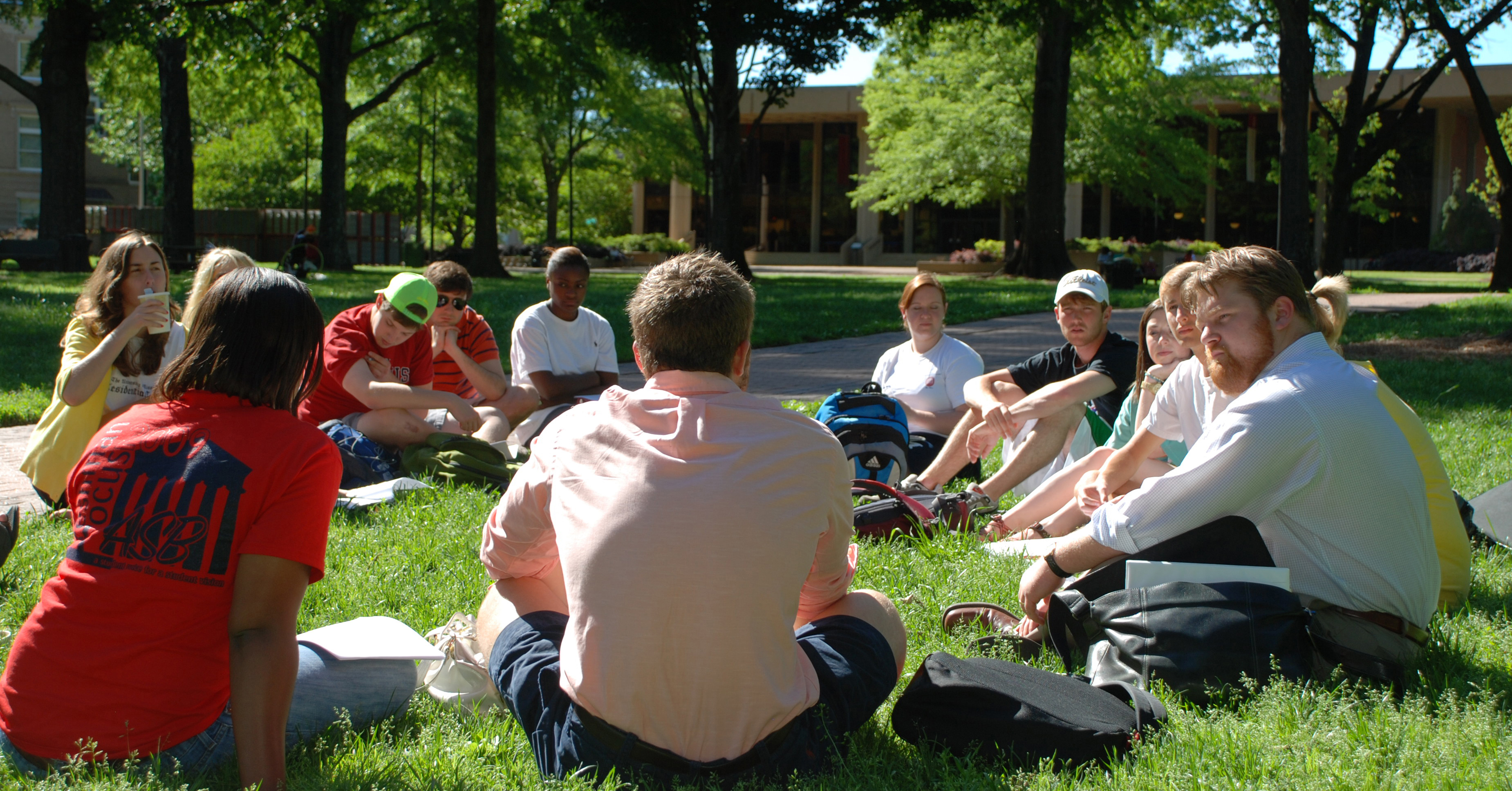
Photo with students at the University of Mississippi.Advanced undergraduates, if you’d like to take this course, email the instructor at eric.t.weber@uky.edu.


Why study the Philosophy of Education?

a) Educators and leaders are expected to have a meaningful grasp of their own philosophies of education;


b) All research is rooted in frameworks of ideas that support and contextualize our work and thought, and that can clarify and help us to focus or be conflicted and confuse us if not carefully considered;

c) Everyone working in educational administration contributes to a system that functions with respect to or in conflict with underlying philosophical ideas. That calls for appreciating and always keeping in mind what we ought to be doing in education.

What you’ll get out of it / create:

Eric Thomas Weber, author of "Uniting Mississippi: Democracy and Leadership in the South" speaks at Sturgis Hall October 19, 2015. Photo Credit: Jacob Slaton

Photo Credit: Jacob Slaton

1) A short “teaching statement,” “Statement on Philosophy of Education,” or related document commonly requested in academic job applications, as well as for administrative positions that often involve teaching courses or otherwise supporting them;

2) A book review for possible publication;

3) A conference-length paper ready for submission to professional calls for papers;

4) A full-length research paper suitable for submission to journals and that could support your other projects;

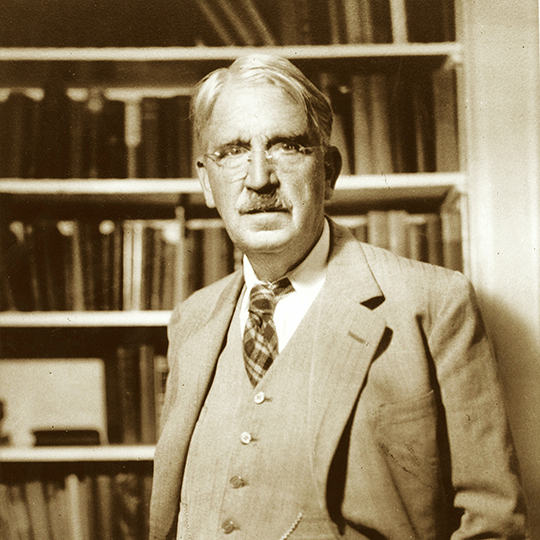
John Dewey, standing.

John Dewey, concerned that you’re not yet signed up for the course.

5) An op-ed-length version of the research paper for possible submission to newspapers or educational periodicals;

6) Credits that can contribute to the Graduate Certificate in College Teaching and Learning.


When & Where?

It’ll be on Wednesdays from 11am-1:30pm in Dickey Hall rm 127.


Questions? Email me at eric.t.weber@uky.edu. You can also connect with me on Facebook, Twitter, LinkedIn, & Academia.edu.

The post [VIDEO]: Why You Should Take my Philosophy of Education Course this Fall first appeared on Eric Thomas Weber.