
New Book on 25 Years of Participatory Budgeting

Screenshot 2014-06-09 17.17.40

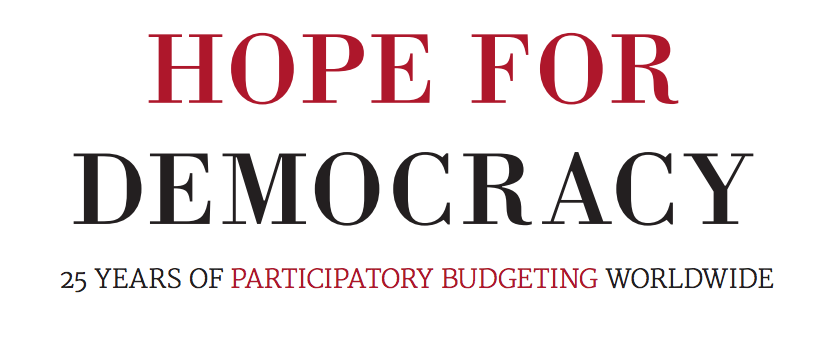
A little while ago I mentioned the launch of the Portuguese version of the book organized by Nelson Dias, “Hope for Democracy: 25 Years of Participatory Budgeting Worldwide”.

The good news is that the English version is finally out. Here’s an excerpt from the introduction:

This book represents the effort  of more than forty authors and many other direct and indirect contributions that spread across different continents seek to provide an overview on the Participatory Budgeting (PB) in the World. They do so from different backgrounds. Some are researchers, others are consultants, and others are activists connected to several groups and social movements. The texts reflect this diversity of approaches and perspectives well, and we do not try to influence that.

(….)

The pages that follow are an invitation to a fascinating journey on the path of democratic innovation in very diverse cultural, political, social and administrative settings. From North America to Asia, Oceania to Europe, from Latin America to Africa, the reader will find many reasons to closely follow the proposals of the different authors.

The book  can be downloaded here [PDF]. I had the pleasure of being one of the book’s contributors, co-authoring an article with Rafael Sampaio on the use of ICT in PB processes: “Electronic Participatory Budgeting: False Dilemmas and True Complexities” [PDF].

While my perception may be biased, I believe this book will be a major contribution for researchers and practitioners in the field of participatory budgeting and citizen engagement in general. Congratulations to Nelson Dias and all the others who contributed their time and energy.


Who Participates in Africa? Dispelling the Myth

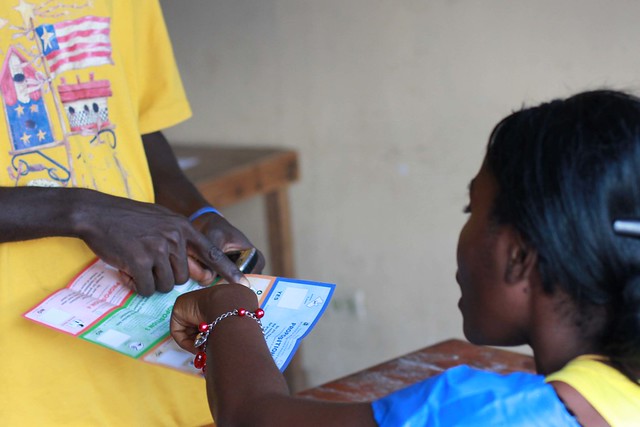
picture by Britanny Danisch on flickr.

Whenever discussing participation in Africa (as well as in other developing contexts) the issue of “who participates” often emerges. A constant in these conversations is an assumption that participation in the continent is strongly driven by material and immaterial resources (e.g. money, time). In other words, there seems to be a widespread belief, particularly among development practitioners,  that the most privileged sectors of society are disproportionately more likely to participate than the least well-off.

In part, such an assumption is empirically grounded. Since the early 70s,  studies have shown inequality in political participation, with the most advantaged groups being disproportionately more likely to participate. Considering that policy preferences between groups differ, unequal participation leads to the troubling possibility that public policy is skewed towards favoring the better off, thus further deepening societal differences and access to public goods and services.

However, often ignored is the fact that most of these studies refer to  participation in traditional western democracies, notably the United States and European countries. But do these results hold true when it comes to participation in Africa? This is the question that Ann-Sofie Isaksson (University of Gothenburg) tackles in a paper published in Electoral Studies “Political participation in Africa: The role of individual resources”.

By looking at an Afrobarometer dataset of 27,000 respondents across 20 African countries, Isaksson’s findings challenge the standard thinking on the relationship between resources and participation:

(…) it seems the resource perspective does a poor job at explaining African political participation. If a resource is relevant for meeting the costs of participating, more of that resource should mean more participation. If anything, however, the estimations suggest that having little time (i.e. working full-time) and little money (i.e. being poorer) is associated with more participation.

Isaksson’s analysis is not confined to participation in elections, also examining non-electoral participation, i.e. attending community meetings. With regard to the latter only, there are modest effects associated with exposure to information  (e.g. radio, TV, newspapers) and education. Yet, as the author notes, “the result that community attendance is higher among the poor remains”.

To conclude, as underlined by Isaksson in her paper, she is not alone in terms of findings, with other studies looking at Asia and Latin America pointing in a similar direction, slowly dispelling the myth of the role of resources for participation in developing countries. Development practitioners should start to take note of these encouraging facts.

***

P.s.: An earlier ungated version of the paper can be found here [PDF].


10 Most Read Posts in 2013

Below is a selection of the 10 most read posts at DemocracySpot in 2013. Thanks to all of those who stopped by throughout the year, and happy 2014.

1. Does transparency lead to trust? Some evidence on the subject.

2. The Foundations of Motivation for Citizen Engagement

3. Open Government, Feedback Loops, and Semantic Extravaganza

4. Open Government and Democracy

5. What’s Wrong with e-Petitions and How to Fix them

6. Lawrence Lessig on Sortition and Citizen Participation

7. Unequal Participation: Open Government’s Unresolved Dilemma

8. The Effect of SMS on Participation: Evidence from Uganda

9. The Uncertain Relationship Between Open Data and Accountability

10. Lisbon Revisited: Notes on Participation