Notre-Dame is eminently restorable

I’m sure others have made this point or are typing it this minute, but I will pile on …

Notre-Dame de Paris is a stunning building but not a well-preserved medieval one. It has been through a lot, including the 18th-century removal of the original stained glass in the nave, the smashing of statuary and most of the remaining glass during the French Revolution, and a profound reconstruction that began in 1844. Some of the most famous features of the cathedral are the work of Eugène Viollet-le-Duc, a Romantic-era restorer who was comfortable redesigning medieval buildings in ways that are now obvious to us. The gargoyles, the spire that collapsed yesterday, portions of the interior architecture, and much of the stained glass is by Viollet-le-Duc, not by anonymous craftsmen of the 12th and 13th centuries. Many other Gothic buildings are much better preserved.

John Ruskin wrote in 1849 (not specifically about Notre-Dame but about the general approach to restoration in his time):

Neither the public, nor those who are responsible for the maintenance of public monuments, understand the true meaning of ‘restoration’. It signifies the most complete destruction that an edifice can suffer; a destruction from which not a single vestige can be recovered; a destruction that comes from the false description of the thing destroyed. It is impossible, as impossible as it is to bring the dead back to life, to restore whatever might have been grand or beautiful in architecture….the enterprise is a lie from the beginning to the end.

Notre-Dame is not a “lie,” but it is to a large degree a legacy of the French Romantic period, as much a creation of Victor Hugo and Viollet-le-Duc as of the first builders in 1160-1260. It is part of the city that we know today, which was profoundly influenced by Georges-Eugène Haussmann (1809-1891), the flattener of ancient neighborhoods and planner of boulevards:

Old Paris is gone (no human heart

changes half so fast as a city’s face) …
There used to be a poultry market here,
and one cold morning … I saw

a swan that had broken out of its cage,
webbed feet clumsy on the cobblestones,
white feathers dragging through uneven ruts,
and obstinately pecking at the drains …

Paris changes … but in sadness like mine
nothing stirs—new buildings, old
neighbourhoods turn to allegory,

and memories weigh more than stone

From Richard Howard’s translation of Baudelaire, Les Fleurs du Mal

It is not a criticism to place Notre-Dame in the 19th century. The years from 1848-1870 mark the apogee of a certain Parisian culture that is admirable and attractive. It was the age of boulevards and cafes, Seine embankments, and Impressionist cityscapes, all of which shape our view of Notre-Dame. The reason the history matters is that we can reconstruct late-19th-century buildings when they are well documented, as every stone of Notre-Dame is. In contrast, we would have neither the materials nor the craftsmanship to reconstruct the stained glass of the nearby Sainte-Chapelle if that were lost.

The fire is a tragedy; the crown jewel of 19th-century Paris will be badly damaged for some time. But in the long run, this will be a footnote.

See also: seeing Paris in chronological order; Paris from the moon; and Basilica of Notre-Dame, Montreal.

Participatory Action Research as Civic Studies

Thanks to the fabulous Tisch College postdoc Margaret McGladrey, we are holding a symposium on “Participatory Action Research as Civic Studies” today at Tufts, with 15 speakers.

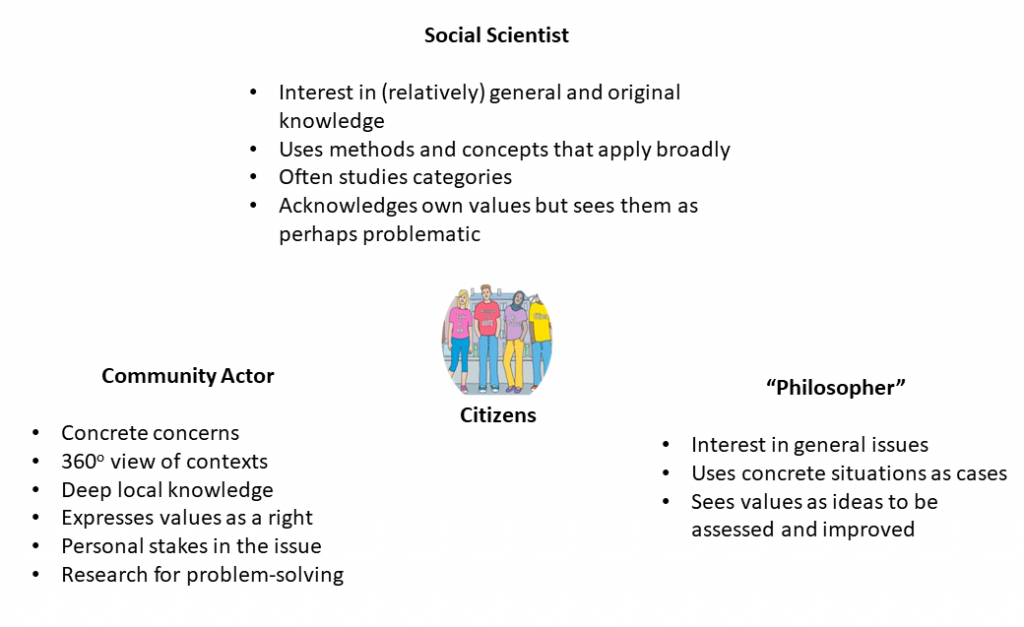
I’m planning to make a few remarks revolving around three “ideal types” or imaginary characters.

I won’t try to explain the whole chart here, but a few explanations might be useful.

The community actor could be a nonprofit leader, activist, or government official. The social scientist could be qualitative or quantitative, teaching in a university or working for an agency or even a research firm. And the “philosopher” need not be a professor of that academic discipline. She might be a scholar from a different field (e.g., theology, normative political theory, law, education) or someone working outside academia, for instance, as a writer or a clergyperson.

When I say that the social scientist “often studies categories,” I mean that her topic is often a set of examples that meet the same criteria: Dominican women, prenatal care programs, kids who are existing foster care. In contrast, a community actor is often concerned with a heterogeneous, multifaceted object like a school or a neighborhood.

When I say that the social scientist “acknowledges [her] own values but sees them as perhaps problematic,” I am thinking about the disclosures of bias and social position that are increasingly common in scholarly articles. Traditional conceptions of science understand it as a quest to understand the world independent of the observer. Social scientists know that observers have values, bias, and assumptions. That is because we are all human. But they regard those attributes of themselves as potential obstacles to understanding their objects of study. So they use techniques for reducing bias, and they disclose or acknowledge their values for the sake of the reader. In contrast, a civic actor typically asserts values as a matter of right, as things that she has. Often those assertions are tied to identities: “As a Pentecostal, I believe …” Finally, a philosopher is trained (if we are trained in anything), to ask whether any claim about values is the best one. We view values not as biases to disclose but as claims that require testing.

In the middle are some “citizens,” using that term in its moral (not legal) sense. They are people who feel responsible for their world: for changing it or preserving what is good about it. They need what each of the three ideal types offer, and they can’t distinguish sharply among these offerings. They need particular and general knowledge, information and good values.

I take it that movements like Participatory Action Research and Community Based Participatory Research attempt to bring together the Community Actor with the Social Scientist, either by reducing differences among these people or by making them into partners. Civic Studies, as we actually practice it so far, tends to combine the Social Scientist and the Philosopher, but really it should bring all three together.

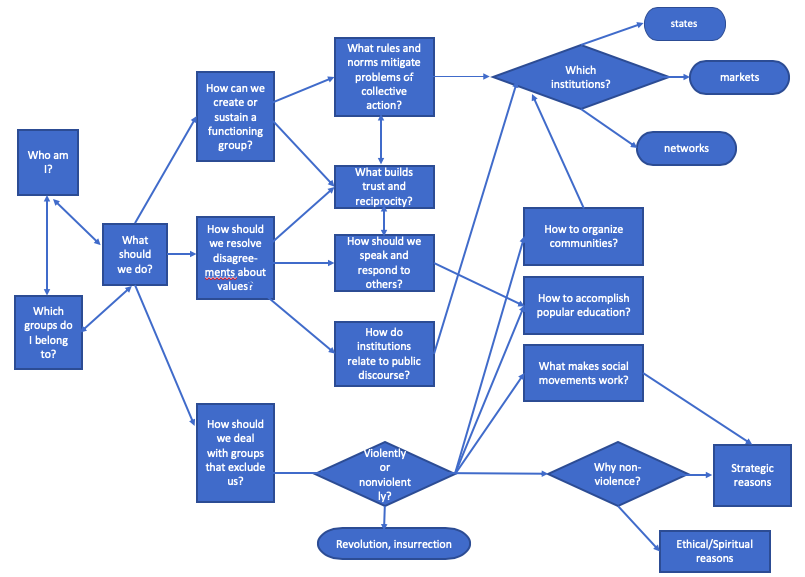
a Civic Studies flowchart

This is an agenda for research and education. It’s a way of organizing the major topics of our Introduction to Civic Studies course for undergraduates. It isn’t intended directly as a flowchart for civic actors (activists, leaders) because their problems are more concrete and more varied. But I hope that by addressing these topics in cumulative research, and by teaching the results (interactively), we can build a base of knowledge useful for activists. (See also the page about Civic Studies on the Tisch College website.)

should US kids learn they have a democracy?

The New York Times’ Dana Goldstein reports a “bruising political fight” over Michigan’s social studies standards, in which one of the questions was whether to describe our government as a democracy or a “constitutional republic,” as some conservatives prefer.

This is a familiar debate, previously held in states like Texas and Georgia. I’ve received messages and comments questioning my expertise on civic education on the ground that I sometimes ignorantly describe the US as a democracy, when it is actually a republic.

Goldstein offers what looks like a definitive, expert resolution:

mainstream historians, political scientists and legal scholars say that the United States is both a representative democracy and a republic — and that there is no contradiction between those terms.

A democracy is government by the people, who may rule either directly or indirectly, through elected representatives. A republic is a form of government in which the people’s elected representatives make decisions.

I think these definitions are fairly arbitrary. Both words have been used for more than 2,000 years in a dizzying variety of ways. The People’s Republic of China doesn’t select its representatives through contested elections. I suppose we might claim it isn’t a genuine republic, but the very first state to claim that title was Rome, whose legislature was hereditary. The first states to call themselves democracies (some of the Greek cities) used a wide variety of methods of governance, including awarding offices by lottery and consulting oracles.

“Republic” has Latin roots, and if you use etymology to determine meaning, then its core idea is the public good–an important domain (sometimes translated as “the commonwealth”) that is public rather than private property. This idea is incompatible with monarchy, which presumes that the state is one person’s property. Therefore, removing Elizabeth II as the titular monarch of Australia would convert it into a republic without really changing how Australia is governed. Developing the idea more fully, we might emphasize the importance and nobility of the public sphere and public life–republican virtues. Conservatives should be cautious about this direction since republicans, from renaissance Italy to Maoist China, have often been hostile to private wealth. The res publica and bonum commune are opposed to private interests.

As for “democracy,” it has Greek roots, and its etymology is power for the people. For some, that means one person/one vote, but that logic has been disputed. For Dewey, it meant active involvement in all sectors of life: science, art, the family, industry. For Soviet apologists, it meant the dictatorship of the proletariat (= the people) through a vanguard party until the state could be abolished entirely. For Bonapartists, it means that voters should anoint a unifying leader in a plebiscite to prevent domination by factions.

It’s true that the word “democracy” often had a pejorative ring until the later 19th century. For many authors, it meant something like mob rule. But they did not consistently equate it with direct, popular rule. In fact, Jefferson used the word “republic” precisely for that form of government:

Indeed, it must be acknowledged, that the term republic is of very vague application in every language. Witness the self-styled republics of Holland, Switzerland, Genoa, Venice, Poland. Were I to assign to this term a precise and definite idea, I would say, purely and simply, it means a government by its citizens in mass, acting directly and personally, according to rules established by the majority; and that every other government is more or less republican, in proportion as it has in its composition more or less of this ingredient of the direct action of the citizens.


— Jefferson to John Taylor, 1816, emphasis added

So when people tell you that the Founders created a republic because they feared “government by its citizens in mass,” they are certainly not remembering Jefferson.

“Ah,” you say, “but what about Madison? Jefferson didn’t write the Constitution or even like it very much. The authors of the Federalist Papers prevailed in its design, and they liked republics rather than democracies.”

Indeed, Madison defended checks on direct, popular rule to protect against factionalism, and his thought remains compelling. But look at what Madison wrote in 1834:

[1] no Government of human device, & human administration can be perfect; [2] that which is the least imperfect is therefore the best Govt. [3] the abuses of all other Govts. have led to the preference of Republican Govt. is the best of all governments because the least imperfect. [4] the vital principle of Repub: Govt. is the lex majoris partis, the will of the majority; [5] if the will of a majority can not be trusted where there are diversified conflicting interests, it can be trusted no where because such interests exist every where ..


— James Madison to Unknown, re majority governments
Dec. 1834 (emphasis added)

So there we see James Madison defending “the will of the majority” and the “law of the larger part,” and calling it republicanism.

For me, the bottom line is that we should stop treating this as some kind of fact that we should impart to youth. What is a democracy, what is a republic, what kind of government we have, and what kind of government we should have are live issues about which thoughtful and learned people disagree. Kids should be welcomed into the conversation.

See also:every Republican president since 1901 has insisted that the US is a democracy; do we live in a republic or a democracy?

pay attention to movements, not just activists and events

Let’s say you work in a school or college, a newsroom, a city government, or a firm. You may encounter a social movement when it makes demands on you. Regardless of your opinion of its demands, you probably see it as different in kind from the organization where you work. Your organization has a bank account, a board, and a mission statement. The social movement may appear to you mainly in the guise of individuals who participate in events or episodes—people you call protesters, boycotters, strikers, or voters. Or you may think of the movement as the name for people who share beliefs or goals. For instance, you could notice that many of your students have become environmentalists, or anti-racists, or neo-fascists. To you, they are a movement.

I want to encourage a different view. Any “movement” that is worthy of that name persists over multiple events and episodes (McAdam, Tarrow & Tilly 2001). It recruits active members and supporters and collects resources, which it uses in more or less strategic ways. Its members may not agree about anything in particular, not even about the marquee slogans of the movement. Ziad Munson has found that many anti-abortion protesters do not start with strong opinions about that issue but are recruited into activist networks from which they derive their anti-abortion views while they act (Munson 2010).

“Opponents of abortion” is the name for a segment of the population, who can be identified with a survey that asks opinion questions. The Pro-Life Movement, on the other hand, is a social entity that has resources and membership that persist over time; some of its members are not even against abortion. This is typical of movements in general.

Once you distinguish between individuals (activists, radicals, protesters) and a movement, you will notice that the movement resembles your own organization in some respects. It may encompass several autonomous components, but it still constitutes a larger whole with a real presence. For example, the American Civil Rights Movement encompassed many churches networked together in organizations like the Southern Christian Leadership Council, classic membership associations like the NAACP and the Urban League, a political party (the Mississippi Freedom Democratic Party) and a union (the Brotherhood of Sleeping Car Porters), among their entities, but we can still tell the movement’s history and describe its central tenets and tendencies at each point in the story

You should not only ask: What political opinions do I hold and which categories of citizens do I agree or disagree with? You should also ask: What do I think of the social movements of the day? Are they drawing diverse people together for generative conversations? Are they inventing new forms of political action that are valuable? Are they bringing out the best in their members? Do they create “Free Spaces,” forums in which their members discuss and learn (Evans & Boyte 1986)? Examples from the past include Grange Halls in Populism, Freedom Schools in the Civil Rights Movement, Talk-Ins against the Vietnam War, consciousness-raising circles in Second Wave Feminism, the “human microphones” of the Occupy Wall Street movement, and the uses of hashtags like #BlackLivesMatter and #MeToo to organize conversations online.

On the other hand, do the social movements of the day promote norms and habits that damage their members or other people? Do they tend toward extremism, nihilism, cynicism, a cult of personality, group-think, or other pathologies? How good are they at SPUD?

A movement can be worthy of support even if you disagree in part with its current agenda, if it provides a forum for learning, growth, and solidarity. We can’t accomplish much alone, so it can be your civic responsibility to participate in a movement that you don’t endorse 100% if you think it’s better than nothing and has the potential to improve. On the other hand, you may find that you agree with every demand of a social movement but choose to avoid it because of its internal dynamics. The point is to pay attention to the movement, not just the claims that it makes at the moment.

See also: a better approach to coalition politics; Habermas with a Whiff of Tear Gas: Nonviolent Campaigns and Deliberation in an Era of Authoritarianism; the value of diversity and discussion within social movements; a sketch of a theory of social movements; and against methodological individualism

Sources: Evans, Sara M & Boyte, Harry C., 1986. Free Spaces: The Sources of Democratic Change in America. New York : Harper & Row; McAdam, Doug, Tarrow, Sidney and Tilly, Charles, 2001. Dynamics of Contention (Cambridge: Cambridge University Press); Munson, Ziad W. 2010; The Making of Pro-Life Activists: How Social Movement Mobilization Works. Chicago: University of Chicago Press.

identities, interests, and opinions

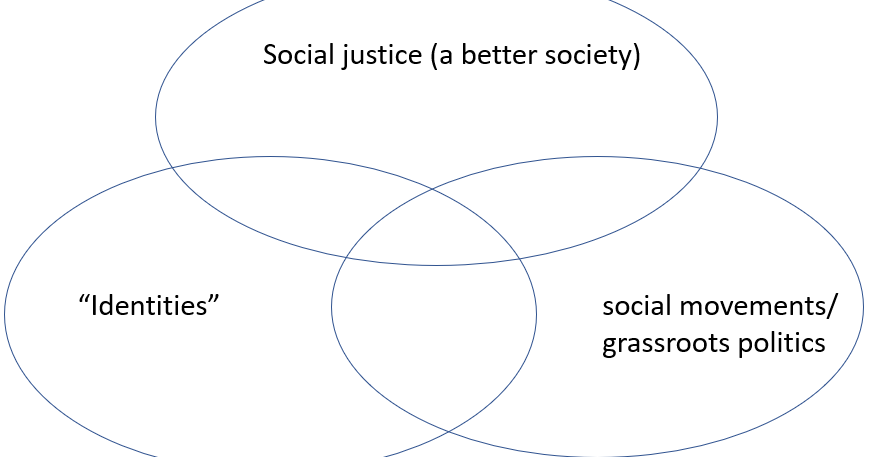
In our Introduction to Civic Studies course, this is the zone we’re currently in:

We all need some account of what would make a good–or at least a better–society. This idea can be provisional and open-ended; we still need something to orient us. If you think that it’s easy to define “social justice,” consider that it was the name of Father Coughlin’s antisemitic and pro-Nazimagazine in the 1930s.

We must consider the potential of bottom-up, participatory, social movements to promote justice, because the powerful won’t reliably offer justice. However, reasonable people disagree about how important bottom-up politics is. Maybe top-down leadership or impersonal forces are much more significant.

Finally, we must consider how identities (what we are, as opposed to what we think) fit in. Is all politics identity-politics? Or should we distinguish between “old” social movements, which made universalist claims, and “new” ones, which are identity-based? If the distinction holds, is the change good or bad? Also, does justice require fair treatment of identities? And what is an identity? For example, religion: an identity or a set of beliefs?

As always, it’s our students’ job to navigate their own way through these shoals; I don’t offer answers. But I do think it is interesting to distinguish:

  • An identity: “Speaking as a …”
  • An interest: “I want …”
  • An opinion: “We should …”

I’ll stipulate that we all use all of these forms of speech, and they are all protected under the First Amendment. Which ones are allowed is not a good question. But we might ask:

  • Which of these can be right or wrong?
  • Which can/should be subject to compromise?
  • Which does one have a moral right to? (Relatedly, which ones do other people have an obligation to honor in various ways?)
  • Which should we be open to changing, and why?

Here is an example of a view, although I am not wedded to it:

People have a right to their identities. Sometimes we should change our identities in response to new understandings. For instance, some people didn’t used to see sexual orientation as an identity, especially if they happened to be straight; now they should see heterosexuality as an identity. We should not, however, compromise our identities as part of a deal with others. We are usually right about our own identities, but not inevitably. We can lie or even lie to ourselves about who we are.

We should be open to compromising our interests in order to share the world with others. Whether to compromise depends in part on the moral standing of the other party. We should also be open to changing our interests in response to principled arguments, but that is a different process from compromise. We have a right to certain basic interests, but we can claim interests that we do not have a right to. You can disagree that something is my legitimate interest. I may even owe you an argument that it is.

Our opinions can be right or wrong. We should be open to changing them on the basis of evidence and arguments. We shouldn’t easily compromise them (in the sense of splitting the difference), although there are times when that is wise. Opinions should be sincere, so if you do compromise them, you should mean it.

See also: the New Social Movements of the seventies, eighties, and today; don’t confuse bias and judgment; and why study social justice?

Interfaith Studies, Civic Studies

In a talk yesterday at Tufts, Eboo Patel, the founder and President of the Interfaith Youth Core, said that the guiding question of the field of Interfaith Studies is how to build a religiously diverse democracy. He defined a democracy as a place “where people can make their personal commitments public.” He said that diversity “is not just the differences you like.” It means being able to deal with people who disagree with you about important matters, including politics. And he defined religion as being “about ultimate concerns.”

Eboo made an explicit connection to Civic Studies, for which the defining question is “What should we do?” How to live democratically with religious diversity is an important branch of Civic Studies. It raises empirical questions (What are the roles of religious congregations in civil society? How will they change? How do human beings react to out-groups?) and normative questions (What is the place of faith in public deliberation? How should we respond to beliefs that are intolerant? When should we treat the transmission of practices from one tradition to another as appropriation?)

In January, I got a dose of Interfaith Studies–meaning the theory, the everyday practices, and the committed people–at a conference of the Pluralism Project. I’m eager to work with our chaplaincy and others to build a stronger strand of Interfaith Studies as a complement to Civic Studies.

See also: when political movements resemble religions; the political advantages of organized religion; are religions comprehensive doctrines?; on religion in public debates and specifically in middle school classrooms; churchgoing and Trump; and is everyone religious?

call for papers: Civic Politics and Global Order

“Civic Politics and Global Order”: A Special Issue of The Good Society: A Journal Of Civic Studies

More than a century ago, US President Woodrow Wilson asked Congress to declare a state of war with Germany—a radical step in pursuit of a radical objective. Seeking “no conquest” and expecting “no indemnities” for any life or treasure lost, Americans, Wilson declared, would fight “for democracy, for the right of those who submit to authority to have a voice in their own governments, for the rights and liberties of small nations, for a universal dominion of right by such a concert of free peoples as shall bring peace and safety to all nations and make the world itself at last free.”

The “concert of free peoples” that emerged from the Great War’s ashes—the League of Nations— never gave adequate international expression to such democratic civic ideals, nor could it prevent a second global conflict. Yet it laid grounds for a complex of institutions—among them the World Bank, United Nations, NATO, and European Union—that for decades after World War II embodied for millions of people the possibility of an increasingly stable and just world order. Now the prestige of that order has reached a historic low, and its continued existence has come into doubt.

Simultaneously, however, citizens and societies worldwide continue to seek ways of achieving Wilson’s essential vision: a vision of self-governing communities collaborating, despite conflicting interests, on the otherwise impossible task of creating a safe and just world.

Aware of such strivings and persuaded of their importance, the editorial board of The Good Society invites submissions from scholars and practitioners exploring the relationship between civic politics and global order. What interests do self-governing communities at the national, subnational, or transnational level have in maintaining international or global order? What normative commitments are required, and what independent and collaborative actions are advisable, to advance such interests while maintaining due regard for divergent local, cultural, and historical contexts?
What strategies and tactics—proven, novel, or forgotten—are ripe for implementation, experimentation, or rehabilitation? Above all hangs the question: Is there a regulative ideal of global order that self-governing aspirants and civic agents should adopt? If so, how can it be formulated, disseminated, theorized, and realized in a manner that respects the plural as well as universal interests and experience of humanity?

The editorial board invites papers of 6,000 to 8,000 words that address the questions above, as well as other relevant questions emerging from serious inquiry into the character of a good society and the conditions for achieving and maintaining it. Please submit papers by May 1, 2019 to: http://www.editorialmanager.com/gs/default.aspx

For more information regarding this call, write Trygve Throntveit, editor, tthrontv@umn.edu

The Good Society is the flagship journal for the interdisciplinary (between disciplines) and transdisciplinary (beyond disciplines) field of Civic Studies. For more information on Civic Studies, please visit http://civicstudies.org/about/ .

Empathy and Justice

My remarks at a conference entitled “Empathy …. or Ways of Caring,” Harvard Department of Romance Languages and Literatures, March 15, 2019. (Apologies for some cutting and pasting from previous posts.)

Doris Sommer mentioned that Barack Obama popularized the notion of an “empathy deficit.” In a 2004 interview with Oprah Winfrey, while he was still a State Senator, Obama said:

I often say we’ve got a budget deficit that’s important, we’ve got a trade deficit that’s critical, but what I worry about most is our empathy deficit. When I speak to students, I tell them that one of the most important things we can do is to look through somebody else’s eyes. People like bin Laden are missing that sense of empathy. That’s why they can think of the people in the World Trade Center as abstractions. They can just crash a plane into them and not even consider, “How would I feel if my child were in there?”

Here Obama links empathy to moral judgment. In a 2006 commencement address, he also implies that the level of empathy in a society as a whole is a precondition of social justice. Our “empathy deficit” explains why we accept that “Americans … sleep in the streets and beg for food,” that “inner-city children …. are trapped in dilapidated schools,” and that “innocent people [are] being slaughtered and expelled from their homes half a world away .”[2]

To suggest that this argument is problematic, I would quote then-President Obama in Jerusalem on March 21, 2013:

I — I’m going off script here for a second, but before I — before I came here, I — I met with a — a group of young Palestinians from the age of 15 to 22. And talking to them, they weren’t that different from my daughters. They weren’t that different from your daughters or sons.

I honestly believe that if — if any Israeli parent sat down with those kids, they’d say, I want these kids to succeed. (Applause.) I want them to prosper. I want them to have opportunities just like my kids do. (Applause.) I believe that’s what Israeli parents would want for these kids if they had a chance to listen to them and talk to them. (Cheers, applause.) I believe that. (Cheers, applause.)

It is not so much the speech as the applause that I find problematic, because I believe that the Israeli electorate supports policies that are unjust, and their political behavior is compatible with a fair amount of actual empathy.

The word “empathy” is a modern coinage. It is not attested before 1895, and it gained its current meaning only in 1946. Many wise people have thought about moral psychology and justice without using this word at all, so we should consider whether it does us any good.*

I’d posit the following definitions:

  • Empathy: Feeling a similar emotion in response to someone else’s emotional state. Your friend is mad at her boss because he treated her unfairly. That makes you mad at her boss. Your anger is probably different in texture and intensity from hers, but it’s the same in kind, an imperfect reproduction of her mental state.
  • Sympathy: Feeling a supportive emotion in response to someone else’s emotional state that is not the same as that person’s original emotion. She is mad at her boss, so you become sorry for her, or committed to fairness, or sad about the state of the world, or nostalgic for better times–but not angry at her boss. Then you are sympathetic. (NB You can be both sympathetic and empathetic if you feel several emotions.)
  • Compassion: A species of the genus sympathy. Another person’s negative emotion causes you to have a specific supportive feeling that is not the same as her emotion: you sincerely wish that her distress would end without blaming her for it.
  • Justice: A situation or decision characterized by fairness, goodness, rightness, etc. (These are contestable ideas and may be in tension with each other.) The English word “just”–like dikaios in classical Greek–can be applied either to a situation or to a person who cares and aims for justice.

There is an old and rich debate about which character traits and subjective states are best suited to pursuing justice. One answer is that you should be a just person, one who tries to decide what is fair or best for all (all things considered), who desires that outcome, and who works to pursue it.

A different response is that we are not well suited to defining and pursuing justice itself. We lack the cognitive and motivational qualities that would allow us to grasp justice and reliably act on it.

Justice is an abstract idea that takes the form of words: it is discursive. According to a mainstream view in contemporary moral psychology, we first form emotional opinions about concrete situations and then we select the ideas that will justify those opinions, post-hoc. Justice doesn’t guide us; it justifies and excuses us.**

In that case, it might be better to cultivate emotions, such as empathy, sympathy, compassion–or loyalty, aversion to harm, or commitment to specific rules–in order to deliver more just outcomes, all things considered.

In her remarks, Marina Amelina noted that developed countries built social welfare systems between ca. 1880 and 1970. That could because their publics became more empathetic. But it also be because less-wealthy people gained power and used it to protect themselves. Equal power plus self-interest might generate justice more reliably than empathy. John Rawls famously modeled justice as the decisions that self-interested parties would make if they were rendered perfectly equal by a Veil of Ignorance that blocked them from knowing their own situations. In the real world, we can approximate the Veil of Ignorance by assuring that everyone has equal rights and powers. This is a clear alternative to the view that justice should be built on empathy.

Paul Bloom and others argue that empathy is particularly unreliable guide to justice, more likely to mislead than to inform. For instance, Donald Trump can make people feel empathy for a small number of individuals whose families were allegedly victimized by undocumented aliens, and then use that emotion to build support for deporting millions of people who have harmed no one. A famous example is Edmund Burke’s outrage at the mistreatment of Marie Antoinette, which obscured any concern for the countless people tortured, executed, or “disappeared” by the ancien regime that she represented. (By the way, I respect Burke–and I don’t think it was fair or smart to execute the Queen–but this passage is still a good example of misplaced empathy.)

Empathy can also substitute for justice, as the transcript from Jerusalem that I quoted earlier suggests. You congratulate yourself for feeling some version of a suffering person’s emotion and excuse yourself from fixing the problem.

Compassion may be better than empathy. Instead of feeling the same emotion as the other person, you feel a combination of beneficence and equanimity that may be a more reliable guide to acting well. But it’s possible that compassion only clears the deck for reasoning about what you should actually do.

Other candidates for emotional states that might be more reliable than empathy include solidarity, responsiveness, openness, and intellectual humility.

For its part, justice can be emotional. You can feel a powerful urge to make the world more just. That is helpful insofar as the feeling motivates you and insofar as people obtain genuine insights from our emotions; but it is dangerous because the emotion of desiring justice can be misplaced. You can feel great about improving the world when you are actually harming it.

In the end, I think we must wrestle with these questions:

  1. Can we human beings reason explicitly about justice in ways that improve upon our strictly affective reactions to particular situations? Can we put into words what is good or fair, and why, and make ourselves accountable for that position? Or is this always special-pleading, mere rhetorical justification for what we have already decided based on our emotions?
  2. Does an improvement in social justice indicate an improvement in empathy?
  3. If we should cultivate an emotional stance toward others as a buttress of—or an alternative to—justice, should that stance be empathy, or rather compassion, responsiveness, solidarity, humility, or something else?

*Buddhism is perhaps most widely associated with the virtue that Obama calls “empathy”—in his terms, “the ability to put ourselves in someone else’s shoes; to see the world through those who are different from us” (Northwestern Commencement speech). But Emily McRae notes that “empathy” has no direct translation in Sanskrit or other languages that have been used to express the Indo-Tibetan Buddhist tradition. Key words from that tradition are better translated as “compassion” and “sympathetic joy.” McRae derives a theory of empathy from Buddhist texts, but she focuses on phrases like “exchanging self and other” rather than any single word that corresponds to “empathy.” McRae, “Empathy, Compassion, and ‘Exchanging Self and Other’ in Indo-Tibetan Buddhist Ethics” in Heidi Maibom , ed., The Handbook of Philosophy of Empathy (Routledge, 2017).

**Jonathan Haidt, The Righteous Mind: Why Good People Are Divided by Politics and Religion(New York: Vintage, 2012), pp. 27-51; Ann Swidler, Talk of Love: How Culture Matters (Chicago: University of Chicago Press. 2001); pp. 147-8; Leslie Paul Thiele, The Heart of Judgment: Practical Wisdom, Neuroscience, and Narrative Cambridge University Press, 2006) and Jesse Graham, Brian A. Nosek, Brian A., Jonathan Haidt, Ravi Iyer, Spassena Koleva, & Peter H. Ditto, “Mapping the Moral Domain. Journal of Personality and Social Psychology, vol. 101, no. 2  (2011)., p. 368)

See also: empathy, sympathy, compassion, justice; empathy: good or bad?; “Empathy” is a new word. Do we need it?; how to think about other people’s interests: Rawls, Buddhism, and empathy