
School and Society in the Age of Trump

John Rogers and the research team of Michael Ishimoto, Alexander Kwako, Anthony Berryman, and Claudia Diera have produced a landmark study entitled “School and Society in the Age of Trump,” based on their survey of 505 high school principals and follow-up interviews of 40 principals.

The principals offered evidence about five challenges that confront schools at this moment: 1. “Political division and hostility,” 2. “Disputes over truth, facts, and the reliability of sources,” 3. “The crises posed by opioid addiction,” 4. “Vulnerabilities associated with threats of immigration enforcement” and 5. “The perils and frequency of gun violence.”

The report explores the frequency of these issues in various types of school: those with predominantly students of color, racially-mixed schools, and schools with mostly white students; schools in Trump, anti-Trump, and politically mixed communities; and schools in different regions of the country. Principals were also also asked how their schools respond. For instance, do they communicate the importance of respecting new immigrants? Do they discipline students for uncivil or demeaning behavior?

All the results make sense, but they are not always immediately intuitive. For instance, derogatory remarks about other racial/ethnic groups are more common than derogatory remarks about immigrants, and both are most common in predominantly white schools, but far from absent in the other schools. (See below.)
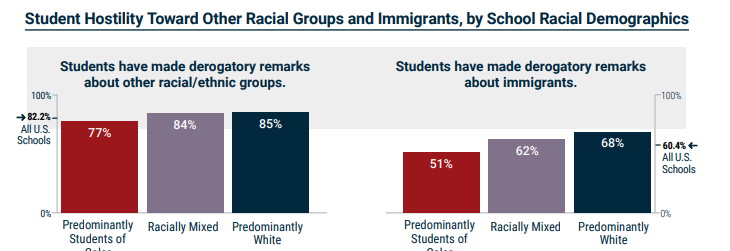
Principals are also most likely to report disciplining students for insensitive remarks in mostly-white schools, but they are much less likely to talk with their students about the importance of respecting immigrants in the mostly-white schools.

Many principals report proactive responses, such as meeting with student groups to ask for their help in promoting civility and respect or meeting with parents for similar purposes. But those responses vary greatly. Sixty-two percent of principals serving mostly youth of color met with parents for this reason, versus 37% of principals in mostly white schools.

It’s common today for parents to challenge the information or news sources that teachers assign or for students to reject assigned sources. The frequency of those events doesn’t differ dramatically depending on the schools’ demographics (although I imagine that the sources that are distrusted differ).

According to the report, “A little more than a quarter of principals report they have restricted topics or information sources in order to diminish the flow of unreliable or contentious information.”

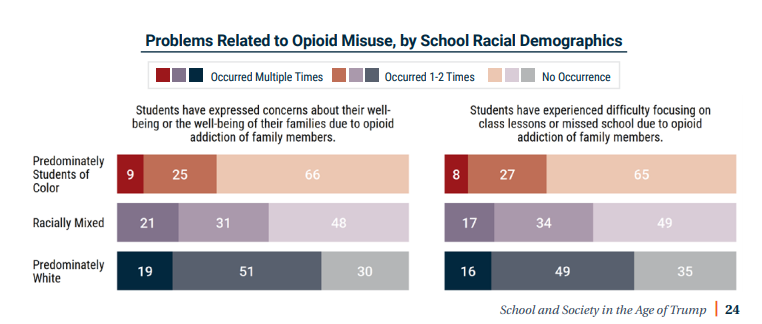
A different kind of stress comes from the opioid crisis. It is worst in predominantly white schools but definitely present in racially-mixed schools and those that serve mostly youth of color.
Rogers and colleague write that “Sixty-eight percent of the principals we surveyed report that federal immigration enforcement policies and the political rhetoric around the issue have harmed student well-being and learning, and undermined the work of their schools in general.”

Students across the board are fearful of gun violence, but more so to the degree that their students are people of color.

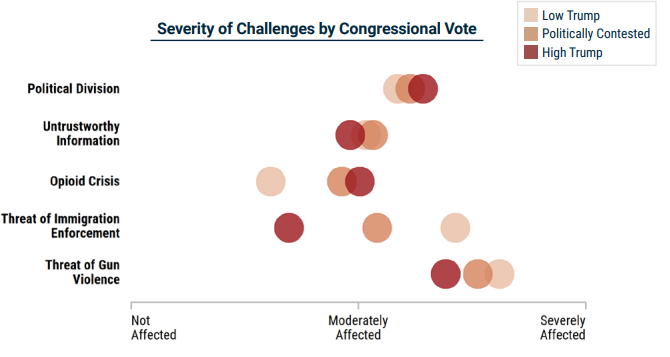
These challenges vary by demographics and region, but I’ll show a final graph about politics. The opioid crisis is most widely reported in Trump country. Political division is also more often reported there than elsewhere, but by small margins. In Trump country, far fewer principals report immigration enforcement as a challenge for their students. (That is either because of where most immigrants live or because of problems of under-reporting in Trump districts, as Rogers notes.) Untrustworthy information is seen as a challenge everywhere, to about the same degree, but I am sure that what counts as untrustworthy varies.
These are just some snapshots from a rich and compelling report.
how to think about other people’s interests: Rawls, Buddhism, and empathy

Last week, my colleague Erin Kelly and I taught excerpts from John Rawls’ Theory of Justice along with Emily McRae’s chapter, “Empathy, Compassion, and ‘Exchanging Self and Other’ in Indo-Tibetan Buddhism,” from the Routledge Handbook of Philosophy of Empathy. I then attended a conference on empathy. As a result, I’ve been thinking about Rawls’ famous thought-experiment, Buddhist exercises for moral improvement–and how empathy relates to both.

Rawls argues that to know what justice demands, you should collect all the relevant available information about how the society in general works, but you should then imagine that you don’t know your own position in the society and ask what rules and institutions you would favor–in your own interest–under this “veil of ignorance.”

To make that method seem intuitive, imagine that I am considering (in the light of last week’s scandalous news about college admissions) whether it is desirable for such institutions as Yale University to exist. I should try to understand how Yale functions, today and in the past, in the broader society. But I should try not to be influenced by the fact that I was admitted to Yale and graduated from there. I should ask whether the existence of Yale would be a good thing if I did not know whether I would ever get anywhere near it. Thus general knowledge plus self-interest plus ignorance about my own circumstance equals justice.

We could think of this thought-experiment as a way of modeling justice. Just as we test a model of a new airplane in a wind tunnel, so we test a theory of justice by using Rawls’ veil of ignorance, because that will yield the same results as justice itself would yield if we could know directly what justice says.

Now compare Rawls’ method to those developed in Indo-Tibetan Buddhism. McRae begins her chapter: “Imagine yourself as an old yak … your back weighed down with a load far too heavy, a rope pulling you by the nostrils, your flanks whipped, your ribs bruised by the stirrups.” She is quoting the nineteenth-century Tibetan master Parrul Rinpoche, who offers it as an exercise in empathy.

McRae defines bodhicitta as a “radically altruistic moral orientation that centrally involves cultivating oneself in order to be the kind of person who can reliably, effectively, and wisely benefit others… . The cultivation involved in becoming a person with bodhicitta–a bodhisattva — … includes developing virtues such as patience, generosity, and wisdom, and moral skills such as mindfulness, moral reasoning, responsiveness, and, arguably, empathy. … .Empathy practices [such as imagining that you are a yak] are traditionally presented in the context of cultivating bodhicitta, since empathy triggers both virtuous emotionality (through the Four Immeasurable Qualities practices) and the realization of no-self (through exchanging self and other practices), both of which are necessary for bodhicitta.”

Here are some differences:

  • Rawls tries to make moral reasoning as impersonal as possible, whereas the Indo-Tibetan Buddhist tradition strives for maximum concrete identification with other sentient beings.
  • In the Buddhist tradition, you cultivate empathy. Rawls provides a way of determining justice that does not require empathy–in part because empathy can be biased, manipulated, and otherwise untrustworthy.
  • Rawls treats every person as equal, whereas a stance of “radical altruism” implies that the thinker should count everyone else as more important than herself.
  • Rawls’ theory is limited to “persons” (probably human beings), whereas Buddhism extends to all sentient life.
  • Rawls offers a technique for deciding what justice is, whereas for the Buddhist theorists, the problem is not deciding what is right–they presume that we should be as altruistic as possible–but rather motivating people to act right. “Exchanging self and other is not simply a heuristic for determining the limiting condition on action (“how would you like it if someone did that to you?”) or a mental exercise in perspective taking. It is a transformative practice that uses empathic imaginative projection to chip away at self-clinging by softening the boundaries of self and other.”

And here are some similarities:

  • Both methods are conducted by the thinker alone. Neither is dialogic, involving an actual exchange of opinions. You imagine you’re a yak, but you don’t ask the yak if you got that right.
  • Like the Buddhist teachers, Rawls also softens “the boundaries of self and other,” but he does so by asking you what you’d want if you did not know who you were.

If you happen to find both arguments persuasive, you’re left with an odd proof:

1. Self-interest plus [a specific form of ] ignorance = justice (Rawls)

2. Compassion plus radical altruism = justice [Buddhism]

So

3. Self-interest plus ignorance = Compassion plus radical altruism

True?

See also: empathy, sympathy, compassion, justice; empathy: good or bad?; “Empathy” is a new word. Do we need it?; Owen Flanagan, The Bodhisattva’s Brain: Buddhism Naturalized; the grammar of the four Noble Truths; avoiding the labels of East and West; Philosophy as a Way of Life (on Pierre Hadot)

Civic Education: Is There Common Ground?

[The video just plays the introduction. Here is a link to all the separate talks.]

This is the video from a panel at the American Federation of Teachers’ Albert Shanker Institute on Wednesday. The panelists are: Leo Casey, Executive Director, Albert Shanker Institute, Jessica Marshall, co-author, “Let’s Go There: Making A Case for Race, Ethnicity and a Lived Civics Approach to Civic Education;” doctoral candidate, Northwestern University; former Director of Social Science and Civic Engagement for the Chicago Public Schools, Robert Pondiscio, Senior Fellow and Vice President for External Affairs, Thomas B. Fordham Institute, Joe Rogers, Director of Public Engagement and Government Affairs, Center for Educational Equity, Teachers College, Columbia University, and me. The moderator is Marla Ucelli-Kashyap, Assistant to the President for Educational Issues, American Federation of Teachers.

I thought the panel reflected some real diversity of perspectives, backgrounds, and opinions, yet we managed to stay focused on a common question: Is there common ground for civic education? My colleagues offered many important insights. My own view, for what it’s worth, is that common ground is available so long as we focus on the vessel into which the content of civics is poured: the need for courses, prepared teachers, funding for materials, etc. Once we begin to discuss how America should be presented to students, disagreements inevitably–and appropriately–arise. Content is the question that excites the most popular interest and concern, from a range of perspectives, and it must be addressed. But we don’t really know to what extent the content of robust civics programs would differ if they developed in more conservative and progressive communities.

conservatism as gratitude or humility?

(DCA) Yuval Levin offers this definition (h/t Robert Pondiscio):

To my mind, conservatism is gratitude. Conservatives tend to begin from gratitude for what is good and what works in our society and then strive to build on it, while liberals tend to begin from outrage at what is bad and broken and seek to uproot it.

You need both, because some of what is good about our world is irreplaceable and has to be guarded, while some of what is bad is unacceptable and has to be changed. 

This is a thoughtful effort to describe left and right evenhandedly, but I don’t think it is the best way to define or defend conservatism.

The problem is that people differ greatly in the degree to which they can reasonably be grateful to any particular polity. Consider, as one of several extreme examples, Native Americans. They can adopt any view of the USA that they want, but they have much less objective reason to be grateful to this republic than I have. They may well feel deep gratitude to their own communities. That gratitude is particularistic. Conservatism would then imply a particularistic ideal: a commitment to the specific communities that deserve each person’s gratitude. Some versions of conservatism have in fact been particularistic–but not Levin’s. He wants Americans (all Americans, I presume) to feel grateful to the nation-state:

But we can also never forget what moves us to gratitude, and so what we stand for and defend: the extraordinary cultural inheritance we have; the amazing country built for us by others and defended by our best and bravest; America’s unmatched potential for lifting the poor and the weak; the legacy of freedom—of ordered liberty—built up over centuries of hard work.

In the same essay, Levin suggests a more secure and persuasive core principle for conservatism—humility:

Conservatives often begin from gratitude because we start from modest expectations of human affairs—we know that people are imperfect, and fallen, and weak; that human knowledge and power are not all they’re cracked up to be; and we’re enormously impressed by the institutions that have managed to make something great of this imperfect raw material. So we want to build on them because we don’t imagine we could do better starting from scratch.

This reminder of “modest expectations” is what conservatism valuably contributes to public debates. Because people are “imperfect, and fallen, and weak”–or, we could say, cognitively and motivationally limited and biased–we should always be somewhat skeptical of ambitious reform proposals, of original designs for complex things (cities, welfare programs, markets), and of the likelihood that any person can dramatically improve things for any other person.

Humility, in this sense, is the common thread that unites libertarians (skeptical of central planning), religious conservatives (skeptical of human reason and motivation), and communitarians (skeptical of formal institutions). It also encourages all three types of conservatives to admire complex phenomena that have emerged and that seem to function well enough–“that have managed to make something great of this imperfect raw material.”

Levin argues that humility implies gratitude, but that connection is contingent. It depends on whether what has emerged so far is good enough for you and the people you care most about. Answers to that question will reasonably differ. Humility is the premise; gratitude is a consequent that depends on the circumstances. Humility is something that everyone has a reason to endorse, although everyone should also be open to the possibility of change.

See also: what defines conservatism?; a plea to conservatives; and from classical liberalism to a civic perspective

“Empathy” is a new word. Do we need it?

According to the OED, “empathy” entered the English language in 1895 to mean “a physiological brain-function”–specifically, “a form of psychophysical energy” in the nervous system–that correlated with a feeling.

This meaning is now obsolete, because the underlying theory is. A somewhat more familiar meaning appeared in 1909: “Not only do I see gravity and modesty and pride … but I feel or act them in the mind’s muscles. This is, I suppose, a simple case of empathy, if we may coin that term as a rendering of Einfühlung.” E. B. Titchener Lect. Exper. Psychol. Thought-processes i. 21  (1909).

But this meaning is now also “rare,” says the OED. The word “empathy” gained its mainstream current meaning only in 1946 (in a professional psychology journal):

[Meaning 2b] orig. Psychology. The ability to understand and appreciate another person’s feelings, experience, etc.

1946 Jrnl. Clin. Psychol.2 61/1   A ‘man-to-man’ regard for the client, characterized (ideally) by the understanding of empathy without the erratic quality of identification or the supportiveness of sympathy.

You might think it’s a Greek word, and it parses in Greek: en- (“of the state or condition of”) plus pathos (“an incident, accident; suffering”) = “the state of someone’s [else’s] suffering.” But no such word is listed in my Liddell & Scott Greek-English Lexicon. It is a modern English word built of ancient Greek components. If anything, the origin is the German word Einfühlung (coined in 1873), which needed an English equivalent.

While noting the recent origins of the English word, Emily McRae also argues that it has no direct translation in Sanskrit or other languages that have been used to express the Indo-Tibetan Buddhist tradition. Key words from that tradition are better translated as “compassion” and “sympathetic joy.” McRae derives a theory of empathy from Buddhist texts, but she interprets phrases like “exchanging self and other” rather than any single word that corresponds to “empathy.”*

Since the word “empathy” is recent, and many wise thinkers have done without it, we might ask whether adding it to our vocabulary has done us good. It would be possible to carve up the conceptual space so that “empathy” vanished and we used only “compassion,” “beneficence,” “good will,” “forgiveness,” “responsiveness,” “mirroring,” and other related words.

I am a little worried that “empathy” confuses matters by combining an empirical concept–empathy exists when person A feels an emotion, which causes person B to feel some of that same emotion–with a positive moral valence (it is good to be empathetic). Yet it is not always good to feel the same emotion as someone else in response to that person.

*“Empathy, Compassion, and ‘Exchanging Self and Other’ in Indo-Tibetan Buddhist Ethics” for Handbook of Philosophy of Empathy (Routledge), edited by Heidi Maibom, 2017. See also: empathy, sympathy, compassion, justice; empathy: good or bad?; and my self, your self, ourselves

tangled beauty

Let us be glad for tangled things--
   For soiled fingers raking thick-stemmed grass;
     For matted fur on long, warm ears;
Or child's hair idly twisted in rings.
   A thatch of ganglia fires in the brain's wet mass:
     A thought--electric--splits, connects, adheres.

All things rooted, snarled, or tensed,
   Whatever needs some mesh to form its mass,
With loops, forks; twists, knots; ends, tears.
   Let's give thanks for things that are soft and dense. 

See also: for Gerard Manley Hopkins; and Pied Beauty, illustrated.

a better approach to coalition politics

Sometimes people view coalitions instrumentally and transactionally. You know what you believe, but unfortunately you don’t (yet) have enough support, or seats, or votes, or dollars to get what you want, so you must join with other people who either share roughly similar beliefs–close enough to settle for–or who will support your agenda in return for your help with theirs.

We see this approach most clearly in parliamentary systems, when parties come together to form majorities. The center-left party will form a government with the Greens if they need the Greens’ votes, but will drop them if they don’t. We also see it in US logrolling politics: Democrats from rural districts vote for HUD; urban Democrats vote for the Farm Bill. And we see it in social movements, when participants advocate for a “big tent” or invoke a “bird that flies with two wings”–clichés that usually mean: “Include me in your coalition or you won’t win.”

Some circumstances–such as parliamentary votes of confidence–require a transactional approach to putting together coalitions of 50% plus one. But it is possible to view a coalition in a different way: as a network of valuable relationships among people who trust and respect one another.

Brad DeLong, a self-proclaimed “neoliberal” and “[Robert] Rubin Democrat,” recently announced his support for a coalition led by people to his left. Speaking of his own faction within the Democratic Party, he wrote:

Over the past 25 years, we failed to attract Republican coalition partners, we failed to energize our own base, and we failed to produce enough large-scale obvious policy wins to cement the center into a durable governing coalition. We blame cynical Republican politicians. We blame corrupt and craven media bosses and princelings. We are right to blame them, but shared responsibility is not diminished responsibility. And so the baton rightly passes to our colleagues on our left. We are still here, but it is not our time to lead.

Note that DeLong is not renouncing his own beliefs or exiting public life in defeat. Instead, has has reached an all-things-considered judgment that people who disagree with him on some important matters should lead a coalition that he will support. It’s their time.

In a Vox interview, he adds:

while I would like to be part of a political coalition in the cat seat, able to call for bids from the left and the right about who wants to be part of the governing coalition to actually get things done, that’s simply not possible as of now.

We shouldn’t pretend that it is, or that it’s going to be. We need to find ways to improve left-wing initiatives, rather than demand that they start from our basic position and do minor tweaks to make them more acceptable to their underlying position.

DeLong wants to contribute, but he thinks the left should lead. His role is non-coercive persuasion: offering market-based suggestions that the left can accept or not. He doesn’t suggest that his support will be conditional on their agreement. He is in, but he wants to retain his voice. His explicit renunciation of a claim to lead should engender some trust from the left. It’s an example of the general principle that Danielle Allen defends in Talking to Strangers. Our task is to become “political friends” who demonstrate “reciprocal goodwill”; and to get there, often the first step is to make an explicit sacrifice.

In turn, if the left were to lead the Democratic Party, it would become the main source of energy and ideas. Progressives would earn the voluntary support of a broader spectrum. They would not view leftover neoliberals as enemies to be rooted out but as fellow members of the coalition who can be inspired and persuaded. They would take seriously their own capacity, opportunity, and moment to lead. They would see themselves as better leaders if people like Brad DeLong continued to follow them. They would value not only the votes of such moderates but their insights.

They would also care about the condition of the coalition. Is it sufficiently attractive to a broad range of people? Does it offer entry-points for newbies and youth while also honoring the folks who have been working hard for a long time? Is it nimble but also principled? Can it manage dissent? How does it handle disagreement? You can’t answer those questions well if you are always thinking about whether your own policy goals will prevail. You must also care about the coalition as a community.

I am not saying that the currently insurgent left is failing to act this way. So far, so good. I am just offering a way to conceptualize leadership that doesn’t reduce a coalition to a pure means for accomplishing the leaders’ goals. I’d argue that valuing the coalition is a path to wiser strategies and more influence.

See also: we need SPUD (scale, pluralism, unity, depth); saving relational politics; and the value of diversity and discussion within social movements.

will the Democrats keep talking to their young voters?

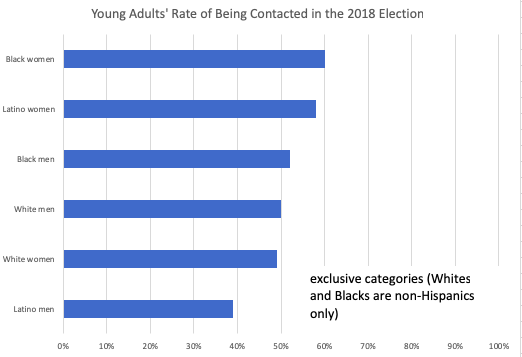
According to CIRCLE’s latest analysis of its own survey data, young people who were contacted by candidates and parties in the 2018 election cycle were much more likely to vote. Some of this is probably selection-bias: campaigns try to contact the most likely voters. But there is also accumulated evidence that contact is effective: it boosts turnout, even for low-propensity voters.

Democrats contacted substantially more youth than Republicans did in 2018. Demographics influenced who received the most contact:

based on CIRCLE data

These differences do not track disparities in political power and SES. On the contrary, young Black women generally face compounded disadvantages in America, yet 60% were contacted in 2018 (presumably by Democrats, for the most part). They top the list. Meanwhile, young white men were ten points less likely to be contacted.

What does this mean? It all depends on the nature of the contact and the follow-up. If Democratic candidates were simply trying to mobilize a reliable segment of their base by sending one-way messages before the election, and if African American women don’t hear from politicians again until October 2020, then the graph demonstrates political opportunism.

On the other hand, if the contact involved some listening and learning by campaigns, and if elected officials now recognize their debt to Black women and continue to engage them between elections, then the graph offers grounds for optimism.

I wouldn’t bet on the more optimistic interpretation, but it’s something to work for.

It’s also worth focusing on young Latino men, who really are left behind. I think this is partly because they are (for the most part) less involved in conventional organizations where people can be found and reached. In social science jargon, they have less “social capital” than the other categories of young Americans.

Finally, I don’t think it’s good news that’s young white men were contacted at low rates. From a partisan Democratic perspective, it could be a reasonably good sign. Democrats, who did most of the outreach to youth in 2018, directed their resources to people of color for a mix of tactical and principled reasons. But we also know that many young white men live in “civic deserts,” where they are generally disconnected from civic and political institutions. That can reinforce combustible forms of alienation. If the low contact rate reflects low levels of membership and belonging, it is evidence of a problem.

See also: Civic Deserts and our present crisis; new research on “civic deserts”; and democracy is coming to the USA.

approaching deadlines for summer opportunities at Tisch College

March 31 is the application deadline for three opportunities:

1. The Summer Institute of Civic Studies

The Summer Institute of Civic Studies is an intensive, selective, interdisciplinary seminar that brings together faculty, advanced graduate students, and practitioners from many countries and diverse fields of study. Topics for the readings and discussions include:

  • How do social systems look from the perspective of people who want to change them?
  • How can people form and maintain functional groups that improve the world?
  • How can people reason together about what is right to do?
  • What practices and institutional structures promote these kinds of citizenship?
  • How should empirical evidence, ethics, and strategy relate?

The Summer Institute was founded and co-taught from 2009-17 by Peter Levine, Associate Dean of Academic Affairs at Tisch College, and Karol So?tan, Associate Professor in the Department of Government and Politics at the University of Maryland. This year it will be led by Peter Levine alone. You can read more about the motivation for the Institute in the Civic Studies Framing Statement.

The 11th annual Summer Institute will start with the Frontiers of Democracy Conference (see below) on June 20-22 and then continue as a seminar until June 28 at 5pm.

Daily sessions take place on the Tufts campus in Medford, Massachusetts. Tuition for the Institute is free, but participants are responsible for their own housing and transportation. One option is a Tufts University dormitory room, which can be rented for $69/night (single room) or $85/night (double room). 

The application consists of a resume, a cover letter about your interests, and an electronic copy of your graduate transcript (if applicable). Please send those materials to Peter Levine, peter.levine@tufts.edu no later than March 31, 2019

2. Proposals for the Frontiers of Democracy Conference

Frontiers of Democracy is an annual conference hosted by the Jonathan M. Tisch College of Civic Life at Tufts University since 2009. It convenes practitioners and researchers who work on strengthening democracy in the US and around the world. The format combines short talks with interactive sessions for smaller groups. This year, it will take place from June 20 (evening) until June 22 (midday) at the downtown Boston campus of Tufts University

In 2019, participants in the Summer Institute of Civic Studies, the APSA Institute for Civically Engaged Research (see below), people involved with the Deliberative Democracy Consortium and Cities of Service, and 40 new fellows of the Lead for America program will attend Frontiers, along with others who register. You can register to hold a spot now. Proposals are also being accepted for individual talks, panels, and other kinds of sessions, such as moderated discussions, workshops, planning meetings, etc. Please submit proposals here by March 31 for best consideration.

3. The first annual American Political Science Association Institute for Civically Engaged Research (ICER)

The APSA Institute for Civically Engaged Research will begin in summer 2019. ICER is intended for advanced graduate students in political science and for political scientists at any stage of their careers who wish to shift to using civically engaged research. (It is not meant for scholars who are already experienced in that approach.)

Approximately twenty participants will meet each day from June 17-20 for intensive discussions. Participants are then expected to attend the Frontiers of Democracy conference from the evening of June 20 until noon on June 22 in downtown Boston.

Tisch College Academic Dean Peter Levine is the organizer. Other confirmed speakers and visitors include: Valeria Sinclair Chapman (Purdue), Archon Fung (Harvard), Taeku Lee (Berkeley), Robert Lieberman (Johns Hopkins), Jamila Michener (Cornell), Amy Cabrera Rasmussen (Cal State-Long Beach), Pearl Robinson (Tufts), and Rogers Smith (Penn). 

Thanks to support from the APSA, participation in the Institute and the conference is free, and scholarships are available to defray costs of travel, food, and housing in dormitories on the Tufts campus. Applicants are expected to seek financial support from their home institution, but admission to the Institute for Civically Engaged Research will not be affected by financial need.

To apply, please complete this form.

In addition, applications are due by March 15 for …

4. The European Summer Institute of Civic Studies

Herrsching, near Munich, Germany, from July 14th to July 27th 2019

The fifth annual European Summer Institute of Civic Studies will take place in Herrsching, near Munich, Germany, from July 14th to July 27th 2019. This Institute is open to applicants from Armenia, Azerbaijan, Belarus, Georgia, Germany, Kazakhstan, Kyrgyzstan, Moldova, Poland, the Russian Federation, Turkmenistan, Ukraine and Uzbekistan. It is funded by the German Government’s Academic Exchange Service (DAAD), which covers travel, food, and lodging costs. The organizers are Prof. Karol Soltan (University of Maryland) and Prof. Tetyana Kloubert (Catholic University Eichstätt-Ingolstadt); Peter Levine will join for 2-3 days.To apply, send a letter of interest, a curriculum vitae, and an academic transcript (if applicable) to Prof. Kloubert at Tetyana.Kloubert@ku.de by March 15, 2019 for best consideration.

the Historovox

Corey Robin’s essay, “Why Has It Taken Us So Long to See Trump’s Weakness?,” is mainly interesting as an argument about trends in reporting. Robin criticizes

a new genre of journalism that forgoes the pedestrian task of reporting the news in favor of explaining it through the lens of academic research. Ensconced at Vox, FiveThirtyEight, dedicated pages of the Washington Post and the New York Times, and across Twitter, the explainers place great stock in the authority of scholarship — and in journalists who know how to wield the authority of scholars

He argues, “There’s a bad synergy at work in the Historovox — as I call this complex of scholars and journalists — between the short-termism of the news cycle and the longue durée-ism of the academy. … When academic knowledge is on tap for the media, the result is not a fusion of the best of academia and the best of journalism but the worst of both worlds.”

An obvious objection is that there are more than just two genres of writing about politics (academic analysis and pedestrian journalism). I’d place Robin’s “Historovox” on a longer list.

  1. Old-school deadline-driven political reporting: The writer tells you what happened yesterday. The lede is an event: a speech, an endorsement, a vote, an indictment. Subsequent paragraphs tell (or remind) you what happened earlier, leading up to this new event. To the extent that the news is explained, the available explanations include: what the actors and their spokespeople say happened, how their critics reply, and the tactical advantages that will result for each. An imaginary example: “The Senator traveled to Wisconsin today to talk about jobs. This follows on the heels of her speech about the environment in Los Angeles last week. People involved in her campaign said that she is engaging two important constituencies. Her opponent charged that she wants ‘to rake in the dollars from spoiled Hollywood liberals.’ Of course, prospective presidential candidates always test their support in key states.”
  2. Positivist, mostly quantitative academic scholarship: The writer looks for statistically significant patterns in representative samples of data (rather than “anecdotes”). She poses and tests explicit hypotheses. She situates her original results in the context of peer-reviewed literature. For instance, “Some previous studies suggest that candidates mainly appeal to donors. Other studies suggest that they focus on ordinary voters. Our analysis of 256 campaign events finds that donor-appeal explains 11% more of the variance in decisions about candidate travel.”
  3. Ideological advocacy: The writer hopes to advance conservatism, or socialism, or environmentalism, or whatever, and uses recent political events as evidence and as a “hook” to persuade the unconvinced and mobilize the base. “The Senator made a great speech about jobs in Wisconsin but needs to remember why unions have declined. It’s no accident that wages have fallen as union membership has fallen: these are the results of neoliberal policy choices.” This style extends from opinion magazines and op-ed pieces deeply into academic journals.
  4. Theory-building: The writer is primarily interested in developing and defending general social theories, which may have both normative and explanatory components. She is trying to develop, for example, a new version of civic republicanism or intersectional feminism or social capital theory. As in #3, recent examples serve as illustrations and “hooks,” but the argument is less predictable, less topical, and may be considerably more complex.
  5. The “Historovox” is a fusion of #1 with #2 and/or #4. Its typical style is to “explain” a concrete recent event by summarizing some relevant positivist social science (#2) and adding an interesting social theory (#4). The very bright, broadly-educated reporter works by searching the scholarly literature and interviewing academics. This style claims to avoid #3, which is seen as politically biased, in favor of “research.”

Robin offers a subtle defense of #1–traditional deadline journalism–by way of quotations from political theorists who might be seen as “particularists”: highly skeptical of generalization and concerned with attending to details:

Everyone knows and cites Orwell’s famous adage: “To see what is front of one’s nose needs a constant struggle.” Less cited is what follows: “One thing that helps toward it is to keep a diary, or, at any rate, to keep some kind of record of one’s opinions about important events. Otherwise, when some particularly absurd belief is exploded by events, one may simply forget that one ever held it.”

and

the job of the scholar is to recall and retrieve what the Marxist critic Walter Benjamin described as “every image of the past that is not recognized by the present.” The task is not to provide useful knowledge to the present; it is to insist on, to keep a record of, the most seemingly useless counter-knowledge from the past — for the sake of an as-yet-to-be imagined future.

If I read him right, Robin is not saying that we need writers to express opinions about each event and record what they have opined. Rather, we–readers, citizens–should do that. Journalism gives us the raw material for our daily opinion-formation, and we should hold ourselves accountable by checking our views as new data arrive.

As a bit of a particularist myself, I find these quotes resonant, and I start with the premise that we badly need paid professional reporters to cover events. But the objection to #1 is that it was never theory-free, never just a record of what happened yesterday. Instead, it always embodied a problematic general theory, according to which history results from explicit decisions by self-interested professional politicians who compete with each other. Absent are deeper causes, issues ignored by the major parties, areas of agreement, and the work of citizens. Thus deadline journalism never served citizen-readers as well as it should have. It served up the wrong mix of “news events” for us to form opinions about.

#2 is valuable but has its limitations. As I argued right after the 2016 election, positivist social scientists mostly failed to predict Trump because their job is to detect trends in data collected already (i.e., the past). They can’t see that something is about to shift fundamentally, and when that happens, they retain a bias in favor of treating the new event as one outlying datapoint that doesn’t threaten the theory. A classic version of that critique is Robert C. Lieberman, “Ideas, Institutions, and Political Order: Explaining Political Change.” American Political Science Review 96.4 (2002): 697-712.

Another problem with #2 is tempo. The process of collecting representative data, analyzing it, and publishing it in peer-reviewed form takes many months or years, by which time events have moved on. Citizens cannot benefit from analysis unless they can use it in time.

Everyone criticizes #3–editorializing in support of an ideology–yet ideologies are indispensable heuristics, and each case of advocacy can contribute to a rich public sphere as long as you read it critically along with other views.

The advantage of #5 is translation. It connects social theory and empirical data to the news, allowing readers/citizens to learn from scholarly expertise. The big disadvantage is that there are theories for every fact. As Robin observes, when Trump looks strong, it’s time to cite the literature on authoritarianism. When he’s weak, we dust off the literature on the weak presidency. Historovox writers have a Malcolm-Gladwellish tendency to discover a new idea and find evidence of it everywhere for a while. Then events change, interests wander, and they find a new idea. As he argues, this is no way to learn.

But I think several commentators on Crooked Timber are right that explanatory journalism strives to address a real need. If we only had the first four categories listed above as separate streams, we’d be crying out for linkages. Sites like Vox and FiveThirtyEight (and The Conversation) don’t do this perfectly, but they seem fairly self-reflective and dedicated to self-improvement, and nobody could pull it off perfectly at first.

See also: why political science dismissed Trump and political theory predicted him; why political science dismissed Trump and political theory predicted him, revisited;