
what if political parties structure our thinking for us?

Presumably, each person should hold a structured set of political opinions. For instance, if you want more government spending without any new taxes, you should be OK with deficits (unless you dispute that deficits will result). If you want a specific right for yourself, you should support the same right for other people, because fairness demands equal protection (unless another worthy principle overrides that conclusion). If you think individual liberty is a high priority, you should oppose censorship (unless you think restricting speech is necessary for a different reason). Each of your beliefs should predict several others, forming a tight network.

In the early 1960s, Philip Converse argued that most Americans’ beliefs were hardly structured at all (Converse 1964). Knowing what a person believed about x would not help you predict what that person believed about y.

Converse’s article has been cited more than 12,000 times and has generated a large literature. Some studies have confirmed his basic finding (e.g., Kinder & Kalmoe 2017). Some use different methods or datasets to challenge his conclusion by finding structure (e.g., Boutyline & Vaisey 2017 or Levine 2022). Some have contested Converse’s interpretation. For instance, maybe people are ambivalent about issues, holding views on both sides. A multiple-choice survey misses their ambivalence and gives a misleading impression that people are inconsistent when they really feel conflicted (Zaller & Feldman 1992).

There is also a line of research that finds that most Americans (Achen & Bartels 2016, p. 268; Sniderman 2017) and Europeans (Galina 2023) hold structured political beliefs, but their structures come from the leaders of their political parties.

It may not be self-evident what a conservative or a progressive party should think about each new topic, from COVID vaccination to Russia’s invasion of Ukraine to bailing out a bank in Silicon Valley. But parties do form views, and their voters generally follow suit. Most people’s lists of issue positions mirror those of their party’s leaders. A given person’s ideas may or may not cohere, but they probably correlate closely with the positions of that person’s party.

I do not think that this research settles the empirical issues. The reality is complicated, with many dynamics at work. There are methodological challenges, such as the limitations of surveys that I mentioned earlier. And it’s not completely clear what causes what. (Maybe party elites are affected by their grassroots members or by some third force, such as celebrities.) Nevertheless, I believe there is at least some important truth to the theory that parties organize people’s thinking for them–or, I should say, for us. As Paul Sniderman puts it, “parties organize the choice environment” for voters “and define what goes with what” (Sniderman 2017 p. 71).

How should we assess this situation? Is it good or bad, and does it require some kind of remedy?

One way to think about those questions is to choose a model for understanding political parties. Here are three, amongst others:

  1. Activists and leaders of political parties are highly interested in issues. Most people defer detailed consideration of issues to the leadership of their preferred party. That makes good sense, in the same way that it’s often wise to delegate a decision to a committee of passionate volunteers. Supporters of a party can assess its general direction and use “voice” (becoming involved in the party’s decisions) or “exit” (leaving the party or just voting for a different one), if they are dissatisfied (Hirshman 1970). Perhaps a given political system needs more voice–more participatory opportunities within each party–or more viable parties, so that voters can exit more easily. But we should not be worried by the general finding that people take their cues from party leaders. People are wisely delegating the nitty-gritty work of political analysis to those who enjoy it most. Voters are learning from the more extensive thinking of party leaders.
  2. Party leaders are politicians, defined as people who want and pursue political offices for themselves. They will choose positions on issues to improve their chances of winning. Their self-interest is not shared by ordinary people, who want good outcomes. Insofar as people take their cues from party leaders, they are being used as means to the politicians’ personal ends. In a better democracy, more of us would exhibit individual structures of ideas, and political leaders would have to cater to our views, not the reverse.
  3. Parties basically reflect social interests. In a given system, there may be a party for the farmers, for the urban middle classes, for the observant Catholics, and for a linguistic minority. In the USA, the electoral system forces the concatenation of interests into two umbrella parties, but they are basically coalitions of such interests. Therefore, voters will primarily seek a party that protects the interests that they consider most important (not necessarily material ones). However, a party must also take positions on many other issues. Leaders choose positions that maximize their party’s political appeal and leverage so that they can protect the voters’ core interests. Voters assess parties as tools for protecting their interests, and as long as they are basically satisfied with a given party, they will mimic its specific issue stances.

I think the truth is some mix of these ideas, depending on the political system. After all, countries differ in respect to how many parties they have, whether and to what degree their major parties are ideologically or demographically distinguished, whether coalitions are built inside parties or among them, whether parties exercise discipline over politicians, to what extent intellectual work is conducted inside the parties compared to other sectors of the society, and which kinds of people constitute the party “elites.” (In the USA, official members of the party committees are less influential than nominally nonpartisan pundits and celebrities.)

As usual, empirical evidence is relevant to our political judgments, but it is insufficient. What should we do if “parties organize the choice environment”? Sniderman clarifies the empirical literature and offers some important normative guidance. But his argument makes me want to think harder about how specific parties in specific political systems play their structuring roles and whether their approaches to choosing and combining positions are acceptable.

See also: Mapping Ideologies as Networks of Ideas; are Americans ‘innocent of ideology’?; what if people’s political opinions are very heterogeneous?; two theories of American political parties; social class inversion in the 2022 US elections, etc.

References: Achen, C. H., Bartels, L. M. (2016), Democracy for Realists: Why Elections Do Not Produce Responsive Government; Princeton University Press; Boutyline, A., & Vaisey, S. (2017), Belief network analysis: a relational approach to understanding the structure of attitudes, American journal of sociology, 122(5), 1371-1447; Converse, P.E. (2006) The nature of belief systems in mass publics, Critical review 18.1-3 (2006): 1-74; Kinder D.R. & Kalmoe, N.P. (2007), Neither liberal nor conservative: Ideological innocence in the American public, University of Chicago Press; Gallina, M (2023), Solving the (false) dilemma: an ecological approach to the study of opinion constraint,” Political studies; Hirschman, A. O. (1970), Exit, voice and loyalty: responses to decline in firms, organizations, and states (Cambridge, MA: Harvard University Press); Levine, P (2022), Mapping ideologies as networks of ideas, Journal of Political Ideologies: 1-28. Sniderman P.M. (2017), The Democratic Faith: Essays on Democratic Citizenship (New Haven, CT: Yale University Press), Zaller, J. & Feldman, S. (1992), A simple theory of the survey response: answering questions versus revealing preferences, American Journal of Political Science, 36:3: 579-616

the design choice to make ChatGPT sound like a human

Elizabeth Weil provides a valuable profile of the linguist Emily M. Bender, headlined, “You Are Not a Parrot, and a chatbot is not a human. And a linguist named … Bender is very worried what will happen when we forget this.”

This article alerted me (belatedly, I’m sure) to the choice involved in making artificial intelligence applications mimic human beings and speak to us in the first-person singular.

For instance, since I’m living temporarily in Andalusia, I asked ChatGPT whether I should visit Granada, Spain.

The first sentence of its reply (repeated verbatim when I tried again) was a disclaimer: “As an AI language model, I cannot make decisions for you, but I can provide you with information that may help you decide if Granada, Spain is a destination you would like to visit.”

On one hand, this sentence discloses that the bot isn’t a person. On the other hand, it says, “I can provide …” , which sure sounds like a person.

Then ChatGPT offers a few paragraphs that always seem to include the same main points, conveyed in evaluative sentences like these: “Granada is a beautiful city located in the southern region of Spain, known for its rich history, culture, and stunning architecture. It is home to the world-famous Alhambra Palace, a UNESCO World Heritage site and one of the most visited attractions in Spain. The city is also known for its vibrant nightlife, delicious cuisine, and friendly locals.”

My initial amazement at ChatGPT is wearing off, but the technology remains uncanny. And yet, would it look less impressive it gave more straightforward output? For instance, imagine if I asked whether I should visit Granada, and it replied:

The computer has statistically analyzed a vast body of text produced by human beings and has discerned several patterns. First, when human beings discuss whether to visit a location or recommend doing so, they frequently itemize activities that visitors do there, often under the categories of food, recreation, and sightseeing. Second, many texts that include the words “Grenada, Granada, Spain” also use positive adjectives in close proximity to words about food, sights, and outdoor activities. Specifically, many texts mention the word “Alhambra” in proximity to the phrases “UNESCO heritage site” and “world-famous,” paired with positive adjectives.

This would be an impressive achievement (and potentially useful), but it would not suggest that the computer likes Grenada, Granada wants to help me, or knows any friendly locals. It would be clear that people experience and judge, and ChatGPT statistically models texts.

We human beings also draw statistical inferences from what other people say, and perhaps we even enjoy the Alhambra because human beings have told us that we should. (See “the sublime and other people.”) But I really did see a peacock strutting past palms and reflecting pools in the Carmen de los Martires this morning, whereas ChatGPT will never see anything. Why try to confuse me about the difference?

See also: artificial intelligence and problems of collective action

learning from Robert’s Rules?

I have never been good at Robert’s Rules of Order, even though decades ago I was the president of a student government that supposedly used them. Looking at the by-laws of incorporated boards and bodies that I serve on now, I see that several include language like this: “Except as may be modified by resolution, Robert’s Rules of Order (current edition) shall govern the conduct of [association] proceedings when not in conflict with [state] law or these By-Laws.” Indeed, I’ve found an estimate that “approximately 95% of the organizations in the U.S. prescribe Robert’s as their parliamentary authority.” However, lots of important but informal groups don’t have by-laws, and those that do often seem to pay little attention to their own provisions about Robert’s Rules.

I probably wouldn’t advocate applying Robert’s Rules much more widely than they are used now. Learning–or recalling–the Rules can be burdensome; depending on them can shift power to people who happen to know them already; and they may conflict with contemporary cultures. After all, they were written by a US Army officer in 1876.

Actually, Brig. Gen. Roberts was an abolitionist Southerner who fought on the Union side and did other worthy things, so he may deserve some consideration. In any event, his Rules embody wisdom, and all groups that make decisions should find ways to accomplish some of their fundamental goals. As Roberts wrote in the first edition of his Rules, it was “really not of so great importance” whether his own processes were the best. What was–and remains–important is to adopt transparent ways of operating in order to avoid “the caprice of the chairman, or captiousness of the members.”

That lesson has been re-learned in very different contexts. By 1970, the feminist activist Jo Freeman, aka Joreen, had become frustrated by the emphasis on “leaderless, structureless groups” in the women’s liberation movement. She acknowledged that women were reacting “against the over-structured society in which most of us found ourselves, and the inevitable control this gave others over our lives, and the continual elitism of the Left and similar groups among those who were supposedly fighting this overstructuredness.”

However, Freeman claimed that all groups have structure, and when they purport to be leaderless and free, it just means that the authority is opaque and therefore unaccountable.

She wrote, “At any small group meeting anyone with a sharp eye and an acute ear can tell who is influencing whom.” Those in the core of an informal group “will relate more to each other than to other people. They listen more attentively [to each other], and interrupt less; they repeat each other’s points and give in amiably; they tend to ignore or grapple with the ‘outs’ whose approval is not necessary for making a decision.”

Freeman saw supposedly leaderless groups as tyrannical. “For everyone to have the opportunity to be involved in a given group and to participate in its activities the structure must be explicit, not implicit. The rules of decision-making must be open and available to everyone, and this can happen only if they are formalized.”

Specifically, groups need explicit rules for delegating authority, sharing information, rotating responsibility, making clear commitments, and holding their own decision-makers accountable. These are the very purposes of Robert’s Rules. If we don’t want to use that document, we need alternatives.

I observe the following deficits in many informal groups’ discussions. First, groups are often not clear about what they have promised, so that members and others can know what to expect. An approved resolution is a commitment. If your group doesn’t vote on resolutions per Robert’s Rules, you need other ways to make clear and official commitments.

Second, it is often unclear what the group is doing at a given moment. Is it discussing a choice prior to making a collective decision? Are individuals giving advice to a person or small team who will make the decision? Are members sharing information with each other? Is the group exchanging perspectives on the overall situation and values? Is the task to identify problems and brainstorm options?

These are all valid activities, but they need to be distinguished. Robert’s Rules does so by allowing any member to offer a motion, which (if seconded) becomes the sole topic until it is resolved. A motion must be stated in such a way that it can be adopted or rejected by a vote. Thus, when a motion is on the table, the group’s task is to discuss it in order to inform the individuals’ votes, not to canvass individuals’ advice or share information. A different motion can be offered next, but it must wait its turn.

Informal groups waste precious time and energy–and become frustrated–when they are not clear on what they are doing. In the absence of rules of order, a moderator can keep people on track, but moderation is an advanced skill, and the power can be abused. Some groups develop other approaches, such as writing the current task on a flip chart. One way or another, it’s essential to clarify what is being done now and to allow people to propose doing something different next.

Third, groups need moments when everyone has equal power, even if they choose to empower some individuals for specific tasks. Robert’s Rules mandates voting on an equitable basis. It allows every member to introduce motions. It forbids anyone from speaking twice on a motion unless everyone has had a chance to speak once.

This kind of equality is purchased at the cost of formality. That is actually a familiar tradeoff. Official elections give each citizen one vote, and that requires ballots, voting dates or periods, and myriad other rules. Courtrooms are rife with procedures designed to equalize rights and powers.

Many groups understandably dislike formality, which seems to undermine spontaneous friendship. Yet, as Freeman observed in the women’s movement, informality breeds inequality. Groups must be able to shift to formal processes that protect equality at decisive moments.

Fourth, groups spend too much of the precious resource of time discussing matters that should delegated to individuals or small teams. A whole group is usually too large to function effectively. Many tasks do not present controversial issues that require broad discussion and participation; someone should simply do the work. At the same time, it is important to clarify what has been delegated to whom, to hold the responsible people accountable, and to give them explicit recognition for their service. Robert’s Rules accomplishes those purposes by allowing groups to elect officers for fixed terms, to establish committees, and to delegate specific tasks to committees. Again, there may be other ways to accomplish these purposes, but they cannot be ignored.

See also: a flowchart for collective decision-making in democratic small groups; civic education and the science of association; friendship and politics; needed: pragmatists for utopian experiments; and du Bois: “Organization is sacrifice.”

symposium: civic education in the 21st century

This is the video from a recent colloquium entitled “What Should Civic Education Become in the 21st Century?” at the Ohio State Center for Ethics and Human Values (CEHV). Law professor Angela Banks (Arizona State University) and I presented, and the moderator was Ohio State philosopher of education Winston Thompson. The blurb from CEHV says:

Democracies, in their essence, require the engaged participation of their citizens working towards articulating and pursuing shared goals. Arguably, these practices require a degree of skill and preparation such that the value of civic education cannot be overstated as a core component of a successful democracy. But how should societies understand the complexities of civic education in the current age? How should civic education respond to growing calls for justice as voiced through emergent social movements? Amidst rising patterns of immigration and globalized loyalties, can traditional approaches to civic education satisfy the needs of our democracy?

Angela Banks discussed how schools should address citizenship when rights to entry and residency and full legal citizenship are contested, and when many students do not have those rights. I presented a general framework for civic engagement that does not put the nation-state at the center. Winston Thompson, who had envisioned and organized this symposium, asked us good questions.

the decline of the daily newspaper and public knowledge of politics

A city or town newspaper was nicely designed to keep people informed about their own elected representatives. Traditionally, it appeared on your doorstep, offering a mix of features that might encourage you to open it up. Election news would often appear above the fold on the main page. Elections in your own community would be emphasized. You didn’t have to be curious about politics to receive the most relevant political news.

As the chart with this post shows, most Americans (69.3%) claimed they read a newspaper “every day” in 1972, but that proportion has been around 20% since 2016, mirroring a 50% decline in the number of paid journalists. People still consume news, but cable television is national, local television tends to skip politics, and online sources require you to seek them out. (They mainly reach those with prior interests.) Besides, very few people are paid to report factual information about local politics.

I wish I could test whether the decline in daily newspaper journalism and readership explains current low levels of political knowledge. Perhaps that can be shown, but I have not found a long-lasting survey that asks about both news consumption and political knowledge in consistent ways.

The American National Election Survey (ANES) did ask individuals how often they read the newspaper and whether they recalled the names of the congressional candidates in their district. That series lasted from 1984 to 2000. Each year, just about twice as many of the regular newspaper readers recalled the candidates’ names correctly. For instance, in 2000, 51.8% of the regular readers and 24.2% of non-readers got that knowledge question right.

I’d conjecture that if these survey questions had continued, the proportion of news readers would have fallen in the ANES, and with it, knowledge of people’s own local political candidates. But I can’t quite prove it.

color-blindness makes it to an art museum

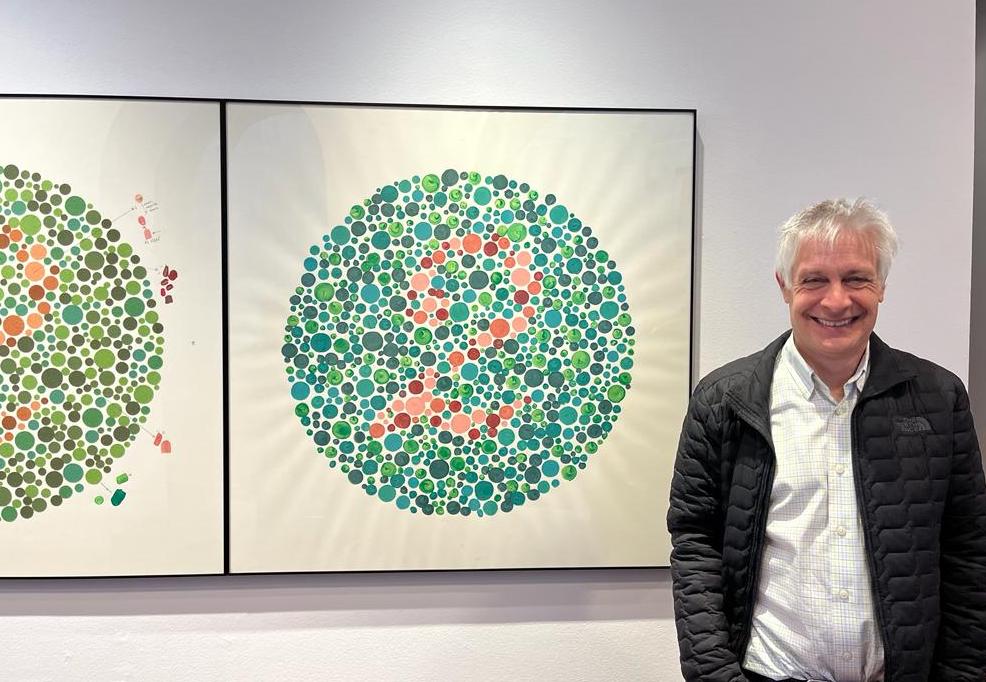
I am color-blind. I have the common red/green type sometimes called Daltonism.

I do not mind. In fact, I don’t think I would accept a permanent “cure,” if there were one. I might like to experience the colors that most sighted people see, but I wouldn’t want to leave the world I know on a one-way journey. I love what I experience.

Miguel Fructuoso, Maria Sanchez and Miguel Angel Tornero are established Spanish artists. Although Fructuoso was born in 1971, he was recently diagnosed with Daltonism. I am curious about that story. Adults realized that I was color-blind when I was still a little kid. Fructuoso is a painter, and he has the same physical condition I do. I am not sure how he remained undiagnosed for half a century. It has been suggested, but not widely accepted, that the English landscape painter Constable was color-blind at a time before that condition was recognized.

In any case, Fructuoso’s realization “initiated an intense collaboration” with Sanchez and Tornero, who have co-produced works as “formal exercises” that help them to explore “empathy and exclusion, the rare and the common, individualism and the collectivity.”

They have created several such works for the Centro Jose Guerrero in Granada. Guerrero was born here in 1914, spent a considerable portion of his life as an abstract expressionist painter in New York City, and died in Barcelona in 1991. He was known for vivid color. That makes his eponymous museum a perfect location for an exhibition about color-blindness.

The photo (above) that illustrates this post shows a painting by Guerrero from ca. 1970 (I think), copied by the three contemporary artists, with color-blind “Bill” choosing the paints. Yes, the two images look very similar to me, except along the top band.

Below is the result when many people with red/green color-blindness were offered a large selection of paints and asked to paint a line of a single color around the room in the Centro Jose Guerrero. Yes, I perceive a green line going all the way around.

Installation in the Centro Jose Guererro (Granada) showing a line painted by many color-blind people. Many would perceive it as changing color,

And here, the artists have reproduced the standard tests for color-blindness as gallery works in paint and print. (No, I cannot see any numbers, but I do like these images.)

Color blindness test reproduced as a paining for the show Daltons at Centro Jose Guererro, Granada

Since I have not felt mistreated as a result of color-blindness, I was not deeply moved by the exhibition’s message of empathy and inclusion, although it’s certainly benign. And I suppose I am sympathetic to Fructuoso, although he has done very well in a conceptual/expressionist mode.

I find aesthetic questions about color-blindness interesting. For example, how might we compare the art that I see (and love) to what most of you see? Does it matter that I don’t see what was intended? And how should I feel, as a person with Daltonism, about monochrome art, expressionist art that is meant to look different from the real world, or impressionist works that reproduce nature’s colors for me even though both the paintings and their objects look different to you?

propose sessions for Frontiers of Democracy 2023

Proposals for sessions at the annual Frontiers of Democracy conference are due by March 31. You can propose a session here.
 
You are also encouraged to register and purchase tickets soon since space is limited.
 
Proposals are welcome on any topic at the “frontiers of democracy”—for instance, political reform, organizing and social movements, dialogue and deliberation, journalism and media, civic education from K-12 to college or community settings, nonviolent resistance, collaborative governance, social entrepreneurship, democratic theory, online forums and tools, issues such as climate change or racial justice, engaged research methods, democracy in any region of the world, and more. Many formats are welcome with a preference for interactive designs over pure presentations.
 
The last face-to-face Frontiers conference before COVID-19 drew about 140 people, of whom 30% were nonprofit staff, 25% were scholars/researchers, 15% were educators, 5% were community-organizers, and the rest came from many fields, including the arts, philanthropy, business, and government. Most came from beyond the Boston area and a few from overseas.
 
Most proposals for 2023 are not expected to address the special theme: religious pluralism and robust democracy in multiracial societies. That theme will mainly be a topic for two of the plenary sessions, which will be panel discussions involving Cornell William Brooks, Brandon Thomas Crowley, Diana Eck, Andrew Hanauer, Aminta Kilawan-Narine, Eric Liu, Cristina Moon, Simran Jeet Singh, Michael Wear, and others to be named. Some conference participants may be interested in considering connections between religion and your proposed topic, but you do not have to mention religion in your proposal.
 
The submission form for a session requires a title and description for the conference agenda, some thoughts about your format and audience, and the contact information of confirmed collaborators.
 
This year’s conference will be in-person, not hybrid. However, session organizers may propose to include remote people in their own sessions.

Time and location: July 13 (5 – 7 PM) to July 15 (noon) on Tufts University’s Medford, MA campus near the Medford/Tufts Station on the Boston Green Line.

Cost: $240 for a standard ticket with discounts for current students. This includes hors d’oeuvres on July 13, breakfast and lunch on July 14, and breakfast and lunch on July 15. Other meals and lodgings are not provided.

sabbatical update

I’m in Granada, Spain, for three months, as part of a sabbatical. We’re living in a “carmen,” which is a “a type of urban housing” typical of two specific neighborhoods in this city, “with an attached green space, both garden and orchard, that constitutes an extension of the dwelling, according to the classic definition of Seco de Lucena. A Carmen is a space closed to the outside, surrounded by walls about two meters high, usually whitewashed, with lush vegetation” (per Wikipedia).

That describes our rented house quite well. We’re located near the summit of the Albaicin, the neighborhood of which the young Lorca wrote, “[El] tiene sonidos vagos y apasionados y esta’ envuelto en oropeles suaves de luz oscura” (“It harbors vague and passionate sounds and is wrapped in soft tinsels of dark light”). I see what he meant, but the views are usually crisp and vivid–with the snow-capped Sierra Nevada rising behind the sharp angles of the Alhambra–and the birds that provide most of the soundscape seem raucously cheerful rather than wistful for the lost world of al-Andalus.

I’m busy with several research projects that will benefit from concentration, including an interesting collaborative study that involves trying to diagram the logic of open-ended responses to a political survey. I appreciate the quiet hours when Americans are asleep, although I’m glad to hear from people once dawn breaks in the USA.

Although I’m certainly learning about Granada and Spain, I feel too much of a novice to post much about those topics yet. I presume I will blog normally about civic engagement and related matters.

politics without metaphysics?

During three recent talks on What Should We Do? A Theory of Civic Life, I received interesting questions of a similar type.

In the book, I argue that human beings must come together in a whole variety of groups in order to learn what is right by discussing and acting together. I claim that this is our best way of pursuing wisdom.

The questions I received were about animals and/or the divine. Does my account presume that people are the only beings that fully count? That assumption could be cashed out as a metaphysical view–for instance, that human beings alone have free will and therefore represent the sole intrinsic goods. As such, it would conflict with many other metaphysical views–for instance, that all sentient beings have been given harmonious roles by their attentive creator.

My answer (hardly an original one) is fundamentally pragmatic. I think that discussing and acting with other human beings is the best way we have to make ourselves wise. We don’t have the option of including animals in our discussions because they can’t talk. And we don’t get direct and explicit divine instructions, unless perhaps very rarely.

This does not mean that animals don’t count or that there is no higher power. Perhaps we have very important duties toward other sentient creatures (which may require close attention to their expressed needs) and toward God or gods. But we must define and honor these duties by interacting with other human beings.

John Rawls is the most famous advocate of the idea that politics does not require metaphysics (see “Justice as Fairness: Political not Metaphysical,” 1985). I am saying something similar, except that my view is much more polycentric.

The main focus of Rawls’ thought is a constitutional democracy as the sovereign power in a nation. He sees a legitimate government as the mechanism for deciding what justice demands. Because its citizens have the right to hold their own religious and other fundamental views, a legitimate state must be neutral in relevant ways, which makes it “liberal” in a certain sense of that term.

I view any religious denomination as one of the venues in which people come together to decide what is right to do together and to learn from one another. It may be defined by certain metaphysical premises that all its members endorse (although that is not uniformly true of religions). Unlike Rawls, I do not see the liberal state as one uniquely legitimate umbrella organization set over the religious denominations and other groups. Rather, a society is a panoply of associations that have diverse purposes and assumptions, and the liberal state is simply the association that is charged with settling a range of issues that involve public law. The society as a whole generates wisdom (and folly, in various proportions).

Most of our associations have no need to be neutral about metaphysics. They are entitled to take strong positions about the divine, about nature, and about other philosophical questions. Still, all of them are necessarily groups of human beings, and the topic that interests me is how to design them to bring out the best in their members. That topic does not seem to require getting the metaphysics right.

Objection: When some groups of human beings gather to decide what they should do, they consult non-human sources. They pray, they study texts of revelation, or they commune with nature and try to learn from non-human animals. Must we not decide whether their beliefs are correct in order to assess their behavior? For instance, perhaps it is wise to pray to a divinity that exists but not otherwise. In that case, metaphysics must come before politics.

I would answer this objection from two different perspectives. First, as an individual, I must put myself in groups to learn from others and keep myself accountable to them. To some extent, I can choose which groups to join. Their core philosophical commitments are relevant to my decisions about membership. I should be less likely to join a group that I fundamentally disagree with, and some of those wouldn’t want me in the first place. However, core philosophical commitments represent one kind of consideration among others. Plenty of people are good members of religious communities despite doubts. In short, I can critically assess groups and join only my favorite ones, but I shouldn’t be too fastidious about these choices.

Second, as a citizen, I should be glad that there are many different groups. They reflect freedom of association and diversity. They contribute to the society-wide discussion. Not only should I fight for their First Amendment rights and tolerate their presence, but in many cases, I should actively learn from them. Even if I disagree with their metaphysics, they may have insights that would benefit me. From a different perspective: even if I am foolish in doubting their articles of faith, their divine inspiration can speak to me through their human members.

I often return to John Dewey’s formulation of “the democratic idea in its generic social sense” from The Public and Its Problems (1927). He proposes three principles. Everyone should belong to many groups, which must “interact flexibly and fully” with each other. These groups should derive the full benefit of all their members’ contributions. And people should be involved in “forming and directing the activities of the groups” to which they belong. This vision is all about human beings, but I don’t think it challenges either religious beliefs or deep concerns for nature. It is rather an idealistic account of how people–who may hold diverse fundamental views–should govern ourselves, because that is something we must do.

See also: modus vivendi theory; bootstrapping value commitments; what if people’s political opinions are very heterogeneous?; social justice from the citizen’s perspective; what secular people can get out of theology; the I and the we: civic insights from Christian theology; latest thoughts on animal rights and welfare, etc.