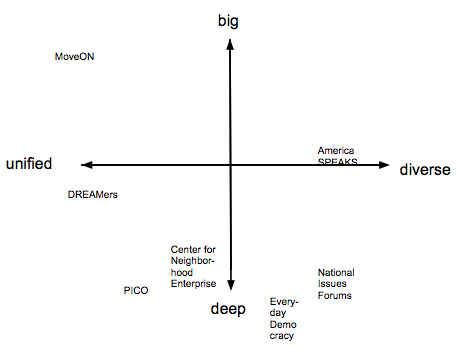
large-scale civic movements forming?

I don’t know much more about these efforts than what I read online, but they represent an interesting confluence:

  • From Idealist.org: “The big day is almost here! We’re just about ready to launch the Idealist network—a new online and on-the-ground platform that will help people everywhere take action on the issues they care about. More than 20,000 people are set to learn more and join us [on] March 11 …. We’ll start with a live online presentation, take your questions, and then start building this network with you. Here’s some background about why we’re doing this, and why we need your voice in the conversation.”
  • From Rich Harwood: “I’m glad to announce today [Feb. 19] The Harwood Institute’s plan to train 5,000 new Public Innovators by 2016. Public innovators are individuals with the mindset and skills to catalyze and drive productive change in communities and change how communities work together. We’ll also grow our Public Innovators Corps to 100,000 members – individuals who actively support this new direction and use our approach to better their communities, organizations and lives.”

Assuming no overlap, that would be 120,000 people. I admire the scale of these efforts. Of course, there are many more people already at work in civic networks–but additions are always welcome.

The post large-scale civic movements forming? appeared first on Peter Levine.

W.H. Auden’s long journey

Articles entitled “The Secret X,” are usually exposés of X’s secret crimes and shames. But Edward Mendelson’s article “The Secret Auden” (New York Review, March 20) catalogs the many discreet acts of kindness, sensitivity, and self-sacrifice of W.H Auden. Auden sounds like one of the nicest famous people who ever lived–sleeping outside the door of an old woman’s apartment to help her with night terrors, befriending awkward teenagers at literary parties, helping convicts with their poetry.

What does this have to do with the man’s writing? Auden went on a long inward moral journey. After his early celebrity as a left-wing poet, he was suspicious of his own motives and the causes they had attached him to. His relentless self-criticism was not barren, self-destructive, or cynical; it gave him material for his best writing.

Mendelson offers an example. Isaiah Berlin was “Auden’s lifelong friend,” and on the surface it would appear that the two men held similar views: resistant to ideology and tolerant of  human beings in all their crooked particularity. In his essay on Turgenev, Berlin wrote: “The dilemma of morally sensitive, honest, and intellectually responsible men at a time of acute polarization of opinion has, since [Turgenev’s] time, grown acute and world-wide.” Mendelson summarizes Auden’s response:

Whatever Berlin intended, a sentence like this encourages readers to count themselves among the sensitive, honest, and responsible, with the inevitable effect of blinding themselves to their own insensitivities, dishonesties, and irresponsibilities, and to the evils committed by a group, party, or nation that they support. Their “dilemma” is softened by the comforting thought of their merits.

This is an example of how far Auden’s journey had taken him: from ideology to the anti-ideological liberalism of Isaiah Berlin, and then beyond that to a stance of deep self-criticism in which even anti-ideology is an ideology. As Mendelson notes, Auden dedicated “The Lakes” (1952) to Berlin. This poem is about preferring homely lakes to the great ocean, and enjoying their diversity and particularity. Berlin might agree, but Auden inserts a warning (not quoted here by Mendelson): “Liking one’s Nature, as lake-lovers do, benign / Goes with a wish for savage dogs and man-traps.”

At a high-theoretical level, Auden explored the many ways in which we are tempted to adopt self-aggrandizing ideas. In his poems, Auden depicted those clashing ideas with irony and humor. And in his private life, he tried to act kindly and lovingly toward all. It seems he actually lived the life he (over-generously) attributed to Sigmund Freud:

Of course they called on God, but he went his way
down among the lost people like Dante, down
to the stinking fosse where the injured
lead the ugly life of the rejected,

and showed us what evil is, not, as we thought,
deeds that must be punished, but our lack of faith,
our dishonest mood of denial,
the concupiscence of the oppressor.

(See also: In “Defense of Isaiah Berlin,” Six Types of Freedom,” “The Generational Politics of Turgenev,” “mapping a moral network: Auden in 1939,” “notes on Auden’s September 1, 1939,” “on the moral dangers of cliché,” and “morality in psychotherapy.”)

The post W.H. Auden’s long journey appeared first on Peter Levine.

the civic one million versus the Lesters

Lawrence Lessig makes the following argument in his TED Talk, his excellent stump speech (which he gave last week at Tufts), and his book The USA is Lesterland:

Members of Congress and candidates for Congress spend anywhere between 30% and 70% of their time raising money to get themselves elected or their party back in power. But they raise that money not from all of us. Instead, they raise that money from the tiniest fraction of the 1%. Less than 1/20th of 1% of America are the “relevant funders” of congressional campaigns. That means about 150,000 Americans, or about the same number who are named “Lester,” wield enormous power over this government. These “Lesters” determine this critical first election in every election cycle—the money election.

I could not agree more. I spent 1991-3 lobbying for campaign finance reform on behalf of Common Cause and have watched things deteriorate ever since. I admire Lessig’s extraordinary leadership and commitment, exemplified by his walking across New Hampshire recently to raise awareness. He has moved easily 1,000 times as many people as I have with my book The New Progressive Era and other writings about campaign finance.

Yet I am not that optimistic about the strategies he proposes. He is clear-eyed about the limitations of each strategy but leaves the audience wondering if anything can work. Here is where I would offer an alternative.

The “Lesters” are exceptionally powerful because their money buys communication. They do not literally purchase votes; they buy the ability to advertise and persuade. One reason that they raise so much money ($7 billion in 2012) is that mass communication has a low return on investment. Influencing elections is an expensive and uncertain proposition.

Meanwhile, in We are the Ones We Have Been Waiting For, I estimate that at least one million Americans are currently involved in demanding forms of civic work–projects and programs that involve strong elements of open-ended public deliberation. Collectively, they engage many millions of their fellow citizens. Their impact per dollar is much higher, because they have strong relationships with peers.

But they are so deeply invested in specific civic projects that they do not have the time to step back and ask why civic work is so frustrating and marginal in our society. A major reason is the corruption of our political institutions, and the Lesters are deeply implicated in that. The strategy I recommend is to organize the “Civic One Million” for political reform. They have vastly less money than the Lesters, but they may actually have more of what the Lesters try to buy: persuasiveness.

In practical terms, this means convening people who do civic work to ask why their efforts are so hard, to diagnose the barriers, and to develop collective strategies for political reform.

The post the civic one million versus the Lesters appeared first on Peter Levine.

toward a technique for moral reflection

classmapmarch

My undergraduate students have identified their own most significant moral ideas and commitments and the important connections among them. The image above shows the networks that have resulted so far–with each student colored differently, and each idea shown as shared if two or more students held it. Today, students are pairing up to explain their moral networks and will adjust their own maps if their partners propose persuasive ideas (or remind them of any ideas they forgot). I anticipate that the class map will become a tighter network as a result.

As I briefly explained in class, a network is a model that can be used to describe anyone’s moral thought. The nodes are ideas; the links are various kinds of connections. That people have moral networks is not a theory that could be found true or false. Rather, a network is a tool for visualizing how anyone thinks.

Often, when we try to improve our moral thought, we seek a systematic philosophy or theology. At any rate, systems (such as Kantianism, utilitarianism, or the classical Hinduism of the Bhagavad Gita) are what we most often teach in courses on philosophy and religion.

Any system organizes the whole network in some way. For instance, the system may assert that there is one highest good (very general and abstract) that should imply all the other ideas on our map. Or the system may offer an algorithm for determining which ideas belong and which ones trump other ones.

If a moral system is valid, then an individual can relate directly to it. You can adopt it as your network. You don’t need other people to help apply the system to your own life.

If you can make a moral system work, that’s fine. But I find that almost all reflective people are not systematic; they have lots of related ideas without a coherent structure. (The same has also been found by some psychologists and sociologists.) This is even true of very religious people. They may assert that God knows one organized structure or even the God holds just one idea. But we can’t know it. We humans must hold lots of different beliefs, values, stories, heroes, etc.–closely connected but not reducible to a system.

If we can’t adopt a system, the other way to improve is constantly to reflect on and revise our own networks. This is more like gardening than architecture. You start with what’s already growing, and you trim, weed, and plant one idea at a time. That process requires other people because we need their perspectives and experiences to provide ideas and to check our own biases. We can expect that our moral network will be dynamic and somewhat situational. (We’ll have different ideas in different contexts.)

At times in the history of thought, systematic moral theories have been dominant. But those moments have alternated with times when many of the leading thinkers just can’t assent to the available systems. They instead offer techniques for moral reflection and self-improvement (a.k.a. moral therapy, or moral hygiene). For instance, the systematic moment of Plato and Aristotle gave way to Stoicism, Epicureanism, and Skepticism, which are all about techniques of self-improvement. The high point of medieval Catholic systematic theology gave way to Renaissance essayists like Montaigne. The era of Kant and Hegel gave way to Emerson and Nietzsche. I think the same alternation has occurred in Eastern thought as well.

The thinkers who teach methods of continuous moral improvement vary a great deal, but I find a very frequent return to three fundamental criteria, each in tension with the other two: 1) truth, or at least the avoidance of error; 2) community or justice; and 3) happiness or inner peace. For instance, those are the three criteria in Greco-Roman thought after Aristotle. Rabbi Shimon ben Gamliel, a rabbi of about the same time, is supposed to have said: “On three things the world stands: justice, truth, and peace.” In Buddhism, the Three Jewels are Buddha (freedom from suffering), dharma (law—but in Buddhism, it often means truth), and sangha (community).

And that is why I am interested in putting people into dialogue with each other about their moral networks and asking them to reflect on whether their networks are compatible with truth, community, and happiness.

The post toward a technique for moral reflection appeared first on Peter Levine.

civics projects are good for AP scores (and what that means more generally)

University of Washington Professor Walter Parker and colleagues are running experiments in which some classes take AP US Government as it’s typically taught (textbooks, lectures, and some discussion), and others experience a curriculum based on mock trials and other projects. All the kids take the same AP standardized test. The project-based curriculum evolves from year to year, because Parker and colleagues didn’t have a perfect model all ready to adopt. But, as they have run the experiment, the kids in the project-based courses have performed at least as well on the AP test as their peers, while also demonstrating higher scores on civic engagement.

All this is well described in a Seattle Times piece by Linda Shaw. The project is important as a rigorous test of the theory that people learn better when they are engaged and interested. Here, the outcome measure (an AP test) is artificial and isolating. Each kid answers the questions privately, to demonstrate her knowledge of relatively abstract material. The kids’ creativity and interaction with each other are not assessed. And yet, learning the material through experience yields equal or better test scores.

The project is also important as a model of collaboration between teachers and university-based scholars. It isn’t a randomized study of a prepackaged intervention (although we do those, and I would defend them), but rather a collaborative process of design and redesign that is then measured very rigorously.

Finally, this project suggests a partial solution to a deep problem. Contrary to popular belief, we have not really cut civic education from our schools. But we have transformed it from a set of discussions and projects into a bunch of academic courses that mimic the social sciences in college–of which AP US Government is a prominent example.

In 1928-9, according to federal statistics, more than half of all American ninth-graders took “civics.” This was the tail end of the Progressive Era, and “civics” meant learning about one’s own community and, often, doing group projects outside of the school.* Enrollment in courses called “civics” had fallen to 13.4 by the early 1970s.

In 1948-9, 41.5 percent of American high school students took “problems of democracy,” which typically involved reading and debating stories from the daily newspaper. By the early 1970s, that percentage was down to 8.9.** But the percentage of high school students who have taken any government course has been basically steady since 1915-1916, and AP US Government is the fastest growing AP course.

Thus we have basically transformed civic education from guided experience of citizenship*** into a dispassionate study of the US government. On philosophical grounds, I object. But as long as that trend continues, Walter Parker’s research is enormously helpful. He shows that by using some of the old techniques of “civics” and “problems of democracy,” we can actually achieve higher scores on a what amounts to a poli. sci. exam–presumably because kids are more engaged and challenged.

*Meira Levinson and Peter Levine, ”Taking Informed Action to Engage Students in Civic Life,” Social Education, vol. 77 no 6 (Nov Dec 2013), pp. 339-341

**Richard G. Niemi and Julia Smith, “Enrollments in High School Government Classes: Are We Short-Changing Both Citizenship and Political Science Training?” PS: Political Science and Politics, vol. 34, no. 2 (June 2001), p. 282.

***”Guided experiential education” is Levinson’s term.

The post civics projects are good for AP scores (and what that means more generally) appeared first on Peter Levine.

the benefits of service for low-income youth

Here are five key points for anyone who promotes service as a means to improve the success of low-income young people.

1. Teenagers who participate in community service have much better academic and psycho-social outcomes than their peers.

Sources: Alberto Dávila and Marie T. Mora, “An Assessment of Civic Engagement and Educational Attainment” (Medford, MA: Center for Information and Research on Civic Learning and Engagement, 2007); Christopher Spera, Robin Ghertner, Anthony Nerino, and Adrienne DiTommaso, Volunteering as a Pathway to Employment: Does Volunteering Increase Odds of Finding a Job for the Out of Work? (Washington, DC: Corporation for National and Community Service, Office of Research and Evaluation, 2013); Dawn Anderson-Butcher, W. Sean Newsome, Theresa M. Ferrari, “Participation in Boys & Girls Clubs and Relationships to Youth Outcomes,” Journal of Community Psychology, vol. 31, No. 1 (2003), pp. 39–55; Jennifer A. Fredericks and Jacquelynne S. Eccles, “Is Extracurricular Participation Associated with Beneficial Outcomes? Concurrent and Longitudinal Relations,” Developmental Psychology, vol. 42, no. 4 (2006), pp. 698-713.

Caveat: These correlations do not prove causation. Teenagers who serve may have personality traits or positive influences from peers, families, institutions, and communities that also explain why they succeed academically. Besides, service clubs and programs have other features (apart from service) that may explain their benefits.

2. At risk-youth enrolled in certain programs that involve service see substantial improvements in academic and economic outcomes

Sources: CIRCLE, “Pathways into Leadership: A Study of YouthBuild Graduates” (Medford: MA, CIRCLE, 2012); Megan Millenky, Dan Bloom, Sara Muller-Ravett, and Joseph Broadus, Staying on Course: Three-Year Results of the National Guard Youth ChalleNGe Evaluation (New York: MDRC, 2011); Constance Flanagan & Peter Levine, “Youth Civic Engagement During the Transition to Adulthood,” in Mary Waters, Gordon Berlin, and Frank Furstenberg (eds.), Transition to Adulthood (Princeton/Brookings: The Future of Children), vol. 20, no. 1, Spring 2010, pp. 159-180.

Caveats: These programs always have other aspects besides service (e.g., caring adults; academic coursework, sometimes residential living). Also, the evaluation methods leave some uncertainty about causation.

3. Service programs have characteristics that resemble the 21st Century workplace. Therefore, they should prepare students for success in the job market.

Sources: Reed W. Larson and Rachel M. Angus, “Adolescents’ Development of Skills for Agency in Youth Programs: Learning to Think Strategically,” Child Development, vol. 82, issue 1, pp. 277–294; Peter Levine, “Jobs, Jobs, Jobs: The Economic Impact of Public Work in America’s Colleges and Universities,” in Harry C. Boyte (ed.), Democracy’s Education: A Symposium on Power, Public Work, and the Meaning of Citizenship (Vanderbilt University Press, in press)

Caveats: Service programs vary in the degree to which they impart valuable skills and habits. Other factors besides skills and habits affect success in the job market. Students may actually obtain valuable skills but not be able to demonstrate those skills to potential employers.

4. There is some evidence that hiring managers see volunteering as relevant experience to consider when making employment decisions.

Sources: CareerBuilder Study Reveals Surprising Factors that Play a Part in Determining Who Gets Hired,” August 28, 2013; Deloitte, “2013 Volunteer IMPACT Survey.”

Caveats: These are based on surveys of managers, who may say they want to hire volunteers even though volunteering does not actually matter.

5. Communities with more civic engagement have much better economic, educational, and social outcomes than similar communities with less engagement.

Sources: Kei Kawashima-Ginsberg, Chaeyoon Lim & Peter Levine, “Civic Health and Unemployment II: The Case Builds,” National Conference on Citizenship: Washington, DC, 2012; Robert D. Putnam, “Community-Based Social Capital and Educational Performance,” in Diane Ravitch and Joseph P. Viteritti (eds.), Making Good Citizens: Education and Civil Society (New Haven: Yale University Press, 2001), pp. 58-95; Robert J. Sampson, Great American City: Chicago and the Enduring Neighborhood Effect (Chicago: University of Chicago Press, 2012); Sean Safford, Why the Garden Club Couldn’t Save Youngstown (Cambridge, MA: MIT Press, 2009); Peter Levine, We Are the Ones We Have Been Waiting For: The Promise of Civic Renewal in America (New York: Oxford University Press, 2013)

Caveats: In these studies, volunteering per se does not predict economic success. Other civic engagement variables–e.g., the number of nonprofits per capita; the density of civic networks; or “collective efficacy”–are the predictors. Also, we do not know whether increasing the civic engagement of (some) youth would boost their communities’ civic engagement in a lasting way.

The post the benefits of service for low-income youth appeared first on Peter Levine.

is science republican (with a little r)?

First, a puzzle about Sir Francis Bacon, one of the founders of science as we know it. He begins his Advancement of Learning (1605):

To the King. … Wherefore, representing your Majesty many times unto my mind, and beholding you … with the observant eye of duty and admiration, leaving aside the other parts of your virtue and fortune, I have been touched – yea, and possessed – with an extreme wonder at those your virtues and faculties, which the philosophers call intellectual; the largeness of your capacity, the faithfulness of your memory, the swiftness of your apprehension, the penetration of your judgment, and the facility and order of your elocution. …

Yet, just a few pages later, Bacon writes:

Neither is the modern dedication of books and writings, as to patrons, to be commended, for that books (such as are worthy the name of books) ought to have no patrons but truth and reason.  And the ancient custom was to dedicate them only to private and equal friends, or to entitle the books with their names; or if to kings and great persons, it was to some such as the argument of the book was fit and proper for; but these and the like courses may deserve rather reprehension than defence.

Dedicating to the King a book in which you denounce dedications would appear to be a contradiction. Perhaps Bacon thought that the argument of his book was “fit and proper” for James I because it was the monarch’s job to support science; perhaps Bacon thought James uniquely deserving of praise (he certainly said so at great length); perhaps the future Lord Chancellor was just being an oily politician; or–most interestingly–perhaps he was deliberately subverting his monarch’s authority.

In any case, the second quotation raises an important issue. Bacon sees that the institution of science must not acknowledge or incorporate arbitrary power. A scientist must not be told: “Believe this because I tell you to.” A scientist must be asked to believe in a purported truth for reasons that she or he can freely accept.

Freedom from arbitrary power is not democracy. Although I see the appeal of writers like John Dewey who would expand “democracy” far beyond voting and majority rule, I prefer to reserve the word for institutions in which people make binding decisions on the basis of equality. Political equality is different from freedom, and it is not applicable in science. Bacon famously opposes democracy (“The Idols of the Marketplace”) as a guide to truth. In The New Organon, XCI, he writes that scientific progress “has not even the advantage of popular applause.  For it is a greater matter than the generality of men can take in, and is apt to be overwhelmed and extinguished by the gales of popular opinions.”

Yet freedom from arbitrary power is essential to republicanism, as Phillip Pettit and others understand that tradition. A republic is a political order in which no one can simply say, “This is how it will be,” without giving reasons. Even a democratic and liberal society like Canada or Australia is not perfectly republican because the Queen, although almost completely stripped of power, holds her office and takes ceremonial actions without giving reasons–because of who she is. In a republic, no one may do that.

Bacon is republican about science in that way. It should have “no patrons but truth and reason”; relationships among scientists should be like those of “equal friends.” He is also republican in a second sense. A republic is a res publica, a “public thing,” better translated as the common good or the commonwealth. Republican virtue means devotion to the res publica. Knowledge is a public good if we give it away. This, of course, is a deeply Baconian theme, for scientists must “give a true account of their gift of reason to the benefit and use of men.”

The post is science republican (with a little r)? appeared first on Peter Levine.

what is generalizable knowledge?

In a group devoted to community-based research, we were discussing the tendency of academics to seek “generalizable” knowledge, while community-based groups want knowledge that has immediate significance to their own circumstances. That difference can generate conflicts over priorities and objectives. Scholars and community leaders may disagree about what projects should be funded, how time and effort should be spent, and even the ethics of research on human subjects. For example, NIH says, “The goal of clinical research is to develop generalizable knowledge that improves human health or increases understanding of human biology.” But a community group may want to find out whether their kids have a well-understood disease. They may see that as “research.”

What is generalizable knowledge? I think generalizability comes in many forms, each playing a different role in each discipline. That makes the tension between scholarly priorities and the needs of community groups complex. The situation will be very different depending on whether the scholar in question is an epidemiologist, an ethnographer, or a theologian.

Statistical generalization means applying a finding from a given population to other populations. If smoking increases the prevalence of emphysema in Somerville, MA, will that also be true in Boston or in Beijing? Widely applicable findings are more useful than narrower findings. However, people obstinately vary, and if a finding does not generalize, it can still be valuable for the population in which it was found. Thus community groups and academics only differ in the relative value they place on statistical generalizability.

Theoretical generalization means developing or contributing to theoretical frameworks that apply in other situations than the one being studied. A theory can be predominantly explanatory or predictive, like Keynes’ theory that excessive saving causes recessions. Or a theory can be predominantly moral/normative, like Keynes’ theory that the state ought to stimulate economies to increase employment. (This implies that the state has the right and the obligation to intervene.) In my view, almost all explanatory theories about people have normative elements, and vice-versa; but certainly the emphasis varies. In any case, theories must generalize: you can’t have a new theory for each case. You can, however, resist theorizing because it overgeneralizes. Or you can resist spending time on theory because you have a program to run. (Yet programs always have their own theories.)

Methodological generalization means developing or demonstrating a method that others can use in different contexts. Methodological innovations can range from highly practical new medical techniques to essays like Clifford Geertz’ “Deep Play: Notes on the Balinese Cockfight.” We do not read that piece because we are eager to understand cockfights in Bali; we read it to learn and debate the method of “thick description,” which we might apply in other settings. Academics value methodological innovation; practitioners rarely care.

Interpretive generalization. Interpreters of texts, images, events, rituals, and dreams describe the particular objects in ways that convey their form, context, and purpose. Sensitive interpretation resists generalization–but not completely. As Geertz notes:

The besetting sin of interpretive approaches to anything —literature, dreams, symptoms, culture—is that they tend to resist, or to be permitted to resist, conceptual articulation and thus to escape systematic modes of assessment. You either grasp an interpretation or you do not, see the point of it or you do not, accept it or you do not. [But] this just will not do. There is no reason why the conceptual structure of a cultural interpretation should be any less formulable, and thus less susceptible to explicit canons of appraisal, than that of, say, a biological observation or a physical experiment.

Indeed, ethnographers and humanists do generalize from their interpretations of particular objects, although, as Geertz concedes, theory based on interpretation should “stay rather closer to the ground than tends to be the case in sciences more able to give themselves over to imaginative abstraction.”

Political generalizability means using a case to achieve some kind of legal or administrative change that affects other people in other places. Some would say that policies should always reflect statistical and theoretical generalities. The law should treat like cases alike; hard cases make bad law. Those maxims suggest that we should first find general patterns through research, and then make policy fit the patterns. But I think sometimes good laws come straight from dramatic cases, which suffice to demonstrate valid points about justice.

The post what is generalizable knowledge? appeared first on Peter Levine.

Ellen Miller on passing the baton

I am no Ellen Miller (and I am not going to retire any time soon), but when the time comes, I will consider it a mark of an outstanding career if I can write as she did today:

When I was a young congressional staffer, I thought changing the world was going to be a sprint. In the middle of my career, when I launched the Center for Responsive Politics and then started Public Campaign, I thought it was going to be a marathon and you just had to be a long distance runner; so I trained up for that. Now, after eight years building and running the Sunlight Foundation, I now see this process as a relay race — and one where I’m glad to say there are many other great people running alongside me, including the terrific team we have built here at Sunlight. It’s truly extraordinary. And it’s time to pass the baton.

The post Ellen Miller on passing the baton appeared first on Peter Levine.

Francis Bacon on confirmation bias

Nowadays, we call it “confirmation bias:” our deep-seated tendency to prefer information that confirms our existing positions. A political controversy erupted in 2010 when the libertarian blogger Julian Sanchez accused conservatives of falling prey to “epistemic closure,” which was his preferred term for the same problem:

Reality is defined by a multimedia array of interconnected and cross promoting conservative blogs, radio programs, magazines, and of course, Fox News. Whatever conflicts with that reality can be dismissed out of hand because it comes from the liberal media, and is therefore ipso facto not to be trusted.

Edward Glaesser and Cass Sunstein call this phenomenon “asymmetric Bayesianism” and give examples from the left as well as the right. I argued earlier this week that Amy Chua’s and Jed Rubenfeld’s book The Triple Package suffers from the same problem.

But–as is often the case–Francis Bacon got there first. In his remarkable compendium of human cognitive frailties (published in 1620), he included this problem:

The human understanding when it has once adopted an opinion (either as being the received opinion or as being agreeable to itself) draws all things else to support and agree with it. And though there be a greater number and weight of instances to be found on the other side, yet these it either neglects and despises, or else by some distinction sets aside and rejects, in order that by this great and pernicious predetermination the authority of its former conclusions may remain inviolate. And therefore it was a good answer that was made by one who, when they showed him hanging in a temple a picture of those who had paid their vows as having escaped shipwreck, and would have him say whether he did not now acknowledge the power of the gods — “Aye,” asked he again, “but where are they painted that were drowned after their vows?” And such is the way of all superstition, whether in astrology, dreams, omens, divine judgments, or the like; wherein men, having a delight in such vanities, mark the events where they are fulfilled, but where they fail, though this happen much oftener, neglect and pass them by. But with far more subtlety does this mischief insinuate itself into philosophy and the sciences; in which the first conclusion colors and brings into conformity with itself all that come after, though far sounder and better. Besides, independently of that delight and vanity which I have described, it is the peculiar and perpetual error of the human intellect to be more moved and excited by affirmatives than by negatives; whereas it ought properly to hold itself indifferently disposed toward both alike. Indeed, in the establishment of any true axiom, the negative instance is the more forcible of the two.

 (Novum Organon, XLVI) 

Of course, Bacon’s goal was not lament our tendency to err but to help us fix it. Evidence has accumulated to reinforce his concerns about our blinkers and biases. Yet, as the Yale psychologist Paul Bloom recently wrote in The Atlantic, even the accumulated evidence does not show that we are fundamentally irrational. We very often make wise and deliberate choices. It all depends on the context of choice and the methods we use to deliberate:

So, yes, if you want to see people at their worst, press them on the details of those complex political issues that correspond to political identity and that cleave the country almost perfectly in half. But if this sort of irrational dogmatism reflected how our minds generally work, we wouldn’t even make it out of bed each morning.

As the heirs of Bacon’s scientific revolution, we should relentlessly investigate all systematic forms of human error–not to shake our faith in reason but to help us to reason better.

The post Francis Bacon on confirmation bias appeared first on Peter Levine.