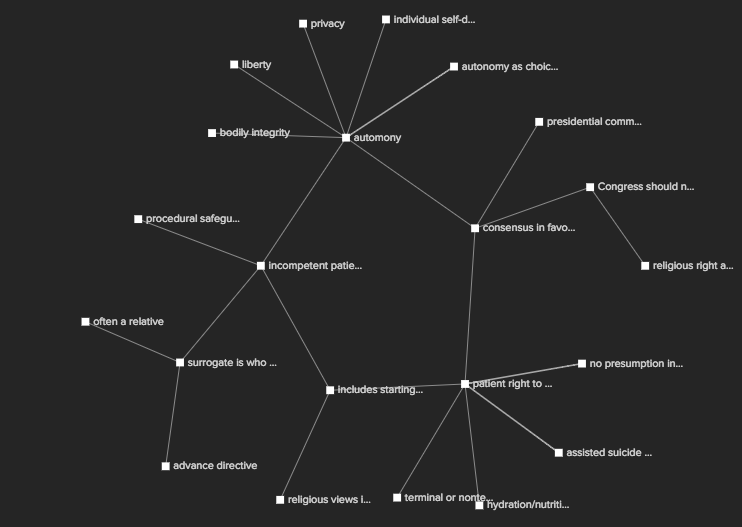
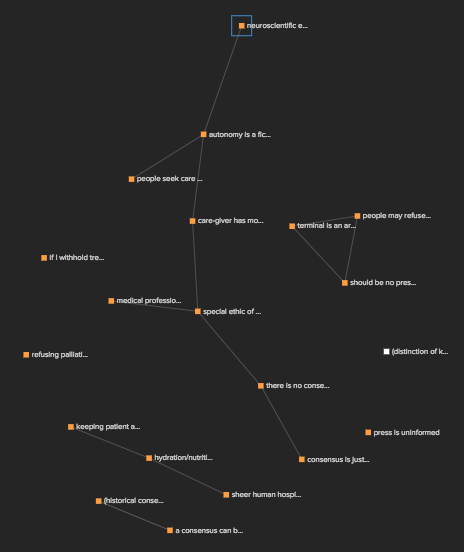
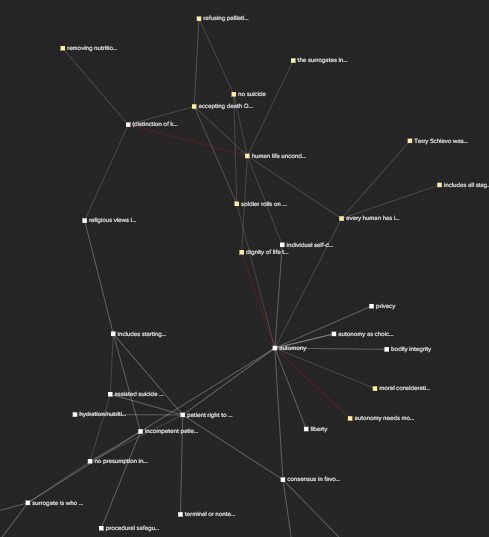
a method for mapping discussions as networks

Two Quebecois scholars, François P. Robert and Pierre Mongeau, have developed a valuable method for modeling the “socio-semantic network” formed when people discuss an issue.* I can envision this method used to assess deliberations, to give real-time feedback to moderators during conversations, and even to reveal patterns of discussion in fictional texts as a contribution to literary criticism.

The article is in French and it uses a lot of terminology from network analysis, so unless you already know how ideas like “directed degree centrality” are expressed in French, you may find it hard going. Since I worked my way through it, I will provide relatively extensive notes below. But here is the shorter version:

Individuals form a social network if they know one another. Each link is a relationship, such as an experience of having talked one-on-on together. Meanwhile, individuals form a “socio-semantic network” if they use the same or highly similar phrases in a conversation on a common theme. “Each word or phrase that two people use in common is a link.” They need not know each other to have a socio-semantic link.

The social relations among people and their socio-semantic networks are different but not necessarily independent. One could affect the other. For instance, we might find that people who are central in a social network disproportionately affect the ideas that are expressed throughout that network. Their prestige may give them influence. Or we might find that people who express ideas that are frequent in the network become more socially central: holding popular ideas may give them prestige.

Robert and Mongeau involved 95 Montreal residents in discussions of a public policy topic: college tuition. Some of these discussions occurred in a large group using formal procedures. (I imagine Robert’s Rules or some variation thereof.) Other discussions occurred in small groups that were less rule-guided.

Some participants knew each other before the experiment. The authors identified all the social links that existed before the deliberation and also found out who had talked to whom during the event. They could thus chart the changing social network of the participants. Meanwhile, the authors asked participants to write about the issue both before and after the deliberation, collected the writing produced during the discussions, and looked for similarities of phrases between pairs of participants. That allowed them to chart the changing socio-semantic network of the group.

They found: “The conventional method [a large group deliberation using formal rules] favors the emergence of a link between social centrality and socio-semantic centrality, while the alternative method [small group discussions] favors the emergence of a negative relationship between these measures.” Apparently, in large group discussions, people who are socially central—knowing many others or interacting with them one-on-one during the meeting—increasingly dominate the views expressed by all the participants. But “in the alternative deliberative format that uses discussions in small groups, the emergence of differences is promoted by providing a space for expressing views different from those of the socially central people.”

The authors draw a lesson for organizers of events. “In practical terms, these results suggest that it would be advantageous for a democratic organization to first use alternative methods so as to promote the expression of a diversity of views and then to continue the deliberation in a conventional manner (like that prescribed in codes of procedure) to develop consensus positions.”

Maybe–although the design of deliberative formats involves more criteria that these. I am more interested in the methodology, because I believe it could be developed and applied for other purposes. To me, the fact that opposite results emerged from different kinds of deliberation validates the method, especially since the authors have a plausible explanation for the patterns they found.

* François P. Robert and Pierre Mongeau, Caractéristiques sociosémantiques des méthodes conventionnelles et alternatives de deliberation, Revue internationale comminucation sociale et publique, no 12, Dec. 2014, pp. 101-120

A bit more detail on the instruments: Before the deliberation, individuals were asked, “Of the following people, with whom did you have [knowledge or contact] before January 28, 2012? ” They were also asked after the deliberation, “With whom [names listed] have you had an exchange, a confrontation, or a sharing of ideas (whether positive or negative, whether or linked or not to the experiment)?” “An extra open-ended question asked respondents to provide information to identify people whose names they did not remember; for example, ‘During the break, I spoke with the gentleman sitting in front of me’ or ‘I talked a lot with the young lady to my right at the first round of discussions.’”

And the findings: “There is a negative correlation (r = – 244; p <0.05) between socio-semantic centrality during the conventional activity [large group deliberation] and that observed in the alternative activity [small group]. This correlation indicates that the central people in the socio-semantic network when the method of deliberation is conventional do not tend to be central in the alternative method. Furthermore, socio-semantic centrality while using the alternative method is positively correlated with that observed after the experiment (r = 378, p <0.01). Thus, people using more words and similar expressions to all participants during the alternative method also tend to do so after the experiment.”

No correlation was found between socio-semantic centrality and “various social centrality measures …. No link can be established before the experiment between centrality in the social network of a person and centrality in the socio-semantic network.”

“In the conventional method [a large-group deliberation], only directed degree centrality in the pre-existing social network is significantly and weakly correlated with socio-semantic centrality (r = 223, p <0.05) (Table 5). Thus, the number of choices received (prestige) of a person in the pre-existing social network is linked, albeit weakly, with the person’s use of words and phrases used by all those present in the conventional method. When the correlations are based on social centralities observed in the circumstantial network centralities all social measures were significantly correlated with sociossemantic centrality in the conventional method. The link is moderate (see Table 6), because the correlations vary around a mean of 0.41 (p <0.01). These results confirm the presumed relationship between social centrality and socioesemantic centrality by our general assumptions (Hg1, Hg2) and the first specific hypothesis (HSA).

“In the alternative method, the correlations between sociosémantique centrality and three of the five social centraly measures are reversed … The correlations between sociosémantique centrality and betweenness centrality measures and proximity are no longer significant for measures of centrality in the circumstantial social network. Furthermore, the centrality of the close pre-existing social network is also weakly negatively related to socio-semantic centrality for the alternative method (r = – 213; p <0.05). …. The alternative method does not attenuate the relationship between sociosemantic centrality and social centrality; it appears to transform them insofar as the correlations are weaker in the alternative method, but reversed. …”

“Indeed, this correlation suggests that people with greater prestige in the network before the [large group] deliberation begins (that is to say, they arrive at the meeting with more  relational capital) have a slight tendency to use words and expressions similar to those used by all participants.

“Conversely, with the alternative method, the central people tend, but moderately, to use words and expressions different from those used by all participants. In other words, the greater the number of relationships a person has with other participants, the more the person’s vocabulary tends to be different, to a moderate degree. This can be explained either by a change of vocabulary on the part of people whose social centrality was already high even before the deliberation began, or else that new themes have become central. Since it seems unlikely that people have changed their vocabulary in such a short period, this suggests that other people have become central in the socio-semantic network during a deliberation using the alternative method. Indeed, the alternative method gives people more time and opportunity to hear a different perspective by using periods of small group discussion. In this situation, a person who brings a new perspective that is taken up and discussed in the group thus increasing his or her centrality in the socio-semantic network. Moreover, the proliferation of small groups not necessarily discussing the same topics explains the relatively weak correlation (r = – 24 on average; p <0.05).”


The post a method for mapping discussions as networks appeared first on Peter Levine.

making the voting age 17

I have an op-ed in Politico today that begins:

It is time to try lowering the voting age to 17 nationwide. Takoma Park, Maryland, has done it. Iowa, too, for caucuses. Scotland went down to age 16 for its recent independence referendum. Evidence suggests it will boost informed participation in our democracy over time.

Supportive research is collected on the CIRCLE website. At 11:35 today, I’ll be live on WBAL (in Baltimore or on the web) talking about the idea with Clarence M. Mitchell, IV.

The post making the voting age 17 appeared first on Peter Levine.

apply for the 2015 Summer Institute of Civic Studies

The seventh annual Summer Institute of Civic Studies will be an intensive, two-week, interdisciplinary seminar bringing together faculty, advanced graduate students, and practitioners from many countries and diverse fields of study.

Organized by Peter Levine of Tufts University’s Tisch College and Karol Soltan of the University of Maryland, the Summer Institute will engage participants in challenging discussions of such topics as:

  • What kinds of citizens (if any) do good regimes need?
  • What should such citizens know, believe, and do?
  • What practices and institutional structures promote the right kinds of citizenship
  • What ought to be the relationships among empirical evidence, ethics, and strategy?

The syllabus for the sixth annual seminar (in 2014) is here. The 2015 syllabus will be modified but will largely follow this outline. You can read more about the motivation for the Institute in the Framing Statement by Harry Boyte, University of Minnesota; Stephen Elkin, University of Maryland; Peter Levine, Tufts; Jane Mansbridge, Harvard; Elinor Ostrom, Indiana University; Karol Soltan, University of Maryland; and Rogers Smith, University of Pennsylvania.

Practicalities

The daily sessions will take place from June 15-25, 2015, at the Tufts campus in Medford, MA. The seminar will be followed (from June 24, evening, until June 27) by a public conference–“Frontiers of Democracy 2015”–in downtown Boston. Participants in the institute are expected to stay for the public conference. See information on the 2014 conference here.

Tuition for the Institute is free, but students are responsible for their own housing and transportation. A Tufts University dormitory room can be rented for $230-$280/week. Credit is not automatically offered, but special arrangements for graduate credit may be possible.

To apply: please email your resume, an electronic copy of your graduate transcript (if applicable), and a cover email about your interests to Peter Levine at Peter.Levine@Tufts.edu. For best consideration, apply no later than March 15, 2012. You may also sign up for occasional announcements even if you are not sure that you wish to apply.

The Sister Seminar in Ukraine

In 2015, there will also be a parallel Summer Institute at Chernivitsi University in Ukraine. It is co-organized by Dr. Tetyana Kloubert (University of Augsburg) with Karol Soltan and Peter Levine and funded by the German government through the DAAD. Participants from Ukraine, Belarus, Poland, and Germany are eligible. More information here.

Please feel free to share this announcement.

The post apply for the 2015 Summer Institute of Civic Studies appeared first on Peter Levine.

the Florida Civic Advance

(Orlando, FL), I am here for the Florida Civic Advance, a summit of people from across the state who support the civic life of their communities. They are the kinds of people who don’t just attend meetings; they organize and facilitate them. They don’t just vote; they build voter-education programs. They don’t just follow and discuss the news; they report and curate news for their communities.

Overall, the proportions of Americans who say that they have attended community meetings, worked with neighbors to address problems, followed the news, and belonged to organizations have all fallen since the 1970s. Florida scores very low on these indicators, sometimes 49th or 50th out of 50.

To boost these forms of engagement requires investment and support. The Associated Press-GfK recently repeated survey questions they had asked in 1984 about voting, volunteering, serving on a jury, and keeping informed about news and public issues. All of those activities had fallen, with the exception of voting (which fluctuates with the political situation) and volunteering, which has been buoyed by a substantial increase in the youth volunteering rate.

That last trend can be explained by the substantial investment in youth volunteering through high school service-learning programs, AmeriCorps, Campus Compact member colleges, and so on. Proponents of service have won new funding and rewards for volunteering, positive media coverage, intensive research and evaluation, and favorable policies, including mandates in many school districts.

There has been no comparable investment in the other forms of civic engagement.

Who will work to strengthen broader opportunities for civic engagement? Not political elites, who have limited interest in empowering citizens. And not average citizens, who have had too little experience with rewarding civic engagement to understand its value. National polling has found that average Americans are lukewarm about civic engagement, no matter how it is named and described.

Our best allies are the kind of people who are gathering at Florida Civic Advance. They have demonstrated their commitment. They grasp the value of civic engagement. Despite the low average levels of engagement across the state, these leaders are numerous enough to be powerful. But they tend to work on specific projects in specific issues domains within their own geographical communities. They do not coordinate to promote civic renewal. They are not conscious of being part of a movement or nascent movement for democracy.

Gathering such people is the strategy I recommend in the final chapter of We are the Ones We Have Been Waiting For, so I am very excited to see this summit draw so many committed and creative people and projects.

The post the Florida Civic Advance appeared first on Peter Levine.

why don’t young Californians vote?

According to our colleagues at UC Davis, youth voter turnout in California in 2014 was just 8.2%. That meant that just 3.9% of the people who voted were under age 25, a proportion that is projected to decline as the state’s population ages. I will be discussing this topic on San Francisco’s KQED today at noon eastern, 9 am Pacific. I’m hoping we can talk about a lack of competitive elections, civic education that too often fails to encourage participation, and concerns about the state’s news media. The other guests will be:

  • Mindy Romero, director of The California Civic Engagement Project, who is really the guru of voting trends in the state.
  • David Weinsoff, a member of the Town Council of Fairfax, CA, in Marin County, which is considering lowering the voting age. (See our supportive research)
  • Roxanna Reaves, a student at Stanford University
  • Sarah Lovenheim, spokesperson for Young Invincibles, a millennial research and advocacy group

After the show, I’ll be signing off this blog for a week of travel. However, KQED usually posts the audio here, and if I can, I’ll add a few quick notes.


The post why don’t young Californians vote? appeared first on Peter Levine.

the Women’s Studies/Civic Studies analogy

In introducing Civic Studies, I am increasingly using an analogy to Women’s Studies. This is how it goes:

In the 1960s, a political movement–known retrospectively as Second-Wave Feminism–developed, with the goals of liberating women and achieving gender equality. That movement had intellectual leaders, including academics and independent writers. They shared political goals with the movement but they also had intellectual objectives: to challenge the invisibility of women in all fields of study (from cancer research to classical history), to explore issues related to gender, and to develop novel theories and methodologies that emerged from thinking as and about women. One strategy for accomplishing those goals was to create women’s studies as a discipline, with all that entailed: journals, conferences, and courses. Apparently, the first women’s studies course was taught at Cornell in 1969, and the first two degree programs were launched in 1970. The courses could be pedagogically innovative, but what really defined them was their subject matter and the developing canon of assigned writers. Of course, participants did not hold uniform ideas but engaged in a rich debate. They have built up a new discipline, developed several generations of scholars, challenged and altered virtually all the other disciplines, and offered insights and information to political and social movements.

Likewise …

Since the late 1980s, there has been a movement to restore the role of active, responsible, collaborating citizens in the creation and the governance of communities. It has arisen to counter trends–centralization, marketization, consumerism, crony capitalism, and positivism–that marginalize citizens. Perhaps it does not deserve comparison to Second Wave Feminism, although if we take a global perspective, it has had striking successes (see this World Bank volume, village democracy in India, or the many cases described in Participedia). This civic renewal movement has an intellectual component led by prominent academics along with some independent writers (e.g., Parker Palmer, Frances Moore Lappé). They too have confronted a problem of invisibility within the academy. Too much research across the social and behavioral sciences, the humanities, and the professional disciplines ignores what I would call “citizens”: people who combine facts, strategies, and values to define and address social issues in common with peers. Citizens are invisible because of artificial distinctions between facts and values and because of research methods that miss human agency. In response, the intellectuals involved in Civic Studies are beginning to build up courses, journals, conferences, and allied efforts (e.g., Civic Science). Again, the pedagogy may be innovative, but this is not an educational reform movement. Our goals are rather to develop a new discipline, to alter the other disciplines, to derive new insights by thinking about and as citizens, and to inform political and social movements that renew civic life.

The post the Women’s Studies/Civic Studies analogy appeared first on Peter Levine.

Ducks Unlimited and civic renewal

I had the pleasure today of interviewing Paul Schmidt, the Chief Conservation Officer for Ducks Unlimited, Inc. While Americans are joining traditional associations at lower rates, Ducks Unlimited has a steadily growing base of roughly one million supporters and volunteers, including an increasing number of younger people, some of whom enter through Facebook. (Ducks Unlimited has more than 1 million Facebook “likes”.)

Schmidt explained that civic engagement is crucial to the conservation movement. Ducks Unlimited does not own or manage much land on which waterfowl live. Instead, the organization tries to influence landowners to be good stewards of their land. These owners may be agencies but often are regular citizens. Influencing them is “not a manipulation,” Schmidt added; it is genuine engagement that changes behavior.

In general, Schmidt thought, the “need and desire for affiliation has eroded.” This trend (documented in “Bowling Alone”) is bad for the conservation movement because “belonging and partnering are key elements … to conservation.”

But duck hunters form strong bonds. It is a “unique recreational pursuit” in that sense, different from deer hunting. I asked what turns the social bond of hunting into associational membership, since the social bond of bowling doesn’t seem to produce bowling leagues any more. Schmidt was not sure, but he thought that for many hunters, the real goal is to appreciate nature together. A classic experience is watching the dawn break over a pond with friends. “We capitalize on the experience,” Schmidt told me. People who appreciate nature together can be activated to protect it, whether that is through their stewardship of their private land, voluntary cooperation and collaboration, influencing other people, or supporting policies. “They will do what it takes to make sure [the view] doesn’t get bulldozed.”

The post Ducks Unlimited and civic renewal appeared first on Peter Levine.

the two basic categories of problems

Human beings face two fundamental categories of problems: problems of discourse and problems of collective action.

Problems of discourse make our conversations go badly, so that we believe or desire the wrong things. They include, for example, our unconscious biases in favor of members of our members of our own groups and our strong tendency to “motivated reasoning,” or picking facts and theories because they yield the results we want. A different example is ideology, defined (in this context) as holding a distorted view of reality that preserves the advantages of the privileged.

Meanwhile, problems of collective action cause us to get results that we do not desire, even when we agree about goals and values. An example is the temptation to “free ride” on other people’s contributions, or the extreme cost of changing a system once it has been chosen and developed (“path dependence”).
Screen Shot 2015-02-10 at 10.20.04 AM

How can I justify the claim that these are the two fundamental categories of problems? My claim is subjective, but it does arise from 20 years of thinking about social problems, during which I have constantly found myself drawn to two quite different conversations. One is about deliberation, communication, and the flaws thereof. The most relevant disciplines are political philosophy, cultural studies, and communications. Famous authorities include Marx and the Frankfurt School, Habermas, Derrick Bell, John Rawls, Judith Butler, and many more. The other conversation is about rational choice, public choice, and game theory. The most relevant disciplines are economics and social psychology. Authorities include Elinor Ostrom, James M. Buchanan, Mancur Olson, and Kahneman & Tversky.

The two sets of problems are connected. For instance, one explanation of motivated reasoning is that to choose the most convenient facts is easier than giving all the evidence a full and rigorous consideration; and we can get away with the easier path because we can free-ride on other people’s intellectual labor. Thus the discourse problem of motivated reasoning is linked to a basic collective action problem.

Yet neither set of problems is, in my view, reducible to the other. For instance, a very ambitious game theorist might assume that game-like models can explain all breakdowns of human interaction. But game theory takes as given the values and identities of the players. In fact, those are not fixed but are generated and changed by discourse.

By the same token, some cultural critics might argue that all of our problems arise from distorted discourse, bias, and ideology. But I think that even if we all sincerely agreed about something as important as climate change, problems of collective action would still be formidable. We would not only face the mother of all tragedies-of-the-commons but also challenges of path dependence (e.g., our dependence on internal combustion engines) and boundary issues (the countries that use the most carbon are separated from the big producers).

I am well aware that we also face a whole range of urgent concrete problems not shown above, such as global warming or racism today–or (at other times in our history) plagues and famines and invading hordes. But while those threats are matters of life and death for specific communities, the two categories shown above apply at all times. They establish the form of human interaction, into which are poured such specific content as poverty, racism, authoritarianism, disease, etc.

I was trying to think of a place where demographic diversity would be absent and where there would be such a high degree of consensus about one transcendent goal that the participants would not care about matters like poverty or climate change. In such a place, we might see neither discourse problems nor collective action problems. I came up with the all-male Orthodox Holy Community of Mount Athos, which is now a quasi-autonomous monastic republic within the EU. Although I certainly do not know the details, I quickly found an example of the two generic problems afflicting this community:

In June 1913, a small Russian fleet, consisting of the gunboat Donets and the transport ships Tsar and Kherson, delivered the archbishop of Vologda, and a number of troops to Mount Athos to intervene in the theological controversy over imiaslavie [the belief that the Name of God is God].

The archbishop held talks with the imiaslavtsy and tried to make them change their beliefs voluntarily, but was unsuccessful. On 31 July 1913, the troops stormed the St. Panteleimon Monastery. Although the monks were not armed and did not actively resist, the troops showed very heavy-handed tactics. After the storming of St. Panteleimon Monastery, the monks from the Andreevsky Skete (Skiti Agiou Andrea) surrendered voluntarily. The military transport Kherson was converted into a prison ship and more than a thousand imiaslavtsy monks were sent to Odessa where they were excommunicated and dispersed throughout Russia.

If a bunch of white men who have voluntarily renounced property, sex, and freedom and who are totally devoted to the Orthodox faith can face deadly problems of discourse and collective action, then these challenges seem universal. That doesn’t mean they always defeat us; it just means we always have to work on them.

The post the two basic categories of problems appeared first on Peter Levine.

a USA Today debate about the citizenship exam

USA Today’s editorial board has an editorial today supporting the recent laws in Arizona and North Dakota that require students to pass the federal test designed for naturalizing citizens. The board acknowledges, “Some questions are easy or trivial. But many about voting, the First Amendment, states’ rights and the Supreme Court offer jumping-off points for enticing discussions about current events. In the hands of a good teacher, they can make students realize how much the American system of government affects their lives. The test can provide a floor on civics learning. It doesn’t have to set the ceiling.”

To their credit, the board gave me equal space for an “opposing view.” I argue, “Requiring students to pass the citizenship exam will reduce both the amount and the quality of civic education in our schools.” I conclude:

The citizenship exam requires, for instance, that you know that “27” is the correct answer when you’re asked how many constitutional amendments have been passed. You don’t need to understand reasons for or against those amendments, or have any sense of why they were important.

A month after students pass this test, they will forget the number 27. But they might retain the message that being a good citizen is a matter of memorizing some random information. That seems like an excellent way to turn people off.

The post a USA Today debate about the citizenship exam appeared first on Peter Levine.

Orozco’s Gods of the Modern World

(Hanover, NH) It’s amusing to be at Dartmouth, talking earnestly with high school civics teachers–after a week of thinking about the civic mission of higher education–while nearby stand the forbidding professors of “Gods of the Modern World,” a pertinent panel from Jose Clemente Orozco’s “Epic of American Civilization” (1932-4):

While behind them the world burns, the skeletal academics in full regalia bring into being a new skeletal graduate or colleague. The skeletal fetuses of other students are embalmed in display cases over piles of musty volumes.

On the other hand … Dartmouth paid Orozco to paint this critique, the college preserved his work despite the resulting controversy, and now they proudly display and assiduously study this exemplary Mexican mural. One could conclude that academia is a haven of free inquiry, that elite institutions can profit from even the most radical assaults, that art is immortal, that art is toothless … Pick your lesson.

The post Orozco’s Gods of the Modern World appeared first on Peter Levine.