Jonathan F. Zaff, Elizabeth Pufall Jones, Alice E. Donlan, and Sara Anderson have published their edited volume entitled Comprehensive Community Initiatives for Positive Youth Development (New York: Routledge, 2016). “Positive Youth Development” is a whole stance toward adolescents that involves supporting them to do positive things rather than preventing them from doing bad things. The preventative approach can be done in a caring and sympathetic way; it still tends to fail. Teenagers get too few opportunities to contribute, and they flourish much better when they have such opportunities. Many Positive Youth Development initiatives are programs: organized, named, defined activities that enlist certain kids for certain purposes, such as service, arts, or sports. But we can also intervene at the level of communities to increase the opportunities for all resident kids and to involve them in designing and allocating programs. Not much has been known empirically about “comprehensive community initiatives” for Positive Youth Development, but this book assembles the best available evidence and has roots in the practical work of the Center for Promise. One chapter is by Jodi Benenson, Kei Kawashima-Ginsberg, yours truly, and Felicia M. Sullivan: “Youth as Part of the Solution: Youth Engagement as a Core Strategy of Comprehensive Community Initiatives.”
Author Archives: Peter
European Institute of Civic Studies, 2016
Summer Institutes of Civic Studies have been held annually at Tufts University since 2009. They are open to applicants from all countries, and the 2016 version will take place from June 13-23. In 2015, Tanja Kloubert, Karol Soltan, and I also organized a version of the Institute in Chernivtsi, Ukraine. Thanks to support from the German Academic Exchange Service (DAAD), we will be able to repeat that European Institute in 2016. It is open to individuals from Ukraine, Belarus, Poland and Germany and will take place in Augsburg, Germany, from July, 25th to August 5th 2016 (at the Augsburg University).
What is the DAAD-supported Summer Institute of Civic Studies?
It is is an intensive, two-week, interdisciplinary seminar bringing together advanced graduate students, faculty, and practitioners from diverse fields of study
Who can apply?
Ukrainian scholars and practitioners are strongly encouraged to apply. We will also consider the applications from Germany, Belarus and Poland. We are especially interested in applicants who have a long term interest in developing the civic potential of Ukraine, and the region.
How to apply?
All application materials must be submitted in English. The application must include the following:
- A cover letter telling us why you want to participate in the summer institute and what you would contribute (maximum 2 pages)
- A curriculum vitae
All application materials can be sent as an email attachment in DOC or PDF format to tetyana.kloubert@phil.uni-augsburg.de.
Deadline: For best consideration apply by March 31, 2016.
Expenditures: The Summer Institute of Civic Studies is being funded by the DAAD (German Academic Exchange Service). Selected participants will be provided with travel costs, visa expenses, accommodation, meals and full event access.
Contact: For more information about the Summer Institute of Civic Studies please contact tetyana.kloubert@phil.uni-augsburg.de
when is cultural appropriation good or bad?
The Oberlin College Cultural Appropriation Controversy is almost certainly getting more attention than it deserves because it reinforces critiques of political correctness in higher education. Nevertheless, it provides an interesting case to consider the general questions: What is cultural appropriation, and when is it bad?
Some Oberlin students criticized Oberlin’s dining hall’s bánh mì and General Tso’s chicken as cultural appropriations. These are wonderfully ironic cases. Bánh mì is a French baguette sandwich with ingredients popular in Vietnam. It is a direct result of French colonialism, a perfect example of a creole or hybrid cultural product. Without cultural appropriation, there could be no bánh mì in the first place. General Tso’s chicken has obscure origins but is most widely thought to have been invented in New York City by chefs of Chinese origin.
I start with the assumption that there is no such thing as cultural purity. We are all creoles, all the way down. We have been in contact with each other all along, naturally and inevitably borrowing, sharing, and stealing. Even supposedly “uncontacted” peoples deep in the rain forest have actually been in close contact with others for thousands of years. Claims of cultural purity and authenticity are almost always problematic, morally as well as factually.
And yet the critical students at Oberlin were making some valid points. To borrow a cultural product is to enter a relationship with someone else. That can be done respectfully and gratefully or rudely and exploitatively. In other words, it involves ethics. Also, it can be done skillfully–so as to produce an excellent product (possibly one never seen before)–or else poorly. In other words, it involves aesthetics. The Oberlin students are saying that their college dining hall’s Asian food has been borrowed disrespectfully and also poorly.
Those can be fair points, but we don’t often conduct such conversations well—for two large and important reasons. Because of positivism, we are not good at talking about ethics. And because we accept deep social inequality, we tend to overlook the material conditions of fine culture.
To the first point: We live at a time when science has enormous prestige, and science cannot address value judgments except to recognize that human beings form them for various reasons. Science suggests that there are two buckets: facts and evidence go in one; values, emotions, preferences and tastes, and personal identities go in the other. To say that Oberlin’s bánh mì are bad is not a factual claim, so it must involve emotion, preferences, and identities. That means that we cannot reason deliberatively with people who might hold different views of Oberlin’s bánh mì or of culture more generally. We can only express opinions that have strong emotional charges and that are linked to our identities. So to take a position on either side is to harm emotionally people who have different identities.
I would not dismiss the significance of emotion or identity. We must be sensitive of both. But we can also deliberate about relatively subtle, charged, and complex questions like food and culture. More than one perspective is valid, and each position can be supported with arguments and reasons. Opinions can change; the group can learn. Expressing a view is not necessarily a threat to other people; it can be an opportunity to reason.
In a positivist and relativist culture, scholars in the humanities and cultural disciplines are basically taught to suppress value judgments–yet certain strong values break through that screen because they are irrepressible and because political movements stand behind them. So even though value judgments are deemed to be culturally relative, it is wrong to be sexist, racist, or colonialist. I agree that those attitudes are wrong, but I see them as just the tip of a submarine mountain of ethical issues, all complex and all deserving of analysis.
When I was writing my book about Dante, I first encountered the view held by certain scholars that cultural appropriation is intrinsically bad. For instance, it was intrinsically problematic that Byron appropriated Dante’s medieval Italian culture for liberal nationalism. My response was: let’s think about when and why various forms of cultural borrowing are good or bad for various people. That is to reason about ethics, which is countercultural for many scholars. (Aaron R. Hanlon has a good response to the Oberlin controversy, calling for a distinction between “appropriation,” which should be value-neutral, and “expropriation,” which is bad and requires a critical argument.)
The second issue is inequality and the material conditions of successful borrowing. The dining hall staff of Oberlin College may not have been given the support they would need to do a good job providing Asian food–or original, “fusion” food. That would take experience, support, and time. Absent those supports, it’s possible that they should stick to what they know best (which will not be culturally pure or authentic, but simply a list of recipes of miscellaneous origin that are familiar to them). Or it’s possible that someone should help them try new things. But it definitely takes resources to engage well with any unfamiliar culture.
In many a Yuppie household (such as mine), people frequently dine in fine restaurants that serve foods from around the world, occasionally travel to distant lands, attempt to learn other languages, and have rows of cookbooks from many cuisines that they use to cook their own food. For instance, we were able to spend the winter break in Guadeloupe, and last night I cooked Chicken Colombo, which is a Guadelopean fusion dish strongly influenced by South Asian indentured workers. Meanwhile, in many families, the adults cook what they learned from their own parents. I remember chatting with a bunch of working-class immigrant high school students from Hyattsville, MD who were amused (more than offended) that Yuppies cook food other than “their own.”
The differences between these two kinds of households may depend in part on personal tastes and proclivities and on local cultural norms. For instance, Mexican/Asian fusion cuisines are famously widespread in San Bernardino County, California. But there is also certainly a socioeconomic aspect of this difference. I cooked Chicken Colombo last night because we could afford to visit Guadeloupe. One reason we visited that island is that we have had opportunities to learn French. And we were comfortable eating food unfamiliar to us because our neighborhoods have long been full of diverse restaurants. These are forms of material support.
I don’t know anyone at Oberlin, but I can imagine two kinds of hypothetical characters: a Yuppie student who despises the college’s bánh mì because she grew up with better ones, and a working-class immigrant student who is offended that the college serves “someone else’s” cuisine because she hasn’t had an opportunity–yet–to sample and cook foods from around the world. Material inequality is relevant to both perspectives. Without sufficient resources, it is simply harder to make something ethical and creative out of a cultural interaction.
to a well traveled hidalgo
This will be hard to explain, so please lie
Still and I’ll try to make it clear to you.
It may have been a normal day; perhaps
You were optimistic, out for a hunt.
Something happened, though–a fall from the saddle?
Boils, putrid breath, and fever? An axe?
Whatever it was, you were dead by day’s end.
(Every death comes before a day has ended.)
At least a few people were sorry enough
They had a huge monument made of you:
Sword in your hand, Pepe curled at your feet,
All in gilt and expensive blue tempera.
Come to think of it, they messed up the garments
A bit. Parts hang down as if you were standing;
Other parts lie flat as if you were prone.
Never mind; in all, it was resplendent.
Some of the rest is easy to relate.
Woodworms are responsible for all those holes.
There was a fire once. You would recognize
La Guerra Civil as a peasant revolt
With more than the typical body count.
Napoleon–he was sort of a Lombard
Who got himself crowned Emperor in Rome
And sent a Frankish army to sack Spain.
Columbus–well, let’s just say there’s another
Large country out west across the sea, yes,
Way west of Galicia, and a part
Of that is settled now by a kind of
Heretical Anglian peasant mob
Who like things like your monument. They bought it
Cheap, carted it over, and laid you out
To be labeled, walked around, and looked at.
Honestly, just one in ten look down, for
The pictures all around you are more vibrant
And hang conveniently at eye level.
Still, now and then a whole regiment
Will gather round, women in their midst, and point.
They know more of your time, Hidalgo, than
You did. They know the before and after
And the why of everything. You just inhaled
The loamy air, tasted salt from your lip,
Felt horsehair, and heard the crack of the whip.
remembering Melisto
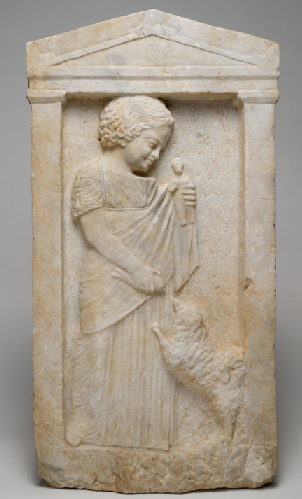
This is Melisto, a daughter of Ktesikrates from Sounion, which is now a day-trip from Athens. I think her name means “Melody,” unless it’s related to the word for “honey.”* Melisto lived for a few years (six, perhaps?) around 340 BCE. The Macedonian King Phillip II was dominating Greece at the time, and his son Alexander was soon to conquer a vast empire. Ktesikrates and perhaps other members of the family were sad enough to lose Melisto that they had a very handsome marble stele carved for her, with her name at the top. She is showing a live bird to her fluffy lapdog and smiling at the results. The figure in her other hand may be a votive object rather than a doll, according to the museum label. A nice little classical building shelters her and announces her name to us, 2,350 years later, in Cambridge, MA.
*Is it from melisma (song) or melisseios (honey)?
survey measures of civic learning and engagement that track change from grades 4-12
Our colleagues Amy Syvertsen, Laura Wray-Lake, and Aaron Metzger have posted on the CIRCLE website a set of survey-based measures of civic engagement that they have carefully developed to be appropriate for kids all the way from fourth grade up to twelfth grade. Such measures are invaluable for assessing growth and learning. They are hard to develop, for reasons the authors describe on the CIRCLE website. Even just finding phrases that are appropriate for both children and older teenagers is a challenge. The new toolkit is the result of an intensive and highly professional project funded by the John Templeton Foundation, and it sets the standard.
See Civic and Character Development: Good Data Starts with Good Measures. The recommended citation for the toolkit itself is: Syvertsen, A. K., Wray-Lake, L., & Metzger, A. (2015). Youth civic and character measures toolkit. Minneapolis, MN: Search Institute.
Rome didn’t end because of barbarian invasions
(New York) This is a classic map of the “barbarian invasions,” taken from Wikipedia. I certainly grew up looking at maps like these. The story they illustrate goes like this. First, there was a Roman Empire with armed borders all around the periphery of the Mediterranean. Inside its borders, the people were Romans who spoke Latin and/or Greek and were ruled from Rome. Beyond were barbarian peoples who behaved very differently. At a certain point, the borders collapsed and various barbarian peoples swept in, taking up residence in portions of the former Empire. They brought new languages, myths, and cultures with them. Their descendants still constitute the majority populations of most parts of Europe, North Africa, and the Levant to this day. The newcomers ceased to be barbarians once they stopped moving, because then missionaries were able to radiate back out from Rome and Constantinople to teach them Christianity, Latin and/or Greek, and other elements of ancient civilization.
I had already begun to realize from various scraps of evidence (even including news reports of genetic data) that this model was quite wrong. Now reading Peter Brown’s brilliant book The Rise of Western Christendom, I understand the current synthesis. It denies that there were vast movements of peoples from one place to another around the time the Roman Empire ended. Rather, the population within and around the territory of the old official Empire went through a series of cultural, political, and economic changes until the Imperial system was gone. These changes often germinated within the borders rather than coming from outside. People who were, in some important sense, Romans turned (over the course of several generations) into people who thought of themselves as Franks or Bulgarians.
To elaborate a bit: The Roman Empire was always much more culturally and linguistically diverse than I was taught in grade school, and much more loosely governed. Local elites always ran things in their own ways. Brown notes that even though Egypt was a crucial province that encompassed one of the biggest cities in the world, Rome posted only one official there per 10,000 residents. Egyptians governed Egypt. The official borders made little difference, since the culture, economy, and political order on both sides was just about the same. However, the Empire was important economically because it taxed everyone within its borders and used the proceeds for armies and official building programs (both of which also enriched an upper class). When the Empire lost its taxing capacity, that changed the flow of goods and greatly reduced levels of construction and production.
The Empire was also important culturally because it offered a set of ideas that could be used by local elites. Among these ideas: Rome was the center of the world (urbs et orbis), the Emperor was the most powerful mortal of the day, Latin was the language of law, and there was a difference between Roman subjects/citizens and barbarians. Those ideas were never exactly true or false—they were closer to orienting value judgments. Over time, they lost their force, and then the same elites who had governed as Romans started to govern as, for instance, Franks. In place of stories about Rome, they started to tell mythical stories about their ancestors’ migrations from primordial homelands beyond the old borders, and those myths continue to influence Europeans to this day.
Meanwhile, profound changes in culture and behavior developed within the Empire. For instance, in the third and fourth centuries, civil wars were almost constant. They were fought by soldiers who pledged personal loyalty to leaders (claimants to the Imperial throne) and moved around regions like northern Italy and the Balkans, often pillaging. They dressed increasingly in ways that we associate with the “Dark Ages.” Brown says these soldiers wore “Embroidered trousers, great swinging cloaks, large gold brooches, and heavy belt-buckles.” They probably spoke various languages other than Latin. We might once have viewed them as barbarians who had somehow come inside the frontiers of the Empire and threatened its security. But a better theory is that they were Roman soldiers who were gradually developing the organization, behavior, and even dress that we associate with the post-Roman era. That is a great example of the new synthesis.
come work with us
(Washington, DC) Tisch College is advertising two positions:
A Program Administrator for the National Study of Learning, Voting, and Engagement, who will manage essential responsibilities associated with NSLVE including recruiting campuses to join the study, distributing data to campuses in the form of reports, and working to develop resources for all campuses to access through the website. The Program Administrator will also be responsible for supporting communications including but not limited to managing the process for the newsletter, updating the website, and collaborating with the team on other publications.
A Coordinator for our Voting Initiative: This individual will coordinate efforts to increase voter participation among Tufts students in the 2016 presidential election through initiatives supported by faculty and staff at all Tufts campuses. Responsibilities will include: working with student groups to sponsor forums on campaign issues of interest; implementing a plan for comprehensive voter registration opportunities; administering a fund for student-driven initiatives (etc.)
is hope an intellectual virtue (or a virtue at all)?
Ta-Nehisi Coates wrote recently that the “black political tradition is essentially hopeful,” yet the historical record gives many indications that injustice is tenacious and unlikely to yield. That means that a historian or a political analyst deeply cognizant of history should not be committed to hope:
A writer wedded to “hope” is ultimately divorced from “truth.” Two creeds can’t occupy the same place at the same time. If your writing must be hopeful, then there’s only room for the kind of evidence which verifies your premise. The practice of history can’t help there. Thus writers who commit themselves to only writing hopeful things, are committing themselves to the ahistorical, to the mythical, to the hagiography of humanity itself. I can’t write that way—because I can’t study that way. I have to be open to things falling apart. Indeed, much of our history is the story of things just not working out.
Coates is critical of “only writing hopeful things” and of assuming that “your writing must be hopeful.” He is not saying: abandon all hope, you who enter into historical thought. But he is distinguishing the cultivation of hope from the pursuit of truth. If hope emerges from truth, that is a matter of sheer chance and not to be counted on.
I have argued, more generally, that truth, justice toward others, and inner psychological wellbeing are distinct goods.* It would be wonderful if they could fit together neatly, and even better if each caused the others. That would be the case in a universe constructed by an omnipotent and just creator, which is why the Bible says things like “the truth will make you free.” But I see no particular reason to believe that truth will make you happy or just, that justice will make you happy or truthful, or that happiness will make you truthful or just. In many situations, knowing the full truth just causes sorrow and paralysis; committing fully to justice requires sorrow and untruth. In my view, all three goals are estimable, but they conflict, and that is one reason it is so hard to live well. This position is consistent with Coates’ admiration for both the truth-telling historian and the hope-instilling tradition of Black politics in the US.
In the previous paragraph, I wrote about happiness in contrast to justice and truth, dropping the word “hope.” For some, hope is a form or close relative of happiness. But one can debate whether hope is a good at all. Neither the classical Greeks nor the ancient Indian thinkers thought that it was. Hannah Arendt observed that “Greek antiquity ignored [faith and hope] altogether, discounting the keeping of faith as a very uncommon and not too important virtue and counting hope among the evils of illusion in Pandora’s box” (The Human Condition, p. 247.).
Indeed, a Stoic or a Buddhist can endorse a strong argument against hope. First, hope is a thought about the future, but wisdom lies in fully experiencing the present, which alone is real. Like nostalgia and regret, hope is a source of irrational disquiet.
Second, hope is about matters beyond our control. For instance, it makes no sense for me to “hope” that I will answer a question honestly. If I am an honest person, I will just answer it honestly. To hope about our own actions is to renounce responsibility. By the same token, we ought to spend no energy hoping that others will be honest–or otherwise ethical–because that is beyond our control. They will do what they will do, and we should respond in the best possible way.
Third, we should not make hope the precondition of acting right, for that is moral weakness. We must do right regardless of the odds of things turning out well.
Most pre-Christian thinkers of the Mediterranean and Northern India ignored or opposed hope. Christians then turned hope into one of the three greatest virtues. That made sense because of their theistic commitments. Indeed, hope is closely connected to faith and charity because it is faith in the Creator’s charity or grace that (alone) substantiates hope in a world of evident suffering.
Arendt was a non-Christian author who thought that the Christian concept of hope had been a positive contribution, related to her own core virtue of amor mundi–love of the world. Notwithstanding the Stoic and Buddhist arguments against hope, and notwithstanding the real tensions between hope and truth that Coates explores–hope could be a virtue. It could be a virtue if it is a resource that human beings need in order to act well. Then instilling hope increases the odds of good action, just as giving people courage does.
In both Stoicism and at least some classical Indian thought, quietism is a common theme. The wise person accepts what is–in which case, hope is irrelevant and distracting. But activists must think about more than the present. They must form plans, which requires estimating the probability of success. When the probability approaches zero, it is time to form a new plan. That means that hope is a rational precondition of action.
And possibly hope is an intrinsic virtue. By Act IV, Scene 1 of King Lear, Edgar has already suffered much, having been cast out of his family and society and onto the wild heath. He convinces himself that he can still be happy because he can still have hope (“esperance”):
Yet better thus, and known to be contemn’d,
Than still contemn’d and flatter’d. To be worst,
The lowest and most dejected thing of fortune,
Stands still in esperance, lives not in fear.
The lamentable change is from the best;
The worst returns to laughter. Welcome then,
Thou unsubstantial air that I embrace!
The wretch that thou hast blown unto the worst
Owes nothing to thy blasts. 2255
Immediately following these lines–in a perfect illustration of tragic irony–Edgar’s father stumbles into view. We have watched his eyes being deliberately thumb-wrenched out of their sockets, and now we see him “Enter …, led by an Old Man.” Edgar cries:
But who comes here?
My father, poorly led? World, world, O world!
But that thy strange mutations make us hate thee,
Life would not yield to age.
It was not true that Edgar had seen the worst or that the subsequent changes would be for the better. Things were about to get much worse. And things ultimately get worse for all of us. Yet it was better for Edgar to have those moments on the heath than not to have had them. It was to his credit that he could forgive and “embrace” life. He chose to describe his state as hope, and that seems praiseworthy. Hope wasn’t an accurate prediction of the future but rather a choice and a disposition.
To return to the beginning: I agree with Coates that history is not hope-instilling and that the rigorous empirical historian should not go looking for hope in the record of the past. At the same time, a human being who manages to be hopeful seems to be praiseworthy and a gift to others. The historian is a human being, and like all of us, must navigate these two inconsistent values.
*See also: on hope as an intellectual virtue (with the opposite thesis from today’s post); unhappiness and injustice are different problems; why we wish that goodness brought happiness, and why that is not so; three truths and a question about happiness; and all that matters is equanimity, community, and truth.

citizens at work: how small groups address large-scale problems
(Orlando) I am on my way home from a meeting of the Florida Partnership for Civic Learning. I’d like to argue that it exemplifies citizens’ work. To be sure, it has a specific mission: improving civic education in Florida’s k-12 schools. And it enlists a specific kind of person: professionals in k12 schools, ed schools, and state agencies, all of whom participate in the effort as part of their jobs. It thus differs in significant ways from a group of miners forming a union or volunteers fixing a neighborhood park. (I can spot k12 teachers and ed-school professors from 500 yards away, due to some ineffable mix of demographics, fashion/accessories, and ways of navigating the physical world). Still, the essential features of this group would apply to different issues and different people.
Using the terms I summarize in this 10-minute video, groups of effective citizens seriously ask the question, “What should we do?” That question implies a deep consideration of values, of facts and constraints, and of strategies. The group not only discusses (deliberates), but also takes collective action (collaborates) and learns from the results of its own actions. Finally, it is attentive to relationships both within the group and with outsiders. It specifically promotes civic relationships, which imply certain values–such as mutual respect and accountability–without relying on personal friendships or financial ties. Because the fundamental question is “What we should do (about some large question)?” the group is satisfied neither with just doing something by itself that has limited effects nor with wishing or hoping that someone else acts. It finds leverage over larger systems.
Without going into details about the Florida Partnership or its current work, I would argue that it embodies all the key words in the previous paragraph. The question for the Partnership is “What should we do to improve civic learning for all Florida students?” The main value-questions include: “What is important for a citizen to learn and know?”, “What rights/obligations do schools have to educate citizens?” and “What constitutes just outcomes for the population of students across the state?” Participants discuss extensive factual information: 7th grade civics test scores for every student in the state, detailed survey data on students’ values and behaviors, and information on the effectiveness of various programs. At this particular meeting, we looked at regression models that predicted test scores, elaborate maps of schools that surpassed expectations, toplines from surveys, and qualitative reports from some of those schools. Participants spent time building relationships among themselves and with other actors. Finally, the group considered a whole range of strategies, from working with elementary reading organizations to changing course requirements in state colleges.
Nothing is perfect, but I think we did a good job of avoiding these classic pitfalls:
- Turning everything into a communications problem, a problem of “getting the word out.” In an era of constant marketing and propaganda, it seems to come as second nature to focus on “messaging.” But rarely is the main problem that lots of people believe the wrong things. And even when they do, communicating is challenging in a very crowded media environment. Smart groups communicate as they need to but don’t overemphasize its importance.
- Imagining phantom agents. It’s a constant temptation to imagine–or hope–that someone else will solve a problem. Someone else’s actions may indeed be essential. For instance, it may take the state legislature to improve civics. But then the question becomes: How can we influence the legislature? The “we” has to be concrete and real: an actual list of individuals who know what to do next. We are the ones we have been waiting for.
- Oscillating between the trivial and the utopian. I have often observed groups jump back and forth between the ends of a spectrum of practicality. At one moment, they will convince themselves that a given problem cannot be solved without changing the whole political/economic system. At another moment, they will talk about making one presentation at someone else’s small-scale meeting. To make a substantial difference, you have to find space between those extremes.
- Operating at only one level of power. According to the train of thinking inaugurated by Steven Lukes and John Gaventa in the 1970s, power operates at several levels. There is explicit power: the power to do something (such as require a statewide civics test or grade an individual kid). There is the power to set agendas. There is power over other people’s preferences and values. And there is power to affect who uses the other forms of power. Truly effective citizen groups think at all these levels.
- Losing the moral questions in data. We have civics test scores for every 7th grader in Florida, and my colleagues have analyzed those data in several illuminating ways (geospatially, demographically, even qualitatively). But it is fundamentally a moral question what to measure on a 7th grade civics test. It is also a moral question whether the state should test students, and what consequences should follow from success or failure on a test. Finally, given a distribution of real test scores, it is a moral question what to do next. Should you devote all your resources to serving the lowest-scorers? Raise the median? Reward the high-scorers? In an age of positivism, we tend to be better at analyzing the data than at reasoning about what the data imply morally. But good groups hold philosophically diverse and productive explicit discussions of the moral issues.
- Losing sight of either the short-term or the long-term. Really effective citizen groups achieve short-term victories with an eye to building momentum and winning longer-term victories later. The two mistakes to avoid are looking only for easy “wins” that don’t create momentum or working directly on long-term problems without having enough people or money to sustain the effort.