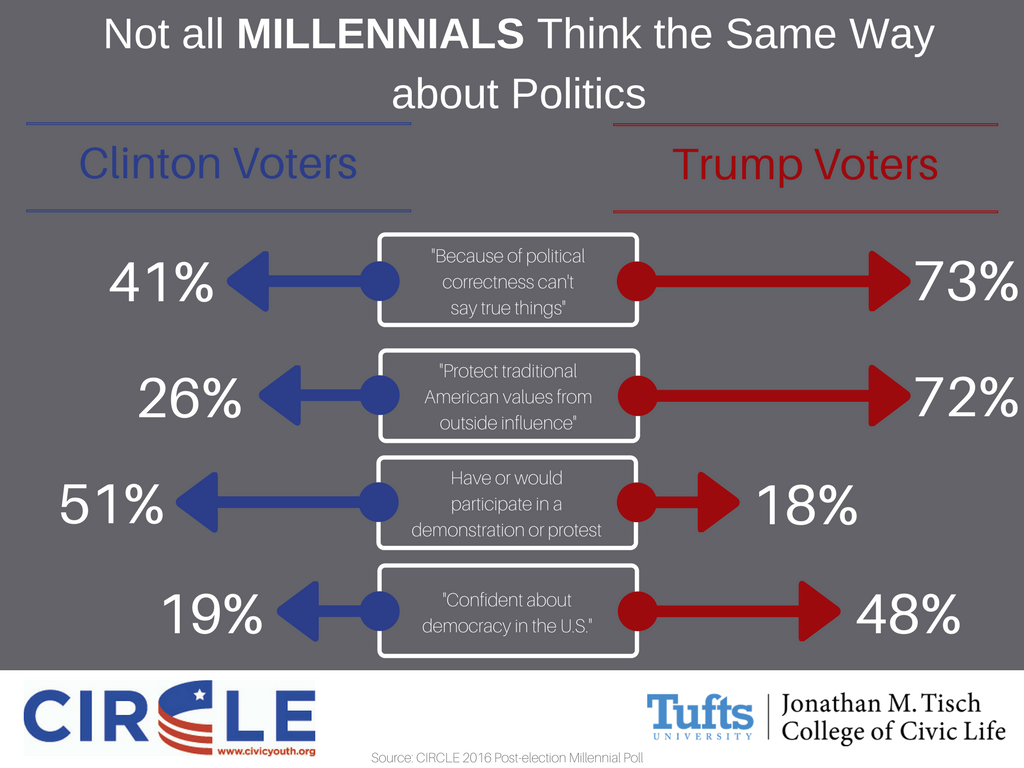
how Millennials split on some key issues

Here are some tidbits from CIRCLE’s analysis of its Millennial youth survey, the second wave of which was conducted in January. A substantial proportion of all Millennials believe that “political correctness” prevents people from saying things that are true, but that opinion is much more common among young people who voted for Trump. Three quarters of pro-Trump Millennials (who were 37% of all the youth who voted) want to protect traditional American values against influences from the outside, compared to one in four of those who voted for Clinton. Clinton voters are much more likely to be ready to participate in demonstrations and protests, and seriously lack confidence in US democracy. Much more at the link.

Millennial women in the 2016 election

A new paper by CIRCLE Director Kei Kawashima-Ginsberg investigates Millennial women’s participation in the 2016 election, their views of democracy, and their own political engagement in the Trump era. It was published as part of a symposium on gender and Millennials convened by the Council on Contemporary Families and is cited today in a New York Times op-ed.

According to the paper, 50 percent of young white women voted for Clinton; 41 percent, for Trump. Young women of color preferred Clinton by wider margins. Only 25% of Millennial women identified as feminists, and less than 15% say that the possibility of electing the first woman president informed their vote choice. Young women were more likely than young men to be inspired by Clinton, but only 23 percent reported that feeling. After the election, they are more concerned about the future of democracy than their male peers are, but not more likely than Millennial men to be interested in political engagement.

to whom it may concern

It has come to my attention that the level of my age
Is now set to fifty, with more movement on the gauge.
Who authorized this increase? Who consented to the change?
The alternative is worse, you say, but we’ve breached my chosen range.
I’ve searched my files for decades past and found most data gone.
Records labeled thirties, forties seem to be withdrawn.
Those phases passed much faster than I’d been led to understand;
I can’t recall what happened then or whether it was planned.
I’m writing to request a reset, please: thirty-five and hold it there.
Oh, and reset all my family, too; just me would be unfair.
Once I see the options back, and the meter’s restored to high,
I’ll retract the review I’ve given you–but I await your prompt reply.

Simon Denny: turning the NSA into art

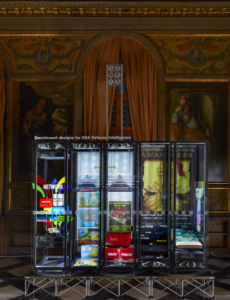
(Waterville, ME) Last week I saw a display that is exemplary of Simon Denny’s work. Inside a case made of server racks and glass panes are three-dimensional versions of the NSA graphics displayed in the PowerPoint presentations that Edward Snowden leaked. For instance, a slide depicting military vehicles crossing barriers has been turned into a diorama made in part of hobbyist models. A slide showing “The 5 Team Dysfunctions” has been turned into a three-dimensional pyramid with levels labeled with phrases like “Lack of Accountability” and “Lack of Results.” For another installation that I didn’t see, Denny actually used a stuffed eagle that he bought from a taxidermist to illustrate the eagle on the NSA’s shield. Lights flicker on the servers. The whole object is neat, shiny, hermetic, and strange.

For the Venice Biennale, Denny’s NSA displays were exhibited in the Renaissance Library of St. Mark (the Biblioteca Marciana), which was originally a storehouse of global knowledge and information for what was then a great mercantile power. The Marciana has held–although not currently–the finest medieval world-map, the Fra Mauro Map (ca. 1450) which compiled intelligence from such emissaries as Marco Polo. Venice sent these feelers into the world and compiled their data for the benefit of her navy and traders.

Here is Denny’s work as displayed in Venice–one empire echoing another across the centuries. Those are portraits of philosophers on the walls, sources of wisdom that might be compared to the gnomic utterances in the NSA slides, such as “Role of the Team Member: Focusing on Collective Impact.”

I, however, saw the same display at MOMA, the high-rise museum in the heart of Manhattan’s Midtown that Rockefellers founded to collect the best art of the world for the most powerful commercial city of its time.

Like much conceptual art, this display poses questions. I value that function, although I also think the appropriate response to a question is an answer. So, standing before Denny’s display and thinking about my own responses, I believe I’d say: As an organization, the NSA resembles a large bureaucratic for-profit firm, at least in its internal rhetoric. Its rhetoric is banal. A highly self-conscious, polished, ironic representation of that banality is art.

ThE NSA collects lots of information without people’s permission. It is part of the United States government, which is owned by the American people. The Agency also affects people around the world. The people who own it and the people whom it affects have a right to understand how it works. Understanding it includes having some kind of grasp of its internal culture, including its banality.

Then again, it is probably both necessary and even valuable for a nation to spy, so long as its foreign policy is reasonably just. To spy in the modern world is going to require an organization that resembles a large bureaucratic for-profit firm, and running such an operation reasonably efficiently may require banal slogans. (I’m not sure about that.)

By the way, the original artist who created many of the NSA’s graphics is David Darchicourt. He gets an odd sort of billing in Denny’s subversive Art-World response. Fortunately, Darchicourt seems good-humored about the whole thing. Ryan Gallagher reports:

Now he is the unwitting central character in a new exhibition that puts the spotlight on the spy agency’s imagery. … He admits he finds it interesting to see his designs in the Renaissance setting. “It’s kind of flattering, but it’s also kind of creepy,” Darchicourt says, adding that he’s now considering deleting some pictures from his online portfolios to prevent them from being used by anyone else in the future. “Anything that has to do with the NSA will be removed; it’s old and I don’t really identify with that organization anymore.”

See also: on the moral peril of cliche; cultural mixing and power; on the deep state

Civic Deserts and our present crisis

My colleagues Kei Kawashima-Ginsberg and Felicia Sullivan have published an article in The Conversation that I believe supports an important diagnosis of the 2016 election and our current crisis. Their article is entitled “Study: 60 percent of rural millennials lack access to a political life.” They find that a majority of rural youth live in areas that they call “Civic Deserts,” which are “characterized by a dearth of opportunities for civic and political learning and engagement” and a lack of “youth programming, culture and arts organizations and religious congregations.”

Young people in these areas are less civically and politically engaged than other youth. They do not belong to groups and they rarely take civic actions, like voting and volunteering. “During the 2016 presidential election, young people who live in Civic Deserts were less likely to vote compared to others with more civic resources.”
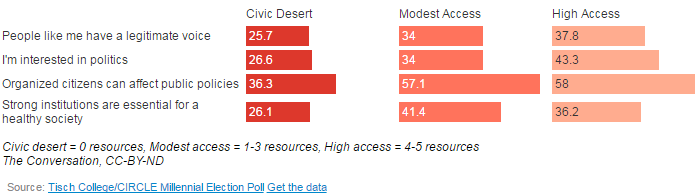
But if they did vote, “they were slightly more likely to choose Trump than those with better access to civic resources.” To illustrate that point: young urban Whites who lived in areas with many civic organizations voted for Trump at a rate of 17 percent. Young Whites who lived in Civic Deserts—which could be rural, suburban or urban—voted for Trump at more than twice that rate: 39 percent.

A person could prefer Trump over Clinton in the November election for a variety of plausible reasons. For instance, if you think that abortion is murder, that is a reason to pull the lever for Trump/Pence instead of Clinton/Kaine. But to like Trump—to appreciate his rhetoric and leadership—is a different matter.

I have argued that few people who belong to functional voluntary groups will appreciate Trump. In almost any kind of voluntary association (whether an evangelical church, a Farmworkers’ local, a business coalition, or a lending circle) leaders typically emerge who demonstrate two virtues: inclusiveness and accountability.

No matter how unified the group, it will encompass some diversity. Members normally expect their leaders to hold the group together by using words and taking actions that include, rather than exclude. Groups do sometimes expel or deliberately alienate members–but only in extremis. The normal goal is to hold the group together.

And members expect their leaders to deliver. If the pastor says the church is going to build a new playground slide, then a new slide had better appear reasonably soon, or the pastor will be blamed. If the informal leader of a social circle promises to organize a gathering but fails to set a date, her stock as a leader will fall.

Donald Trump exhibits neither virtue. He is happy to exclude and he is utterly unaccountable. Indeed, I believe many of his fans don’t really expect him to deliver. For them, he is like a droll uncle sitting beside them on the couch, watching O’Reilly, and making remarks that reflect their feelings. When he says he’s going to drain the swamp, they take that to mean that he endorses their values and despises the lobbyists and politicians whom they despise, not that he will actually pass ethics reforms. I posit that this attitude reflects a lack of satisfying experiences with voluntary associations in which the leaders are inclusive and accountable. And that is an increasingly common situation given the steep decline in organizations like unions and churches.
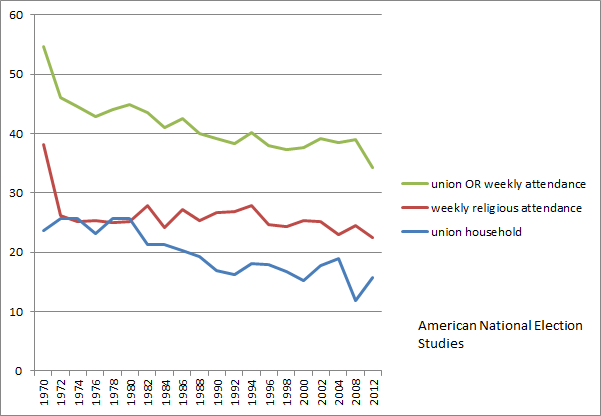
http://peterlevine.ws/?p=17944

Thus I consider the decline in membership—especially among working class Whites—a fundamental cause of Trump.

As evidence, I cite my colleagues’ new finding that White Millennials who live in Civic Deserts voted for Trump. I’d also cite a recent conversation with a self-described Southern conservative evangelical pastor, who told me that he despises Trump because the president’s leadership style violates everything he believes about how to hold a community together.

I’d also cite Hannah Arendt’s argument that loneliness is a precondition of totalitarianism. For her “isolation” means being alone, but “loneliness” means having no felt capacity to control the world in conjunction with other human beings:

Isolation may be the beginning of terror; it certainly is its most fertile ground; it always is its result. This isolation is, as it were, pretotalitarian; its hallmark is impotence insofar as power always comes from men acting together, ‘acting in concert’ (Burke); isolated men are powerless by definition. …

In isolation, man remains in contact with the world as the human artifice; only when the most elementary form of human creativity, which is the capacity to add something of one’s own to the common world, is destroyed, isolation becomes altogether unbearable…

Isolation then becomes loneliness. … Totalitarian domination … bases itself on loneliness, on the experience of not belonging to the world at all, which is among the most radical and desperate experiences of man (The Origins of Totalitarianism, p. 474-5).

Donald Trump is no totalitarian, but the mechanism is similar. When individuals learn from hard experience that they stand alone in a harsh world, they are prone to follow leaders who simply echo their private thoughts and make them feel part of a unified mass.

See also the hollowing out of US democracyto beat Trump, invest in organizing and the “civic state of the union”

Derek Walcott becomes the volcano

(Orlando, FL) I’ve settled on a poem with which to express homage to the late Derek Walcott: his “Volcano” (1976)

Joyce was afraid of thunder
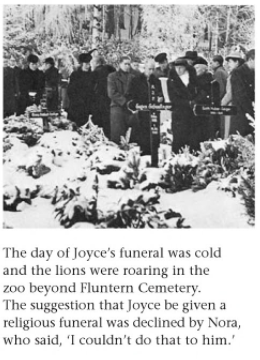
but lions roared at his funeral
from the Zurich zoo.
Was it Trieste or Zurich?
No matter. These are legends, as much
as the death of Joyce is a legend,
or the strong rumour that Conrad
is dead, and that Victory is ironic.
On the edge of the night-horizon
from this beach house on the cliffs
there are now, till dawn,
two glares from the miles-out-
at-sea derricks; they are like
the glow of the cigar
and the glow of the volcano
at Victory‘s end.
One could abandon writing
for the slow-burning signals
of the great, to be, instead,
their ideal reader, ruminative,
voracious, making the love of masterpieces
superior to attempting
to repeat or outdo them,
and be the greatest reader in the world.
At least it requires awe,
which has been lost to our time;
so many people have seen everything,
so many people can predict,
so many refuse to enter the silence
of victory, the indolence
that burns at the core,
so many are no more than
erect ash, like the cigar,
so many take thunder for granted.
How common is the lightning,
how lost the leviathans
we no longer look for!
There were giants in those days.
In those days they made good cigars.
I must read more carefully.

Two of “the great” are named in this poem: Joyce and Conrad. Joyce is a foil for Walcott: an exiled former subject of the British Empire who wrote Ulysses, to which Walcott, from a different Atlantic island, replied with Omeros. It turns out that lions did roar at Joyce’s funeral, and one can risk the pathetic fallacy that they roared for the master’s passing.

I don’t know Conrad’s novel Victoria, but Wikipedia suggests why Walcott might like it (as long as it can be read as “ironic”). Apparently, it describes yet another colonial island-outpost, this one in the Pacific, from European and subaltern perspectives–offering that double vision that fascinates Walcott. And according to Walcott, it ends with two lights shining on the ocean horizon, one a cigar and one a volcano. Seeing a similar pair of lights on the sea off his Caribbean home, Walcott imagines them as messages from Conrad, who is only “rumored” to be dead because his words still speak.

Walcott, the future Nobelist, has every right to place himself in these men’s company. He strives to write great works, to make his own mark. The poem relates a moment, however, when he considers whether it might be better to devote himself to reading: in fact, to become the “ideal reader.” That is a ruminative life, more modest, quieter, although Walcott’s character still compels him to be the “greatest reader in the world.”

“Volcano” adopts a rhetoric of decline. “Awe … has been lost in our time”; “so many take thunder for granted.” But I think the narrator pokes a little fun at himself for that mood when he says, “In those days they made good cigars.” It’s not really that culture has declined and all the great ones have passed. That’s simply what a person feels when he or she pledges, “I must read more carefully.”

With Walcott gone now, I’d like to think of him as a light from far offshore, sending his slow-burning signals for a long time to come. Best to enjoy them, not try to outdo them, because they really don’t make writers like Derek Walcott any more.

what makes conversation go well (a network model)

I’m looking forward to presenting later today at NULab’s first annual conference, on the theme: “Keeping the Public Sphere Open.”

I think of the “public sphere” as all the venues where people come together to share experiences, emotions, and reasons in order to form public opinion. In turn, public opinion should then influence institutions; that makes the society democratic.

An open public sphere, as in the title of the conference, is one that permits and appropriately responds to every person’s ideas; no idea or person is blocked. The state can threaten the openness of the public sphere by censoring ideas or blocking individuals from participating. The marketplace can threaten the openness of the public sphere when, for instance, ISPs charge more money for some content, or when private donors flood the airwaves with campaign commercials. Thus, to preserve an open public sphere, we need policies like a strong First Amendment, net neutrality, and campaign finance reform.

But openness is not enough. The conversations within any public sphere can go well or badly. Along with several colleagues, I have been thinking about deliberation in the following way:

  1. People hold ideas prior to a conversation that we can think of as networks. Each idea may be connected to each other idea by reasons. The person’s network has content (what the ideas say) and also a form. For instance, someone might arrange all of her ideas around one central node, or might hold a set of disconnected principles.
  2. When we talk, we share portions of our existing networks, one node or one reason at a time.
  3. Interaction with other people may cause us to change our network. We can adopt ideas that other people disclose, see new connections or doubt that connections really hold, think of new ideas on our own, or even adopt contrary ideas. In any case, our personal networks are subject to change.
  4. The discussion itself can be modeled as one network to which the various participants have contributed nodes and links.

If we could develop a valid and reliable way of modeling an individual’s private network with respect to a given topic before a conversation, and then we put individuals in dialogue and modeled their interactions, I would predict that: 1) the formal properties of their networks before the discussion would influence the quality of the discussion, 2) the quality of the discussion would be related to changes in their personal networks, 3) an individual’s networks would tend to look formally similar even when the topic changed (e.g., some people would be prone to thinking about most topics in a centralized or in a scattered way), and 4) a given issue would tend to produce formally similar networks for diverse individuals (e.g., the abortion debate and a budget discussion would generate different-looking networks regardless of the participants).

There then follow a whole set of questions about what a good conversation looks like and how people should structure and change their thoughts.

See also: it’s not just what you think, but how your thoughts are organizedtracking change in a group that discusses issuesnetwork dynamics in conversation; and assessing a discussion.

new project on the socio-emotional impact of civic engagement

(New York City) People can gain satisfaction, empathy, purpose, insight, and a host of other socio-emotional or psycho-social benefits from taking part in civic life. Also, if they demonstrate psychological maturity or even excellence, it can help them to be responsible civic actors. On the other hand, they can pay a psychosocial price from acting politically. I am haunted by Doug McAdam’s findings, in his great book Freedom Summer, about the longterm human costs of participating in the voter registration drives in Mississippi. Whether psychosocial development and civic engagement benefit each other depends on how we design those experiences, and in doing so, we must be attentive to the varying experiences of people who stand in different places with respect to the social issues (such as racism) that are at stake.

Therefore, I am pleased to share this news:

Tisch College is launching a new initiative in Social-Emotional Learning and Civic Engagement thanks to a generous gift from David T. Zussman, A53, J80P, and his family through the Zussman Fund for Social and Emotional Learning (SEL). The gift will support Tufts faculty’s integration of social-emotional learning into their teaching, and will promote related research and education across the University through frequent collaboration with the Center for the Enhancement of Learning and Teaching (CELT). A key aim is to encourage all Tufts students—undergraduate, graduate, and professional—to develop their social-emotional skills through civic experiences in and out of the classroom. The initiative will also generate new knowledge for the benefit of other institutions.

More at the link.

how to respond, revisited

Right after the election, I posted a flowchart about “how to respond” that was (by my standards) quite widely shared. I hear anecdotally that it is being used by community groups for discussions.

Incidentally, the question is open-ended; it doesn’t say “How to respond to Trump.” People could use it if they believe the current situation is dire but not because of Donald J. Trump, or not merely because of him.

Last night, I had a chance to use the flowchart with a group of about 16 people in my own community (Cambridge, MA). That discussion encouraged me to make some minor clarifications to the text; see below. (And thanks to my colleague Alberto for the improved graphics.) I’m always open to suggestions for bigger changes.

The people who met last night would like suggestions for concrete next steps, resources, and organizations for each cell. We could even think through what each cell at the bottom means for various institutions: schools and colleges, philanthropies, news media, religious congregations and denominations, municipalities, and so on. If, for example, you work in philanthropy and you want to support ideologically diverse deliberations, what should you invest in? If you’re a k-12 educator who wants to teach deliberation, what should you do, and who will support you? Canvassing these options is a good exercise for a group.

Right now, I think many people are focused on how to sustain momentum. There was a burst of energy around the Inauguration, and some people perceive a dip since then. This challenge also arose at the recent “Civic State of the Union” forum with Mara Liasson, Bob Putnam, Shirley Sagawa, and me.

I offer two thoughts. First, relationships create the motivations and accountability that power movements. People don’t stay involved because of an issue, but because of the other people. Therefore, it is worth cultivating relationships by adding regular social interactions to political efforts. Get together for pizza even if you aren’t sure what to do politically.

Second, we have to be willing to take satisfaction, even joy, from politics. Yes, people are suffering and even possibly dying, and I am not one of those harmed. (My taxes could well go down under Trump.) Therefore, it can seem self-indulgent for people like me to take pleasure from resistance. Yet political engagement is an aspect of a good life, the nascent resistance is a beautiful thing to be part of, and if we engage out of sheer duty, we’ll falter sooner or later. I’d say: less guilt, more joy, and let’s stick together.

(See also taking satisfaction from politics in the face of injustice.)

Talloires Conference: “Social Responsibility and Human Dignity in Higher Education Engagement”

The Talloires Network Leaders Conference (TNLC) 2017 convenes 21-24 June 2017 at the Universidad Veracruzana in Xalapa, Mexico.

The conference will explore the theme, “Social Responsibility and Human Dignity in Higher Education Engagement.” Within this overarching theme, the conference will explore three sub-themes:

  • The right to education and the responsibility to be socially inclusive and to promote quality education to all
  • The right to leadership opportunities and economic mobility and the responsibility to create prosperous communities and societies
  • The right to a livelihood and the responsibility to prepare people for employment and entrepreneurship, and to contribute to economic development

The Conference Program is available here.

Featured speakers include rectors and chancellors from several countries, a former US ambassador to Mexico, and cultural figures. Register here. Veracruz travel logistics here. Conference materials en Espanol.