
White racial resentment and the 2016 election

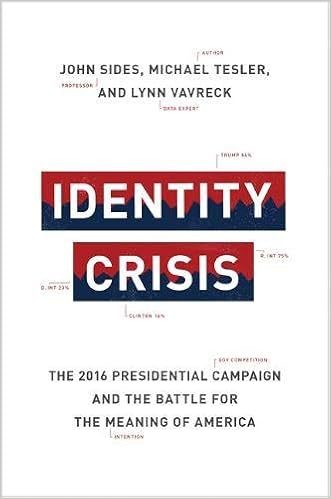
Yesterday, I got to hear Michael Tesler present about his forthcoming book with John Sides and Lynn Vavreck: Identity Crisis: The 2016 Presidential Campaign and the Battle for the Meaning of America. I don’t want to give away the content based on yesterday’s presentation; the book is due early next year. But promotional materials already say: “Identity Crisis reveals how Trump’s victory was foreshadowed by changes in the Democratic and Republican coalitions that were driven by people’s racial and ethnic identities. The campaign then reinforced and exacerbated those cleavages as it focused on issues related to race, immigration, and religion.”

The 2016 election can’t have a single cause, but this book adds weight to the thesis that White racial identity played a major role–more so in 2016 than at any point since 1968. Tesler made me think of an argument by Manuel Pastor, who has noted that White identity peaked in California when Whites saw their majority control nearing its end. In 1994, Californians passed Prop. 187 to block undocumented people from getting state services and to establish a “citizenship screening system.” Governor Pete Wilson made support for Prop. 187 his hallmark issue and used it to win reelection. Incumbent Democratic Senator Diane Feinstein tried to position herself as a critic of immigration as well.

California is no utopia today, but defensive White identity seems to have passed its peak there. I suspect that facing the prospect of losing majority status triggered a sense of threat. Once Whites actually became a minority in California, the sky didn’t fall, and the sense of threat passed. Whites retain their social and economic advantages despite representing just 48% of the votes cast in the 2016 election. I would contrast Texas, where a White-majority coalition still dominates the electorate but the demographic trends are against them. In 2016, 57% of Texas voters were still White (and they preferred Trump by 43 points), but they must know their electoral control won’t last.

It would be valuable to look in more detail at major cities where Whites lost majority control after 1970. Often, White racial identity peaked around the point when the first Black mayor was elected, which marked a threat to White control. The next mayor was sometimes propelled by White backlash, but then a racially diverse coalition came to dominate, and most Whites adjusted to it.

Earlier this year, Pastor told the New York Times, “The United States just went through its Prop. 187 moment.” That period in California was ugly and lasted a while. Pastor asked, “Why go through all of our pain? That was no fun, and it dashed a lot of people’s lives. We underinvested in education. We over-imprisoned, so we got a lot of people locked out of the labor market. We broke apart a lot of families because of anti-immigrant sentiments. We did a lot of stupid things to ourselves.” The good news is that if the country follows California’s trajectory, we will ultimately reach a better place, but we need to get there much faster and with less damage.

the remarkable budget deal

Many have been rightly alarmed by the Trump Administration’s commitments to terminate programs related to scholarship and science, aspects of k-16 education, environmental and climate research, and national and community service. The critical response from citizens has been appropriate and welcome. But it’s also valuable to recognize the limits on any administration’s ability to change federal priorities, the degree to which valuable programs enjoy bipartisan support in Congress, and the extraordinarily inept record of the Trump team so far.

All of those factors are evident in the Consolidated Appropriations Act of 2017. The bill is 1,665 pages long, and it is written as a set of dollar figures plus instructions (“riders”). Because these aren’t presented as changes compared to last year, it is hard to see what Congress has done. But as far as I can tell, most of the changes have been in the direction of more funding for education, culture, science, and even climate science.

The National Institutes of Health, National Endowment for the Humanities, and National Endowment for the Arts all see increases (source). NEH’s research funding is modestly cut, while support for the State Humanities Councils goes up. (My friend Elizabeth Lynn has explained how the State Councils are responsible for the NEH’s political fortunes since the 1970s.) The Corporation for Public Broadcasting is fully funded (source).

EPA faces a one percent overall cut. The Department of Energy’s research budget and the National Science Foundation see increases. Climate research within DoE is boosted. “The Bureau of Land Management, National Park Service and Fish and Wildlife Service all would see more money under the bill, which included few policy riders for the agencies” (source). NOAA receives an increase, and the Climate Program Office within NOAA is held flat. The National Environmental Information Office and Regional Climate Centers have flat budgets.

Education as a whole is cut by 0.1%. Within Education, Title I funding rises; support for education research is trimmed.

The bill “restores year-round Pell Grant funding, a longtime priority sought by student aid groups since its elimination as a cost-saving measure in 2011. The deal also … provides modest increases to college readiness programs TRIO and GEAR UP, which were reduced significantly in the proposed White House 2018 budget plan” (source).

Normally, the president proposes and Congress disposes. In this case, the president has alienated enough potential allies, failed to fill enough key positions, and played his hand so badly that after he proposed, Congress just developed an entirely different budget on a fairly bipartisan basis. To be sure, next year could be worse; and some of the people responsible for implementing these programs will do their best to sabotage them. Still, the new budget deal ought to be an antidote to defeatism.

(See also “mixed feelings on the DeVos nomination battle,” in which I argued that the new Education Secretary will have very limited impact on policy.)

Mozart illustrates the importance of “bids” in romantic relationships

The psychologist John Gottman discovered a fundamental condition of successful romantic relationships (which is consistent with my experience of 21 happy years of marriage). Partners frequently make “bids” for positive attention. Emily Esfahani Smith illustrates with an example: “the husband is a bird enthusiast and notices a goldfinch fly across the yard. He might say to his wife, ‘Look at that beautiful bird outside!’ He’s not just commenting on the bird here: he’s requesting a response from his wife—a sign of interest or support—hoping they’ll connect, however momentarily, over the bird.” Couples who stay together respond positively to each others’ bids an average of 86% of the time. Couples who end up divorcing respond only 33% of the time.

The opening scene of the Marriage of Figaro is set in the room that Figaro and Susanna expect to occupy after their wedding the next day. They are alone together. Figaro is busy measuring the space for the bed that they will share. He sings a foursquare, masculine theme that has been identified as a march. Simultaneously but separately, Susanna is admiring herself in a new hat and telling herself how happy it makes her. Singing in her own ornamented and undulating gavotte, she asks Figaro to pay attention for a moment: “look a little, my dear Figaro.” He keeps on counting, and she keeps on asking: their two themes now playing in counterpoint. She gets more insistent as her light gavotte turns forceful: “look a little / will you look already at my hat!” At that point, Figaro notices her bid. He switches to her melody and meter to reply, “Yes, my heart, it is very pretty. It really seems  to have been made for me. Ah, next morning at our wedding …” Susanna answers in counterpoint, “How sweet is my tender groom,” as Figaro keeps singing about the “beautiful little hat.” Their melodic lines join as they sing the same lyrics about their wedding.

If you interpret the duet as a competition or struggle of wills, then Susanna wins. Daniel Heartz (1987) writes:

Susanna makes Figaro sing her tune to her rhythm, while complimenting her on her hat. With this little drama in music, which almost needs no text, Mozart has succeeded in foreshadowing the entire opera in the first number. By the end of Act 4 Figaro will have been taught a lesson by Susanna, and learnt to sing her tune for good, we hope, with regard to matters of trust and mutual respect between them. The conflict of march and gavotte, of military masculinity with the feminine grace of one of the most gallant court dances, will [recur in later scenes as well].”

But I’d prefer to see the scene as win/win. Each partner makes a bid and each replies. As soon as the duet concludes, Susanna asks in recitative, “What are you so busy measuring, little Figaro?” Statistics predict that these two will have a happy marriage.

source: Heartz, Daniel (1987). “Constructing Le nozze di Figaro.” Journal of the Royal Musical Association 112.1, 77-98. For a more detailed analysis of the duettino, see Stephen Rumph, Mozart and Enlightenment Semiotics, University of California Press 2011. And see why romantic relationships do not function like markets.

was the Civil Rights Movement successful because of the Cold War?

It’s widely argued that the federal government made concessions on civil rights between 1945 and 1970 because blatant racial oppression was embarrassing during the global struggle against communism. Doug McAdam illustrates this argument by noting the “stark contrast” between FDR and Truman on issues of racial justice. FDR was an extraordinarily powerful president who tended toward liberal personal attitudes on race and drew overwhelming support from Black voters in the North, yet he did virtually nothing for civil rights–not even endorsing anti-lynching bills that were pending in Congress. Truman held more ambiguous views and faced political peril, yet he took substantial steps to desegregate the military and civil service. McAdam, following other authors, attributes the difference to the onset of the Cold War.

This explanation has two slightly dispiriting implications (not for McAdam, but for other observers). One is that White American leaders didn’t respond to moral arguments, principles, or empathy; they simply wanted to win a geopolitical struggle. The other is that the Civil Rights Movement succeeded thanks to a fortunate circumstance, not due to its own courage and excellence.

What those inferences overlook is the skillful and principled ways that the Movement took advantage of openings to shift Whites’ hearts and minds.

First, Movement leaders intentionally provoked responses that would look ugly on national TV. After the setback experienced in Albany, GA, where local authorities behaved civilly but refused to budge, the Movement rushed to Birmingham, AL to confront Bull Connor during his lame-duck period because they knew he could be counted on to respond with brutality. The Cold War made the US vulnerable, and the movement took full advantage.

Second, the protesters wrapped themselves in the flag, the constitution, and other symbols of American patriotism. I am sure this was sincere–I read thinkers like King and Rustin as genuine patriots. But it was also smart.

As McAdam concludes: “the extraordinary string of civil rights victories achieved in the 1950s and 1960s (and beyond) has to be accounted as owing at least as much to the creativity and courage of movement forces as to favourable environmental circumstances.” Stephen Jones argues that successful social movements almost always need both “luck and pluck.”

The skill and success of the Civil Rights Movement then echoed in unexpected ways. In Communist states such as Czechoslovakia and Poland, television footage of brutal American racism was widely aired to discredit the US. These regimes also broadcast antinuclear protests from Western Europe. At least some viewers identified themselves with the protesters–and the communist state with the oppressors. They learned that nonviolent social movements could succeed against powerful governments like their own.

Aldon D. Morris writes, “in the early days of the Solidarity movement in Poland, Bayard Rustin, a major tactician of the civil rights movement, was summoned to Poland to give a series of colloquia and speeches on how nonviolent direct action worked in the civil rights movement.” Later, the Tiananmen protesters in China learned “that King’s methods of non-violence and civil disobedience had helped the blacks win civil rights in the United States. They were also impressed by King’s interactions with American presidents in that effort, which offered them a model to follow when they requested a meeting with China’s leaders.”

A movement for universal human rights embarrassed a government ostensibly committed to those values. Foreign dictatorships then tried to exploit this embarrassment, only to inspire similar movements against themselves. This is a story of some luck and lots of pluck.

Sources: Doug McAdam, “The US Civil Rights Movement: Power from Below and Above, 1945-70,” Merle Goldman, “The 1989 Demonstrations in Tiananmen Square and Beyond: Echoes of Gandhi,” and Stephen Jones, “Georgia’s ‘Rose Revolution’ of 2003: A Forceful Peace,” all in Adam Roberts and Timothy Garton Ash (eds.), Civil Resistance and Power Politics: The Experience of Non-violent Action from Gandhi to the Present (Oxford: Oxford University Press, 2009); Aldon Morris, “A Retrospective on the Civil Rights Movement: Political and Intellectual Landmarks,” Annual Review of Sociology vol. 25, no 1 (Nov. 2003), pp. 517-539.

A new resource from CIRCLE: Reaching All Youth Strengthens Engagement (RAYSE)

(San Antonio) My CIRCLE colleagues have produced a user-friendly online tool called Reaching All Youth Strengthens Engagement (RAYSE). It provides information about youth voters (and potential voters) in every county of the US. It’s meant to help organizations and movements allocate their resources effectively. It’s designed to inform a range of agendas. You could use it to identify counties where an additional youth voter is most likely to affect the outcome of the 2018 election, or where highly disadvantaged youth are most prevalent, or to learn more about the counties where you already know you want to work.

In early 2016, CIRCLE launched the Youth Electoral Significance Index (YESI), which ranked states and congressional districts that showed high levels of youth engagement (and factors that correlate with engagement) and that were expected to be politically competitive in 2016. The RAYSE Index complements YESI. Whereas the YESI ranked states and congressional districts by the potential impact of youth on voting results in 2016, RAYSE looks at counties, provides data on forms of civic engagement beyond voting, and allows the user to choose priorities instead of providing a single ranking.

the impact of post 9/11 war on our politics

(San Antonio, TX) Any effort to understand the current political situation must take seriously the fact that we have been war since 2001. Although it’s problematic to assess wars as won or lost, that’s a hard framework to avoid; and in those terms, we’ve lost. Neither Afghanistan nor Iraq—let alone Libya or Syria—is in a state that any proponent of these wars would have remotely advocated before we invaded.

Nations typically respond poorly to the experience of losing wars. The post-9/11 conflicts have been somewhat unusual. Even though we failed in our objectives, the vast majority of the human price was borne by people who are remote from US voters in both space and culture—Iraqis and Afghans. We lost no territory and very few lives at home after 9/11. Meanwhile, a small proportion of US citizens have actually been deployed in those zones. Military personnel are far from representative of the US population. Instead, they are concentrated in certain communities and families. It’s easy for some of us to forget that we have been at war; impossible for those who have served in a war zone or have sent close relatives there.

I think that for many Americans, the experience of having fought and lost is very salient. For others, it’s hardly a thought. To be critical of George W. Bush for launching an unjust war (as I am) is very different from feeling the trauma of having personally served and suffered for no apparent reason. Across history, that type of experience has often produced very ugly political results.

Certainly, voters will blame leaders who were responsible for launching and then managing these conflicts. George W. Bush left office deeply unpopular. Hillary Clinton voted (with very few fellow Democrats) for the Iraq War and then, as Secretary of State, took partial responsibility for managing the conflicts (from Libya to Pakistan) when they weren’t going well. I think the political cost of that record has been under appreciated. It didn’t help that she prospered personally and sought even higher office while others paid for decisions that she had supported. Barack Obama got a partial pass because he—like Donald Trump—was out of office when the war began. However, one of several reasons that President Obama was a polarizing figure is that some Americans blamed him for losing the wars he had inherited, some thought he disappointingly continued the Bush policies, and others thought he managed these wars skillfully.

Trump lied that he opposed the war at first, but presumably many people believed him because they never saw the counter-evidence. More importantly, Trump acknowledged the experience of having lost wars and proposed a response: from now on, we will win, because we’ll spend much more money and ignore any moral and diplomatic constraints.

Veterans and people who live in communities with heavy military presence were far more likely to vote for Trump in November. Maybe I have missed it, but I don’t recall hearing a plausible message to those communities from politicians and movements that oppose these kinds of wars. I respect a genuinely pacifist (or anti-imperialist) stance, but it has a long way to go to capture majority support, and it faces valid questions as a policy position. (Should we really not intervene militarily against ISIS?) Any viable message must acknowledge the experience of trauma without patronizing those who have served. And it must recognize the desire for the nation to succeed without being bellicose.

agenda for Frontiers of Democracy

Frontiers of Democracy will take place this June 22-24, 2017 in Boston. It is hosted by the Jonathan M. Tisch College of Civic Life at Tufts University, with the Deliberative Democracy Consortium, Everyday Democracy, the Charles F. Kettering Foundation, and the Carnegie Mellon’s Entertainment Technology Center. Register now because two-thirds of the spaces are taken.

Draft Schedule (subject to additions and changes)

View the full conference schedule, including speaker bios and session descriptions, here.

Thursday, 6/22

5:00 PM                                Registration and Reception

5:45 PM                                Welcome and Opening Remarks: Peter Levine, Tisch College

6:00-7:00 PM                      @Stake: A game for generating ideas and discussion.

7:00-7:45 PM                      “Short Takes” talks, followed by group discussion:

  • Dr. F. Willis Johnson, senior minister of Wellspring Church in Ferguson, Missouri
  • Wendy Willis, Executive Director of the Deliberative Democracy Consortium; Director of Oregon’s Kitchen Table at Portland State University
  • Jill Abramson, Harvard and former executive editor of The New York Times (invited).

Friday, 6/23          

8:00 AM                                 Breakfast/logistics

9:00-10:30 AM                     Plenary: Framework #1 for Civic Action:
Ceasar McDowell, Professor of the Practice of Community Development at MIT, presenting eight public engagement design principles to leverage the public’s voice in five strategic types of public dialogue

10:30-10:45 AM                  BREAK

10:45AM-12:15 PM            Concurrent Sessions. Choose among:

1. Civic Gaming
Joshua Miller
, University of Baltimore; Daniel Levine, Community Mediation; Sarah Shugars, Northeastern University

2. How to Teach Democracy in Authoritarian Nations
Tianlong You
, Arizona State; Haimo Li, University of Houston; Yao Lin, City University of Hong Kong

3. Are We Still Relevant? The role of Democratic Deliberation Innovators in a “Downgraded Democracy”
Jessie Conover, Healthy Democracy; Ashley Trim, Davenport Institute for Public Engagement and Civic

4. How Do We Midwife the Emergence of Wise Governance Networks?
Tracy Kunkler
, Circle Forward; Tom Atlee, Co-Intelligence Institute; Steve Waddell, Networking Action

5. Beyond Novelty: What Sustainable Civic Media Practice Looks Like
Eric Gordon
and Gabriel Mugar, Emerson College Engagement Lab

6. Working to Instill Intellectual Humility in our Classrooms and Civic Life
Jonathan Garlick
, Tufts University and Lauren Barthold, Endicott College and Essential Partners

7. Crime, Safety and Justice: Creating Opportunities for Citizen Decision-Making
Amy Lee
and John Dedrick, Kettering Foundation; Martha McCoy, Everyday Democracy; Kristen Cambell, Philanthropy for Active Civic Engagement

8. How to Start a Revolution
Maureen White
, strategy consultant; Pedja Stojicic, Senior Scholar for Stewardship and Engagement, ReThink Health

12:15PM                               LUNCH     

1:15-2:45 PM                       Plenary: Framework #2 for Civic Action
Archon Fung, Harvard Kennedy School: Analyzing Faces of Power.

3:45-3:00 PM                       BREAK

3:00-4:15 PM                       Plenary: Framework #3 for Civic Action:
A “Fishbowl” Discussion of a draft Strategic Framework from Civic Nation + Co., moderated by Edna Ishayik of Civic Nation. In the fishbowl:

  • Jeff Coates, National Conference on Citizenship
  • Felton (Tony) Earls, Harvard University
  • Lewis A. Friedland, University of Wisconsin
  • Kei Kawashima-Ginsberg, Tufts University
  • Taeku Lee, University of California-Berkeley
  • Carmen Sirianni, Brandeis University
  • Janet Tran, The Ronald Reagan Presidential Foundation and Institute

4:15-6:00 PM                       “Short Takes” talks, followed by group discussion 

    • Hardy Merriman, President of the International Center on Nonviolent Conflic
    • Rekha Datta, Professor of Political Science at Monmouth University
    • Ashley Trim, Executive Director of the Davenport Institute for Public Engagement and Civic Leadership at Pepperdine University
    • Carol Rose, Executive Director of the ACLU of Massachusetts

Saturday, 6/24

8:00-9:00 AM                       Networking breakfast

9:00-10:30 AM                     Concurrent Sessions. Choose among:

9. Teaching Youth Participatory Politics in Higher Education
Chaebong Nam, Harvard University

10. Working in and with Faith Communities in Times of Democratic Crisis
Elizabeth Gish
, Western Kentucky University; John Dedrick, The Kettering Foundation

11. The Battle for the Soul of Our Republic
Adam Eichen and Laura Brisbane, Small Planet Institute

12. Democratizing Our Schools
Roshan Bliss, National Coalition for Dialogue & Deliberation; J.A. Strub, Students Organizing for Democratic Alternatives; Shari Davis, Participatory Budgeting Project, and others

13. How might citizens use principles of opening governance to confront authoritarianism?
Jonathan Harlow and Erik Johnston, Research Network on Opening Governance, Arizona State University
Center for Policy Informatics

14. How to Make Public Engagement Truly Engaging
Maureen White, Former Public Engagement Campaign Manager, Go Boston 2030

15. Putting Democracy to Work: Community Action that Binds, Not Divides
Rob Jones and Meagan Picard, Founding Forward Democracy Labs

16. Social Emergency Response Centers
Kenneth Bailey, Lori Lobenstine, and Ayako Maruyama

10:30-10:45 AM                  BREAK

10:45AM-12:15 PM            Plenary: Framework #4 for Civic Action:
Participants will work in groups of eight to apply this framework and will add ideas to a Google doc.

what gives some research methods legitimacy?

I’m back from a meeting of people who practice and advocate mixed-methods research (research that integrates quantitative and qualitative data). They have identified barriers or biases against such work. Editors and reviewers tend to be either quantitative or qualitative experts, journals impose tight word limits that are frustrating if you want to describe two complementary methods, and so on.

A more general question is how any type of scholarship gains legitimacy. I have observed several efforts to legitimize new methods, such as Community Based Participatory Research (CBPR) and Participant Action Research (PAR), as well as defenses of older methods that are being squeezed out, such as philosophical argumentation within the discipline of political science.

It is worth considering what gives scholarly methods legitimacy in the first place. I would offer a roughly Weberian theory. For Weber, “modernity” means secularization and specialization. Under those two conditions:

  1. It pays to demonstrate a specialized skill or capacity, because desirable social roles are now doled out to specialists—not (or at least not officially) to people who have social rank and pedigree.
  2. Specialists not only receive, but they also need, tools and methods that require scarce resources. A particle physicist needs a supercollider, to name an extreme example. If you can’t get access to the necessary instruments, you can’t practice the trade.
  3. The society as a whole lacks confident, consensus beliefs about ethics, metaphysics, epistemology, and aesthetics (the classic four pillars of philosophy). But you can’t talk or think very well without having beliefs about those matters, and it’s difficult to justify them satisfactorily to people who disagree. Therefore, we make routine progress within smaller communities that share beliefs or that may even be defined by their shared beliefs.

You can see the result of these conditions in the development of academic fields. For instance, classicists used to be numerous and influential in universities. They possessed specialized skills: fluency in Greek and Latin and the experience of having already read all the major ancient classics at least once. These texts were widely believed to be better (ethically and aesthetically) than most or all of what had been written since. However, whole categories of people could not read them; for instance, very few women were taught Greek or Latin. They certainly couldn’t see the rare ancient manuscripts needed for the philological work of establishing authentic texts. Thus, being a classicist was rewarded with status and with scare resources, such as access to teaching jobs and libraries.

As the Greco-Roman classics receded in importance and lost their privileged place in the culture, people began to want to study modern literature. But virtually everyone in a country like England could read works in English. How then could English literature professors justify their special social role? One step was to develop a canon of difficult works that could claim to be as valuable as the ancient classics were. Having read Shakespeare and Milton set you apart a bit. Another step was to introduce philology and epigraphy to the study of modern texts. (That also required direct access to manuscripts and rare printed volumes). And a third step was to develop specialized and non-intuitive ways of reading, such as by applying theoretical frameworks.

Already in the eighteenth century, the editors of The Literary Magazine could claim legitimacy on the basis of specialization: “a selection has been made of men qualified for the different parts of the work, and each has the employment assigned him, which he is supposed most able to discharge” (quoted in Kramnick 2002).

At that time, there was still considerable consensus about values. In modernity, however, ethical, metaphysical, epistemological, and aesthetic values are seen as controversial and perhaps culturally relative. Fortunately, you needn’t justify a given philosophical premise in order to write an ordinary work of literary criticism today; you can just cite a major theorist who has been deemed legitimate within the scholarly community. Names of theorists become tokens that justify premises, much as scripture might justify spiritual assumptions within a traditional religion.

This is a purely external, sociological explanation of the development of modern literary criticism. I believe that the discipline yields valuable insights, so I welcome its development. Indeed, if literary criticism produced little public value, it might collapse. Specialized occupations need public support in the long run. Still, a Weberian perspective allows us to identify specialization and a reliance on canonical theorists as two responses to modernity, irrespective of whether the resulting scholarship is any good.

Most disciplines have used these means to capture scarce positions that bring status and resources.

  • Many natural and some social sciences use advanced mathematical techniques, which are difficult to learn. Physics and economics enjoy relative prestige in part because they use harder math than kindred disciplines do.
  • Many natural scientists need expensive instruments.
  • Ethnographers seem at first to be doing what anyone can do—observing human beings in their settings. But if you have done fieldwork in an isolated village in the global South, you have bona fides to be an ethnographer instead of a layperson.
  • Quantitative social science requires not only math skills but also large-n data, which is expensive to collect.
  • Qualitative researchers who achieve inter-rater reliability among numerous observers have the budgets and institutional support to hire and train those observers.
  • Some humanistic research requires access to rare objects.
  • Some practitioners of CPBR and PAR have social capital and cultural fluency in both academia and in highly disadvantaged communities. Their ability to code-switch sets them apart.

Within these communities, certain philosophical premises are typically shared. For instance, in most of the social sciences (both qualitative and quantitative), a moral value is something that a person or group holds and that has causes and consequences. It is not something that can be shown to be right or wrong, better or worse. However, a belief about the divine is incompatible with science and thus (implicitly) false. Among theologians, obviously, both of those assumptions are widely rejected. You have to be a kind of moral relativist to speak the language of social science, but that is a minority position in philosophy and theology.

Under such conditions, an approach like mixed-methods research struggles for legitimacy. Perhaps integrating quantitative and qualitative data would yield the most reliable findings under a range of common circumstances. However, the Weberian logic of modernity encourages some researchers to maximize their specialization in math, others to maximize their specialization in ethnography; and mixed methods fall uncomfortably in between.

One solution is a Weberian judo move: as experts criticize your lack of expertise, use their momentum against them by defining what you do as a difficult new specialization. That was one tactic recommended in the conversation about mixed methods. I find it more interesting to think about ways to combat the harmful consequences of modernity in intellectual life so that we begin to assign legitimacy differently. Obviously, the ideal way would be to reward solutions to public (including cultural) problems, rather than academic methods for their own sake. But that is a hard shift to accomplish.

[Citing Jonathan Brody Kramnick, “Literary Criticism Among the Disciplines,” Eighteenth-Century Studies, Volume 35, Number 3, Spring 2002, pp. 343-360. See also the future of classics and why social scientists should pay attention to metaphysics.]

loyalty in intellectual work

(Los Angeles) Academics and scholars most commonly relate to institutions, movements, or fields of practice by assessing them. They identify the underlying theory or rationale of a given practical effort and assess its plausibility and its consistency with principles of justice. They also observe the actual performance of the practice to date and render judgments about success or failure.

Since my undergraduate days, I’ve instinctively adopted a different stance toward fields of practice. I’ve seen them basically as groups of people. I’ve never taken their theories completely seriously, because I expect them to evolve. And I’ve never seen the empirical data about success or failure so far as dispositive, because I assume that efforts will fail until they are refined and improved. You can start from many premises and get good results if you are open to reflection and change. The theory is less important than it seems.

Fields of practice are working communities of people who are either worth joining or not. What inclines me to want to join a group is a sense of its members’ motivations (in a very general sense) and their capacity or potential. Once I feel that I’m part of the group, I adopt a stance of loyalty. That doesn’t prevent me from making critical comments, either privately or publicly, if that seems helpful to the cause, but it does pose a question about any possible communication: is it helpful?

In this general mode, I’ve found myself part of the following fields or movements since my undergraduate days in the late 1980s:

  • service-learning
  • public deliberation and dialogue
  • university/community partnerships
  • campaign finance reform
  • public or civic journalism
  • k-12 civic education
  • relational community organizing
  • certain political campaigns
  • Action Civics

Clearly, these efforts share some principles or norms. Of the enormous variety of projects and groups that are active around us, most wouldn’t appeal to me as much as these. In We Are the Ones We Have Been Waiting For, I tried to analyze and defend the norms underlying the fields that I most admire in generic terms. Still, I don’t go around looking for movements that match all these principles. Instead, I tend to join movements that seem appealing and then try to reflect on their emergent principles.

Relating to fields of practice in this way sometimes causes misunderstandings. I’ve noticed that sometimes people expect me to endorse the underlying “theory of change” of a given field very strongly and are disappointed when I won’t. I usually cannot say that a given strategy or premise is the best one available, because I don’t really believe that. Instead, I think that a field or movement turns into what people make of it. So I see myself as a member who wants to make the movement as good as it can be, not as an independent scholar who has judged the movement and found it superior to others.

See also:  loyalty to place in the age of jet-set academiabringing loyalty backAlbert O. Hirschman on exit, voice, and loyalty; and “Seeing Like a Citizen: The Contributions of Elinor Ostrom to ‘Civic Studies‘” (because I see Ostrom as having a similar stance).

European Summer Institute of Civic Studies, this August in Chernivtsi, Ukraine

The Summer Institute of Civic Studies will take place in Chernivtsi, Ukraine, from July, 31st to August, 12th 2017 (at the Chernivtsi Yuri-Fedkovych-University). The Summer Institute of Civic Studies is organized by a team from Tufts University (Prof. Peter Levine), the University of Maryland (Prof. Karol Soltan) and the University of Augsburg (Prof. Tetyana Kloubert).

The total number of participants will be limited to 20. Ukrainian scholars and practitioners are strongly encouraged to apply. We will also consider the applications from Germany, Belarus, Poland and Moldova. We are especially interested in applicants who have a long term interest in developing the civic potential of Ukraine and the region.
The working language of the Summer Institute will be English. Your mastery of the English language must be sufficient to read and understand complex texts from multiple disciplines, and to take part in a lively discussion.

Objectives and topics

The Summer Institute of Civic Studies is an intensive, two-week, interdisciplinary seminar bringing together advanced graduate students, faculty, and practitioners from diverse fields of study.

The Summer Institute of Civic Studies deals with issues of development of civil society, the role of an individual/citizen in society, the role of education in promoting democracy, the role of institutions in the development of a civil society and questions related to the ethical foundation of civic issues in a (democratic) society. These topics will be examined in international and comparative perspectives, considering European (especially German) and US-American civic traditions. International examples will be discussed in the context of consolidation of democracy in Eastern Europe, particularly in Ukraine, Poland, Moldova und Belarus.

The Summer Institute of Civic Studies engages participants in challenging discussions such as:

  • What kinds of citizens (if any) do good regimes need?
  • What should such citizens know, believe, and do?
  • What practices and institutional structures promote the right kinds of citizen-ship
  • What ought to be the relationships among empirical evidence, ethics, and
    strategy?

Summer Institutes of Civic Studies were annually organized by Peter Levine and Karol So?tan at Tufts University since 2009. Read about the summer institutes.

How to apply

All application materials must be submitted in English. The application must include the following:

  • A cover letter telling us why you want to participate in the summer institute and what you would contribute (maximum 2 pages)
  • A curriculum vitae

All application material can be sent as an email attachment in DOC or PDF format to
tetyana.kloubert@phil.uni-augsburg.de.

Decisions will be announced before the end of May 2017. For best consideration apply by May 20, 2017.

Expenditures: Selected participants will be provided with accommodation, meals and full event access (in some urgent cases also with travel costs).

Contact: For more information about the Summer Institute of Civic Studies please contact tetyana.kloubert@phil.uni-augsburg.de

We encourage you to share this message with your networks of people who might be interested by the Summer Institute of Civic Studies.