how political knowledge related to opinions in 2016

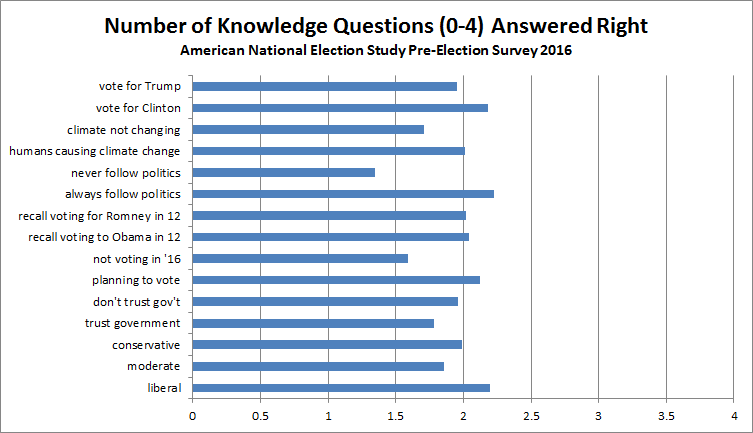
Last fall, the American National Election Study asked a representative sample of Americans four factual-knowledge questions about government: which party controlled the House and the Senate, how long a Senator’s term lasts, and which federal program costs the most. The mean respondent got just under two (1.94) of the four items right.

I thought some comparisons would be interesting. As shown in the chart below, Clinton voters scored a bit higher than Trump voters–but not by a mile. Political knowledge of this type correlated somewhat with understanding climate change, and a lot with following political news and planning to vote. Obama and Romney voters had indistinguishable levels of political knowledge. Liberals performed a bit better than conservatives, and both knew more than moderates. Knowing more about government correlated with trusting it a bit less.

Mindlessness: A Sonnet

I’m striving to be a little less present.
You need the attention of our group.
Your anxious eyes, urgent words convey a gripe;
They sketch a threat you’re sure is prescient.

But I’m counting syllables in my head,
Selecting words for a private longing,
Rehearsing anxieties—more than learning.
The staccato of your speech makes it hard

For me to keep my restless inward eye
Focused steadily on my lost past, my fears,
Or to freeze this mood in lasting phrases.
You, they, and we interrupt the flimsy I.

It’s a discipline to suggest attention
While indulging fully my own tension.

(Posted on the DC->Boston shuttle)

don’t let the behavioral revolution make you fatalistic

Beginning in the late 1960s, Amos Tversky and Daniel Kahneman shook the prevailing assumption that human beings can plan and make decisions rationally. Their experiments demonstrated that we use “simplifying heuristics rather than extensive algorithmic processing” to make decisions. We err in predictable ways even when we want to think rationally (Gilovich & Griffin 2002).

Tversky’s and Kahneman’s revolutionary program spread across the behavioral sciences and constantly reveals new biases that are predictable enough to bear their own names. Attribution Bias means explaining one’s failures as the results of difficult external circumstances, while others’ failures must flow from their bad choices. The Control Illusion is the tendency to overestimate how much we control events. The Halo Effect causes us to overvalue work by people whom we have previously judged as talented. And the lists go on for pages.

These phenomena are held to be deeply rooted in the cognitive limitations of human beings as creatures who evolved to hunt-and-gather in small bands on African plains. Not only has the burgeoning literature on cognitive biases challenged rational market models in economics, but it undermines the “folk theory” of democracy taught in civics textbooks and widely believed by citizens and pundits. The folk theory holds that “Ordinary people have preferences about what their government should do. They choose leaders who will do these things, or they enact their preferences directly in referendums. In either case, what the majority wants becomes government policy” (Achen and Bartels 2016). Citing the research on human cognitive limitations as well as other evidence, Achen and Bartels argue that this folk theory is not only false as a description of actual politics in the United States; it is impossible.

Such evidence should be taken very seriously. No reform program will work that doesn’t address human cognitive limitations. But we can design solutions. For example, people are not very good at measuring time, but most of us carry little prosthetic devices on our wrists that tell us what time it is. We’ve also sprinkled our walls and computer screens with clocks that are synchronized so that we can coordinate billions of people’s time.

Similarly, a newspaper is a prosthetic device for telling us what important events are occurring around the world that are relevant to our decisions as consumers, workers, and citizens. We didn’t evolve to know the news, but we have built tools that tell us the news.

To be sure, human cognitive limitations make the news business a hard one. We human beings are not very good at separating reliable information from misinformation, at seeing the world from perspectives other than our own, or at absorbing information that challenges our prior assumptions. We are not automatically motivated to pay for reliable information about public issues.

Some of these points have been known for a very long time. Francis Bacon, for example, was an acute observer of human cognitive limitations. Around 1880, there was no such thing as a professional, politically independent, reliable press in the United States. If people had considered the many reasons to doubt that human beings can know or value the news, they would not have set about to create the modern press.

Instead, naively, they went ahead and built the press. And they made it work by selling a desirable package that included entertainment and advertising as well as hard political news. The metropolitan daily newspaper had a pretty good run until new forms of advertising and entertainment finally shrank it in our century. Behavioral science would have predicted the demise of the independent newspaper–but about a century too soon. In fact, “the press” (reporters, editors, journalism educators, and others) sustained the newspaper as a tool for overcoming human cognitive limitations for decades. Nor is the newspaper the only such success story. Behavioral science would not predict schools and universities, research labs, or public libraries, either.

The moral is to be sober about the limits of reasonably rational and ethical human behavior without ever giving up on our ability to create better tools and contexts.

Sources:

  • Christopher H. Achen and Larry M. Bartels, Democracy for Realists: Why Elections Do Not Produce Responsive Government (Princeton: Princeton University Press, 2016)
  • Thomas Gilovich and Dale Griffin, “Introduction–Heuristis and Biases: Then and Now,” in Gilovich and Griffin (eds.), Heuristics and Biases: The Psychology of Intuitive Judgment (Cambridge: Cambridge University Press, 2002).

See also: hearing the faint music of democracyJoseph Schumpeter and the 2016 election.


it’s no accident that people distrust institutions

Bill Bishop (who is a terrific reporter and thinker) wrote a Washington Post piece on March 3 entitled “Americans have lost faith in institutions. That’s not because of Trump or ‘fake news.’” The article is illustrated with a bank of charts showing declining trust in almost all institutions. Bishop’s explanation throughout is cultural and attitudinal:

The leaders of once-powerful institutions are desperate to resurrect the faith of the people they serve. They act like they have misplaced a credit card and must find the number so that a replacement can be ordered and then FedEx-ed, if possible overnight.

But that delivery truck is never coming. …

We haven’t simply changed our attitudes. We’ve voted with our feet, walking away from the institutions we supported for generations. …

We have become, in Polish sociologist Zygmunt Bauman’s description, “artists of our own lives,” ignoring authorities and booting traditions while turning power over to the self. The shift in outlook has been all-encompassing. …

People enjoy their freedoms. There’s no clamoring for a return to gray flannel suits and deferential housewives. Constant social retooling and choice come with costs, however. Without the authority and guidance of institutions to help order their lives, many people feel overwhelmed and adrift.

My view is different. I think that when things are going well, institutions offer attractive deals to citizens that they would be very happy to accept today. For instance, if unionized manufacturing jobs paid decent wages, people would like unions. If local government agencies had enough resources to provide consistently decent services, people would like government. If political parties were driven by volunteers (instead of swamped by money that flows to for-profit consultants who work for entrepreneurial candidates), people would engage with parties. And if a metropolitan daily newspaper offered the best available way to get news, sports, classifieds, and comics, people would subscribe, the subscription money would pay for journalists, and readers would trust the news industry.

But there are reasons that these institutions are not prospering. They all have competitors or outright enemies. Unions, for example, did not decline because we became “artists of our own lives.” Industries that had been unionized lost jobs to automation and outsourcing, and states passed laws that frustrate organizing. As they used to say on the left, it’s no accident, comrade, that unions have lost support.

An attitudinal explanation puts all the emphasis on people’s preferences or values. I’d introduce power into the narrative and explain people’s low trust as a reflection of objectively weak institutions that, in turn, were weakened by their rivals and enemies. The whole story is no doubt complex, with reciprocal causation, vicious cycles, and elements of cultural change; but intentional efforts to dismantle institutions must be part of the diagnosis.

my working theory of Trump and the Russians

A working hypothesis, subject to being disproven and probably incorrect in several respects:

The Putin Government has a list of issues that they perceive as points of conflict with the US and NATO countries. At the top are Syria and Ukraine, but the list extends beyond that.

In 2016, they viewed Hillary Clinton as the most likely next president, but not as a sure bet. They saw her as competent and hostile to their interests. They created a barrage of fake news and stole and leaked true information to lower her odds of winning and to weaken her mandate if she prevailed.

They viewed Donald Trump as having some chance of winning, and they much preferred that outcome. He had ideological affinities with Putinism (as a form of macho authoritarian White Christian nationalism) and was likely to divide and weaken US political institutions and alliances while also bringing disrepute to the US. So they directed their propaganda to favor him and chose not to leak secret information about him, if they had any.

Meanwhile, Trump’s entourage included a bunch of characters who had strong ideological commitments to Putinism or financial ties to Russia, or both. By enticing these men into back-channel conversations or business deals, the Russians could gain leverage over them. This might influence US foreign policy. Alternatively, the Russians could suborn scandalous or unlawful behavior and use (or threaten to use) their knowledge of these secret interactions at their convenience.

Trump had no idea of any of this. He thought the stolen information from the Democratic Party should be public and he believed the fake news that he retweeted. He either didn’t know about the back-channel conversations or didn’t think they were inappropriate. To this day, he doesn’t understand what was wrong and he regards the criticism he’s receiving from the security agencies, Congress, and the press as sheer partisan hostility. This is why he continually draws attention to the scandal instead of trying to distance himself from it.

Trump did, however, state publicly and privately tell James Comey that he wanted the investigation to end. By firing Comey when he didn’t comply, Trump probably obstructed justice. That would be a felony carrying up to five years in federal prison. Although some people in Trump’s orbit may have committed original crimes (such as receiving Russian money unlawfully), the main violations involve interference with the investigation.

Meanwhile, Putin has gotten what he wants as the Trump government squanders American soft power and weakens the Western Alliance. Neither is exactly an intentional goal of the Trump administration, whose malice is exceeded by its sheer incompetence.

civic life and health research

This is an online lecture (video, slides, and discussion questions) entitled “Civic Life and Health Research.” It’s offered by, and thanks to, the Tufts Clinical Translational Sciences Institute (CTSI), where I hold a research professorship. Dr. Thomas Concannon introduces the CTSI and the session. I then offer four frameworks for understanding civic life:

  1. social capital
  2. collective efficacy
  3. common pool resources
  4. the public sphere

For each one, I explain why there are important empirical and conceptual connections with public health that have implications for both research and practice. Public health really serves as an example to illustrate how to apply these concepts, so the talk might be of some use in other fields as well, such as education or economic development.

(You can find and register for other free CTSI courses here.)

college curricula for civic learning and engagement

I’d welcome recommendations of particularly promising undergraduate courses or programs that are intended to boost students’ civic knowledge, skills, and engagement. I’m especially interested in two approaches: 1) requiring a specific course with a civic focus for all students at a given institution, or 2) offering a major, minor, or certificate program for especially interested students.

Civic education at the college level may address contested concepts (justice, citizenship, democracy), skills (from facilitating meetings to reading regression tables), bodies of knowledge (how a bill becomes a law; the texture of the local geographical community; social determinants of health …), self-understandings and identities (“Who am I and what is my role in the community?”), and relationships among students or between students and others. The list of possible outcomes is so long that one reasonable view is: A civic education is a liberal education–it’s the whole curriculum and co-curriculum. But it’s valuable to consider what to offer (or perhaps even require) in the finite span of one course or one major.

Many colleges and universities require first-year seminars. Students can typically choose a course from a menu, but all the seminars create a similar experience, which is supposed to build a community among the students. To the extent that first-year seminars address issues of civic importance, this is also a way of teaching ideas and skills relevant to citizenship. At Cal. State Chico, the guiding principle of the first year seminar program is “Public Sphere Pedagogy.” Chico aims to shift “from a typical classroom setting” to real public dialogues with “diverse campus and community members.”

Other institutions require a particular course or sequence of courses for all students. Columbia’s Core Curriculum is a distinguished example that dates to the early 1900s. Since Columbia’s Core course on “Literature Humanities” has included the Iliad, Oresteia, and Inferno for all of its 75 years, every Columbia College student since WWII has read those books. “The communal learning–with all students encountering the same texts and issues at the same time–and the critical dialogue experienced in small seminars are the distinctive features of the Core.” One could focus mainly on formal, historical, or theological issues while reading texts like the Inferno; but among the topics emphasized in the Core seminars are explicitly civic ones: “What does it mean, and what has it meant to be part of a community?” “By what rules should we be governed?”

At Florida Gulf Coast University, all 13,000 students must take the University Colloquium, an “interdisciplinary environmental education course designed to explore the concept of sustainability as it relates to a variety of considerations and forces in Southwest Florida. In particular, we will consider environmental, social, ethical, historical, scientific, economic, and political influences.” The Colloquium requires 10 hours of service, which can go toward FGCU’s universal requirement of 80 hours for graduation.

Note the interesting difference in content focus: classic texts at Columbia; the local physical and human environment at FGCU.

At least 31 institutions offer majors with titles like “Civic Engagement,” “Service Learning,” “Civic Leadership,” “Community Service,” or “Leadership, Ethics, and Social Action,” and variations on those themes.* I would add majors in “Peace & Justice Studies,” “Advocacy Studies,” “Citizenship & Civic Engagement,” and others to this list.

These programs almost always require community-service experiences or internships. Most also require a foundational course. Butin* finds that the content of these courses varies a great deal. The most frequently assigned material is research about civic engagement in America, e.g., Robert Putnam’s Bowling Alone or excerpts from de Tocqueville; but those particular texts are assigned in a minority of all the foundational courses.

Majors are usually more ambitious than minors or certificates, but a program like the University of Maryland’s Civicus is not only a certificate with some required courses; participants also live together in a dedicated dorm and conduct service projects beyond their courses. In that situation, a certificate may be more intensive than a major.

I view public policy programs (whether undergraduate or graduate) as somewhat different from programs in civics. I like to say that the question for Civic Studies is “What should we do?” whereas the question for public policy is “What should be done?” (Or, “What should a policymaker do?”) However, public policy programs can emphasize the citizen’s side of policymaking. Some assign all their students to participate in simulations in which they role-play various official leaders in a fictional crisis. These simulations typically fill a limited number of days before the main coursework begins and serve to build a community while teaching civic skills. I am not aware of any institution that offers or requires a simulation for its whole undergraduate student body, but that’s an interesting prospect.

* Dan Butin, “’Can I major in Service-Learning?’ An Empirical Analysis of Certificates, Minors, and Majors,” Journal of College & Character, vol. 11, No. 2 (2010), pp. 1-18.

psychoanalyzing presidents

There’s lots of conversation right now about Donald Trump’s mental condition. It includes claims that he demonstrates narcissistic personality disorder and that changes in his speech patterns reveal cognitive decline. I [analyzed] his speech pattern from a particular angle here.

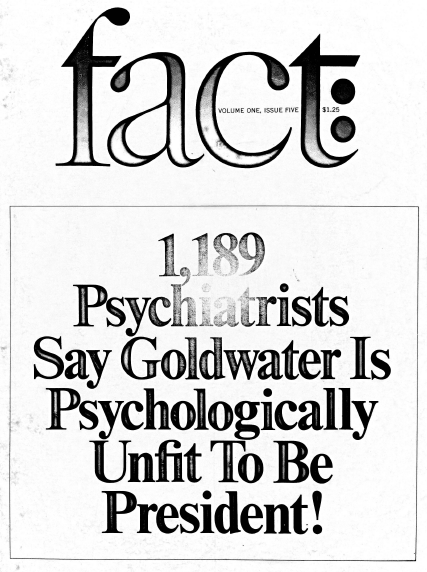
This discussion evokes the episode in 1964, when Fact magazine surveyed psychiatrists about then-candidate Barry Goldwater’s psychological fitness to be president.

Just under half (49.2%) of the 2,417 respondents thought he was unfit, with the rest split evenly between those who didn’t believe they could answer and those who considered him fit for office. Fact also gave respondents a chance to write comments and printed 40 pages of quotes from their answers. Goldwater sued and won over $1 million in damages (which bankrupted Fact magazine), leading to the American Psychiatric Association’s “Goldwater Rule,” which forbids members from making evaluative comments about public figures whom they have not examined as individual patients. A patient/physician relationship triggers ethical responsibilities that are absent when psychiatrists discuss public officials.

For me, the original Fact magazine issue is a fascinating example of professional authority encountering politics. It’s important to note that a considerable minority of the quoted statements either object to psychoanalyzing Goldwater without examining him in person or vouch for his mental health. Some of the surveyed psychiatrists even opine that he is the only sane candidate, surrounded by crazy socialists. But the majority of the quoted MDs make claims that now seem risibly dated and morally problematic. They do so under their professional titles, in a magazine entitled “Fact.” For example:

  • “Descriptions of his early life that I have read indicate to me that his mother assumed the masculine role in his family background. … The picture, therefore, is of a domineering, emasculating mother and a somewhat withdrawn, passive, narcissistic father. … This would provide a fertile background for sado-masochistic temperament, such as is seen in paranoid states.” — M.D., name withheld.
  • “From TV experiences, it is apparent that Goldwater hates and fears his wife. At the convention, she consistently appeared depressed and withdrawn. Certainly she was not like the typical enthusiastic candidate’s wife, e.g., Mary Scranton.” — M.D., name withheld.
  • “Barry Goldwater’s mental instability stems from the fact that his father was a Jew while his mother was a Protestant. This ethnic and cultural split accounts for his feelings of insecurity and spiritual loneliness. … ” — M.D., name withheld.
  • “In trying to analyze Mr. Goldwater’s behavior I am tempted to call him a ‘frustrated Jew.’ … He has never forgiven his father for being a Jew. … What the Senator from Arizona stands for is the antithesis of the traditional Jewish concepts of social justice, of humility, of moderation in speech and action, and of concern for the feelings of others, especially the vanquished. In eschewing these concepts, the Senator subconsciously expresses his hatred for his Jewish father.” — Max Dahl, M.D. Supervising Psychiatrist [etc.]
  • “In allowing you to quote me, which I do, I rely on the protection of Goldwater’s defeat at the polls in November; for if Goldwater wins the Presidency, both you and I will be among the first into the concentration camps.” – G. Templeton, M.D.,  Director, Community Hospital Mental Health [etc.]
  • “Characterologically, Goldwater is like many middle-class Americans. He is ‘formula’ oriented with a belief in the infallibility of his own rhetoric. … In short: Goldwater is an anal character who believes all’s well in his ‘tidy’ world.” — M.D., name withheld.
  • “From his published statements I get the impression that Goldwater is basically a paranoid schizophrenic who decompensates from time to time.” — M.D., name withheld.

I think we should talk about Donald J. Trump’s character and psychological fitness for office. It seems problematic to use the Goldwater Rule to keep the whole psychiatric profession out of this discussion. And yet these quotes from 1964 remind us how historically-relative, value-laden, and agenda-driven people can be, even when they present themselves as scientific specialists dealing only in Facts.

social movements depend on social capital (but you can make your own)

The Montgomery Bus Boycott was the glorious chapter in the American Civil Rights Movement that began when Rosa Parks refused to give up her seat on the segregated bus. This story is usually misrepresented in ways that hide Parks’ planning, leadership, skill, and feminist radicalism (see the real Rosa Parks). In any case, at least 99 percent of the city’s African Americans quickly started boycotting the bus company. That meant that 17,500 workers needed a different way to get to work.

At first, Black-owned taxi companies carried them for the price of a bus ticket, but then the city threatened to enforce a minimum-fare law. Next, more than 150 people volunteered to drive boycotters to work in their own cars. These volunteers “responded immediately,” Martin Luther King recalls in Stride Toward Freedom, but “they started out simply cruising the streets of Montgomery with no particular system.” That must have meant that many workers missed getting available rides. Ministers responded by calling for new volunteers from their pulpits, and even more drivers came out, but that meant (King writes) that “the real job was just beginning–that of working out some system for these three hundred-odd automobiles, to replace their haphazard movement around the city.”

Committees were formed and roles were assigned. It was easy to identify [morning] pickup locations, because African Americans lived in dense urban neighborhoods. But “we discovered that we were at a loss in selecting [afternoon] pick-up stations,” because domestic workers were employed all over the White neighborhoods. Two Black postal workers helped design regular routes. King recalls all this organizational work with evident pride, and concludes, “Altogether the operation of the motor pool represented organization and coordination at their best. Reporters and visitors from all over the country looked upon the system as a unique accomplishment.”

I’d like to draw two theoretical implications from this story.

First, we tend to think of social movements as examples of contentious politics, along with protests, strikes, and even revolutions. Contentious politics has a substantial literature. A separate literature concerns how communities organize themselves to provide services and manage common resources over the long term. For the most part, these two discussions are rather separate. They draw on different disciplines and have different dominant rhetorical styles. But actual social movements rely heavily on what could be called “common pool resource management.”

The two postal workers who designed routes exemplify lessons from the research of Elinor Ostrom and her colleagues: local people tend to have the most detailed relevant information; clear rules enable coordination; and public goods can be rotated geographically to serve many people. I’ve been arguing that we should combine the political-economy of Elinor Ostrom with the insights of Gandhi and King for a more complete civic theory.

The practical implication is that people who want to confront power often benefit from learning how to organize systems and processes that look like nonprofit enterprises.

Second, it’s commonplace to note the dependence of the civil rights movement on “social capital,” especially in the form of churches and unions. Both institutions play explicit roles in Dr. King’s narrative of Montgomery. But this analysis can leave you at a loss if you’re part of a community that doesn’t happen to have much social capital. And social capital can be mysterious, for it is invisible, and its connections to tangible outcomes seem obscure.

Indeed, social capital is a metaphor: Montgomery’s African Americans did not have a literal deposit of social capital in the bank. When social capital is measured by asking individuals about their tendency to join groups and to trust one another, it’s hard to see how we could boost these assets or why they would be important politically.

A different way of looking at social capital is as a concrete capacity to solve collective-action problems, such as providing free rides to 17,500 people every day. That may have been easier in Montgomery because so many people were already organized in other successful, functioning groups, such as the Black churches. “Labor, civic, and social groups were our staunch supporters,” King writes, “and in many communities new organizations were founded just to support the protest.” Like other forms of capital, social capital can be built up in one place and used in another. But what mattered was actually organizing the carpools to sustain the boycott. Skillful citizens can pull off such successes even in the absence of existing high levels of social capital, when they design good structures.

In short, social capital is a metaphor for self-organization, and people can self-organize.

See also what is a social movement?Ostrom, Habermas, and Gandhi are all we need; and Habermas, Ostrom, Gandhi (II).