does every country have the same moral obligation to migrants?

About 1 million US citizens, mostly retirees, currently reside in Mexico. According to one study, 92 percent of them don’t have their papers fully in order to live there. Even if they are fully documented, they hold ambiguous civil and political rights. The Constitution of Mexico, after stating that everyone shall have the basic privileges and immunities guaranteed by Chapter 1, goes on to say, “However, The Federal Executive shall have the exclusive power to compel any foreigner whose remaining he may deem inexpedient to abandon the national territory immediately and without the necessity of previous legal action. Foreigners may not in any way participate in the political affairs of the country” (Article 33).

You might think that all human beings have human or natural rights to live anywhere. Then Mexico and the United States are both illegitimately blocking some migration. (This is a radical view with radical implications.) Or you might say that all people must have free speech and due process rights, regardless of their citizenship. Then Mexico’s Article 33 seems problematic.

My intuition is different. I favor equal rights for people who reside within the United States even if they don’t have legal citizenship. I recognize that in some cases, their entry was an illegal act, but I am inclined to weigh that very lightly, if at all. I am mainly concerned about how they may be exploited or dominated within this country if their rights are not guaranteed. I am particularly uncompromising about their civil and political rights. Meanwhile, I would object to US retirees entering Mexico against Mexican law and would not complain if they were deported. And while I’m not sure I’m a fan of Article 33, I can see plausible reasons for Mexico to ban resident aliens from political engagement.

In other words, I am sympathetic to people who migrate from the Global South to the US, but not vice-versa. I myself would enjoy living for a time in several foreign countries, but I would not claim a right to do so unless it was legal under those countries’ laws. And I would tend to respect any prohibitions they imposed on my political action within their borders. I might make exceptions if the local government had forfeited its legitimacy and I wanted to help the opposition, but even then, I would be inclined to defer to citizens of the country in question to be the leaders.

This is an inconsistent position if it’s all about human rights, abstractly. Why not treat migration the same way regardless of its direction? I think my view puts human rights in the context of justice among nations. Mexico is a lot less wealthy than the United States and has excellent reasons to worry about its national sovereignty. It is because I assume that the international order is unjust in this kind of way that I am prone to favor rights for migrants to the US, regardless of their legal status. I then end up favoring rights for wealthy migrants from wealthy countries only because it’s best not to discriminate within the class of immigrants. The paradigm case for me is a migrant from a nation that has been disadvantaged by global politics.

Two questions: 1) Is my stance justified? And 2) Does it help to explain the political disagreement about immigration? Many Americans don’t see the US as unfairly advantaged at the global level; some even think that we’ve been unfairly disadvantaged as a nation, as Donald Trump often claims. I wonder whether that premise helps explain why they are so unsympathetic to migrants.

twenty-five years of it

Now 50, I can see that my scholarly or intellectual life has turned out differently from what I had imagined at age 25. Then I had a 9-5 job in politics–for the “citizens’ lobby,” Common Cause. I had written a dissertation that became an obscure book, and I was working on a novel that was later published, albeit without much notice. My job left me time to work on other research. I had no idea what I’d achieve, but I thought I knew what the goal looked like. I’d produce writing. It would be helpful (I hoped), but also distinctive, original, and influential. Most of my intellectual work would be done alone. I would stand somewhat aside from society and its institutions, offering critical perspectives. I would find new things to say to readers about perennial authors and issues.

Today, my actual work consists of meeting with people, reading and writing, preparing talks, reading others’ draft papers, grant proposals, budgets, and planning documents, proposing projects, sending emails to groups of colleagues on timely matters, starting and editing Google docs, and facilitating discussions, whether in classrooms or elsewhere. When I ask myself why I do any of these particular tasks, the answer is almost always that someone has asked me to. (My blog posts are exceptions, and misleading ones if they’re all you know about me.) I care about the person who has asked me for each task–usually at a personal level, but often also because of our respective roles in organizations. When things go well, I feel that my work contributes to a network. Even when I’m the sole author of a document, it is usually destined for a publication that has been jointly planned by a group.

My work is much less original than I might have hoped or planned for it to be. Not only are my thoughts typically in the same vein as what others have already said, but often I have said the same things before. For example, I have already argued for civic education in k-12 schools many times. But perhaps I have not made yet that case to school superintendents, or historians, or people in Ukraine. If the cause seems valuable, I’ll find a new way to make the same points.

I’ve focused much more intensively and narrowly than my natural inclinations would predict. Starting all the way back in grade school, I had a tendency to grasp concepts superficially: just well enough to be able to say something that worked for the situation. Then I would get bored and want to learn something new. This is mostly a vice. But as things have turned out, I’ve worked on certain topics (civic education in US schools, youth voting, public deliberative forums, measuring civic life, aspects of political reform) for decades. My views may be wrong–they are certainly fallible–but they are not superficial. I’ve heard cogent critiques from all sorts of angles and have made appropriate changes. I’ve pursued some questions like a bloodhound with his nose to the ground.

My work is much more empirical than I’d expected: I deal more with statistics than with classic texts. It’s more collaborative. It’s less glamorous. Of course, glamour is in the eye of the beholder, but writing about famous authors has a certain cachet that seems missing in a grant proposal or a budget report.

I’m motivated much more by demand than supply, to use economists’ language; or by relationships rather than self-expression. Sometimes I chafe at that, wanting to say something more ambitiously distinctive. But working for and with other people increases the odds of making a difference. So does focus, and especially focus on relatively narrow and overlooked topics.

I also work much harder than I did at 25. I think that’s driven by demand. When you’re a young scholar, you do what you must to be employed. Beyond that, you’re motivated mostly by factors internal to you: curiosity, ambition or sheer love of the material. Once you’re securely embedded in a network, the importance of all those motivations diminishes. Often I find myself hard at work late at night because someone who’s doing something valuable needs my contribution (no matter how modest it may be) by the next morning. The net result is a lot more work per week than I thought I could do half a lifetime ago.

I think that if I could beam a message back to myself at age 25 that described my current life, the youthful me would probably be disappointed. But that’s just because this 50-year-old wouldn’t be able to convey the satisfactions of a life focused on participation in organizations and networks.

against state-centric political theory

What do all these statements have in common?

  1. “Republicanism is a consequentialist doctrine which assigns to government, in particular to governmental authorities, the task of promoting freedom as n0n-domination.” — Philip Pettit, Republicanism: A Theory of Freedom and Government
  2. “Of course governments may delegate … to private entities, but in the end it is government, meaning the society’s basic political structure, that bears the ultimate responsibilities for securing capabilities …. . The Capabilities Approach … insists that all entitlements involve an affirmative task for government: it must actively support people’s capabilities, not just fail to set up obstacles. … Fundamental rights are only words unless and until they are made real by government action.” — Martha Nussbaum, Creating Capabilities: The Human Development Approach
  3. “Justice is the first virtue of social institutions, as truth is of systems of thought. A theory however elegant and economical must be rejected or revised if it is untrue; likewise laws and institutions no matter how efficient and well-arranged must be reformed or abolished if they are unjust.” — John Rawls, A Theory of Justice
  4. “The free man will ask neither what his country can do for him nor what he can do for his country. He will ask rather ‘What can I and my compatriots do through government’ to help us discharge our individual responsibilities, to achieve our several goals and purposes, and above all, to protect our freedom? And he will accompany this question with another: How can we keep the government we create from becoming a Frankenstein that will destroy the very freedom we establish it to protect?” — Milton Friedman, Capitalism as Freedom

These authors disagree about what the government should do and what powers it should have. Friedman wants as little government as necessary to protect a certain kind of freedom. Nussbaum and Rawls would assign the state the powers it needs to guarantee a range of social outcomes. Pettit starts with a particular conception of freedom and concludes with an argument for an assertive state.

But all agree that justice means getting the role of the government right.

One objection to this shared premise is that no government alone can determine whether people experience justice or injustice. Amartya Sen begins his book The Idea of Justice with a quote from Great Expectations (“In the little world in which children have their existence, nothing is so finely felt and perceived as injustice”) to support the point that non-state actors–in Pip’s case, an older sister–can be just or unjust in ways that no state would be able to determine.

I agree, but my objection is different and (I think) more radical. All the books quoted above are about justice, but their authors and readers are not governments. Instead, these books are written by people for people. People can adopt views of what governments should do, and sometimes people influence governments. But individual people–even dictators–cannot directly make governments either just or unjust. The question for these authors and their readers should be: What must we do?

From that perspective, governments do enter the picture, as do families, markets, customs, religions, ecosystems, laws of nature, and many other tools and constraints. The question for us is not how each of these things should ideally work (if so, I’d favor laws of nature that guarantee us all perfect happiness forever), but rather how we should deal with the constraints and opportunities that confront us.

In particular, the governments that we deal with differ greatly. Some of us live in Denmark; others in North Korea or Bukina Faso. All the authors cited above would agree that Denmark’s government is better than North Korea’s, but that conclusion has limited value for residents of either country. Further, citizens of Denmark can fine-tune the justice of their government’s policies by supporting the political parties that best reflect their views. In North Korea (because of tyranny) and in Burkina Faso (because of poverty), that approach to improving the world isn’t really available.

My objection is not that governments should play a more limited role than they play today or than some theorists recommend. As an individual voter, it happens that I would support more assertive government. My objection is to treating the question, “What is a good government?” as an answer to the existential question, “What should I do as a citizen?” Apart from voting for the party that recommends my favorite size and type of government, what am I to do?

I’d venture an analogy to a family of theological views. For many theists, God is the Unmoved Mover, ultimately responsible for everything but not subject to being changed. Our stance toward God should involve such virtues as hope and faith. We can pray for certain outcomes, and we can be confident that divine choices will be just. We can ask what God is likely to do, given that God is just. We cannot, however, choose how God will act.

Likewise, in all the political philosophies cited above, the state is the unmoved mover of a system of justice. Unlike God, a state can either be good or bad; it can merit admiration or criticism. And we can debate whether the state should be more or less powerful (in contrast to God, Who is all-powerful). But these theories all suppose that the question of justice is: What is the ideal state? This question resembles the theological question, What are the attributes of God? It is a matter for analysis and inquiry, but not a choice.

Of course, everyone realizes that people make and change governments. The modern Danish state didn’t arise spontaneously; Danes made it and sustain it. They have also made the Danish language and economy and the physical layout of Danish towns and the countryside. But the strategies and ethics of citizens’ action are sidelined in all these political philosophies–even in Friedman’s libertarianism. He wants the state to do little, and private actors to do what they want; but that’s still not a theory of how we can accomplish justice. Again, if we are Danes who agree with Friedman, we can vote for classical-liberal candidates; but if we are North Koreans, Friedman’s ideals are empty.

How did a strategy for influencing the world become available in Denmark that is absent in North Korea? Because of the past behavior of people, both inside these countries and beyond.

Perhaps political philosophers focus on the state because they believe that blueprints of just political orders influence history. Without Locke, no American Revolution; without Rousseau, no French Revolution; without Marx, no Russian Revolution. The social impact of abstract philosophy is a large question on which I claim no special expertise. However, my general premise is that the Owl of Minerva flies at dusk and doesn’t see all that well. Locke writes after the actual English Revolution of 1688 and tries to make theoretical sense of it. He has some influence on the American framers, but they have many other influences as well, including their hands-on experiences in colonial government. Likewise, Robespierre may have carried his copy of Rousseau around with him–and Lenin, his Marx–but the actual revolutions that they led didn’t resemble these blueprints all that well. Not to mention that most sustainable change doesn’t occur during revolutions at all. It reflects slow, cumulative, experimental adjustments that are theorized after the fact.

Another reason that most political philosophers focus on the state rather than people may be that the actions of citizens appear to be theoretically uninteresting. Action is a matter of praxis, and the only question is empirical: Given the actual circumstances, what will work to move the society toward justice? That’s a question for strategists and empirical students of activism, lobbying, elections, social movements, revolutions, and so on, but not for political philosophers.

This is where I dissent. When we set out to change the world, we must decide what is right for us to do under the circumstances. The main way to test our answers to that question is to discuss them with other people. We must also coordinate our actions to increase our odds of changing the world. Unless we have already coordinated with some other people, we probably lack a venue in which to deliberate, because a deliberation is itself a shared activity, and it almost always takes place within an organization of some kind that we must sustain.

Deliberating and coordinating action generate relatively consistent classes of problems. They are hard problems, yet some groups of people have solved them. These problems are just as conceptually and ethically complex as the problem of designing a good state. But they are more pressing for us, because we can deliberate and coordinate, but we cannot implement our ideas of a good state. The only way that states will get better is if people (including those who work in and for states) deliberate and coordinate better. And–while we are at it–we can also change cultures, markets, religions, and even ecosystems. Theorizing that work is the task of Civic Studies.

See also: Ostrom, Habermas, and Gandhi are all we need; Habermas, Ostrom, Gandhi (II)new book–Civic Studies: Approaches to the Emerging Field; and The Good Society symposium on Civic Studies

some notes on Nietzsche’s Beyond Good and Evil

Here–free for the digital commons–are some teaching notes for chapter 1 of Nietzsche’s Beyond Good & Evil. Before discussing this text, my class had read Plato’s Apology; I present Nietzsche and the Socrates of the Apology as foils.

Socrates begins a quest for knowledge, claiming that he only knows that he knows nothing. Instead of writing or producing connected arguments, he merely interrogates his fellow citizens, testing what they think. He is a critic of rhetoric (who, however, speaks eloquently) and an ascetic who has renounced any role in society other than truth-seeker.

Nietzsche challenges this Socratic quest. He is a critic of language who uses it masterfully. He refuses to write connected arguments, instead employing an aphoristic style full of irony, paradox, and contradiction. He is a critic of asceticism who actually lives a solitary life devoted to writing.

What assumptions does Socrates make when he sets out on his mission? Maybe …

  • A good life, or perhaps the best life, is a life of pursuing truth. This is a demanding ideal that requires renouncing other entanglements, such as money, political power, and romance.
  • Customs and assumptions are unreliable and dangerous. You shouldn’t act on things that you can’t show are true. You should go through life with skepticism and doubt.
  • However, there is truth to be known and told in words. Specifically, there are knowable truths about human excellence or the good for us as human beings (moral truths).

What did we add to these assumptions in the 2,300 years between Socrates and Nietzsche?

  • Science and the scientific method. Socrates didn’t practice science. He was accused of studying the things in the sky and below the earth, but he denied it. Since his time, we have studied those things intensively. (What is science, anyway? Methods for understanding nature objectively, where nature includes human beings as natural phenomena. Science presumes that everything is understandable through these methods, unless it’s “supernatural.”)
  • Science as applied to human beings–social science and history–has revealed a deep diversity of values and basic beliefs.
  • We have developed various accounts of what “nature” is and how that might influence or even define morality or justice. (Natural rights, the state of nature, “the Laws of Nature and of Nature’s God.” Or Darwinism: nature as survival of the fittest. cf. Beyond Good & Evil §9: what if nature is “wasteful beyond measure, indifferent beyond measure …?”)
  • Beliefs in the underlying premises of the scientific method: math, logic, cause-and-effect, an objective world. (cf. §4 “… constant falsification of the world by means of numbers …”)
  • Some widespread moral premises? (“All men are created equal.”)
  • Confidence in the basic motivations of people, such as scientists, who say (and who probably believe) that they are seeking truth.

Nietzsche raises doubts about everything listed above. He thinks (§5) we’re “not honest enough” when we assume that we’re pursuing truth. We haven’t had the courage to turn that pursuit back on itself and ask hard questions about truth-seeking.

  1. Suspicion of words as representations of reality. §16 “I shall repeat a hundreds times: we really ought to free ourselves from the seduction of words!” Proceeds to investigate “I think” and all its linguistic assumptions. (That there’s an I, that we know what thinking is.) §14 “pale, cold, gray concept nets which they threw over the motley whirl of the senses.”
  2. We’re not deliberately thinking at all. §16: “When I analyze the process that is expressed in the sentence ‘I think,’ I find a whole series of daring assertions …. ” §17 “A thought comes when it wishes, and not when I wish, so that it is a falsification of the facts of the case to think that subject I is the condition of the predicate think. It thinks. …”
  3. We believe we’re discovering things about the world, but we’re expressing things about ourselves. §6 “Every philosophy is the involuntary and unconscious memoir of its author.” §9 You physicists pretend to find laws in nature, but you’re actually egalitarian democrats who want to believe that nature obeys laws because you like laws.
  4. He doubts the motivations of truth-seekers. §6 “I do not believe that a drive to knowledge is the father of philosophy, but rather that another drive  has … employed understanding (and misunderstanding) as its instrument.”
  5. We make an assumption about value: that truth would be better than falsehood. Why?  §4. “The falseness of a judgment is for us not necessarily an objection. The question is to what extent is it life-promoting, life-preserving, species-preserving, even species cultivating.” Falsehoods might do that better than truths. He says that this stance places us beyond good and evil. Why?

What does Nietzsche actually believe? The secondary literature discusses a set of “doctrines” that he may have held. One of them is explicit in Beyond Good & Evil, chapter 1: the Will to Power. According to §13, life itself is Will to Power (not self-preservation but the will to discharge strength). Nietzsche also says (§23) that he’s developing a psychology of Will to Power. Willing is “something complicated.” §19: “Freedom of the will” is “an expression for the complex state of delight of the person exercising volition. Here Nietzsche concedes that one drive might be for knowledge. It operates in scientists and scholars, but not in philosophers, because philosophy is “the most spiritual will to power.”

What does Will to Power mean? Some interpretations:

  1. A normative position: Nietzsche likes power and the powerful. Might is right. This interpretation was typical between 1900 and 1950 (and Nietzsche inspired fascists during that era), but is very marginal in the academic secondary literature today.
  2. A different normative position, and one that we might appreciate (i.e., not fascism): Will to Power is not about dominating other people but enhancing the individual and the species–making us somehow more creative. The reason to drop the will to truth is that it sometimes blocks our potential and creativity. “Why not rather untruth?” (Cf. §12, where he condemns himself to invention.) We should move beyond Good and Evil only in the sense that certain premises of traditional morality have limited our growth.
  3. A view of nature and human nature. Perhaps Nietzsche believes that every biological entity actually is a center of power rather than something stable. And perhaps this metaphysics (or physics?) is defensible.
  4. An intentional paradox that is meant to shake our convictions, roughly analogous to a koan. Start with the premise that everything is a manifestation of our Will to Power. Develop all the implications of that premise to make it plausible. Then apply it back to itself: the creature that envisions Will to Power is expressing its own power, not discovering truth. Then we know nothing. We don’t even know that “we” “know” nothing. What does it mean to live that way? In what style would one write?

Tufts Political Theory Workshop

(Please contact me if you would like to attend.)

September 28th and 29th at Fung House. 48 Professors Row, Tufts Campus, Medford MA

Thursday Sept. 28

5 pm “(Un)equal Respect and Agents of Justice”
Benedetta Giovanola, Associate Professor of Moral Philosophy
Department of Political Science, Communication, and International Relations, University of Mascerata, Italy Commentator: Dennis Rasmussen, Associate Professor of Political Science

6:15 pm “The Nature and Design of Robust Institutions”
Speaker: Brian Epstein, Associate Professor of Philosophy
Commentator: Peter Levine, Lincoln-Filene Professor of Citizenship and Public Affairs Jonathan M. Tisch College of Civic Life

7:30 pm Dinner for all participants

Friday, Sept. 29th
9:00 am “Justice, Self-Sufficiency, and Commodious Living: Hobbes’ s Commercial Republic”
Speaker: loannis Evrigenis, Professor of Political Science Commentator: Vickie Sullivan, Professor of Political Science

10:15 am “Grounds for Coverage: Considering the Basis for Entitlements of Immigrants to Health Care”
Speaker: Keren Ladin, Assistant Professor of Public Health and Community Medicine and Occupational Therapy
Commentator: Alecia McGregor, Assistant Professor of Community Health

11:30 am “We, the Mediated People: Unconventional Adaptation in post-Cold War South America”
Speaker: Joshua Braver, Jonathan M. Tisch Post-doctoral Fellow in Political Science Commentator: Abiodun Williams, Director, The Institute for Global Leadership

12:30 pm . Lunch

Sponsored by the Tufts Department of Philosophy, the Department of Political Science, and the Jonathan M. Tisch College of Civic Life

new overview of civic education

I’m at Democracy at the Crossroads, a conference on civic education, with speakers who include Justice Sonia Sotomayor, former Secretary of Education John B. King Jr., Senator Bob Graham, Prof. Danielle Allen, and more. At this conference, we are releasing “The Republic is (Still) at Risk–and Civics is Part of the Solution.” Kei Kawashima-Ginsberg and I are the authors of this new overview document, which builds on The Civic Mission of Schools (2003) and Guardians of Democracy (2011). We argue that the main reason to strengthen civics is the perilous condition of our republic, that today’s circumstances require innovation (not your grandparents’ civics), that a wide range of practices are effective when done well, and that state policies can support civics. The paper releases new information on positive changes in Florida and Illinois. It is available for download.

Citation: Peter Levine and Kei Kawashima-Ginsberg, “The Republic is (Still) at Risk—and Civics is Part of the Solution” (Medford, MA: Jonathan M. Tisch College of Civic Life, Tufts University, 2017)

college student voting rose in 2016

Today, my colleagues at Tisch College’s Institute for Democracy and Higher Education have released their national study of college students’ voting, based on the voting records of 9,784,931 students at 1,023 higher education institutions.  The team finds a national college turnout rate of 48.3% in the 2016 presidential election, up from 45.1% in 2012, with significant variations by race, gender, field of study, and institution type. Women voted at rates about seven points above men in both years. (It’s interesting that the dynamics of the 2016 campaign didn’t change that pattern.) Asians and Latinos increased their turnout substantially. African Americans’ turnout slipped from a high baseline in 2012.

  • Here is the full national report.
  • This is an interactive portal where you can explore the data yourself.
  • The team also sent individual reports to 1,005 colleges, with their own turnout data broken down as much as possible by students’ demographics and fields of study.
  • On NPR, Danielle Kurtzleben covers the release in a story headlined, “2016 Voter Turnout Dropped At HBCUs, Climbed At Women’s Colleges, Study Finds.”

becoming adults more slowly

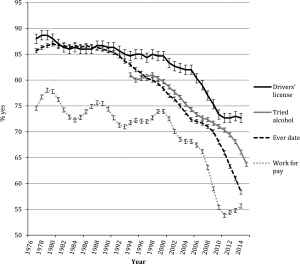
A new paper by Jean Twenge and Heejung Park (2017) is getting a lot of coverage. The main finding is a delay in the onset of certain activities traditionally defined as “adult.” This graph shows the trends in having a driver’s license, drinking alcohol (ever), dating, and working for pay–all down steeply for teenagers.
Twenge and Park find that these trends are parallel for different racial and economic groups. They also find that adolescents simply go outside their homes without their parents much less often than their predecessors did.

These data jibe with my observations teaching college and raising kids (and observing their cohorts) for 25 years. But I would have strongly surmised that my observations had a class bias. I would have explained the delay in adult activities as a result of increasing investments in children by parents who have assets to invest. American parents spend an average of $38,000 per child while their children are between the ages of 18 and 34 (Furstenberg, Rumbaut, Settersten 2005). That statistic conceals huge differences by social class. Some young people are rationally delaying their careers and the formation of their families while they accumulate human capital, thanks to their parents. Other people are on their own at age 15.

This graph, from Kei Kawashima-Ginsberg’s paper on extracurricular activities, shows a widening disparity in the sheer cash invested in organized activities.

Another reason to hypothesize a growing gap in the onset of adulthood by social class is Annette Lareau’s finding (ca. 2003) that middle-class American parents use a strategy of “concerted cultivation”–viewing childhood as an opportunity to develop human capital–while working-class parents prefer “the accomplishment of natural growth,” or letting kids be kids. One reason that middle-class and affluent American teenagers don’t spend much time away from their parents is that their parents are now providing “concerted cultivation” in the form of paid after-school activities, supervised homework, intentional conversations about valuable topics, etc. Meanwhile, the working class are trying to let their kids enjoy some freedom before they have to get jobs.

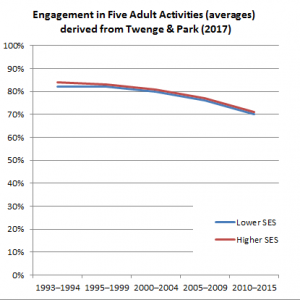
Given these prior assumptions, this is my biggest surprise in the Twenge and Park article: the lack of difference in rates of “adult” activities by social class. Here I graph the data in their Table 2.

Twenge, J. M. and Park, H. (2017), The Decline in Adult Activities Among U.S. Adolescents, 1976–2016. Child Dev. doi:10.1111/cdev.12930.

Furstenberg, F.F,  Rumbaut, R.G. Settersten, R.A. , “On the Frontier of Adulthood,” in Settersten, Furstenberg, and Rumbaut, eds., On the Frontier of Adulthood: Theory, Research, and Public Policy (University of Chicago Press, 2005)

See also: the changing transition to adulthoodcoming of age in your thirtiesGeneration Me?

religion and politics in the US versus many other countries

Here is a thesis that experts can evaluate better than I: The issue of religion in politics is fundamentally different in the US from many other countries. In the US, it is mainly about majority opinions versus minority rights. In countries from Mexico to Myanmar, it is about the social functions of a single organized body, the clergy. This difference matters for everyday politics.

The US has always had a religious majority that has been divided among many Christian denominations, with other faiths also represented. The Constitution gives individuals the right to exercise their religions freely. It also prevents any religion from being “established.”

The classic questions of religion and politics in the US involve majorities versus minorities. Sometimes, a coalition composed of many denominations supports a policy (e.g., banning abortion) for reasons that include religious ones. Then the questions become: 1) Does the desired policy impinge on constitutional rights? and 2) Are religious reasons for the policy acceptable or desirable in the public sphere? At other times, the majority becomes adverse to a particular religion–Mormonism in the 1800s being a clear example. Then the same two questions arise, but now the majority threatens the minority’s free exercise.

In nations with a single dominant religion that is organized in a hierarchical fashion (Catholic countries, but also, perhaps, some Muslim, Orthodox, Buddhist, Lutheran, and Anglican countries, plus in some respects, Israel), the issue is different. These countries have an organized, institutionalized body: the clergy. Typically, the clergy has a history of delivering some public services to the nation as a whole. For example, there may have been a time when the Catholic Church ran and staffed almost all of the state-funded schools in a given country. Sometimes, there is also a history of violent reaction against the clergy as an institution. Priests were executed in the French and Mexican revolutions, for instance.

In these countries, the question is not directly about whether to enact laws consistent with religious values. The question is whether to entrust an organized group of people, the clergy, with particular social functions. At the anti-clerical end of the spectrum, the clergy or priesthood is seen as a bane on society. At the clerical end, it is seen as a bulwark. These positions are, in principle, separate from one’s opinions of theology and of policy issues. A person could agree with the Church on most topics but distrust the clergy, or vice versa.

Here are some practical consequences of the difference:

  1. In the US, when debates over policy have religious components, they are deeply divisive and feel existential. At least some other countries treat such debates as fairly routine. The divisive issues for them concern the prerogatives of the clergy as an institution. An interesting hybrid case is Ireland, where the ballot victory on same-sex marriage was greeted with joy, at least in Dublin. I think voters were pro-equality, they celebrated because they had defeated the Irish clergy, a (currently unpopular) institution.
  2.  In the US, religious involvement in politics is usually mediated by officially secular political parties. The parties strive to assemble majorities by drawing people from several denominations. They typically recruit believers, not churches, into their ranks. In many other countries, each political party has a relationship with the main denomination, ranging from a formal partnership (e.g., for the Christian Democratic parties) to official hostility. Indifference may also be an option, just as a party can be neutral on other issues, but it will face questions about the clergy.
  3. In the US, it doesn’t really make sense to ask a candidate what she thinks of “the clergy.” You can ask her about abortion, God, her own faith, or the First Amendment, but there is no national clergy to have an opinion about.

See also: a typology of denominationsthe political advantages of organized religionreligion and politics in the Muslim world and the USA; and on religion in public debates and specifically in middle school classrooms.

Lifeworld and System: a primer

The great social theorist Jürgen Habermas has drawn attention–for more than half a century–to the problem that he calls the “colonization of the Lifeworld by System.” Here is my explanation, based mainly on a rare concrete example from his Theory of Communicative Action, vol. 2. 

The Lifeworld, for Habermas, is the background of ordinary life: mainly private, somewhat naive and biased, but also authentic and essential to our satisfaction as human beings. It is a “reservoir of taken-for-granteds, of unshaken convictions that participants in communication draw upon in cooperative processes of interpretation.” In the Lifeworld, we mostly communicate with people we know and who share our daily experience, so our communications tend to be opaque to outsiders and certainly not persuasive to people unlike us. But Habermas argues that we are incapable of thinking about everything at once. In order to reason and communicate, we must take most points as givens. Only then can “single elements, specific taken-for-granteds” be brought up for conversation and critical analysis.

Meanwhile, the “System” is composed of formal organizations, such as governments, corporations, parties, unions, and courts. People in a System have official roles and must pursue pre-defined goals (albeit sometimes with ethical constraints). For example, defense lawyers are required to defend their clients, corporate CEOs are supposed to maximize profit, and comptrollers are supposed to reduce waste in their own organizations. In the current period, there are fundamentally two Systems: markets (in which instrumental action leads to profit) and governments (in which instrumental action demonstrates power). Although the people who work in markets and governments are complex individuals with other commitments, their official work responsibilities are to maximize money or to administer power.

To illustrate the Lifeworld, Habermas invites us to envision an “older construction worker who sends a younger and newly arrived co-worker to fetch some beer, telling him to hurry up and be back in a few minutes.” The senior worker assumes that a whole set of beliefs and values are shared on the team: German construction workers enjoy and expect to drink beer at breaks during the workday, beer is for sale in the vicinity, the younger and/or most recently hired person is the one who does unpaid chores for the group, and so on. Each of these assumptions could be brought into doubt and subjected to debate. For instance, as Habermas suggests, the younger worker might say, “But I don’t have a car,” or “I’m not thirsty.” Other “elements of the situation” might generally pass unnoticed yet become relevant as circumstances change. If the younger worker is an immigrant without health coverage and he falls off the ladder as he goes to buy the beer, several relevant laws and controversies may suddenly occur to the workers, moving from their background knowledge to topics of explicit discussion. But at any given moment, simply by virtue of being human, the workers must assume most features of the situation as a shared and implicit background, a “vast and incalculable web of presuppositions.” This is their Lifeworld.

In order for the workers (or any other group of people) to be free and self-governing, they must be able to render any aspect of the Lifeworld problematic. It is a definitive feature of modernity that no assumptions are considered immune to critique; and it is a condition of democracy that no critique is blocked by law or other force. When the younger construction worker notes that no beer is available within walking distance and he doesn’t have a car, he is giving a reason for someone else to go. This turns his work group into a small Public Sphere. To the extent it is democratic and deliberative, his reasons will require responses.

Imagine (to go beyond Habermas’ presentation of this example) that the radio is playing as these men work. A news program includes an interview with a feminist activist who criticizes the construction industry for hiring very few women, followed by an immigrant leader who notes that alcohol is forbidden to Muslims (thus the assumption that everyone wants to drink beer is exclusionary), followed by a health expert who attributes disease to excessive daytime beer consumption. These people are making arguments that compel critical attention to specific aspects of the workers’ Lifeworld. They represent the larger Public Sphere of the Federal Republic or the European Union. It doesn’t matter whether the interviewees have self-interested motivations, such as selling copies of their books, or whether the radio station is a for-profit company trying to attract listeners. The format of any reasonably well-run news program will compel the speakers to give reasons that can be checked and assessed by reporters and listeners. This is a case of a democratic Public Sphere challenging citizens to reflect about aspects of their Lifeworld.

But although every particular point should be subject to discussion, the whole Lifeworld must be protected. One reason is that we need the Lifeworld to think at all, for we are capable of testing a specific assumption only while holding our other assumptions for granted. A second reason is that our Lifeworld is ours, a condition of living authentically. Any political program that tries to strip a group of people of their accumulated assumptions all at once would be totalitarian. A radio program that brings separate issues to the workers’ attention expands their thinking; but if a revolutionary government seizes all the radio stations and begins broadcasting propaganda against contemporary German working-class culture as a whole, that is a threat to their Lifeworld.

Meanwhile, the Lifeworld is vulnerable to manipulation by interested parties who act instrumentally. For example, suppose that on the radio, the workers hear men with similar accents to their own praising a particular brand of beer. Maybe women are also heard, enjoying these men’s company and appreciating their good taste. It sounds as if friends have entered the real Lifeworld of the construction site, but these supposed friends are really actors who are are paid to sell beer. Of course, the workers will understand the purpose of an advertisement, yet by skillfully imitating their authentic Lifeworld, the ad can affect their behavior. No reasons need be given; no rebuttal is invited. In this case, Habermas would say that the Lifeworld of the workers has been colonized by the System of markets. The System of government might similarly colonize their Lifeworld if a candidate for public office started talking on the radio as if he were their friend who shared their values and experiences.

In discussions of Systems colonizing Lifeworlds, common examples include commercial advertisements that masquerade as authentic communications. These are cases of “commodification”: firms mining the Lifeworld for economic advantage. Habermas also emphasizes the tendency of welfare state bureaucracies to “juridify” or “judicialize” the Lifeworld. For instance, when well-intentioned states seek to protect pupils and parents against unfairness in testing and discipline, fairness “is gained at the cost of a judicialization and bureaucratization that penetrates deep into the teaching and learning process,” depersonalizing the school, inhibiting innovation, and undermining relationships.

A neo-Marxist line of criticism faults Habermas for equating juridification with commodification and the state with the market. This critique hold that the underlying process is capitalist exploitation, and the welfare-state is only a threat to the Lifeworld because it is a tool of capital. Habermas disagrees. For him the underlying process is growing specialization, a feature of modernity. He insists that in socialist societies, the state colonizes the Lifeworld in a parallel way to the market’s colonization in capitalist societies; and in welfare states, both threats operate at once.

[It turns out that I have posted 58 times before on Habermas, collected here. My broadest posts are probably Habermas and critical theory (a primer)saving Habermas from the deliberative democrats; and Ostrom, Habermas, and Gandhi are all we need.]