Has Tolstoy been refuted by sabermetrics?

(New York City) In War & Peace, Tolstoy rejects the “great man theory of history.” Napoleon caused nothing, Tolstoy says; events just swept the emperor along with them. An example is the decisive battle of Borodino. Each foot soldier made a decisive choice whether to stand or run. Simply as a result of their aggregate choices (each of which was made freely), Napoleon ended up the victor. He was actually less free and less influential than they were, because they made him the victor.

And it was not Napoleon who directed the course of the battle, for none of his orders were executed and during the battle he did not know what was going on before him. So the way in which these people killed one another was not decided by Napoleon’s will but occurred independently of him, in accord with the will of hundreds of thousands of people who took part in the common action. It only seemed to Napoleon that it all took place by his will…Napoleon at the battle of Borodino fulfilled his office as representative of authority as well as, and even better than, at other battles. He did nothing harmful to the progress of the battle; he inclined to the most reasonable opinions, he made no confusion, did not contradict himself, did not get frightened or run away from the field of battle, but with his great tact and military experience carried out his role of appearing to command, calmly and with dignity (Book X: Chapter XXVIII).

Ethan Arsht has used the techniques developed to estimate the impact of individual baseball players on their teams’ success (“sabermetrics”) to rank 6,619 generals involved in 3,580 unique battles across the span of history. “Among all generals, Napoleon had the highest [rank] by a large margin.” In Arsht’s model, Napoleon gets .49 of his 16.679 score from his victory at Borodino, the very battle where Tolstoy said Bonaparte had no effect at all.

In all seriousness, if you wanted to measure the relative importance of generals versus other factors, you’d have to be careful to include as many of those factors as possible in your model (terrain, morale, equipment, weather …). Arsht’s model is best designed for weighing one general against the others. That design seems appropriate for baseball teams. The main issue is which players to hire from the market. Equipment is standardized, all teams travel, and factors like fan noise must play modest roles. If you can calculate that one player makes more difference than another, you should pay him more. With generals, it is plausible that none of them make much difference. Napoleon may have been many times more effective than Rommel (who scores -1.9 on Arsht’s scale, meaning he did more good for the British than Hitler), yet maybe neither one mattered much.

Of course, the same question hovers over CEOs, college presidents, newspaper editors, and anyone else at the helm of a large organization. Tolstoy would say they are all swept along by deeper currents.

Billy Collins, The Night House

Thanks to my friend Sterling Speirn, here is a wise poem about the relationship between the private life and the public life (“the grass of civics, the grass of money”). It’s by Billy Collins.

Collins interprets civic and economic life as work, presumably in the dignified, creative sense of that word. It’s the use of tongs, needles, and pens. Meanwhile, the inner life has many aspects and they like to spend a little time by themselves, not working. They are “voices”–the soul even sings–but they can be quiet, too.

The self is free at night and works all day. But the voices that dominate our dreams talk “to each other or themselves / even through the heat of a long afternoon,” and sometimes they interrupt our work to demand attention.

Some online commentators presume that the narrator is female. I’m not sure about that. The body is “its,” and its heart and soul are “she’s.” The mind has no gendered pronouns. The author’s name is “Billy.” I’m inclined to think that the gender is multiple.

Yarbough (2011) notes that Collins uses prominent phrases from very famous 20th-century American poems–such anthologists’ favorites as Frost’s “Mending Wall,” Eliot’s “Prufrock,” Bishop’s “the Fish,” and Stevens’ “The Idea of Order at Key West.” Yarbough suggests that Collins wants to depict the self as a conversation. I would add that this internal discussion involves strong, possibly overbearing characters. It’s because we have all these famous voices in our heads that sometimes we have to put down our tools “to stare into the distance, / to listen to all its names being called.”

(Scott D. Yarbrough (2011) “Poetic Allusions in Billy Collins’s The Night House,” The Explicator, 69:1, 35-37) See also: introspect to reenchant the inner lifethe importance of the inner life to moral philosophy; and a poem should.

why the deliberative democracy framework doesn’t quite work for me

In some ways, I came of age in the field of deliberative democracy. I had an internship at the Kettering Foundation when I was a college sophomore (when the foundation defined itself more purely in deliberative terms than it does today). By that time, I had already taken a philosophy seminar on the great deliberative theorist Jürgen Habermas. In the three decades since then, I’ve served on the boards of Kettering, Everyday Democracy, and AmericaSPEAKS. I wrote a book with “deliberative democracy” in its subtitle and co-edited The Deliberative Democracy Handbook with John Gastil. I was one of many co-founders of the Deliberative Democracy Consortium and have served on its steering committee since the last century.

None of these groups is committed to deliberation in a narrow sense (although opinions differ within the field). For me, these are the main limitations of focusing on deliberation as the central topic or unit of analysis:

Deliberative values are worthy ones, but they are not the only worthy ones. My own values would also include personal liberties and nonnegotiable rights, concerns for nature, and virtues of the inner life, such as equanimity and personal development. Stating my values doesn’t substitute for an argument, but it may suffice to make the point that deliberation is not the only good thing, and it’s in tension with other goods. A deliberative democrat will reply that I should discuss my values with other people. And so I should–but that doesn’t mean that the norms intrinsic to deliberation trump all other norms. Nor are fellow citizens the only sources of guidance; introspecting, reading ancient texts, consulting legal precedents, and conducting scientific experiments are helpful, too.

By the same token, deliberative virtues are not the only civic virtues. Deliberation is about discourse–talking and listening–so its virtues are discursive ones: humility and openness, empathy, sincerity, and perhaps eloquence. (The list is contested.) But a good citizen may be hard-working, physically courageous, or aesthetically creative instead of especially good at deliberating. The people who physically built the Athenian agora were as important as the people who exchanged ideas in it.

Deliberation depends on social organization. In order for people to have something that’s worth discussing, they must already make, control, or influence things of value together. That requires social organization, whether in the form of a market, a commons, a voluntary association, a functional network, or a political institution. Discussion rarely precedes these forms, because people can’t and won’t come together in completely amorphous groupings. Discussion is more typically a moment in an ongoing process of governance. Often a small group of founders chooses the rules-in-use that create a group in which deliberation can occur.

Thus we should ask about leadership and rules, not just about deliberation. Another way to put that point is that deliberation is often a good rule for a group to follow, but it is only one of the rules that they need. Indeed, some functional groups wisely choose rules that limit deliberation or that keep excessively divisive topics off the agenda.

A good argument for deliberation is that people gain practical wisdom and make better judgments by exchanging ideas and information. I see enough potential in that process to disagree with Austrian School economists who think that there is no way to make informed decisions without the data provided by prices in an unregulated market. But the ideas that arise in a deliberation (just like the prices that emerge in a market) are highly fallible. We ought to consider as much information as we can, including market signals and scientific findings as well as other people’s ideas and values. This is an argument for deliberation, but only as one source of guidance. In an ideal deliberative democracy, where “the people” governed through discourse alone, there would be no price signals, and so groups would make poor decisions.

The logic of deliberative democracy suggests that every institution should be a mini-public in which equal members exchange reasons. Moreover, there should be no rigid barriers among institutions: One Big Deliberation is the implicit goal. That goal has been challenged by “difference democrats” like Nancy Fraser, who writes, “public life in egalitarian, multicultural societies cannot consist exclusively in a single, comprehensive public sphere.” Fraser favors “a multiplicity of publics” over a “single public”; and she particularly celebrates “subaltern counterpublics,” meaning “parallel discursive arenas where members of subordinated social groups invent and circulate counterdiscourses to formulate oppositional interpretations of their identities, interests, and needs” (“Rethinking the Public Sphere,” 1994). I’m for that, but I would go further. We need not only “subaltern counterpublics” in which minority groups hold their own deliberative conversations. We also need non-deliberative institutions: hierarchical churches, efficient markets, massive social networks, and laboratories. That is because a plurality of power-centers–polycentricity—is essential to maintain liberty. 

Finally, deliberation by itself has limited power, and especially limited power to challenge dedicated opponents, such as authoritarian states and metastasizing markets. Authoritarian states can be persuaded to organize deliberative fora: see Baogan He & Mark E. Warren, “Authoritarian Deliberation in China,” Deadalus (summer 2017). Deliberative processes help the Party manage complex problems that would undermine its authority if left unaddressed. But deliberative fora don’t challenge illiberal regimes or powerful companies unless they are “free spaces” (Evans and Boyte) within social movements that can deploy power.

Because deliberative values are genuine values, it is absolutely worth giving them attention–in both theory and practice. But because deliberation depends upon so many other values, virtues, institutional forms, and political configurations, it is best not analyzed or pursued on its own.

Mike Kelley, Jim Shaw, and memories of Rust Belt adolescence

Mike Kelley and Jim Shaw (pictured below) were born in urban Michigan during the 1950s. By the time they were art students in the early 1970s, they’d seen all the stuff you don’t study in a University of Michigan classroom: doodles drawn in ball-point pen on lined paper while the teacher isn’t looking, fundamentalist tracts, album covers, semi-professional local ads, cable-access shows, comics, sci-fi paperbacks, D&D manuals, second-hand children’s book covers, toy packages from the dime store, pinups, and posters for high school plays. They collected that material, imitated it, and mashed it together in their gallery art and for the stage performances of their punk band Destroy All Monsters.


Their two-man gallery show, “Michigan Stories: Mike Kelley and Jim Shaw” (MSU Broad Museum), evokes the claustrophobia of adolescence, when you realize that you’re being raised to play a role in a society that you don’t much like. All those adults coming at you to tell you what to believe and do feel like monsters from a late-night horror film. Kelley, who died in 2012, was explicit that his adolescence was miserable.

That wasn’t my life. I was raised in a protective family, encouraged to explore a wide range of paths, and basically in love with the world. Yet I can summon memories of, say, junior high school in Syracuse, NY circa 1980 that powerfully evoke Kelley and Shaw. I was a half-generation younger, so when they were blasting their “noise rock,” I was afraid of big kids like them. But the graphic art and music of their cohort formed the backdrop for us early Gen-Xers.

For me, these guys evoke something more specific than perennial adolescent claustrophobia. They witnessed the particular disappointment of Rust Belt America when manufacturing crashed and the postwar promise turned out to be hollow. Black people and women captured some power in cities like Detroit and Syracuse, and everyone got permission to be a bit more free–just as capital and opportunity drained away. Kelley and Shaw were white boys watching a society that seemed unfair or cruel to others and pretty hollow for people like them. Out of that experience, they made some powerful visual art.

See also: Detroit and the temptation of ruin.

revisiting the Port Huron Statement’s focus on universities

(en route to Michigan) The Port Huron Statement (1962) inaugurated the New Left. I had forgotten that it concludes with an argument that universities are the most promising sites of social change. It’s interesting to revisit that argument 55 years later.

The statement is written in opposition to a “dominating complex of corporate, military, and political power.” It defines the Republican/Dixiecrat coalition as “the weakest point” in that complex, vulnerable to political opposition. In our time, someone writing a similarly radical manifesto might target the neoliberal political coalition in Congress, which often includes mainstream Republicans and moderate Democrats. Despite partisan polarization that makes Congress ineffective, this coalition musters majorities for policies that neoliberals like and that radicals oppose.

“But” says the statement, “the civil rights, peace, and student movements are too poor and socially slighted, and the labor movement too quiescent, to be counted with enthusiasm. From where else can power and vision be summoned? We believe that the universities are an overlooked seat of influence.”

This would be like saying in 2017 that #Blacklivesmatter, #Occupy, and the #Dreamers lack the resources to challenge the ruling coalition–and labor is too moderate–so social change should start in universities.

That seems an implausible claim on its face, but the Statement offers reasons:

First, the university is located in a permanent position of social influence. Its educational function makes it indispensable and automatically makes it a crucial institution in the formation of social attitudes. Second, in an unbelievably complicated world, it is the central institution for organizing, evaluating and transmitting knowledge. Third, the extent to which academic resources presently are used to buttress immoral social practice is revealed [by the way defense contractors and corporations rely on academia for technical research].

The Statement acknowledges the university’s serious limitations but adds even more reasons to focus there:

Any new left in America must be, in large measure, a left with real intellectual skills, committed to deliberativeness, honesty, reflection as working tools. … A new left must be distributed in significant social roles throughout the country. … A new left must consist of younger people … A new left must include liberals and socialists, the former for their relevance, the latter for their sense of thoroughgoing reforms in the system. … A new left must start controversy across the land, if national policies and national apathy are to be reversed. The ideal university is a community of controversy, within itself and in its effects on communities beyond. … A new left must transform modern complexity into issues that can be understood and felt close up by every human being. … The university is a relevant place for all of these activities.

Reflecting on this argument in 2017, I’d propose:

  1. Quite a few people still think this way. In particular, they continue to see social movements, labor, and the universities as the promising sites of radical change, but they believe that the first two are too weak or quiescent. Political parties and campaigns, municipal governments, and working-class cultural movements are resources that seem to be overlooked, then and now.
  2. You don’t have to be paranoid to be concerned about the ideological capture of the university, if you are a conservative. That was an explicit proposal of a hugely influential document in 1962.
  3. Some reasons that the university resists the ideals of the Port Huron Statement are unfortunate: e.g., the influence of Big Money on research. But the university also resists these ideals because of worthy principles: independence, nonpartisanship, and intellectual diversity. (On the other hand, a friendly reading of the Port Huron Statement would conclude that its authors liked robust, untrammeled, and diverse debate.)
  4. It’s interesting to read this document in conjunction with recent and widely-publicized research by Kyle Dodson, who finds that students’ interactions with faculty tend to moderate their political opinions, but participation in student-led groups makes them more radical. The Port Huron Statement, of course, was written by students, not by faculty. Perhaps it prefigures today’s student organizing but not the current curriculum.

spring courses on civic engagement

Tufts University offers many courses relevant to civic engagement. The Tisch College of Civic Life makes some of these courses possible each semester, thus contributing to the available opportunities for Tufts students. Here is the list of our supported courses for spring 2018. The topics also indicate some of our research interests. More details are here.

Public Amnesias and Their Discontents
Instructor: Diane O’Donoghue, Tisch College Senior Fellow for the Humanities

Organizing for Social Change
Instructor: Danny LeBlanc, CEO, Somerville Community Corporation
Co-Instructor: Kenneth Galdston, Director, InterValley Project

Massachusetts State Government – Learning While Doing
Instructor: Ben Downing, Former Massachusetts State Senator

New Media, New Politics
Instructor: Robin Liss, Lecturer

The People, Revolution, and Popular Constitution-Making
Instructor: Joshua Braver, Postdoctoral Fellow

Creating Children’s Media
Instructor: Julie Dobrow, Tisch College Senior Fellow for Media and Civic Engagement

Children and Mass Media
Instructor: Julie Dobrow, Tisch College Senior Fellow for Media and Civic Engagement

Social Entrepreneurship, Policy, and Systems Change
Instructor: Scott Warren, CEO, Generation Citizen

Innovative Social Enterprises
Instructor: Julianne Zimmerman, Lecturer, Gordon Institute

Special Topics: Science & the Human Experience
Instructor: Jonathan Garlick, Tisch College Senior Fellow for Civic Science

Dialogue, Identity & Civic Action
Instructor: Jonathan Garlick, Tisch College Senior Fellow for Civic Science

Community Development, Planning, and Politics
Instructor: Lorlene Hoyt, Associate Research Professor, Urban and Environmental Policy and Planning

Technology, Media, and the City
Instructor: Aditi Mehta, PhD Candidate, MIT Department of Urban Studies and Planning

Mass Incarceration & The Literature of Confinement
Instructor: Hilary Binda, Senior Lecturer in Visual and Critical Studies and Director of Women’s, Gender, and Sexuality Studies Program (an Inside-Out™ class composed of Tufts students and incarcerated students in equal numbers)

past scholarship on government shutdowns

The probability seems fairly high that the federal government will shut down in December or January when Congress fails to pass appropriations bills or a continuing resolution. Previous research suggests:

GDP growth might lose .1 percentage point per week, up to about .6 points in a quarter. Of course, that prediction is very uncertain and leaves aside the possibility of shocks. (Labonte, Marc. “The FY2014 Government Shutdown: Economic Effects.” Library of Congress, CRS, 2013)

Certain communities that are dependent on relevant discretionary behavior (e.g., tourism in national parks) may see substantial economic losses. Gabe, Todd. “Effects of the October 2013 US Federal government shutdown on National Park gateway communities: the case of Acadia National Park and Bar Harbor, Maine.” Applied Economics Letters 23.5 (2016): 313-317.

In most state and federal shutdown examples, both parties lose popularity. However, popularity is usually more valuable to the incumbent party than to the minority party, and that gives the minority an incentive to force the shutdown. Also, in the 2013 shutdown, Republicans lost much more popularity than President Obama did, although he did see some decline. Gamage, David, and David Scott Louk. “Preventing Government Shutdowns: Designing Default Rules for Budgets.” 86 Colorado Law Review 181 (2015) (2015).

In general, a budget impasse is best modeled as a Chicken game (Gamage & Louk). In “Chicken,” the best strategy is to pre-commit: to take a position that you can’t back off of. The Democratic leaders may have been signalling a pre-commitment when they canceled yesterday’s meeting with Donald Trump. From a PR perspective, I’m skeptical that canceling was a smart statement, but as a move in a Chicken game, it may have been very smart.

During the 1996 shutdown, reporters chose among the following “frames” for describing the unfolding events: “talk,” “fight,” “impasse” and “crisis.” They also increased the amount of attention that they devoted to the budget negotiations. The amount of coverage plus the predominant frame affected public opinion. Jasperson, A. E., Shah, D. V., Watts, M., Faber, R. J., & Fan, D. P. (1998). Framing and the public agenda: Media effects on the importance of the federal budget deficit. Political Communication, 15(2), 205-224.

State budget shutdowns were traditionally rare but have become quite frequent. Rubin, Irene S. The politics of public budgeting: Getting and spending, borrowing and balancing. CQ Press, 2016. I suppose this context may affect the public’s response to a federal shutdown.

Observers tend to interpret a government shutdown in identity terms: as our side versus their side. Observers’ tolerance for compromise depends on whether they perceive the other side as respecting their identity. Thus allowing the other side to “save face” can promote compromise. Bendersky, Corinne. “Resolving ideological conflicts by affirming opponents’ status: The Tea Party, Obamacare and the 2013 government shutdown.” Journal of Experimental Social Psychology 53 (2014): 163-168. Implication: the Democrats should hold fast to important policy goals but look to give symbolic victories to GOP base voters if they want to win on the policy. On the other hand, if their goal is for Republicans to lose face, they may need to sacrifice on policy to extract more symbolic concessions. This is not as simple a choice as it may seem, because costing Trump a lot of face could help the Democrats win the Congress in 2018, giving them more policy leverage.

effects of school climate on civic engagement

Sarah K. Bruch (Iowa) and Joe Soss (Minnesota) are conducting important research on the relationships between school climate and young people’s civic engagement. They have more research in the pipeline, but their working paper entitled “Learning where we stand: How school experiences matter for civic marginalization and political inequality” is already available.

Bruch and Soss challenge the idea that schools prepare students for democracy by transmitting a set of skills and knowledge that make people better citizens. If that were the whole picture, then more–and more equal–civic education would yield a better and more equal democracy. But Bruch and Soss note that schools are also institutions and communities that can encourage–or discourage–participation by demonstrating how the larger society works. Bruch and Soss did not invent this framework–it has a scholarly heritage, which they summarize, and it is being forcefully advocated by young people today–but they contribute important empirical findings.

Bruch and Soss use nationally representative surveys of students and administrators to measure the strictness of the school’s disciplinary policies, the perceived negativity of the school’s culture, individual students’ reported personal experiences with punishments, perceptions of unfair treatment by the school, rates of membership in school groups, and reports of feeling included or marginal in the school community. Some of these factors are about perceptions of the whole school, and others about perceived personal experiences. Some are about treatment by adults, while others involve treatment by fellow students. Some come from student data; others, from administrators.

To a large extent, these factors are related to race, class, and gender. To illustrate with a strong example, African American boys whose parents have little education are more than ten times more likely to be punished by a school than White girls with well-educated parents.

In a multivariate model that includes many other factors, most of these school climate variables are related to civic engagement, with harsher and less inclusive climates depressing graduates’ community engagement, voter turnout, and trust in government. But there are important differences among these relationships.

Perceptions of unfair treatment are related directly to lower civic and political engagement and trust in government. Not being involved in school activities is a strong predictor of being disengaged from community after graduation, but half of that relationship is indirect: students who miss out on school activities go on to have adult experiences with criminal justice, welfare, etc., that are related to disengagement from civic life.

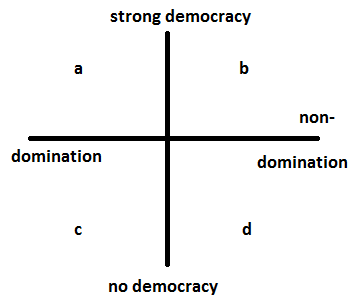
Authoritative disciplinary climates are related directly to more civic engagement, more voting, and higher trust in government, but such climates also predict adult roles that tend to depress these outcomes. The net impact is insignificant for voting and civic engagement and comes out as positive for trust in government. This finding begins to suggest that the problem is not school discipline per se: in fact, a well-ordered school may be a good place to learn to be a citizen. The main problem is unfairness. In political philosophers’ terms, a school can restrict freedom (defined as individual choice) by establishing and enforcing rules, but it should avoid “domination” in the sense of arbitrary power.

See also: school discipline in a democracyavoiding arbitrary command.

timely quotes from Bayard Rustin (1965)

Two years after organizing the March on Washington, Bayard Rustin made the following arguments in “From Protest to Politics: The Future of the Civil Rights Movement” (Commentary, 2/39, Feb. 1965). By calling these points “timely,” I don’t mean that they are necessarily correct; I mean that they are usefully provocative in our moment.

1. Racial justice is impossible without a new economy, because the current economy is too unequal and too limited to accommodate many newly enfranchised people. For example, there are too few decent jobs, and the people who have them will hold onto them unless the supply is expanded.

My quarrel with … moderates is that they do not even envision radical changes; their admonitions of moderation are, for all practical purposes, admonitions to the Negro to adjust to the status quo, and are therefore immoral.

2. The goal is not to confront racist attitudes (which would assume that, deep down, racists and hypocrites can have benign motives). The goal is to change institutions; attitudinal change will follow from that.

[Meanwhile, a second group] pursues what I call a ‘no-win’ policy. Sharing with many moderates a recognition of the magnitude of the obstacles to freedom, spokesmen for this tendency survey the American scene and find no forces prepared to move toward radical solutions. From this they conclude that the only viable strategy is shock; above all, the hypocrisy of white liberals must be exposed. These spokesmen are often described as the radicals of the movement, but they are really its moralists. They seek to change white hearts–by traumatizing them. Frequently abetted by white self-flaggelants, they may gleefully applaud (though not really agreeing with) Malcolm X because, while they admit he has no program, they think he can frighten white people into doing the right thing. To believe this, of course, you must be convinced, even unconsciously, that at the core of the white man’s heart lies a buried affection for Negroes–a proposition one may be permitted to doubt. But in any case, hearts are not relevant to the issue; neither racial affinities nor racial hostilities are rooted there. It is institutions–social, political, and economic institutions–which are the ultimate molders of collective sentiments. Let those institutions be reconstructed today, and let the ineluctable gradualism of history govern the formation of a new psychology.

3. Radical change does not require violence.

[The] term revolutionary, as I have been using it, does not connote violence; it refers to the qualitative transformation of fundamental institutions, more or less rapidly, to the point where the social and political structure which they comprised can no longer be said to be the same.

4. But to change institutions does require power.

There is a strong moralistic strain in the civil rights movement which would remind us that power corrupts, forgetting that the absence of power also corrupts.

5. In a democracy, power requires numbers–indeed, a majority of the whole electorate.

A handful of Negroes, acting alone, could integrate a lunch counter by strategically locating their bodies so as directly to interrupt the operation of a proprietor’s will; their numbers were relatively unimportant. … But in arriving at a political decision, numbers and organizations are crucial, especially for the economically disenfranchised.

6. Coalition politics is inevitable, and it implies the right kind of compromise.

[The] effectiveness of a swing vote depends solely on ‘other’ votes. It derives its power from them. … Thus coalitions are inescapable, no matter how tentative they may be. … The issue is which coalition to join and how to make it responsive to your program. Necessarily there will be compromise. But the difference between expediency and morality in politics is the difference between selling out a principle and making smaller concessions to win larger ones. The leader who shrinks from this task reveals not his purity but his lack of political sense.

7. The coalition must include everyone with reasonably aligned interests so that they can marginalize their real opponents, the Donald Trumps of the day.

It has become fashionable in some no-win Negro circles to decry the white liberal as the main enemy (his hypocrisy is what sustains racism). [Thus] the Negro is left in majestic isolation, except for a tiny band of fervent white initiates. But the objective fact is that [Dixecrat Mississippi Senator James] Eastland and [GOP Presidential nominee Barry] Goldwater are the main enemies–they and opponents of civil rights, of the war on poverty, of medicare, of social security, of federal aid to education, of unions, and so forth.

people trust authoritarian governments most

(Philadelphia) This Edelman international poll shows that trust in government is low in most countries and declining almost everywhere. But five important countries stand out as exceptions. People trust the world’s largest single-party state, an absolute monarchy, a country in which one party has governed since 1959, a democracy with a very strong elected leader whom critics call authoritarian–and Indonesia, where a government chosen recently in a competitive election actually seems to be trusted.

I arrived at this graph from a piece by Ethan Zuckerman, who notes, “Depressingly, there is a discernible, if weak, correlation (R2=0.162) between more open societies and low scores on Edelman’s trust metric.”

I don’t think we have long-term historical data on this question, but the pattern that Ethan notes is what I would imagine for the 1930s, when the European democracies were fraying and authoritarianism was on the rise. I didn’t expect to see it in my lifetime.

Note also that the US actually scores above the OECD democracies on trust in government, surpassing states that (in my opinion) are governed in a more trustworthy fashion. This chart indicates that we can’t explain distrust in the USA by focusing on specifically American traits, events, or leaders: the pattern is global.