what is cultural appropriation?

Matt Walsh, who writes from the perspective of the religious right, garnered widespread attention after sharing his dismay that Christians indulge in “Hindu worship” like yoga. … It’s worth noting that he’s not necessarily wrong. Yoga derives from ancient Indian spiritual practices and an explicitly religious element of Hinduism …. Modern practice has been commodified, commercialized, and secularized, and has been as controversial among Hindu scholars of religion as it has among members of the Christian right. Last week, Shreena Gandhi, a religious studies professor at Michigan State University, published an academic paper critiquing how the modern Western yoga industry is a form of “cultural appropriation … intimately linked to some of the larger forces of white supremacy.” —Tara Isabella Burton, in Vox.

“Appropriation” is bad. But we have other vocabulary for such cases: “imitation,” “borrowing,” “exchange,” “influence,” “confluence,” “mashup,” even “admiration.”

No culture is pure and free of influence, nor is purity desirable. Just for example, the word “Hinduism” derives from Greek. Traveling from the Mediterranean to explore or conquer the subcontinent, Greeks had to cross the River Indus, which defined India and its many systems of belief for the them. Later, similar words and meanings suited Arab and Western European imperialists who also arrived from the same direction. “India” and “Hindu” were then creatively appropriated by South Asians to promote religious unity from the immense diversity of the region. Thus to say that yoga is an appropriation of Hinduism is to use a European concept that Indians have powerfully appropriated for their own purposes.

I’m not suggesting that there is no problem with cultural appropriation: just that we need a sophisticated apparatus for distinguishing appropriation from other forms of interaction that we should celebrate.

One issue is respect. If you imitate a practice or aesthetic from somewhere else, do you demonstrate appropriate respect for the people who originated it? Are you making fun of them and treating their work as easy? Or are you striving to appreciate its excellence? (By the way, respect is not always merited; there is also room for satire.)

Another issue is quality. In borrowing a cultural product, are you making something excellent or are you cheapening the original? That judgment involves some subjectivity, but there are clearly wonderful examples of cultural imitation–and very poor ones.

And a third issue is the right of ownership. To “appropriate” often means to profit from something that should not be yours. If, for example, a group of people have been using a medicinal herb for centuries until a pharmaceutical company learns of its benefits and patents the compound, I would say that their intellectual property has been appropriated. Although intellectual property is a social construct (not a law of nature), the indigenous people get a raw deal in such cases. Likewise, if Western yoga somehow supports the economic exploitation of South Asians, that is bad. But this is a causal thesis that needs evidence. When a community converts to Christianity, they are not “appropriating Western culture,” and they owe nothing to the West (although some missionaries have thought that they do). Who owes what to whom depends on the context of power.

A deeper question is: What is a culture, anyway? And to whom does any culture belong?

Per the Oxford English Dictionary, “culture” can now be a “count noun,” a noun that makes sense in the plural. In that form, it means “the distinctive ideas, customs, social behaviour, products, or way of life of a particular nation, society, people, or period. Hence: a society or group characterized by such customs, etc.”

This usage is not old. It is first attested in English in 1860, and since then, related uses have emerged, such as contact among cultures (since 1892), the idea of cultural gaps or boundaries (since 1921), culture clashes (since 1926), and the culture of an organization (since 1940).

These uses reflect a profound shift in the way English-speakers see the human world. For many centuries in Europe, it was assumed that there was one best way to do the most important things in life. A good building should have pointed arches and stained glass in 1400, baroque ornaments in 1700. “Culture” was not a count noun: there were not many cultures.

The word had originated in the middle ages with agricultural meanings, but it evolved to mean the cultivation of the mind or spirit–e.g., Sir Thomas More in 1510: “to the culture & profitt of their myndis”–and then a state of refinement. In 1703: “Men of any tolerable Culture and Civility must needs abhor the entering of any such Compact.” The world was divided between those who had Culture and those who did not.

To be sure, some authors, such as Herodotus and Montaigne, were fascinated by the diversity of human customs and beliefs. Still, to be cultured was to do things right, and differences either reflected superficial variations or the unfortunate fact that some people were uncivilized.

However, an alternative theory had emerged in Europe by ca. 1750. On this view, there were many cultures, each reflecting the spirit of a particular people or an age. A person could thus be assigned to a culture as a descriptive category.

I am not qualified to discuss whether other communities across time and space have viewed culture as singular or plural. I suspect that singular views have prevailed in some other places, e.g., in China and Islamic civilization before modernity. In any case, the shifting European theory of culture had global significance because of European colonialism.

One consequence of modern view is a distinction between authentic and borrowed culture. If you are actually English, then to behave like an Indian is inauthentic (and vice-versa). That framework depends on the premise that there are multiple and distinct cultures in the world, and each person really belongs to one.

Another consequence is a marked anxiety about whether we are doing anything right. If there are many cultures, then our cultural norms are local and perhaps arbitrary. Just as Europeans were beginning to understand styles of art and architecture from around the world, they stopped having a normative style of their own. Almost all 19th century European and American architecture is revivalist: it borrows (or “appropriates”) styles from other times and places: Greco-Roman, Byzantine, Gothic, Mughal, and countless others. High modernism is then a revolt against revivalism that seeks new universals–heroically, but without lasting success. And postmodernism is often revived revivalism with a layer of irony.

In this context, it’s important to remember that there are no cultures. Each person has a large set of more-or-less related beliefs, values, and habits that change over her lifetime. The person next door typically shares most but not all of these components. If you examine the components carefully, you’ll find that the come from all over the world and they fit together imperfectly.

A culture is a handy shorthand for this array of components. It’s useful for generalizing about groups of people but always risks overgeneralization. For almost any population, it is possible to draw the cultural boundaries in different places. Nothing they do and believe is completely original or immune to change. Everything is impure–wonderfully so, as a testament to the interconnectedness and avid interactivity of human beings.

Putting up walls and blocking out influences is foolish. But that is not to say that particular acts of borrowing are always respectful, excellent, or fair. When and how to imitate is a hard question for ethical and aesthetic judgment.

See also: when is cultural appropriation good or bad?cultural mixing and powerMaoist chic as Orientalismhorizon as a metaphor for culturewas Montaigne a relativist?is a network a good representation of a person’s moral worldview?are religions comprehensive doctrines?is society an artifact or an ecosystem?; and avoiding the labels of East and West.
pseudoscience and the No True Scotsman fallacy

I’m sure the point has been made before, but it occurs to me that to describe shameful episodes like racial eugenics as “pseudoscience” risks the “No True Scotsman” fallacy.

This is an early (possibly the first) telling of the No True Scotsman story, by Anthony Flew:

Imagine Hamish McDonald, a Scotsman, sitting down with his Glasgow Morning Herald and seeing an article about how the “Brighton Sex Maniac Strikes Again”. Hamish is shocked and declares that “No Scotsman would do such a thing.” The next day he sits down to read his Glasgow Morning Herald again; and, this time, finds an article about an Aberdeen man whose brutal actions make the Brighton sex maniac seem almost gentlemanly. This fact shows that Hamish was wrong in his opinion, but is he going to admit this? Not likely. This time he says: “No true Scotsman would do such a thing.”

It would similarly be fallacious to say, “No scientist would claim to assemble evidence for white supremacy. Ah, I see that a whole raft of highly distinguished scientists argued for white supremacy, and a few still do. Well, they are not true scientists.”

If “Racism is pseudoscience” is just a way of saying “racism is false,” then I agree with it. But if it’s meant to imply that the actual practice of science–science as a real human activity–would never support racism, then it’s false. Science did support racism, and that tendency lingers in some quarters. Racist scientists are truly scientists in the sense that they practice that occupation and participate in that social institution. They’re wrong, but that shows that science is susceptible to error–both empirical and moral. It’s not helpful to try to evade the problem by definitional fiat.

See also: is science republican (with a little r)? and is all truth scientific truth?

22 million new voters by 2020

With The LAMP, a New York City nonprofit that works on media and digital literacy skills, my colleagues at CIRCLE are launching the 22×20 Campaign, which has the tagline “22 million new voters by the year 2020.”

For the night of the State of the Union, 22×20 helped organize Action Parties in “New York City, Washington D.C., Austin, Chicago, Boston and San Francisco with partners such as Austin Public Library, Mikva Challenge, DoSomething.org, KQED, OZY, Sony, and YVote.” Students were encouraged to discuss, analyze, and share their reactions. More information about how to organize such events is here.

The campaign also provides educational resources. For example, you can find lesson plans on media literacy and tutorials on how to create videos using news clips. I thought the guide entitled “Ten Easy Steps to Fact-Checking” was a perfect resource for viewers of the State of the Union.

More events are coming up. Follow the campaign on Twitter (@22millionVotes) or by using the hastag #22×20CIRCLE also has an explanatory blog post on “Teens and Elections” with valuable background data. 

echoes

In home movies and fading Polaroids,
They look funny, their lapels wide and garish,
Their facial hair risible, movements jerky.
They look naive–fools, ignorant of what came next.
But I report: the grass felt just the same
When you raked your fingers though its crisp stems.
On a suddenly warm January day,
Wafting over sodden drifts, the air smelled
The same, and laughter sounded the same
Filtered through traffic thrum and cicadas.

[edited on Feb. 4, 2018]

differences in voting by major

My colleague Inger Bergom has a piece in The Conversation with  entitled “Why don’t STEM majors vote as much as others?” They are analyzing data from the two million college students who are included in our National Study of Learning, Voting and Engagement at Tisch College.

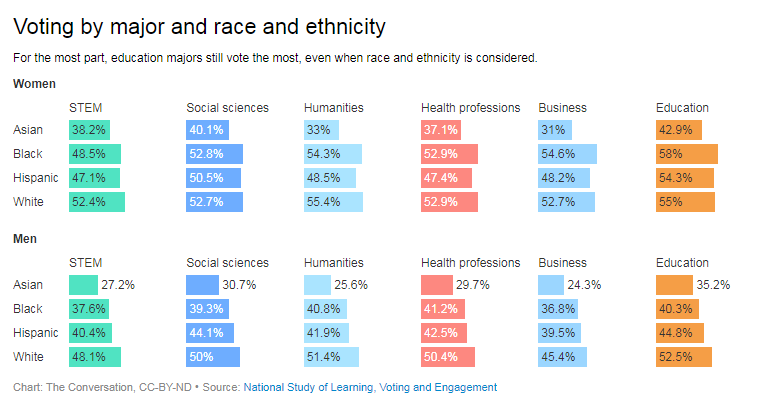
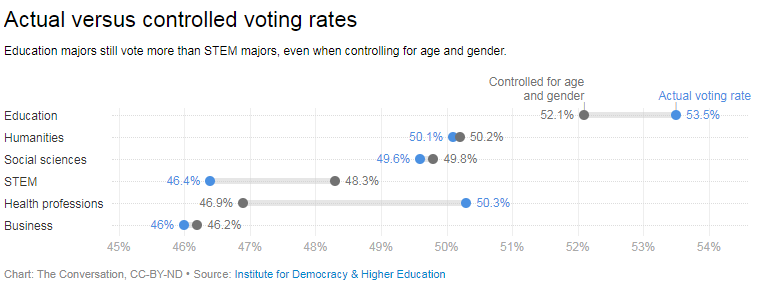
The raw correlations between college majors and voting rates are pretty substantial. In 2016, more than half of all education majors voted (53.5%), which was more than 7 points ahead of the rate for business students.

But majors attract different demographic groups. For example, women vote at somewhat higher rates than men. If more education majors were men, the turnout rates in education programs would fall. By the same token, STEM turnout would rise if STEM majors recruited more women. However, education majors would still be ahead.

Once you zero in on major, race and gender together, you see some interesting patterns. African American women who major in education voted at a 58% rate in 2016, well over double the rate of Asian-American men who majored in business.

Self-selection must be part of the story: people who are more interested in the kinds of issues that arise in politics may also enroll in majors like education. Still, there is room to improve the civic education that STEM and business majors experience.

conflict v mistake as a framework for politics

Scott Alexander has an interesting blog post that distinguishes two ways of thinking about politics:

  1. “Politics as mistake.” I’d put this one a little differently. The core idea is that institutions have flaws that result from their designs and the incentives that they create for participants. Sometimes institutions work well enough, but we use the word “politics” for efforts to fix them. Political action is driven by a belief that the structure and incentives of existing institutions demands change.
  2. “Politics as conflict”: Here the idea is that different people have different interests and ideals, so it matters who’s in charge. Politics is mostly about putting one’s own side in control of institutions.

Alexander’s post is long and I could argue that it’s a bit tilted in favor of #1, partly because the examples he cites of #2 are unnecessarily tendentious, e.g., a Baffler article on James Buchanan. Very serious people from a range of perspectives agree with #2. Still, even with a possible tilt, I find Alexander’s framework useful.

The poster child for #1 would be China. The Communist Party took control in 1949, representing a demographic group (workers and peasants) and an ideology (state communism). A fairly continuous group of leaders still runs that Party and that country. For instance, the current premier, Xi Jinping, is the son of the Party’s former propaganda chief, vice-premier, and National People’s Congress vice chair (1952-62). But the regime has shifted from radically egalitarian to rapaciously capitalist, and many grandchildren of Red revolutionaries are billionaires. I make sense of this story by discounting politics as conflict. It doesn’t matter who runs the government or what they stand for. Structures and incentives ultimately prevail. If single-party government gives the ruling cadre a chance to rack up billions, they will sooner or later rack up billions.

Roberto Mangabeira Unger has unimpeachable leftist credentials, but he faults the 20th century left for ignoring institutional structures and the incentives they create. “With few exceptions (such as the Yugoslav innovations),” he writes, “the radical left … has produced only one innovative institutional conception, the idea of the soviet or conciliar type of organization: that is to say, direct territorial and enterprise democracy.” But soviets were never seriously developed to address “practical problems of administrative and economic management,” and they have “quickly given way to forms of despotic government” (False Necessity, pp. 24-5).

On the other hand, politics as conflict (#2) makes better sense of “realignment” elections in functional democracies. When FDR won the presidency in 1932, or when the British Labour Party won in 1945, new people with new interests and new ideas took over those countries. The result was a raft of new policies and institutions. When Thatcher and Reagan won elections decades later, they reversed some of those policies and began to dismantle some of those institutions. It matters who wins the support of the majority of voters and what program they propose.

The same debate also arises in specific domains of policy. For example, people who believe in politics as conflict think that the key questions for education are what is taught and how. There are lively debates between whole language and phonics, patriotic and critical versions of American history, STEM and the humanities. To influence the outcome of these debates, we can try to persuade teachers and schools to adopt our vision of education. We can also enact favorable policies, such as legislative mandates to teach or assess in certain ways.

Meanwhile, some people believe that the important questions in education concern structures and incentives. Maybe we must pay teachers more and protect their autonomy, or assess student outcomes and hold teachers accountable, or give parents choice and let dollars flow to the schools that they choose. These are politically and ideological contrasting theses, but all presume that the way to improve education is to get the incentives right.

It’s too easy to say, but I believe it: politics is both institutional design and conflict over ideas and interests, and each aspect requires attention. Unger recommends that reformers “develop elaborate institutional incentives, a strategy for putting them into effect, and a view of social transformation to inform both their programmatic and their strategic ideas. They must also redefine their guiding ideals and their conceptions of the relation of these ideals to the aims of their political opponents. For if the real meaning of an ideal depends upon its tacit institutional background, a shift in the latter is sure to disturb the former” (pp. 20-21).

It’s a mistake to ignore incentives and assume that institutions will do what they officially promise, unless that somehow pays off for the people in charge. To assume that public schools will serve every child is like assuming a can-opener on a desert island. (Or assuming that a dictatorial party will pursue equality just because it calls itself “communist.”) But it’s also a mistake to discount ideas and ideals or to presume that the only payoffs that people care about are monetary. For the purpose of explaining social change, both incentives and ideals have power.

Further, if you want to know whether you are changing the world for the better, you must rely on a range of evidence. It’s useful to observe people’s behavior under constraints. For example, price signals tell you what people value, given what they have. That kind of analysis falls under Alexander’s “politics as mistake” heading (although the word “mistake” is a bit misleading; it’s really politics as engineering). However, evidence from behavior is always insufficient, because you must also decide what means and ends are good. Unless you arrogantly assume that you can answer that question by yourself, you must listen to other perspectives. And that necessitates “politics as conflict.”

See also how to tell if you’re doing goodthe visionary fire of Roberto Mangabeira Ungerschool choice is a question of values not data.

watching democratic cultures decline

Yesterday, I offered some evidence that broad public deliberation declines when authoritarianism rises. I used data Varieties of Democracy, which asks 2,800 experts questions about specific countries in specific years.

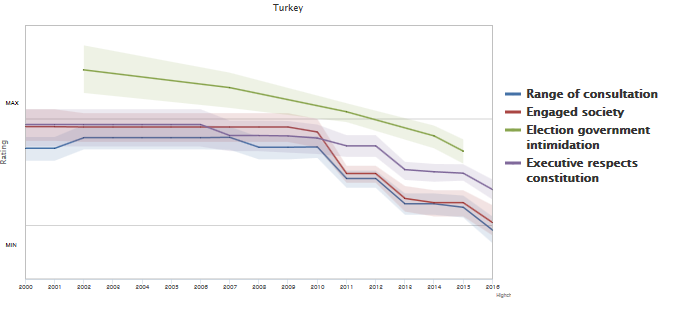
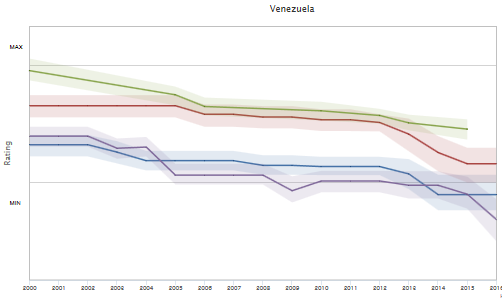
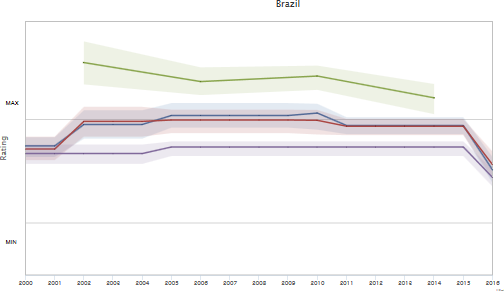
For this purpose, I’ll define “authoritarianism” as a system that relies on the arbitrary will of leaders. It’s a system of rulers without many rules. Its opposite, then, is “republicanism” in Philip Pettit’s sense: a system in which nobody can be told what to do without a justification. Many variables in the V-Dem database relate to authoritarianism, but I’ve selected two: (1) whether the executive branch respects the constitution of its country, and (2) whether elections are held without intimidation. I chose this election-related variable because regular and fair elections provide a check on arbitrary rule, and also because a typical tactic of an autocrat is to interfere with elections.

Pettit, citing Quentin Skinner, emphasizes that “one of the central themes” of the civic republican tradition is “belief in dialogical reason.” The connection between republicanism and deliberation is not definitional. In other words, you could imagine an authoritarian state that encourages deliberation or a genuine republic that is weak on deliberation. But republicanism and deliberation have often been connected because one way to make decisions non-arbitrary is to encourage discussion of them.

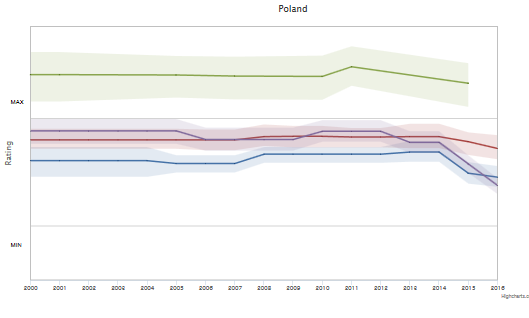
V-Dem offers two measures of deliberation: 1) to what extent do “large numbers of non-elite groups as well as ordinary people … discuss major policies among themselves, in the media, in associations or neighborhoods, or in the streets”?; and 2) to what extent do leaders consult a wide range of stakeholders? Along with the two measures of authoritarianism, we have four variables whose relationships interest me.

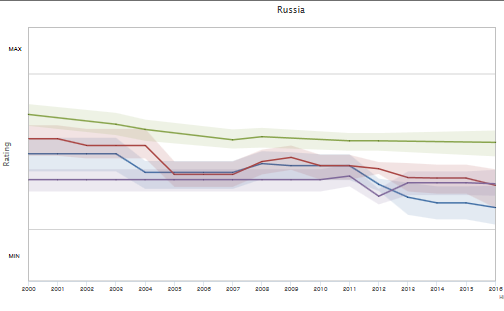
In Turkey, for example, all four measures have fallen since 2010. The fair elections variable began to decline first; then the other three fell in tandem.

The pattern is less pronounced but similar in Poland since 2011.
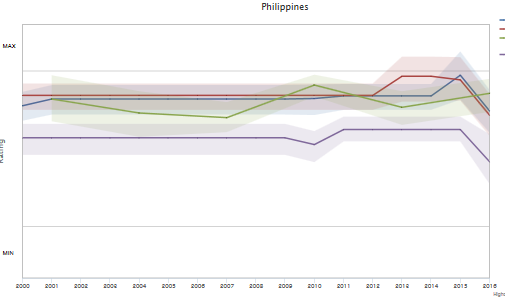
In the Philippines, election intimidation has not grown worse, but the other three variables have taken a dive since 2012.

In Venezuela, it’s been steadily downhill since 2000.

Brazil’s elections got a little worse first (starting at a high baseline), and then everything plunged after 2015.

Russia has seen fairly steady declines from a lower baseline.

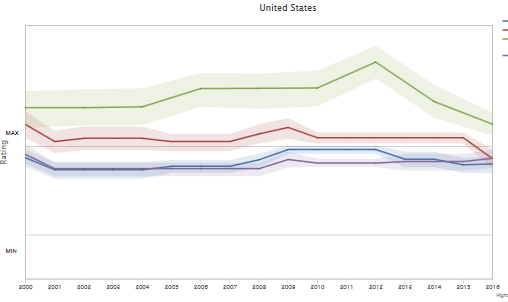
And the US saw declines before 2016 in elections and in public dialogue that may presage rising state authoritarianism in 2017 and ’18 (not shown yet).

authoritarianism and deliberative democracy

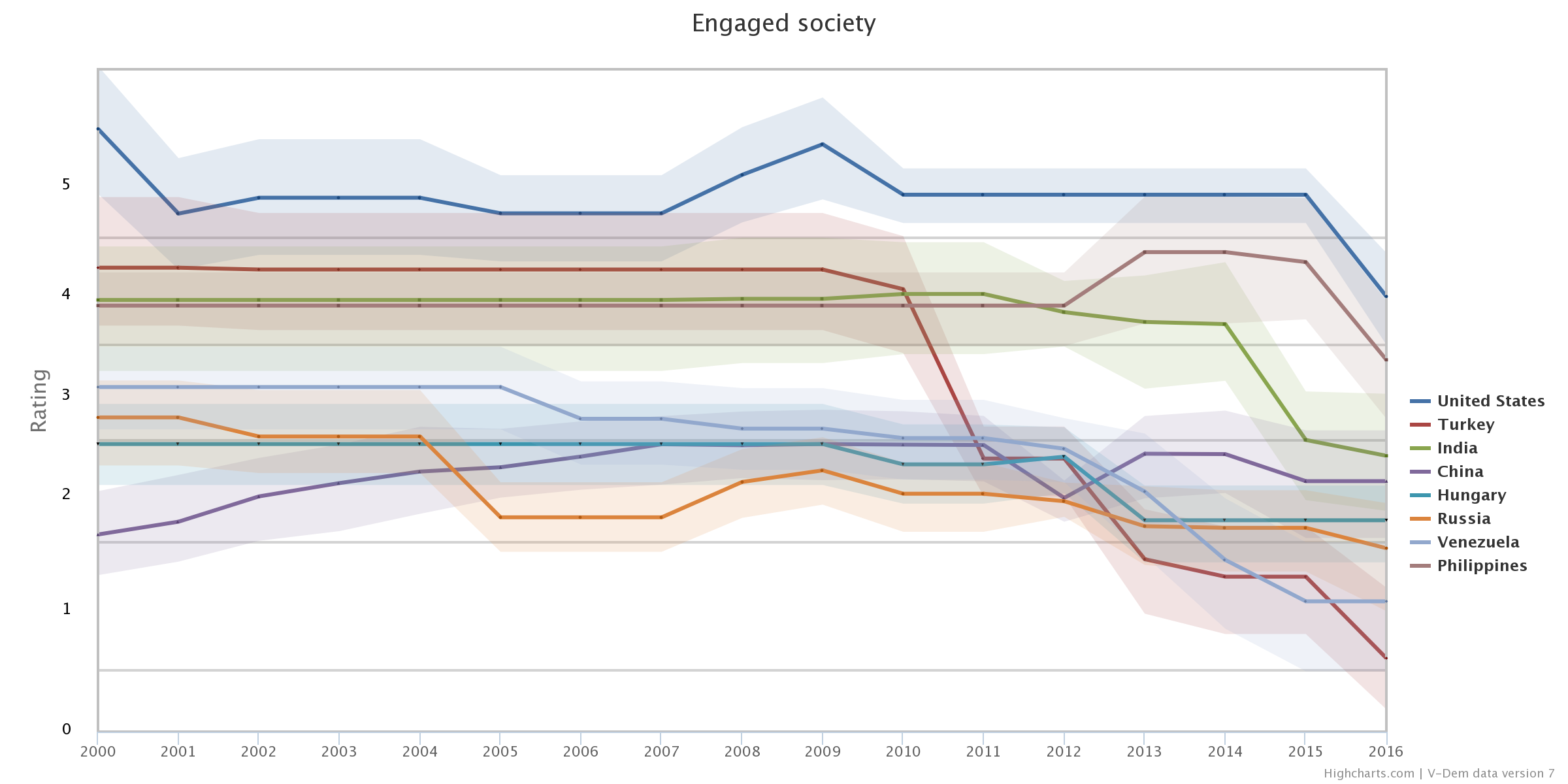
The Varieties of Democracy project asks 2,800 experts many questions about specific countries in specific years. One question is “When important policy changes are being considered, how wide and how independent are public deliberations?” The scale ranges from zero (“Public deliberation is never, or almost never allowed”) to 5 (“Large numbers of non-elite groups as well as ordinary people tend to discuss major policies among themselves, in the media, in associations or neighborhoods, or in the streets. Grass-roots deliberation is common and unconstrained”).

Below is a graph that shows the change in public deliberation (so measured) since 2000 for eight countries that I see as increasingly authoritarian. My choice of these countries is subjective. (Why not the Central African Republic, which Freedom House names as the single-biggest “backslider” on democracy in the world? Because I don’t know much about the CAR.) But of the countries that I selected in advance to serve as examples of growing authoritarianism, all but one showed declines in the V-Dem measure of broad public deliberation.

This pattern may seem self-evident or even tautological. Perhaps countries that are tending toward authoritarianism see less deliberation because authoritarianism is the opposite of deliberation. But I find the graph at least somewhat meaningful. At the core of authoritarianism is a reliance on powerful leaders who disdain constitutional limits. It’s possible for authoritarians to run a state even while “large numbers of people … discuss major policies among themselves, in the media, in associations or neighborhoods, or in the streets.” Some authoritarian states even choose to expand deliberative fora. For example, China’s Communist Party is implementing deliberative processes, which it probably sees as devices for blunting criticism and improving satisfaction with its deeply undemocratic regime (He & Warren 2017). Caroline W. Lee (2015) has argued that small-scale deliberation co-opts resistance in the USA, and Cristina Lafont (2017) worries that creating ideal deliberative fora can delegitimize regular democratic processes.

So the question arises whether authoritarianism is really contrary to deliberation at all. One might even suspect that the biggest threats to deliberation arise in mass capitalist societies, where corporate and partisan propaganda drown out reasoned conversation on poorly designed platforms, like Twitter.

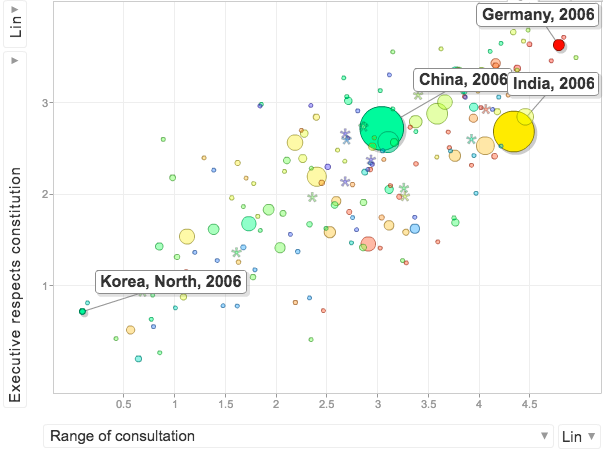
But this is partly an empirical question, and I do see evidence of a negative correlation between authoritarianism and deliberative values. Above I showed that countries well known for turning more authoritarian are also seeing less public deliberation. Below are two graphs showing a different relationship–between leaders’ respect for the constitution and the government’s tendency to consult a wide range of stakeholders. Again the source is V-Dem data, but unfortunately from 2006.

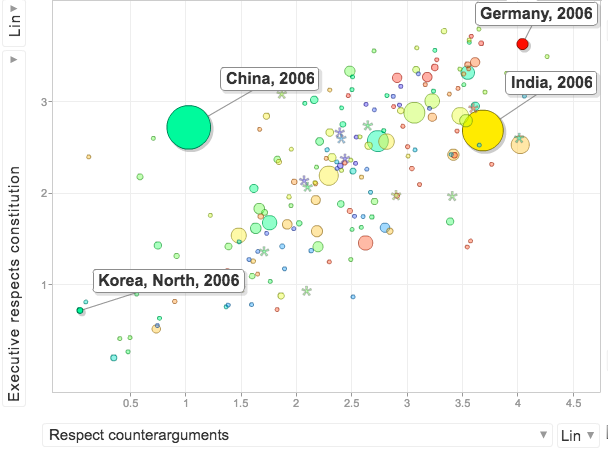
I take respect for the constitution as an inverse measure of authoritarianism, and consultation as a sign that a government wants to deliberate. The correlation is pretty clear. Most countries fall on a line between North Korea and Germany. India’s government consults more than China’s does. Neither respects its own constitution more than the other, but the Indian constitution is much better on civil liberties. The US is a circle between those two countries but a little higher up.

The next graph shows the same y-axis (respect for the constitution) plotted against the degree to which politicians respect counter-arguments. A high score on that measure means that they generally feel compelled to give explanations when they are challenged. Again, the line is defined by North Korea and Germany. On this plot, China is an outlier, showing decent respect for its own constitution but reluctance to consult diverse stakeholders.

Much more analysis could be done (and it would be better to use more recent data than 2006). Still, this seems to be evidence of a correlation–in practice, if not in theory–between respect for constitutional restraints and deliberative values. One reason may be that political leaders tend to model deliberation in societies where they also respect limits, and they fail to do so when they turn authoritarian. Or it could be that when publics are organized and motivated to demand discussion, they also block authoritarianism.

Sources: Baogang He  & Mark E. Warren “Authoritarian Deliberation in China,” Daedalus, 146, 3, 155-166; Caroline W. Lee, Do-It-Yourself Democracy: The Rise of the Public Engagement Industry New York: Oxford University Press, 2015; Cristina Lafont, “Can Democracy be Deliberative & Participatory? The Democratic Case for Political Uses of Mini-Publics,” Daedalus 2017 146:3, 85-105.

DACA and justice

About 800,000 people are “DREAMers”–enrolled in Deferred Action for Childhood Arrivals (DACA). They are subject to deportation unless Congress reverses Donald Trump’s executive order rescinding DACA. Their cases represent 800,000 potential tragedies. When so many people are faced with such brutal and deliberate hardship, it can seem bloodless to consider subtle theoretical questions–especially when one isn’t personally threatened.

But politics is often a matter of life and death, and it’s important to debate abstract issues of justice as long as one also retains empathy and commitment. A refusal to address contrary arguments can come across as fear that those arguments may actually be right. Here are some thoughts on three issues that have come up in the debates so far.

Does amnesty violate the rule of law?

Attorney General Jeff Sessions invoked the rule of law when he announced that DACA would be rescinded:

No greater good can be done for the overall health and well-being of our Republic, than preserving and strengthening the impartial rule of law. Societies where the rule of law is treasured are societies that tend to flourish and succeed.

Societies where the rule of law is subject to political whims and personal biases tend to become societies afflicted by corruption, poverty, and human suffering.

To have a lawful system of immigration that serves the national interest, we cannot admit everyone who would like to come here. That is an open border policy and the American people have rightly rejected it.

Therefore, the nation must set and enforce a limit on how many immigrants we admit each year and that means all can not be accepted.

This does not mean they are bad people or that our nation disrespects or demeans them in any way. It means we are properly enforcing our laws as Congress has passed them.

It is with these principles and duties in mind, and in light of imminent litigation, that we reviewed the Obama Administration’s DACA policy.

Here Sessions echoes prevalent talking points on the anti-immigration side. The idea is that it’s illegal to bring a child here without authorization; and for the government to ignore illegality is to erode the rule of law, which is a buttress of the republic. Sessions cites the fact that President Obama enacted DACA by unilateral executive order as additional evidence that the policy is arbitrary.

I endorse the rule of law as an aspect of justice. But I think Tyler Cowan offers the right response to Sessions’ argument:

What is striking about immigration, and immigration policy, is the very simple but oft neglected fact that it concerns human bodies. Any exercise of immigration law thus requires some violence, either explicit or implicit, against those bodies. It will mean the rounding up and forcible restraint of bodies, the widespread use of prisons and other coercive holding chambers, and tearful scenes of airport separation. Those methods will be applied to individuals who do not enjoy the full protections of the U.S. Constitution, who are vulnerable to mistreatment during the process, and who do not always have full fluency in the English language or a full understanding of their legal rights. … A somewhat lax enforcement of immigration restrictions is in fact the friend of the future of the rule of law, not the enemy.

If you have faith in the government to execute laws impartially and efficiently, you could conclude that rule-of-law arguments support deporting people who are present in the United States against the law. (You might think that even if you also see stronger reasons to support DACA). On the other hand, if you doubt that our actual government can deport hundreds of thousands of people without demonstrating partiality, without committing arbitrary violence, and without violating legal rights, then the way to preserve rule of law is to offer amnesty. This is a point where insights from classical liberalism and Public Choice theory are pertinent.

In Origins of Totalitarianism, Hannah Arendt defines citizenship as “the right to have rights.” Without DACA, DREAMers are people inside the United States who have no right to have rights. That status threatens the rule of law for all. Removing them is not only cruel but also impossible to accomplish without permitting the state to act lawlessly against a large category of people. In principle, a wise state could follow its own laws as it made decisions about people who lacked rights. A real state will surely not do that.

Is migration an intrinsic human right?

Arendt argues that everyone must be a citizen somewhere; statelessness is a profound human rights violation. But that doesn’t mean that everyone has a right to be a citizen anywhere.

If you believe that every human being has a right to reside anywhere, then the DREAMers should obviously not be deported. Neither should anyone else, nor should anyone be stopped at any border.

For my own part, I don’t believe it. There are many countries where I would like to be able to live and work, but I think I have a moral (as well as a legal) obligation to follow the immigration laws of those countries. They have a right to keep me out unless I am a refugee in immanent danger. My reason for being highly sympathetic to migrants to the USA, regardless of their legal status, is that I regard US relations with many of their home countries as unjust. I don’t see their decision to move to the US as simply “free,” because the economic and political conditions in their home countries were beyond their own control and are sometimes the result of US foreign policy. When, however, highly educated citizens of wealthy nations sneak into the US illegally, I am unsympathetic.

Most Americans do not share this worldview. Quite the contrary: they believe that we are generous with foreign aid and brave in defending democracy abroad. This premise is factually incorrect, but skepticism about immigration follows logically enough from it.

Is there a basis for distinguishing the DREAMers from other undocumented residents?

Perhaps we are debating DACA separately right now because of sheer political necessity. There is no immediate opportunity to accomplish a reform that would cover people other than the DREAMers. The DREAMers won precarious rights through DACA that Congress is actually considering enacting by statute. That would be half a loaf, but it’s better than none.

If the reason to separate DREAMers from other undocumented immigrants is nothing but political necessity, it’s important to say so publicly and clearly. Otherwise, we might inadvertently justify denying rights to other people, including the DREAMers’ parents. We might allow that distinction to harden.

It’s clear that the DREAMers have won more public support than other immigrant groups. One explanation could be their own skillful, innovative, and courageous organizing. I suspect two other reasons as well. First, people who’ve lived in the US since their childhood are especially likely to suffer if they are suddenly deported; and suffering is to be avoided. That is a utilitarian rationale for offering a unique policy to DREAMers. But clearly, DREAMers are not the only people who suffer from deportation (or the threat of it), and some may suffer more.

A different argument involves intention. Since the DREAMers did not choose to immigrate, they should not be held responsible for their parents’ choices. I’m sure that this argument is widely held, but it is problematic. It assumes that adults’ choices to migrate were free (in a morally relevant sense), and it justifies imposing very dire penalties on individuals because they were adults when they migrated.

Both arguments have some plausibility, but neither really justifies a bright line between the DREAMers and other undocumented residents. If it’s a matter of justifiable expediency to single out the DREAMers, we should constantly say so.

Trump’s approval rating as a case study in public opinion

Donald Trump’s popularity is really quite stable. For a while, it looked as if he was losing a point or so per month, but that trend has reversed. From the perspective of January 2018, the flatness of the line is striking.

Then again, presidential popularity is usually correlated with economic performance. A strong correlate of approval for an incumbent president is satisfaction with the direction of the country. Since the economy is humming along and satisfaction with the direction of the country is modestly risingone would expect Trump’s popularity to be 7-17 percentage points higher than it is.

To be clear, I don’t think that the economy is producing fair results. But historically, measures like satisfaction and consumer optimism usually correlate with presidential approval. Trump has broken that pattern.

Also, a prevailing model in political science holds that our demographic identities come first. They lead us to affiliate with political parties that seem to represent or encompass those identities. Our attitudes toward politicians are then strongly colored by our partisan affiliations.  But party identification sometimes changes faster than the demographic composition of the country. I’ve created the following graph of party affiliation using Gallup data (moving averages over 7 months). It shows that there’s not been that much change over time–the y-axis goes from 20%-50%–but Republican identification (the red line) has fallen since Trump was elected. First Independents (gray) seemed to gain at the expense of Republicans and Democrats, but lately it’s been Democrats (blue) who have increased their share.

I’d conclude that underlying factors–demographics, economics, and partisanship–do explain most of a president’s support. But they don’t fully explain it, and Donald Trump is demonstrating that you can alienate a lot of people from yourself and your party if you really act like a jerk. This is kind of a perverse finding (doing a very bad job can cause damage), but it’s still evidence that rhetoric and intentional action matter, regardless of what else is happening in the world. It lends support to a theory I have long suspected: agency is often hard to detect because most people who lead major organizations and movements are pretty competent, and their efforts tend to cancel out. Trump is an exception that shows that intentional behavior and competence mattered all along.

If the economy continues to prosper and Trump doesn’t behave even worse, I suspect we will see some improvement in his popularity. The underlying circumstances will count more and more. On the other hand, if the economy hits some bumps, he’s vulnerable. (But that is truly not to be wished for, because too many people will suffer.)