agenda for Frontiers of Democracy 2018 is taking shape

There is still room to register and pay to hold a spot for Frontiers of Democracy 2018 (June 21-23 in Boston). Although many slots on the agenda are filled, there is still room for a few more proposals for sessions or presentations. The following is an incomplete list of the confirmed speakers and sessions, with several more in the pipeline for approval.

Keynotes

“Innovating Democracy Reform”
Josh Silver, Founder & Executive Director, Represent.us

“Activism under Fire: Violence, Poverty and Collective Action in Rio de Janeiro”
Anjuli Fahlberg, Northeastern University

“Fear and Present Danger”
Kelly Greenhill, Tufts University

“The Disenfranchised”
Sekwan R. Merritt, a formerly incarcerated person who advocates for an end to mass incarceration in America

“Overcoming Civic Fragmentation Through Public Work”
Harry Boyte, Augsburg College

“These Words: A Century of Printing, Writing, and Reading in Boston’s Chinese Community”
Susan Chinsen, Managing Director, The Chinese Historical Society of New England

Presentations and Sessions

(The category headings are for information only. Some titles refer to standalone sessions, while others will be combined to create panels. The panels may not be organized along these topical lines.)

Institutions in Communities

“How Can Museums Strengthen a Civil Society?”
Abby Pfisterer, Education Specialist; Magdalena Mieri, National Museum of American History; Rebekah Hardingrharding, Ronald Reagan Presidential Library; Michelle Martz, Lincoln Cottage; Teresita Paniagua, La Casita; Noelle Trent, National Civil Rights Museum; Dory Lerner, National Civil Rights Museum; Abby Kiesa, Director of Impact, CIRCLE, Tisch College

“The Role of Religious Communities in Strengthening Democracy”
Elizabeth Gish, Western Kentucky University, and John Dedrick, Kettering Foundation

“Civic Tinkering as Democratic Practice”
Scott Tate, Virginia Tech

Youth Voice

“The 2016 Boston Student Walkout Movement: Stories, Strategies, and Impacts”
Andrew King, Mark Warren, Mariette Ayala, Sheetal Gowda, Kate Kelly, Jeff Moyer, and Luis Navarro

“Unchaining the Power of Student Voices”
Frank LoMonte, The Brechner Center, and Zack Mezera, Providence Student Union

“Building Agency and Voice in Student Activists”
Pamela Conners and Leila Brammer, Gustavus Adolphus College

Media and Tech

“Data Justice: A Hands-On Workshop”
Libby Falck, MIT

“Civic Entertainment”
Anushka Shah, MIT Media Lab

“Votes that Count and Voters Who Don’t: How Journalists Sideline Electoral Participation”
Sharon Jarvis, University of Texas at Austin and Annette Strauss Institute for Civic Life

“If Only Journalists Care about the Future of Journalism, Democracy is in Trouble”
Fiona Morgan, Free Press

“What are the Responsibilities of Civic Technology?”
Erhardt Graeff, MIT Media Lab

“Bridging the US Political Divide Online: What we Learned from Using Big Data”
Kate Mytty, Build Up

Education (K12 and College)

“Civic Learning and Young Citizens: Democratic Engagements in Higher Education “
Ivy Dhar, School of Development Studies, Ambedkar University Delhi (AUD), and Nidhi S. Sabharwal, Centre for Policy Research in Higher Education (CPRHE), National Institute of Educational Planning and Administration (NIEPA), India

“Deliberative Dialogue in Classrooms and Other Settings”
Sharyn Lowenstein and Denny Frey, Lasell College

Connecting the Public and Government

“The Missing Link: Connecting Our Work to The People Who Need It”
Larry Schooler, National Civic League

“State of the Congress: Staff Perspectives on Congressional Capacity”
Kathy Goldschmidt, Congressional Management Foundation

Getting Past Division

“How can we productively talk about divisiveness in a time of polarized public discourse?”         
Elizabeth Gish, Western Kentucky University, and John Dedrick, Kettering Foundation

“Civility In Our Democracy – Collaborating and Rebuilding Bridges of Trust, and Respect”
Cheryl Graeve and Ted Celeste, National Institute for Civil Discourse

State-Wide Strategies

“Democracy in your backyard: Building local and state capacity for participatory public engagement”
Quixada Moore-Vissing, Michele Holt-Shannon, and Bruce Mallory, New Hampshire Listens

“Civic Health in a Changing Landscape: Arizona as a Case Study”
Kristi Tate, Center for the Future of Arizona

social movements of the sixties, seventies, and today

Fifty years after Dr. Martin Luther King’s assassination–as new social movements are again taking to the streets–a Washington Post-Kaiser Family Foundation poll asked respondents to compare the protests of the late sixties to today. I show responses for all adults and for 18-29s, because I was curious what young adults are learning and thinking about the sixties.

These results are ambiguous, because individuals can have varying opinions of the sixties and of today, but they are only asked to compare the two. A person could think that the protests of the 1968 were terribly violent and extreme, and today’s are worrying but not quite as bad. Or a person might think that the ’60s were violent and it’s great to see some of that righteous rage coming back. Or that neither were violent. By the same token, a person could feel that protesters in the ’60s were well organized, and today’s are even more so, or that both were badly organized. . … And we can multiply the possibilities.

Let’s assume (as a rough approximation) that you are enthusiastic about today’s protests if you think they are organized and effective but not extreme or violent, and that they are at least as good–by those criteria–as the protests of the late 1960s were. So measured, enthusiasm seems reasonably high for all Americans, but higher for youth.

I wouldn’t use these survey results to actually assess the social movements of the sixties vs. our time. I doubt that most people have thought deeply about the wide range of movements in these two rapidly changing periods. For instance, there is an interesting debate about whether the same forms of organization are necessary today as in 1968, but I wouldn’t call random phone numbers to ask the people who answer what comes immediately to mind on this question.

I do find these results interesting as a possible bellwether of support for social movement politics. On the whole, young people seem to perceive the current array of protest movements as reasonably organized, effective, nonviolent, and mainstream. That should encourage them to join.

See also: Why Civil Resistance Works; a sketch of a theory of social movementsthe New Social Movements of the seventies, eighties, and today.

system, organism, person, organization, institution: some definitions

If you want real expertise on this kind of question, you should attend “Social Ontology 2018, the 11th Biennial Collective Intentionality Conference” from August 22-25, 2018 at Tufts. But in case you want some light musing on the subject …

A system is an assemblage of interacting parts that persists over time. It can change, but a parsimonious description applies over its whole history. (“My Mac could run SPSS once I installed the new software, but it’s still the same system.”)

An organism is a system that no one designed. Instead, it results from the reproduction of similar organisms.

A biological organism is an organism that exhibits the properties of life. This definition implies that there may or could be non-biological organisms.

A sentient organism is one to which we can accurately attribute mental states, such as pain, pleasure, aversion, desire.

A person is a system whose mental states include memory, planning, and decision. Thus the person’s development over time is partly her responsibility, not solely the result of accident and force. Not all persons are organisms. Entities that meet the definition of persons include human beings but also God, angels, devils, space aliens, perhaps other advanced mammals, perhaps some future AI, and organizations–see below.

A human person is a person that is also an organism of the species homo sapiens. A human person is capable of certain specific mental states that are not necessary conditions of personhood in general, e.g., love and suffering.

An institution is a system composed of at least two persons, plus any number of other components (e.g., buildings, legal rights). A market, for example, is an institution that combines many buyers and sellers, their goods, their rights, rules, and so on. Note that a market is not a person because it doesn’t have mental states.

An organization is an institution to which we can attribute memory, planning, and decision. Such attributions are not metaphorical but use exactly the same logic that we apply to human persons. (“I can tell that Tufts intends to educate students from the fact that it expresses this intention on its website and then actually educates.” Tufts doesn’t love, but Tufts does intend and plan. As such, it is a person.)

By these definitions, a social organization is a person; it is simply not a human person. It lacks the rights of a human being. Human beings gain rights not from the mere fact that we are complex systems capable of remembering, planning, and deciding–so are organizations–but from something else. I would attribute our rights to the fact that in addition to being able to remember, plan, and decide, we can also love and suffer.

(I was led to these thoughts by the discussion of Elinor and Vincent Ostrom and their eclectic readings of Daniel Dennett, John Dewey, Douglas North, and others, as summarized in Vlad Tarko, Elinor Ostrom: An Intellectual Biography, pp. 137-43. See also: against methodological individualismwhy social scientists should pay attention to metaphysics; and the legacy of Elinor Ostrom and the Bloomington School.)

youth in recent protests

A new Washington Post-Kaiser Family Foundation poll provides detailed information about participation in current protests and social movements. The Post leads with: “Tens of millions of Americans have joined protests and rallies in the past two years, their activism often driven by admiration or outrage toward President Trump.” Here, I’ve broken out the data for ages 18-29 and separated the questions into categories.

To begin, 17% of 18-29s would call themselves “activists,” just a point below the whole adult population. They are less sure than older people that they will vote in 2018 (only 37% are “absolutely sure”), but more likely to disapprove strongly of Donald Trump. Just under 20 percent actually voted in 2014, the last midterm election. It will make a great deal of difference whether that number rises in 2018.

During the past two years, an outright majority of 18-29s have signed a petition, and many have taken other classic political acts. They are less likely than older Americans to give money, but they come close on most other measures of engagement.

I’ve divided the long list of topics for rallies and protests into right- and left-wing causes. Respondents are asked whether they have personally attended a rally or protest of each type in the past two years.

Under-30s do not appear in detectable numbers in the rallies for Confederate monuments, for oil and gas, or against the Affordable Care Act. About one percent of 18-29s have rallied against abortion, against immigration, or in support of police conduct. Three percent have turned out at physical events for Trump. For right-wing causes, the rates of participation are low for all adults. Most of these are fringe movements.

Young adults have been more active on the other side of the political spectrum. Nine percent have marched or rallied against Trump, the most popular cause. (They have been over-represented in the anti-Trump events.) Marches for LGBT rights and immigration have also been popular for youth, and disproportionately so.

Only one percent have turned out (so far) in support of gun control. However, that could be misleading because students under the age of 19 have played notable leadership roles in the gun-violence movement. I commented on MSNBC about the youth protests against gun violence.

Sinclair and Bezos: media ownership and media bias

These two stories ran on the same page of the print New York Times on April 2: “Sinclair Videos Renew Debate Over Media Ownership” and “To Trump, It’s the ‘Amazon Washington Post.’ To Its Editor, That’s Baloney.”

Both articles are about possible bias in powerful, for-profit media companies. Donald Trump has opinions on each case. He thinks that Sinclair (which owns 193 local TV stations) is a “far superior” media company that is being smeared by liberals. But he suggests that the “Fake News Washington Post [is] being used as a lobbyist weapon against Congress to keep Politicians from looking into Amazon no-tax monopoly.”

I start with the opposite assumptions: Sinclair is a creepy would-be monopolist, while the Washington Post holds power accountable. I’m no fan of Amazon, but I assume that Jeff Bezos’ investments in the Post strengthen democracy by enabling the newspaper to do more investigative reporting. I see two threats to the First Amendment: Sinclair’s goal of owning more than 200 local TV stations, and a president–who sits atop a regulatory state–threatening the owner of a newspaper.

But imagine that you admired Trump rather than despising him (as I do). You might then reverse the polarity. The biggest threat might seem to be the billionaire with the national newspaper. You might be a little cynical when the Post‘s executive editor, Martin Baron, says, “There isn’t anybody here who is paid by Amazon … Not one penny.” Technically true, but Bezos, who makes his money from Amazon, bought the Post for $250 million, and, “Buoyed by [these] new resources, it has added more than 200 newsroom employees.”

I want to control corporate influence on politics, but when people point out that newspapers also influence politics, and they are corporations (or owned by corporations), I cry “First Amendment!” When Rupert Murdoch builds Fox News, I see a billionaire colonizing the public sphere, but when Bezos expands the Post, I am grateful to him.

It’s important to be principled, not arbitrary or reflexively partisan, in making such judgments.

The economics are complex. You can make money selling news that you don’t agree with, or lose money by selling views you like. (Generations of owners of The New Republic will testify to that.) There is evidence of media effects: news companies change public opinion. But consumers also choose which news to buy and thereby affect the production of news.

The sociology is complex. Sinclair Broadcast Group is a publicly traded company that maximizes returns for its shareholders. It is also an organization with a CEO and other leaders who have leverage over the shareholders. And it employs reporters, who can be understood as members of a profession that is committed to the public good. It would be naive to ignore the corporate structure, but cynical to ignore the professionals. An anonymous anchor interviewed by Maxwell Strachan said,

most of the people who are commenting on this have never even watched our local newscast. … They see that we’re a Sinclair station. They assume what they want to assume about it. But we produce good news here. Sinclair does not tell us what to cover, who to talk to, or what to say in terms of local coverage. Our local news, it doesn’t have bias. If people are looking for it, they won’t find it. So don’t call me a zombie. I do damn good work on a daily basis and anybody in my community would tell you that.

Whether he is right or not, his point that many critics have never watched a Sinclair Station’s local newscast applies to me.

Finally, the politics is complex. I have no doubt that Donald Trump is a terrible leader, but I choose to consume news that mostly reinforces that view, and I rarely delve deeply into the other side. We should make judgments and take a stand. Forming a judgment is not a form of bias. But we must recognize our fallibility.

Ultimately, you can’t render appropriate judgments without taking a closer look at both the products of these companies (Are their stories any good?) and the detailed ways in which they work. I presume that the Post has a strong firewall between its business operations and its newsroom, but that is an empirical assumption that can be tested. I find this kind of language in Sinclair’s employee handbook disturbing: Sinclair “may monitor, intercept, and review, without further notice, every employee’s activities using Company’s electronic resources and communications systems.” But I don’t know whether anything similar applies at the Post.

All of this plays out in a marketplace. We’d like journalists to have market power over their employers. But for newspaper reporters, the market is terrible:

According to a new Knight Foundation report, “In the decade since the last recession hit, newspapers have shed 26,300 newsroom employees — 46.1 percent of total employment. … In contrast, local TV news employment is up 4.9 percent in that same time frame, and most TV newsrooms are at their highest level of staffing ever.” Many stations are hiring former newspaper reporters and editors.

Despite the rising number of employees in broadcast journalism and the generally tight labor market, Sinclair has leverage over its employees, perhaps because there are just a few TV stations in any community. The anonymous Sinclair anchor says,

These jobs? they’re very hard to come by. And if I quit, I owe the company 40 percent of my salary, plus a percentage of the [redacted] years remaining on my contract, plus any bonuses that they’ve paid to me and any reimbursements that they’ve paid to me. And they’re going to take me to court for it. And in the time that I’m in court, I’m not employable.

See also: media literacy and the social discovery of realitydon’t confuse bias and judgment.

new research on youth and nonviolence

While the student anti-gun student movement attracts national attention, two new publications have arrived in my inbox that address youth engagement in nonviolent social movements. Both depict youth as peacemakers rather than victims or perpetrators of violence, but both require significant caveats.

Taylor et al. provide a useful literature review with mixed findings. In some studies, exposure to political violence and abuse during childhood predicts more empathy and more civic engagement–even in some of the worst situations in the world. That suggests that youth can be peacemakers rather than victims of violence. In other studies, the relationships are negative.

Using a longitudinal dataset from Northern Ireland, the authors find (if I understand their complex statistics correctly) that kids who have seen more sectarian violence and discrimination by age 10 are more empathetic and more engaged in their communities, but that prolonged exposure to such violence reduces engagement. Empathy and engagement are positively correlated, but engagement falls for everyone during the teen years.

Dahlum finds that “Campaigns with a high degree of involvement by students and educated protesters are more likely to be nonviolent” and “Campaigns with a high degree of involvement by students and educated protesters are more likely to succeed”–but the latter is only true because students and educated protesters are more likely to opt for nonviolent strategies, which are more successful than violence. (See Why Civil Resistance Works.)

A casual look at Dahlum’s article, which is entitled “Students in the Streets,” might suggest that this is a study of youth. She is actually focused on people of all ages who have a lot of education. That is basically a proxy for social advantage. For example, she mentions a movement in Bangladesh that was led by “students, doctors, lawyers, [and] intellectuals,” among others. That is not a description of an age group but of a social class.

Dahlum combines students with graduates (of any age). If we view them separately, students have these characteristics:

  1. They tilt toward the young. Even in very poor countries, many (and often most) 7-year-olds are students. But nowhere are most 75-year-olds in school. Not only are students experiencing childhood, adolescence, or young adulthood as developmental stages, but they represent the newest generation in any society. (See this post on age versus generational effects.)
  2. They tilt toward the upper socio-economic tiers, because education is an expense and a path to income and power. This tilt varies by country and by age. Seven-year-olds in Sweden are students regardless of their social class. But at age 20, only the elite in many countries are still in school.
  3. Being a student is an occupation, a way of life. It may facilitate social activism because schools and colleges concentrate large groups of peers in places where they can be mobilized (or mobilize themselves); because they often are better protected against retaliation than many workers are; and because institutions devoted to learning are good places to spread news and ideas. (See also: why do students sometimes lead social change?)

Therefore, students often play disproportionately important roles in social movements. But that is only partly a matter of age and generation. Social class and occupation are also relevant.

Sources: Dahlum, S. 2018. Students in the Streets: Education and Nonviolent Protest, Comparative Political Studies, April 2, 2018 (online); Taylor, L., Merrilees, C. E., Baird, R., Goeke-Morey, M. C., Shirlow, P., & Cummings, M. (2018). Impact of Political Conflict on Trajectories of Adolescent Prosocial Behavior: Implications for Civic Engagement. Developmental Psychology (online).

youth voting on All Things Considered

Excerpts from “All Things Considered” (March 29): Barbara Howard  interviewing my colleague and our CIRCLE director, Kei Kawashima-Ginsberg:

BH: It seems like with these rallies last weekend, there was a real crackling in the air. People registering kids right there at the rallies. And you can register now when you’re 17, coming up into the midterms. Is there a chance that the interest will wane? There’s some months between now and November.

KG: That’s correct. Registering young people is, of course, very important, but it’s often not enough. There are many ways we can keep young people engaged, though. One of them is to really make sure that they can feel like they can do something at their local community. Some of the ways in which to do that is [to] make sure young people are motivating their own friends and families, uncles and aunts, and even grandparents. Also, they can work at polling places in some states, including, I believe, Massachusetts, where young people can be [a] really active part of the process even before they’re actually eligible to vote.

BH: But young people do tend to turn out in much smaller numbers than older voters.

KG: That’s correct. Traditionally, they’ve turned out at the lower numbers; it is especially the case in midterm elections. Last midterm election we measured youth turnout was 2014, and nationwide only 20 percent of under 30s actually turned out.

BH: Do you think this time it’s different, having seen the rallies last weekend?

KG: There are certainly great indicators of hope. One is that there’s of course been a lot of enthusiasm and passion from young people, and it’s for the movement that’s started by and led by young people. So they’re certainly taking the lead and really putting a stake in the ground to say, we’re not going to wait for a political leader to come to us and talk about the issues that’s important to them, but we’re going to tell them what’s important to us, and they’re going to put that on their agenda. So it’s certainly promising. We’re also seeing other polling that there is a lot of young people saying we’re enthusiastic about coming out to vote in November, and also the suggestion that they actually may be signing up with political parties, especially the Democratic Party, more than they did before.

I’d also note the clear connection between this social movement’s agenda and voting. The youth who are working for gun control are on the same side as the majority of all voters; it’s just elected officials who block the legislation they want. The solution is to vote new politicians in. Voting is more fraught and complicated for radical social movements that challenge mainstream public opinion or that lack allies in electoral politics (or both). Thus I would predict a bigger electoral impact from the gun control movement than from other recent social movements.

the emperor’s new wall

Donald Trump says that his border wall is being built; yesterday, he even tweeted pictures of it. Today he added, “We started building our wall, I’m so proud of it. We started. We have $1.6 billion. You saw the pictures yesterday. I said what a thing of beauty.”

The budget he signed into law provides $341 million “to replace approximately 40 miles of existing primary pedestrian and vehicle border fencing along the southwest border using previously deployed and operationally effective designs, such as currently deployed steel bollard designs, that prioritize agent safety; and to add gates to existing barriers.”

But the President can have what he wants: a tweet about his own success. Almost 100,000 people clicked to like it. They could feel the #MAGA. Meanwhile, we don’t have to pay for a wall. It has no environmental impacts. Pronghorn antelope may still roam back and forth at will. I assume our neighbors in Mexico realize the wall is not actually taking physical form in the universe that we inhabit as corporeal creatures.

So everyone wins. Could this be the model for solving other problems in the Trump years?

from I to we: an outline of a theory

These are the main ideas that I’ve defended (or plan to develop) in my theoretical scholarship. They are organized from micro to macro and from ethics to politics. As always, I put this draft online to welcome critical feedback.

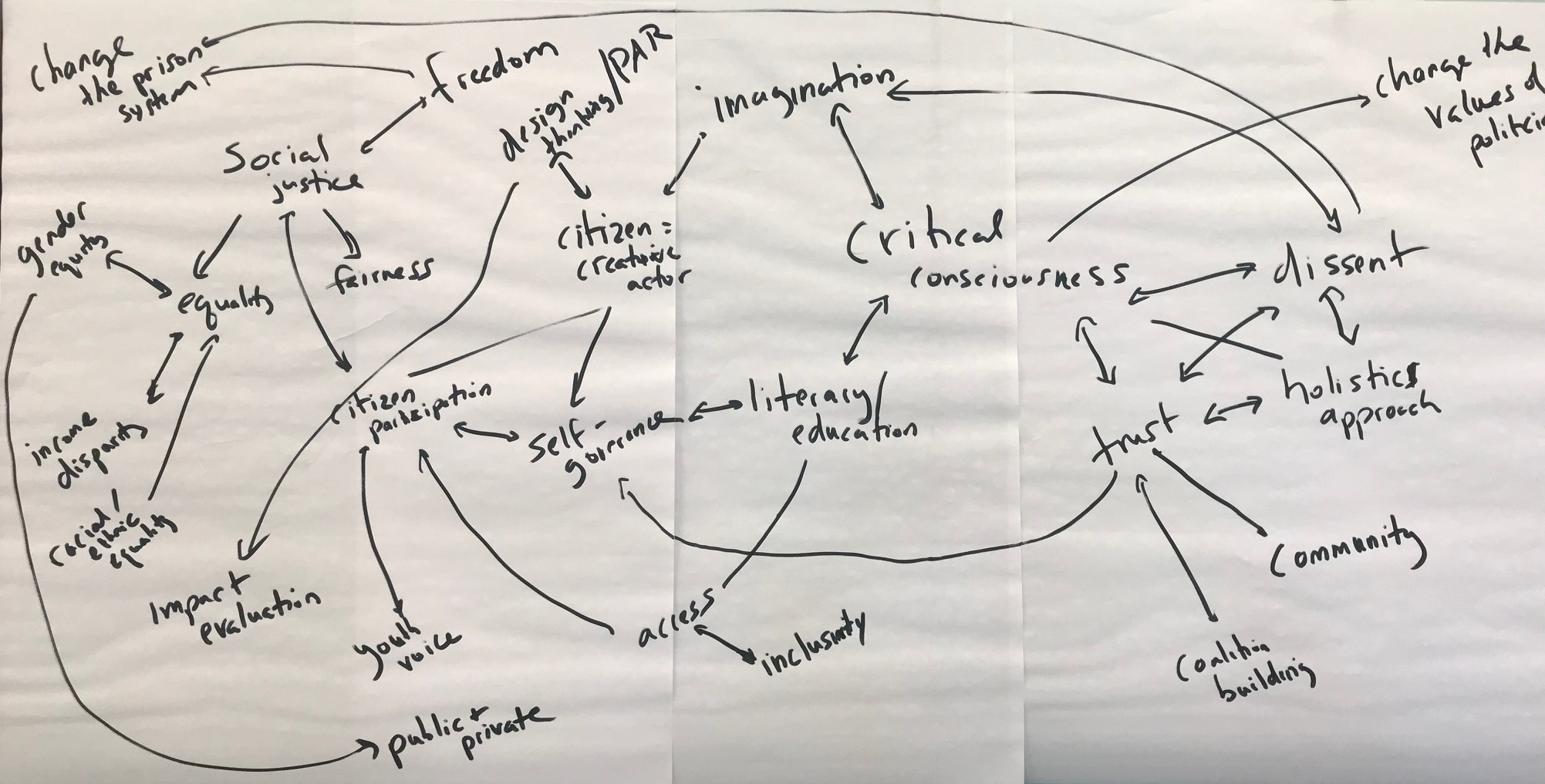
  1. Each individual holds a changing set of opinions about moral and political matters. These ideas are connected by various kinds of logical relationships (e.g., inference, causation, or resemblance). Thus each person’s moral opinions at a given moment can be modeled as a network composed of ideas, plus links. In a conference paper, Nick Beauchamp, Sarah Shugars and I have derived network diagrams for 100 individuals and provide evidence that these are valid models of their reasoning about healthcare, abortion, and child-rearing. This approach challenges theories that depict moral reasoning as implicit, unconscious, and unreflective.
  2. A culture, religion, or ideology is best modeled as a cluster of roughly similar idea-networks held by many individuals. Human beings are not divided into groups that are defined by foundational beliefs that imply all their other beliefs. Rather each person holds a unique and often flat and loose network of ideas that overlaps in part with others’ networks. This model avoids radical cultural relativism, as I already argued in my Nietzsche book (1995).
  3. This model of culture also challenges John Rawls’ argument for liberalism as tolerance and neutrality. Rawls presumes that most citizens hold incompatible but highly organized and consistent “comprehensive doctrines.” As a result, they must largely leave one another alone to live according to their various conceptions of the good. If, instead, we understand worldviews as loose and dynamic idea-networks, we find support for a liberalism of mutual interaction instead of distant toleration.
  4. We are not morally responsible for the ideas that we happen to learn as we grow up. That is a matter of luck. But we are responsible for interacting with other people who hold different opinions from ours. Such dialogues can be modeled as the interactions of people who hold different idea-networks. As they disclose and revise ideas and make connections, the discussants produce a shared network. In a paper now being revised and resubmitted, David Williamson Shaffer, Brendan Eagan, and I model Tufts students’ discussions of controversial issues as dynamic idea-networks.
  5. A person can organize her beliefs in ways that either enable or block dialogue. For instance, an individual whose network is centralized around one nonnegotiable idea cannot deliberate; neither can a person whose ideas are disconnected. Thus discursive virtues can be defined in network terms, deliberations can be evaluated using network metrics, and we can strive to organize our own ideas in ways that facilitate discussion.
  6. If people talk, it implies that they were willing to sacrifice time and attention to a conversation. If they have something significant to talk about, they must hold a good in common that they can control or influence. Thus we cannot have the kinds of discussions that improve our own values unless we are organized into functional groups. But creating and sustaining groups requires more than talk. Groups also need rules and practices that coordinate individuals’ action, as well as relationships marked by trust, loyalty, and other interpersonal virtues. In short, civic life depends on a combination of deliberation, collaboration (solving collective action problems), and relationships.
  7. To enable deliberation, collaboration, and relationships requires favorable institutions, such as appropriate legal rights, widespread education in these virtues, and a robust civil society composed of associations that offer opportunities for self-governance. Since these institutions are inadequate in the USA, we need reform.
  8. To change constitutional rights, school systems, and other large institutions, political actors must employ leverage. They must move strangers and impersonal organizations at a distance. Making effective use of leverage is an ethical obligation but also a threat to the relational values implied by points 1-7 (above), which are prized by certain political theorists, such as John Dewey and Hannah Arendt. We must understand how to use impersonal leverage at large scales without undermining or displacing relational politics.

the 2018 Youth Electoral Significance Index (YESI)

From CIRCLE today:

CIRCLE’s updated Youth Electoral Significance Index (YESI) is a valuable tool for any individual, campaign, organization, or institution that seeks to increase youth political engagement. Earlier this month, we highlighted the top 10 congressional districts where young people might have an especially high electoral influence. Today we are releasing the top 10 senate and gubernatorial races where young people have the potential to do the same. The YESI can help stakeholders identify places where additional efforts and resources to turn out the youth vote could be decisive. It can also be a tool for equity and broadening engagement, if efforts focus on reaching those not yet engaged in the top-ranked locations.

Please click to Explore the Interactive Index  or Read the Full Report and Methodology