from classical liberalism to a civic perspective

Earlier this summer, I was in the van Mises Room in the Friedrich von Hayek Program in the James Buchanan Building at George Mason University, talking about my intellectual hero, Elinor Ostrom, who learned a great deal from Hayek and Buchanan. This is a sketch of how I presented my own position. By the way, the audience was ideologically diverse, and each attendee held nuanced views; but I wanted to say something about the people for whom the space was named.

Hayek objected to thinking about “social justice” for two reasons that I endorse. First, no person or group has nearly enough cognitive or moral capacity to decide what everyone deserves across a whole society. Second, thinking about “social justice” encourages ideas about what the state should do to make the society just and to keep it just. I’ve collected quotations from a wide range of political theorists who move quickly from ideas of social justice to blueprints for states. There’s an interesting “tell” in Philip Pettit’s influential book Republicanism when he distinguishes between the objectives of “the authorities” (people who exercise power in a republican system) from what “we, as system designers” seek. He imagines his readers to be system-designers, but we are not that. We are participants in existing systems. And if we had the power to design and enact a real polity, we should be primarily concerned with humility and with placing limits on our own power to dictate to others. Hundreds of millions of people were shot or gassed in the 1900s by people who thought their job was to design polities and who had opportunities to do so.

The main question that confronts us is what should we do, not what regime should we live in. If I could choose which country I’d like mine to resemble–Denmark, Burkina Faso, or North Korea?–I would vote for Denmark. But I don’t need an elaborate theory to help me answer that question, nor do I need a theoretical rationale for my choice. Interestingly, everyone from a classical liberal to a social democrat would concur. It appears that well- designed, balanced regimes that rest on strong civic cultures optimize both freedom and equality.

I can vote on whether to make the US a little more like Denmark, and that is the way I usually choose to vote (i.e., for candidates of the left or center-left in our system). But my vote is far from the most consequential civic decision I make, and those candidates won’t redesign our regime. Like me, they are embedded in complex systems that they seek to adjust from where they are.

However, none of the above means that we should cease assessing the justice, fairness, and desirability of the situations that we observe around us. In fact, we must not only assess but try to remedy the injustices we see. That is our duty as ethical persons. We can think about social justice as members of a society, not as designers of it.

In a polycentric world, we are participants in many overlapping and nested political, economic, cultural, linguistic, and natural systems, all at once. We are immanent in these systems but we can influence them. We have moves to make in the “games” that we find ourselves in, but we can also change the rules or shift to different games. We are public entrepreneurs who can choose where and how to exercise leverage.

As such, we have much to gain from Vincent and Elinor Ostrom and the Bloomington School of Political Economy. First, we obtain the concept of polycentricity itself and a theory of ourselves as a participants in numerous interrelated systems. Second, the Institutional Analysis and Development Framework gives us a way of identifying the “action arenas,” “contexts,” “actors,” etc. that we must understand in order to be effective. Third, the list of design principles that Lin Ostrom and colleagues gleaned from experiments and observations is not only useful for practice–which it is–but it also exemplifies a process of gleaning rule-of-thumb guidelines from complex reality.

Yet the Bloomington School does not suffice. It focuses on certain problems that confront groups of people–e.g., how to encourage contributions and discourage free-riding–but not on other problems, such as how to deal with disagreements about principles or about the justice of boundaries among groups. The School offers a response to power asymmetries (basically, the classical liberal response of reducing concentrated power and encouraging people to manage their own concerns at the local level). This response is important but it doesn’t satisfy me as way of dealing with massive disparities in wealth and power or oppressive mentalities and norms.

Finally, the Bloomington School’s concrete suggestions (when abstracted from its philosophical background) are too value-neutral. The design principles, for example, would be just as useful for fascists as for democrats; just as useful for a cocaine cartel as for a community hospital.

We need to know what is right. As human beings, we lack direct access to certainties about ethics and justice. Our intuitions and are badly fallible. Most of our forebears had terrible values, and we are also subject to error for the same reasons they were. The best we can do is to listen and learn from people who have different values and interests from our own. Under the heading of “listening and learning,” I include not only discourse and deliberation but also art and narrative.

Thus we need a theory of communication, a theory that helps us to avoid propaganda and ideology, to distinguish good rhetorical moves from bad ones, and to design good formats for discussion (broadly defined). For that theory, I’d look to the Frankfurt School more than the Bloomington School, to Habermas more than the Ostroms.

And both the Frankfurt School and the Bloomington School are most helpful for relatively stable situations in which a community exists and faces problems of collective action or of disagreement. These schools are less helpful for moments when a community needs to be formed, when some people are excluded from a community that they have a right to join, or when some people want to exit a system that they find oppressive. For these situations, we need the tradition of nonviolent civil resistance represented by Gandhi and King. I come to that tradition without a fixed commitment to pacifism (I happen to think that some wars are just). Instead, I believe we can learn general principles from cases in which people forego violence yet still confront power.

The Bloomington School offers a framework: a cluster of theories, models, theses, and findings. I think we need a larger framework that encompasses the Bloomington School plus theories of deliberation and of nonviolence.

See also: social justice from the citizen’s perspectiveagainst state-centric political theorythe legacy of Elinor Ostrom and the Bloomington School; and Habermas, Ostrom, Gandhi (II).

postmodernism and Trump

In the Washington Post, Colby College English professor Aaron Hanlon argues that postmodernist theorists didn’t inspire or prepare the way for Donald Trump and other politicians who openly disparage truth. Rather, postmodernists lamented a world in which propaganda and media manipulation badly distorted our understanding and judgment. The death of truth “was a diagnosis, not a political outcome that [Lyotard] and other postmodernist theorists agitated to bring about.” Thus, as the Post’s headline puts it, “Postmodernism didn’t cause Trump. It explains him.”

I think I agree with every sentence in Hanlon’s article, which is a valuable contribution. But he seems to omit an important dimension: our changing views of journalism, science, and scholarship.

Most thoughtful people have long been concerned about political propaganda (in the narrow sense). Lippmann, Dewey, Orwell, Arendt, Hayek, and many others worried that politicians who obtained influence over the state could distort public opinion and obfuscate the truth. That concern has been a central theme in liberalism since long before postmodernism.

Hanlon makes the French postmodernists sound like liberals, in this sense:

But if we bother to understand Baudrillard’s thesis — that our impressions of the [First Gulf War] conflict have been warped by media framing and agitprop — it’s clear that the real enemy of truth is not postmodernism but propaganda, the active distortion of truth for political purposes. Trumpism practices this form of distortion on a daily basis.

But postmodernism also treats natural science, other forms of scholarship, professional disciplines like law, and independent journalism as purveyors of propaganda rather than pursuers of truth. The validity of science, for example, was the issue in the “Science Wars.” Postmodernism is concerned about “the active distortion of truth for political purposes,” but it extends “politics” to laboratories, classrooms, and newsrooms as well as elections and governments.

In the 1980s and 1990s, people who defined themselves as postmodernists were quick to reject the pretentious of institutions like scholarly disciplines and The New York Times. Nowadays, similar people are more likely to defend the elite consensus on matters like climate change, to use findings from social science in their arguments, and to decry the failure of politicians like Donald Trump to respect the truth as presented in venues like The New York Times. On the question of whether The Times or the NSF is a source of truth, Trump sounds like the postmodernist.

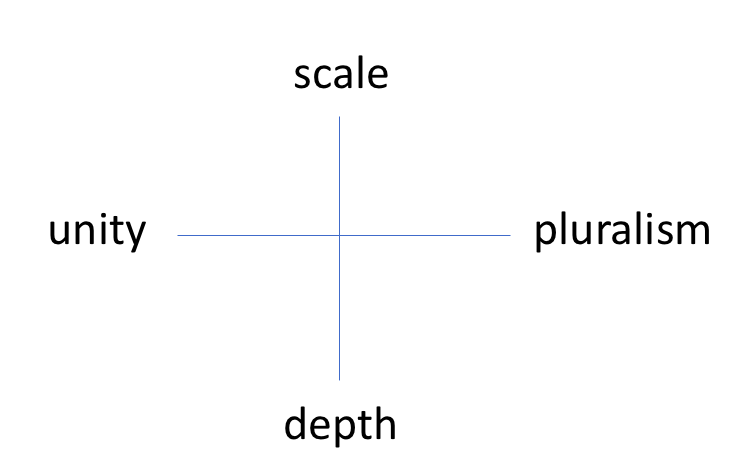
Pure objectivity is a myth, almost universally acknowledged as such. However, if you don’t like what influential people are claiming to be true, you have options. First, you can decide where you stand on a spectrum from relativism (“Any claim depends entirely on who makes it”) to critical objectivity (“There are obvious truths that are being overlooked or concealed because the people in charge of knowledge are bad”). Another spectrum goes from reformist (“New people and new research agendas should be incorporated into the institutions that produce knowledge”) to separatist (“We need new institutions to produce knowledge.”) Since these questions are independent, four options result:

When French postmodernism arrived in the US, much of the academic left was reformist and somewhat relativist, or so I recall. A common view was that science and scholarship were valuable pursuits, but they needed to be substantially diversified. Humanists tended to doubt the claims of objectivity made by their colleagues in the sciences. Works like Peter Novick’s That Noble Dream: The ‘Objectivity Question’ and the American Historical Profession (1988) extended the critique to the humanities. Thus many academics found themselves in Cell A, although some self-described leftists argued that it was a fundamental mistake to undermine objectivity; they defended Cell C.

In that context, French postmodernism was strongly relativist and at least implicitly separatist. Its critique of established institutions (universities, clinics, newspapers, etc.) was radical enough to suggest the need for alternatives–whole new institutions, or perhaps anti-institutions. It made a case for Cell B that many accepted with caveats or else resisted.

At that time, most of the academic right claimed to be strongly anti-relativist and also reformist (Cell D). They viewed relativism as an insidious attack on core values. Conservatives were reformist because they thought that conservative voices were marginalized in the academy and the media and deserved more prominence. Conservatives believed in truth and wanted to change who spoke most powerfully about the truth.

However, some conservatives were separatist: Cell D. They might gravitate to the Federalist Society, the Liberty Fund, evangelical colleges, conservative think tanks–or even “Creation Science”–as alternatives because they had given up on the academy and government-funded science. They believed in objectivity but had lost faith in professors and reporters to produce or disseminate it.

I think a lot of the academic left today falls in Cell C. They believe that real knowledge is possible but that we must enhance diversity in newsrooms, laboratories, universities, and funding agencies in order to get closer to the truth. “Diversity” refers not only to the demographics of the researchers and reporters–although that is important–but also to their topics and methods. Many academics on the left are vigorous defenders of tenure, federal science funding, public radio, and other bulwarks of fairly traditional knowledge-production. Women Also Know Stuff is a perfect example of Cell C.

This means that the academic left shares some of the values that animated conservatives during the 1970s-1990s. Meanwhile, there are strands of the right that now prefer Cell B. They debunk truth, doubt the value of independent scholarship, and want to create alternatives to Fake News, lying scientists, etc.

It’s in that respect that French postmodernism presaged the era of Donald Trump.

See also: Bernard Williams on truth as a virtue of the humanitiesconservative relativismteaching evolution, creationism, Intelligent Design; and media literacy and the social discovery of reality.

issues in the philosophy of social science

Here is the outline of a course I’d like to take–or possibly design and teach some day:

  1. What is the social world? Is it, for example, a bunch of human individuals who interact? Perhaps not, since individuals’ identities and values emerge from social processes, while institutions also have intentions and agency. Do sex and/or gender (for instance) actually exist? Do cultures exist, or are they simplified labels that we impose on heterogeneous phenomena?
  2. Does it matter who studies the social world? On one hand, we might think that what we believe about society is just a function of who studies it. On the other hand, we might assume that social phenomena can be objectively known using procedures that are independent of who uses them. The truth probably lies in between. So how does the identity of the researcher influence the results of social science, and, more generally, how does power relate to truth?
  3. Facts and values: Are they distinct? How do they relate? Should we think of values as biases that may interfere with objectivity, or can they be valid as opposed to invalid? Should social science have values?
  4. What do various methods of social science assume about epistemology? For example, what must we believe about our ability to know in order to run a randomized controlled experiment, develop a game-theoretical model, survey a population and calculate distributions, or interpret a Balinese cockfight?
  5. What is and ought to be the role of social science in society? Should it be influential? When and how? Is everyone a social scientist, or does that phrase name a distinct group of experts or specialists? Should the goal of changing the world affect the research agendas and methods of social science? Who should govern (i.e., fund, regulate, organize) social science and how?

new special issue of The Good Society on reintegrating facts, values, and strategies (open access)

Newly published–and free without a subscription through November — is The Good Society‘s Special Issue on Reintegrating Facts, Values, Strategies, vol. 26, no. 2-3 (2017). Guest edited by me.

Table of Contents

my self, your self, ourselves

Thesis: I have a vocabulary for describing my own behavior that’s full of words about motives, goals, and principles. “Why did I raise my hand? Because I wanted to answer your question. Why did I give that answer? Because I knew it was the truth and I was obliged to say it.” This is a valid way of thinking, because each claim is subject to being tested and can be refuted. (Maybe I raised my hand to show off, or because I misheard you, or to reach for a light switch.) It’s morally important that I think this way about myself, because it reminds me that I am responsible for my actions and must strive to apply the best principles. It’s also morally important that I envision you in the same terms. That is necessary for recognizing your dignity and equality, and it reminds me that I should help you to make your own choices wisely. I should strive to remove obstacles and enhance your freedom.

Antithesis: We have a vocabulary for describing any action in nature that’s all about causes and effects. “Why did he raise his hand? Because an electrical signal traveled along a nerve to a muscle. Why did that signal happen? Because a synapse fired in his brain.” This is the only scientific way to think about life, because science is defined as a third-person account of nature that sets aside the subjective perspective. It’s morally valuable to think this way about other people because then we realize that they are caught in a web of causality and cannot escape suffering; it makes us compassionate. And it’s important that I apply this way of thinking to my own case, viewing my own first-person talk of goals and principles as kind of myth. Then I can escape an overweening attachment to myself that makes me selfish, self-important, and fearful.

Synthesis: There are two ways of thinking about sentient action, the first-person and the third-person mode, and each has its own norms of validity and tests of truth. We are nowhere near being able to make these two perspectives cohere, if we ever will. But we must treat one another right. We’re in this together, and we’re all we’ve got. That requires holding several ideas in our minds at once. 1) I am responsible for what I do and should strive to do right by you. But 2) The condition of my self is of no great consequence to the world and is fundamentally a matter of luck. 3) You face choices and can strive to do right, and I ought to help you. But 4) The condition of your self is a matter of luck; often you will be a in a state of unease or even suffering; and I have compassion for you.

See also: Hegel and the Buddhathree truths and a question about happiness; and on philosophy as a way of life.

how philosophy is supposed to work

(Posted during the Social Ontology 2018 Conference, hosted at Tufts) We live in a positivist culture in which many smart people hold fairly simple views of science and believe that all rigorous thought is scientific. Their objection to highly abstract conceptual questions and to questions of value (moral, political, or aesthetic) is that these matters cannot be scientific; hence progress is impossible. Endless debate must result from the brute fact that we hold different opinions.

But we must figure out what to value and what to believe about conceptual issues. Given our cognitive and moral limitations as individuals, our best way to think about such matters is with other people–learning from their perspectives and testing our beliefs with them. Words are not our only tools for thinking together–mathematical notations, diagrams, images, music, and bodily movements also work–but words are awfully helpful and usually play a role even when we make heavy use of the alternatives.

Therefore, human beings talk about conceptual and normative matters. We always do, everywhere and in every era. But a literal conversation has drawbacks. Since an actual, oral dialogue must involve a small number of people, the cognitive resources are limited. It lasts for a finite amount of time–too brief to address all the relevant questions and issues. And it proceeds in a linear fashion, with one comment or question occupying attention at any given moment, followed by the next one. Although people may make discursive moves like saying, “Let’s go back to your earlier point P, because I disagree with it,” the participants can barely explore the whole network of potentially connected ideas. A conversation is one walk through one part of the network.

A discipline like philosophy is an effort to improve the conversation by institutionalizing it. Many people can participate in a discussion that is organized in the form of journals, books, symposia, and reviews. Participants publish their claims and reasons, leaving them on the record to be picked up by others. They take time to make each point carefully, offering reasons and considering objections. If someone claims P, other people are supposed to read and cite that claim before they say P or not-P. If you criticize P, then other people who begin by believing P are supposed to read and consider your objection to P before they use it as a premise in their arguments. The debate still continues permanently, but it is supposed to become increasingly organized and refined in a process that is just as cumulative as a “normal science” is. Moreover, the strictly philosophical debate is not insulated from other intellectual work but is constantly informed by developments in the sciences, humanistic thought, and actual events in the world.

This is all idealized. I am perfectly aware that not everyone can participate in a professional discipline’s discussion; in fact, the vast majority of human beings are excluded, for a whole range of reasons. Nor would everyone want to join even if that were easy for them. Those who participate act imperfectly, showing too much deference to certain authorities, demonstrating group-think, etc. And ethics (in particular) still suffers from myopia about cultural diversity and empirical data that Owen Flanagan well describes in his new book, The Geography of Morals: Varieties of Moral Possibility.

Still the ideal has significance as a heuristic. It draws our attention to Robert Merton’s four CUDOS norms, which he developed for science (per Wikipedia):

  • Communalism all scientists should have equal access to scientific goods (intellectual property) and there should be a sense of common ownership in order to promote collective collaboration, secrecy is the opposite of this norm.
  • Universalism all scientists can contribute to science regardless of race, nationality, culture, or gender.
  • Disinterestedness according to which scientists are supposed to act for the benefit of a common scientific enterprise, rather than for personal gain.
  • Organized Skepticism Skepticism means that scientific claims must be exposed to critical scrutiny before being accepted.

These norms also apply to philosophy, and we can add more values, such as 1) the norm of citing and addressing previous contributions to the same discussion; 2) the principle that academic discussions should ultimately (but not always directly) benefit public life; 3) the value of being permeable and connected to other discussions in other fields; and 4) an affirmative effort to incorporate people and perspectives that have hitherto been marginalized.

See also: is all truth scientific truth?does naturalism make room for the humanities?why social scientists should pay attention to metaphysics, and adding democracy to Robert Merton’s CUDOS norms for science.

love what you see: Kogonada’s Columbus (2017)

Kogonada’s Columbus (2017) is beautifully filmed in Columbus, IN, a small city stocked with distinguished modernist architecture. Casey (Haley Lu Richardson) had a rough adolescence, but in the midst of that turmoil, she started relishing one particular modernist structure in an ugly strip mall. (I think it is Deborah Berke’s First Financial Bank, below.) She begins to explore the history of modernist architecture and discovers a possible exit from her current life into a world of art and ideas. 

A fine modernist building is an exquisitely planned abstract design composed of a limited number of elements. So is Columbus. The patterns are “subtle” (which is the effect that Casey “goes for” when she cooks for her mom), but also pervasive. For example, Jin (John Cho) and his father are Korean or Korean-American men who form parallel friendships with Midwestern women. Jin and Haley have difficult relationships with parents of the same sex. Near the beginning, Eleanor (Parker Posey) walks across Eero Saarinen’s Miller House toward Jae Yong Lee. Near the end, Casey walks across the Miller House toward Jin. Just like Eliel Saarinen’s First Christian Church, as Casey describes it, the whole film is asymmetrical yet carefully balanced.

Jin’s father left a line-drawing in a notepad, and Jin tries to identify its subject. It could be Mill Race Park Tower by Stanley Saitowitz. Or it might represent negative space, such as the gap in the brick facade of Columbus City Hall by Skidmore, Owings and Merrill. Jin’s father, in his coma, is negative space, and the drawing he left probably does depict the gap in City Hall. But Casey doesn’t like that building, ranking it “low teens, high twenties” on her list of Columbus’ architectural monuments. She strives to bridge gaps–much like James Stewart Polshek’s Mental Health Center, which is built across Haw Creek, with the water flowing beneath for the benefit of the patients.

The film is about appreciating where you are and what you have, taking time to observe. Gabriel (Rory Culkin) even delivers an amusing speech about attention spans, ostensibly summarizing the views of a famous–but absent–critic. Everyone wants Casey to get out of Columbus and escape from her family life, but her moral excellence lies in her genuine love for both. This is not a story about a teenager who needs to break away from a small city in Indiana, but about a person who has learned to see and to love what she sees. Columbus is a lesson in both.

civics in the very early grades

I’m far from an expert on civics for young children, but I bump into the subject in various capacities–as an author of the College Career and Civic Life (C3) Framework for Social Studies, which covers grades k-12; as an evaluator of a pilot civics program in Ukraine, which includes a first-grade curriculum; as a proud board member of Discovering Justice, which focuses more than other nonprofits do on the early grades; and as the director of CIRCLE when we commissioned “Indicators and Measures of Civic Outcomes for Elementary School Students” by Bernadette Chi, JoAnn Jastrzab, and Alan Melchior.

If I’m asked what little kids should learn about civics, this is my working answer. Mostly, they should learn how to relate appropriately to other people: sharing resources fairly, taking turns, resolving conflicts peacefully, and addressing common problems. They should also begin to see that the same issues arise at larger scales and for adults in formal roles. Just as they should they help a classmate who’s crying on the playground, so “neighborhood helpers” like firefighters should help citizens in need. Just as they should resolve disputes with words, so should national leaders. Just as their classroom has rules, so does the society. At some point in the early grades, they should begin to realize that just as kids may fail to treat each other right, so may adults who hold official roles; and when that happens, it requires remedies. These analogies should be represented in the materials, such as historical narratives, that children read and otherwise study academically.

I don’t think we know whether experiencing high-quality civics at age 7 matters at age 17 (or 70). You might expect that it only matters if the experience is reinforced in between, but that’s an empirical question. In 1999, Sir Bernard Crick observed that, “there is no political Piaget,” and longitudinal research on civic development before adolescence is sorely lacking. Thus I base my advice on accumulated classroom experience and theory, not on statistical data.

empathy, sympathy, compassion, justice

I’d posit the following definitions:

  • Empathy: Feeling a similar emotion in response to someone else’s emotional state. Your friend is mad at her boss because he treated her unfairly. That makes you mad at her boss. Your anger is probably different in texture and intensity from hers, but it’s the same in kind, an imperfect reproduction of her mental state.
  • Sympathy: Feeling a supportive emotion in response to someone else’s emotional state that is not the same as that person’s original emotion. She is mad at her boss, so you become sorry for her, or committed to fairness, or sad about the state of the world, or nostalgic for better times–but not angry at her boss. Then you are sympathetic. (NB You can be both sympathetic and empathetic if you feel several emotions.)
  • Compassion: A species of the genus sympathy. Another person’s negative emotion causes you to have a specific supportive feeling that is not the same as her emotion: you sincerely wish that her distress would end without blaming her for it.
  • Justice: A situation or decision characterized by fairness, goodness, rightness, etc. (These are contestable ideas and may be in tension with each other.) The English word “just”–like dikaios in classical Greek–can be applied either to a situation or to a person who cares and aims for justice.

There is an old and rich debate about which character traits and subjective states are best suited to pursuing justice. One answer is that you should be a just person, one who tries to decide what is fair or best for all (all things considered), who desires that outcome, and who works to pursue it. A different response is that we are not well suited to defining and pursuing justice itself. It’s better to cultivate other emotions, such as empathy, sympathy, compassion–or loyalty, aversion to harm, or commitment to specific rules–in order to deliver more just outcomes, all things considered.

I haven’t yet read Paul Bloom’s new book, Against Empathy, but based on this interview and other secondary material, I take it to be an empirically-based contribution to this debate. Bloom marshals evidence that empathy is a highly unreliable guide to justice, probably more likely to mislead than to inform. We should cultivate justice itself, not settle for a substitute, and certainly not the poor substitute of empathy.

For instance, Donald Trump can make people feel empathy for a small number of individuals whose families were allegedly victimized by undocumented aliens, and then use that emotion to build support for deporting millions of people who have harmed no one. A famous example is Edmund Burke’s outrage at the mistreatment of Marie Antoinette, which obscured any concern for the countless people tortured, executed, or “disappeared” by the ancien regime that she represented. (By the way, I happen to respect Burke a lot–and I don’t think it was fair or smart to execute the Queen–but this passage is still a good example of misplaced empathy.)

Empathy can also substitute for justice, as I argued on a visit to Israel in 2013. You congratulate yourself for feeling some version of a suffering person’s emotion and excuse yourself from fixing the problem.

Compassion may be better than empathy. Instead of feeling the same emotion as the other person, you feel a combination of beneficence and equanimity that may be a more reliable guide to acting well. But it’s possible that compassion only clears the deck for reasoning about what you should actually do.

For its part, justice can be emotional. You can feel a powerful urge to make the world more just. That is helpful insofar as the feeling motivates you and insofar as people obtain genuine insights from our emotions; but it is dangerous because the emotion of desiring justice can be misplaced. You can feel great about improving the world when you are actually harming it.

Justice is also necessarily discursive. You must put into words–at least inside your own head–what is good or fair, and why, and make yourself accountable for that position. Therefore, much hinges on whether we human beings can reason explicitly about justice in ways that improve upon our strictly affective reactions to particular situations.

See also: empathy: good or bad?the limits of putting yourself in their shoes and looking with their eyes; an alternative to Moral Foundations Theory; structured moral pluralism (a proposal); and how to save the Enlightenment Ideal.

Election Imperatives: Ten Recommendations to Increase College Student Voting and Improve Political Learning and Engagement in Democracy

I’m on vacation and not blogging, but I’m proud to help circulate a major new report from our Institute for Democracy & Higher Education entitled Election Imperatives. It recommends 10 strategies that colleges and universities should implement to improve political participation on college campuses in 2018 and beyond. The Chronicle of Higher Education ran an exclusive story on it this morning. More than a dozen national organizations are endorsing and disseminating the report, and you can see that list here. There is also a nice video gif of the report with photos.

Here are the 10 headings, but you have to consult the report to understand them fully:

  1. Reflect on past elections and reimagine 2018
  2. Remove barriers to student voting
  3. Develop informed voters
  4. Establish a permanent and inclusive coalition to improve the climate for learning and participation
  5. Increase and improve classroom issue discussions across disciplines
  6. Support student activism and leadership
  7. Empower students to create a buzz around the election
  8. Invest in the right kind of training
  9. Talk politics across campus
  10. Involve faculty across disciplines in elections