the weirdness of the higher ed marketplace

Princeton has $2.86 million in endowment per student, which would yield about $140k per year in interest for every undergraduate. Princeton could charge no tuition if its goal were to maximize accessibility. On the other hand, Princeton received 32,000 applications last year, so it could easily fill a highly-qualified class with people who could pay its full tuition price–or much more than that–if the university’s goal were to maximize tuition income. Princeton could also double or triple its size or create a new campus in another state or country if it wanted to maximize both accessibility and revenue.

Of course, a university sees itself as doing more than providing education. It also generates research, arts and culture, public service, etc. Every dollar that it collects from a student can go to those other purposes. But any endowment money that it spends on those other purposes could have gone to financial aid.

Meanwhile, prospective students also want a bundle of things, including prestige. Prestige comes with selectivity and sticker-price. Imagine you have a choice between paying the basic in-state tuition at UW-Madison ($10,725) or the same amount to Stanford after receiving financial aid. Stanford might look like a better deal, since its tuition sticker price is $55,473. It seems like you are being given $44k. However, it is unlikely that the marginal cost per student at Stanford is really 5.5 times higher than the cost at UW-Madison. More likely, Stanford knows it can charge a base tuition of $55k because many families will pay that much; and asking for less would be leaving cash on the table. Stanford with financial aid is arguably a better deal than UW-Madison’s full price, not because Stanford offers a better (or more costly) education in the classroom but because attending a college that is extremely selective and expensive looks better.

In short, the demand curve rises with price. The more other people pay for a given college, the more valuable it is to you, holding your own costs and the quality of the education constant.

It sounds as if college is a Veblen good, one that rises in perceived value the more it costs. But that logic does not exactly apply. If a college that regularly turns away 94% of its applicants decided to fill its seats with people who could pay full price, it would look less academically selective (as well as less diverse), and it would become less desirable. Many of the people who could pay to attend would now try to go elsewhere. In other words, if you pay full price, you are better off the more of your fellow students do not. Financial aid demonstrates that the college is selecting on criteria other than wealth. This is not typical of a Veblen good, which looks more desirable if only rich people buy it.

As Frank Bruni amusingly postulated, a college could win the prestige sweepstakes by deciding that no one was qualified for admissions. Bruni imagines the day when Stanford finally admits zero applicants:

At first blush, Stanford’s decision would seem to jeopardize its fund-raising. The thousands of rejected applicants included hundreds of children of alumni who’d donated lavishly over the years. …

But over recent years, Stanford administrators noticed that as the school rejected more and more comers, it received bigger and bigger donations, its endowment rising in tandem with its exclusivity, its luster a magnet for Silicon Valley lucre.

In fact just 12 hours after the university’s rejection of all comers, an alumnus stepped forward with a financial gift prodigious enough for Stanford to begin construction on its long-planned Center for Social Justice, a first-ever collaboration of Renzo Piano and Santiago Calatrava, who also designed the pedestrian bridge that will connect it to the student napping meadows.

One of the anomalies that Bruni is pointing to is that people who attended a college in the past now underwrite it voluntarily with their donations. Usually, you pay in order to obtain a good. Here, you get the good and then you pay for others to get it–in part so that it can be withheld from as many applicants as possible, thus raising its value even more on your own resume.

These are strange incentives ….

Lou Frey Institute/FJCC Civics in Real Life Webinars

Good morning, friends in social studies and civics! Back in December, we here at the Institute launched a new webinar series linked, somewhat loosely. to our Civics in Real Life series. Did you miss any of them? Check out the upcoming March webinar with Dr. Kenicia Wright, and then scroll down to see what you may have missed! You can also view all of our archived webinars on our dedicated schooltube channel!

Coming in March! Representation Matters: A Discussion of the Effects of Diversity in American Politics and Education in the United States, with Dr. Kenicia Wright

Register for Dr. Wright’s webinar here! Want the flyer? Click here!

The 1920 Ocoee Election Day Massacre, with Dr. Robert Cassanello

You can view this webinar here.

Presidential Inaugurations and Why They Matter, with Dr. Terri Fine

You can view this webinar here.

Using the SOURCES Framework to Examine Blockbusting, with Dr. Scott M. Waring and Dr. Tina M. Ellsworth

You can view this webinar here.

If you have questions about the webinars, or would like any of the referenced resources, please contact us!

‘The New Systems Reader’: Strategies for System-Change

As befits our time of converging existential crises, a number of new anthologies of essays are popping up to make sense of how modern industrial society got here and to propose coherent strategies for moving forward. Today I’d like to call attention to a fantastic collection of 29 original essays, The New Systems Reader: Alternatives to a Failed Economy, edited by James Gustave Speth and Kathleen Courrier and published by Routledge. 

This 480-page book is a cornucopia of fresh, original thinking by leading thinkers and activists such as Gar Alperovitz, Tim Jackson, Michael Shuman, Ed Whitfield, Riane Eisler, David Korten, Richard D. Wolff, Kali Akuno, Aaron Tanaka, and J.K. Gibson-Graham. 

Chapters cover a wide gamut of topics: social democracy and radical localism, the elements of a new, green economy, worker democracy, the Solidarity economy, cooperatives, participatory economics, reparative economics, and much more. (I have my own chapter on commoning as a transformative social paradigm.)

The Next System Project is an initiative of the Democracy Collaborative, which has long been showcasing the best research and strategic thinking about "visions, models and pathways that point to a 'next system' radically different in fundamental ways from the failed systems of the past and present...." So it's a pleasure to have so many diverse voices consolidated into a single volume.

“The starting point for this book,” writes the editors Speth and Courrier, “is the inability of traditional politics and policies to address fundamental challenges.” That’s why reading this book is so bracing – it squarely addresses the deep structural, political, economic, and cultural issues that must change. 

In sifting through the diverse perspectives of contributors, the editors identify a number of shared premises, which I paraphrase here:

  • a shift of ownership and control to workers and the public
  • the imperative to protect the planet and its climate
  • democratically determined priorities in investment
  • the abandonment of growth and GDP as the focus of national well-being
  • equal justice and reparative justice to address systemic racism, and
  • greater popular sovereignty and economic democracy

For those who may wish to study these essays with a reading group or class, there is a useful 24-page study guide that accompanies The New Systems Reader. It’s by Thad Williamson, for the Democracy Collaborative, and a free PDF of the guide can be downloaded here.

In a previous post, I noted my own offering in the small but growing oeuvre of system-change anthologies and treatises. Check out The Great Awakening: New Modes of Life Amidst Capitalist Ruins, co-edited with Anna Grear, available under a Creative Commons license and available in print or free downloads.

In my next blog, another excellent anthology dealing with system-change strategies.

‘The New Systems Reader’: Strategies for System-Change

As befits our time of converging existential crises, a number of new anthologies of essays are popping up to make sense of how modern industrial society got here and to propose coherent strategies for moving forward. Today I’d like to call attention to a fantastic collection of 29 original essays, The New Systems Reader: Alternatives to a Failed Economy, edited by James Gustave Speth and Kathleen Courrier and published by Routledge. 

This 480-page book is a cornucopia of fresh, original thinking by leading thinkers and activists such as Gar Alperovitz, Tim Jackson, Michael Shuman, Ed Whitfield, Riane Eisler, David Korten, Richard D. Wolff, Kali Akuno, Aaron Tanaka, and J.K. Gibson-Graham. 

Chapters cover a wide gamut of topics: social democracy and radical localism, the elements of a new, green economy, worker democracy, the Solidarity economy, cooperatives, participatory economics, reparative economics, and much more. (I have my own chapter on commoning as a transformative social paradigm.)

The Next System Project is an initiative of the Democracy Collaborative, which has long been showcasing the best research and strategic thinking about "visions, models and pathways that point to a 'next system' radically different in fundamental ways from the failed systems of the past and present...." So it's a pleasure to have so many diverse voices consolidated into a single volume.

“The starting point for this book,” writes the editors Speth and Courrier, “is the inability of traditional politics and policies to address fundamental challenges.” That’s why reading this book is so bracing – it squarely addresses the deep structural, political, economic, and cultural issues that must change. 

In sifting through the diverse perspectives of contributors, the editors identify a number of shared premises, which I paraphrase here:

  • a shift of ownership and control to workers and the public
  • the imperative to protect the planet and its climate
  • democratically determined priorities in investment
  • the abandonment of growth and GDP as the focus of national well-being
  • equal justice and reparative justice to address systemic racism, and
  • greater popular sovereignty and economic democracy

For those who may wish to study these essays with a reading group or class, there is a useful 24-page study guide that accompanies The New Systems Reader. It’s by Thad Williamson, for the Democracy Collaborative, and a free PDF of the guide can be downloaded here.

In a previous post, I noted my own offering in the small but growing oeuvre of system-change anthologies and treatises. Check out The Great Awakening: New Modes of Life Amidst Capitalist Ruins, co-edited with Anna Grear, available under a Creative Commons license and available in print or free downloads.

In my next blog, another excellent anthology dealing with system-change strategies.

‘The New Systems Reader’: Strategies for System-Change

As befits our time of converging existential crises, a number of new anthologies of essays are popping up to make sense of how modern industrial society got here and to propose coherent strategies for moving forward. Today I’d like to call attention to a fantastic collection of 29 original essays, The New Systems Reader: Alternatives to a Failed Economy, edited by James Gustave Speth and Kathleen Courrier and published by Routledge. 

This 480-page book is a cornucopia of fresh, original thinking by leading thinkers and activists such as Gar Alperovitz, Tim Jackson, Michael Shuman, Ed Whitfield, Riane Eisler, David Korten, Richard D. Wolff, Kali Akuno, Aaron Tanaka, and J.K. Gibson-Graham. 

Chapters cover a wide gamut of topics: social democracy and radical localism, the elements of a new, green economy, worker democracy, the Solidarity economy, cooperatives, participatory economics, reparative economics, and much more. (I have my own chapter on commoning as a transformative social paradigm.)

The Next System Project is an initiative of the Democracy Collaborative, which has long been showcasing the best research and strategic thinking about "visions, models and pathways that point to a 'next system' radically different in fundamental ways from the failed systems of the past and present...." So it's a pleasure to have so many diverse voices consolidated into a single volume.

“The starting point for this book,” writes the editors Speth and Courrier, “is the inability of traditional politics and policies to address fundamental challenges.” That’s why reading this book is so bracing – it squarely addresses the deep structural, political, economic, and cultural issues that must change. 

In sifting through the diverse perspectives of contributors, the editors identify a number of shared premises, which I paraphrase here:

  • a shift of ownership and control to workers and the public
  • the imperative to protect the planet and its climate
  • democratically determined priorities in investment
  • the abandonment of growth and GDP as the focus of national well-being
  • equal justice and reparative justice to address systemic racism, and
  • greater popular sovereignty and economic democracy

For those who may wish to study these essays with a reading group or class, there is a useful 24-page study guide that accompanies The New Systems Reader. It’s by Thad Williamson, for the Democracy Collaborative, and a free PDF of the guide can be downloaded here.

In a previous post, I noted my own offering in the small but growing oeuvre of system-change anthologies and treatises. Check out The Great Awakening: New Modes of Life Amidst Capitalist Ruins, co-edited with Anna Grear, available under a Creative Commons license and available in print or free downloads.

In my next blog, another excellent anthology dealing with system-change strategies.

a survey about technology for hybrid public meetings

I am working with Tufts colleagues who have backgrounds in civic engagement and engineering to investigate the use of technology in public meetings. Our goal is to develop software that can facilitate video coverage of meetings, enabling different levels of participation for remote participants. The software will be cheap and scalable–it will allow multiple people to use their phones to film the same meeting. Initially, the software will produce one automatically edited, live video-stream of the meeting, which is much cheaper than hiring a professional videographer/editor. Over time, the software will incorporate other features: ways for people not physically at the meeting to speak, links to documents, simultaneous translations, and even possibly fact-checking.

We are interested in understanding how meetings are run (before and during COVID-19), your experiences (if any) with using technology (e.g., Zoom, Facebook) for meetings, and how future technologies can benefit people.

If you would be willing to take an 11-minute survey to inform this project, please click here: https://tufts.qualtrics.com/jfe/form/SV_3t97H86qQy95GpE

The survey is meant for people who have some role in organizing or staffing public/community meetings. You must be at least 18 years old to participate. It does not matter whether you are a US citizen, but you must be in the USA when you take the survey.

Thanks for your advice and ideas!

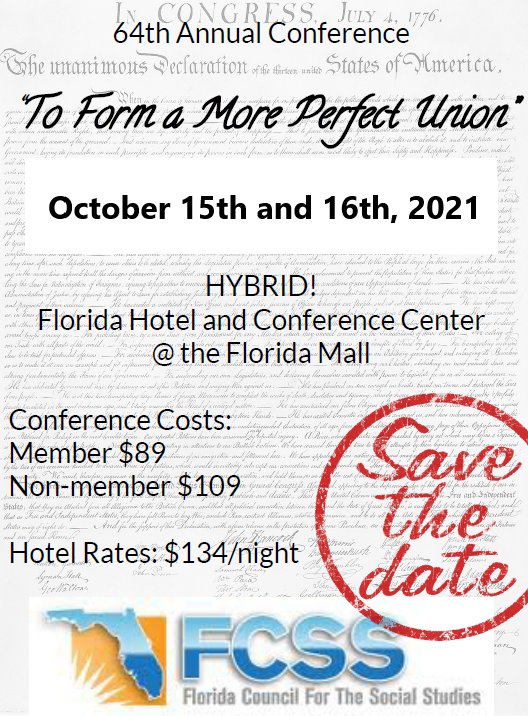
The Virtual Florida Council for the Social Studies Conference is Saturday!

Good afternoon, friends! The upcoming virtual social studies conference is this weekend. Will you be joining us? As a reminder, be sure to check out our keynotes, and don’t forget to register here for the upcoming Florida Council for the Social Studies virtual conference as well! So let’s take a look at some more of Saturday’s fun!

Session: Introducing Inquiry in the Elementary Classroom: Equipping Young Student Historians!

Excite students by interacting with age-appropriate primary sources to grow a culture of inquiry. Create a thinking classroom where students work as junior historians by modeling a “historical mystery” replicated with other content and grades.

Session: Teaching Human Geography through Storytelling

Join the adventure! Explore the interaction of humans with the world, through the inspiring voices of National Geographic explorers.

Session: Digital Notebooking

Participants will learn some ins and outs (determined on what the group knows) of creating more interactive Google Slides for online learning.

Session: Transforming History Curriculum by Integrating Diverse Voices of America’s Past

Engage with strategies to integrate primary and secondary sources representing diverse voices in American History, leveraging library databases.

Register here for the upcoming Florida Council for the Social Studies virtual conference!!

the ethical meanings of indigeneity

Quentin Gausset, Justin Kenrick, and Robert Gibb note that there are two separate conversations within their own discipline (anthropology) that involve different scholars and different families of examples.

In one conversation, the keyword is “indigenous,” and it applies either to “hunter-gatherers and nomads whose livelihood and culture is threatened by encroachment from their neighbours and state … or to groups who occupied a territory before it was forcibly settled by colonising powers and have struggled ever since to maintain some control over what was left of their resources.”

For instance, I am sitting on land where the Wampanoag are indigenous, a few miles from the offices of a federally recognized Wampanoag tribe.

In the other conversation, the keyword is “autochthonous” (born in the place) and it refers to large populations–often the majority in a given country–who “believe that their resources, culture or power are threatened by ‘migrants’.”

Anthropologists have had opposite reactions to these two families of cases:

[They] have tended to display sympathy and support for indigenous peoples (such as marginalised nomads) while often being highly critical of those advancing autochthonous claims (for example, extreme right-wing parties in European countries…). While indigenous movements are often idealised as innocent victims, or even as globally concerned and ecologically sound, autochthonous movements are, on the contrary, demonised and their agenda is reduced to ‘the exclusion of supposed “strangers” and the unmasking of “fake” autochthonous, who are often citizens of the same nation-state.’

As these authors note, a dictionary treats the two words as synonyms. Thus the existence of parallel discourses is noteworthy. We could add a third conversation about “irredentism,” a belief that a given nation should regain control over all of its former territory. Irredentist claims are usually seen as bellicose and nationalistic. Fascism is often autochthonous and irredentist. We don’t typically describe fascists as the “indigenous” populations of their countries–although they may see themselves that way.

Given the availability of these three terms–with overlapping meanings but different ethical valences–all kinds of intriguing uses emerge.

Erich Fox Tree observes that migrants to the USA from Central America increasingly identify as indigenous within the United States. Their claim is “somewhat irredentist, by asserting a super-territorial homeland” that spans the continent. However, in my view, they are expressing an understandable Latino/Native solidarity and opening possibilities for powerful coalitions within the USA.

According to Cheryl L. Daytec-Yañgot, “Tribal Peoples in Africa, such as the San or Maasai, self identify as indigenous to participate in indigenous discourses in the UN, even though their occupation of the region they inhabit does not predate those of other groups.” Meanwhile, “white Afrikaners from South Africa claimed indigeneity and attempted to forward their agenda to the UN Working Group on Indigenous Populations.”

Daytec-Yañgot notes that the discourse of indigeneity is “Eurocentric.” To put it a slightly different way, I would say that concerns about the oppression of indigenous minorities arise in settler countries–places, like the USA, Australia, or Argentina, where European conquerors came in very large numbers and numerically overwhelmed the original inhabitants. This model does not fit well in much of Asia and Africa, where imperialism was also devastating but the imperialists were limited in number and have mostly gone back home. It also doesn’t fit contexts like the Caribbean, where the majority population was transported against their will to replace the older inhabitants. In at least some important cases, the most threatened groups are minorities who migrated in and are accused of being interlopers. For instance, Hindu Nationalism often presents adherents of the dharmic religions as indigenous, and Muslims (as well as Christians) as the legacy of imperialism. But Muslims are now the threatened group in India.

There is nothing wrong with the mixed affective responses of anthropologists and others. It seems right to sympathize with indigenous groups in places like Massachusetts and to criticize autochthonous majorities who want migrants to “go home” (even though the words indigenous and autochthonous are synonyms). These judgments can be consistent with appropriate theories of justice, ones that take account of past injustices, current patterns of inequality and domination, the intrinsic value of cultures, the equal rights of all human beings, and ecological considerations.

It is a curiosity that we have two sets of vocabulary for different categories, but the ethical variation is not surprising. As always, the empirical study of human beings is inseparable from value-judgments, and the objective is to get our judgments (as well as our facts) right. Being explicit about the basis of our judgments helps: it allows us to test them in dialogue with other people. But explicitness is not sufficient: the point is to improve our judgments.

See also these posts about ethical judgments embedded in social science: when is cultural appropriation good or bad? and what is cultural appropriation?; social justice should not be a cliché; science, law, and microagressions; morality in psychotherapy; insanity and evil: two paradigmsprotecting authentic human interaction;  is all truth scientific truth?; and don’t confuse bias and judgment.

Looking at Florida Council for the Social Studies Virtual Conference Sessions!

Well, the conference is this weekend, so let’s take a look at some more sessions that might be of interest! Be sure to check out other previews here and here and here and also herePlease register and join us, and be sure to check out this preview of our two fantastic keynote speakers as well!

Remember that our theme for this virtual conference is

Please be sure to register and join us!

Session: Don’t Make Me Repeat Myself: Teaching Contextualization to Effect Change

This presentation uses primary sources and pedagogy to inform and inspire discourse about history. Using historical thinking skills, participants will experience how to perceive the past through a contextual lens to broaden perspective and effect change.

Session: Transforming History Curriculum by Integrating Diverse Voices of America’s Past

Engage with strategies to integrate primary and secondary sources representing diverse voices in American History, leveraging library databases.

Session: Grounded in the local: Rediscovering African-American History

During this session, Newsela will demonstrate the importance of using local experts and resources in your social studies courses – specifically, African-American History. Florida has a complex story to tell regarding African-American History, and that story should be told through the use of local historical resources and primary sources, to make the content come to life for students.

Session: Building Support Networks for Advanced Placement Teachers in Florida

Session for AP Teachers interested in participating in a support, sharing, leadership and communication network among AP teachers in social studies throughout the state. Teaching strategies will be discussed.

We will share some more sessions tomorrow. Until then, register today for what will be an excellent conference!

Even More Highlights of the Upcoming Florida Council for the Social Studies Virtual Conference!

And now we take a look at some more interesting sessions! Be sure to check out other previews here and here and here and also herePlease register and join us, and be sure to check out this preview of our two fantastic keynote speakers as well!

Session: FLDOE Office of Assessment Update

This annual Conference message about the middle school Civics and high school U.S. History EOC Assessments will provide an overview of legislation and implementation, insights into the educator committee review process, and review of student performance data.

Session: The Franklin Project

Step Up America provides free lessons involving American History, Civics, Good Citizenship and many others through the Franklin Project. The Franklin Project is an interactive approach to giving our children effective lessons on the importance of our freedoms and introduce them to historical characters that made a positive difference in the foundation of our country. These lessons are given through a digital Avatar of Founding Father Benjamin Franklin.

Session: Creating a community of caring citizens: social-emotional learning bell ringers

Photo by Mike on Pexels.com

Participants will explore the significance of social emotional learning. Participants will engage in 5 social emotional bell ringer activities that can be enacted with materials most teachers already have and devote less that ten minutes to each task.

We will highlight more sessions soon! Remember that our theme for this virtual conference is

Please be sure to register and join us, and be sure to check out this preview of our two fantastic keynote speakers as well!