Survey Finds Regional, Racial Divides in K-12 Remote Schooling Impact During Pandemic

I did this analysis, which was released today …

New nationwide survey by Tufts University researchers finds that parents credit schools with limiting academic harms but see damage to social relationships.

More than 70% of K-12 students across the country experienced some remote schooling during the 2020-21 school year, with stark differences emerging along regional and racial lines and the worst effects on students’ social relationships, according to a new, nationally representative study conducted by Ipsos, using its KnowledgePanel, for the Tufts University Research Group on Equity in Health, Wealth and Civic Engagement.

Thirty percent of students in the South attended entirely in-person, compared to just 11.5% in the West. Sixty-one percent of students in the West attended entirely remotely, significantly more than in the other regions.

NortheastMidwestSouthWest
Entirely in-person17%27%30%11.5%
Entirely remote50%32%26%61%
Mix of both30%36%35%23%
Did not attend school3%4%9%5%

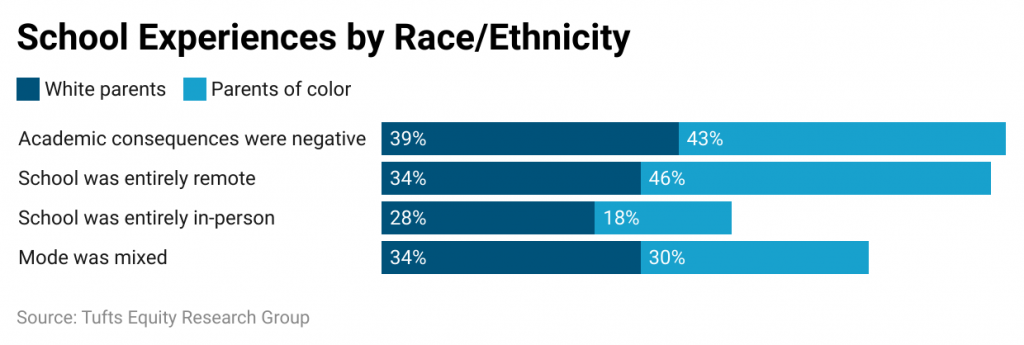
White students were most likely to attend in person. Parents or guardians of color were somewhat more likely than white parents to report negative academic experiences with remote learning, but that difference was within the margin of error. (Given the sample size, analysis of specific racial and ethnic groups is not possible.)

The survey was fielded online between April 23 and May 3, 2021 and had 1,449 respondents, 248 of whom provided responses about their own children’s schooling experience during the COVID-19 pandemic. Statistics based on these 248 responses have a margin of error of +/- 6.2 percentage points.

About 24% of K-12 students attended school entirely in-person, 39% entirely remotely, 32% in a hybrid mix of both modes, and nearly 6% of school-aged children did not attend school at all.

Parents reported the worst effects on their children’s social relationships, followed by physical fitness and emotional wellbeing. On academics, slightly more parents reported positive than negative effects from the measures their schools took to limit the spread of COVID-19.

All data included in the survey was reported by parents or guardians describing their own children. Parents were not asked about the overall impact of the pandemic, but specifically about the measures that their children’s schools had taken to limit the spread of the virus.

“Many parents seem to credit schools with making the best of the situation, although some see bad effects, especially on social relationships,” said Peter Levine, an associate dean at Tufts’ Tisch College of Civic Life and co-principal investigator of this study.

Tufts University’s Research Group on Equity in Health, Wealth and Civic Engagement was established in 2019 as part of a strategic effort to use resources and expertise across the university to address major global issues. It brings together researchers from across the university to discuss and investigate aspects of equity and inequity in the United States and the world. The research has been funded by Tufts University’s Office of the Vice Provost, the Tisch College of Civic Life at Tufts, the Tufts Data Intensive Science Institute and the Tufts Clinical and Translational Sciences Institute. 

For more data and findings from the Research Group on Equity, please visit https://equityresearch.tufts.edu/.

The group’s principal investigators are Jennifer Allen, professor of community health in the Tufts School of Arts and Sciences; Peter Levine, associate dean for academic affairs and Lincoln Filene Professor of Citizenship & Public Affairs at the Tisch College of Civic Life at Tufts; and Thomas Stopka, associate professor of public health and community medicine at Tufts University School of Medicine. Other members of the group can be found here.

what must we believe?

A study by Roland G. Fryer, Jr. provoked controversy because of its conclusion that Black and Hispanic people are not more likely than whites to be shot to death by police, although they are more likely to experience non-lethal force at the hands of police. In “Race, Policing, and The Limits of Social Science,” Lily Hu uses this study and the resulting controversy to explore important questions about the persuasiveness of social science. Her questions are not merely academic–they have existential significance as we each decide how to interpret and improve the world.

Speaking for myself (but in a similar vein to Hu), I would draw attention to the results in the tables near the end of Fryer’s piece (pp. 39ff). You’ll see familiar-looking columns of numbers, many of which are means or coefficients. They are labeled with text, including such words or phrases as “High-crime Area,” “Carrying Suspicious Obj,” “Incident type: Street Stop,” “Officer Unit Majority White,” “Pinellas County,” and “Hispanic.”

Why are we reading these tables? For one thing, Roland Fryer has captured our attention and a baseline level of trust. This is not a given. I crunched some numbers on police discrimination last year and drew modest traffic. I am not complaining: Fryer genuinely deserves much more attention because of the ambitiousness and originality of his paper (even if one criticizes it). Yet it is worth noting that we read his paper as a consequence of many causal factors, including Fryer’s talent and hard work but also his status and position.

In short, knowledge results–like everything else–from causes. The factors that cause us to know and to trust any given claim include power and social status.

Fryer’s specific findings are the result of methods that social scientists have developed and that he chose to use. Methods are always contestable, and, in this case, they have been challenged. I do not have anything valuable to add about his methods, but their contestability is important.

As for the data that Fryer uses, they result from social processes. He analyzed five million records from New York City’s Stop, Question, and Frisk program, which mandated a great deal of data-collection as part of its approach to enforcement/social control. He also used the Police-Public Contact Survey, which is a federally funded survey conducted by the US Census Bureau for the Justice Dept. Finally, he and a team coded reports from the files of the police in LA County, Houston, Austin, Dallas, Houston and six large Florida counties.

Thousands of people generate these data: randomly selected residents who complete surveys and police officers who file required reports. Many hundreds of people design these instruments and make sure that they are completed. A police officer files a report about an incident with a civilian because of other required reports: a personnel file on the officer, an evaluation of the unit commander, etc. Deeper in the background are previous efforts to measure our social world. For instance, racial categories come from thousands of previous surveys designed and fielded for other purposes. We code and analyze stored bodies of text (such as police files) thanks to techniques previously developed for other research.

Different phenomena could be measured, and different measures could be used. The government of France does not record race and literally does not know how many French residents are people of color. In contrast, the US has always categorized our population by race, albeit with changing categories and purposes. Already in the Census of 1800, Americans were categorized as free whites, other free persons, or slaves.

One way to think about such differences is in terms of choices. We could choose not to measure race, to measure it in a different way, or to measure things that we do not measure now. But this “we” is misleading. We citizens are not convened like a committee to review discrete choices. Instead, the practice of measuring any given thing often results from concerted efforts by specific people or groups. Some people develop and revise concepts and organize and advocate; other people then spend money or apply power to cause data to be collected. I have been involved in such efforts–for instance, helping to write the federal assessment of civics, and playing a role in generating voter turnout data for most US colleges and universities. These are purposive efforts, undertaken to change the world for specific reasons. They reflect people’s values and strategies.

People also undertake concerted efforts to build up social institutions. It is not natural or inevitable that we have police at all–meaning uniformed, armed, bureaucratically organized public-sector employees with unique rights and responsibilities. Having police is a choice, but again, it is not an item on a menu that was set before the public. Instead, policing is an institution with its own inertia, constituencies, and political influence. The choice that each of us faces is whether to support policing, assent to it, subvert it, or help to build up an alternative.

The same is true of the political jurisdictions listed in Roland Fryer’s tables. It is not inevitable that Houston and Pinellas County, FL are organized as entities with police forces and other state powers. Indeed, Elinor Ostrom showed that much smaller jurisdictions produced better policing, and she found especially good results in small Black-majority communities that had their own police forces. So it is a choice to have a Houston police force–but again, this choice reflects many decades of concerted efforts by many people with many agendas.

Particular facts are the results of power deployed through social institutions. Power is not necessarily bad: it is nearly synonymous with “capacity,” and we want capacity. Nor is power necessarily zero-sum: we can measure and value more than one thing at a time. Therefore, to say that knowledge emerges from power is not cynical. Whether knowledge is good or bad depends on the motives, the means, and the consequences that relate to it.

This implies that to assess knowledge is always partly a matter of values–it is a normative as well as an empirical matter. You can’t assess the crime rate unless you know which activities are deemed illegal and how the law is enforced. You can’t assess the employment rate until you know what counts as employment, which jobs are consistent with a good life, and what happens to the people who are labeled unemployed. The crime rate or the employment rate is not a simple fact: it is a result of social institutions that cause people to behave in various ways and that cause their behaviors to be measured and classified in various ways.

The next question (for me) is: What should we evaluate? I resist evaluating very broad and vague phenomena, such as capitalism or modernity or even the USA. That is a path to ideology, in the bad sense of that word: broad assessments prevent careful thought and nuance.

On the other hand, each social phenomenon is linked tightly with many others. A claim cannot be assessed all by itself. For instance, to accept that a city block is a “high crime area” (as in one of the datasets in Fryer’s paper) is to accept a whole system of social monitoring and control that gives some places that label.

We assess one thing at a time, yet each assessment is related to many previous ones. In this way, we gradually build up a worldview that combines normative judgments, empirical generalizations, causal inferences, and many other components. Hu cites “what philosopher W. V. O. Quine so charmingly called our ‘web of belief.'”

As she points out, a particular piece of information may come along that conflicts with some existing components of our web. For instance, Fryer’s specific statistics about police-involved shootings contradict what I had believed. In such cases, we must consider “what must be sacrificed so that other beliefs might be saved. And since our webs are not all identical, what rational belief revision demands of us will also vary. One man’s happily drawn conclusion (p, therefore q!) is another’s proof by contradiction (surely not q, therefore not p!). Or as the saying goes, one man’s modus ponens is another man’s modus tollens.

Her rather startling conclusion: “Rejecting a study’s methods or its starting assumptions on the basis of disagreement with its results is a completely legitimate inferential move.”

Confronted by Fryer’s original paper, someone who is very concerned about police shootings of unarmed Black civilians might:

  • Doubt the sources of the statistics (although the paper uses several different kinds of sources);
  • Doubt the mathematics, either because of specific methodological concerns or because of a low threshold of trust in the author (who could, in theory, have made basic errors);
  • Doubt the conclusions because they conflict with other sources of information;
  • Acknowledge the specific conclusions but accentuate the part of the study that reinforces prior views: police use non-lethal force in a racially discriminatory way;
  • Modify strategies for police reform to focus more on the non-lethal uses of force; or
  • Revise basic beliefs, including beliefs about other sources of knowledge, such as news coverage of police homicides.

Hu implies that any of these responses might be rational, depending on one’s overall web of belief. For instance, it would be irrational for me to distrust Fryer’s basic mathematics, because I have accumulated trust in institutions like Harvard and the NBER. They have served me well on many prior occasions. However, other people might have no such basis for trust and might have very well-grounded reasons to doubt a result that contradicts their vivid accumulated experiences. Hu writes:

For those whose beliefs, empirical and ethical, are forged in participation in radical sociopolitical movements from below, to be ill-inclined to accept certain findings about race and policing is to remain steadfast in a commitment to a certain thick set of empirical and ethical propositions in their webs of beliefs: that systems of policing and prisons are instruments of racial terror and that any theory of causation, theory of race, and statistical methods worth their salt will see race to be a significant causal factor affecting disparate policing and prison outcomes. This just is the first test of “fitting the data.” It is not a flight from rationality but an exercise of it.

Bertrand Russell summarized a significant tradition when he wrote his Liberal Decalogue (ten commandments) for educators. He included these points:

1. Do not feel absolutely certain of anything.

 5. Have no respect for the authority of others, for there are always contrary authorities to be found.

 6. Do not use power to suppress opinions you think pernicious, for if you do the opinions will suppress you.
 
 7. Do not fear to be eccentric in opinion, for every opinion now accepted was once eccentric.

 8. Find more pleasure in intelligent dissent that in passive agreement, for, if you value intelligence as you should, the former implies a deeper agreement than the latter.

 9. Be scrupulously truthful, even if the truth is inconvenient, for it is more inconvenient when you try to conceal it.

This list is “liberal” in the sense that it prizes autonomy, freedom of conscience and speech for all, a marketplace of ideas, and the individual’s exercise of reason. It is a version of Kant’s “enlightenment.” It has merit–perhaps slightly underplayed in Hu’s excellent article. We suffer from motivated reasoning, intellectual conformity, and polarization, and it takes work to keep our minds open. Russell’s advice is valuable for that reason. In this spirit, we might do well to wrestle with the specific claims in an article like Fryer’s–to see what insights we can get from them.

But Russell’s list is incomplete, for the reasons that Hu presents. Basically, he treats each “truth” and each observer as independent, when they actually belong to Quinian webs of belief and social institutions. Therefore, we should also remember to:

  1. Recognize the consequences or what we choose to say, including arguments and findings that we choose to repeat from other people’s work. In making these choices, strive to do no harm.
  2. When encountering new and troubling findings, don’t forget what we already know or neglect our debt to our existing sources.
  3. When encountering a new argument or study, be open to all of it, not just the headlines. (For instance, don’t forget Fryer’s finding that police discriminate in using non-lethal force.)
  4. Cultivate our whole webs of belief, which ought to be internally diverse and complex but also reasonably coherent.
  5. Value a range of sources of knowledge, including personal experience and testimony as well as statistics and models.
  6. Ask whether it is beneficial–or not–for each of us to speak publicly on any given topic.
  7. Critically assess the institutions that generate knowledge.
  8. Critically assess our own roles in such institutions.
  9. Never neglect the normative aspect of knowledge.
  10. Don’t take the questions for granted, but ask what we could be asking about.

See also: police discrimination, race, and community poverty; more data on police interactions by race; on the phrase: Abolish the police!; some remarks on Elinor Ostrom and police reform; what gives some research methods legitimacy?; six types of claim: descriptive, causal, conceptual, classificatory, interpretive, and normative; we should be debating the big social and political paradigms; judgment in a world of power and institutions: outline of a view; teaching about institutions, in a prison; a template for analyzing an institution; what does a Balinese cockfight have to do with public policy analysis?, etc.

Despite Similar Levels of Vaccine Hesitancy, White People More Likely to Be Vaccinated Than Black People

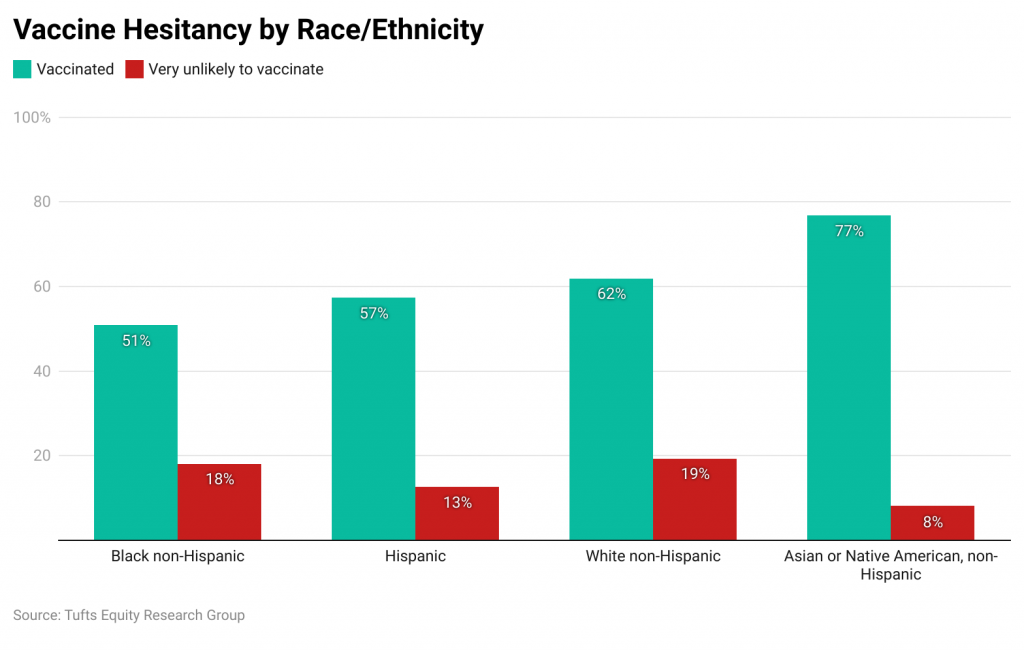
I crunched the data for this new release, based on our very recent national survey. We find that those most hesitant to be vaccinated are younger, less educated, and more likely to trust former President Donald Trump; we also find a racial divide in access to the vaccine.

Image courtesy Tufts University Research Group on Equity in Health, Wealth and Civic Engagement

White people are more likely to have been vaccinated than Black people despite similar levels of vaccine hesitancy, or saying they are very unlikely to get a vaccine. Therefore, access to vaccines and other factors could be limiting vaccination efforts.

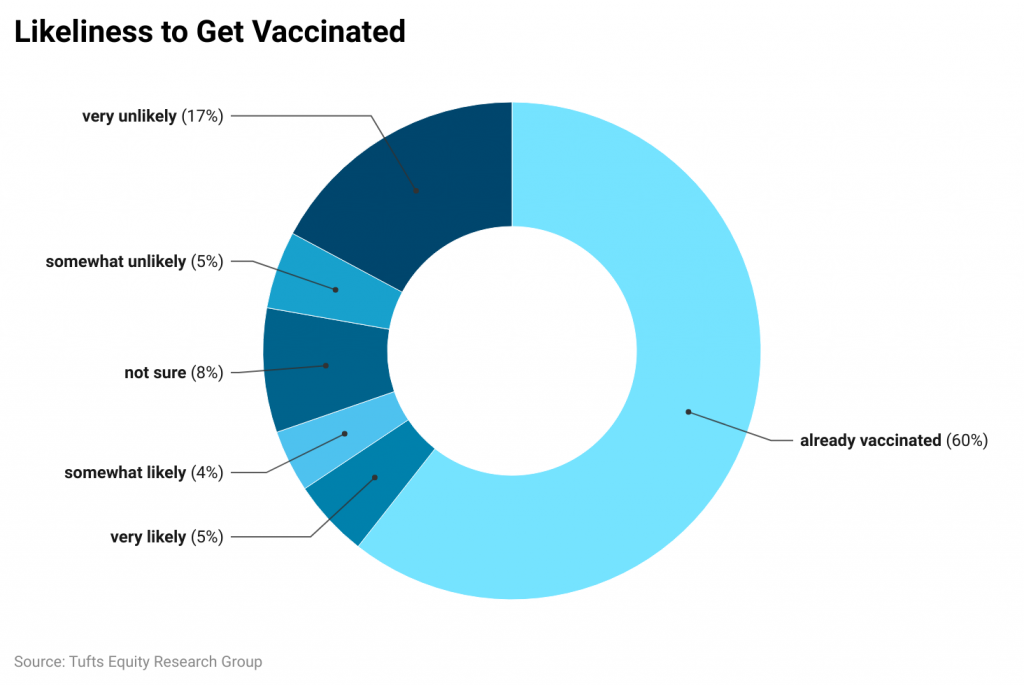
About 17 percent of the U.S. adult population currently say they are “very unlikely” to get a vaccination for COVID-19.

This nationally representative survey by Ipsos, using its KnowledgePanel, for the Tufts the Tufts University Research Group on Equity in Health, Wealth and Civic Engagement was fielded online between April 23 and May 3, 2021 and had 1,449 respondents.

Please read more here.

open positions at Tisch College: senior researcher for student programs, postdoc in Civic Science

Please consider applying and spread the word …

Senior Researcher, Student Programs – Tisch College (More details here)

The Jonathan M. Tisch College of Civic Life prepares students in all fields of study for lifetimes of active citizenship. Tisch College promotes new knowledge in the field and applies this knowledge to evidence-based practice in programs, community partnerships, and advocacy efforts. Central to the university’s mission, the college offers Tufts’ students opportunities to engage in meaningful community building, civic and political experiences, and explore commitments to civic participation.

The Senior Researcher will report to the Director of Programs at Tisch College and be based on the Medford/Somerville Tufts University Campus.  As a member of the Tisch College Student Programs team, the Sr. Researcher will focus on designing and implementing a comprehensive assessment strategy encompassing all Tisch College programs and endeavors. In addition, the Senior Researcher will grow and promote a shared vision for assessing civic engagement across all the Health Sciences campuses.  Tufts has made a commitment to be an anti-racist university, and this is also an important aspect of this role. The Senior Researcher will be committed to ensuring that all assessment and evaluation is conducted with a commitment to equity.        

Specific responsibilities will include: conducing literature reviews and background research; designing and conducting quantitative, qualitative, and mixed methods assessment designs; developing and executing an external publication plan, including collaborations with Tufts faculty and, where appropriate, colleagues across the nation and internationally; collaboration with the advancement team and Tufts faculty to secure grant funding; coding and transcribing data; curating and preparing data sets for various audiences; developing and executing a plan for representing Tisch College Programs with conference presentations; conducting program evaluation for community-engaged, service-learning initiatives across Tufts; providing feedback, assistance, and support to colleagues on research and evaluation related questions; performing administrative duties as needed; and participation in Tisch College and Tufts’ meetings and activities.

Postdoc in Civic Science–Tisch College (read more here)

Deadline: May 20, 2021 at 11:59 PM Eastern Time. Please note that this position was inadvertently shown as closed for a week or more, but it remains open.

Tufts University’s Jonathan M. Tisch College of Civic Life will award a Postdoctoral Fellowship in Civic Science for the 2021-22 academic year (June 1, 2021-May 31, 2022). This postdoctoral fellowship is offered in partnership with the Charles F. Kettering Foundation in Dayton, OH and involves some work at Kettering’s offices in Dayton as well as full-time employment at Tufts in the Boston area.

The Tisch College Civic Science initiative (https://tischcollege.tufts.edu/civic-studies/civic-science), led by Dr. Peter Levine and Dr. Samantha Fried, aims to reframe the relationships among scientists and scientific institutions, institutions of higher education, the state, the media and the public. It also asks about the relationships and distinctions among those institutions, historically and today. With this context in mind, Civic Science seeks to…

  • Reconfigure the national conversation on divisive and complex issues that are both scientific and political in nature, thereby connecting scientific institutions, research, and publications to people’s values, beliefs, and choices.
  • Define and advance the public good in science, thereby finding ways for scientific institutions to better serve communities.
  • Explore the concept of knowledge as a commons (or common-pool resource), developing a line of work pioneered by Elinor Ostrom and her colleagues
  • Develop curricula that simultaneously attend to scientific and civic issues and that teach students to understand and communicate both kinds of narratives together to a variety of audiences.
  • Develop approaches to democratic governance that are attuned to the role of the scientific enterprise in society.
  • Ask what it would mean to earn the trust of communities that have been historically marginalized by the institution of science, and what science would look like if this was a priority.
  • Intervene at institutional and grassroots levels, alongside a robust theoretical analysis.

A PhD is required. Applicants must also demonstrate a strong interest in investigating the intersections of science and civic matters as the focus of their postdoctoral year.

Civic Science is interdisciplinary, and this fellowship is open to specialists in any relevant field.

problem-solving, not worrying, is addictive

The main points I learned from Ezra Klein’s interview with Brown professor Jud Brewer may be very widely known already, but they were new to me. This is what I took away …

Anxiety and worrying can be habitual, even addictive. Most people are probably addicted to these behaviors at least some of the time. The mystery is why we would become addicted to something that brings discomfort, not pleasure. One answer is that we are not directly addicted to worrying. The addictive habit is problem-solving.

You wake up in the morning and realize you want coffee. Without expending much mental energy at all, you identify that need, locate the coffee, water, mug, and machine, make yourself a cup, and enjoy it. You experience an arc from the problem to the solution, which repeats many times every day. It brings satisfaction and is deeply habitual, partly because it is adaptive. Solving problems increases the odds of survival.

But what if you cannot solve the problem that you have identified? Perhaps it is beyond your control–you are powerless–or perhaps you cannot address it now. For instance, you will be able to deal with the problem during the meeting scheduled for next Tuesday at 3, but you can’t do anything about it until then.

In such cases, the addictive desire to address a problem causes your brain to turn it over and over, looking for a new way to solve it now. This is anxious worrying. It is unfortunate because it wastes the most precious scarce resource of all–the very stuff of life–which is time. It also tends to reduce your ability to deal with the problem at hand or other problems that may arise, because it may cost you sleep, confidence, mental sharpness, and other useful assets.

Jud Brewer’s recommendation is to replace the addictive behavior with another one that is equally or more compelling. One option is kindness: do something good for someone else. That seems right, except that there may be no available outlet for kindness when you need it. You can’t wake other people up at three in the morning to be nice to them. It is also challenging to shift one’s attention away from oneself when one is anxious.

A different option is curiosity. We are drawn to curious inquiry for much the same reasons that we are drawn to problem-solving: it is adaptive. Answering a question brings satisfaction. Brewer especially recommends asking curious questions about one’s own bodily state. The nervous system is the locus of the anxiety, and one can investigate it with curiosity. “Where do I feel nervous? How does my breath feel?”

I am certainly no expert in the science of happiness or psychological approaches to well-being. But I keep my eyes open for this kind of research, for two main reasons. First, I am always glad to learn useful tips. Second, I am fascinated by the interplay among three questions: 1) What are practical ways to enhance the quality of life (or to reduce suffering)? 2) What constitutes a good or admirable life? And 3) What are metaphysical and epistemological truths that pertain to those two questions? (For instance, is there a benign and omnipotent creator? Does the self exist?) Some people have argued that these three questions fit naturally together: an admirable person knows the truth and attains happiness as a result of believing and doing the right things. I am much less confident about such harmony.

See also: questions about happiness; why we wish that goodness brought happiness, and why that is not so; unhappiness and injustice are different problems; three truths and a question about happiness; how to think about the self (Buddhist and Kantian perspectives), etc. etc.

The Tufts Equity Research Group

This is a video of me and my colleague Dr. Wenhui Feng discussing the Tufts Equity Research Group. I talk broadly about our research, and Wenhui shares some specific findings about COVID-19 vaccination. We are in the field right now with a new national survey, so please stay tuned for results and check out our interactive website about equity in the USA, which I describe in the video. This presentation was at the Tufts Clinical & Translational Institute (CTSI)’s annual Translational Research Day 2021.

Congratulations to the Recipients of the Civvys Award!

Please join us in praising the winners of the Civvys!

Recently six organizations, were recognized by the American Civic Collaboration Awards during their virtual livestream ceremony.  This year’s ceremony saw a peak number in nominations, reflecting the growing civic efforts happening in the United States.

Congratulations to The Civic Responsibility Project, SA2020, Green Our Planet, Pandemic Voting Project, Issue Voter, DoSomething.org’s Our 2020 Vision campaign for elevating democracy with your impactful civic- oriented work!

Read more below for more details on the winners or navigate to the original post here.


Six Exemplary Projects Named Civvys Winners

The American Civic Collaboration Awards honored six organizations for their impactful work across the country in civic engagement in a livestreamed, virtual ceremony on April 19th.

The six winners represent outstanding examples of civic-oriented work that elevate democracy at every level of American life. The 2020-21 award cycle saw the highest number of nominees, making for a competitive selection process — and demonstrating the growing breadth and depth of civic efforts happening across the nation.

In case you missed it, you can stream the ceremony again at civvys.org. This year’s awards were hosted by F. Willis Johnson, Jr., Vice President of Partnerships and Programming with Bridge Alliance, and feature award announcements by esteemed members of the Civvys Review committee. This year’s program also included a special tribute to Joel Odom, who accepted the Youth award on behalf of Generation Nation last year and sadly lost his life in 2020. Join us in honoring Joel and the work of all Civvys nominees, finalists and winners.

In total,18 finalists were selected from this year’s nominees in three different categories. Read on to meet this year’s 6 Civvys winners, and stream the ceremony if you missed it.

Meet The Civvys Winners

Please join us in congratulating all finalists and honorable mentions!

NATIONAL WINNER – CIVIC RESPONSIBILITY PROJECT

The Civic Responsibility Project brings the broader business community together in collaboration to support voter participation and civic engagement. Research shows that supporting democracy is good for business – and the Civic Responsibility Project helps brands create and implement civic responsibility programs that get their employees and consumers actively engaged in our democracy. Through their work, thousands of companies actively supported voting in the 2020 election, and other industries can take lessons from this coalition, service-based model.

LOCAL WINNER — SA2020

Throughout the year 2020, nearly 12,300 people in San Antonio reaffirmed and strengthened a shared vision originally created by nearly 6,000 people in 2010. Both processes were led by SA2020, the nonprofit organization responsible for driving progress toward San Antonio’s Community Vision through research, storytelling, and practice. This work includes measuring progress on more than 60 community indicators, telling stories that broaden perspectives and reshape narratives about San Antonio, and holding institutions accountable to leading change. SA2020’s work is a model for broad based community visioning and impact.

YOUTH WINNER – GREEN OUR PLANET

From its hub in Las Vegas, Green Our Planet has projects all over the U.S. and is making immediate impact as the largest “school garden” program. In a creative approach, they bring together STEM learning, hydroponics, school yards, and the business world of farmers’ markets, to help young people connect with the Earth, their own skills and knowledge, and civic responsibility in communities. Across 10 states, 3500 teachers, thousands of students – Green Our Planet demonstrates impact, teaching self-reliance and hard work, entrepreneurship and climate science, and healthy living and eating. It’s a holistic, engaging, real approach to getting young kids involved in community and civic life.

COMMITTEE CHOICE AWARD – PANDEMIC VOTING PROJECT

Missouri’s impressive voter turnout in 2020 had the Pandemic Voting Project to thank, organized by the NAACP Missouri State Conference and Show Me Integrity. This truly cross-partisan initiative brought together Republicans and Democrats, the public and private sector, as well as an initiative called DoctorsForDemocracy, that collaborated to help more people in Missouri vote safely. Together, they gave people more ways to vote absentee, supported election authorities, registered and educated voters, and launched new technology at MoVote.org that registered 16,000 voters with a 92% voting rate.

COMMITTEE CHOICE AWARD — MARIA YUAN AND ISSUE VOTER

Issue Voter connects constituents to members of congress and uses technology to make peoples’ voices heard. Given the urgent need for an easy, clear understanding of issues, Issue Voter breaks down complicated policy and ballot measures and helps citizens to be more informed. Maria Yuan was also nominated for her work in streamlining data collection to better track and combat anti-Asian hate crimes. Her work in gathering, organizing and disseminating key data – on ballot issues and hate crimes alike – provides a replicable, scalable model that other civic collaborators might learn from.

COMMITTEE CHOICE AWARD — DOSOMETHING.ORG

The pandemic, the election, and protests for racial justice all changed the way we live in 2020, but young people were especially affected, as school and major milestones were disrupted. DoSomething.org’s Our 2020 Vision campaign mobilized in response to give young people more of a say – with their vote. The “Our 2020 Vision” campaign registered 250,000 voters all online, and 37% of those were rural voters. DoSomething.org’s work focused on gathering broad stakeholders, serving immediate needs and making an impact.

Six civic engagement organizations were recognized Monday night for their work to strengthen democracy in a cross-partisan way.

Keep The Collaboration Going

Ready to help repair America’s divides, one conversation at a time? America Talks is a powerful two-day event that invites Americans to connect one-on-one, face-to-face on video across our political divides. Find dialogue and bridge-building events near you during the National Week of Conversation.

Mark your calendar for America Talks and the National Week of Conversation, kicking off June 12!

Find the original version of this post on the American Civic Collaborations Awards’ site at: www.civvys.org/the-2020-civvys


wildlife commons

As a follower of the late Elinor Ostrom (1933-2012), I am glad to see Michelle Nijhuis‘s article “The Miracle of the Commons” in Aeon. Nijhuis draws on her book, Beloved Beasts: Fighting for Life in an Age of Extinction (2021), which looks important.

I would offer the following very brief summary as an enticement to read more of the article. We can think of beloved megafauna, like wild elephants and lions, as public resources. Their survival is good for human beings in general, yet individual humans can profit from hunting them one by one.

If we apply a simple tragedy-of-the-commons model, then these beasts are doomed unless “something is done.” And that something must be some kind of enforced prohibition on hunting, perhaps connected to state ownership of the land. However, we should be concerned that the state will use its powers badly–that poachers will bribe wardens, or officials will prove incompetent, or authorities will turn a blind eye to development.

Ostrom found, instead, that communities are entirely capable of managing and protecting vulnerable public resources. They need mechanisms for allocating tasks and benefits and making decisions–and the authority to do so.

Nijhuis shows that communities in Namibia have been very successful at preserving endangered species when permitted–and, to some extent, supported–to manage these commons themselves. This is a perfect example of a commons as neither a “tragedy” (doomed to failure), nor a “comedy” (sure to work out well), but a “drama” whose outcome depends on us.

See also many previous posts about Ostrom.

Teacher Conversation: Middle School Students Apply Civic Learning to Curb Community Crime

From our dear friend Mary Ellen Daneels with Illinois Civics:

Civics is all around us. There is a lot to know about the government and how “We the People” interact with the government and each other. Programming at the Lou Frey Institute (LFI)  is designed to help the youngest members of our communities expand their civic literacy. 

LFI has developed in partnership with the Illinois Civics Hub, the Guardians of Democracy Program is an online professional development program with extended learning opportunities for interested 6-12 educators. Dr. Shakeba Shields, an instructional coach at Orange County Public Schools has participated in the pilot program. She recently helped 7th-grade students in a Civics course at a Title 1 school explore the essential question, “Are schools doing enough to curb crime in the community?” This endeavor allowed students to apply their civic knowledge and skills, aligned to Florida’s Civics End of Course Assessment, to help make, “a more perfect union.” 

We asked Dr. Shields to explain a bit more about this experiential learning that encouraged the development of civic and political skills. Here are her responses to the questions we posed.

How did this activity deepen students’ disciplinary content knowledge and/or meet learning targets?

This project helped to deepen students’ understanding of the second amendment. Students were able to evaluate the pros and cons of gun control and consider how schools can help with ensuring students are safe in their communities. 

How did this project deepen students’ knowledge of themselves and their community?

Students completed Harvard University’s Implicit Bias test on weapons and gained some  insight into their own biases regarding who and what poses danger. They were to  carefully classify items as weapons or harmless immediately after seeing a Black or Whiteface. The students were surprised to learn that as with many other respondents,  they too have some hidden views of Blacks having weapons. In our discussion of our topic students drew attention to several issues in the community that contributes to crimes. These include poverty, lack of access, insufficient lighting, deplorable buildings, and family attitudes. 

What comes next? What did students identify as future opportunities to address this issue?

The students created a survey with possible solutions to address the issue such as starting new clubs on campus and increasing security at school and police presence in the community. However, the most glaring response involved bullying. Students believed that school leaders had a major role to play in curbing community crime by focusing on students who are being bullied. This is due to the fact that many off-campus fights occur due to on-campus and online bullying.  Almost 90% of the 129 respondents agreed that the schools needed to pay more attention to this issue and these students. 

Did you receive any feedback from your community on this project?

  • “This shows us that our kids actually have solutions and are able to lead.” Administrator 
  • “What a heavy topic? I’m glad to see that they handled it so well.” Teacher
  • “I like coming up with these ideas. It makes me feel important.” Student

What advice would you give teachers thinking about opportunities for engaging their students in applying knowledge and skills to better their community?

My advice to other teachers would be to start small and include the students in EVERY step of the process. You will be surprised how interested they are in being a part of these types of projects. 

Thank you to Dr. Shields for taking the time to talk with us! You can learn more about the free Guardians of Democracy professional development program here!

the case for (and against) nonviolence

During a whole semester reading and debating Martin Luther King Jr, I think my students and I built a richer understanding of nonviolence as a political tradition and alternative. Several students noted that they had moved from thinking of nonviolence as a restriction or limitation (i.e., you must exclude violent means) to a powerful approach of its own.

The Case for Nonviolence

  1. It tends to work. Erica Chenoweth and Maria J. Stephan find that nonviolence has a higher rate of success than violent methods, at least in their sample of large movements aimed at major political change. (See Why Civil Resistance Works.)

One reason is that nonviolence actually draws larger and more diverse participants, and big and diverse movements are more likely to win. It is true that some people feel a need to employ violent means, but they tend to be tilted toward young men. Nonviolence broadens the base of a movement. I also think that nonviolent movements are more favorable to intense internal debate and discussion, and that is useful for success. (See the value of diversity and discussion within social movements.)

It is worth noting, however, that the success-rate of nonviolent social movements has fallen during the 2000s. I interpret both nonviolence and state repression as general approaches that evolve over time as their practitioners innovate and learn. I think that nonviolent strategies improved dramatically from 1955-1989 while autocrats stagnated, but the autocrats are learning fast. (See why autocrats are winning (right now).)

  1. It improves the odds that the resulting system will be democratic.

This is another empirical finding from Chenoweth and Stephan. One reason is that nonviolence allows a negotiated settlement and the peaceful exit of the incumbents. Autocrats have reason to fear violent movements and may respond by fighting almost to the death. They are more likely to settle with a movement that demonstrates nonviolence.

Relatedly, nonviolence prevents a cycle of escalating violence that makes democracy harder to attain. And it compels a movement to use relatively democratic methods for making decisions internally, because the leaders cannot violently compel their own people. That prepares the movement to govern democratically if it wins. And it gives the participants the specific skills and values that will be most useful to them in democratic governance.

  1. It is a variety of self-limitation, and self-limitation is valuable

Movements face twin risks: heating up too much (until they cannot sustain the intensity), or else dwindling away. It’s important to keep the intensity within bounds. One way to do that is to establish explicit or implicit norms of behavior. Nonviolence is not the only norm that works to regulate intensity. In the Intifada, the rule was to use rocks, not guns or bombs. From a pragmatic perspective, that worked–the effort persisted for two years. However, nonviolence has the advantage of being an intuitive, bright line that people understand, even under duress.

  1. It brings a particular kind of dignity, self-respect or efficacy to the participants

Martin Luther King Jr. described his goal as “seeking to instill in my people a sense of dignity and self-respect.” He recalls that African American Montgomerians “who had previously trembled before the law were now proud to be arrested for the cause of freedom. … They looked the solicitor and the judge in the eye with a courage and dignity for which there was no answer.”

It is possible that nonviolence is especially likely to enhance self-respect, because nonviolent movements are self-reliant. They don’t depend on guns, which are impersonal tools (and are often supplied by outsiders of some kind). The accomplishments of a nonviolent movement are theirs alone.

  1. It is compatible with uncertainty about one’s goals and strategies.

Gandhi emphasizes this point. If you do not know (for sure) what your ultimate objective should be, and you are not certain about the best path forward, you should prefer nonviolence. Violence is irrevocable and closes options. (see Gandhi on the primacy of means over ends.) As King says, nonviolence permits learning, including learning from the other side: “Here is the true meaning and value of compassion and nonviolence, when it helps us to see the enemy’s point of view, to hear his questions, to know his assessment of ourselves.”

I recently found a very nice statement of a similar idea at the very end of The Combahee River Collective Statement (1977) which is a seminal text for today’s social movements:

In the practice of our politics we do not believe that the end always justifies the means. Many reactionary and destructive acts have been done in the name of achieving “correct” political goals. As feminists we do not want to mess over people in the name of politics. We believe in collective process and a nonhierarchical distribution of power within our own group and in our vision of a revolutionary society. We are committed to a continual examination of our politics as they develop through criticism and self-criticism as an essential aspect of our practice.

  1. It might be particularly relevant to a dispersed minority group that confronts a basically stable regime.

King depicted violence as futile in a situation like the USA in his time:

When one tries to pin down advocates of violence as to what acts would be effective, the answers are blatantly illogical. Sometimes they talk of overthrowing racist state and local governments. They fail to see that no internal revolution has ever succeeded in overthrowing a government by violence unless the government had already lost the allegiance and effective control of its armed forces. Anyone in his right mind knows that this will not happen in the United States. In a violent racial situation, the power structure has the local police, the state troopers, the national guard and finally the army to call on, all of which are predominantly white.

King thought that nonviolence looked promising in comparison.

  1. It is compatible with ethical scruples, including the principle that you should not kill.

Maybe sometimes we do have to kill. I don’t see how Auschwitz could have been closed without killing the German soldiers posted to the beaches of Normandy (and many, many more). However, if nonviolence has at least as good a chance of succeeding as violence does, then surely, it is better not to kill.

II. The Case Against?

  1. It doesn’t work all the time.

(Would it have ended slavery or defeated Nazism?)

2. It does not satisfy all kinds of people

Maybe more people will participate in a nonviolent social movement than an armed insurrection, but what about the people who feel compelled to arms? Don’t they need some kind of outlet?

3. It demands sacrifice–up to and including death–from the people who should be least obliged to sacrifice, those who are oppressed.

(Then again, a violent campaign is also bound to cause casualties, including completely innocent ones. And to leave the status quo unchallenged is to tolerate ongoing violence and oppression.) See: the kind of sacrifice required in nonviolence and the question of sacrifice in politics.)

4. It might rely on certain external factors, such as media and partisan competition.

Both Gandhi and King were able to play to audiences of voters who had reasonably free access to media and choices at the ballot box. Even though most African Americans and all Indians were disenfranchised, white British and US voters had the power to make change. That means that success is somewhat contingent on factors that cannot always be counted on. Contrary to I.4, above, nonviolence is not always self-reliant.

5. It requires a mildness or compassion toward opponents that they may not deserve.

(Then again, I am not sure that defeating an opponent by using effective non-violent means is all that kind.)