Engaging College Students in Civic Life

When I spent two weeks back home in the Boston area, I did more than just catch the Sox at Fenway and get inked (ahem). I spent that two weeks discussing civic work, civic life, and civic education with like minded folks from across the globe. As part of that discussion, we talked about ways in which we can create a sense of engagement among citizens, how community is formed and works, the role of the commons in civic life, and how we as educators and passionate citizens engage in the practice of civic work (among many many other things). Very recently, it has come to my attention that my colleague at the Bob Graham Center, Dr. Emma K. Humphries, is collaborating with Dr. Melissa Johnson, Associate Director of UF’s Honors Programs in implementing a brand new course that works with college students to:

• Familiarize themselves with the new city in which they live;
• Be a champion for the common good;
• Realize the power of individual and group action;
• Tackle real community problems by looking for creative solutions, using available resources, collaborating with others, and taking risks; and
• Reflect upon and evaluate methods for civic activism.

This is, I think, an exciting opportunity to engage new college students in the civic life of their new communities. To paraphrase their course syllabus, isn’t it better to get involved with your community, to engage in civic life, than to sit around and watch Netflix all summer? (The answer is Yes. Please say the answer is Yes.) I encourage you to take a look at the course syllabus below, and I know that Emma would love to hear from you if you have questions or comments about the course. I have asked her to do a reflective post for us at the end of the summer about the course and how it went, and the role that civics can play in the lives of college students. Wouldn’t it be fantastic if we could do something like this long term at the K-12 level? Imagine a course like this that scaffolds with students from Kindergarten through High School!

Syllabus for a course that could change the civic life of a college student

Syllabus for a course that could change the civic life of a college student

syllabus 2


Power Creates Power

I recently finished John Gaventa’s Power and Powerlessness: Quiescence and Rebellion in an Appalachian Valley.

The book is an in depth case study of one coal mining community. Gaventa documents how people had their land taken out from under them over 100 years ago by a huge, multinational company. He details the development of power structures separating the working poor, the local elite, and the absentee Company.

He illustrates how the very institutions intended to protect and support “the people” were turned against them: how Company power over workers’ jobs, home, and welfare led to power over their private ballots. How the union became so corrupted its leaders turned to murder rather than suffer a challenger who was slightly more populist. How those in power took both significant and subtle actions to maintain power, while those without power learned better than to even think of questioning authority.

Gaventa, who for years led the Highlander Center, sums up his study eloquently in his conclusion:

Continual defeat gives rise not only to the conscious deferral of action but also to a sense of defeat, or a sense of powerlessness, that may affect the consciousness of potential challengers about grievances, strategies or possibilities for change. Participation denied over time may lead to acceptance of the role of non-participation, as well as to a failure to develop the political resources – skills, organization, consciousness – of political action. Power relationships may develop routines of non-challenge which require no particular action on the part of powerholders to be maintained…

From this perspective, the total impact of a power relationship is more than the sum of its parts. Power serves to create power. Powerlessness serves to re-enforce powerlessness. Power relationships, once established, are self-sustaining. Quiescence [inaction] in the face of inequalities may be understood only in terms of the inertia of the situation. For this reason, power in a given community can never be understood simply by observation at a given point in time. Historical investigation must occur to discover whether routines of non-conflict have been shaped, and, if so, how they are maintained.

This last point is particularly critical – too often we forget that the “impact of a power relationship is more than the sum of its parts.” We forget that these relationships are self-sustaining, with power creating power and powerlessness creating powerlessness.

The result is that we all find ourselves caught in a power structure not of our own making. We may consciously or unconsciously act in ways which reinforce or resist that structure. We may or may not even recognize a power structure is there.

Paulo Freire recognized this, too, arguing in Pedagogy of the Oppressed:

As the oppressed, fighting to be human, take away the oppressors’ power to dominate and suppress, they restore to the oppressors the humanity they had lost in the exercise of oppression.

It is only the oppressed who, by freeing themselves, can free their oppressors. The latter, as an oppressive class, can free neither others nor themselves.

That is to say, we are all caught in this power structure, but it is only the oppressed who can save us.

facebooktwittergoogle_plusredditlinkedintumblrmail

Who Owns Democracy? The Great Debate

Over the coming long months of public focus on elections, we need to talk about who owns democracy and what it means. College and university campuses, as well as other sites, have potential to be venues.

Both Republican and Democratic presidential candidates are talking about democracy. Jeb Bush recently questioned his brother's efforts to promote democracy in the Middle East and elsewhere. Democracy promotion, he argued, "has to be tempered with the realization that not every country is immediately going to become a little 'd' democratic country." Rand Paul's skepticism runs deeper. In 2013 he told the Coalition of African American Pastors Leadership Conference that "We should never be for democracy," because it means majority will expressed through elections. "Jim Crow came out of democracy."

In contrast, Democratic candidates express enthusiasm for democracy as they understand it. On June 4, Hillary Clinton outlined her plan to revitalize democracy through protection and expansion of voting rights, new standards for early voting, automatic voter registration, and a constitutional amendment "to undo the Supreme Court's damage in Citizens United." Bernie Sanders, in his announcement speech, raised the question of ownership. "Enough is enough," he declared. "This great nation and its government belong to all the people and not to a handful of billionaires."

For all the differences, Republicans and Democrats define democracy in similar ways. "We know what democracy is supposed to be about," said Sanders. "It is one person, one vote, with every citizen having an equal say." Put differently, both sides see democracy as a trip to the ballot box in which citizens elect people to act on our behalf, with little or no attention to the everyday civic work of citizens between elections.

America was born with a different meaning. Unlike monarchies emerging from the dim mists of the past, or aristocracies ruled by landed nobility, or communist governments which claimed the label of "people's republics" guided by vanguards, in the United States the people were the agents and authors.

The revolutionary generation of the 1770s, drawing on decades of experiences in which settlers built towns and local governments, constituted themselves as the new political body. As the political theorist Sheldon Wolin argued in his great essay, "The State of the Union," in the New York Review of Books, reflecting on President Carter's address in 1978, the Declaration of Independence "set out a conception of collectivity that... attempted to ground public authority in the specific capacity of the people to constitute their own political identity." A decade later the Constitution "not only preserved the democratic conception of collectivity... but even conceded the most crucial element in it, the idea of a people who could act politically. The language of Preamble was unequivocal on that score [with] active verbs such as 'form,' 'establish,' insure,' 'provide,' and above all, 'ordain.'" These demonstrated "a conception of the 'people' as an entity which could develop and express its collective will."

Elite interests set to work immediately to undermine founding democratic definitions. One strategy was the Constitution itself, which followed the Preamble, full of mechanisms to dilute the voice of citizens. Another was the sustained and continuing effort to displace the authority and identity of the people with the authority and authorship of elites. This required redefining "people" as "electorate." In democracy-as-elections, citizens' work to build a democratic way of life disappears from view.

Yet elite definitions were fiercely contested in practice as well as theory. America continued to be the setting of robust self-organizing activities, from voluntary associations, common schools, and colleges to the abolition movement, slave rebellions, and struggles of labor and women which challenged exclusions from "we the people." Indeed Abraham Lincoln's formulation of "government of people, by the people, and for the people" was not only the crystallization of decades of self-organizing citizen labors, but also a challenge to definitions of democracy in which ownership was vested in the political class. For Lincoln, government was not simply based on popular consent. It grew from the people's civic agency.

The civil rights movement of the 1950s and 1960s and all the energies which grew from it revitalized for a time an understanding of democracy as a way of life. This was the participatory democracy which I learned from grassroots organizers like Ella Baker, Septima Clark, and Dorothy Cotton. Martin Luther King voiced this view in "Letter from a Birmingham Jail," proposing that the movement was "bringing the country back to the great wells of democracy" created at the nation's founding.

Yet efforts to narrow democracy's meaning also reached a new level in President Jimmy Carter's state of the union address in 1978. Carter declared that to remedy the distance which had grown between people and government, "we must have what Abraham Lincoln sought -- a Government for the people." As Wolin observed, "in... appealing to the memory of the folk hero (Lincoln)... the president effected a distortion... that was as revealing as it was radical." Carter dropped government "of" and government "by." What was left was "for," government providing benefits and solutions, a bureaucratic conception of government in which the president is manager-in-chief and citizens are needy clients.

We saw further sidelining of citizens when we worked with President Clinton's Domestic Policy Council from 1993 to 1995 in the Reinventing Citizenship initiative. Our coalition of colleges and universities, civic groups, and foundations developed strategies for overcoming the citizen-government guide. We used the phrase "reinventing citizenship" to argue that government cannot reform itself -- "reinvent government" -- without a rebirth of a civic ethos and identity within government and the larger society.

We lost the battle. Citizen were redefined as customers across all federal agencies.

Vice President Gore asked me to speak to his annual Family Re-Union Conference on the eve of his president bid in 1999, I asked several colleagues with long experience in Washington what I might say. The best counsel came from David Mathews, Secretary of the Department of Health and Human Services in the Ford administration and now president of the Kettering Foundation.

"Tell them we are not customers of government," Mathews said. "We own the store."

This is a point of view worth recalling in 2015 and 2016.

Harry Boyte, coordinator of the Reinventing Citizenship initiative with the White House Domestic Policy Council from 1993 to 1995, is also editor of the collection Democracy's Education: Public Work, Citizenship, and the Future of Colleges and Universities (Vanderbilt University Press 2015)

TeachingAmericanHistory.org Webinar on 14th and 15th Amendments

We do not often share information about a PD opportunity that would cost you money, but I thought that perhaps this might be of interest and use, especially since it can be connected to Florida’s civics and history benchmarks in multiple grades. TeachingAmericanHistory.org, one of my own favorite sites for resources, is hosting a series of webinars on the 13th, 14th, and 15th Amendments. The 13th Amendment one was done recently, but the 14th and 15th Amendments webinars are later this month. From our friends at TeachingAmericanHistory.org:

TAH.org and NCSS have partnered to provide a series of three webinars concerning the 13th, 14th, and 15th Amendments and the change in the Constitution that they represented and did not represent. We will seek to understand these amendments within the Constitution’s basic structure to see how they fix problems endemic to the Constitution, while also understanding these amendments in their immediate context as vehicles to bring peace and protection for freedmen at the end of the Civil War. We will look at the layers of context and the immediate effects of these amendments-and also why they failed to secure their goals in the years immediately following the Civil War.

Even though you may have missed the first webinar this past Tuesday there’s still time to register for the remaining two installments now.

  • Tuesday, July 14: Completing the Constitution with the 14th Amendment
    This webinar focuses on how states would be re-integrated into the Union in the immediate aftermath of the Civil War and the powers Congress assumed in that extraordinary time. The 13th Amendment abolished slavery in all states of the Union, holding states to consistent standards for free labor and giving enforcement of this provision to the national Congress. Yet problems arose about the unequal treatment of freedmen after the war ended, giving rise to the need for a more radical limit on state power if the Union’s goals in the Civil War were to be accomplished.
  • Tuesday, July 21: The 15th Amendment and the Failure of Reconstruction
    Reconstruction presents a dual-edged dilemma, as Republicans tried to re-integrate the Southerners back into the Union while providing protection for freedmen. The easier the terms of re-integration for the Southerners, the more difficult it would be to secure rights for the freedmen. The formula Republicans hit upon was to secure freedmen through the vote, so that they could, in effect, protect themselves. This strategy, adopted by the Grant Administration, required a huge effort on behalf of the Union army and law enforcement and was ultimately abandoned as requiring too much of an abridgment on Southern self-government.
 
Time: 6:30 pm – 8:00 pm ET / 3:30 pm – 5:00 pm PT
Presenter: Scott Yenor, Associate Professor and Department Chair of Political Science, Boise State University, Idaho; partner faculty member, Ashbrook Center for Public Affairs, Ashland University, Ohio.

Please keep in mind that THIS DOES COST MONEY! NCSS members can attend the webinar for sixty dollars, while non-members may attend for 150 dollars. If you have any questions, please contact Jeremy Gypton, Teacher Programs Manager, at jgypton@tah.org


New FJCC Resource for Florida Elementary Civics!

Friends in civics, I mentioned previously that I had spent a week in Miami last month, prior to my two weeks in Boston, working with our Val McVey and teachers and staff from Miami Dade schools. This work involved creating curricular materials for third through fifth grade that are aligned with the grade level Civics and Florida Standards for ELA. While we already have entire extended lessons for these, the new materials are actually intended to be 15 to 20 minute mini-lessons that we believe effectively get to the civics benchmarks without requiring a significant investment of time. Elementary social studies is the curricular equivalent of the Ottoman Empire in 1914: it exists,  everybody likes to pretend it matters, but no one wants anything to really do with it until they absolutely have to. I’ve discussed this briefly before

We know that both nationally and in Florida, social studies education is often lacking at the elementary level. This is NOT a new thing; generally speaking, social studies has been on the decline for decades, especially at the elementary level. The reasons for this are many and varied, but one can assume, rightly I think, that a decline in general social studies instruction could also result in a decline in civics instruction in the elementary grades.

The most pressing problem for elementary teachers is, most often, time. In our observations, and in the research, we just don’t see hard-pressed elementary teachers finding the time to do extensive work with social studies in general and civics in particular. To address this, we teamed with folks from Miami, with the support of their fantastic Social Studies director, Bob Brazofsky. The result of this partnership is our new collection of mini-lessons for elementary teachers, which we have termed

Civics in a Snap! For when you have just enough time to help your kids learn about being good citizens!

Civics in a Snap! For when you have just enough time to help your kids learn about being good citizens!

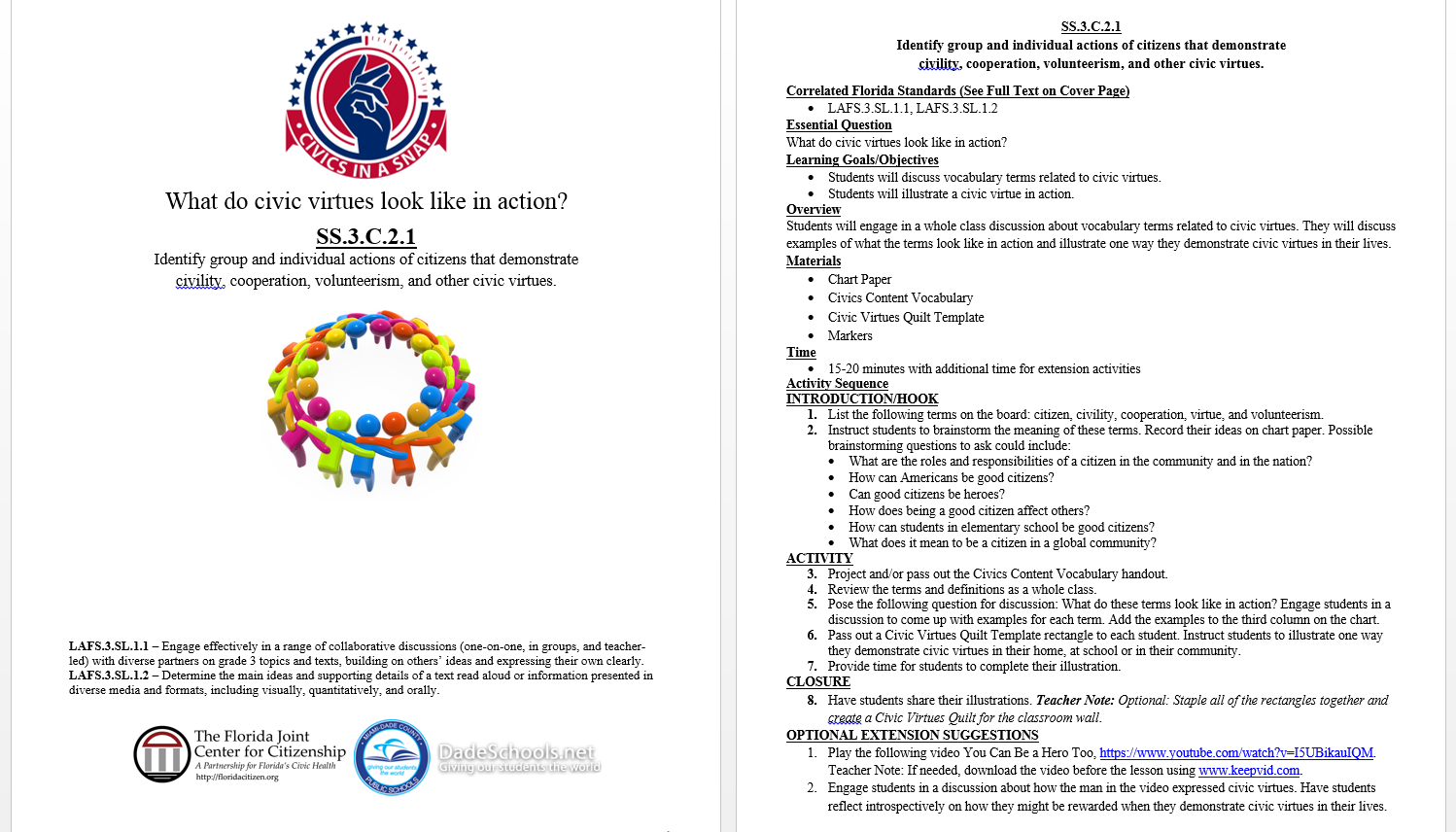
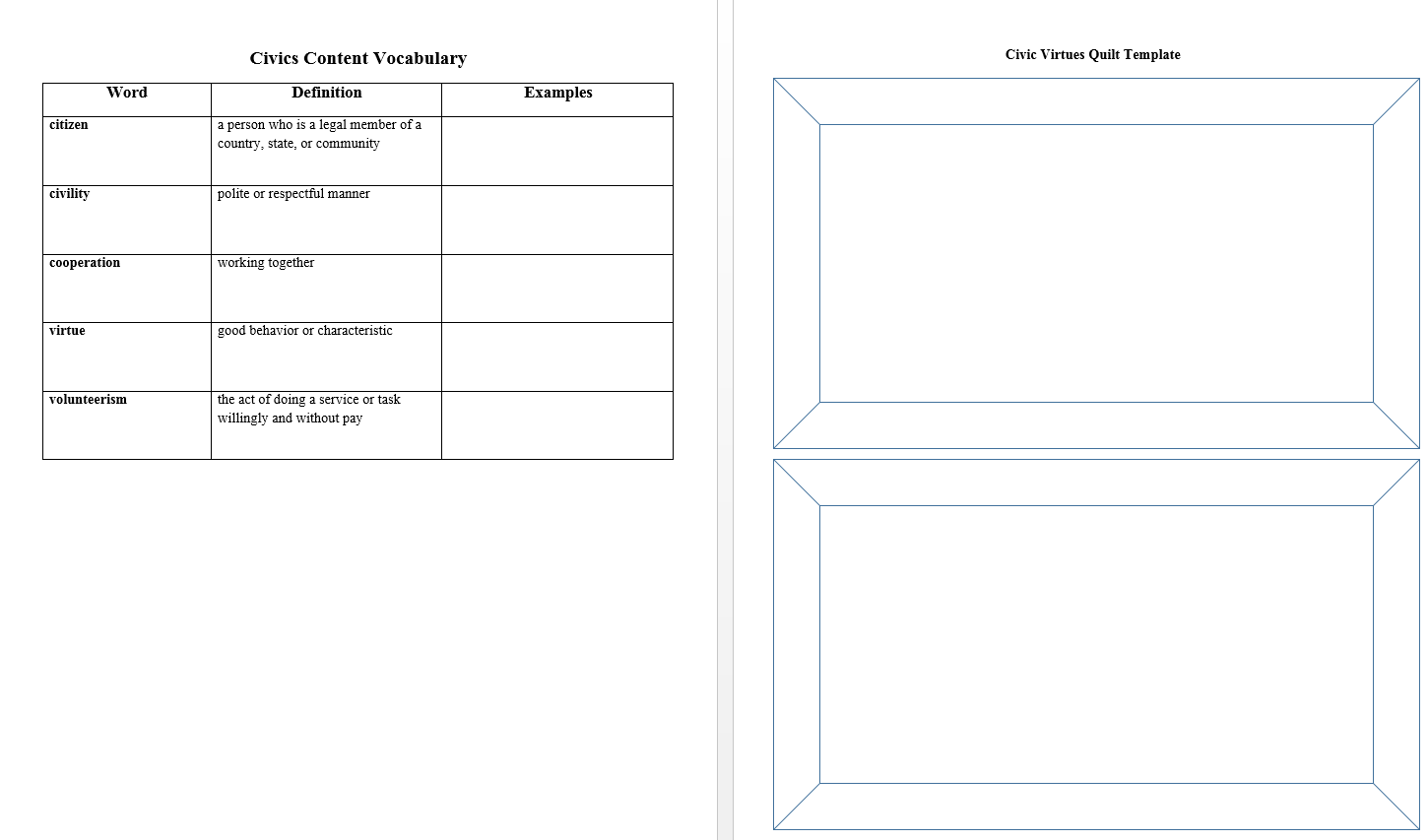
These mini-lessons will be shared with you once we get our new website up and running this fall. Miami-Dade is in the process of integrating them into their planning guides, and we will be hosting them on a new section of our website devoted to elementary civics. For now, I am sharing with you a sample of that work, in this case, the Civics in a Snap lesson for SS.3.C.2.1:Identify group and individual actions of citizens that demonstrate
civility, cooperation, volunteerism, and other civic virtues. Click on the images to embiggen them (embiggen is, of course, a perfectly cromulent word)!

3.c.2.1

3.c.2.1 addition

If you have questions about these new resources, feel free to shoot me an email! We are so excited about what we hope will be a useful, and used, civics resource for elementary teachers!


La Japonaise

Boston’s Museum of Fine Arts has recently come under fire for inviting patrons to “Channel your inner Camille Monet and try on a replica of the kimono she’s wearing in La Japonaise.”

It’s worth taking a moment to look at the image they used to promote the opportunity: A white American woman pretending to be a white French woman pretending to be Japanese. There’s a lot going on there.

After several complaints from Boston’s Asian American community, the MFA has decided to remove the dress up portion of the activity, instead inviting guests to “touch and engage with” the kimonos, but “not to try on.”

I’ve seen this story pop up on my newsfeed the last few days, but it really caught my attention with the morning news announced the change from the MFA.

The (white) news anchors said that the MFA received “a small number of complaints” from a “handful of activists.” They added that the MFA initially responded that it would continue with the demonstrations, but eventually shifted their position after the complaints “went viral.”

The news anchors expressed general confusion as to why anyone was offended by the exhibit, and appeared disheartened that the MFA had changed it’s policy in response what they saw as a small number of protestors. They called it a case of “political correctness going to far.”

That got my attention.

Now. I do appreciate a general concern about the dangers of political correctness. The last thing that serves a productive conversation about race is an atmosphere in which people feel shut down from expressing themselves – where they’d rather say nothing than run the risk of saying the wrong thing. This is the approach that led to the fallacy of a “color blind” society – as if denying our problems would make them go away.

But “political correctness gone to far” is also a conveniently safe out for people who don’t see – or don’t want to see – a problem.

Frankly, when you have a group of Asian Americans saying they find an exhibit of Kimono dress-up offensive, I think you have to stop and try to understand why they feel that way. It doesn’t matter whether you don’t find it offensive – it’s about not thoughtlessly discrediting someone with a different view from you.

Blogger Evan Smith has a great post explaining why the “be Camille Monet” activity is problematic:

The painting in question, a work from 1876, is a singular example of Orientalism, a tradition in Western art that broadly caricatures regions as disparate as North Africa and East Asia with the aim of cultivating a Romantic visual language around Western cultural imperialism. Japonisme, the particular subset of Orientalism that Monet’s canvas depicts, is a loose interpretation of Japanese culture by French aesthetes marked by ornamentation, hyper-femininity and a sense of escapism bordering on pure fantasy. In La Japonaise the artificiality of the genre is underscored by the blonde wig Camille donned when posing for the painting in order to emphasize her whiteness, contrasting her body to the Otherness of her garments and surroundings.

That’s not to say we need to dismiss the artwork all together, but neither should we celebrate the Orientalism it embodies.

The painting took place less than 30 years after Commodore Perry’s “opening of Japan.” It was a time when Europeans were fascinated by the “topsy turvey” world of Japanese culture – seen as both civilized and barbaric.

In fairness, the Japanese were equally intrigued by European culture – seen as both civilized and barbaric. And there is some great Japanese art that depicts the ape-ishness of Europeans, just as European art captured the beauty and brutality they saw in Japan.

Orientalism was an important movement in European culture, and it seems reasonable that Western society should study it, seek to understand it, and possibly even celebrate the art that came out of it.

But we shouldn’t seek to recreate it.

We should seek to appreciate and understand other cultures, not seek to appropriate them. We shouldn’t celebrate their seeming exoticism, but seek to truly understand them.

facebooktwittergoogle_plusredditlinkedintumblrmail

Should Civic Work Be ‘Fun’? I Don’t Know

Well, it has been a while! I apologize for the long time between posts. I spent a week in Miami working with that district and our own Val McVey on an exciting elementary project that is near completion, and then spent two weeks in Massachusetts attending the Institute for Civics Studies and the ending Frontiers of Democracy conference. It was a fantastic time; I got to be back home and spending two weeks talking civics with some very smart and engaging people. Plus, you know, the Red Sox.

One of those smart and engaging people I met is Sarah Shugars. She works with the Tisch College of Citizenship and Public Service at Tufts, and does some excellent advocacy and research concerning civic life. During the Frontiers of Democracy Conference, Sarah led a session about how we engage in civic work. My own group during that session had a somewhat heated discussion about whether civic work should be ‘fun’. 

What do we mean by civic work? Put simply, ‘civic work’ is essentially the engagement of the individual (not necessarily the citizen! one need not be a citizen to engage in civic work) in the civic life of a community. This work ranges from simply having a conversation with a neighbor or colleague about an issue of relevance to voting to active protest and beyond. Our definition of civic work must necessarily be expansive; our venues of civic work are expansive, and some are more open to certain types of civic work than others.

The debate in my group during this session was not necessarily connected to what we meant by ‘civic work’. Instead, the debate really began when one of the folks in the group suggested that the best way to encourage engagement was to make sure that such engagement could be seen as ‘fun’.  The problem, I think, centers around the language that we use to define ourselves and our work. When I hear the term ‘fun’, I think of giggles and play, rather than work for change. As one of the folks in the group suggested, there was probably nothing ‘fun’ about the Edmund Pettus Bridge. If we have to make everything ‘fun’ in order to engage our fellow citizens in civic life and civic work, doesn’t that raise questions about the feasibility of long term engagement? As Sarah suggests

There can be a paternalistic danger in this approach, too – a tendency to say, “we’d better make civic work fun because that’s the only way we can get the people to do what is best for them.”

I hesitate to say this, but I do think that sometimes that is actually the attitude of some folks that work in civic education and civic life. I know that as a classroom teacher, ‘I have to make this fun so that my kids come away with what I want them to and they want to engage in this learning’ was always at the back of my mind when crafting units. And, friends, as you well know, that sort of thing gets exhausting. You cannot simply make everything ‘fun’, and if it requires ‘fun’ in order for folks to engage in something that should be valuable to their lives and future, not to mention the common good, well, have we really made a difference? Will the outcome of that work last? I have my doubts.

So what then do we mean by ‘fun’? Do we mean public spiritedness, rather than fun, as some suggested during that session? Is it a matter of more clearly defining what we mean by ‘fun’? The language that we use in the work that we do is important. I struggle with that word ‘fun’. Perhaps ‘enjoyable’ or ‘gratifying’ might be more appropriate terms, if ‘public spiritedness’ is too dry a term in this case? I don’t know. I don’t have an answer for this, honestly.

I do believe that civic work should be gratifying. When you engage in a cause that you believe in, no matter where you fall on the partisan divide, I believe that to be a gratifying experience. I don’t know whether it should always be ‘fun’ (though there may be times!).

I don’t know. Maybe I will ask my 7 year old daughter. She loves both civics AND fun.