The Hardest Problems are the Easiest to Ignore

I was somewhat surprised this morning – though perhaps I should not have been – to find coverage of terrorist attacks in Brussels to be the sole focus of the morning news.

I wasn’t surprised by the news of an attack somewhere in the world – a grim reality we’ve all grown sadly accustomed to – but I was surprised at the intensity of coverage. Broadcast morning news coverage isn’t, you see, my typical source for international news.

Suddenly it was all they could talk about.

Where was this attention when a suicide bomber attacked a busy street in Istanbul over the weekend? Or when three dozen people died in the Turkish capital of Ankara last week?

Even from a wholly self-interested perspective, recent attacks in Turkey seem noteworthy as the EU increasingly relies on Turkey to address the Syrian refugee crisis.

But even as I wondered why Belgium elicited so much more concern than Turkey, I felt the sinking sense of an answer.

Where, indeed, was the coverage of attacks in Beirut just days before the now more infamous attacks in Paris?

On it’s surface, this bias in coverage and compassion seems to most obviously be one of culture, or cultural perspective, for lack of a better word. Perhaps people in France and Belgium are perceived to be “more like us” than people in Lebanon or Turkey. The disparity is essentially racism with an international flavor.

Another theory would be one of newsworthiness – Turkey, Lebanon, and many places in the Middle East regularly suffer from terrorist attacks. In a cold sense of the word, such an attack is not news – it is expected.

Such an explanation, though, has the ring of a hollow excuse. The sort of defense you come up with when accused of something unseemly. And the two ideas – that we show greater concern for those in Western Europe because they are “more like us” and that we are more interested in unexpected events – are not entirely unrelated.

In the States, people of color die every day in our cities. And most often, their deaths go unreported and unremarked on by society at large. A murder in a white suburb, though, is sure to grab headlines.

Neighbors grapple to make sense of the shocking news. Things like this don’t happen here. This is a safe community.

It’s not that suburbs are intrinsically more safe, I would argue, but rather that we as a society, would never allow violence in suburbs to rise to the levels it has within the inner-city. Suburbs are already where our wealthy residents live, but in addition to that privilege, we collectively treat them with more time, attention, and care.

Violence in suburbs and attacks in western cities are shocking reminders that we’ve been ignoring the wounds of this world. That we’ve pushed aside our our responsibility to confront seemingly intractable challenges, closing our eyes and hoping those ills only affect those who are different.

All this reminds me of Nina Eliasoph’s thoughtful book, Avoiding Politics: How Americans produce apathy in everyday life.

Working with various civic groups, Eliasoph notes how volunteers eagerly tackle seeming simple problems while avoiding the confrontation that comes from the most complex issues. In one passage, Eliasoph describes the meeting of a parents group in which one of the attendees was “Charles, the local NAACP representative” and “parent of a high schooler himself.”

He said that some parents had called him about a teacher who said “racially disparaging things” to a student…Charles said that the school had hired this teacher even though he had a written record in his file of having made similar remarks at another school. Charles also said there were often Nazi skinheads standing outside the school yard recruiting at lunchtime.

The group of (mostly white) parents quickly shut Charles down. Responding, “And what do you want of this group. Do you want us to do something.” Eliasoph notes this was not “as a question, but with a dropping tone at the end.”

Afterwards, Eliasoph quotes the meeting minutes:

Charles Jones relayed an incident for information. He is investigating on behalf of some parents who requested help from the NAACP.

The same minutes contained “half of a single-spaced page” dedicated to “an extensive discussion on bingo operations.”

Eliasoph’s other interactions with the group indicates that they aren’t intentionally racist – rather, they are well-meaning citizens to whom the deep challenge of race relations seems too much to handle; they would rather make progress on bingo.

And this is where the cruelest twist of power and privilege come in: it is easy to ignore these hard problems, to brush them off as unavoidable tragedies, to simply shake your head and sigh – all of this is easy, as long as it’s not happening to you.

facebooktwittergoogle_plusredditlinkedintumblrmail

do we actually want higher youth voter turnout?

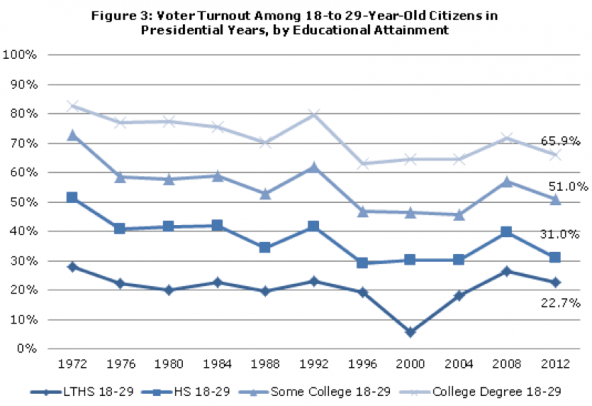
Abby Kiesa and I have a new piece in the Stanford Social Innovation Review (online), entitled “Do We Actually Want Higher Youth Voter Turnout?” We dispute the premise that youth turnout has declined–or risen. Instead, we note the “the relentless replication of political inequality by class,” as illustrated (for instance) by this graph:

We observe that the traditional solution to political inequality has deteriorated. “The civil society built in the 20th century tended to recruit young members for non-political reasons and then make them political. Large institutions—such as unions, churches, Urban League, and Elks—had the means and motivations to recruit widely, and they had incentives to interest at least some of their young members in politics. Belonging to these groups (or subscribing to a newspaper) was correlated with voting. But … all these organizations have lost youth members since the 1970s.”

We argue that no single reform or strategy will work in the 21st century, but that sustained investment by major organizations would pay dividends.

Some Twitter replies to the article have said that we overlook new platforms and modes of engagement that have arisen in this century. This is what we said, though:

To be sure, there are now alternatives to these organizations that serve to empower at least some young people. No one could join a social media campaign in 1974, for example. Still, the new array of civic networks and groups have not yet shown that they are capable of boosting youth voter turnout significantly or reducing gaps by social class.

Democracy and Civic Studies

In our "Bridging Differences" blog discussion on Education Week, Deborah Meier and I have been discussing the meaning of democracy. We both agree that such discussion is important today, when democracy's meaning has been dramatically reduced - and we both agree that democracy is vastly more than elections!

We also have agreement that democracy involves tradeoffs and compromises, and agree on principles such as rough equality in power and knowledge. I like the comment of William Hastie, the first black federal judge, that democracy is a journey, not a destination.

We also have some differences worth exploring.

For one thing, Meier stresses self-governance as the heart of democracy, and, related, highlights the idea of leisure time ("the trouble with socialism is that it takes too many evenings," quipped Oscar Wilde, who meant it resolves around meetings. People say the same about democracy). In contrast, I find compelling the argument of Victor Hanson in The Other Greeks. Hanson argues against the dominant scholarship which assumes that Athenian public life represented the democratization of aristocratic leisure. Such a view is associated with the ideal of "civic virtue," which holds that citizens should put aside their interests to pursue a common good.

Hanson marshals a good deal of evidence to suggest that in fact Athenian democracy grew out of the breakup of the large landed estates and the rise of small farms. The gritty, everyday challenges and disciplines of such farming necessitated cooperative labors on common projects. It wasn't a matter of putting aside interests, but finding that interests sometimes needed to be pooled through cooperation. It was a political process, in the sense of politics we've been discussing. And the discipline of learning to tie one's interests, especially in work, to the long range health of the city turns out to be a key democratic habit.

Hanson's argument complements my research on the roots of democracy across the world in communal labors, which also suggests what the classicist Josiah Ober has shown: democracy in its Greek meaning did not mean a decision making structure, majority rule (see my last blog, "What Is Democracy?"). Rather for the Greeks it meant the capacity or power to act to shape the public world.

Put differently, democracy doesn't only involve participating in decision making. It means creating communities. The concept of citizen as co-creator is a revolutionary challenge to contemporary societies, worth much more discussion.

Democratic practices of communal labor, what we call public work, can be found in every culture long before the term democracy came into existence. Cooperative public work across differences of economic rank and status, sometimes others like ethnicity, has an element of democratic decision making that distinguishes it from conscripted labors organized and controlled by outside powers, whether emperors or nobles or kings. Public work is self-organized cooperative effort by a mix of people which produces something of lasting common benefit (cultural as well as material). It generates the sense that democracy is something people make, not simply participate in. Water systems, common spaces, public institutions, and also cultural products, from songs and dance to schools, are all examples of the many "commons" whose creation and sustenance are foundations of a democratic way of life.

Public work existed in settings (like medieval Europe) where formally people were ruled by kings and immigrants brought these traditions to America - a wellspring of our democratic culture. I describe the ways in which public work generates civic agency, collective power, in an essay in Political Theory, "Constructive Politics as Public Work."

Another ancient democratic practice is deliberation. Nelson Mandela in his autobiography Long Walk to Freedom argues that deliberation of (male) villagers of all backgrounds and ranks is the heart of democracy - even though the chief made the final decision. These practices of deliberation, often around a great tree in the middle of villages, are an ancient feature of African civic life.

Deliberation and public work feed into the transdisciplinary field called Civic Studies, with a website at The Jonathan Tisch College of Citizenship and Public Service at Tufts University. Civic Studies is based on concepts of agency and citizens as co-creators of communities at different scales.

Another concept in Civic Studies is self-governance of common resources like forests, irrigation systems, fisheries and others, which turns out to be essential to their survival, according to the research of Elinor Ostrom, one of our co-founders, her husband Vincent, and an international network of collaborative researchers. Olstrom won the Nobel Prize in Economics for this research in 2009. Her Nobel lecture, "Beyond Markets and States," can be taken as a brilliant case for Civic Studies. She contrasted citizen governance of common resources, where local communities set rules and sanctions and apply them, with control by outside forces ("markets and states"). Formal governance structures often are complex, what Ostrom calls "polymorphic," with many levels, but strong citizen involvement in their governance is essential for their survival.

After we worked together with several others to form Civic Studies and before her untimely death in 2012, we had many conversations about the relationship between governance of common resources and the work that creates and sustains them. Ostrom was enthusiastic about the concept of public work and terms I had discovered for its different forms, in cultures across the world.

Civic Studies also includes other traditions of theory and practice such as critical theory, community organizing, popular education, and interpretative social science, which recognizes the importance of different kinds of knowledge and different ways of knowing, not simply scientific or academic knowledge.

Civic Studies is full of implications for how we organize and practice democracy education, at every level. It also is full of resources for democracy in a time of trial.

Democracy and Civic Studies

Civic Studies also includes other traditions of theory and practice such as critical theory, community organizing, popular education, and interpretative social science, which recognizes the importance of different kinds of knowledge and different ways of knowing, not simply scientific or academic knowledge.

Democracy and Civic Studies

Civic Studies also includes other traditions of theory and practice such as critical theory, community organizing, popular education, and interpretative social science, which recognizes the importance of different kinds of knowledge and different ways of knowing, not simply scientific or academic knowledge.

Democracy and Civic Studies

Civic Studies also includes other traditions of theory and practice such as critical theory, community organizing, popular education, and interpretative social science, which recognizes the importance of different kinds of knowledge and different ways of knowing, not simply scientific or academic knowledge.

Jessica Jones and the Banality of Evil

Most of the characters in Marvel’s Netflix show Jessica Jones are not very Good – in the deeper, capital-G sense of the word.

They’re not very good people.

Some are certainly worse than others, and some are even moderately good, but few, if any, stand out as paragons of virtue. Indeed, the main villain of the story – Zebediah Killgrave, who uses his powers of mind-control to manipulate people for his violent and disturbing ends – is hardly the tale’s only bad guy.

He is simply the most powerful.

Early on in the season, Jones’ friend Trish Walker laments Kilgrave’s egoism: Men and power, it’s seriously a disease.

Kilgrave is dangerous not because he’s a depraved, disturbed individual – but rather it is his power which makes him dangerous. Another man with the same power might be just as villainous, and Kilgrave without his powers would be just another unremarkable man.

Indeed, over the course of the season we see this transformation to power take place in Officer Will Simpson, who spirals out of control as he becomes increasing reliant on a drug that boosts his adrenaline.

It’s not just the drug that makes Simpson a menace: his personality had always veered towards anger and violence. Rather the addition of a superhuman ability transforms him from unremarkably disagreeable to near-supervillian status.

Yes, all women, the whole season seems to scream.

In many way, these themes remind me of Hannah Arendt’s famous reflections on the “banality of evil,” from Eichmann in Jerusalem.

While in no way defending Eichmann – who was clearly immoral and depraved – in the end, Arendt finds him wholly unremarkable – a bureaucratic man whose terrible acts were driven by his own uncaring quest for power. In the setting of Nazi German, Eichmann unleashed great evil – but without the power of his position and context, he would have been just another, unremarkable, power-hungry man.

As Arendt writes:

In the face of death he had found the cliché used in funeral oratory. Under the gallows his memory played him the last trick he was “elated” and he forgot that this was his own funeral. It was as though in those last minutes he was summing up the lesson that this long course in human wickedness had taught us – the lesson of the fearsome word-and-thought-defying banality of evil.

facebooktwittergoogle_plusredditlinkedintumblrmail