Carcross/Tagish First Nation

Author: 
The Carcross/Tagish Nation gained self-governance in about 2003. Since that time they have been creating a system of governance that is rooted in their history and people. Each step of the way provides innovative and interesting examples of self-governance and democratic decision-making. They are gradually developing policies in a number...

#PpediaTeam Livestream Schedule

On June 6th - 9th, 2016 researchers and practitioners from around the world will gather at the University of British Columbia, Vancouver for the first large-scale meeting of the Participedia project. Project partners who have been working together for over a year via email and Skype will come together to share knowledge and resources as they refine plans for the next four years of a SSHRC Partnership Grant

#PpediaTeam Livestream Schedule

On June 6th - 9th, 2016 researchers and practitioners from around the world will gather at the University of British Columbia, Vancouver for the first large-scale meeting of the Participedia project. Project partners who have been working together for over a year via email and Skype will come together to share knowledge and resources as they refine plans for the next four years of a SSHRC Partnership Grant

an alternative to Moral Foundations Theory

Jonathan Haidt’s Moral Foundations Theory is one of the most influential current approaches to moral psychology and it exemplifies certain assumptions that are pervasive in psychology more generally. I have been working lately with 18 friends and colleagues to “map” their moral views in a very different way, driven by different assumptions. As part of this small pilot project, I gave the 18 participants Haidt et al’s, Moral Foundations Questionnaire. Although my sample is small and non-representative, I am interested in the contrasting results that the two methods yield.

Haidt’s underlying assumptions are that people form judgments about moral issues, but these are often gut reactions. The reasons that people give for their judgments are post-hoc rationalizations (Haidt 2012, pp. 27-51; Swidler 2001, pp. 147-8; Thiele 2006). “Individuals are often unable to access the causes of their moral judgments” (Graham, Nosek, Haidt, Iyer, Koleva, & Ditto 2011, p. 368). Hence moral psychologists are most interested in unobserved mental phenomena that can explain our observable statements and actions.

Haidt et al ask their research subjects multiple-choice questions about moral topics. Once they have collected responses from many subjects, they use factor analysis to find latent variables that can explain the variance in the answers. (Latent variables have been “so useful … that they pervade … psychology and the social sciences” [Bollen, 2002, p. 606]). The variables that are thereby revealed are treated as real psychological phenomena, even though the research subjects may not be aware of them. Haidt and colleagues consider whether each factor names a psychological instinct or emotion that 1) would have value for evolving homo sapiens, so that our ancestors would have developed an inborn tendency to embrace it, and 2) are found in many cultures around the world. Now bearing names like “care” and “fairness,” these factors become candidates for moral “foundations.”

Because Haidt’s method generates a small number of factors, he concludes that people can be classified into large moral groups (such as American liberals and conservatives) whose shared premises determine their opinions about concrete matters like abortion and smoking. “Each matrix provides a complete, unified, and emotionally compelling worldview” (Haidt 2012, p. 107). In this respect, Haidt’s Moral Foundations theory bears a striking similarity to Rawls’ notion of a “comprehensive doctrine” that “organizes and characterizes recognized values to that they are compatible with each other and express an intelligible view of the world.”

In contrast, I have followed these steps:

  1. I recruited people I knew. These relationships, although various, probably influenced the results. I don’t entirely see that as a limitation.
  2. I asked each participant to answer three open-ended questions: “Please briefly state principles that you aspire to live by.” “Please briefly state truths about life or the world that you believe and that relate to your important choices in life.” “Please briefly state methods that you believe are important and valid for making moral or ethical decisions.”
  3. I interviewed them, one at time. I began by showing each respondent her own responses to the the survey, distributed randomly as dots on a plane. I asked them to link ideas that seemed closely related. When they made links, I asked them to explain the connections, which often (not always) took the form of reasons: “I believe this because of that.” As we talked, I encouraged them to add ideas that had come up during their explanations. I also gently asked whether some of their ideas implied others yet unstated; but I encouraged them to resist my suggestions, and often they did. The result was a network map for each participant with a mean of 20.7 ideas, almost all of which they had chosen to connect together, rather than leaving ideas isolated.
  4. We jointly moved the nodes of these networks around so that they clustered in meaningful ways. Often the clusters would be about topics like intimate relationships, views of social justice, or limitations and constraints.
  5. I put all their network maps on one plane and encouraged them to link to each others’ ideas if they saw connections. That process continues right now, but the total number of links proposed by my 18 participants has now reached 1,283.
  6. I have loosely classified their ideas under 30 headings (Autonomy, Authenticity/ integrity/purpose, Balance/tradeoffs, Everyone’s different but everyone contributes, Community, Context, Creativity/making meaning, Deliberative values, Difficulty of being good, Don’t hurt others, Emotion, Family, Fairness/equity, Flexibility, God, Intrinsic value of life, Justice, Life is limited, Maturity/experience, Modesty, No God, Optimism, Peace/stability, Rationality/critical thinking, Serve/help others, Relationships, Skepticism/human cognitive limitations, Striving, Tradition, Virtues). Note that some of these categories resemble Moral Foundations, but several do not. The ones that don’t tend to be more “meta”–about how to form moral opinions.

My assumptions are that people can say interesting and meaningful things in response to open-ended questions about moral philosophy; that much is lost if you try to categorize these ideas too quickly, because the subtleties matter; and that a person not only has separate beliefs but also explicit reasons that connect these beliefs into larger structures.

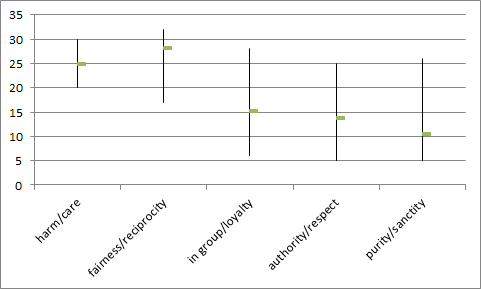
Since I also gave participants the Moral Foundations Questionnaire, I am able to say some things about the group from that perspective. This graph shows the group means and the range for their scores on the five Moral Foundations scales. For comparison, the average responses of politically moderate Americans are 20.2, 20.5, 16.0, 16.5, and 12.6. That means that my group is more concerned about harm/care and fairness/reciprocity than most Americans, and not far from average on other Foundations. But there is also a lot of diversity within the group. Two of my respondents scored 5 out of 35 on the purity scale, and two scored 20 or higher. The range was likewise from 6 to 28 on the in-group/loyalty scale.

MoralFoundations

You might think that this diversity would somehow be reflected in the respondents’ maps of their own explicit moral ideas and connections. But I see no particular relationships. For instance, one of the people who rated purity considerations as important–a self-described liberal Catholic–produced a map that clustered around virtues of moral curiosity and openness, friendship and love, and a central cluster about justice in institutions. She volunteered no thoughts about purity at all.

This respondent scored 20 on the purity scale. A different person (self described as an atheist liberal) scored 9 on that scale. But they chose to connect their respective networks through shared ideas about humility, deliberation, and justice.

The whole group did not divide into clusters with distinct worldviews but overlapped a great deal. To preserve privacy, I show an intentionally tiny picture of the current group’s map that reveals its general shape. There are no signs of separate blocs, even though respondents did vary a lot on some of the “Foundations” scales.

moralmap

A single-word node that appears in five different people’s networks is “humility.” It also ranks fourth out 375 ideas in closeness and betweenness centrality (two different measures of importance in a network). It is an example of a unifying idea for this group.

Many of the ideas that people proposed have to do with deliberative values: interacting with other people, learning from them, forming relationships, and trying to improve yourself in relation to others. Those are not really options on the Moral Foundations Questionnaire. They are important virtues if we hold explicit moral ideas and reasons and can improve them. They are not important virtues, however, if we are driven by unrecognized latent factors.

One way to compare the two methods would be to ask which one is better able to predict human behavior. That is an empirical question, but a complex one because many different kinds of behavior might be treated as outcomes. In any case, it’s not the only way to compare the two methods. They also have different purposes. Moral Foundations is descriptive and perhaps diagnostic–helping us to understand why we disagree. The method that I am developing is more therapeutic, in the original sense: designed to help us to reflect on our own ideas with other people we know, so that we can improve.

[References: Bollen, Kenneth A. 2002. Latent Variables in Psychology and the Social Sciences. Annual Review of Psychology, vol. 53, 605-634; Graham, Jesse, Nosek, Brian A., Haidt, Jonathan, Iyer, Ravi, Koleva. Spassena, & Ditto, Peter H. 2011. Mapping the Moral Domain. Journal of Personality and Social Psychology, 101:2; Haidt, Jonathan. 2012. The Righteous Mind: Why Good People Are Divided by Politics and Religion. New York: Vintage; Swidler, Ann. 2001. Talk of Love: How Culture Matters. Chicago: University of Chicago Press; Thiele, Leslie Paul. 2006. The Heart of Judgment: Practical Wisdom, Neuroscience, and Narrative Cambridge University Press.]

Embracing Behinity

Throughout the week, I’ve been reflecting on Sándor Szathmári’s great work of social satire, Voyage to Kazohinia. The work critiques a number of social institutions, but largely seems to focus on a broader question: is an ideal society one at equilibrium or one which embraces extremes?

Szathmári presents this question by introducing us, through the shipwrecked Englishman Gulliver, to two contrasting societies: the brilliant, efficient and loveless Hins and the backwards, chaotic, and destructive Behins.

Given the Hin’s complete lack of love, art, and unique character, one might be inclined to favor the mad but passionate world of the Behins, though Szathmári clearly seems to favor the ordered society of the Hins.

Following the principal of kazo – mathematical clarity – the Hins naturally act “so that the individual, through society, reaches the greatest possible well-being and comfort.” The Behins, on the other hand, are “kazi” – a term for the irrationality which captures everything not kazo.

While I have commented this week on the arguments favoring both types of communities and on reasons why we might want to force a choice between the two rather than just rejecting the premise all together, I have yet to actually answer the question for myself.

On this topic, I have found myself greatly torn.

On the one hand, the peaceful, equitable, and rational world of the Hins is clearly the more reasonable of the two societies. Nearly every logical thought argues in its favor.

Yet the Hin’s lack of art, of passion, of love seems too much to bear. It nearly seems worth sacrificing peace and equity for these peculiarities that make us so deeply human.

Furthermore, being generally inclined to favor unpopular opinions makes me want to argue for the Behinistic perspective on principle. If the kazo world of the Hins is so clearly the rational choice, the troublemaker and contrarian in me just has to push against it.

This instinct is quite clearly kazi.

Additionally, that proud desire to be kazi in the face of all reason strikes me as potentially little more than an arrogantly American trait.

One of my Japanese teachers once told me that she couldn’t understand why Americans took such pride in being individualistic. We fancy ourselves as standing up against the crowd, as being brave radicals willing to boldly buck conventional norms. My teacher just laughed. You think doing what you want is hard? Doing what’s best for others is harder.

As something of an aside here, I would be remiss if I didn’t mention that in addition to being a clever critique of western society at large, Szathmári’s novel brilliantly satirizes the west’s Orientalism.

The Hins – whose philosophy I previously compared to Lao Tzu‘s – encapsulates everything “the west” thinks of “the east.” They do not, of course, reflect any real culture existing in the world, but our English Gulliver views them exactly as he might if he had found himself among any of the real peoples of East Asia.

Gulliver comments that “the Behins respected the Hins very much even though they loathed them,” a sentiment which perfectly encapsulates Gulliver’s own attitude. He is impressed by their efficiency and technological innovations, but hates their uniformity and dispassion.

This duality epitomizes the sentiments of Orientalism, and is particularly resonant of western views of Japan around the second world war, when Kazohinia was written. It is no accident that Gulliver was being deployed to Japan when he was shipwrecked.

The Behins, on the other hand, represent the west as it is, disrobed from the vain glory in which it sees itself. One could also make a strong argument that the Behins represent eastern views of the west, but either way Szathmári seems to write in the hopes of convincing his Behinistic western audience to be a little less kazi – using our own stereotypes to highlight our failings and the true ideal we neglect.

And thus I come to my final conclusion. While I put little stock in the gross over-generalizations of cultures, whether as a product of my culture or a product of my experiences, I find myself irreparably kazi. I know rationally that the kazo life is better, but I cannot accept it; I could not survive.

Like Foucault, I’m inclined to find that madness is little more than a social construct and, like Lewis Carroll, I’m inclined to believe we are all mad here.

The whole world is kazi, and – while I’d like to work to make the world a little more kazo – I’m no less Behin than anyone else.

Ironically, it would be kazi to assume otherwise. Throughout Gulliver’s time among the Behins he finds people who rightly mock the foolish beliefs and invented norms of their kazi peers. The greatest error comes, though, when these Behins don’t recognize the same foolishness within themselves. They simply substitute one kazi belief for another.

To not recognize one’s own Behinity, then, seems the height of madness.

At the end of the novel, Szathmári tells as about a certain kind of Behin “whose only Behinity is that he doesn’t realize among whom he lives; for it could not be imagined, could it, that someone aware of the Behinistic disease would still want to explain reality to them?”

I take this as a direct appeal to the reader: having been enlightened as to the Behinistic disease and possibly identifying Behinistic traits within ourselves, we are urged to move beyond our kazi instincts and embrace the better path of kazo. The Hins, we learn, were once Behins themselves.

This is, perhaps, a wise argument, but, in typical fashion, I find myself siding with Camus. The world is indeed absurd and the only thing left is to embrace that absurdity.

facebooktwittergoogle_plusredditlinkedintumblrmail

Equilibrium vs. Extremes: Rejecting the Premise

In my post yesterday I posed a question raised by Sándor Szathmári’s Voyage to Kazohinia: Is an ideal society one at equilibrium or one which embraces extremes?

In Kazohinia – as well as in some other social satires – these opposite choices are presented as mutually exclusive; a society can not have both. Both options seem to have pros and cons: the society at equilibrium is efficient and stable, but lacking in art, love, and life in its richest sense. The society with extremes has creativity, growth, and change but also has war, poverty, and injustice.

So which is better?

I was careful yesterday not to answer this question for myself: partly out of a interest in trying to define both sides of the argument, and partly because I’m not entirely satisfied with my answer.

I will also not answer that question today, instead exploring an alternate approach. Frankly, my instinct is to reject the premise of the question – why must we see these choices as exclusive? Surely there is some way to embrace the best of both models?

That is a tempting out of this debate, and would surely be the best option. This, however, quickly leads to a host of other questions: is a balance between these models possible? What would that look like?

A core argument for an equilibrium society is that so-called good things necessarily create so-called bad things: that the existence of love intrinsically means the existence of hate. Therefore, finding a proper mix of these two social models means finding a path that allows for some close relationships while preventing apathy towards the broader populace.

You’ll note that I’ve softened the contrast here: perhaps love does not necessitate hate, but favoring some people – through the simple realities of one’s energy and resources – does seem to necessitate not favoring others. In a wealthy country where the global populations we don’t favor are starving to death in poverty, this presents a real conundrum – even if you generously assume that not favoring these populations is completely separate from issues of hate and racism.

This is exactly the issue philosopher Peter Singer tackles in his book, One World. In lecturing to his students, Singer quotes Victorian philosopher Henry Sidgwick:

We should all agree that each of us in bound to show kindness to his parents and spouse and children, and to other kinsmen in a less degree: and to those who have rendered services to him, and any others whom he may have admitted to his intimacy and called friends: and to neighbors and to fellow-countrymen more than others…

Singer comments that his students nod their heads in agreement with these words. This is the existence of love. We should love our family more than our friends, and love our friends more than strangers. One might sense a nagging doubt at these circles of concern, but on the whole it seems reasonable: we might care for humanity at large, but it seems improper and unnatural to love a stranger as much as your own child.

But while this demarcation may seem reasonable and morally valid, Sedgwick quickly goes off the rails:

…and perhaps we may say [we are bound to show kindness] to those of our own race more than to black or yellow men, and generally to human beings in proportion to their affinity to ourselves.

Singer’s students “sit up in shock.” This completely reasonable moral perspective to which they found themselves agreeing suddenly turned into a racist manifesto. Good people certainly don’t endorse that last sentence!

Singer shares this story to challenge the notion that “it self-evident that we have special obligations to those nearer to us, including our children, our spouses, lovers and friends, and our compatriots.”

His work, then, centers around answering the question, “How can we decide whether we have special obligations to ‘our own kind’ and if so, who is ‘our own kind’ in the relevant sense?”

For his part, Singer finds moral justification for preferential treatment of family members and friends:

Very few human beings can live happy and fulfilled lives without being attached to particular the human beings. To suppress these partial affections would destroy something of great value, and therefore cannot be justified from an impartial perspective.

Furthermore, while these relationships do require partiality, they may not necessarily result in the sort of broader injustice that should cause us concern. Friendships, after all:

…are stronger where there are shared values, or at least respect for the values that each holds. Where the values shared include concern for the welfare of others, irrespective of whether they are friends or strangers, then the partiality demanded by friendship or love will not be so great as to interfere in a serious way with the capacity for helping those in great need.

So there are grounds for accepting these intimate relationships. After that, though, the circles of concern break down.

I am inclined to agree with Singer in finding “few strong grounds for giving preference to the interests of one’s fellow citizens, and none that can override the obligation that arises whenever we can, at little cost to ourselves, make an absolutely crucial difference to the well-being of another person in real need.”

It is good to love ones friends and family, but nationalism is a step too far.

This all seems good and rational, but there’s something seemingly arbitrary in determining where we draw our lines. Nationalism, for example, doesn’t quite seem to capture the international biases we show in our daily lives. In the US, for example, media attention and public concern are biased first towards our own affairs, and then towards European countries we find, though some ineffable metric, to be like us. Those people we find least like us are then shown the least concern.

Singer resolves this issue by arguing that what we think of as “community” is really a made up concept. Being “American” or even “Somervillian” really just means being part of an imagined community. Building off Benedict Anderson, Singer explains:

Though citizens never encounter most of the other members of the nation, they think of themselves as sharing an allegiance to common institutions and values, such as a constitution, democratic procedures, principals of toleration, the separation of church and state, and the rule of law.

And if our nationalism is little more than an imagined community, we can, with a little effort, imagine ourselves as part of a different community. A global community.

This is an inspiring thought, but Singer has far to go in illustrating that such a thing were broadly possible. If everyone saw this as the clear moral path, one might imagine we’d have accomplished it already.

Furthermore, given the deep racial and social injustices we see within our own ‘American’ community, it is hard to imagine that we are anywhere close to collectively embracing our international identities. If our current imagined community is so narrow as to only accept people of similar race, class, ideology, and national identity, how are we ever – on a collective scale – to move beyond that?

Thus Singer’s solution leaves me somewhat disenchanted. In theory, his approach provides a map for integrating cultures of equilibrium and extreme. We ought, one might hope, to be able to love select people a little bit more, while loving the vast mass of humanity all the same. However, the mere fact that Singer has put so much effort into answering this question – and that the answer is disputable – illustrates that, even if balance is possible, it is neither easy nor self-evident.

As much as we may resist it, we may, indeed, be left with the choice: equilibrium or extremes?

facebooktwittergoogle_plusredditlinkedintumblrmail

Bridging Divides in the Methodist Church on LGBTQ Issues

As we prepare to think together about how we can bridge our nation’s divides during our NCDD 2016 conference, there’s much to be learned from the piece we’ve shared below from the Public Conversations Project, an NCDD member organization. In it, PCP’s Jessica Weaver reflects on key lessons that can be learned how the Methodist Church has been dealing with its perennial conflict about LGBTQ people in the church. You can read her article below or find the original piece here.


Three Lessons About Embracing Difficult Conversations from The Methodist Church

PCP new logoAs you may have read in the last few weeks, a deep conflict within the Methodist Church has surfaced once again. More than 750 congregations within the Church have formed the Reconciling Ministries Network, which advocates for the inclusion of LGBT people in a denomination that has barred them from being ordained, and from marrying a person of the same sex.

“It’s the perennial issue that will not go away, and for better or for worse, it’s the main battle flag issue between the liberal side of the Church and the conservative side of the Church,” said Mark Tooley, president of the Washington, D.C.-based Institute on Religion & Democracy, as quoted in the Religion News Service.

Understandably, this conversation has a history of being emotionally and politically fraught, disrupting conversations, gatherings, and relationships. The narrative I’ve noticed emerging from major media outlets about this movement is that it’s a sign of struggle, of irrevocable conflict, of failure. But I look at this story and I see something beyond a deeply emotional, and seemingly intractable conflict. I see resilience, a willingness to come to the table in the midst of deep differences, and an intentional approach, not only to the outcome of this critical discussion, but to how those conversations take place and how relationships can be preserved. Here are three strengths I think we should celebrate amidst this very difficult – and very public – divide.

1. A perennial conflict isn’t a sign of failure, it’s a fundamental reality of being part of any human community: there are differences we have to live with, not overcome.

The mainstream media has drawn out notes of exasperation in its coverage of this resurfacing issue. From within the U.S., where same-sex marriage is legalized and supported by the majority of the American public, the Church’s struggle is being criticized as backwards and behind the times. Research reveals, however, that almost two-thirds of church members accept homosexuality in society, simply not within the Church (i.e. would not want the Church to ordain someone who identifies as LGBTQ). Broader social acceptance of gays and lesbians in American society is complicated by the Church’s recent expansion into regions of the world where homosexuality is flatly banned.

In other words, it’s far more complicated than “liberals vs. conservatives,” as a number of factors are pulling factions of the church in different directions. That it is once again up for debate is not a sign of the Church’s failure to engage in a difficult conversation, or a sign that previous conversations have failed. There will always be differences in identity: in sexual orientation, faith, and relationship to scripture. What matters most is the community’s continued willingness to engage in these difficult conversations; to keep listening through the hard conversations.

2. How the conversation happens is just as important as the outcome.

Before diving into the specifics of the issue, the Church’s top lawmaking assembly (the Commission on the General Conference) decided to define a structure for discussing this divisive and often emotional issue. “We need to expand the ways that we can make decisions and be in conversation with each other,” said Judi Kenaston, the commission’s chair. The resulting “Group Discernment Process” called for smaller committees to meet and draft petitions to be submitted to a larger body of elected members. On Wednesday, however, that process was voted down.

While deep disagreements persist around how to even have this conversation, at least the “how” is being broached with intentionality and transparency. That’s not the case for so many divisive community issues. So it seems the Methodist Church acknowledges something critically important: no constructive conversation can proceed without an effective process in place.

3. “Togetherness” isn’t a monolith, and it doesn’t mean consensus.

In such a divided environment, talk of schism or splintering has inevitably arisen. Prominent leaders in the Church have openly admitted that it’s a possible outcome, especially in the midst of such a polarized age, when the “nation’s third-largest denomination and many of the political and theological divisions that divide America into its red and blue camps.” Those same leaders, and many more, are also exploring the nuances of what “unity” means and are unwilling to prematurely name the future of the Church. Said the president of the Methodist Council of Bishops, “we remain open to new and innovative ways to be in unity. We will remain in dialogue with one another and others about how God may be leading us to explore new beginnings, new expressions, perhaps even new structures for our United Methodist mission and witness.”

So what we have here is messy. It’s the hard, raw stuff of deep differences and human pain. But it’s worth noticing when public conflicts are handled with resilience and curiosity instead of posturing and accusation. This is a community struggling to remain intact and understand exactly what that means, how to reconcile individual beliefs with a community’s story. Let’s not shame them; let’s name what they’re doing right.

You can find the original version of this Public Conversations Project piece at www.publicconversations.org/blog/three-lessons-about-embracing-difficult-conversations-methodist-church.