Feb 1 '18
Africa i-Parliaments is a set of United Nations initiatives and projects designed to enable African Parliaments to facilitate democracy and good governance through technology applications.


With The LAMP, a New York City nonprofit that works on media and digital literacy skills, my colleagues at CIRCLE are launching the 22×20 Campaign, which has the tagline “22 million new voters by the year 2020.”
For the night of the State of the Union, 22×20 helped organize Action Parties in “New York City, Washington D.C., Austin, Chicago, Boston and San Francisco with partners such as Austin Public Library, Mikva Challenge, DoSomething.org, KQED, OZY, Sony, and YVote.” Students were encouraged to discuss, analyze, and share their reactions. More information about how to organize such events is here.
The campaign also provides educational resources. For example, you can find lesson plans on media literacy and tutorials on how to create videos using news clips. I thought the guide entitled “Ten Easy Steps to Fact-Checking” was a perfect resource for viewers of the State of the Union.
More events are coming up. Follow the campaign on Twitter (@22millionVotes) or by using the hastag #22×20. CIRCLE also has an explanatory blog post on “Teens and Elections” with valuable background data.
It’s time to mark your calendars for the highly anticipated 2018 National Conference on Dialogue & Deliberation! We’re excited to announce that our next national conference will take place in downtown Denver this November 2-4.

Our conferences only come around every two years, and you won’t want to miss this one! NCDD conferences aren’t just about having fun and enjoying the company of our field’s movers and shakers. They’re about forming new partnerships, strategizing together about how we can tackle our field’s greatest challenges, showcasing some of the coolest arts, technologies, and methods for public engagement — and so much more.
If you haven’t attended an NCDD conference yet, watch our highlight video by Keith Harrington of Shoestring Videos to get a sense of the energy and content of the last national conference…
We can’t wait to see you this November! We’ll be holding the conference at the Sheraton Denver Downtown.
Keep an eye out for registration, a call for volunteers for the planning team, and of course efforts to engage the broader NCDD community around conference content and theming. The call for workshop proposals will be distributed in a couple of months, but it’s never too soon to start thinking about what you’d like to present about and who you’d like to present with. Information will be posted soon at www.ncdd.org/events. For now, be sure to hold these dates on your calendar.
To stay up-to-date on NCDD Denver news and opportunities, be sure to subscribe to our conference updates email list!
Please share this post widely in your networks! Building on a 16-year legacy of popular, well-loved events, NCDD 2018 will be our 8th National Conference and just the latest of many events, programs and gatherings that NCDD has hosted since we formed in 2002.
In home movies and fading Polaroids,
They look funny, their lapels wide and garish,
Their facial hair risible, movements jerky.
They look naive–fools, ignorant of what came next.
But I report: the grass felt just the same
When you raked your fingers though its crisp stems.
On a suddenly warm January day,
Wafting over sodden drifts, the air smelled
The same, and laughter sounded the same
Filtered through traffic thrum and cicadas.
[edited on Feb. 4, 2018]
It is at this point in the year when the President of the United States provides Congress with a mandatory State of the Union report. While it is now delivered as a speech, it was not always the case. In the long tradition of the State of the Union, delivering it as a speech to Congress is a relatively new development.
So how do you use the State of the Union in your classrooms? This post will share some useful resources for teaching about, discussing, following, or using the State of the Union address as a teaching and learning tool.
Surveying State of the Union Addresses
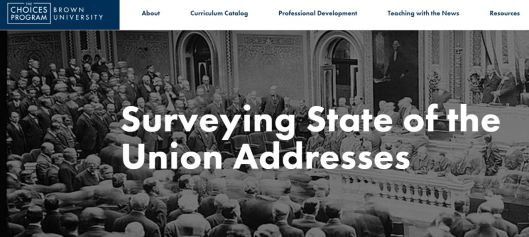
This approach comes to us from Brown University’s Choices Program. In it, students will
This is an extended and engaging lesson, popularly used by social studies teachers of multiple grade levels across the country, and easily adaptable for your classroom.

This lesson is an older one, but still good, from the National Constitutional Center. It looks at the language of the State of the Union, and considers it as a means of engagement with constitutional duties and the broader public. Students will
Flocabulary State of the Union
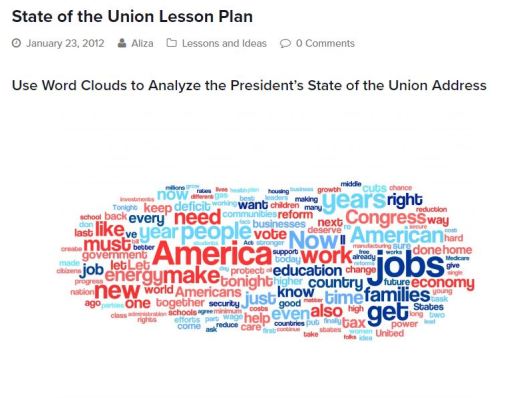
This is not a particularly deep lesson, but it does engage students with analyzing the language and content of the State of the Union using word clouds. What terms, concepts, ideas, language appears the most in the address? What does that mean for the goals and purposes of the president and his or her constitutional duties?
C-Span’s State of the Union Lesson
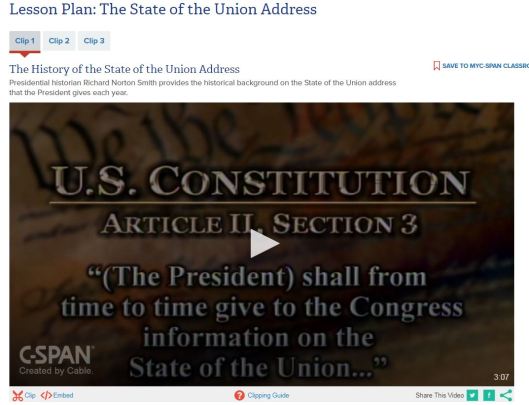
This lesson, from the good folks at C-Span, has students identify the constitutional requirement for the State of the Union address, examine the issues presented in State of the Union speeches, and analyze President Trump’s proposals for each issue. It has them breaking down the address comparing it to prior presidential addresses and State of the Union speeches.
Online Engagement With the New York Times

The New York Times is hosting an online ‘pre-discussion’ of the SOTU address that allows students to share their opinions and predictions, and then a post-address discussion. While you may not want to have your students as part of the conversation, the guiding questions and approach taken here may be something you want to duplicate in your classroom.
Bonus Opportunity: The 22×20 Campaign

The 22×20 Campaign (so named because there will be 22 million new voters by 2020) is hosting an online ‘viewing party’ and will have an active presence on social media. Students can take part in the conversation by using #22×20 online. This is a great opportunity to engage with other students all across the political spectrum during the address, and can be a fruitful source of ongoing discussion in your classrooms.