Event: Cultivating Community Capacity with Four “Deep Wisdom” Practices

Join the National Coalition for Dialogue & Deliberation (NCDD) and NCDD Sponsoring Member Susan Stuart Clark of Common Knowledge for this free event Friday, April 24, from 2-3:15 PM Eastern/11-12:15 PM Pacific. In honor of Arbor Day, this is an invitation to explore how we cultivate our personal and community capacity for deeper wisdom and healthy interconnectedness. Don’t miss this opportunity – register today!

This event is the start of a series of activities and collection of resources at sense-us.org, a new pro bono project for Common Knowledge and allies in the arts, healing and community transformation. Participants will learn more about the four practices identified by cross-cultural pioneer Angeles Arrien, which we can use to help deepen our individual and collective capacity for discovering the deeper wisdom in and between us.  The four practices and their importance to us and our work designing and facilitate community engagement during and after this pandemic are outlined in this wonderful piece by Susan Stuart Clark. 

The April 24 Zoom session will include different ways of centering ourselves and an overview of the four practices as a stepping off point for group reflection. Participants will have the opportunity to connect more deeply with one another, sharing how the practices resonate for you personally, as well as how they relate to your work in and with communities.

Drawn from ancient and indigenous wisdom, these practices invite us to bring our whole selves – heart, body and mind –  to our work as cultivators of community, dialogue stewards and/or peace builders. During this time of physical isolation, let’s embrace the ways we can bring closeness to one another through sharing our truest selves with each other. Let’s see how we can expand our capacity to understand the patterns and structures that brought us to this current moment and choose more inclusive and collaborative ways to co-create our future.

Join us for this opportunity to explore how these practices can transform our work. Register today to reserve your spot!

About Common Knowledge

Common Knowledge specializes in bringing new combinations of people together to listen to and learn from each other. Leading together. We facilitate powerful new connections across sectors, silos, and social divides that generate breakthrough civic participation, employee and community engagement programs. Learn more at www.ckgroup.org.

About Susan Stuart Clark

Susan Stuart Clark is Founder and Executive Director of Common Knowledge. Susan formed Common Knowledge to pioneer “community-driven design”, demonstrating how inclusion of diverse stakeholders stimulates innovative solutions on issues such as housing, health care, the environment, education outcomes, voting and financial literacy. Susan has over two decades of experience designing culturally responsive communications and engagement programs and presents frequently about increasing participation of lesser-heard voices, multi-sector collaboration and how investments in social cohesion enhance a community’s overall well-being.

About NCDD

The National Coalition for Dialogue & Deliberation (NCDD) is a network of innovators who bring people together across divides to discuss, decide, and take action together effectively on today’s toughest issues. NCDD provides opportunities for members of the broadly-defined dialogue and deliberation (“D&D”) community to share knowledge, inspire one another, build collaborative relationships, and have a greater collective impact. Learn more at www.ncdd.org.

Convergence Names David Eisner New President & CEO

Our friends at the Convergence Center for Policy Resolution recently announced the appointment of their new President & CEO. Please join us in congratulating Convergence and David Eisner on the new position! The full announcement is below and also accessible at this link.


Convergence Center for Policy Resolution is excited to share that we have a new President & CEO, David Eisner! Convergence is a 501c3 nonprofit organization with a mission to convene people and groups with divergent views to build trust, identify solutions, and form alliances for action on critical issues. David is a national leader in public, private, and nonprofit sectors and will team with Convergence Founder Rob Fersh to expand Convergence’s scale and impact.

“Bridging divides of ideology, identity and partisanship to address America’s core challenges has never been more urgent,” says Eisner.

The following statement was released by Jean Molino, Chair of the Board, Convergence Center for Policy Resolution:

First, let me express to all in the Convergence community our heartfelt hopes that you are well and taking good care in this challenging time. We are eager to stay in touch with you and want to hear from you as we continue to do our work, now more important than ever, to create community and collaboration to deal effectively with issues of great concern to us all.

To further that end, Convergence Center for Policy Resolution’s Board of Directors is delighted to announce that David Eisner will become Convergence’s new President and CEO, effective April 1, 2020. David is a national leader who brings broad experience as a senior executive across the private, public, and nonprofit sectors. His demonstrated excellence at scaling organizational impact and results through effective programming, partnership, fundraising, and staff development, combined with his longstanding passion for coalition-building and cross-partisan problem-solving make David the right leader for Convergence at the right time.

Highlights of David’s career include his appointment by President George W. Bush and confirmation by the U.S. Senate to serve as the CEO of the Corporation for National and Community Service, where he grew AmeriCorps from 50,000 to 75,000 members, built bi-partisan support and oversaw the iconic AmeriCorps response to Hurricane Katrina. Additionally, David served as CEO of the National Constitution Center, appointed by former President Bill Clinton, where he facilitated leading scholars and influentials in dialogue across deep differences over pressing Constitutional issues. David chaired the nonprofit All for Good, which built the system supporting President Obama’s signature service initiative, Serve.gov, and most recently served for six years as CEO of Repair the World, the nonprofit Jewish service organization. David has also held senior leadership roles at America Online (& AOL Time Warner) and Fleishman-Hillard, and has served on many national nonprofit boards, including Independent Sector, Public Allies, National 4-H Council, Network for Good and Points of Light.

We are also especially pleased that David and Rob Fersh, Convergence’s founder and current CEO, have agreed to build an active partnership as Rob segues to the role of Founder/Senior Advisor, maintaining deep involvement in Convergence’s planning, programming and fundraising. Convergence just celebrated its first decade, during which Rob developed Convergence’s unique methodology – our “secret sauce” –which has proven remarkably effective at bringing people together across differences to address some of society’s most intractable problems. We look forward to David building on that solid legacy, bringing innovation, scale and expanded impact to Convergence’s work in its second decade.

As Chair of Convergence’s CEO Search Committee, I can share that identifying the person to lead Convergence in the large footprints of our exceptional founder was both challenging and invigorating. We were delighted to engage with a great many exceptional and influential leaders of nonprofits and policy, which underscored the strong reputation of Convergence as well as the importance of the work.

Rob noted: “I am truly delighted to welcome David as the new CEO of Convergence. He brings a wealth of talent and experience along with great passion for our mission. I look forward to working closely with him to further the success of his leadership and Convergence. I am grateful to our terrific Board of Directors for concluding this search with such a great result.”

David shared his excitement about taking on this new challenge: “I am thrilled to be joining the Convergence team at a time when bridging divides of ideology, identity and partisanship to address America’s core challenges has never been more urgent. Convergence meets this need in a way that is uniquely powerful. I am particularly delighted that Rob will continue to bring his leadership and experience so that the uniqueness and power of our work remains true even as we scale our reach and impact.”

David looks forward to connecting with the Convergence network, and we will create opportunities in the coming months for our colleagues to get to know him. While we are currently living and working in highly unusual circumstances, these will not prevent David from coming fully and wholly on board. We look forward to his leadership for many years to come.

Jean Molino, Chair
Convergence Board of Directors

New Civic Engagement Section of the American Political Science Association

The APSA has approved a new section on Civic Engagement. In the proposal for this section, we noted that “APSA has been dedicated to civics education and the task of stimulating civic engagement since its inception in 1903.” However, there had not been “an organized section” for “political scientists who specialize in teaching and/or research in civic engagement.”

We said that our purposes would include:

  • To promote the teaching of and scholarship in civic engagement through sponsorship of civics education and civic research panels and/or short courses.
  • To facilitate the development of faculty in this field through mentoring.
  • To publicize new research and share pedagogical experiences through a newsletter and/or journal.

With APSA’s approval, we are now in business and we invite political scientists to join the section. For APSA members, the cost is minimal ($5 per year). After you log in to apsanet.org, click on your name and you will go to your own profile. “Add section” will be one of the options. That will bring up a list of sections you can join. Ours is the second from the bottom on the list. Or you can do so by adding it the next time you renew your registration. 

We welcome scholars working with diverse methodological backgrounds and in diverse institutional settings including research-intensive universities, teaching-intensive colleges and universities, HBSUs and HSIs, community colleges, and in the nonprofit sector.

We have been given two panels at the APSA annual meeting in September. Please look for those in the program and help us out by attending, if you can. Also, we are planning to hold a business meeting and a reception at the annual meeting.  They should be listed in the program or we will advertise them separately. Please join us for those events. The business meeting will be our first as an organized section and we would appreciate your input on the governance of this new section.

The co-chairs are Elizabeth Bennion and Richard Davis. I am the Vice-Chair, and Malliga Ochs is the Treasurer.

Let the Institutional Innovation Begin! (Part I)

In corvid-19, neoliberal capitalism has met a formidable foe. The pandemic has shown just how fragile and dysfunctional the market/state order -- as a production apparatus, ideology, and culture -- truly is. Countless market sectors are now more or less collapsing with a highly uncertain future ahead. With a few notable exceptions, government responses to the virus range from ineffectual to self-serving to clownish.

While politicians clearly hope that massive government bailouts will restore the economy, it’s important to recognize that this is not just a financial crisis; it’s a social and political crisis as well. Many legacy market systems – generously subsidized and propped up by state power – are not really trusted or loved by people. Do Americans really want to give $17 billion to scandal-ridden Boeing while letting the post office go bankrupt? It is too early to declare that the old forms will never return, and we do need to remember that the authoritarian option is dangerously close. But it is clear that the future will have a very different pattern.

To me, one thing is obvious: searching for the rudiments of a New Order should be our top priority once emergency needs are taken care of. We need to identify and cultivate new patterns of peer provisioning and place-based governance, especially at the local and regional levels. We need new types of infrastructures and new narratives that understand the practical need for open-source civic and economic engagement.

This is not only necessary to help us deal with climate change and inequality; it is a preemptive necessity for fortifying democracy itself. Reactionary forces are already poised to try to restore a pre-pandemic “normal." “Prepare for the Ultimate Gaslighting,” writes filmmaker Julio Vincent Gambuto in a wonderful essay on Medium.

Gambuto astutely predicts that corporate America, the White House, and the rest of capitalist establishment will soon mount a massive marketing campaign to minimize the realities we’re now experiencing and rebrand the American Dream as back:

Get ready, my friends. What is about to be unleashed on American society will be the greatest campaign ever created to get you to feel normal again. It will come from brands, it will come from government, it will even come from each other, and it will come from the left and from the right. We will do anything, spend anything, believe anything, just so we can take away how horribly uncomfortable all this feels.

And on top of that, just to turn the screw that much more, will be the one effort that’s even greater: the all-out blitz to make you believe you never saw what you saw. The air wasn’t really cleaner; those images were fake. The hospitals weren’t really a war one; those stories were hyperbole. The numbers were not that high; the press is lying. You didn’t see people in masks standing in the rain risking their lives to vote. Not in America…. But you did. You are not crazy, my friends. And so we are about to be gaslit in a truly unprecedented way.

Put another way, economists Samuel Bowles and Wendy Carlin foresee what they call “the coming battle for the COVID-19 narrative.” In a paper by that title on Vox CEPR Policy Portal, Bowles and Carlin declare the coronavirus to be “a blow to self-interest as a value orientation and laissez-faire as a policy paradigm, both already reeling amid mounting public concerns about climate change.”

They predict that a struggle will soon be underway to lock in the political and economic lessons of the pandemic. There will be a big push for a state-friendly, capitalist-affirming narrative, of course. But that frame will narrow the debate to familiar binary choice of “liberal” vs. “conservative” policy, subtly foreclosing consideration of larger structural reforms or a paradigm shift. We will need only ask ourselves, Do we want a bigger, more active government or free markets (sic)?

Fortunately, the pandemic supplies plentiful evidence to support a more ambitious, breakthrough agenda. The Commons Sector and all sorts of alt-economy approaches, long hovering on the progressive fringe, are now bursting out into mainstream view. Makerspaces have stepped up to make personal protective equipment using 3D printers. The City of Amsterdam has embraced Kate Raworth’s “Doughnut Economics” framework. All sorts of localized commons – for food, social support, emergency responses, etc. – are flourishing through people-powered ingenuity and goodwill. Thanks to the pandemic, once-fringe ideas (universal basic income, wealth taxes, relocalizing supply chains) are seen as practical if not essential options.

Bowles and Carlin argue that the pandemic calls into question the very language of economics and public policy. It is now clear that neither market contracts nor government edicts are capable of solving this and future pandemics. In addition, they argue, a “market vs. state” framing of future possibilities fails to acknowledge what the pandemic is showing -- “the contribution of social norms and of institutions that are neither government nor markets – like families, relationships within firms, and community organisations.”

For example, 750,000 ordinary Brits volunteered to help the National Health Service in dealing with the pandemic (only 250,000 could be practically put to work). Among South Koreans, there was a huge outpouring of social cooperation to get tested for the virus. One might also add to these examples the remarkable mutual aid projects that have spontaneously arisen worldwide, as chronicled by George Monbiot in The Guardian.

The pandemic has demonstrated that old systems are broken (and were always broken). But many people, including progressives and political parties, are still not willing to recognize this reality. They can’t quite admit that new institutional forms and social behaviors are entirely possible on a systemic, ongoing basis.

Rather than backslide into the old, familiar ideological mindsets, it's vital that we stride into the new spaces that have opened up! If you look carefully to the outskirts of mainstream politics and policy – to the many “new economy” experiments underway – you can see the lineaments of a new order. There is a huge constellation of promising experiments and proven archetypes. What they share in common beyond non-capitalist organizational forms is their invisibility on MSNBC, CNN, and among many progressive NGOs.

It's hard to acknowledge that bottom-up social energies can and do work, that there are developed alternatives awaiting expansion and refinement. These models don’t resemble markets or bureaucracies, however, which is surely one reason they have been marginalized. They are emergent, situation-based social phenomena. They can’t be strictly controlled from the top-down, which may be why traditional power centers are so wary of them. They have a quasi-sovereignty of their own that stems from being grounded in a geography, with real grassroots players, who work together as a living, peer-organized, evolving force. This is precisely why they can accomplish so much serious work so quickly and flexibly, as pandemic mutual-aid initiatives have shown.

As renegade economists, Bowles and Carlin appreciate the limits of markets and the state:

Neither government officials nor private owners and managers of firms know enough to write incentive-based enforceable contracts or government fiats to implement optimal social distancing, surveillance, or deployment of resources to the health sector, including to vaccine development….

[N]on-governmental and nonmarket solutions may actually contribute to mitigating problems that are poorly addressed by contract or fiat. The behavioral economics revolution makes it clear that people – far from the individualistic and amoral representation in conventional economics – are capable of extraordinary levels of cooperation based on ethical values and other regarded preferences.

Bowles and Carlin don’t really explore HOW to foster new forms of collective social action, however, or what specific ones ought to be embraced. Perhaps they are not so familiar with the world of commoning and the impressive variety of “new economy” projects.

It is precisely this cohort of players who hold answers for the future. I’m talking about people who are pioneering the relocalization of food and place-based markets, new types of cooperatives, platform cooperatives in digital spaces, non-capitalist forms of finance, degrowth strategies, digital peer production, globally shared design (open source style) used to manufacture locally, agroecology and permaculture, urban commons, and countless other projects that point beyond capitalism and state bureaucracy.

A rare historical moment has opened up new possibilities. We can’t let it be wasted. We need to support an aggressive surge of institutional innovation, relationship-building and meme-spreading along with the development of new grand narratives and collaborative strategies. In a future post, I will look at some of the intriguing new institutional forms that are emerging in specific sectors.

Announcing NCDD’s April Tech Tuesday with EnCiv!

NCDD is thrilled to announce our next Tech Tuesday event featuring EnCiv and their new tool, the “Undebate.” This free event will take place Tuesday, April 28 from 2-3 PM Eastern/11-12 PM Pacific. Don’t miss this opportunity – register today to secure your spot!

EnCiv is a tech start-up led by NCDD Members Will Ferguson, David Fridley, and Adolf Gundersen. EnCiv automates proven human-interaction methods to scale productive democratic discourse.

In this Tech Tuesday event, these three principals from EnCiv will share with us an exciting new tool for online discourse, the “Undebate,” and the expansive vision that spawned it. The Undebate is being made available to voters across the country this election season by EnCiv partner Ballotpedia under the label “Candidate Conversations.” EnCiv will share with us more about this tool, and also ask for your input on other ways to use Undebate! We’ll also have an opportunity to hear about what else they are working on.

About our presenters

Will Ferguson is co-founder and CEO of Enciv, Inc. and a technology leader involved in numerous successful startups. He is also a co-inventor on eight patents in machine learning solutions.

Adolf Gundersen is co-founder and COO of EnCiv, as well as VP & Research Director at Interactivity Foundation. Adolf has thirty years experience as theorist and practitioner of democratic discussion.

David Fridley is CTO of EnCiv and Founder of Synaccord, LLC. David is a social entrepreneur, product manager, full stack developer, and has 30+ years experience in voice and video over the internet.

This event will be a great opportunity to see a new tool in action and connect with the presenters! Don’t miss it – register today!

Tech Tuesdays are a series of learning events from NCDD focused on technology for engagement. These 1-hour events are designed to help dialogue and deliberation practitioners get a better sense of the online engagement landscape and how they can take advantage of the myriad opportunities available to them. You do not have to be a member of NCDD to participate in our Tech Tuesday learning events.

More Video Civic Lessons from Palm Beach District Schools!


Good news, friends in Civics! More useful tools from our friends in Palm Beach! For the past three weeks, we shared with you a collection of video lessons for learning civics from home, put together by the excellent folks in Palm Beach using some resources from Civics360. Today, we are happy and grateful to share five more. Each video runs about ten minutes long, give or take a couple of minutes. I’ve included a link back to Civics360 under each video. Thank you, Lori Dool, for giving us a chance to support teachers!

Citizenship

Civics360 Module

Citizen Responsibilities and Obligations

Civics360 Module

The Bill of Rights and Amendments

Civics360 Module

Constitutional Safeguards and Limitations

Civics360 Module

Constitutional Rights

Civics360 Module

We hope you found these useful, and thank you again to Palm Beach District Schools for sharing them!

why the relatively good US numbers for COVID-19 mortality?

Major news sources are reporting that the USA has had the most cumulative COVID-19 deaths. That is a meaningless statistic, since our population is, for example, seven times larger than Spain’s. On a per capita basis, the US is reporting far fewer cumulative deaths than ten major OECD countries.

(My analysis of data from Our World in Data.)

One objection is that we are experiencing the pandemic later than Spain and Italy, and our per-capita cumulative rate will grow to meet theirs. However, assuming we peak (as expected) early this week, then we should not converge with Italy and Spain.

For a more precise comparison, here are per-capita cumulative deaths on the 30th day after each country saw its deaths reach one in ten million.

(I have consulted Kevin Drum’s daily updates to find Day 30 for each country. Several nations have not yet reached Day 30 and are not shown.)

The ratios are, indeed, smaller in this second graph than in the first. For example, on April 10, Spain had almost six times more cumulative deaths per capita than the USA that same day. If you compare the two countries on their respective Day-30’s, which happened weeks apart, the ratio is just 4.8-to-one. Still, the gap is unlikely to close much further, which means that Spain’s outcome will be four or five times worse than ours.

Another objection is that national aggregates are misleading because health outcomes in the USA are badly unequal by race. If per capita mortality for African Americans and Native Americans were shown separately, those numbers might look much worse. Then again, white Americans would then look even more fortunate in international comparison.

The same goes for regional breakdowns. On its own, New York City would look bad, but removing New York would make the national statistics look even better.

A third objection is that these statistics are inaccurate. No doubt, some COVID-19 deaths are not being appropriately counted. However, I am using deaths instead of diagnoses, because mortality statistics are generally considered pretty reliable and comparable across countries. Also, the epi-curves in these countries are rising smoothly in the expected ways.

A fourth objection is that we have only considered the first wave. If the pandemic revives in a second wave, all bets are off. I would say that it is wise to prepare for a second wave, but the only data we can discuss come from the current phase. It’s worth trying to analyze what it means.

Assuming that these statistics are fairly accurate, there doesn’t seem to be a meaningful relationship between COVID-19 mortality and the size of a welfare state (% of GDP spent on social welfare). The correlation would be positive (more spending goes with higher mortality), but the scatterplot is diffuse.

Nor is there a correlation between COVID mortality and health expenditures per capita, adjusted for purchasing power.

The preliminary evidence suggests that public policy, political leadership, and the social contract matter much less in this pandemic than I would have thought. I think we must look elsewhere for explanations of the variance in COVID-19 deaths.

Some differences in national outcomes may be due to social and geographical factors, such as the median age of populations, population density, or the frequency of living together in intergenerational households. I suspect a major variable is the timing of the onset of the disease. By the time the pandemic was starting its rise in the USA, many Americans had already become alarmed by the news from Italy and Spain; we self-isolated pretty rigorously. Like Iran, Italy and Spain didn’t have the benefit of as much warning. Meanwhile Taiwan and South Korea did better because they had previously experienced SARS.

This analysis is preliminary and amateurish and could easily change. That said, it challenges my own ideological priors. I would have assumed that Donald Trump would make things worse here than in other countries, and that our lack of health coverage would set us up for failure. It is always worth challenging your own ideological premises when conflicting evidence arises.

It’s also important to prepare for a summer and fall in which anti-Trump forces will try to blame the US situation on him, and the most cogent defense will be that the US is actually faring better than most social democracies. I don’t expect Trump to present his defense with any discipline, but his critics should be ready for it.

Upcoming NCDD-NCL Joint Webinar on Social Distancing and Public Engagement

Wow! We are a bit blown away to announce, we have reached max capacity attendance for our upcoming webinar this week with our partner organization, the National Civic League. The webinar happening this Wednesday, April 15th at 1 PM Eastern/10 AM Pacific, will give strategies for public engagement work during this period of physical distancing due to COVID-19.

While participants are no longer being accepted, we will be recording the webinar and can send it to folks afterwards. For those who are already registered for the event, you will be receiving the recording already. If you were not able to register, please sign up via this Google form and we will send the recording to you as well.

About the webinar

The webinar will feature Wendy Willis, Executive Director of the Deliberative Democracy Consortium, and Larry Schooler, Director of Consensus Building and Community Engagement, CD&P.  Wendy and Larry will showcase strategies for virtual public engagement in this time of social isolation.

This webinar will include information about leveraging government access television at all times, including this current time, to enhance the efforts of local government to connect with their residents and stakeholders.  Presenters will also talk about differences in various forms of online engagement and when it might make sense to use them, as well as tips for turning your in-person meetings into virtual ones. Sign up here to receive the recording!

Presenters:

Wendy Willis, Executive Director of the Deliberative Democracy Consortium

Wendy Willis is the Executive Director of the Deliberative Democracy Consortium, a global network of major organizations and leading scholars working in the field of deliberation and public engagement. Wendy is also the Founder and Director of Oregon’s Kitchen Table, a program of the National Policy Consensus Center in the Mark O. Hatfield School of Government at Portland State University.  Wendy is also a widely published poet and essayist, writing often on issues of public life.


Larry Schooler, Director of Consensus Building and Community Engagement at CD&P

After an award-winning career as a journalist across the globe, Larry Schooler became a mediator, facilitator, public engagement consultant, and educator. He works with agencies around the world to resolve disputes, build consensus and involve the public and stakeholders in decisions that will affect them. He also specializes in land use mediation, strategic planning, and visioning.  Dr. Schooler has written a manual on facilitating public meetings and has a forthcoming book on involving the public in the resolution of major community issues.

Florida Call for Teacher Experts for K-12 Civics and Government Standards Review

Friends in civics, passing along this notice from the Florida Department of Education. If you are interested in helping to review the state of Florida’s K-12 Civics Standards, please consider getting yourself nominated by your district to do so. 

flfoe

On June 26, 2019, Governor Ron DeSantis signed House Bill 807, which amended section 1003.4156, Florida Statutes, requiring the Florida Department of Education to complete a review of the statewide civics education course standards by December 31, 2020.

In accordance with Rule 6A-1.09401 of the Florida Administrative Code, the department is convening teacher experts for review of the K-12 Civics and Government Next Generation Sunshine State Standards (NGSSS) and is seeking two nominees from each district for consideration.

The department, on behalf of Commissioner Corcoran, invites you to submit the names of two candidates employed by your district for consideration to serve as a teacher expert. To ensure that the review process represents the needs of all Florida students, be mindful of providing candidates that are experts in the field, have experience with Exceptional Student Education, English for Speakers of Other Languages and Universal Design for Learning, with a minimum of three years teaching experience using the Civics and Government NGSSS.

Please use this online survey to submit one nominee for grades K-5 and one nominee for grades 6-12 by Monday, April 27, 2020. Teacher experts selected by the department will represent the many unique and diverse needs of Florida classrooms and will represent the district during the K-12 Civics and Government standards review. The Bureau of Standards and Instructional Support will contact individual nominees to obtain additional information to facilitate the selection process.
If you have any questions, please contact Michael DiPierro, Director of Standards, at
Michael.DiPierro@fldoe.org or 850-245-9773.

effects on civil society will be mediated by the economy

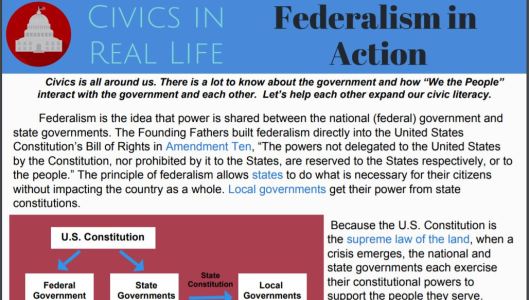
How will the current pandemic affect civic engagement? We certainly cannot know, but I would offer the following hypotheses:

People’s voluntary behaviors, values, and preferences will not change very much. If you can, you will snap back to pre-COVID habits and beliefs as soon as possible. However, the economic turmoil caused by the shutdown will destroy many nonprofit associations, newspapers, and businesses that are integrated into community life (such as cafes and barber shops). In the short term, not only will that destruction harm many people, but it will suppress civic life, since most people engage in and because of organizations. In the longer term, there will be space for civic innovation and growth, and maybe younger and more diverse leadership will emerge. However, civic organizations–particularly, local newspapers–that already have fragile business models may never be replaced.

Although it’s a century old, our best model for predicting the pandemic’s effects is the great influenza pandemic of 1918. In many parts of the world, its effects are impossible to disentangle from the impact of World War I, the Russian Revolution, and the collapse of empires. However, the US was peripheral to those matters and lost less than 1/20th of one percent of our population in the Great War. Changes that occurred between 1918 and 1920 can be plausibly attributed to the pandemic, which killed 650,000 out of 103 million Americans (equivalent to about 2 million deaths today).

Graphs from Robert Putnam’s Bowling Alone show no significant or lasting impact on civil society. Deep trends–industrialization, urbanization, the Great Migration–were ongoing, and so were trends in civic life. For instance, the early 1900s was the era when Americans constructed national organizations with local chapters, and their growth proceeded unabated through 1918.

Putnam also presents trends for membership in professional associations and unions, the rate of playing card games, the number of police officers per capita, and telephone ownership. These rates do not all smoothly rise in the early 1900s, but none seems to bend around 1918.

One possible exception is the rate of founding of major membership organizations, which was lower in the 1920s than in the 1910s:

Putnam lists the actual associations by their date of founding. None were launched in 1918, but three came into being in 1919. I see little evidence that the pandemic affected associations, unless it caused a delay in foundings during the actual year of the flu. In 1920, Warren Harding won election on the promise of a “return to normalcy”–poor grammar but a pretty accurate prediction.

However, the civic life that Americans built in the early 1900s depended on small contributions, dues, or subscriptions (in the case of newspapers) from many ordinary people. As long as they had jobs, they could support the associations. Organizations seemed to have weathered any short-term loss of income.

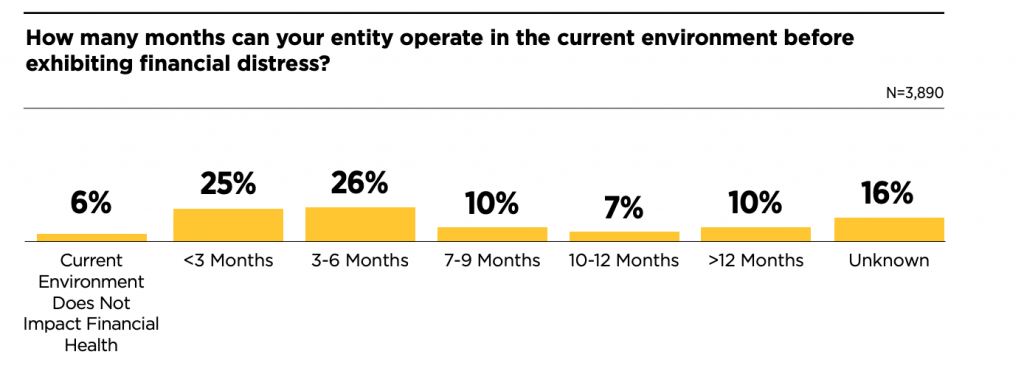
In contrast, today’s civil society is heavily dependent on philanthropy from foundations and wealthy individuals and contracts with governments. Many 21st century nonprofits basically run as businesses with a small number of investors and lots of constituents who do not pay for their services. A market meltdown could easily kill them off. In an international survey conducted from March 24-26, 68% of nonprofits already report a decline in contributions.

I worry especially about the metropolitan daily newspaper, because I believe it was an interesting hybrid invented between 1890 and 1920. Newspapers were often very profitable thanks to advertising and wide reach. At their peak, they attracted more than 80% of households by providing a basket of goods–sports, classified ads, comics. Meanwhile, they served a civic function by presenting important news on the front page. They did not invest in reporting because it maximized their profits but because professional reporters and editors–“the press”–exercised some influence over the owners of newspapers. The resulting combination was valuable but vulnerable and already in steep decline by 2010. If the recession now kills the last surviving metropolitan daily newspapers, there is no reason to think that any functional equivalent will replace them.

See also: new research on “civic deserts”; The “civic state of the union”; Bowling Alone after (almost) 20 years; and the hollowing out of US democracy.