structured moral pluralism (a proposal)

(New York) Isaiah Berlin recalled that the Russian novelists he read as boy shared with “the major figures [of philosophy], especially in the field of ethical and political thought,” a common “Platonic ideal.” This ideal implied,

In the first place that, as in the sciences, all genuine questions must have one true answer and one only, all the rest being necessarily errors; in the second place that there must be a dependable path towards the discovery of these truths; in the third place that the true answers, when found, must necessarily be compatible with one another and form a single whole, for one truth cannot be incompatible with another – that we knew a priori. This kind of omniscience was the solution of the cosmic jigsaw puzzle. In the case of morals, we could then conceive what the perfect life must be, founded as it would be on a correct understanding of the rules that governed the universe (2013, p. 4) .

This passage is a simplification of intellectual history (Berlin himself cites Vico, Herder, and others as opponents of the view that he attributes to “the major figures”), but he accurately describes one tendency. For some important thinkers, moral truths–if they exist at all–must form a single whole, like a completed jigsaw puzzle or like a mechanism in which some components support or drive others. Not only should the elements be compatible, but articulable reasons or arguments should connect them together. If you believe A, you should be able to say why in terms of B. If you believe A and B, but the two seem to conflict, then you should be able to resolve the conflict by adjusting the two principles.

By the way, you can hold this model of moral thought even if you doubt, given our cognitive and moral limits, that we will ever see the whole puzzle correctly. The truth may still be a coherent structure even if what we know is always partial and confused.

Another view is very different from this one. It is the theory that human beings have instinctive, affective reactions to situations. After we form those reactions, we may rationalize them with arguments, but our arguments are always insufficient to determine our reactions, and we are good at gerrymandering our general principles to fit what we want to conclude about specific cases. Thus our arguments do not explain our judgments. However, empirical psychologists can detect patterns in our various reactions, which suggest the existence of unconscious latent factors that do explain what we feel about cases. Those factors may not be mutually compatible, which is why we are often ambivalent or inconsistent. They may also vary from person to person. But they exist, and what we say about moral issues is inconsequential compared to this structure of latent factors (see, e.g., Haigt and Graham et al.).

This view could be correct, although I suspect it is partly an artifact of the research methods. To the extent that it is true, it denies the value of moral deliberation, which is a fundamental obligation in the tradition that Berlin calls “Platonic.” Moral positions, Haidt writes, are “nearly impregnable to arguments from outsiders.” That implies an answer to the question that opens the Federalist Papers–“whether societies of men are really capable or not of establishing good government from reflection and choice, or whether they are forever destined to depend for their political constitutions on accident and force.” If latent factors determine responses, then we are destined to depend on accident. I hope that is not the case.

Berlin famously dissented from the “Platonic” view of morality and developed a version of pluralism. There are the main elements of his position:

  1. “There is a world of objective values” (p. 11). In other words, some things really are valuable. It is wrong to deny an actual value, such as freedom or equality, or to add something to the list of values that doesn’t merit inclusion. In short, there can be a right or a wrong answer to the question whether something (e.g., love, war, desire, loyalty) is a good. This is different from Moral Foundations theory, which presumes that we must value whatever we value.
  2. But the genuine “values can clash – that is why civilisations are incompatible. They can be incompatible between cultures, or groups in the same culture, or between you and me” (p. 12).
  3. Because of the nature of morality and/or human nature, there is no possible world inhabited by human beings in which all the goods are perfectly compatible. “These collisions of values are of the essence of what they are and what we are. … The notion of the perfect whole, the ultimate solution, in which all good things coexist, seems to me to be not merely unattainable – that is a truism – but conceptually incoherent; I do not know what is meant by a harmony of this kind. Some among the Great Goods cannot live together” (pp. 13-14).
  4. The misguided effort to harmonize all worthy values into one structure is a dangerous illusion (p. 15), or even “the road to inhumanity” (pp. 19-20), because it justifies the imposition of moral beliefs on others without compromises.

I am basically pluralist, but I would alter Berlin’s view in one important respect. He seems to assume a list of fully distinct and potentially incompatible goods. I observe that people make connections among some of their own ideas. They say that one value implies, or supports, or resembles another value in various respects.

These structures seem to me to have merit. Connecting two ideas means giving a reason for each of them, because now they hang together. We ought to reason in order to live an examined life and to deliberate with other people. We are prone to very grave limitations and biases if we merely rely on our instinctive reactions to moral situations, taken one at a time, or if we allow latent factors to determine our reactions. We should struggle to put our ideas together into explicit structures and should present portions of those structures to other human beings for inspection and critique. That is just an idiosyncratic way of saying that we must reason together about values. Reasoning does not mean endorsing various Great Goods, one at a time, but rather connecting each idea to another idea.

This view is still compatible with Berlin’s pluralism, for two important reasons. First, the structure of moral ideas that each of us gradually builds and amends may contain incompatible values. Each of us can be a pluralist, even as we attempt to connect many of our own ideas into networks. Our networks can contain gaps and loose links and can reflect tradeoffs. Second, is it likely that even human beings who strive to develop the best possible structures of moral ideas will never produce the same structures. That is because moral reflection is deeply dependent on local experience and on conversations with concrete other people, each of whom is affected by her own conditions. So we will forever disagree. In contrast to the image of a “cosmic jigsaw puzzle” that we are all working together to complete, I’d propose a great web of loosely connected ideas that we are all perpetually creating and linking together.

See also: 10 theses about ethics, in network termsJonathan Haidt’s six foundations of moralityan alternative to Moral Foundations Theory; and everyone unique, all connected.

Sources:

Berlin, Isaiah. The crooked timber of humanity: Chapters in the history of ideas. Princeton University Press, 2013.

Jonathan Haidt, The Righteous Mind: Why Good People are Divided by Politics and Religion (New York: Pantheon, 2012)

Jesse Graham, Brian Nosek, Jonathan Haidt, Ravi Iyer, Spassena Koleva, and Peter H.Ditto, “Mapping the Moral Domain,” Journal of Personality and Social Psychology, Vol 101(2), Aug 2011, 366-385.

the lack of diversity in philosophy is blocking its progress

I’m on vacation this week and most of next, so I’m not blogging. However, a piece of mine has just appeared in Aeon, entitled “The lack of diversity in philosophy is blocking its progress.” It begins:

Philosophy is a remarkably un-diverse discipline. Compared with other scholars who read, interpret and assign texts, philosophers in the United States typically choose a much higher percentage of their sources (often, 100 per cent) from Europe and countries settled by Europeans. Philosophy teachers, too, look homogeneous: 86 per cent of new PhD researchers in philosophy are white, and 72 per cent are male. In the whole country, only about 30 African-American women work as philosophy professors.

pragmatism and the problem of evil

Discussing Dewey in the Summer Institute of Civic Studies yesterday, I (and, I think, several colleagues) had the sudden recognition that American pragmatists tend not to deal with evil very persuasively. In The Public and its Problems, Dewey writes:

Nevertheless, the current has set steadily in one direction: toward democratic forms. That government exists to serve its community, and that this purpose cannot be achieved unless the community itself shares in selecting its governors and determining their policies, are a deposit of fact left, as far as we can see, permanently in the wake of doctrines and forms, however transitory the latter. They are not the whole of the democratic idea, but they express it in its political phase. Belief in this political aspect … marks a well-attested conclusion from historic facts. (p. 146)

Dewey’s idea is that we can’t justify processes like electing leaders a priori. There is no natural right to vote; it doesn’t depend on a social contract. Rather, it’s a “deposit of fact” left from human learning over many centuries. Voting exists because we have learned to vote. Fortunately, that process is progressive and beneficial: the current has steadily flowed toward democracy. It is crucial not to fetishize any given process or right, because we will come up with better ones later. When we think of documents like the Constitution, Dewey says, “the words ‘sacred’ and sanctity’ come readily to our lips” (pp. 169-70), interfering with our critical reasoning and our ability to learn from experience.

These words were published in 1927. About 14 million people were sentenced to the Gulag from 1929 to 1953. Auschwitz opened in 1940. The current was not exactly steady in the direction of democracy. Robert Zaretsky has a beautiful piece in today’s Times about how not being occupied during World War II made Americans–probably white Americans more than others–“stupid.”  According to Zaretsky, Czeslaw Milosz was fairly indulgent of our stupidity, although he diagnosed it clearly. It is precisely the kind of foolishness suggested by the first sentence in Dewey’s quotation above.

What if we said the following instead? Human beings torture each other, enslave each other, carpet-bomb each other, and intentionally wipe out whole communities. This happens often. Enough: it has to stop. Translated into constitutional terms, “thou shalt not torture people” turns into a right to due process and rule of law. We must do our best to make such rights sacred and nonnegotiable. They are not literally sacred, in the sense that God or nature decreed them. But they are bulwarks against cruelty, which is the worst of us, to paraphrase Judith Shklar’s Liberalism of Fear. When everything is left open to experimentation and learning, people may spend hundreds of years “learning” that they can own other people or that Jews are blood-sucking parasites. We should rather treat as sacred and unamendable such passages as Article One of the German Constitution:

(1) Human dignity shall be inviolable. To respect and protect it shall be the duty of all state authority. (2) The German people therefore acknowledge inviolable and inalienable human rights as the basis of every community, of peace and of justice in the world.

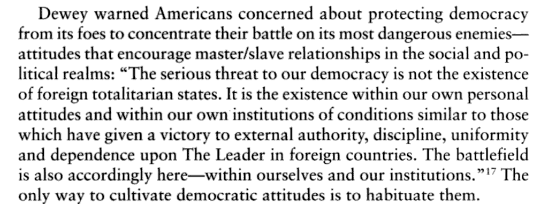
I think that there are pragmatist replies to this kind of liberalism, but I can’t be satisfied with them unless they explicitly invoke and address the problem of evil. I’m worried about this kind of theme in Dewey (ably summarized by John M. Savage in John Dewey’s Liberalism):

Dewey

I’m all for cultivating democratic habits, but that’s not the only bulwark against tyranny. It’s also helpful to ban tyranny and to make that prohibition permanent.

who says that binary thinking is Western?

I often hear that binary oppositions are typical of Western thought. The implication is that “we” should strive to avoid being trapped by such oppositions.

To be sure, certain distinctions (white/non-white, male/female, Christian/non-Christian) are the basis of injustices. Those distinctions have been important in Western Europe and have been used to justify oppression. As a result, some people are moved to challenge what they call Western dualism. But the problem isn’t dualism–after all, the whole point is to promote justice over its opposite, injustice–nor is it helpful to introduce a binary distinction between the West and the rest. It seems odd to invent a very simple and global binary in order to criticize dualism.

I’m skeptical of the very notion of the West, because it encompasses so much diversity and has overlapped with so many other parts of the world for so long that I don’t know how to define it. But one thing the West has not been consistently is dualistic.

Christianity is surely a Western phenomenon, and a core Christian idea is that Jesus is both divine and human, both a person and one with the persons of God and the Holy Spirit. Another orthodox Christian assumption is that nature/the world is good and is solely God’s creation, yet it is not identical with God. Many of the thinkers who have been formally condemned as heretics by Christianity have been banned for adopting dualistic views either of Christ or of nature.

Nobody could be more dualist than George Boole, the inventor of Boolean logic (in which all values are reduced to TRUE or FALSE). Apparently Boole was deeply influenced by classical Indian logic, which is rife with sharp distinctions. Taoism is also described as fundamentally dualist. All of which is to say that binary oppositions don’t seem to be particularly “Western” to me.

Jacques Derrida is cited as the source of the view that Western thought is binary, although it would surprise me if he really caused it to be so widespread. Besides, Derrida says things like this: “Doubtless Western metaphysics constitutes a powerful systematization of this illusion, but I believe it would be an imprudent overstatement to assert that Western metaphysics alone does so.”* Three points to notice about this sentence: 1) Derrida is talking about a specific tradition of philosophical thought (“metaphysics,” as Heidegger would define it), not about Western culture, more broadly. 2) He is not criticizing binary thinking per se but certain specific binaries, especially text versus reference. And 3) He doubts that Western metaphysics alone suffers from this “illusion.”

See also: to whom do the ancient Greeks belong?Jesus was a person of coloravoiding the labels of East and Westwhen East and West were oneon modernity and the distinction between East and West.

*Derrida, Positions, translated by Alan Bass (1982), p. 33

aphorisms, proverbs, maxims, and the purpose of this blog

If you search the Internet for “aphorisms,” you’ll find a mix of authors, from Lao Tze to Jean Baudrillard.

Some are literary figures who are eminently quotable–good at writing short, memorable passages that stand on their own even if they were originally composed for longer poems or continuous narratives. Oscar Wilde, Dorthy Parker, and Emerson are just a few examples of people called “aphorists” because they are pithy and witty.

Other books of aphorisms are lists of sentences or very short passages that are intended to be serious and wise. The biblical books of Proverbs and Ecclesiastes, the Greek collections of accumulated sayings attributed to Pythagoras and the Delphic Oracle, and the sutras of the Hindu tradition are examples. When these statements take the form of imperative sentences (“Enter not into the path of the wicked, and go not in the way of evil men”), they can be called maxims. When they sound more like generalizations about the world (“To every thing there is a season, and a time to every purpose under the heaven”), they are better named proverbs.

A philosophy professor friend of mine once disclosed his profession to the person sitting next to him on an airplane. “Oh, you are a philosopher,” the neighbor said. “What are your sayings?” He was thinking of traditions in which philosophy means explicit wisdom, and wisdom is succinct and quotable. Needless to say, that is not what professional philosophy is today.

Once collections of short, pithy sayings are treasured as wisdom (a thesaurus means a “treasury”), it becomes possible to write collections that look like proverbs but are more idiosyncratic, personal, and perhaps ironic or subversive. La Rochefoucauld exploits the subversive potential of the genre when he writes in the format of the biblical Book of Proverbs but gives advice like, “If we had no faults we should not take so much pleasure in noting those of others.”  Erasmus collects real wisdom in some of his books (Adagia, Apophthegmata), but he puts strings of quotable falsehoods in the mouth of the Fool in the Praise of Folly. It is never clear where the author stands. James Geary collects current examples of aphoristic writers in this tradition.

By the way, the root of “aphorism” is the Greek verb for dividing, defining, or setting limits (ultimately from horos, boundary). In the New Testament, the verb aphorizo is used for dividing the damned from the saved and for excommunicating sinners. I think “aphorism” means division because each one is disconnected from the next (not because their content is necessarily about distinctions). In contrast, the Sanskrit word sutra means “string” or “thread.” Both traditions refer to distinct fragments of text that are loosely strung together without explicit transitions. The Greek word emphasizes the distinction among these items; the Sanskrit stresses their connectedness.

Francis Bacon and Friedrich Nietzsche epitomize a different tradition. They are highly critical empiricists who use the aphoristic form to shake their readers’ assumptions and demand their readers’ creative attention.

Bacon begins his book Novum Organum (“or, true suggestions for the interpretation of nature”) by decrying two categories of thinkers. On one hand, some have “presumed to dogmatize on Nature,” inventing or borrowing a theory, trying to explain everything in terms of that theory, and “bringing others to their [preconceived] opinion.” On the other hand, some have succumbed to the “despair of skepticism” and are known only for their “complaints and indignation at the difficulty of inquiry.” The third course is to observe and experiment with nature, one piece at a time, striving always to challenge our prior assumptions. Having proposed that course, Bacon then offers a series of numbered “Aphorisms on the Interpretation of Nature and the Empire of Man.”

Why aphorisms? Arguably, because Bacon is highly suspicious of grand theories that organize everything neatly and prevent us from noticing what is actually happening. So he is suspicious of the logical connective tissue that would turn individual propositions into larger arguments. He prefers to list specific propositions and encourage the reader to consider each one on its merits and to put them together only tentatively. We must stop to think about the logical relationship, if any, among Bacon’s thoughts. The form thus befits its substance.

Nietzsche’s earliest works are essays distinguished by their highly quotable passages yet also connected into rhetorically powerful wholes, with beginnings, transitions, and conclusions. With Human All Too Human (1878) Nietzsche shifts to a new genre that then occupies almost all of his energy for the rest of his life: collections of aphorisms. Like all his later books except ZarathustraHuman All Too Human is a set of numbered passages that range from a single sentence to a few pages in length.

Although Nietzsche’s style is influenced by aphoristic authors after Bacon (La Rochefoucauld, whom he cites in aphorism #35; Pascal; Lichtenberg, and others), the opening of Human, All Too Human takes us back to Bacon. Nietzsche, too, wants to shake his readers out of their “habitual opinions and approved customs.” He too is fascinated by people’s cognitive biases and limitations and suspicious of generalizations. In the very first aphorism of his first aphoristic volume, Nietzsche writes: “in fact, I myself do not believe that anybody ever looked into the world with a distrust as deep as mine.” I think he is hinting why his book will not offer a connected argument. A string of distinct ideas avoids the pretentiousness or naïveté implied by a larger whole.

Here Nietzsche almost sounds like one of the skeptics whom Bacon decries for dropping the effort to understand nature because they understand our limits all too well. But they are just complainers. Nietzsche, echoing the distinctions of Novum Organum, insists that he takes “pleasure in externals, superficialities, the near, the accessible, in all things possessed of color, skin and seeming.” That is not the same as Bacon’s path–striving to understand the phenomena–but Nietzsche sees it as the next step. He is moving beyond Baconian empirical science into his own “gay science.” (And in Ecce Homo, Nietzsche insists, “We do not know half enough about Lord Bacon—the first realist in all the highest sense of the word—to know what he did, what he willed and what he experienced in his inmost soul.”)

A final tradition consists of authors who have left collections of numbered and loosely connected passages–string-like sutras–because death or some other contingency prevented them from pulling these fragments into more coherent works. An inspiration for Bacon may have been Hippocrates, the ancient physician who called for close observation. Hippocrates’ writings (other than the Hippocratic Oath) read like aphorisms for a contingent reason: he didn’t write them. They are collections of fragmentary Greek texts about medicine wrongly attributed to him.

I am not sure to what degree Novalis wanted to write connected arguments, but we have his fragmentary notes in the condition that he left them when he died of consumption; both his tragic youthful death and his aphoristic style seem to match the content of his thought. A century later, Kafka also died of TB, leaving 109 aphorisms on philosophical topics.

And then there’s Wittgenstein, all of whose major works consist of short numbered passages without explicit connections. After he died, Elizabeth Anscombe and Georg Henrik von Wright published

a collection of fragments made by Wittgenstein himself and left by him in a box-file. They were for the most part cut from extensive typescripts of his, other copes of which still exist …

Often fragments on the same topic were clipped together; but there were also a large number lying loose in the box. …

We … came to the the conclusion that this box contained remarks which Wittgenstein regarded as particularly useful and intended to weave into finished work if places for them should appear. Now we know that his method of composition was in part to make an arrangement of such short, almost independent pieces as, in the enormous quantity that he wrote, he was fairly satisfied with.

They published this book under the title Zettel, which I think it an unpretentious work for snippet or cutting. But a cutting is also what an aphorism is. A clipped-together packet of snippings from typescript also bears a distant resemblance to a string of beads, a sutra. 

The word “cutting” could also have a more organic sense. In his 1948 poem “Cuttings,” Theodore Roethke evokes their generative potential:

Sticks-in-a-drowse over sugary loam,
Their intricate stem-fur dries;
But still the delicate slips keep coaxing up water;
The small cells bulge;

One nub of growth
Nudges a sand-crumb loose,
Pokes through a musty sheath
Its pale tendrilous horn.

To be sure, Roethke wrote a much darker second poem with the same title, emphasizing the pain of growth and rebirth. April is the cruelest month, and all. But I’d like to stress the latent promise of things that are clipped and piled together in conditions favorable to regeneration. In fact, that hope explains why I have been moved to write 3,123 posts on this blog (which is yet another word to compare with aphorism, sutra, maxim, and the others cited here). If I believe anything, it’s that we are too strongly influenced by grand conceptions that simplify and block our progress, yet we do need ambitious ideas. So let’s let them emerge from close, responsive, joyful engagement with people and their creations, taken one at a time.

10 theses about ethics, in network terms

  1. People hold many morally relevant opinions, some concrete and particular, some abstract and general, some tentative and others categorical.
  2. People see connections–usually logical or empirical relationships–between some pairs of their own opinions and can link all of their opinions into one network. (Note: these first two theses are empirical, in that I have now “mapped” several dozen students’ or colleagues’ moral worldviews, and each person has connected all of his or her numerous moral ideas into a single, connected network. However, this is a smallish number of people who hardly reflect the world’s diversity.)
  3. Explicit moral argumentation takes the form of citing relevant moral ideas and explaining the links among them.
  4. The network structure of a person’s moral ideas is important. For instance, some ideas may be particularly central to the network or distant from each other. These properties affect our conclusions and behaviors. (Note: this is an empirical thesis for which I do not yet have adequate data. There are at least two rival theses. If people reason like classical utilitarians or rather simplistic Kantians, then they consistently apply one algorithm in all cases, and network analysis is irrelevant. Network analysis is also irrelevant if people make moral judgments because of unconscious assumptions and then rationalize them post hoc by inventing reasons.)
  5. Not all of our ideas are clearly defined, and many of the connections that we see among our ideas are not logically or empirically rigorous arguments. They are loose empirical generalizations or rough implications.
  6. It is better to have a large, complex map than a simple one that would meet stricter tests of logical and empirical rigor and clarity. It is better to preserve most of a typical person’s network because each idea and connection captures valid experiences and serves as a hedge against self-interest and fanaticism. The emergent social world is so complex that human beings, with our cognitive limits, cannot develop adequate networks of moral ideas that are clear and rigorous.
  7. Our ideas are not individual; they are relational. We hold ideas and make connections because of what others have proposed, asked, made salient, or provoked from us. A person’s moral map at a given moment is a piece of a community’s constantly evolving map.
  8. We begin with the moral ideas and connections that we are taught by our community and culture. We cannot be blamed (or praised) for their content. But we are responsible for interacting responsively with people who have had different experiences. Therefore, discursive virtues are paramount.
  9. Discursive virtues can be defined in network terms. For instance, a person whose network is centralized around one nonnegotiable idea cannot deliberate, and neither can a person whose ideas are disconnected.  If two people interact but their networks remain unchanged, that is a sign of unresponsiveness.
  10. It is a worthwhile exercise to map one’s own current moral ideas as a network, reflect on both its content and its form, and interact with others who do the same.

does focusing philosophy on how to live broaden or narrow it?

Pierre Hadot (1922-2010) built a quietly devoted following and influenced many others indirectly, via Michel Foucault. A classicist, Hadot interpreted the Hellenistic philosophical schools (Stoicism, Epicureanism, Skepticism, and Neoplatonism) as communities of people devoted to improving themselves by employing a range of mental techniques. Argumentation was just one of their exercises, along with meditation, introspection, confession, renunciation and so on. These schools were similar to classical Indian and Chinese movements, but unlike (say) Kantianism or British empiricism, which are mainly structures of arguments.

Hadot thought that the Hellenistic tradition of “philosophy as a way of life” still echoed in the work of certain post-medieval thinkers: Montaigne, Spinoza, Goethe, Nietzsche, and Wittgenstein, among others. But it had become marginal by the 20th century, because philosophy had turned into an academic discipline, dispassionate and purely intellectual.

Hadot blamed that situation on Christianity, which–he argued–had divided the heritage of Hellenistic thought into two distinct parts. The arts of the self (meditation, confession, and the like) had been assigned to the monasteries, while abstract argumentation went to the universities. Hadot had first trained as a priest and was a learned student of early Christianity, but perhaps he had the critical bias of an ex-believer. None of Hadot’s major positive examples were Christian thinkers.

In any case, Hadot suggested a choice. “Philosophy” can mean argumentation united with mental discipline to produce communities devoted to moral improvement; or it can mean the dispassionate and often individual pursuit of truth. One can see these alternatives oscillate over time. The grand theoretical edifices of Plato and Aristotle give way to the Hellenistic Schools and their focus on self-improvement. Medieval scholasticism yields to humanistic writers like Montaigne and Erasmus, who are more concerned with particular inner lives. German idealism fades in favor of Nietzsche, Emerson, and other practitioners of philosophy as a way of life.

That is a provocative framework, but not the only available one. In The Rise of Western Christendom, Peter Brown describes how a generation of great converts to Christianity–Jerome, Augustine, and their contemporaries–debated the relevance of classical thought and “often took up extreme poses against the pagan classics.” But

such a narrowing down of culture (drastic as it was) [was not] an altogether unique event in the long history of the ancient world. It did not necessarily betray a moment of irreparable breakdown. Rather, the history of Greek and Roman civilization had always been marked by a characteristic pendulum swing. Moments of exuberant creativity were repeatedly followed by long periods of retrenchment. And this pendulum swing was marked by constant alternation between periods of creativity in literature and in speculative philosophy followed by long periods of single-minded preoccupation with ethical problems. How educated persons should groom themselves; how they should conquer their weaknesses; how they should overcome pain and console themselves in moments of grief; how they should stand in relation to their fellows and to the gods: these were issues pursued  by ancient philosophers, for centuries on end, with remarkable singlemindedness. [A footnote to Hadot follows a paragraph later.]

In Brown’s framework, moments when abstract thinkers predominate–like 5th century Athens and perhaps Vedic India, 12th century Paris, or 18th century Germany–are exuberantly creative and expansive, but they are followed “by long periods of retrenchment” in which the focus narrows to how to live, including such trivial matters as “how educated persons should groom themselves.” In Hadot’s framework, periods of disconnected, abstract, “academic” thought alternate with times when rigorous argument unites with spiritual practices to produce people who can live “in the service of the human community.”

They could both the right, because intellectual history is vast and complicated. I am left with a sense that there are two risks for any kind of thinking that we call “philosophy.” It can degenerate into mental hygiene, focused on how to live everyday life to the exclusion of challenging questions about nature and reality. Or it can turn strictly theoretical, disconnected from questions about how to live (or–worse–influenced by unexamined assumptions about the good life).

See also on philosophy as a way of lifemy notes on Pierre Hadot; and Hannah Arendt and philosophy as a way of life

Tamsin Shaw’s critique of moral psychology

I think that Tamsin Shaw’s article “The Psychologists Take Power” (New York Review of Books, February 25, 2016) is very important. I enjoyed an informal seminar discussion of it on Friday, but that conversation made me realize that the article is rather compressed and allusive, and its argument may not convey to readers who are unfamiliar with the research under review or with important currents in moral philosophy.

This is how I would reconstruct Shaw’s argument:

First, the psychological study of morality presents itself as a science; it claims to be value-neutral and strictly empirical. The phenomena under study are called “moral,” but the researchers purport or at least strive to be value-free.

Given that self-understanding, psychologists are attracted to three research programs: evolutionary biology, neuroscience, and game theory. Each presents itself as value-neutral. The three programs can be made highly consistent if one focuses on rapid human reactions to very basic stimuli, such as sexual desire or perceived threat. These reactions presumably arose well before cultural differentiation, they have Darwinian explanations, they would serve individuals or groups in competitive situations (e.g., while struggling for food or mates), and they light up specific parts of the brain. Findings that seem consistent with all three streams of research have special prestige because they seem particularly hard-headed and empirical. (A perfect example is the Times’ article yesterday: “What’s the Point of Moral Outrage? It may seem noble and selfless, but it’s also about improving your reputation.”)

People who think this way about morality are basically amoral. They have no independent moral compass. Yet they learn techniques that are useful for manipulating subjects, particularly in extreme situations where instinctive human impulses are most pertinent. Therefore, it is no surprise (Shaw writes) that some of them became professional advisers on torture during the first years of the Iraq occupation. Any argument against torture will seem to them arbitrary and subjective.

The last point may be a bit of an ad hominem, although it is certainly worth taking seriously as a warning. But even if all psychologists use good professional ethics, the agenda of making moral psychology strictly empirical needs to be challenged.

For one thing, you can’t study phenomena categorized as “moral” without independently deciding what constitutes morality. We have many deep, instinctive impulses. For instance, we are capable of altruism and even self-sacrificing love, but also of violence and greed. It’s plausible that many of these impulses have evolutionary roots and can be explained in game-theoretic terms. But only some of them are moral. Imagine, for instance, that I said, “Greed is a moral virtue that we developed early in our evolution as a species to motivate individuals to maximize resources.” This would not be a scientifically false statement. It would be morally false. The mistake is to call greed a “virtue.”

Jonathan Haidt likes to provoke liberals by describing “authority” and “sanctity” as moral values. They may be, but that requires a moral argument against the position that only care, fairness, liberty, and loyalty count as moral. The fact that some people see authority and sanctity as virtues does not make that opinion right. Hitler thought that racial purity was moral, and he was wrong. So moral reasoning is indispensable.

Further, when we reason morally, we are usually thinking about very complex, socially constructed phenomena that we don’t directly perceive. We certainly don’t experience them as immediate sense-data. I wrestle with my feelings about democracy, the United States, academia, capitalism modernity, etc. These things don’t appear in my visual field like violent threats or piles of yummy food. I experience such institutions through speech and text, through vicarious reports, and by accumulating experience and arguments over decades. Possibly the impulses that homo sapiens developed early in our evolution influence my judgments. For instance, I may have a deep, unconscious tendency to separate people into in-groups and out-groups, and that may affect my tendency to see the USA as my group. But I could treat another unit as my main group, I could be uninterested in (or even unaware of) the USA as an entity, or the country might not even exist. A nation is a social construction, built by people for complex reasons, that we understand in a mediated way. It would be a contentious assumption, not a hard-nosed scientific premise, that our most primitive impulses have much to say about institutions or our attitudes toward them.

See also: Jonathan Haidt’s six foundations of morality; neuroscience and morality; morality in psychotherapy; on philosophy as a way of life; is all truth scientific truth?; and right and true are deeply connected.

Korsgaard on animals and ethics

(Northern Virginia) I made some comments about animal rights and welfare at one of the Tisch Talks in the Humanities last week. I have contributed no original scholarship on this topic, nor even followed the vast literature closely. But in the course of a quick lit. review, I came across the line of argument that Christine Korsgaard has developed, and it struck me as persuasive. I’d put a central point like this:

  1. There are two kinds of beings, those that have wants and those that don’t.
  2. There are two kinds of beings, those that can “reason” and those that cannot (where to reason is to have reflexive thoughts, or the ability to assess wants, desires, etc. critically).

Screen Shot 2016-02-11 at 1.23.50 PM

Inert objects like rocks and stars neither have wants nor can they reason. It follows that nothing is good or bad for them. All members of the animal kingdom, including human beings, have wants. That implies that some things are good and bad for each of them. Perhaps we alone are rational, in the Kantian sense. In that case, we and not animals have moral duties. But our moral duties are not only to those who are rational, but to those who have wants, which includes animals.

(I put God in the space for “can reason,” but “has [no] wants,” because I’ve been reading Spinoza this winter, and that’s his view. It’s theologically plausible that if there’s a God, God has wants. In that case, God would be in the same zone with us.)

Kant wrote:

If a man shoots his dog because the animal is no longer capable of service, he does not fail in his duty to the dog, for the dog cannot judge, but his act is inhuman and damages in himself that humanity which it is his duty to show towards mankind. If he is not to stifle his human feelings, he must practice kindness towards animals, for he who is cruel to animals becomes hard also in his dealings with men.

Korsgaard is a major Kantian, but in her Tanner Lectures on “Fellow Creatures: Kantian Ethics and Our Duties to Animals” (2004) and subsequent work, she disagrees with Kant’s reasoning here. What is wrong with shooting the dog is not that the man somehow neglects his duties to other humans. He has done wrong by mistreating the dog. Just like the man, the dog has desires, and there are things that are good for the dog. The man has negated the dog’s good in his own interest.

It is likely that dogs do not have the capacity to reflect on or change what they want. Therefore a dog does not have the right or obligation to participate in creating moral norms that are binding on itself or the man. It “cannot judge” in the way that a person can. We don’t blame it (or genuinely esteem it) for acting like a dog; that is simply its nature. But the man’s duty to reflect on his own desires is precisely the duty to take others’ desires into account. It doesn’t matter whether the others can judge; it matters whether they have desires and goods. Likewise, our duties to other human beings are not contingent on their acting like Kantian rational subjects.

See also: latest thoughts on animal rights and welfare and my evolving thoughts on animal rights and welfare.

Selim Berker on moral coherence

In “Coherentism via Graphs,”[i] Selim Berker begins to work out a theory of the coherence of a person’s beliefs in terms of its network properties. Consider these two diagrams (A and B) borrowed from his article, both of which depict the beliefs that an individual holds at a given time. If one beliefs supports another, they are linked with an arrow.

Screen Shot 2016-02-07 at 12.47.04 PM

Both diagrams show an individual holding three connected and mutually consistent beliefs. Thus traditional methods of measuring coherence can’t differentiate between these two structures. However, Graph A is pretty obviously problematic. It involves an infinite regress—or what has been called, since ancient times, “circular reasoning.” Graph B is far more persuasive. If someone holds beliefs that are connected as in B, the result looks like a meaningfully coherent view. If you find coherence relevant to justification, then you will have a reason to think that the beliefs in B are justified—a reason that is absent in A.

Berker also proposes a subtler but more decisive reason that B is better than A. Below I show A again, now with the component beliefs labeled as P, Q, and R. If the law of contraposition holds, than A implies another graph, A’, that is its exact opposite. A’  includes beliefs -P, -Q, and -R, and the arrows point in the reverse direction.

Screen Shot 2016-02-07 at 12.48.37 PM

But that means that if belief P is justified because it is part of a coherent system of beliefs, then the same must be true of -P, which is absurd.[ii]

The overall point is that coherence is a property of the network structure of beliefs. That should be interesting to coherentists, who argue that what justifies any given belief just is its place in a coherent system. But it should also be interesting to foundationalists, who believe that some beliefs are justified independently of their relations to other ideas. Foundationalists still recognize that many, if not most, of our beliefs are justified by how they are connected to other beliefs. Thus, even though they believe in foundations, they still need an account of what makes a worldview coherent.

I have been developing a similar view, with a narrower application to moral thought (and without Berker’s deep grasp of current epistemology). I am motivated, first, by the sense that what makes a moral worldview impressively coherent cannot be seen without diagramming its whole structure. Imagine, for instance, a person who holds two major moral beliefs: “Never lie” and “Do not eat meat.” Assume that this person has not found or seen any particular connection between these two main ideas.

Screen Shot 2016-02-07 at 12.50.10 PM

His or her set of maxims is perfectly consistent: there is no contradiction between any two nodes. And every idea has a connection to another. But if we wanted to judge the coherence of this worldview, we would not be satisfied with knowing the proportion of the components that were consistent and directly connected. It would matter that the person holds two separate clusters of ideas—two hubs with spokes. This person’s network is fairly coherent insofar as it is organized into clusters rather than being completely scattered; but it would be more coherent if the two clusters interconnected via large integrating ideas. You can’t see the problem without diagramming the structure.

I also have another motivation for wanting to explore moral worldviews and political ideologies as networks of beliefs. In moral philosophy and political theory, constructed systems are very prominent. Although diverse in many respects, such systems share the feature that they could be diagrammed neatly and parsimoniously. In utilitarianism, the principle of utility is the hub, and every valid moral judgment is a spoke. That theory is so simple that to diagram it would be trivial. Kantianism centers on several connected principles, and Aristotelian, Thomist, and Marxist views are perhaps more complicated still. But in every case, a network diagram of the theory would be organized and regular enough that the whole could be conveyed concisely in words.

In contrast, my own moral worldview has accumulated over nearly half century as I have taken aboard various moral ideas that I’ve found intuitive (or even compelling) and have noticed connections among them. My network is now very large and not terribly well organized. A narrative description of it would have to be lengthy and rambling. Many of my moral beliefs are nowhere near each other in a network that sprawls widely and clusters around many centers.

I suspect this condition is fairly typical. No doubt, individuals differ in how large, how complex, and how organized their moral worldviews have become, but a truly organized structure is rare. (I have asked a total of about 60 students and colleagues to diagram their own views, and only one of the 60 gave me a network that could be concisely summarized.) That means that such constructed systems as Kantianism and utilitarianism are remote from most people’s moral psychology.

Further, I think that having a loosely organized but large and connected network is a sign of moral maturity. It is a Good Thing. That is obviously a substantive moral judgment, not a self-evident proposition. It arises from a certain view of liberalism that would take me more than a blog post to elucidate. But the essential principle is that we ought to be responsive to other people’s moral experiences.

Berker includes experiences as well as beliefs in his network-diagrams of people’s worldviews.[iii] In science, it should not matter who has the experience. An experience of a natural phenomenon is supposed to be replicable; you, too, can climb the Leaning Tower and repeat Galileo’s experiment. But in the moral domain, experience is not replicable or subject-neutral in the same way. Since I am a man, I cannot experience having been a woman my whole life so far. Thus vicarious experiences are essential to moral development.

If we are responsive, we will accumulate sprawling and random-looking networks of moral beliefs as we interact with diverse other people. These networks can be usefully analyzed with the techniques developed for analyzing large biological and social networks. It will be illuminating to look for clusters and gaps and for nodes that are more central than average in the structure as a whole. The coherence of such a network is not a matter of the proportion of the beliefs that are consistent with each other. Its coherence can better be evaluated with the kinds of metrics we use to assess the size, connectedness, density, centralization, and clustering of the complex networks that accumulate in nature.

On the other hand, if someone adopts a moral view that could be diagrammed as a simple, organized structure, he has not been responsive to others so far and he will be hard pressed to incorporate their experiences in the future. At the extreme, his simple graph is a sign of fanaticism.

See also: envisioning morality as a network; it’s not just what you think, but how your thoughts are organized; Stanley Cavell: morality as one way of living well; and ethical reasoning as a scale-free network (my first thoughts along these lines, from 2009).

Notes

[i] Berker, S. (2015), Coherentism via Graphs. Philosophical Issues, 25: 322–352. doi: 10.1111/phis.12052

[ii] “Coherence, we have been assuming, is a matter of the structure of support among a subject’s beliefs, experiences, and other justificatorily-relevant mental states at a given time.” But we can use directed hypergraphs (in mathematics, networks in which any of the nodes can be connected to any number of the other nodes by means of arrows) to represent all of those support relations. That is, we use directed hypergraphs to represent all of the relations that have a bearing on coherence. It follows that coherence is itself expressible as a graph-theoretic property of our directed hypergraphs (p. 339).

[iii] “Many theorists hold that a subject’s perceptual experiences are justificatorily relevant (in these sense that they either partially or entirely make it the case that the subject is justified in believing something).”