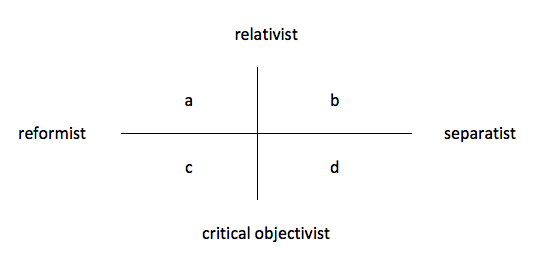
issues in the philosophy of social science

Here is the outline of a course I’d like to take–or possibly design and teach some day:

  1. What is the social world? Is it, for example, a bunch of human individuals who interact? Perhaps not, since individuals’ identities and values emerge from social processes, while institutions also have intentions and agency. Do sex and/or gender (for instance) actually exist? Do cultures exist, or are they simplified labels that we impose on heterogeneous phenomena?
  2. Does it matter who studies the social world? On one hand, we might think that what we believe about society is just a function of who studies it. On the other hand, we might assume that social phenomena can be objectively known using procedures that are independent of who uses them. The truth probably lies in between. So how does the identity of the researcher influence the results of social science, and, more generally, how does power relate to truth?
  3. Facts and values: Are they distinct? How do they relate? Should we think of values as biases that may interfere with objectivity, or can they be valid as opposed to invalid? Should social science have values?
  4. What do various methods of social science assume about epistemology? For example, what must we believe about our ability to know in order to run a randomized controlled experiment, develop a game-theoretical model, survey a population and calculate distributions, or interpret a Balinese cockfight?
  5. What is and ought to be the role of social science in society? Should it be influential? When and how? Is everyone a social scientist, or does that phrase name a distinct group of experts or specialists? Should the goal of changing the world affect the research agendas and methods of social science? Who should govern (i.e., fund, regulate, organize) social science and how?

my self, your self, ourselves

Thesis: I have a vocabulary for describing my own behavior that’s full of words about motives, goals, and principles. “Why did I raise my hand? Because I wanted to answer your question. Why did I give that answer? Because I knew it was the truth and I was obliged to say it.” This is a valid way of thinking, because each claim is subject to being tested and can be refuted. (Maybe I raised my hand to show off, or because I misheard you, or to reach for a light switch.) It’s morally important that I think this way about myself, because it reminds me that I am responsible for my actions and must strive to apply the best principles. It’s also morally important that I envision you in the same terms. That is necessary for recognizing your dignity and equality, and it reminds me that I should help you to make your own choices wisely. I should strive to remove obstacles and enhance your freedom.

Antithesis: We have a vocabulary for describing any action in nature that’s all about causes and effects. “Why did he raise his hand? Because an electrical signal traveled along a nerve to a muscle. Why did that signal happen? Because a synapse fired in his brain.” This is the only scientific way to think about life, because science is defined as a third-person account of nature that sets aside the subjective perspective. It’s morally valuable to think this way about other people because then we realize that they are caught in a web of causality and cannot escape suffering; it makes us compassionate. And it’s important that I apply this way of thinking to my own case, viewing my own first-person talk of goals and principles as kind of myth. Then I can escape an overweening attachment to myself that makes me selfish, self-important, and fearful.

Synthesis: There are two ways of thinking about sentient action, the first-person and the third-person mode, and each has its own norms of validity and tests of truth. We are nowhere near being able to make these two perspectives cohere, if we ever will. But we must treat one another right. We’re in this together, and we’re all we’ve got. That requires holding several ideas in our minds at once. 1) I am responsible for what I do and should strive to do right by you. But 2) The condition of my self is of no great consequence to the world and is fundamentally a matter of luck. 3) You face choices and can strive to do right, and I ought to help you. But 4) The condition of your self is a matter of luck; often you will be a in a state of unease or even suffering; and I have compassion for you.

See also: Hegel and the Buddhathree truths and a question about happiness; and on philosophy as a way of life.

how philosophy is supposed to work

(Posted during the Social Ontology 2018 Conference, hosted at Tufts) We live in a positivist culture in which many smart people hold fairly simple views of science and believe that all rigorous thought is scientific. Their objection to highly abstract conceptual questions and to questions of value (moral, political, or aesthetic) is that these matters cannot be scientific; hence progress is impossible. Endless debate must result from the brute fact that we hold different opinions.

But we must figure out what to value and what to believe about conceptual issues. Given our cognitive and moral limitations as individuals, our best way to think about such matters is with other people–learning from their perspectives and testing our beliefs with them. Words are not our only tools for thinking together–mathematical notations, diagrams, images, music, and bodily movements also work–but words are awfully helpful and usually play a role even when we make heavy use of the alternatives.

Therefore, human beings talk about conceptual and normative matters. We always do, everywhere and in every era. But a literal conversation has drawbacks. Since an actual, oral dialogue must involve a small number of people, the cognitive resources are limited. It lasts for a finite amount of time–too brief to address all the relevant questions and issues. And it proceeds in a linear fashion, with one comment or question occupying attention at any given moment, followed by the next one. Although people may make discursive moves like saying, “Let’s go back to your earlier point P, because I disagree with it,” the participants can barely explore the whole network of potentially connected ideas. A conversation is one walk through one part of the network.

A discipline like philosophy is an effort to improve the conversation by institutionalizing it. Many people can participate in a discussion that is organized in the form of journals, books, symposia, and reviews. Participants publish their claims and reasons, leaving them on the record to be picked up by others. They take time to make each point carefully, offering reasons and considering objections. If someone claims P, other people are supposed to read and cite that claim before they say P or not-P. If you criticize P, then other people who begin by believing P are supposed to read and consider your objection to P before they use it as a premise in their arguments. The debate still continues permanently, but it is supposed to become increasingly organized and refined in a process that is just as cumulative as a “normal science” is. Moreover, the strictly philosophical debate is not insulated from other intellectual work but is constantly informed by developments in the sciences, humanistic thought, and actual events in the world.

This is all idealized. I am perfectly aware that not everyone can participate in a professional discipline’s discussion; in fact, the vast majority of human beings are excluded, for a whole range of reasons. Nor would everyone want to join even if that were easy for them. Those who participate act imperfectly, showing too much deference to certain authorities, demonstrating group-think, etc. And ethics (in particular) still suffers from myopia about cultural diversity and empirical data that Owen Flanagan well describes in his new book, The Geography of Morals: Varieties of Moral Possibility.

Still the ideal has significance as a heuristic. It draws our attention to Robert Merton’s four CUDOS norms, which he developed for science (per Wikipedia):

  • Communalism all scientists should have equal access to scientific goods (intellectual property) and there should be a sense of common ownership in order to promote collective collaboration, secrecy is the opposite of this norm.
  • Universalism all scientists can contribute to science regardless of race, nationality, culture, or gender.
  • Disinterestedness according to which scientists are supposed to act for the benefit of a common scientific enterprise, rather than for personal gain.
  • Organized Skepticism Skepticism means that scientific claims must be exposed to critical scrutiny before being accepted.

These norms also apply to philosophy, and we can add more values, such as 1) the norm of citing and addressing previous contributions to the same discussion; 2) the principle that academic discussions should ultimately (but not always directly) benefit public life; 3) the value of being permeable and connected to other discussions in other fields; and 4) an affirmative effort to incorporate people and perspectives that have hitherto been marginalized.

See also: is all truth scientific truth?does naturalism make room for the humanities?why social scientists should pay attention to metaphysics, and adding democracy to Robert Merton’s CUDOS norms for science.

empathy, sympathy, compassion, justice

I’d posit the following definitions:

  • Empathy: Feeling a similar emotion in response to someone else’s emotional state. Your friend is mad at her boss because he treated her unfairly. That makes you mad at her boss. Your anger is probably different in texture and intensity from hers, but it’s the same in kind, an imperfect reproduction of her mental state.
  • Sympathy: Feeling a supportive emotion in response to someone else’s emotional state that is not the same as that person’s original emotion. She is mad at her boss, so you become sorry for her, or committed to fairness, or sad about the state of the world, or nostalgic for better times–but not angry at her boss. Then you are sympathetic. (NB You can be both sympathetic and empathetic if you feel several emotions.)
  • Compassion: A species of the genus sympathy. Another person’s negative emotion causes you to have a specific supportive feeling that is not the same as her emotion: you sincerely wish that her distress would end without blaming her for it.
  • Justice: A situation or decision characterized by fairness, goodness, rightness, etc. (These are contestable ideas and may be in tension with each other.) The English word “just”–like dikaios in classical Greek–can be applied either to a situation or to a person who cares and aims for justice.

There is an old and rich debate about which character traits and subjective states are best suited to pursuing justice. One answer is that you should be a just person, one who tries to decide what is fair or best for all (all things considered), who desires that outcome, and who works to pursue it. A different response is that we are not well suited to defining and pursuing justice itself. It’s better to cultivate other emotions, such as empathy, sympathy, compassion–or loyalty, aversion to harm, or commitment to specific rules–in order to deliver more just outcomes, all things considered.

I haven’t yet read Paul Bloom’s new book, Against Empathy, but based on this interview and other secondary material, I take it to be an empirically-based contribution to this debate. Bloom marshals evidence that empathy is a highly unreliable guide to justice, probably more likely to mislead than to inform. We should cultivate justice itself, not settle for a substitute, and certainly not the poor substitute of empathy.

For instance, Donald Trump can make people feel empathy for a small number of individuals whose families were allegedly victimized by undocumented aliens, and then use that emotion to build support for deporting millions of people who have harmed no one. A famous example is Edmund Burke’s outrage at the mistreatment of Marie Antoinette, which obscured any concern for the countless people tortured, executed, or “disappeared” by the ancien regime that she represented. (By the way, I happen to respect Burke a lot–and I don’t think it was fair or smart to execute the Queen–but this passage is still a good example of misplaced empathy.)

Empathy can also substitute for justice, as I argued on a visit to Israel in 2013. You congratulate yourself for feeling some version of a suffering person’s emotion and excuse yourself from fixing the problem.

Compassion may be better than empathy. Instead of feeling the same emotion as the other person, you feel a combination of beneficence and equanimity that may be a more reliable guide to acting well. But it’s possible that compassion only clears the deck for reasoning about what you should actually do.

For its part, justice can be emotional. You can feel a powerful urge to make the world more just. That is helpful insofar as the feeling motivates you and insofar as people obtain genuine insights from our emotions; but it is dangerous because the emotion of desiring justice can be misplaced. You can feel great about improving the world when you are actually harming it.

Justice is also necessarily discursive. You must put into words–at least inside your own head–what is good or fair, and why, and make yourself accountable for that position. Therefore, much hinges on whether we human beings can reason explicitly about justice in ways that improve upon our strictly affective reactions to particular situations.

See also: empathy: good or bad?the limits of putting yourself in their shoes and looking with their eyes; an alternative to Moral Foundations Theory; structured moral pluralism (a proposal); and how to save the Enlightenment Ideal.

the right to strike

Yesterday, Alexander Gourevitch from Brown University spoke on “The Right to Strike.” I won’t try to summarize (or scoop) the argument of his forthcoming paper, except to say that Gourevitch uses an account of oppression to give a strong defense of the right to strike, and he squarely addresses the hard issue. Successful strikes often require a degree of coercion in the form of picket lines, sit-ins, work-stoppages that close the firm, strong moral pressure on potential scabs, etc. Many liberal political theorists, American jurists, and European social democrats defend unions and acknowledge the right to strike but are squeamish about the coercive aspect. They either deny that coercion occurs or argue that strikes are only acceptable when free of all coercion. Gourevitch defends the coercive aspect of strikes–although not as an absolute right.

I would reach the same destination from a different starting point. I would begin with the premise that human beings have the right to create, design, and govern groups. Among the many types of groups that we design are governments (at all levels and scales), companies (privately held or publicly traded), and unions. Any of these three can allow or prevent an individual from working in a particular job. The government can regulate or legislate against the job or a category of workers, the firm can refuse to hire or fire an employee (or close the whole shop), and the union can strike. I begin with no assumption that any of these acts is more–or less–legitimate than the others. Governments, companies, and unions can be good or bad. They can do the right or the wrong thing. It all depends on the details.

In particular, it depends on how they are organized internally and what effects they have on outsiders (including natural systems as well as people). Assessing their internal structures and their consequences is controversial because it raises all the basic questions of justice.

For example, it you are a participatory democrat, you will value institutions just to the degree that they are internal democracies. Companies seem the least promising candidates, although democratic firms do exist. Both unions and governments range from highly democratic to highly authoritarian. Before you acknowledge the justice of a coercive strike, you will ask whether the union is democratic (and whether it is more or less democratic than the state that seeks to police it). You may embed in the definition of “democratic” some openness to outsiders, such as workers who are not already members of the union.

If, on the other hand, you are libertarian, you will value institutions just to the degree that the reflect individual, voluntary choice. Governments are the least promising, because very few citizens literally and actively consent to be governed. Governments are only legitimate to the degree that they create space for private agreements. Companies and unions are both potentially legitimate, but unions may be less so, to the extent that they coerce. Hayek claimed that unions “are the one institution where government has signally failed in its first task, that of preventing coercion of men by other men–and by coercion I do not mean primarily the coercion of employers but the coercion of workers by their fellow workers.”

For my own part, I am deeply pluralist. I believe in the value of maintaining a diverse set of institutional arrangements as checks against each other and as manifestations of human plurality and creativity. I am happy to see non-democratic institutions (e.g., the Catholic Church), strongly democratic ones, and many other forms. But I am not a relativist. I think that some organizations are better than others, and some combinations are more desirable than others. It’s just that an account of what makes organizations good must be nuanced and pluralist. One size doesn’t fit all.

On these grounds, I would defend unions as human creations that contribute to a pluralist public sphere. And I would accept that they will act coercively–within appropriate limits–when they strike. I am not positively enthusiastic about coercion, but I’d stress that states and companies also coerce. If you want (or need) to work, and a union has closed your workplace, then you have a complaint; but you also have a complaint if the company fires you arbitrarily or the state throws you in jail. Stronger unions make the second two forms of pervasive injustice less likely. A world with states, companies, and unions is more just than a world with just the first two.

See also my “The Legitimacy of Labor Unions” (2001), which is too moderate, China teaches the value of political pluralism, and should all institutions be democratic?

system, organism, person, organization, institution: some definitions

If you want real expertise on this kind of question, you should attend “Social Ontology 2018, the 11th Biennial Collective Intentionality Conference” from August 22-25, 2018 at Tufts. But in case you want some light musing on the subject …

A system is an assemblage of interacting parts that persists over time. It can change, but a parsimonious description applies over its whole history. (“My Mac could run SPSS once I installed the new software, but it’s still the same system.”)

An organism is a system that no one designed. Instead, it results from the reproduction of similar organisms.

A biological organism is an organism that exhibits the properties of life. This definition implies that there may or could be non-biological organisms.

A sentient organism is one to which we can accurately attribute mental states, such as pain, pleasure, aversion, desire.

A person is a system whose mental states include memory, planning, and decision. Thus the person’s development over time is partly her responsibility, not solely the result of accident and force. Not all persons are organisms. Entities that meet the definition of persons include human beings but also God, angels, devils, space aliens, perhaps other advanced mammals, perhaps some future AI, and organizations–see below.

A human person is a person that is also an organism of the species homo sapiens. A human person is capable of certain specific mental states that are not necessary conditions of personhood in general, e.g., love and suffering.

An institution is a system composed of at least two persons, plus any number of other components (e.g., buildings, legal rights). A market, for example, is an institution that combines many buyers and sellers, their goods, their rights, rules, and so on. Note that a market is not a person because it doesn’t have mental states.

An organization is an institution to which we can attribute memory, planning, and decision. Such attributions are not metaphorical but use exactly the same logic that we apply to human persons. (“I can tell that Tufts intends to educate students from the fact that it expresses this intention on its website and then actually educates.” Tufts doesn’t love, but Tufts does intend and plan. As such, it is a person.)

By these definitions, a social organization is a person; it is simply not a human person. It lacks the rights of a human being. Human beings gain rights not from the mere fact that we are complex systems capable of remembering, planning, and deciding–so are organizations–but from something else. I would attribute our rights to the fact that in addition to being able to remember, plan, and decide, we can also love and suffer.

(I was led to these thoughts by the discussion of Elinor and Vincent Ostrom and their eclectic readings of Daniel Dennett, John Dewey, Douglas North, and others, as summarized in Vlad Tarko, Elinor Ostrom: An Intellectual Biography, pp. 137-43. See also: against methodological individualismwhy social scientists should pay attention to metaphysics; and the legacy of Elinor Ostrom and the Bloomington School.)

from I to we: an outline of a theory

These are the main ideas that I’ve defended (or plan to develop) in my theoretical scholarship. They are organized from micro to macro and from ethics to politics. As always, I put this draft online to welcome critical feedback.

  1. Each individual holds a changing set of opinions about moral and political matters. These ideas are connected by various kinds of logical relationships (e.g., inference, causation, or resemblance). Thus each person’s moral opinions at a given moment can be modeled as a network composed of ideas, plus links. In a conference paper, Nick Beauchamp, Sarah Shugars and I have derived network diagrams for 100 individuals and provide evidence that these are valid models of their reasoning about healthcare, abortion, and child-rearing. This approach challenges theories that depict moral reasoning as implicit, unconscious, and unreflective.
  2. A culture, religion, or ideology is best modeled as a cluster of roughly similar idea-networks held by many individuals. Human beings are not divided into groups that are defined by foundational beliefs that imply all their other beliefs. Rather each person holds a unique and often flat and loose network of ideas that overlaps in part with others’ networks. This model avoids radical cultural relativism, as I already argued in my Nietzsche book (1995).
  3. This model of culture also challenges John Rawls’ argument for liberalism as tolerance and neutrality. Rawls presumes that most citizens hold incompatible but highly organized and consistent “comprehensive doctrines.” As a result, they must largely leave one another alone to live according to their various conceptions of the good. If, instead, we understand worldviews as loose and dynamic idea-networks, we find support for a liberalism of mutual interaction instead of distant toleration.
  4. We are not morally responsible for the ideas that we happen to learn as we grow up. That is a matter of luck. But we are responsible for interacting with other people who hold different opinions from ours. Such dialogues can be modeled as the interactions of people who hold different idea-networks. As they disclose and revise ideas and make connections, the discussants produce a shared network. In a paper now being revised and resubmitted, David Williamson Shaffer, Brendan Eagan, and I model Tufts students’ discussions of controversial issues as dynamic idea-networks.
  5. A person can organize her beliefs in ways that either enable or block dialogue. For instance, an individual whose network is centralized around one nonnegotiable idea cannot deliberate; neither can a person whose ideas are disconnected. Thus discursive virtues can be defined in network terms, deliberations can be evaluated using network metrics, and we can strive to organize our own ideas in ways that facilitate discussion.
  6. If people talk, it implies that they were willing to sacrifice time and attention to a conversation. If they have something significant to talk about, they must hold a good in common that they can control or influence. Thus we cannot have the kinds of discussions that improve our own values unless we are organized into functional groups. But creating and sustaining groups requires more than talk. Groups also need rules and practices that coordinate individuals’ action, as well as relationships marked by trust, loyalty, and other interpersonal virtues. In short, civic life depends on a combination of deliberation, collaboration (solving collective action problems), and relationships.
  7. To enable deliberation, collaboration, and relationships requires favorable institutions, such as appropriate legal rights, widespread education in these virtues, and a robust civil society composed of associations that offer opportunities for self-governance. Since these institutions are inadequate in the USA, we need reform.
  8. To change constitutional rights, school systems, and other large institutions, political actors must employ leverage. They must move strangers and impersonal organizations at a distance. Making effective use of leverage is an ethical obligation but also a threat to the relational values implied by points 1-7 (above), which are prized by certain political theorists, such as John Dewey and Hannah Arendt. We must understand how to use impersonal leverage at large scales without undermining or displacing relational politics.

notes on the metaphysics of Gandhi and King

Gandhi offers a fully developed metaphysics and epistemology–original even though it is grounded in classical Indian thought. For Martin Luther King, Protestant theology provides a core theory of human nature, but King navigates his way through debates in modern Protestantism and offers his own synthesis and draws political implications. Even for non-Hindus and non-Protestants, some premises that both of these authors share may be persuasive.

For Gandhi, there are truths–for example, about the good life and the just society–but they exceed any individual’s comprehension. Almost everyone (perhaps literally everyone[1]) contributes valuable insights by observing the world from her own limited and fallible perspective.

The golden rule of conduct, therefore, is mutual toleration, seeing that we will never all think alike and we  shall see Truth in fragment and from different angles of vision. Conscience is not the same thing for all. Whilst, therefore, it is a good guide for individual conduct, imposition of that conduct upon all will be an insufferable interference with everybody’s freedom of conscience.
Q. With regard to your Satyagraha doctrine, so far as I understand it, it involves the pursuit of Truth and in  that pursuit you invite suffering on yourself and do not cause violence to anybody else.
A. Yes, sir.
Q. However honestly a man may strive in his search for Truth, his notions of Truth may be different from the notions of others. Who then is to determine the Truth?
A. The individual himself would determine that.
Q. Different individuals would have different views as to Truth. Would that not lead to confusion? …
A. That is why the non-violence part was a necessary corollary. Without that there would be confusion and  worse.[2]

According to Bhikhu Parek, Gandhi believes that “rational discussion and persuasion” are the “best way to resolve conflict.”[3] However, these methods depend on well-motivated reasoners who are able to overcome our species’ deep cognitive and ethical limitations. Under ordinary circumstances, reasoning is likely to fail, because we are mired in our own interests and not rational enough to be persuaded by arguments. Violence is therefore tempting but intrinsically problematic. The violent actor assumes that she is right, even though we are all inevitably wrong. Violence also threatens to erase the insights of the target by silencing or even eliminating her, or it may force her to do something without being sincere. On the other hand, voluntary sacrifice can touch the other person’s heart without negating her freedom.

Gandhi also believes that we ought to perform actions that are intrinsically meritorious without being concerned about their outcomes, which lie beyond our control. As Krishna teaches in the Baghavad Gita, “Motive should never be in the fruits of action.” Actions must be sincere in order to have value, and sincerity requires commitment by the heart and mind together. Unlike a typical action that is taken to achieve an end beyond the direct control of the actor, sacrifice remains connected to the person who sacrifices. For example, if I choose not to eat, that remains my will until the end of my fast. If my refusal to eat causes you to change your behavior, that may be good (assuming that my cause was right), but I am responsible only for forgoing the food, not for your behavior. I thus escape the pitfall of attaching my happiness and meaning to an end beyond my control.

Like Gandhi, King holds that violence “is immoral because it seeks to humiliate the opponent rather than win his understanding; it seeks to annihilate rather than convert. … It leaves society in monologue rather than dialogue.” Nonviolence is “the ultimate form of persuasion,” where the word “ultimate” means both the most powerful form and the one to try last, after arguments have failed.[4] King also shares with Gandhi a theory of the human soul as both rational and affective, a recognition of the limitations of human understanding, and the ideal of a transcendent truth that we can only approach together. He says that he found in Hegel the idea that “truth is the whole,” which is roughly analogous to Gandhi’s remarks about Brahman, the universal soul.[5]

However, King’s framework is Protestant rather than classically Indian, so his metaphysics is somewhat different. Human beings are made in God’s image and are granted freedom, but we are also fallen. God is personal, an actual character who loves us and can work with us. King says that personalism “is my basic philosophy,” the foundation of his faith in an active personal God and “the metaphysical basis for the dignity and worth of all human personality.” People have dignity and worth not because they are good but because of divine grace. King says that he agrees with Reinhold Niebuhr about “the reality of sin on every level of man’s existence,” contrary to a “great segment of Protestant liberalism” that is too optimistic about human nature. “While I still believed in man’s potential for good, Niebuhr made me realize his potential for evil as well.” King ultimately came to believe that Niebuhr had “overemphasized the corruption of human nature” because he had “overlooked” the power of divine grace to work with communities of people; yet King retained a sharp awareness of sin and evil.[6]

Agape–disinterested love–is the answer for King. It serves to explain the nature and will of God, our relationship to God, and our obligation to other people. It is not “sentimental” and it does not ignore sin. Instead, King defines nonviolent resistance as “a very stern love that would organize itself into collective action to right a wrong by taking on suffering.”[7] The combination of organization and collective action, love, and nonviolent sacrifice is essential.

These philosophical and theological positions cannot both be completely right, because they conflict at points. For instance, King’s God is personal whereas Gandhi’s divine is abstract. Gandhi acknowledges that God is love but attributes that view to Christianity and endorses it in the context of saying that “the human mind is a limited thing and you have to labour under limitations when you think of a being or entity who is beyond the power of man to grasp.”[8] Christians contribute the partial insight that God is love; for Gandhi himself, God is Truth.

Nevertheless, the overlapping premises of these two philosophies seem plausible even in secular contexts and are compatible with behavioral science.[9] People really are cognitively and ethically limited when we think and act alone, but we are capable of reasoning better when we come together in groups that are organized to bring out the best in us. We really do make better decisions when we preserve alternative views instead of violently suppressing them. Yet we cannot expect the best conclusions to emerge from deliberation alone; change aso requires organized sacrifice.

[1] That is Parek’s reading.  Gandhi: A Very Short Introduction (Oxford University Press, 2001), p. 54.
[2] These quotations come from several articles in the newspaper Young India, but they were combined by Nirmal Kumar Bose in his Selections from Gandhi (Ahmedabad: Navajivan Publishing House, 1948), pp, 66-67, which carries a very strong endorsement from Gandhi. Thus I treat them as a coherent argument that Gandhi approved.
[3] Parek, p. 51
[4] King, Stride Toward Freedom, Kindle locations 2850 and 2892.
[5] King, location 1355; cf. Nicholas F. Gier, The Virtue of Nonviolence: From Gautama to Gandhi (Albany: SUNY Press, 2004), pp. 40-1
[6] King, Stride Toward Freedom, 1355, 1327
[7] King, “My Trip to the Land of Gandhi,” originally published in Ebony magazine,1959, in Martin Luther King Jr., I Have a Dream: Writing and Speeches that Changed the World, edited by James M. Washington, (Glenview, IL, Harper Collins, 1992), p. 44.
[8] Bose, 4.
[9] Christopher Beem relates Niebuhr’s theological commitment to human limitations to the findings of modern psychology and draws political implications in Democratic Humility: Reinhold Niebuhr, Neuroscience, and America’s Political Crisis (Lanham, MD: Lexington Books, 2015).

See also the relationship between justice and peace; the central role of sacrifice in social movements; how the Montgomery Bus Boycott used and created social capital; prophesy as a form of political rhetoric; and the need to consider evil in politics.

the moral significance of instinct, with special reference to having a dog

When dogs and their human owners look into each others’ eyes, oxytocin, a hormone involved in the maternal bond, rises in both creatures. When dogs are given oxytocin via a nasal spray, they want to look in their humans’ eyes (source). I find this result interesting, but equally interesting is my reaction to it. Why is this scientific finding heart-warming? Is it evidence of something good?

As members of an evolved natural species, we human beings have instincts. Maternal bonding is an example. Domesticating dogs may be one as well.

Instincts are not universal, nor are they necessarily desirable. For example, we presumably developed an instinct for violence against people outside our own kin groups. Yet many individuals never exhibit that instinct, it is generally bad, and we can create contexts in which it becomes marginal. To say that humans have an instinct for violence is a little like saying that bees sting. It’s true even though most bees never actually sting. It’s not a statistical generalization but a claim about the way we were designed through the process of natural selection. It’s about what’s “built in” to us, for better or worse.

One pitfall is to replace moral evaluation with such talk of instincts. To say that anything we are hard-wired to do is right to do is to commit the naturalistic fallacy. It excuses, for example, violence, exploitation, and dominance.

Another error is to romanticize the human species by defining only the good drives as our authentic instincts. An example would be claiming that we are naturally peaceful and made violent only by civilization. This seems implausible if it’s a testable claim; and if it’s meant to be true by definition, it’s an instance of the “No True Scotsman” fallacy.

A third error is to ignore the natural characteristics of the species entirely when making moral judgments. Perhaps ethics is species-independent, and we can first define the good (in general) and then use it to assess the actual behavior of human beings. What is right for us would also be right for angels, elves, Klingons, God.

One problem with this approach is that it’s unrealistic. A deeper problem is that it fails to demonstrate love for the species. To love an oak tree is to appreciate it for what it naturally does. And to love humankind is to appreciate us as the evolved natural species that we happen to be. To wonder whether we would be better without sex would be like wondering whether oak trees would be better off without acorns. (But then we shouldn’t wish that we had no proclivity for violence, because violence, too, is part of being human.)

Again, this doesn’t mean that there is a list of characteristics that are innate because of natural selection, and everyone should (or does) demonstrate those characteristics. Sex, for example, is an instinct that admits of great variation: some people want it and some don’t; various people want different kinds of it; and it can be good or bad for the people affected. Still, sex is not just a desire that some people happen to have, and it is not merely good if the net benefit happens to be positive. Sex is intrinsic to the species and is something we should encompass when we value human beings.

Back to dogs and people: It appears that these two species co-evolved very early, each taking its modern form under the influence of the other. I’ve even wondered whether guard dogs allowed our distant ancestors to sleep deeply; and deep sleep permitted cognitive development. Dogs certainly allowed us to spread into vast regions that had been dominated by big mammals with teeth. It’s not clear that we could have become who we are without dogs–or vice versa.

To say “Because having a dog is natural, it must be good” would be an example of the naturalistic fallacy. We can live without dogs. Some people much prefer to. Some communities bar them. And maybe those are the right decisions. Whether or not to have a dog is an ethical question. The rights and welfare of all affected people–and the dog–should be considered.

But it would also be a mistake to interpret (some) people’s bond with dogs as just another preference, a choice that happens to have hedonic value for them and that should be weighed against other desires and interests. Loving a dog is an instinct that influences human perceptions (we are good at interpreting dogs’ behavior) and even our hormones. That means that if you happen to love a dog, I think you are justified in believing that you are acting naturally. And if you happen not to like dogs, you should still recognize the impulse in others as a human capability. Like other capabilities, it is something that people should be able to choose to exercise so long as that is compatible with other important goods.

See also: latest thoughts on animal rights and welfare; my evolving thoughts on animal rights and welfareKorsgaard on animals and ethics; and introducing the Capabilities Approach.

sorting out human welfare, equity and mobility

Here are three distinct goals that you might pursue if you see education as a means to improve a society. All three are plausible, but they can conflict, and I think we should sort out where we stand on them.

  1. Improving lives. What constitutes a better life is contested, as is the question of how a population’s welfare should be aggregated to produce a score for a whole society. The Human Development Index includes such components as mean life expectancy at birth and “mean of years of schooling for adults.” You might think that what counts is not these averages but the minima: how much life, education, safety, health (etc.) does the worst-off stratum get? Their circumstances can improve with balanced and humane economic development. Arguably, the worst-off 20 percent of Americans are better off than Queen Elizabeth I was in 1600, because you’d rather have clean running water in your house than any number of smelly and disease-carrying servants. But our minimum is still not very good, since some Americans sleep on grates or are warehoused in pretrial detention facilities because they can’t afford bail.
  2. Equity. By this I just mean the difference between the top and the bottom, e.g., the GINI coefficient, although one might consider more factors besides income. Algeria and Sweden have almost identical levels of equity (GINI coefficients of 27.2 and 27.6, respectively), but Sweden is much wealthier, with 3.3 times as much GNP per capita as Algeria has.
  3. Mobility. This means the chance that someone born at a relatively low level in the socioeconomic distribution will rise to a relatively high level. By definition, that means that someone else must fall. (Or one person could fall halfway as far, and a second person could fall the other half way, to make room for the person who rises all the way up.) By definition, mobility is zero-sum, being measured as the odds of moving up or down percentile ranks. If everyone moves up, that’s #1 (an increase in aggregate welfare), not a sign of mobility.

These three goals can come apart. For example, equity coincides with very poor human development when everyone is starving together. Sweden has high human development and high equity but not much mobility: Swedish families who had noble surnames in the 17th century still predominate among the top income percentiles. It’s just that it doesn’t matter as much that you’re at the bottom in Sweden, because the least off do OK there.

To be sure, the best-off countries in the world tend to be more equitable and prosperous, and there’s a long list of very poor countries that are also highly unequal and (I guess) have little mobility. That pattern could suggest that the path to higher development requires equity. But that’s a contingent, empirical hypothesis, unlikely to be true across the board, and the goals are not the same.

For proponents and analysts of education, the difference matters. Presume that you are concerned with improving human lives. One way to do that is to expand the availability of education. More people reach higher levels of education today than did in 1930–and more people lead safer, longer, lives. This strategy won’t produce equity, however. As educational attainment has risen in the United States, the most educated people have increased the wage gap.

Another way to enhance human welfare is to yield outputs that benefit everyone: skillful doctors and engineers who have great new technologies, medicines, training, etc. To get the best results, it might be smart to concentrate resources at very high-status institutions. The universities that produce the most scientific advances tend to be highly competitive institutions in inequitable systems like the US.

Presume that you want to promote mobility. Then you must reduce the correlation between parents’ and children’s educational attainment. That means admitting and advancing more students whose parents were disadvantaged. It also means, by definition, admitting fewer students from advantaged homes. Increasing the number of total slots is an inefficient way to enhance mobility. Mobility requires competitiveness: when people can compete better, newcomers can more easily knock off incumbents. When individuals are protected against failure, mobility is hampered.

Mobility also operates at the level of communities. In a system of Schumpeterian “creative destruction,” Detroit can fall while Phoenix rises. European countries intervene much more effectively than we do to protect their deindustrializing cities. That is better for human flourishing, but it may also hamper mobility.

Finally, presume that you really want to improve equity. One way to do that would be to improve the education of the least advantaged while holding the top constant. Another way would be to lower the quality and value of the education received by the top tier. Very few people would support doing that, even if it improved equity. That’s because most people think that welfare and mobility are at least as important as equity. (I leave aside liberty, although that is also a valid and important principle.)

Hybrid goals are possible. Perhaps what we want is to maximize the welfare of the least advantaged while not allowing inequality to get out of hand or mobility to vanish. That’s arguably the outcome in Denmark and Sweden. The US may under-perform regardless of how you weigh the three goals. We have vast inequality, limited mobility, and not much safety or health for a large swath of our people. But even if we can make progress on all three fronts at once, they are still different directions.

See also: to what extent can colleges promote upward mobility?when social advantage persists for millennia, and the Nordic model