turning away from disagreement: the dialogue known as Alcibiades I

The dialogue known as Plato’s Alcibiades I is now widely believed to have been written after Plato’s death, hence by someone else (Smith 2003). Perhaps that is why no one has ever told me to read it. But it is an indisputably ancient text, and it’s a valuable work of philosophy.

In several places, Michel Foucault discusses Alcibiades I as the earliest text that offers an explicit theory of what he calls “spirituality” (Foucault 1988, 23-28; Foucault 1981, 15-16). For Foucault, spirituality is the idea that reforming one’s soul is a necessary precondition for grasping truth. One way to summarize Alcibiades I might be with this thesis: You are not qualified to participate in politics until you have purified your soul enough that you can know what is just. That is an anti-democratic claim, although one that’s worth pondering.

At the beginning of the dialogue, we learn that Alcibiades will soon give a speech in the Athenian assembly about a matter of public policy. He is talented, rich, well-connected, and beautiful, and his fellow citizens are liable to do what he recommends. Athens is a rising power with influence over Greeks and non-Greeks in Europe and Asia; Alcibiades aspires to exercise his personal authority at a scale comparable to the Persian emperors Cyrus and Xerxes (105d). However, Alcibiades’ many lovers have deserted him, perhaps because he has behaved in a rather domineering fashion (104c). Only his first lover, Socrates, still cares for him and has sought him out—even as Alcibiades was looking for Socrates.

Alcibiades admits that you should not expect a person who is handsome and rich to give the best advice about technical matters, such as wrestling or writing; you should seek an expert (107a). Alcibiades plans to give a speech on public affairs because it is “something he knows better than [the other citizens] do.” (106d). In other words, he claims to be an expert about politics, not just a celebrity.

Socrates’ main task is to dissuade Alcibiades from giving that speech by demonstrating that he actually lacks knowledge of justice. Alcibiades even fails to know that he doesn’t know what justice is, and that is the most contemptible form of ignorance (118b).

Part of Socrates’ proof consists of questions designed to reveal that Alcibiades lacks clear and consistent definitions of words like “virtue” and “good.” The younger man has no coherent theory of justice. This is typical of Socrates’ method in the early dialogues.

A more interesting passage begins when Socrates asks Alcibiades where he has learned about right and wrong. Alcibiades says he learned it from “the many”–the whole community–much as he learned to speak Greek (110e, 111a). Socrates demonstrates that it is fine to learn a language from the many, because they agree about the correct usages, they retain the same ideas over time, and they agree from city to city (111b). Not so for justice, which is the main topic of controversy among citizens and among cities and which even elicits contradictory responses from the same individuals. The fact that the Assembly is a place of disagreement shows that citizens lack knowledge of justice.

In the last part of the dialogue, Socrates urges Alcibiades to turn away from public affairs and rhetoric and instead make a study of himself. That is because a good city is led by the good, and the good are people who have the skill of knowing themselves, so that they can improve themselves. For Foucault, this is the beginning of the long tradition that holds that in order to have knowledge–in this case, knowledge of justice–one must first improve one’s soul.

Socrates verges into metaphysics, offering an argument that the self is not the observable body but rather the soul, which ought to be Alcibiades’ only concern. This is also why Socrates is Alcibiades’ only true lover, for only Socrates has loved Alcibiades’ soul, when others were after a mere form of property, his body.

The dialogue between the two men has been a conversation between two souls (130d), not a sexual encounter or a public speech, which is an effort to bend others’ wills to one’s own ends. Indeed, Socrates maintains from the beginning of the dialogue that he will make no long speeches to Alcibiades (106b), but will rather permit Alcibiades to reveal himself in response to questions. Their dialogue is a meant, I think, as a model of a loving relationship.

Just to state a very different view: I think there is rarely one certain answer to a political question, nor is there a decisive form of expertise about justice. However, good judgment (phronesis) is possible and is much better than bad judgment. Having a clear and structured theory of justice might be helpful for making good judgments, but it is often overrated. Fanatics also have clear theories. What you need is a wise assessment of the particular situation. For that purpose, it is often essential to hear several real people’s divergent perspectives on the same circumstances, because each individual is inevitably biased.

Socrates and Alcibiades say that friendship is agreement (126c) and the Assembly evidently lacks wisdom because it manifests disagreement. I say, in contrast, that disagreement is good because it addresses the inevitable limitations of any individual.

Fellow citizens may display civic friendship by disagreeing with each other in a constructive way. Friendship among fellow citizens is not exclusive or quasi-erotic, like the explicitly non-political relationship between Alcibiades and Socrates, but it is worthy. We need democracy because of the value of disagreement. If everyone agreed, democracy would be unnecessary. (Compare Aristotle’s Nic. Eth. 1155a3, 20.)

Despite my basic orientation against the thesis of Alcibiades I, I think its author makes two points that require attention. One is that citizens are prone to be influenced by celebrities–people, like Alcibiades, who are rich and well-connected and attractive. The other is that individuals need to work on their own characters in order to be the best possible participants in public life. But neither point should lead us to reject the value of discussing public matters with other people.

References: Smith, Nicholas D. “Did Plato Write the Alcibiades I?.” Apeiron 37.2 (2004): 93-108; Foucault, “Technologies of the Self: A Seminar with Michel Foucault,” edited by Luther H. Martin, Huck Gutman and Patrick H. Hutton (Tavistock Press, 1988); Foucault, The Hermeneutics of the Subject, Lectures at the College de France 1981-2, translated by Graham Burchell (Palgrave, 2005). I read the dialogue in the translation by David Horan, © 2021, version dated Jan 1 2023, but I translated the quoted phrases from the Greek edition of John Burnet (1903) via Project Perseus. See also friendship and politics; the recurrent turn inward; Foucault’s spiritual exercises

Generous Listening Symposium

This week, I am helping to lead a research symposium on “Generous Listening in Organizations” in partnership with the Vuslat Foundation. The main topic is listening to colleagues, including supervisors and employees. This practice is important for society and it matters to me, as a long-time middle-manager in a large organization (a university).

I also come into this conversation as someone who studies politics, broadly defined, and who believes that a better understanding of listening may create fruitful openings for strengthening democracy.

There is a vast literature on political communication, speech and rhetoric, deliberation, debate, and the public sphere–defined as the institutions in which people express their views. This topic is important because we do not automatically hold opinions, even about our own circumstances. We usually obtain our views through communication, which can go either well or badly. We can be persuaded to sacrifice for the common good or to become murderous racists. We can be persuaded that we are citizens of the world or members of narrow communities. Political action then follows communication.

Listening is one side of this exchange. It is certainly not absent in the literature but is less often discussed than the other side: speaking.

The research on political communication is diverse and nuanced, but quite a lot of it is critical. Survey-based research in the United States–and in many other countries–often finds that people are ill-informed, biased, and incoherent. I semi-facetiously summarize the overall message of current political science as: “People are stupid and they hate each other.”

The specific findings are often valid and worth consideration, but the overall message may hamper efforts to improve civic life. The message is most discouraging when the specific findings are linked to general claims about human beings, e.g., that we are naturally self-interested or that we evolved to use heuristics helpful in small groups of hunter-gatherers that fail to equip us for responsible self-government at a mass scale. If human beings have deep psychological limitations for participating in democracy, then perhaps we had better shore up our most basic safeguards (especially the peaceful transition of power after each election), and not be distracted by more ambitious democratic ideals.

I start with a different assumption. I presume that we exchange ideas in artificially designed settings that can help us to be wise or foolish: assembly halls, churches, newspapers, classrooms, laboratories, online networks, and many more. Designing and expanding good settings requires a degree of optimism about human potential. Therefore, research that implies we are hard-wired to be foolish can discourage people from working to build better institutions. And when our institutions are weak, we tend to think and behave in troubling ways that research then reveals, thereby reinforcing the researchers’ skepticism–a classic vicious cycle.

A focus on listening might help break the cycle. The evidence is pretty strong that when we form and state opinions, we are not as wise as we believe. We offer reasons for what we think and value that sound good to us–they sound like explanations of our views. But often, we have formed our views intuitively and then merely rationalized them in speech. Furthermore, our intuitions are unreliable, because they often reflect cognitive biases, selfishness, and limited empathy.

However, there is also evidence that we can be pretty good at listening. We can assess the reliability and competence of speakers and the cogency of their claims. In turn, our assessments of others’ statements can shift our intuitions. Indeed, Mercier & Sperber (2017) argue that we evolved to do this–to scan our human environment for people whose views are worthy of trust.

But then the questions include: How can we listen well? And how can we design institutions to enable and reward good listening?

Reference: Mercier, Hugo and Dan Sperber, The Enigma of Reason, Cambridge, MA: Harvard University Press 2017. See also: how intuitions relate to reasons: a social approach; how the structure of ideas affects a conversation; An agenda for R&D for democracy etc.

Providence College talk on What Should We Do?

This is the video of my Jan. 31 presentation about my recent book, What Should We Do? A Theory of Civic Life at The Providence College Humanities Forum, along with a Q&A session with good questions from the audience. The presentation should make sense and, I hope, have some value for people who don’t read the book. I am grateful to my Providence College friends for the opportunity.

civic leverage

The illustration with this post illustrates an idea from my book What Should We Do? A Theory of Civic Life, but it is not included in the book (because I just thought of it.)

The circle labeled “institutional design” refers to a process of establishing rules, norms, membership criteria, etc. for any group. Unless an institution evolves from its predecessors, it is usually designed by a single founder or a small leadership team. An inchoate collection of people cannot design an institution from scratch. Only once the design is reasonably effective will many human beings be able to coordinate their behavior sufficiently to accomplish anything worth discussing. The options for designs include democratic processes, market mechanisms, strong leaders, bureaucratic structures, and many more.

From a civic perspective, a good institution is one that encompasses some variety of perspectives and values and that enables its members to express their contrasting views in ways that inform the whole. The circle labeled “conversation about values” can mean a deliberative democracy, but it can take many other forms as well. For instance, although the Catholic Church does not purport to be a democracy, it is a rich platform for discussion and debate. Conversations about values increase the chances that a group will make wise choices and allow individuals to exercise voice and agency, which is part of a good life.

When people in a functioning group discuss values, they may motivate themselves to make sacrifices (the third circle in the diagram). Even an ordinary voluntary association asks people to spend time attending its meetings. A movement that confronts violent repression may ask its participants to put their lives at extreme risk. The degree of contribution varies, but some level is inevitable. “Organization is sacrifice,” as WEB DuBois once wrote.

Sacrifice can affect the original institutional design. For instance, an ordinary voluntary association will wax or wane depending on who gives time and money, and how much. A social movement may change the fundamental structure of the government itself.

This cycle must occur at a human scale. It’s about discussion, relationships, and individuals’ impact on groups. Participants must know one another. The maximum number of people who can engage together is not clear, but it is much less than the eight billion people who share our earth today. Thus the limitation of this cycle is its size in comparison to the scale of our problems.

The answer must be leverage–smallish groups affecting much larger groups by influencing governments, markets, corporations, or media-producers.

Leverage affords power, but it is problematic because it is unidimensional: some people affect others without knowing them or hearing from them. I think we must accept the moral disadvantage of leverage, but we can mitigate it by expecting the people who exercise power over others to do so as members of groups that are somewhat diverse and porous (or connected to other groups) and that go through the cycle of institutional design, conversation about values, sacrifice, and re-design. That process increases the odds that they will be wise in their treatment of strangers.

See also du Bois: “Organization is sacrifice.”; the kind of sacrifice required in nonviolence; a flowchart for collective decision-making in democratic small groups; both detailed institutional analysis and holistic critique;  a template for analyzing an institutionComplexities of Civic Life, etc.

Mapping Ideologies as Networks of Ideas

Newly published (behind a firewall): Peter Levine (2022) Mapping ideologies as networks of ideas, Journal of Political Ideologies, DOI: 10.1080/13569317.2022.2138293.

This is an early publication from my main current scholarly project. I am concerned that several streams of research and intellectual conversations are converging on the same conclusion: people just aren’t very thoughtful or rational about politics. This stance discourages efforts to enhance democracy and the public sphere. However, the most prevalent measurement tools–standard opinion surveys–are systematically biased against detecting the complexity and individuality of individuals’ political views. Various colleagues and I are experimenting with alternative quantitative methods that involve directly asking people about the connections among their distinct beliefs and analyzing the results as networks. This sole-authored article is a pilot study aimed at validating the method.

Abstract:

Individuals in a non-representative sample of 93 US progressives were asked which social outcomes they valued and then asked about the relationships among these opinions. Did each outcome provide a reason for a different one? Would each outcome cause a different one? If each outcome came to pass, would it make them more likely to support another outcome? Network diagrams derived from these responses represent portions of these individuals’ ideologies, understood as structures of political thought. Scrutiny of the network diagrams and analysis of the aggregate data suggest that most respondents carefully and reasonably identified relationships among their own ideas. Features of their networks predicted their assessments of five prominent politicians. This exploratory study paints a strikingly different picture of the sample than what would emerge from more conventional methods, such as factor analysis. Instead of a group that looks ideologically homogeneous on a unidimensional scale or that exhibits a low level of ideological coherence (because very few of their ideas are correlated), this method displays a collection of people who hold diverse and complex structures of thought. The method should be replicated with representative samples to explore the variation and significance of such structures.

See also: what if people’s political opinions are very heterogeneous?;  individuals in cultures: the concept of an idiodictuonideologies and complex systemsdon’t let the behavioral revolution make you fatalistic, etc.

who are today’s republicans (in the classic sense of the word)?

In our Introduction to Civic Studies course, we are briefly discussing both the classical tradition of republican thought (from Cicero to John Adams) and the contributions of Black American republican thinkers of the 19th century, as described by Melvin Rogers (2020). In this brief introductory video, I identify the following components of traditional republicanism:

  • Opposition to domination (which republicanism defines as the basic problem)
  • Rule of law
  • Separation of powers
  • Deliberation
  • The common good
  • Popular participation (going beyond voting, which by itself can allow domination by the majority)
  • Anti-elitism
  • Civic virtues and an expectation of sacrifice for the common good

One of our US political parties happens to be called “Republican,” and I think that is not merely coincidental. The GOP has roots in antebellum abolitionist movements that, in turn, explicitly invoked republican ideas.

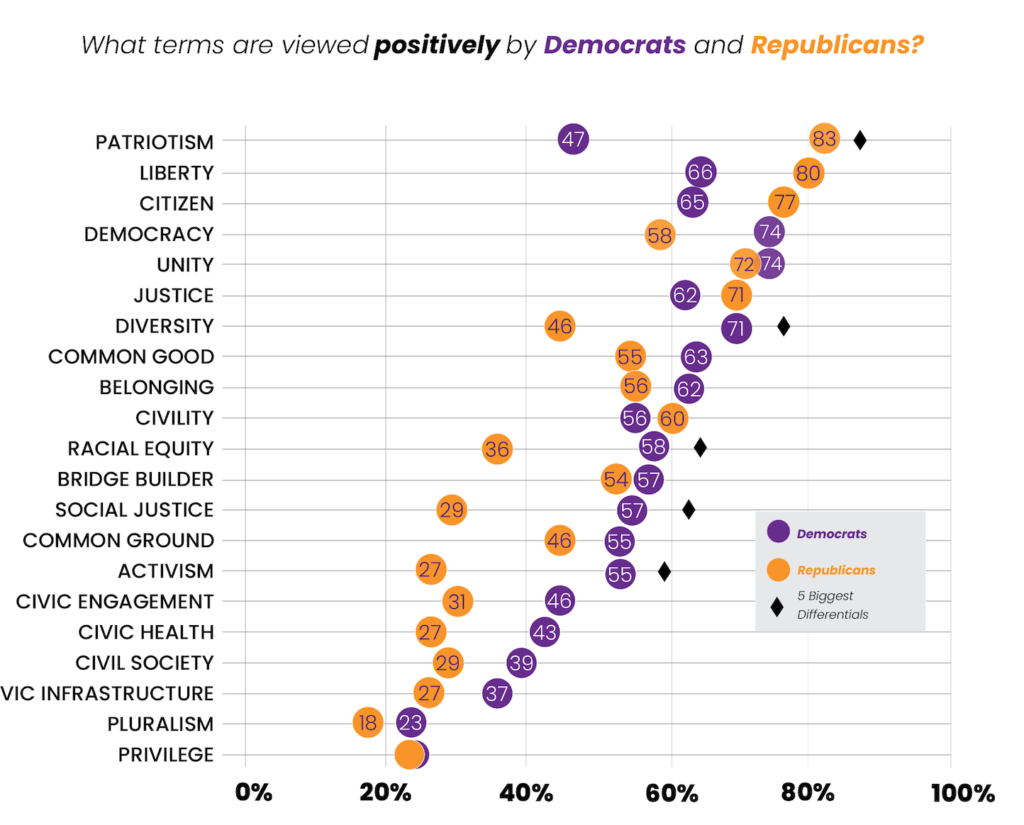
But that doesn’t mean that either of our major parties today is necessarily more republican (in the classical sense) than the other. The recent Civic Language Perceptions Project from Philanthropy for Active Civic Engagement (PACE) offers a chance to see how partisanship–as well as demographics–relate to classical republican ideals. Not all of the components of republicanism are tested, but some are. The data come from a nationally representative random sample of 5,000 registered voters conducted in 2021.

One component of traditional republicanism was an orientation to the common good. That phrase might seem like empty rhetoric, but classical republican authors placed the common good ahead of individual negative freedom, material prosperity, and pluralism, which they often decried as “factionalism.”

PACE asked respondents to react to the phrase “common good,” and it performed best among people who identified as “very liberal.” (See the graph above.)

Patriotism is not on my list of components of republicanism, but often the civic virtues have been defined in patriotic terms. Although some today may see patriotic rhetoric as conservative, it was fundamental to left-wing revolutionary republican movements, from France in 1789 to Mexico in 1910 to Russia in 1917. According to the PACE data, patriotism polls far better among Republicans than among Democrats: a 36-point gap. (See below.)

“Liberty” was the great principle for classical republicanism, and it polls better among Republicans than Democrats. However, some Americans may think of liberty as non-interference (simply being left alone), whereas for classical republicans, it meant non-domination (freedom from arbitrary will). This semantic ambiguity makes the result hard to interpret.

Both parties like “unity,” which was a classical republican value, but Democrats like “diversity” much more than Republicans do. Classical republicans tended to be skeptical of diversity. Therefore, either Democrats dissent from classical republicanism on this issue, or else the word “diversity” is being used in a new way–basically to mean racial equity, which Democrats like much more than Republican do: a 22-point gap. Classical republicans should have embraced racial equity, even though few actually did.

Republics require participation, also known as civic engagement, and that phrase is more popular among Democrats than Republicans.

Democracy is compatible with republicanism, although proponents of democracy tend to emphasize majority rule and responsiveness to mass opinion, whereas republicans want voting to play the limited role of checking elite domination. Madison writes, “If a faction consists of less than a majority, relief is supplied by the republican principle, which enables the majority to defeat its sinister views, by regular vote” (Federalist 10). In this passage and many others, he’s defining “republican” as majoritarian, but his own overall view is more complex. Democrats are more favorable to the word “democracy” than Republicans are, according to the PACE data, although a majority of Republicans do support it.

On balance, one might conclude that today’s Democrats are more republican than Republicans are; but perhaps it’s more accurate to regard the classical republican tradition as marginal all across our spectrum.

PACE infographic

Source: Melvin Rogers, “Race, Domination, and Republicanism,” in Difference without Domination: Pursuing Justice in Diverse Democracies, edited by Danielle Allen and Rohini Somanathan (University of Chicago Press 2020). See also introducing republicanism; James Madison in favor of majority rule; every Republican president [until Trump] insisted that the US is a democracy; a Democratic Republican Federalist; what defines conservatism?; liberals, conservatives, and love of the Constitution etc.

the relevance of American civil religion to K-12 education

Lately, debates about how to teach American government and history in K-12 schools have turned very hot.

These subjects have high stakes. A government can require children to study the government itself in ways that it chooses. Witness the appalling new curriculum required by the Russian government during the current war. Even when a government’s intentions are benign, education is still a means of shaping the society; therefore, we should expect citizens to advocate various goals and outcomes. Baron von Clausewitz famously called war “a mere continuation of politics by other means,” and one could say the same about civic education.

I believe that “American civil religion” generates additional energy that makes this issue particularly electric today. I take that phrase from Robert N. Bellah’s essay, “Civil Religion in America” (1967). Bellah writes: “What we have, then, from the earliest years of the republic is a collection of beliefs, symbols, and rituals with respect to sacred things and institutionalized in a collectivity.” He calls this collection a “religion,” for “there seems no other word for it.”

Much of American history and civics in K-12 schools has been defined by this civil religion, for better or worse. Efforts to change the curriculum look like efforts to change the civil religion, and maybe they are.

Although Bellah does not cite Durkheim, he evidently accepts Durkheim’s seminal 1915 definition of religion: “a unified system of beliefs and practices relative to sacred things, that is to say, things set apart and forbidden—beliefs and practices which unite into one single moral community called a Church, all those who adhere to them” (Elementary Forms of the Religious Life, p. 41; my thanks to Brian Hatcher for the reference).

As I observed a decade ago in Montpellier, VA, plexiglass now covers the “ink stain on the floor that may be some of the ink with which Mr. Madison took his notes on ancient constitutions, preparing for the Philadelphia convention.” That ink stain is something “set apart and forbidden” as sacred.

It is a good illustration of the original American Civil Religion, which, according to Bellah, “focused above all on the event of the Revolution, which was seen as the final act of the Exodus from the old lands across the waters. The Declaration of Independence and the Constitution were the sacred scriptures and Washington the divinely appointed Moses who led his people out of the hands of tyranny.” Bellah acknowledges a close analogy to Christianity but denies that the founders’ civil religion was meant to promote Christianity or to substitute for it. The founders applied a Christian model reflexively; it was all they knew.

Bellah locates a major change around 1860. “With the Civil War, a new theme of death, sacrifice, and rebirth enters the new civil religion. It is symbolized in the life and death of Lincoln.” The sin of slavery and its overcoming become explicit and acknowledged elements of the American civil religion; Lincoln becomes a prophet. Like Christianity, the postbellum American civil religion includes evil, sacrifice, repentance, and salvation. I would add that when Reconstruction is betrayed, the national story gains another series of episodes and new prophets. Martin Luther King ultimately joins the annual cycle of collective remembrances, alongside Washington and Lincoln.

Writing in 1967, Bellah adds a new stage to the story:

We as Americans now face … what I call the third time of trial. The first time of trial had to do with the question of independence, whether we should or could run our own affairs in our own way. The second time of trial was over the issue of slavery, which in turn was only the most salient aspect of the more general problem of the full institutionalization of democracy within our country. This second problem we are still far from solving though we have some notable successes to our credit. But we have been overtaken by a third great problem that has led to a third great crisis, in the midst of which we stand.

The Vietnam War symbolizes this third crisis. Bellah argues that the American civil religion has always posed dangers, but its emancipatory and democratic elements have often been helpful at home. (Here I would note the central role of Black Americans in the liberation for which Lincoln was traditionally given credit.) However, Bellah argues, the American civil religion has often been harmful abroad. “With respect to America’s role in the world, the dangers of distortion are greater and the built-in safeguards of the tradition weaker.” Bellah acknowledges that “the theme of the American Israel was used, almost from the beginning, as a justification for the shameful treatment of the Indians so characteristic of our history [and] has been used to legitimate several adventures in imperialism.”

I think that right-wing Americans today see civil religion as under assault by what they label “Critical Race Theory”; their anger reflects a sense of blasphemy or profanation. They are especially anxious because they know that Christians are shrinking to a minority; thus the decline of the secular civil religion reflects a decline in the literal religion that has always mirrored it.

Ron DeSantis and his ilk miss the central meaning of the postbellum civil religion: Americans must struggle to defeat the evil of racism. This error has many precedents. Bellah wrote in 1967, “For all the overt religiosity of the radical right today, their relation to the civil religious consensus is tenuous, as when the John Birch Society attacks the central American symbol of Democracy itself.” On the other hand, I observe that real, principled conservatives know that the American story combines evil and redemption. They are much less fragile when people point out the evil roots of American history.

Bellah’s civil religion cannot suffice today. For one thing, it never seriously grappled with settler colonialism. Columbus stands alongside Lincoln on the annual civil/liturgical calendar, and that symbolism is no longer acceptable. The deep analogy to Christianity has also become increasingly problematic as the population has become more religiously pluralistic and secular. Because of the indelible contributions of Black Americans, I would not call the American civil religion simply ”white,” but it has never been inclusive enough.

Still, the postbellum civil religion was emancipatory and democratic. The American Civil Rights Movement then appropriated and strengthened the received story in powerful ways. Meanwhile the American national civil religion legitimized a federal role in social policy, which has served progressive ends.

Therefore, I wouldn’t give it up too quickly. I would be more interested in deepening and complicating the national myth than abandoning it. Taking a leaf from the major religious traditions, we should remember to include solidarity, celebration, contribution, salvation, and hope–as well as acknowledgement and repentance–in the recipe. (This is a gentle critique of certain forms of social movement activism that seem to favor repentance and blame over redemption, rather like politicized Calvinism.)

Political leaders and movements should tell and retell the national story in ways that broadly resemble religious narratives. In an educational setting, however, any single story poses a threat to free inquiry and debate. Inculcating a national civil religion, no matter how benign, is not the same as educating free citizens. For this reason, I would use questions to define the content of American history and civics, rather than promulgating any particular answers.

That distinction is a bit too simple, since the choice and framing of questions always reflects deeper commitments. Schools should be committed to such to core values as equity and liberty. It’s also unfair to describe a religion, as Durkheim does, as a “unified system of beliefs,” since religion always involves disagreements, questions, and critical debates. These can be elements of a civic religion as well. However, the more that a curriculum resembles Durkheim’s portrait of a religion as a unified belief-system, the less it involves free inquiry. And free inquiry is the core of liberal education.

See also: constitutional piety; when political movements resemble religions; is everyone religious?; the Democrats and religious Americans; what secular people can get out of theology; civic education in Russia;  the political advantages of organized religionthe I and the we: civic insights from Christian theology;

introducing Habermas

This is a 29-minute video lecture* in which I introduce the core ideas of the great German philosopher and sociologist Jurgen Habermas. I made it for our current Introduction to Civic Studies course, but it’s available for anyone to use. It also summarizes the beginning of chapter 4 of my recent book, What Should We Do? A Theory of Civic Life. In the book, I proceed to raise numerous critiques of Habermas, all of which have some validity, although I continue to find his framework useful.

*New version posted on 9/29, with better audio.

applying Beyond Adversary Democracy to solve problems

Jane Mansbridge published Beyond Adversary Democracy in 1983. This book has been cited thousands of times and has deeply influenced political theory, certainly including my own work. At the recent annual meeting of the American Political Science association, Mansbridge won the Benjamin E. Lippincott Award for a “work of exceptional quality by a living political theorist that is still considered significant after a time span of at least 15 years since the original date of publication.” Beyond Adversary Democracy was the book in question, although Mansbridge would also deserve the Lippincott for Why We Lost the ERA (1986). She gave a beautiful and interesting lecture on the future of political theory.

During her speech, Mansbridge recalled that she had been inspired to write Beyond Adversary Democracy to help the radically democratic organizations of the 1970s–the many co-ops and communes that sprang up in that era–to address the challenges of self-governance that seemed, sooner or later, to wreck most of them. Someone asked whether any group had ever used her book to solve such problems. She said: never!

Perhaps no one has developed, tested, improved, re-tested, refined, and disseminated a practical toolkit based on the theory of the book. Such a product would be useful not only for radically democratic organizations but for any group that employs democratic decision-making for some purposes and at some times. For instance: a department in a university.

The first draft of such a tool would be an experiment, requiring testing and improvement. The draft might start like this:

A friendly person who is independent of the organization should conduct an anonymous survey (derived from Jenny Mansbridge’s own instrument) to identify points of widespread agreement as well as conflicts of deeply felt interest within the group. “Interests” mean not only self-interested goals and needs (like raising one’s pay) but also ideals, such as committing the organization to a certain strategy.

The person who conducts the survey should then provide a public list of any issues that are not conflictual within the group. Members should not devote time to discussing these issues. Instead, they should delegate them to one person or a small team. The people who are put in charge of each non-conflictual issue should be required to report back periodically and to keep records, and they should be open to advice and complaints, but they should decide what to do without the whole group’s involvement. Rotating such responsibilities can be smart, but it can also be wise to give these tasks repeatedly to people who enjoy them and are good at them.

The survey should also generate a public list of issues that are contentious. The whole group should discuss these issues with a trusted moderator who can stay fairly neutral. An important purpose of such discussion is to help everyone better understand the contours of the disagreement by allowing individuals to voice their divergent values and needs. Some time should be spent looking for creative solutions that could satisfy most people. However, the group should be prepared to resolve such issues by voting anonymously after a finite amount of time spent on deliberation. Although majority rule cannot satisfy everyone, it is better than trying fruitlessly to reach consensus when interests actually diverge.

Once a vote is taken, the fact that a minority has lost should be explicitly acknowledged, and the group should formally thank them and resolve to try to make it up to them in some way later on. Then the group should shift to an issue that has been identified as non-controversial. They should explicitly mark this transition. “Well, that was a tough discussion, but now let’s talk about office furniture. Does everyone agree that Al can take care of that? Thanks so much, Al. Everyone, please contact Al if you have any special concerns.”

The survey should be designed to reveal whether differences of interest fall along identity lines. For example, women might be tend to differ from others on matters related to maternity. Or people of color might have specific concerns in a predominantly White organization. When that is the case, it is important for the people who hold leadership positions to represent both or all of the relevant identity groups. It may be both fair and necessary to reward them for serving on committees, since this burden can fall disproportionately on disadvantaged members of an organization.

On the other hand, when there are no differences of interest, or when differences do not fall along identity lines, then it is much less important for the decision-makers to be demographically representative. It becomes correspondingly more important to give tasks to willing volunteers, to individuals who have experience for the task at hand, or to people whose turn it is do more for the group.

These are principles or maxims, but they could be turned into flowcharts with diagnostic questions and suggestions. For instance: “Does this disagreement seem to divide your group by race, or gender, or job title, or some other identifiable characteristic? If so, what is the characteristic? Does the committee include people on both sides of that difference? How should we reward individuals who join the committee to make it more representative?” (etc.)

This kind of application by no means exhausts the value of Beyond Adversary Democracy, which is mainly a rich contribution to theory. For instance, the book can influence how we read Aristotle or Rousseau. However, applying insightful theories can improve the world; and the experience of applying them can further enrich theory.

Added later: a flowchart for collective decision-making in democratic small groups. See also: the New Social Movements of the seventies, eighties, and today; friendship and politics; needed: pragmatists for utopian experiments

explaining Ostrom

Elinor Ostrom (1933-2012) was a political scientist at Indiana University and a leader of the intellectual movement informally known as the Bloomington School. She won the Nobel Prize in Economics in 2009 and was a MacArthur “genius” Fellow and president of the American Political Science Association. For me, she was a major inspiration, and I find that I have mentioned or discussed her in 142 blog posts over the years. I also summarize her work in chapter 3 of What Should We Do? A Theory of Civic Life (2022).

I have now recorded two videos to introduce all of her major ideas, as I see them. I discuss her basic principles in Part I (17 minutes) and how to apply her ideas in Part II (11 minutes). These are free for anyone to use and are embedded in this public website about what we should learn to be effective citizens.