new journals related to civic renewal

Scholars working on civic engagement, civic education, and related topics have no shortage of publication venues, including free, online–but peer-reviewed–journals:

The International Journal of Research on Service-Learning and Community Engagement has published its first issue. Articles include “Rethinking Peer Review: Expanding the Boundaries for Community-Engaged Scholarship” by Sherril B. Gelmon, Cathy M. Jordan, Sarena D. Seifer, and “A Research Agenda for K-12 School-based Service-Learning: Academic Achievement and School Success” by Andrew Furco.

The Journal of Public Deliberation (JPD) is now up to volume 9, issue 2.  The new issue includes articles on stakeholders and citizens in deliberation; participation in the New York Public Schools; and the effects of non-neutral moderators. The current editorial team has done a great job, but they are handing it over to a great new team of Laura Black, Tim Shaffer, and Nancy Thomas.

The Journal of Civic Literacy has launched its website and invites research on “the causes and consequences of low levels of literacy, the role of public education, the comparative efficacy of available curricula and programs (what is working? why and how?), the connections between the current media environment and deficient civic understandings, and the role of civic literacy in defining ethical and trustworthy public service.”

The eJournal of Public Affairs is published by Missouri State University and affiliated with the American Democracy Project. “Public Affairs” means different things to different people, but this journal is actually devoted to civic engagement, civic education, and closely related topics.

Partnerships: A Journal of Service-Learning and Civic Engagement comes out of North Carolina Campus Compact but has national reach and is also a peer-reviewed, open-access journal.

The Journal of General Education (“A Curricular Commons of the Humanities and Sciences”) is edited by Jeremy Cohen, who has a deep commitment to civic education, free speech, and public media. So, although its topic is “general education” at the undergraduate level, it is an important site for discussions of civic education and engagement.

[Added later:]

The Good Society is a distinguished journal of political theory, now turning to what we call Civic Studies. It is not open-source because of the contract with the publisher, but articles are freely available for two months after publication. In any event, it is a fine journal.

And Public, from Imagining America, is a peer-reviewed, multimedia e-journal focused on humanities, arts, and design in public life.

The post new journals related to civic renewal appeared first on Peter Levine.

do companies control governments?

Consider that:

  • The same US government that can apparently tap almost any telephone in the world cannot harvest information that people voluntarily provide on the government’s own website regarding their eligibility for insurance.
  • A private firm, CGI Federal, botches healthcare.gov. A private firm, Dell, employs the analyst, Edward Snowden, who leaks the NSA’s secrets.
  • Snowden reveals (inter alia) that the NSA has been spying on Angela Merkel, whose main impact has been holding down government spending and debt throughout Europe, in keeping with neoliberal economic doctrine.
  • Companies like Google and Facebook possess unprecedented knowledge of the private behavior and beliefs of citizens. They profess “outrage” at the government’s collection of private information. They call it “outright theft.” Apart from their annoyance at losing their data to the state, they fear that consumers will now be reluctant to share information on US-based networks–information that is currently worth about $1,200/person to firms like Google and Facebook.
  • The Tea Party is a loose movement that professes support for free markets and resistance to government. Its power has presumably kept corporate taxes and regulations lower than they would be otherwise. Yet the US Chamber of Commerce and individual companies like AT&T and Caterpillar are so angry about the recent federal shutdown that they are spending significant money to defeat Tea Party-backed candidates in Republican primaries.
  • Facebook founder Mark Zuckerberg creates FWD.us to promote immigration reform. Through a subsidiary called Americans for a Conservative Direction, FWD.us funds conservative candidates who support reducing certain barriers to immigration. Through a different subsidiary called the Council for American Job Growth, it “reach[es] out to progressive and independent voters.”

One way to put these scattered points together is to talk about “the neoliberal state.” Big businesses basically get the policies they want, whether in the US, Germany, Russia, or in (nominally communist) China. Far from constraining them, the state is their assistant. The news consists of little skirmishes between particular businesses and forces not completely under their control: Tea Partiers, the national security apparatus, the US Attorney in Manhattan, and the Democratic Party. Business wins virtually all the skirmishes, and the underlying reality is even more favorable to its interests than the scattered conflicts suggest.

I mention the idea of the neoliberal state because I see that it contains a lot of truth. But I dissent in part on theoretical, moral, and strategic grounds:

Theoretically: we have to remember the problem of collective action. Each business gains from laissez-faire policies–but only a bit, and the competition gains as well. It is not in each firm’s self-interest to be too politically active. Eruptions like the Chamber versus the Tea Party, the Koch Brothers versus Obama, or Google versus the NSA show that it is genuinely difficult for a whole array of competing businesses to coordinate their efforts to achieve the ends they want. Clearly, ordinary people face even more daunting collective-action problems, but that is what political organizing is for.

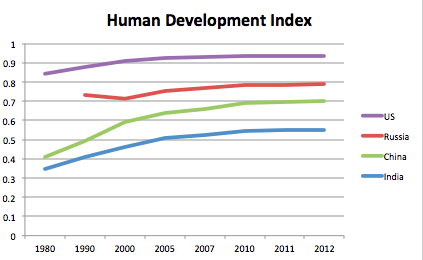
Morally: the critique of the neoliberal state ignores the benefits of global markets. The Human Development Index is a pretty good measure of actual well-being, incorporating not just per capita wealth, but also outcomes like health, education, safety, and women’s empowerment. This graph shows the trends in HDI since China and India opened their economies to direct foreign investment and became sensitive to global markets. The upward trends represent substantial net improvements in the lives of billions of human beings.

Screen Shot 2013-11-03 at 8.33.29 PM

Strategically: the theory of the neoliberal state gives the impression that ordinary people have no power. That impression is itself disempowering. Elections in the US are influenced by cash, but no one literally has more than one vote. If we choose not to do what big businesses tell us to do, we win. A defeatist theory makes that less likely.

I am not saying that the governments of the US, the EU’s members, China, India, and Russia are independent of big business or that corporate pressure is benign. I am claiming that the situation is somewhat complicated and unpredictable, and there is room for strategic action. Each of the bullet points with which I began this post is a pressure point.

(See also “two doses of realism about democracy,” “what is corruption?,” and “putting facts, values, and strategies together: the case of the Human Development Index.”)

The post do companies control governments? appeared first on Peter Levine.

music and civic engagement (an analysis of private and public goods with intrinsic value)

A colleague recently suggested an analogy between music and civic engagement, emphasizing that both have been transformed by technological/economic changes, and there is no going back to the old days. We used to get music from recording companies and participate in public life thanks to daily newspapers, unions, grassroots political parties, and durable civic associations. The traditional institutions for both music and citizenship have been replaced by loose networks and individual choice.

We could extend the analogy by noting that civic engagement, like music, can bring satisfaction to the participants. Neither activity is a mere chore to be done to achieve an outcome. In both cases, people may be enthusiastic to participate (or not–their interest varies). Both activities are heavily collaborative. And in both cases, we should welcome a wide range of excellence. The one-in-a-million talent is admirable in politics, as in music, but we also need average people to sing and to express their political views. In both cases, people appreciate excellence better if they also contribute at their own level.

The differences are also worth noting. For one thing, civic engagement has a strong ethical aspect. Mussolini was active and skillful, but he made the world worse. We must able to evaluate civic engagement ethically with attention to means and ends. I would, for example, build into the definition of good engagement a strong desire to understand alternative views. The most ethically demanding aspects of citizenship do not come naturally. Neither does good musicianship, but I think that the ethical demands of citizenship are more onerous than the preconditions of making music.

Also, certain forms of civic engagement are rivalrous or competitive. More engagement by Tea Partiers means less success for liberals, and vice-versa.

Everyone has a right to be heard in the political domain. Although no one is obligated to listen to me sing (an unpleasant experience), my fellow citizens must give me equal time in a public meeting, just because I am a member of their community.

Finally, it is healthy in both civic life and music for people to form smaller communities of interest with diverse styles. However, as long as important decisions are made by governments, the people of each political jurisdiction must sometimes form a single political community to discuss and act on their common fate. In contrast, we never have to bring all the choirs, bands, and orchestras together to make one stream of music.

The differences between music and citizenship mostly point to the need for intervention in the civic domain. I think music will thrive in a world of digital files, free choice, and loose voluntary networks. Civic engagement needs help.

The post music and civic engagement (an analysis of private and public goods with intrinsic value) appeared first on Peter Levine.

the death of an ancient commons?

Vista típica de la Huerta de Valencia.

(Near Tarrytown, NY) The huertas of Valencia, Spain, represent a magnificent example of human cooperation, but I am told they are now doomed. The reasons are endemic to modernity and require serious consideration.

Water is a scarce resource, essential for life. If you can take water for your own crops, basic economic theory says you will take lots of it even if others downstream don’t get enough. The rain and the river can’t be privatized in simple ways. The state can police water-use, but it’s hard and rare to build states that are smart, responsive, virtuous, and just enough to accomplish tasks like efficient and fair water-management.

But, contrary to a simplistic economic model, farmers in Valencia, Spain, have been distributing very scarce water consistently since before 1238. The rules and tools they developed are summarized here. Their tribunals and other processes were already in place during the Muslim period and may have predated the Islamic conquest. They continued more or less smoothly despite the Christian Reconquista, the unification of Spain, its economic decline, Civil War, and fascism.

But, as I am told by Francisco Arenas-Dolz (a distinguished Spanish academic whose own family used to farm in the huerta system), it is now disappearing. Former farmers are moving to high-rises in the city, and suburban sprawl is swallowing up agricultural land.

One cannot blame people for “exiting.” I would not want to be a farm-worker in an arid climate (or anywhere). I suspect that, despite the radical shifts in Valencia’s political and religious regimes over a millennium, one thing remained constant: peasants couldn’t leave the land. Now they can leave, and they are leaving, and I don’t lament that.

But we can lament two outcomes. First, the huertas have aesthetic, cultural, and environmental value that individual participants (as well as outsiders) prize. The individuals’ exit benefits them but destroys something that they love. They would all be better off if somehow the huertas could be preserved. The agricultural landscape could perhaps have evolved into something new and better, an economy that offered higher-skilled and more profitable jobs to a few people still in touch with their traditions. Instead, it is just vanishing.

Second, the heurtas taught ethics, skills, habits, and techniques for solving collective-action problems. Even if we give up on small-scale agriculture in Valencia, we still face inescapable problems at a bigger scale. Climate change is only the most dire example. If everyone exits the huertas and that model vanishes, how will we learn to address bigger Tragedies of the Commons?

(See also “Why Engineers Should Study Elinor Ostrom,” my obituary of Ostrom, and “Albert O. Hirschman on Exit, Voice, and Loyalty.”)

The post the death of an ancient commons? appeared first on Peter Levine.

Albert Dzur and democracy inside institutions

Albert Dzur, author of Democratic Professionalism and Punishment, Participatory Democracy, and the Jury, is writing a series in the Boston Review entitled “Trench Democracy: Participatory Innovation in Unlikely Places.”

When we think of democratic reform, our minds usually turn to explicitly political upheavals: the Civil Rights Movement, the Arab Spring. In such cases, masses of people put aside their ordinary lives of family and work to press for a new government–or at least for new laws.

That definition of reform hides a different kind of democratic politics that is more sustained, less state-centric, and less obvious to reporters and average citizens. It is what Dzur calls “the public work of self-directing community groups that band together to secure affordable housing, welcome new immigrant groups, and repair common areas like parks and playgrounds.”

I am aware of this kind of public work and have put it at the center of my book We Are the Ones We Have Been Waiting For. I argue that about one million Americans are engaged in “self-directing community groups” in particular places and issue areas. But they do not yet see themselves as part of a civic movement that is larger than their particular projects and causes. So we must organize them to advocate in their common interest–for funds to support civic processes, rights to public participation, education policies that support high-quality civic education, and news coverage of citizens’ work.

In developing this strategy and counting my one million civic activists, I did not pay sufficient attention to the layer of politics and reform that Dzur investigates. I describe leaders and members of civic groups, but his main topic is the everyday pro-democratic work of professionals within mainstream organizations:

[T]hey take their public responsibilities seriously and listen carefully to those outside their walls and those at all levels of their internal hierarchy in order to foster physical proximity between formerly separated individuals, encourage co-ownership of problems previously seen as beyond laypeople’s ability or realm of responsibility, and seek out opportunities for collaborative work between laypeople and professionals.We fail to see these activities as politically significant because they do not fit our conventional picture of democratic change. As if to repay the compliment, the democratic professionals I have interviewed in fields such as criminal justice, public administration, and K-12 education rarely use the concepts employed by social scientists and political theorists. Lacking an overarching ideology, they make it up as they go along, developing roles, attitudes, habits, and practices that open calcified structures up to greater participation. Their democratic action is thus endogenous to their occupational routine, often involving those who would not consider themselves activists or even engaged citizens.

Though they belong to practitioner networks and engage in ongoing streams of print, online, and face-to-face dialogue, the democratic professionals I have met do not form a typical social movement. Rather than mobilizing fellow travelers and putting pressure on government office holders to make new laws or rules, or convening temporary participatory processes such as citizens’ juries, deliberative polls, and citizens’ assemblies, democratic professionals are making real-world changes in their domains piece by piece, practice by practice. In the trenches all around us they are renovating and reconstructing schools, clinics, prisons, and other seemingly inert bodies.

The rest of Dzur’s series will explore examples of this work, using his own interviews with committed democratic professionals. These professionals must be part of a movement for civic reform. The first step is to learn who they are and what they are striving for. Dzur’s work is indispensable for that purpose.

The post Albert Dzur and democracy inside institutions appeared first on Peter Levine.

We Are the Ones We Have Been Waiting For, the animated version

I very much enjoyed presenting my new book today at MIT’s Center for Civic Media. The questions and discussion were terrific. Also, Willow Brugh produced an animated version of my talk in real time:

I still maintain that it’s worth reading the book, but this pretty much sums it up.

The post We Are the Ones We Have Been Waiting For, the animated version appeared first on Peter Levine.

can nonprofits solve big problems?

Bill Shore and Darrell Hammond are fabulously successful social entrepreneurs. Each founded a nonprofit that raised tons of money, inspired many thousands of volunteers, drew great press, and provided lots of services. (Share Our Strength fed homeless people; KaBOOM! built playgrounds.) Now, along with Amy Celep, these two founders have written a provocative piece entitled “When Good is Not Good Enough.” This passage –contributed by Shore–gives a flavor of the whole article:

So I began with an idea that was clear, simple, and wrong: we would end hunger by raising money and granting it out to food banks and other emergency food assistance programs. It should have been obvious then, as it is now, that hunger is a symptom of the deeper, more complex problem of poverty.

Both Share Our Strength and KaBOOM! have shifted to addressing what they see as the root causes of big social problems, using tactics inspired by the movements against smoking, drunk driving, and malaria.

In a reply also published by the Stanford Social Innovation Review, Cynthia Gibson, Katya Smyth, Gail Nayowith, & Jonathan Zaff anticipate most of the points I would want to make. They applaud the honesty and ambition of the original article but raise doubts about whether nonprofit organizations can really “solve” social problems without the rest of the public. The two articles together offer a great guide to the debate between social entrepreneurship and civic engagement.

I would add a couple of points that are generally consistent with Gibson, Smyth, Nayowith and Zaff.

First, the metaphor of “root causes” is problematic and misleading. It suggests that if you could fix the root, you could solve a whole problem in one stroke, much as pulling out the root of a weed will kill it. Much more typically, problems form complex systems with no  primary cause. For example, racism, crime, violence, education, and poverty all influence each other. Poverty worsens crime, but crime independently deepens the poverty of afflicted communities. Such complexity should not cause despair. You can intervene helpfully at many points in the cycle, not only at the “deepest” point, which may be the least accessible. For instance, better policing does not directly address poverty, but it can cut crime, and that helps poor people.

The metaphor of a root misleadingly suggests that you should only work on the part of the problem that seems somehow biggest and most difficult. That is doubly wrong: (1) you might be able to do more good with limited resources if you intervened somewhere else, and (2) even if you solved the problem that you see as primary, the rest of the system would remain.

Second, the idea that organizations can solve social problems ignores the persistence of politics. In We Are the Ones We Have Been Waiting For (starting on pp. 65), I mention the popular “moon-ghetto” metaphor from the 1960s:

This was the idea that engineers and other specialists had put human beings on the moon (and brought them safely home), so it should be possible to tackle the problems of the so-called “ghetto” in much the same way. It was all a matter of scientifically diagnosing the causes of poverty and efficiently deploying solutions.

Actually, the moon and the “ghetto” are very different. The moon is almost perfectly detached from all other human issues and contexts, because it is 240,000 miles away from our planet (although NASA’s launch facilities in Florida and Houston might have some local impact). The goal of the Apollo Program—whether you endorsed it or not—was clear and easily defined. The challenges were physical; thus Newtonian physics allowed engineers to predict the impact of their tools precisely in advance. The costs were also calculable—in fact, the Apollo Program was completed under budget. The astronauts and other participants were highly motivated volunteers, who had signed up for a fully developed concept that they understood in advance. The president and other national leaders had committed enough funds to make the Apollo Program a success, because its value to them exceeded the costs.

In contrast, a low-income urban neighborhood is enmeshed with other communities. Its challenges are multi-dimensional. Its strengths and weaknesses are open to debate. Defining success is a matter of values; even how to measure the basic facts is controversial. (For example, how should “race” be defined in a survey? What are the borders of a neighborhood?) Everyone involved—from the smallest child on the block to the most powerful official downtown—has distinct interests and motivations. Outsiders may not care enough to provide adequate funds, and residents may prefer to leave than to make their area better. When social scientists and policymakers implement rewards or punishments to affect people’s behavior, the targets tend to realize what is happening and develop strategies to resist, subvert, or profit from the policies—a response that machines can never offer. No wonder we could put a man on the moon but our poor urban neighborhoods persist. …

The post can nonprofits solve big problems? appeared first on Peter Levine.

forthcoming in 2013: Civic Studies (the book)


This is a video of me (having a bad hair day) and some good friends making the case for the civic mission of higher education.

It is also an advertisement for the Civic Series, a set of short books on themes related to active citizenship and higher education. I am co-editing the volume entitled Civic Studies with Karol Soltan. It should be available by the end of 2013. The Table of Contents follows:

I. Overview

1. Peter Levine, “The Case for Civic Studies”
2. Karol Soltan, “The Emerging Field of a New Civics”
3. (multiple authors) “Framing Statement on Civic Studies”

II. The art and science of association: the Indiana Workshop

4. Filippo Sabetti, “Artisans of the Common Life: Building a Public Science of Citizens”
5. Paul Aligica, “Citizenship, Political Competence, and Civic Studies: the Ostromian Perspective”

III. Deliberative participation

6. Tina Nabatchi and Greg Munno, “Deliberative Civic Engagement: Connecting Public Voices to Public Governance”
7. Ghazala Mansuri and Vijayendra Rao, “The Challenge of Promoting Civic Participation in Poor Countries”

IV. Public work

8. Harry C. Boyte and Blase Scarnati, “The Civic Politics of Public Work”

V. Research engaged with citizens

9. Sanford Schram, “Citizen-Centered Research for Civic Studies: Bottom-Up, Problem-Driven, Mixed methods, Interdisciplinary”
10. Philip Nyden, “Public Sociology, Civic Education, and Engaged Research”

The post forthcoming in 2013: Civic Studies (the book) appeared first on Peter Levine.

why engineers should study Elinor Ostrom

(New Haven) Next week, I will lead a discussion of the Nobel-Prize-winning research of the late Elinor Ostrom. I will be with a group of engineers, natural scientists, and social scientists who are concerned about water, one of the basic scarce and contested natural resources.

Ostrom studied water-management, but she was a political scientist concerned with “civic engagement,” especially the practices that ordinary people develop to manage common resources. Why should an engineer or a scientist concerned with water care about civic engagement, as Ostrom analyzed it?

One reason is that ordinary people’s deliberate and creative action is a more important condition of successful resource-management than analysts had thought before Lin Ostrom wrote. The dominant 20th century view held that resources were either public or private. If they were private, the owners would have incentives to protect them (although market failures might occur under specific conditions). Public resources, however, would be destroyed by the Tragedy of the Commons in the form of free-riding, overuse, underinvestment, etc. Thus public resources had to be privatized or else governed by a central state. Water was quasi-public because you can’t own the oceans or clouds (“fugitive resources”), although you can own a gallon of water or a spring. Applying the theory that public goods were doomed, 20th century regimes either privatized or nationalized forests, grazing lands, and water. The results were frequently catastrophic, contributing to mass human and animal death. (See Governing the Commons, p. 23. All subsequent quotes are also from that book.)

Ostrom discovered that, contrary to the simplistic theories of collective action, people were capable of managing public goods, including waterways and fisheries. They did not always succeed, but they did not always fail, either. Variation in the ways that they worked mattered to the outcomes. To succeed, they needed institutional arrangements, skills, norms, motivations, and habits. All of these factors then became important predictors of preserving or destroying natural resources. An engineer or a chemist cannot ignore these factors if she actually wants to contribute to good water management. Discovering a process or inventing a technical system does no good unless someone uses it. That someone cannot be an omnicompetent and incorruptible state, because there is no such thing. Somehow, people have to adopt any technical innovation, and often they can contribute to designing it as well.

An example is a crisis of overfishing off Alanya, Turkey (pp. 19-20). The fishers solved the problem through an ingenious system of randomly assigning all the licensed boats to specific starting points and rotating these locations on a fixed schedule. Privatization could not have solved the problem because this was already a system of private boats and workers, and the fish are a “fugitive resource.” Nor could it have been solved by the state, except at high cost. The fishers knew exactly where to put each location, and the state would have had to recreate that knowledge—assuming that it acted fairly and without corruption. The best solution was a self-created one.

If the first reason to read Ostrom is that she studied citizenship and found that it mattered, the second is that she was a citizen. She was a scientist who won countless NSF grants as well as the Nobel and a MacArthur “genius” award. But she was a scientist who wanted to improve the world, and that made her a model citizen. For instance, after introducing the prisoner’s dilemma, she writes, “As long as people are described as prisoners, policy prescriptions will address this metaphor. I would rather address the question how to enhance the capabilities of those involved to change the constraining rules of the game to lead to outcomes other than remorseless tragedy (p. 7).”

This is a complex pair of sentences, worth unpacking. Ostrom’s ultimate goal is to avoid “remorseless tragedy.” The stakes are high, and they are defined in moral terms, even though Ostrom is a scientist. To avoid tragedy, she will not propose direct solutions. Instead, she wants to “enhance the capabilities of those involved.” These people will not merely act within a system, discussing issues and making choices. The limiting case of a person who makes a choice within a fixed system is the prisoner in a prisoner’s dilemma. “Individuals who have no self-organizing and self-governing authority are stuck in a singe-tier world. The structure of their problems is given to them” (p. 54). In contrast, Ostrom wants people to change the rules. And she is part of that process, because she discloses her own goal in the first-person singular: “I would rather address. …” In real life, Ostrom actually worked with peasants and fishers because she had to learn from them and because she wanted them to benefit from her findings.

In short, Ostrom not only discovered that complex social/environmental systems involve deliberate human collective action. She also treated social science as part of those systems, and herself as one of the human beings who was trying to manage the commons.

Other insights from Governing the Commons:

“Instead of presuming that optimal institutional solutions can be designed easily and imposed at low-cost by external authorities, I argue that ‘getting the institutions right’ is a difficult, time-consuming, conflict-invoking process” (p. 14).

“… as long as analysts assume that individuals cannot change … situations themselves, they do not ask what internal or external variables can enhance or impede the efforts of communities of individuals to deal creatively and constructively with perverse problems such as the tragedy of the commons” (p. 21)

“Empirically validated theories of human organization will be essential ingredients of a policy science that can inform decisions about the likely consequences of a multitude of ways of organizing human activities. Theoretical inquiry involves a search for regularities. … One can, however, get trapped in one’s own intellectual web” (p. 24)

“The basic strategy is to identify those aspects of the physical, cultural, and institutional setting that are likely to affect [the results.] Once one has all the needed information, one can then abstract from the richness of the empirical situation to devise a playable game that will capture the essence of the problems the individuals are facing” (p. 55).

The post why engineers should study Elinor Ostrom appeared first on Peter Levine.

cover blurbs for We Are the Ones We Have Been Waiting For

WeAretheOnes“As America has wallowed through an unprecedented decline in civic engagement, Peter Levine has been a lighthouse warning of the dangers of civic alienation. Now, he makes the encouraging case that although we will live for a while with the consequences of past mistakes, the worst of the storm is over. Professor Levine concludes with ten common sense strategies that can energize the people and their governmental institutions while preparing a new generation of Americans with the values and competencies to sustain our reinvigorated democracy.”—Bob Graham, United States Senator (1986-2004)

“Peter Levine is a remarkable asset—a scholar whose research is rigorous and unflinching but whose passion for democracy brims with optimism and engagement. In We Are the Ones We’ve Been Waiting For, Levine catalogues all the ways our institutional systems discourage engagement among citizens. But he finds and lifts up a million people doing civic work for a better world, and asks us to join and harness that energy for real change. It’s clear-eyed and a clarion call—and a must read whether you’re a full time advocate or ‘just’ a citizen hoping to make a difference.” —Miles Rapoport, President, Demos

“We know what it means to get better leaders. But how are we supposed to produce better citizens? That’s the question Peter Levine brings into focus. If the examples he describes can spur the one million most active citizens into a movement for civic renewal, we will all benefit from communities that are more deliberative, more collaborative, and more engaged.”—Alberto Ibargüen, President and CEO, the John S. and James L. Knight Foundation

“In an America now rife with inequality, institutionalized corruption, a jobless recovery and more prisoners than any other country, many sense that we stand at a nadir of democracy. With inspiring erudition, Levine points to an unlikely solution: the people themselves. Drawing from experiences in schools from Washington, D.C. to neighborhoods in San Antonio, he develops a pragmatic approach to civic revitalization that builds upon developments in organizing, deliberation, civic education, and public service, but goes far beyond any of these to reach for an ambitious vision of participatory democracy. He asks us to join the emerging civic movement he describes, and we all should.”—Archon Fung, Ford Foundation Professor of Citizenship and Democracy, Harvard Kennedy School

The post cover blurbs for We Are the Ones We Have Been Waiting For appeared first on Peter Levine.