three ways of thinking about social reform

A group has been discussing how to improve upward economic mobility in the Boston metro area, which is booming but leaving a lot of people behind. I do not know much about economic mobility, nor do I lead an antipoverty organization, so I have found it a privilege to be in the room with people who have real knowledge and clout.

In the discussions so far, I detect three theses. When I mentioned this list, some people felt that they are all true. Indeed, the ideas may fit together in various combinations, but I see tensions among them.

1. We know how to improve the prospects of low-income people; we just don’t have the will to do it. Innovation should be at the political level, changing the balance of power or the messages that resonate.

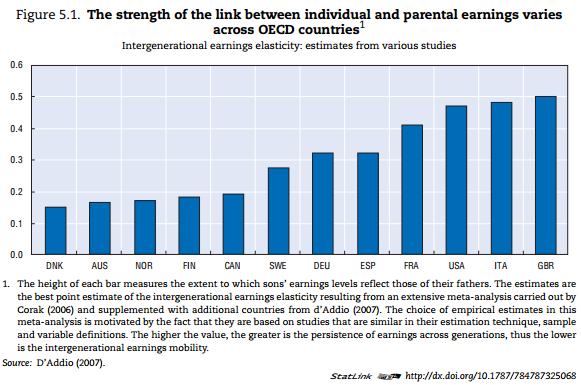
Probably the strongest evidence for that thesis is international. This OECD publication is one of many that shows poor intergenerational mobility in the US compared to countries like Denmark, Australia, and Norway. The same study finds that public investment in early childhood correlates with better mobility. We don’t invest much in preschool in the US. The reason is arguably that affluent suburbanites don’t vote for it because they don’t need it, while poor people don’t vote for it because they are generally disenfranchised and dispirited. So we need political strategies to change voters’ preferences to shift government.

intergenerational
2. We don’t know how to help people move up the mobility ladder in a post-industrial, knowledge-based, global economy. We need innovative programs and R&D.

Ron Haskins recently wrote, “Despite decades of efforts and trillions of dollars in spending, rigorous evaluations typically find that around 75 percent of programs or practices that are intended to help people do better at school or at work have little or no effect.” That’s a controversial claim; I have previously addressed the complex question of whether to rely on randomized studies. But it is a plausible claim, especially if we restrict it to hands-on service programs (in contrast to entitlement transfers). To be sure, we see more intergenerational mobility in Denmark than in the US, and Denmark has large-scale policies that probably work–but I’ll bet they work less well than they used to, and they may not apply in situations like our massively deindustrialized cities. So there is a case for finding new strategies that really work instead of spending tons of money on things that don’t.

3. People in poor communities should determine their own futures.

Both #1 and #2 can be read as “We should do various things for–or to–people in poor communities.” Clearly, they need resources. But perhaps “we” should show a little more modesty. People in poor communities should not only decide how to use resources but also do the (paid) work of community development, creating their own solutions.

Again, I think these theses can fit together in various ways; many individuals see merit in two or even three of them. But they do pull you in different directions.

The post three ways of thinking about social reform appeared first on Peter Levine.

the Civic Studies Institute spreads to Ukraine

Thanks to our colleague Dr. Tetyana Kloubert of the University of Augsburg and a grant from the German Academic Exchange Service (Deutscher Akademischer Austauschdienst), the Summer Institute of Civic Studies that we hold annually at Tufts is adding a parallel institute in Ukraine, which I will help to teach in 2015. Ukrainian scholars and practitioners are strongly encouraged to apply. We will also consider applications
from Germany, Belarus and Poland. Please feel free to circulate this announcement.

Summer Institute of Civic Studies and Civic Education
Call for Applications

We are happy to invite you to participate in the Summer Institute of Civic Studies and
Civic Education that will take place in Ukraine from 3-16 August 2015 (at the Chernivitsi National Yuriy Fedkovych University).

The Summer Institute of Civic Studies and Civic Education is organized by a team from Tufts University (Prof. Peter Levine), the University of Maryland (Prof. Karol Soltan) and the University of Augsburg (Dr. Tetyana Kloubert).

Objectives and topics

The Summer Institute of Civic Studies and Civic Education is an intensive, two-week, interdisciplinary seminar bringing together advanced graduate students, faculty, and practitioners from diverse fields of study.

The Summer Institute of Civic Studies and Civic Education deals with issues of development of civil society, the role of an individual/citizen in society, the role of education in promoting democracy, the role of institutions in the development of a civil society and questions related to the ethical foundation of civic issues in a (democratic)
society. These topics will be examined in international and comparative perspectives, considering European (especially German) and US-American civic traditions. International examples will be discussed in the context of consolidation of democracy in
Eastern Europe, particularly in Ukraine.

The Summer Institute of Civic Studies and Civic Education engages participants in challenging discussions such as:

  • What kinds of citizens (if any) do good regimes need?
  • What should such citizens know, believe, and do?
  • What practices and institutional structures promote the right kinds of citizenship?
  • What ought to be the relationships among empirical evidence, ethics, and strategy?

Summer Institutes of Civic Studies have been annually organized by Peter Levine and Karol Soltan at Tufts University since 2009.

How to apply

All application materials must be submitted in English. The application must include the following:

  • A cover letter telling us why you want to participate in the summer institute and what you would contribute (maximum 2 pages)
  • A curriculum vitae

All application materials can be sent as an email attachment in DOC or PDF format to
tetyana.kloubert@phil.uni-augsburg.de

Decisions will be announced in April 2015.

The total number of participants will be limited to 20. Ukrainian scholars and practitioners are strongly encouraged to apply. We will also consider the applications
from Germany, Belarus and Poland. We are especially interested in applicants who
have a long term interest in developing the civic potential of Ukraine, and the region.
The working language of the Summer Institute will be English. Your mastery of the
English language must be sufficient to read and understand complex texts from multiple disciplines, and to take part in a lively discussion.

Deadline

For best consideration apply by March 31, 2015.

Expenditures

The Summer Institute of Civic Studies and Civic Education is being funded by the DAAD
(German Academic Exchange Service). Selected participants will be provided with
travel costs, accommodation (in a twin room), meals and full event access.

For more information about the Summer Institute of Civic Studies and Civic Education,
please contact tetyana.kloubert@phil.uni-augsburg.de

We encourage you to share this message with your networks of people who might be
interested by the Summer Institute of Civic Studies and Civic Education

Generously funded by DAAD

The post the Civic Studies Institute spreads to Ukraine appeared first on Peter Levine.

two perspectives on our political paralysis

Let’s define “governing” in a democracy (and I mean really governing, as opposed to administering or muddling through) as putting an agenda before the people, achieving a mandate, and enacting the agenda before the next election offers a verdict.

No one has governed the United States, in this sense, for at least a quarter century, except for transient and incomplete moments: Reagan cutting taxes in 1980-82, Clinton raising taxes to balance the budget in 1992-4, G.W. Bush cutting taxes and passing the Patriot Act after 9/11, and Obama passing the Affordable Care Act (ACA) in 2010. But those names also remind us of abandoned agendas. Under Reagan, taxes and spending rose as a percentage of GDP and the federal service added a net 230,000 jobs. In retrospect, it’s hard to say what the domestic policy agendas of Clinton or the two Bushes were. Obama stopped governing (in the sense I mean here) when he lost his House majority in 2010. No one expects anything except paralysis through at least 2016. Gallup reports that “2014 was … the first year since 2007 that the economy was not the top ranking issue, and it was the first year ever in Gallup records that dissatisfaction with government topped the list.”

Here are two ways of interpreting this situation.

First, political scientist Juan Linz would note that every presidential system other than the US has collapsed. Individual legislators are not held accountable for the performance of the country but do get credit for criticizing the president. Thus a legislature has every incentive to undermine the executive branch. When the two branches are separately elected, you are bound to see legislative obstructionism (on one side) and executive unilateralism (on the other) whenever power is split.

That is just what we have seen in the US since ca. 1986. Why not before? Because until the 1980s, Congress always had at least three effective political parties, the Democrats being composed of two radically different wings (the Southern conservatives and Northern liberals). Thus a president could normally put two of the three congressional blocs together to obtain a majority. He was basically in the position of a Prime Minister, assembling a majority in the legislature. That opportunity vanished when the parties sorted neatly into left and right, so now we face the Linzian nightmare. Presidents will rule by executive order and congresses will obstruct until the system fails.

Alternatively, political scientist James A. Morone has argued that the US system was designed to avoid governing (in the sense of this post.) That is not only true of the federal constitution, with its famous checks and balances, but also of new institutions that we have developed subsequently, such as the New Deal regulatory agencies and the ACA. They always incorporate numerous veto points because they cannot come into being unless their opponents are mollified by such barriers–and because Americans profoundly fear governing as a form of tyranny.

Morone argues that at several points in American history, the federal government (blocked by design from changing its policies) has become manifestly out of step with a changing country. To name one example, Washington could not recognize unions but was faced with a militant labor movement ca. 1932. In such cases, Americans typically denounce their hobbled government as corrupt and elitist and demand that power shift to “the people.” They are invoking a myth, because the population is not unified; in fact, one of the reasons that government is paralyzed is that it reflects citizens’ conflicting interests. Nevertheless, by invoking “the people,” the reformers win new political rights or procedures (white male suffrage in the Jacksonian Era, regulatory agencies in the Progressive Era, collective bargaining under the New Deal, community action agencies in the 1960s). These new rights and procedures change who is effectively enfranchised and thus shift policy outcomes. Once a new equilibrium is reached, the system returns to paralysis, but in better alignment with the underlying social/economic situation.

If Linz is right, our challenge is largely unprecedented, and we are in big trouble. If Morone is right, we have faced the same circumstance at least five times before and the time now looks ripe for a new set of populist institutional innovations. Based on the past waves of reform, we should expect “an exuberant mix of democratic images and contemporary organizational methods: open meetings, civic education, broad opportunities to participate, professional staff support” (The Democratic Myth, 1990, p. 28). Today that might mean Participatory Budgeting, online games for city planning, and service corps, among other examples. These reforms will adjust the political balance and policy outcomes before they ultimately disappoint by puncturing the myth of a unified people.

Neither argument is exactly rosy, but both should be taken seriously if we hope to find better ways forward.

The post two perspectives on our political paralysis appeared first on Peter Levine.

questions for the social movement post Ferguson

(Washington, DC) The social ferment following the Ferguson verdict looks bigger to me than Occupy, and bigger than the other nascent US social movements that I can recall from personal experience, going back to the 1980s.

That is a subjective impression based on my social networks, personal interests, and preferred news sources, but I have talked to reporters who feel the same way. [link added later.] The unrest taps much deeper and broader concerns than the recent shootings and legal decisions themselves. It is a response to trends as large as the incarceration crisis and the fraught condition of America’s poor communities of color. As my colleague Peniel Joseph writes, “Multiracial, multi-ethnic, multi-class, and multi-generational Americans have swarmed the streets in vast numbers to not only protest against racial injustice but to expose systemic oppression that has been an open secret since the heyday of the late 1960s and early 1970s.” They are developing the “WUNC” elements of a successful social movement that Charles Tilly identified:

  • Worthiness: moral standing in the eyes of the country;
  • Unity: Despite  demographic, ideological, and regional diversity, a sense that participants stand together;
  • Numbers: Marches, die-ins, etc., signify that many people stand together;
  • Commitment: Getting arrested, standing up to speak—these and other actions demonstrate commitment.

Many of my friends are involved in this nascent movement, in body and/or soul, and I see a lot of potential myself. But what I can offer at this moment are some relatively abstract thoughts about the challenges that face such movements in general. (By the way, we should not expect a uniform response to any of these challenges. Internal debates will yield a variety of approaches, and that is healthy.)

1. Participants must decide on their level of diagnosis. Confronted with the Ferguson verdict, some people think the problem is the control that prosecutors exercise over grand juries. Then a solution might involve special prosecutors. A totally different kind of diagnosis says that the problem is racism, as a relatively invariant underlying force in American life. When de jure segregation ended, racism was like a pool of water that needed a new outlet, and mass incarceration followed. In that case, the only solution would be some direct, frontal attack on racism. Many other theories are available, and they are not all mutually exclusive, but they suggest very different strategies. My own view is that social problems can rarely be divided into foundational causes and superficial effects. They are usually complex systems of reciprocal causes. That is an argument against treating the largest available abstraction, such as racism, as the main target. But this is debatable, and it will be debated.

2. Participants must choose a target. Occupy chose Wall Street: that was the original name of the movement. But Occupy never found a way to press Wall Street itself. The institutions that Occupy most effectively challenged were public universities, like UC-Davis, and big cities, like Oakland, where conflicts with the police made the institutions look bad. This was a case, in my opinion, in which one target was chosen but a different one was hit. After Ferguson, the question is again where to direct confrontation and how to make sure that the intended target receives the pressure.

3. Related to the question of diagnoses and targets is the matter of demands. What will the movement call for, and what will it accept?

4. Participants will have to figure out their relationship to formal institutions, such as governments, parties, the mass media, and universities. I have been asked whether I expect the movement to start running candidates or rather to eschew electoral politics because it looks so corrupt and unresponsive. I think it is far too early to say. Social movements often begin in their own spaces, apart from institutions that they perceive as hostile and unreformable. Especially during that phase, it is appropriate for some participants to say that they stand apart from the system. Such statements do not rule out later engagement with formal processes.

5. Participants must demand attention in a competitive space. Social movements typically say that business as usual must stop because their issue is too important to allow regular activities to continue. That is often a valid claim, actually. But it competes against many other such claims. Right now, for instance, a serious case can be made that all Americans must demand criminal prosecution of the torture authorizers during the Bush Administration. Inaction makes us complicit in felonious torture. Not to mention climate change and campaign finance, which just got worse yesterday. Social movements must  claim attention while somehow navigating rival claims.

6. The movement will have to address the usual tensions between prominent leadership and decentralized activism; honoring the heritage of past work while demanding new directions and giving space to young leaders; and staying relatively small and pure versus broadening and potentially losing focus.

The post questions for the social movement post Ferguson appeared first on Peter Levine.

the cultural change we would need for climate justice

One way to think about climate change is that “we” (however you define that) have the wrong relationship to nature. We are exploitative and wasteful. We must change our basic orientation to save the world and ourselves: “The survival of the globe is dependent on a fundamental, philosophical shift in the way we relate to nature.”

I have three concerns about this approach. First, I don’t believe a fundamental philosophical shift is coming. If we need it but it’s implausible, then resignation ensues. Second, this stance seems inappropriately moralistic, based on beliefs about the superiority of unadulterated creation and the fallenness of humankind that I don’t share. It is not intrinsically bad for people to change the world. The question is whether we are improving it or making it worse. Third, even if the philosophical position implied in this view is correct, a lot of people won’t share it for principled reasons of their own–thus it is politically divisive.

A different way to think about climate change is that putting carbon into the atmosphere is an externality (a way of changing the world for the worse) that is free right now. If we taxed emissions at a rate equal to the public cost, people would cut back–a lot. If the biggest economies of the world imposed a carbon tax on their own economies, they could bend the curve. The tax would cost money, but it would generate revenue that could cover a big cut in current taxes. My Tufts colleague Gilbert Metcalfe testified to the US Senate that if we taxed carbon at $20 per ton, we could cut payroll taxes by about 1.5 percent and come out even. I don’t know if a tax of that size, enacted simultaneously in the US, EU, China, and Japan, would do the trick. In a different paper, Metcalfe notes that we cannot be sure how much tax is necessary to stabilize the climate (pp. 512-13). But if we need more than $20/ton, then we can also cut payroll taxes more deeply. William Nordhaus recommends a tax equal to 1 percent of GDP.

Why don’t we do this? Because of interest group pressure by carbon producers and a global prisoner’s dilemma. If the US enacts a tax but no one else does, the results are insufficient, and that gives us a reason not to enact the tax. Industry opponents make this point explicitly.

Note that we can explain our failure to act without blaming ourselves for having the wrong fundamental orientation to nature. The overuse of carbon is a classic collective action problem of the type that inevitably arises when goods are public. Such problems can be solved by appropriate policies, such as taxing the externalities. To get decent policies requires a political struggle and the application of countervailing power against carbon producers. In turn, building an effective political movement requires confidence in rather conventional tools: elections, laws, and treaties. In the face of organized opposition, this is a hard enough task. If we believe that we first need a fundamental change in our culture and souls, I fear we will overestimate the magnitude of the task and thus decrease the odds of success.

There is, however, a more modest cultural shift that we do need: we must reinvigorate our engagement with public life. There is little question that citizens of the major democracies are dispirited about government and about the potential of their own political action. The climate change movement is wonderfully diverse and heterogeneous, but Harry Boyte argues that it still fails to offer a model of broad-based, effective, and authentic political action. Any viable model would have to appeal across a wide spectrum to be effective. We have seen such models before, and they have achieved more difficult reforms than a tax equal to one percent of GDP. But people do need confidence in their ability to change systems.

See also: Sen on Climate Change.

The post the cultural change we would need for climate justice appeared first on Peter Levine.

why do the disadvantaged not participate?

In last week’s election, 51% of the voters said they were college graduates. Among adult Americans (by my calculation), 34% have associates’ degrees or higher and 29% have a bachelor’s or more. If a college degree is a mark of middle-class status, then the 2014 electorate was far more middle class–and less working class–than the population as a whole.

Many explanations can be given, and they are cumulative. Voting is harder for people who have less pertinent information ready at hand: for instance, those who do not already read political news. They may also face higher burdens in taking time off work or getting to the polls. Their confidence in their own opinions may be lower. They may see themselves and their concerns less reflected in politics. They hear fewer plausible messages about how the political system will address their needs. They are certainly less likely to be contacted and encouraged to participate–not only in the election of the moment, but in all forms of politics.

We can address these problems. Gaps are smaller in some other countries and used to be smaller in the US when turnout was higher here. In India, the lowest castes have higher turnout than the Brahmins.

But it is also striking how old and persistent are the patterns of unequal participation. In Beyond Adversary Democracy (1980), Jane Mansbridge found unequal levels of voice and influence in both a current Vermont town meeting and a radical commune, the two settings she studied. For comparison, she looked back at the earliest town meetings of colonial America. For instance, Dedham, MA (founded 1636) expected and required that everyone attend its meetings. The stakes were high, as the town set taxes and owned much common property of essential value to the residents. It was more like a commune than a modern municipality. But Mansbridge remarks (p. 131):

Even though no more than fifty-eight men were eligible to come to the Dedham town meeting and to make decisions for the town, even though the decisions to which they addressed themselves were vital to their existence, even though every inhabitant was required to live within one mile of the meeting place, even though each absence from the meeting brought a fine, and even though a town crier personally visited the house of each latecomer half an hour after the meeting had begun, only 74 percent of those eligible actually showed up at the typical town meeting between 1636 and 1644.

I don’t think we have evidence about how the participants differed from the nonparticipants in Dedham; but in nearby Sudbury, when a “crucial meeting” was held to decide whether common land would be apportioned equally or given in larger amounts to the wealthier landowners, the poor stayed home even though by attending they could have changed the outcome in their favor (p. 133).

Opportunities for political participation, such as votes, should be made convenient and actively encouraged. The recently enacted barriers, such as restrictive photo ID laws, may worsen inequality and also send a discouraging message. On the other hand, we have seen dramatic efforts to encourage participation, such as vote-by-mail, Motor Voter, and early voting. Those have done little good. And 17th century Dedham shows that even rules and processes highly favorable to participation are not sufficient.

Ultimately, there is no substitute for effective bottom-up political movements that drive agendas favorable to working people. The ideology of consensus and common interest in colonial Massachusetts may have discouraged participation by suggesting that there was no place for interest-based criticism and advocacy. If every good Christian agreed, then the town gentry might as well make all the decisions. In a somewhat parallel situation today, working class Americans lack a vital social movement that can make a real pitch for their votes.

The post why do the disadvantaged not participate? appeared first on Peter Levine.

six varieties of politics

If “politics” means all interactions on public or common matters, here are six varieties of it. They overlap, yet no category is coterminous with any of the others:

1. Adversarial politics: The parties hold incompatible interests or goals, but some resolution must be reached. We can divide this category into three subtypes:

1a. Negotiation: the parties reach a satisfactory conclusion that partly meets each one’s interests.

1b. Authoritative decisions, which may be made by a ruler or ruling body, by an outside mediator, or by the group as a whole using an authoritative process, such as majority rule.

1c. Doing without agreement by protecting individual liberty and letting the aggregate outcome be a function of private decisions.

2. Unitary politics: The parties either have or are able to create a genuine consensus of interests. As Jane Mansbridge argues in Beyond Adversary Democracy, this can happen if their interests happen to coincide from the beginning, if they persuade one another to agree (see variety 3, below), or if they all take the interest of the group as paramount.

3. Deliberative politics: The parties exchange reasons and attempt to persuade others to change their authentic goals and interests. Deliberative politics differs from Negotiation (1a) in that deliberators hope to make interests coincide rather than treat them as fixed and try to maximize everyone’s satisfaction. It differs from Unitary politics (2) because it may not generate anything close to a consensus and may, indeed, be rather contentious.

4. Co-creative politics (“public work” in Harry Boyte’s phrase): The parties create or build something together, whether the object is open-source software, a physical playground, or the norms and traditions of a community. Public work differs from Deliberative politics (3) because it may not be very discursive; and if the participants do talk, they may not need to address conflicting interests and values. They may share goals and only discuss means and techniques.

5. Relational politics: interactions among people who make decisions or take collective actions knowing something about one another’s ideas, preferences, and interests. Each participant has at least the potential to influence and be influenced by each of the others; thus relational politics is interactive. It need not be face-to-face if available technologies (letters in 1776, the Internet today) allow sufficient interaction at a distance. Nor does relational politics depend on or produce unity; people can have close political interactions with their opponents and critics. The defining feature of relational politics is mutual knowledge and influence.

6. Impersonal politics: yields decisions and actions without the participants having to know one another. Examples of impersonal politics include populations that vote by secret ballot, consumers who determine prices by the aggregate of their purchasing decisions, and rulers who issue laws, orders, or edicts that apply to unknown individuals. Each of these is an act of leverage in the Archimedean sense. As actors in impersonal politics, we can move distant objects, even if our impact is minuscule or outweighed by others’.

My own view is that we need all of these varieties. Relational politics, in particular, is by no means ideal or sufficient. The phrase “office politics” has a negative ring because so many interactions in a workplace where colleagues know one another are manipulative, unfair, exclusive, or just tedious. The extreme case is torture, which is as relational an interaction as we can conceive. David Luban observes:

The torturer inflicts pain one-on-one, deliberately, up close and personal, in order to break the spirit of the victim–in other words, to tyrannize and dominate the victim. The relationship between them becomes a perverse parody of friendship and intimacy: intimacy transformed into its inverse image, where the torturer focuses on the victim’s body with the intensity of a lover, except that every bit of that focus is bent to causing pain and tyrannizing the victim’s spirit. (David Luban,“Liberalism, Torture, and the Ticking Bomb,” Virginia Law Review, vol. 91 (Oct. 2005), p. 1430)

Office politics and (much more so) torture are marked by inequality, yet even under conditions of rough equality, relational politics can be inefficient or unproductive.

Yet I would argue that relational politics fills an important need in a society dominated by impersonal and adversarial institutions. It is best when it is also deliberative (3) and co-creative (4). That combination deserves active support. Further, since powerful institutions have no incentives to promote such politics and may have reasons to subvert, coopt, or repress it, someone must fight on behalf of productive relational politics. That requires some use of adversarial and impersonal tools (votes, lawsuits, mass communications) in the defense of relational interactions. How to accomplish that seems to me one of the hardest problems for anyone concerned about civic renewal.

The post six varieties of politics appeared first on Peter Levine.

Matthew G. Specter, Habermas: An Intellectual Biography

(Orlando, FL) Matthew G. Specter’s Habermas: An Intellectual Biography (Cambridge, 2010) is not really a biography of the contemporary German philosopher. It doesn’t say where Habermas was born, whether he has a family, what he did in his various jobs, which countries he has visited, or what he experienced in the Hitler Youth in 1944-5. It isn’t even really an intellectual biography, if that implies a comprehensive account of his influences and ideas. We don’t learn much about how or when Habermas encountered American pragmatism, French poststructuralism, or German hermeneutics, let alone what he studied in high school or what works of art he prizes (if any).

But Specter’s book is a sustained and valuable argument for a thesis. Specter shows that Habermas has always been deeply engaged in the most pressing constitutional questions facing the Federal Republic of Germany at each stage of its history.

In the 1950s, a key question was whether the Constitutional Court could safeguard democracy or whether the legislature and people had to be active proponents of democratic values. In the 1960s, the questions included how to come to terms with the suppressed Nazi past and how to deal with student protest—a complex issue for Habermas, who placed himself to the left of the Social Democratic Party but also upheld the constitution. In the 1970s and 1980s, the era of anti-nuclear protest, a pressing issue was civil disobedience: extra-legal activism in a constitutional democracy. After 1989, Habermas’ attention turned to German unification; he argued that the East offered nothing of value in the form of political institutions but that the daily experiences of the GDR’s citizens had to be valued, and the unified state needed a new constitution. Since the Millennium, Habermas has been concerned about the European Union and particularly how it should treat religious minorities.

Specter mixes quotes from Habermas’ editorials and interviews with his more abstract philosophical work. The result is pretty persuasive: Habermas is always a critical friend of the Federal Republic, whether he is analyzing Max Weber or addressing students in a 1960s university cafeteria. He is more politically engaged than his philosophical works  suggest if they are read out of context. He is also more specifically German. Of course, he demonstrates an impressive range of reading and deserves credit for bringing Anglophone authors, such as Charles Sanders Pierce, J.L. Austin, and John Rawls, into Continental debates. But Habermas is always interested in improving his own republic. He emerges as a German Ronald Dworkin, addressing jurists and civic leaders as much as philosophical colleagues.

The post Matthew G. Specter, Habermas: An Intellectual Biography appeared first on Peter Levine.

should people trust the government?

Since the 1950s, pollsters have been asking Americans whether they “trust the government in Washington to do the right thing most of the time?” The proportion who say yes has plummeted. Here I show that trend along with data on horizontal trust (i.e., citizens trusting and working with one another).

I worry about the trust-in-government decline for three reasons. First, the government can be a valuable tool for public purposes, and when it’s deeply distrusted, voters won’t allow it to be used. In other words, distrust will prevent ambitious government. But–second–distrust will not necessarily curb or limit government. When the state is widely distrusted, interests still use it for private gain and don’t have to worry about a mass public that has higher expectations. So a distrusted government can be intrusive and expensive without doing much good. And, third, the trend line of distrust may–in part–reflect declining trustworthiness. Alexander Hamilton proposed as a “general rule” that people’s “confidence in and obedience to a government will commonly be proportioned to the goodness or badness of its administration.”

But I bring all of this up because I recently read Matthew G. Specter’s Habermas: An Intellectual Biography (Cambridge, 2010) and kept track of Habermas’ thoughts on the importance of mistrust in government. For instance, in 1985, he wrote, “The legitimacy of rechtsstaatlichen [rule-of-law] institutions rests in the end on the non-institutionalizable mistrust of the citizens.” Separately, he argued that the legitimate state depends on a “non-institutionalized mistrust of itself,” which roughly translates into checks and balances. Habermas is an influence on theorists like Jean Cohen, who has written:

It makes little sense to use the category of generalized trust to describe one’s attitude toward law or government. One can only trust people, because only people can fulfill obligations. But institutions (legal and other) can provide functional equivalents for interpersonal trust in impersonal settings involving interactions with strangers, because they, as it were, institutionalize action-orienting norms and the expectation that these will be honored.*

If you asked Habermas whether he had confidence in the German state, he would probably say yes (at least “some confidence”–depending on the policies of the ruling coalition), but if you asked him whether he trusted it, he would say no. For him, trust in the state is a great evil that underlay German statism, from Frederick the Great to Hitler. Habermas is primarily concerned with preventing totalitarianism, something that he can personally remember.

Yet the aggregate survey results would be very similar if one replaced the word “trust” with “confidence,” because most people don’t make that subtle distinction. So, from a Habermasian perspective, what level of trust/confidence should we consider optimal? Too high means we have turned into state-worshipers, and totalitarianism is a threat. But too low means we no longer believe that we can use the state as our tool, and the national deliberation will suffer as a result. We could slide into some kind of dictatorship here, but since the American left is generally concerned with civil liberties and the right has a powerful strain of libertarianism, I think our more serious threat is the abandonment of government rather than too much of it.

In any case, this whole debate often focuses on the proportion of people who do not trust the government. But the desirable answer to this question is probably a subtle one, lying somewhere between trust and mistrust. We don’t want the proportion of people who trust the government implicitly to rise; we want everyone to give it partial trust (and to hold themselves responsible for improving government when it fails). I am not actually sure that the median American is so far from the optimal position if you take their ambivalence into account.

*Jean L. Cohen, “American Civil Society Talk,” in Robert K. Fullinwider, ed., Civil Society, Democracy, and Civic Renewal, p. 66. See also where do you turn if you mistrust the government and the people? and If You Want Citizens to Trust Government, Empower Them to Govern

The post should people trust the government? appeared first on Peter Levine.

science, democracy, and civic life

(Arlington, VA) After a day discussing Civic Science at the NSF, I am inclining to this conceptual model:

Screen Shot 2014-10-02 at 2.37.46 PM

Note that none of these circles is conterminous with any other. I believe, for example, that one can be a good citizen in a context (such as a church) that is not and should not be democratic. I believe that some valuable science is not done in public or with the public, although it must be justified to the public if they are asked to pay for it. And I believe that there are worthy aspects of civic life that are not scientific. Nevertheless, the three circles overlap, and given our particularly dire problems–matters like the climate crisis–a democratic civic science must be expanded.

See also is all truth scientific truth? and is science republican (with a little r)?.

The post science, democracy, and civic life appeared first on Peter Levine.