the parable of the bricklayer and the Cathedral

(En route to Chicago for an #OFA event) Two people are working side by side, laying bricks at a similar speed. When asked what they are doing, the first says, “Laying bricks,” and the second says, “Building a cathedral.”*

In civic or political organizations and campaigns, we need the activists to feel that they are building cathedrals. Then they will be motivated to go beyond their assigned quotas, they will contribute their ideas to improve the whole structure, they will bring other people into the team, they will hold their fellow workers accountable, and they will go on to start new cathedrals when the current one is finished. On the other hand, if they are just laying bricks, the best we can hope is that they will do what they are asked.

Also, in any political context, we are not working with inanimate objects, like bricks. Rather, people are working with people, which takes enthusiasm, listening, and tact. So the subjective attitude of the worker is even more important in the political domain than on a construction site, although it matters there as well.

In order to get their workers or volunteers to build cathedrals instead of laying bricks, some organizations try to tell them about the overall goal in inspiring ways. They use exalted language and charismatic leaders. That approach will not work if the workers really are laying bricks—just implementing the instructions they have been given. They will only feel that they are building a cathedral if they are building a cathedral.

That means that volunteers and paid employees must (on the one hand) be treated as serious and important workers and held accountable for results: attractive and strong walls. They should not be patronized by being praised for just showing up and trying; results matter. But (on the other hand) they must be given opportunities for creativity and innovation. If they can figure out a better way to lay bricks, or a better brick, or a better wall, or a better cathedral, they should be encouraged to try it.

That recipe—measurement and accountability for outcomes along with scope for creativity and agency—is what Wellesley College professor Hahrie Han, my fellow speaker tonight in Chicago, finds essential for developing leaders and building strong and effective organizations.

*Google tells me that I took this story (like much else) from Harry Boyte.

The post the parable of the bricklayer and the Cathedral appeared first on Peter Levine.

voting and punishment: Foucault, biopower, and modern elections

Michel Foucault wrote a great deal about punishment as a tool that governors use to discipline the governed. Voting seems like the opposite: a device for the governed to discipline the governing. But Foucault’s concept of bio-politics can be illuminatingly applied as a critique of modern voting.

Foucault begins “Security, Territory, Population” (his 1977-8 lectures at the Collège de France) with a “very simple, very childish example” of punishment in three forms.

  • Juridico-Legal: The law defines a category of actions as a crime (e.g., theft), and sets a certain punishment to follow it in order to restore justice. This punishment is usually conducted in public and on the body of the accused.
  • Disciplinary: Punishment is used to influence behavior, both of the person being punished and of others who may be deterred. Punishments are now designed to have results; for instance, prisons become “houses of correction.” If a given punishment lacks beneficial consequences (as Cesare Beccaria argued of torture), it should be repealed. But in Discipline and Punish, Foucault interprets this apparent humanity or leniency as a reflection of an ominous improvement in the efficiency of discipline, whose purpose is “not to punish less, but to punish better.'”
  • Security: The objective becomes to influence the frequency of undesirable actions (such as theft) in the population as a whole. Outcomes are measured statistically, for instance, in terms of crimes/capita or probabilities of recidivism. A given punishment, such as imprisonment, is now a mere tool for security, to be assessed by its aggregate costs and benefits and compared against other tools, such as paying or training people to behave as desired or subjecting them to surveillance and monitoring.

Foucault emphasizes that these three “modulations” of punishment have not simply replaced one another in a historical sequence. Even medieval law sometimes aimed at security; juridico-legal thinking remains alive today. But security has become far more prominent in the current era than it was before.

Like punishment, voting has adopted relatively durable forms but has changed its purposes and rationales in profound ways. Drawing on Michael Schudson’s accessible history, I would identify the following three stages in the history of US voting:

  • Nineteenth Century: Voting is mostly a public expression of full membership in a group. By voting at all, a man shows that he is a full and free US citizen. By voting for a party, he shows his loyalty to a sub-population, e.g., Southern white Protestant farmers vote for Democrats. Voting is conducted in public (ballots are not secret) along with torchlight parades and other public rituals. Generally, everyone in a given community votes alike and reinforces each other. Voting is an obligation.
  • Progressive Era: Voting is a private choice among independent candidates and ballot questions. Voting maximizes the degree to which the government represents the voter’s interests and values. Elections also punish corrupt or incompetent incumbents by rotating them out of office. To enable a free and precise choice, the ballot is now secret; candidates are distinguished from parties; numerous offices are made elective; and important questions are put to referenda. Reporters, experts, and civic educators purport to assist voters in making up their own minds. Voting is a source of power that should be employed responsibly.
  • Post-Watergate: For individuals, voting is one means of influencing the government (at a time when other means have proliferated) and is one optional way to spend time and energy. A prospective voter is assumed to weigh the costs of voting–including the costs of becoming informed–against its benefits. The population is assumed to vote as a function of large external factors, such as the billions of dollars spent on campaign advertising and the constantly shifting procedures for registering and voting. Candidates are entrepreneurs who make heavy use of Big Data to target and influence citizens. Some prominent political scientists and jurists defend private campaign finance on the basis that the various campaign donors cancel each other out in a competitive market. Voting, running for office, and giving money are choices; aggregate results can be predicted.

The three stages of voting resemble those of punishment. In each case, we see a move from 1) symbolic to 2) deliberately manipulative to 3) scientific and statistical. We also see a move from 1) automatic to 2) individually tailored to 3) designed at a social scale. And a sequence of 1) physical impact on bodies, to 2) influence over individual minds, to 3) tweaking the milieux that shape mass behavior. Foucault calls scientific control over the contexts that shape human behavior “bio-politics,” which is the ascendant norm.

In the case of punishment, the tool’s effectiveness has increased, but control is increasingly dispersed. The medieval king was fully in charge of the gallows, but he couldn’t influence much of his realm with it. The modern regime of schools, prisons, and police is much more effective and pervasive, but there is no single king. Power strengthens but also multiplies.

In the case of voting, the tool may possibly have become more powerful, but the individual voter pretty clearly has less influence today, for other political acts (from drawing district lines to allocating campaign dollars) have become highly sophisticated and effective. Voting looks more like a dependent variable than the cause of anything.

If this portrait of the current situation is accurate, we need both an assessment and a strategy for improvement. Foucault proposes some theses about assessment and strategy at the outset of “Security, Territory, Population”:

I do not think there is any theoretical or analytical discourse which is not permeated or underpinned in one way or another by something like an imperative discourse. However, in the  theoretical domain, the imperative discourse that consists in saying “love this, hate that, this is good, that is bad, be for this, beware of that,” seems to me, at present at any rate, to be no more than an aesthetic discourse that can only be based on choices of an aesthetic order. And the imperative discourse that consists in saying “strike against this and do so in this way,” seems to me to be very flimsy when delivered from a teaching institution or even just on a piece of paper. … So, since there has to be an imperative, I would like the one underpinning the theoretical analysis we are attempting to be quite simply a conditional imperative of the kind: If you want to struggle, here are some key points, here are some lines of force, here are some constrictions and blockages. In other words, I would like these imperatives to be no more than tactical pointers. … So in all of this I will therefore propose only one imperative, but it will be categorical and unconditional: Never engage in polemics.

Contra Foucault, I would like to assert that the current system of elections (and much worse, of prisons) in the US is bad; that this is not a merely aesthetic judgment; that making such judgments is worthwhile if you defend them; and that effective polemics are badly needed. But I take Foucault’s point that a paper argument against the status quo can be valueless or arbitrary. As always, the question “What should we do?” requires tough-minded analysis that is about strategy as well as facts and values. Specifically, if we want to defend the Progressive Era ideal of voting, we must take seriously the deep shift toward what Foucault called “bio-power” in the society as a whole.

See also:when society becomes fully transparent to the state; qualms about Behavioral Economics; citizenship in the modern American republic: change or decline?

The post voting and punishment: Foucault, biopower, and modern elections appeared first on Peter Levine.

should all institutions be democratic?

Many of my friends and colleagues believe that the more democratic any institution is, the better. I take a more pluralist position: democratic values are worthy but they are inconsistent with other values, and what we want is a mix of institutional types.

You can’t enter this debate without having a definition of “democracy” in mind. I would reserve the word for any system that defines a group of people (the demos) and empowers them all to rule (the “-cracy” part, from kratein) with roughly equal influence or authority over the outcomes.

Voting is neither necessary nor sufficient for democracy. It isn’t necessary because other devices, such as lotteries, common property regimes, and consensus decisions, can also afford everyone equal influence. And it isn’t sufficient because a vote can’t achieve its purported purpose without various supports. These supports include at least freedom of speech and assembly and also (I would assert) universal education, an actual press that performs its role well, an independent judiciary, habits of deliberation, and enough social equality that no caste, class, race, or gender is able to dominate the discussion because of its perceived superiority. Social equality may, in turn, require at least a limited degree of economic equality. These conditions are highly debatable, but it’s pretty clear that at least some of them are necessary.

Democracy embodies at least two valid principles: 1) equal respect for the dignity of all people, and 2) a general presumption that decisions made by the demos will be wiser, or more just, or at least less corrupt and self-serving than decisions made in other ways. These two democratic principles are always worth considering, whether you are involved with a firm, a neighborhood, a church, a university, a family, or a scientific community.

But they are not the only valid principles. You should also consider: liberty, solidarity, excellence of various kinds, truth, diversity, peace, rule of law (which implies stability and predictability), psychological and material wellbeing, intimacy and privacy, efficiency, the interests of future generations and animals, and–if you are so oriented–God.

Alas, these various principles do not fit neatly together but often trade off. For instance, empowered groups can easily suppress individual liberty or ignore the rule of law. So how should we decide how to make the tradeoffs? A superficially appealing answer is: “Let’s decide democratically.” But democratic processes are biased in favor of the democratic principles over the other ones. Likewise, market processes are biased in favor of efficiency and liberty; scientific processes privilege truth and certain kinds of excellence; legal processes favor rule of law.

The cautious, pragmatic solution is pluralism. Let there be powerful democratic institutions and also intentionally undemocratic ones, where the latter category includes physics departments, for-profit startups, hierarchical churches, anarchistic commons, and many more. Assign decisions about certain broad questions of distributive justice to democratic institutions. But limit the scope of democratic decisions with a strongly liberal constitution that defends pluralism.

This is very far from an original or idiosyncratic position, but it may be useful as a dissent from the “strong democracy” thesis that is pervasive in some circles I move in. It also suggests a more capacious definition of “the civic” or “civic engagement.” I use these phrases to mean not democratic participation but rather creative love for the world. It is a secondary question whether the best way to improve the world (in a given situation) is democratic. Sometimes it is, but definitely not always.

If this statement seems lukewarm about democratic reform, it shouldn’t. The institutions that make decisions about broad questions of distributive justice are badly undemocratic, and changing that situation is a fundamental task of our time. I just wouldn’t interpret it to mean that all organizations must become democratic, because if they did, I would want to leave them.

The post should all institutions be democratic? appeared first on Peter Levine.

what defines an organization? the case of the global sangha

(National Airport) What defines an “organization”? Normally, I would cite some kind of boundary around the people who belong to the group, plus some kind of system for making decisions that affect the whole. The boundaries can be temporary or permeable, and the decisions can be partial or occasional, but these seem to be definitive features.

It’s interesting to think about the global community of Buddhist monks, the sangha. According to the received story, The Buddha himself ordained the first monks and nuns and gave them the authority to ordain others. According to this account, today’s Buddhist monastics are descendants of a continuous series of ordinations that go back to the founding; this makes them the sangha. There are strict criteria for membership, and new monks and nuns take detailed vows. Even if the lineage of ordinations doesn’t really extend from each of today’s monastics all the way back to The Buddha, the lines extend a long way through history, and the story makes a plausible hypothetical.

The sangha is clearly a network, because the ties of ordination link everyone. Is it also an organization? It has a boundary (with monks/nuns on the inside and laypeople without). The ordination criteria and vows are tools for constraining the monastics’ behavior and influencing results. A monk can be expelled by his own abbot. Because there is no leader, steering committee, or electorate, it is hard to change the direction of the sangha as a whole (as opposed to the policies of any given monastery). But the practices of the whole sangha can evolve as a result of the members’ aggregate choices. Practices could shift quickly if a change that was compatible with the traditional vows spread fast. Is that enough to make the sangha an organization?

Incidentally, priests in the Roman Catholic, Anglican, and Eastern Orthodox churches all claim a lineage of ordinations all the way back to Jesus and St. Peter—the Apostolic Succession. So do some Lutherans, Methodists, and Moravians. If the global Buddhist sangha is an organization, then all of these churches also form one organization that just happens to be internally divided today. I think that is more or less the Anglican view of the situation, but not the Roman Catholic one; and the other denominations are mixed on the issue. This raises the question of whether someone can be a member of a given organization and yet deny it.

The post what defines an organization? the case of the global sangha appeared first on Peter Levine.

community organizing, community-engaged research, and the problem of scale

“I have yet to see something big that’s good.” So said a friend and esteemed colleague  at a conference that I have been attending for the past two days. The conference is on “Collaboration Research for Action and Equity in Education,” and most of the participants practice either community-engaged research or community organizing. They build or participate in rather small, participatory projects, but they also care about large forces and structures. So the problem that my friend posed is a fundamental one for them.

I actually don’t believe that the precise issue that matters is scale. In the 21st century, things that used to be limited to small scales (such as friendship networks and discussions) can now be very big. The difference that interests me is between relational politics and impersonal politics.

In relational politics, you know the other people you are affecting directly. You know their names and locations and something about what they want. There is at least a possibility that you can work together. In impersonal politics, you affect people you have never heard of or met. Impersonal politics includes such structures as votes, laws, rights, policies, large firms, and markets.

The two categories certainly come together. In fact, the street-level impact of impersonal politics is almost always relational. For instance, the edge of the policies that produce mass incarceration in the United States is the back of a police van in Baltimore. The police officers there knew Freddie Gray.

That example reminds us that relational politics isn’t preferable to impersonal politics. You can’t be truly cruel without being in a relationship with the victim. From office politics–or the activities of “street-level bureaucrats” (like police officers)–to torture, some of the most problematic human interactions are relational. And impersonal structures include such excellent creations as legal rights.

But we do need relational politics, because only in relationships can we learn from other people, build networks that are sources of power and capacity, and act with agency. It is only in relational politics that we can seriously ask the question “What should we do?” A difference between the conference I am attending and a more standard conference on urban America is not that this one has been more critical. There is a vast scholarly literature that documents and analyzes inequality and oppression. You can walk up and down the halls of a hotel during a sociology, public health, or education conference, and in every room they will be talking about oppression. But they are addressing the question “What should be done?”, not “What should we do?” Agency is lost when politics and research are impersonal rather than relational.

And yet practitioners of community-engaged research and community organizing are also deeply concerned about impersonal politics. One of the most frequently-used words at this conference was “neoliberalism,” understand as some kind of mass-scale and impersonal system. (But note that a social democracy would also be highly impersonal.)

So how can we make the relational improve the impersonal? I think the most common strategy is to create or support relational projects, connect them together in networks, recruit others to join the networks, and advocate for policies in institutions like universities that will directly support these projects. (For instance, we might advocate changes in the kinds of research that help scholars win tenure.) This strategy has been implicit in a lot of my own work. But I must admit that I don’t really believe in it, because I don’t believe that networks of relational projects will seriously trouble existing impersonal systems. Finding a better connection between the relational and the impersonal seems to me the most pressing issue of our time.

See also beyond small is beautiful; leverage as a moral issue; and civic relationships (what they are and why they matter).

The post community organizing, community-engaged research, and the problem of scale appeared first on Peter Levine.

learning exchanges at Frontiers of Democracy

There is still space for registrants at Frontiers of Democracy 2015, and we have just posted a preliminary list of the interactive concurrent sessions, or “learning exchanges.” More details here, but the headings are:

Additive/Replacement Engagement

Organized by Stephen Abbott, Great Schools Partnership, and the Glossary of Education Reform

Advancing Equity in Civic Deliberation

Organized by Chad Raphael, Santa Clara University

The Civic Media Project

Eric Gordon and Paul Mihailidis, Emerson College

Civic Potential of Modernity: Civic Studies as an Antidote to Civic Despair

Peter Levine, Tisch College, Tufts University
Joshua A. Miller, George Washington University
Karol Soltan, University of Maryland

Community—Police Relationships: The Critical Intersection of Race, Rights, and Respect

Bruce Mallory and Michele Holt-Shannon, New Hampshire Listens and the University of New Hampshire
Carolyn Abdullah and Val Ramos, Everyday Democracy

Continuum of Civic Action

Jason Haas, MIT Media Lab/Education Arcade
Cindy S. Vincent, Salem State University
Christy Sanderfer, University of Arkansas Clinton School of Public Service
Sarah Shugars, Tisch College at Tufts University

Creative Democratic Work at the Intersection of Faith and Community

John Dedrick, Kettering Foundation
Elizabeth Gish, Western Kentucky University
Robert Turner, Mathews Center for Public Life

Democracy through Text Messaging

Timothy J. Shaffer, Kansas State University

How does conflict resolution theory and practice contribute to the field of public deliberation?

Tina Nabatchi, Syracuse University, Maxwell School of Citizenship and Public Affairs
Lisa-Marie Napoli, Indiana University, Political and Civic Engagement Program

Innovations in Civic Technology

Charlie Wisoff, Kettering Foundation
Nick Santillo, Conva

Is there a place for social justice in higher ed? Practitioners and academics share their experiences

Margaret Brower, Tisch College at Tufts University
Ande Diaz, Allegheny College
David Schoem, University of Michigan

Next Generation: Training Lawmakers for a Different Kind of Politics

Ted Celeste, NICD
Democratic and Republican legislators from Massachusetts

Schooling and Citizenship (P-20)

Lori D. Bougher
Phil Martin
Jim Scheibel
Rebecca Townsend

From Protest to Policy

Allison Fine

The post learning exchanges at Frontiers of Democracy appeared first on Peter Levine.

pay-for-success in government

Let’s say you represent a program that would really save the government money as well as serving a social need. For instance, your program can cut the number of felonies, thereby saving $31,000 per person/per year in incarceration costs while reducing human suffering and injustice.

You’d like to ask the government for funds. You can’t get money from the executive branch at any level, because government budgets are committed to specific current activities, such as incarcerating a predicted number of inmates or fielding a certain number of police officers. Most agencies lack discretionary budgets for prevention, even if an investment would save them money later.

You could get funding from a legislative appropriation, but legislatures are not well set up to distinguish between truly effective preventive programs and those that just lobby well. In a crowded environment with tight budgets, your odds aren’t especially good.

You could offer the executive branch a contract that would commit the government to pay you from the savings that you actually achieve later on. They could measure the size of the savings using the most rigorous methods, such as random control groups. Then they could afford to pay you out of the savings in their planned budgets in future years.

But how can you operate your program until you deliver the savings and get paid? That apparent conundrum may have an answer: private third parties could invest in your program and get their money back–with a profit–once the government pays you for saving it money.

This is the pay-for-success model. Last week, we heard about it at a Tisch College panel with Jeffrey Liebman of the Harvard Kennedy School (the intellectual leader of this movement, who also provides technical support to governments); Molly Baldwin, Founder and CEO of Roca Inc., which has a pay-for-success contract to cut incarceration among highly at-risk young men in Massachusetts; Jeff Shumway of Social Finance, who sets up these deals; and Brian Bethune of the Tufts Economics Department and a Tisch College Faculty Fellow for 2015-16.

The evidence seemed compelling that Roca will save Massachusetts money while helping young men get on a better track. But I am a civic engagement/democratic participation guy, so I am supposed to ask, “Where are citizens in all of this?” I would say the following:

First, pay-for-success is value-neutral. It is an efficiency measure that could be used for a wide range of purposes. A dictatorship could use it to round up human rights protesters more effectively. Reducing incarceration in Massachusetts sounds much better than that, yet it could possibly legitimize the prison system. I don’t really agree with that critique, but I would acknowledge that any social intervention is a value choice. As such, it should be informed and reviewed by the public.

We already have the power to elect the high officials who preside over Massachusetts’ state government. But an election presents a binary choice (the Republican or the Democrat), which is a crude device for influencing subtle choices, such as whether to fund Roca, Inc. We can lobby and advocate on such matters, but there is an inevitable tendency for most advocates to be biased by self-interest or strong ideology. So we need more deliberative forms of civic engagement that get a wider range of people involved in making difficult value choices.

But increasing civic engagement seems fully compatible with using a pay-for-success model to get the government’s own job done. In fact, pay-for-success is wonderfully transparent. If citizens are asked to pay for 10,000 jail cells, we have no way of knowing how that will affect crime, safety, or fairness. But we can review the Roca, Inc. agreement and decide whether it offers what we want. And we don’t pay a dime unless it delivers.

A different question is how citizens should be involved in the programs themselves. I would hypothesize that in general, programs that produce good results have been designed and built through collaborations that involve the affected communities. Social policy is not like medicine, where chemical compounds that were invented in labs can cure (some) diseases in the real world. Social interventions operate in complex contexts with lots of conflicting values and interests, so they typically work only if they have been co-constructed. That is true, by the way, of Roca; Molly Baldwin emphasized that youth in the program have influenced its design.

Finally, if you want a robust democracy, one element has got to be a reasonably effective government that is capable of delivering what the people choose after due reflection. Eighty years after the New Deal, the US welfare state is not well designed for that purpose. It can’t, for example, make sensible investments in prevention. Even when it pays for activities that should have preventive effects (such as education), it doesn’t pay for success; it just funds the activities, some of which are ineffective. So I believe that pay-for-success is one step toward restoring confidence in government as the people’s instrument. Confidence is not an end in itself, but it is an important means to reengaging citizens in public life.

But see also: “qualms about a bond market for philanthropy”, “can nonprofits solve big problems?” and “innovation and civic engagement.”

The post pay-for-success in government appeared first on Peter Levine.

America’s Civic Renewal Movement: The View from Organizational Leaders

With support from the William and Flora Hewlett Foundation, Eric Liu—the founder and CEO of Citizen University and executive director of the Aspen Institute Citizenship and American Identity Program—and I interviewed 20 key organizational leaders about strategies to expand civic engagement in the United States. Our new paper is: Peter Levine and Eric Liu, “America’s Civic Renewal Movement: The View from Organizational Leaders” (Medford, MA: Jonathan M. Tisch College of Citizenship & Public Service, 2015).

Interviewees agreed that the nation faces polarization, corruption, and weakened civic capacity. David McKinney from the Alliance for Children and families observed: “Everyone is sick-and-tired of hyper-partisanship,” and we need “stories of leaders and their lives, folks that are doing the work in ways that are trying to cut through.” Anna Galland from MoveOn said, “Right now, our government is captive to lobbyists with money to spend.” Paul Schmidt of Ducks Unlimited observed that “the need and desire for affiliation has eroded.”

Most interviewees thought that citizens would have to play a major role in reversing these declines. John Bridgeland of Civic Enterprises said that we need civic engagement “now, more than ever” because of the paralysis and dysfunction of government and changes in society such as emerging conflicts, gaps in education and social mobility, racial conflict, and divides over immigration.

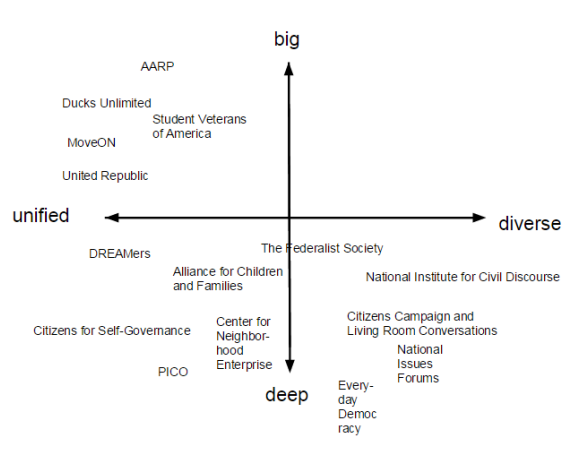
Some organizations included in this study are large, some are ideologically diverse, some have a coherent and focused agenda, and some are deep (engaging their members in learning, growth, leadership, and voice). But no organization has managed to be large, deep, diverse, and focused.

temp

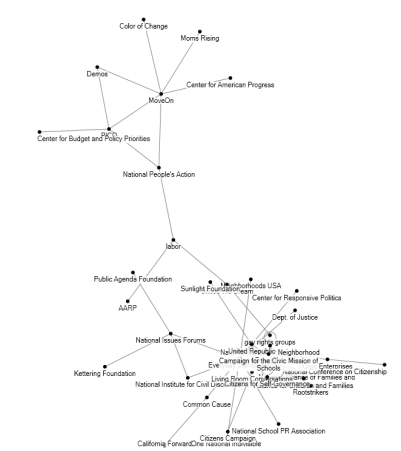
Furthermore, despite some working connections among these organizations, they do not yet form a coherent network. A simple network analysis of the connections that were either mentioned explicitly in the interviews or implied by the interviewees’ bios (for instance, when an individual holds leadership positions in two or more organizations) yielded the diagram below.

temp2

In exemplary episodes from American history, such as the Civil Rights Movement, networks of organizations have managed to be large, deep, diverse, and focused.

The paper concludes with some recommendations for research and convening to strengthen today’s network for civic renewal. You can download the full report here.

The post America’s Civic Renewal Movement: The View from Organizational Leaders appeared first on Peter Levine.

Innovation and Civic Engagement

I’m speaking briefly tomorrow at a Tufts Institute for Innovation symposium on “Research, Innovation, and Community Engagement.” I may say something along these lines:

It is exciting and valuable to put these four words together. We need innovation because existing strategies have not solved stubborn problems. We need research to explain the problems and to assess what works. We need communities, meaning not just populations of people who happen to live in particular places, but groups of people who have networks and norms that allow them to improve the world. (Voluminous scholarship finds that community ties are essential for success.) And we need engagement if we want research and innovation to influence the world.

So I am a fan. But I would like to take a few minutes to note some risks that may arise if we try to combine research, innovation, community, and engagement in the wrong ways.

Research and innovation go together neatly. In fact, university-based research must be innovative, almost by definition. An inquiry doesn’t count as “research” if it has been done before. To be sure, some academic research is highly routine and standard. But that kind of work is valued less than original research. Innovation is esteemed in the university. Famous scholars are innovators.

Innovation is also valued highly in the private sector, in part because making or doing something new can be especially profitable. One definition of a “commodity” is a good for which the demand is met by undifferentiated suppliers. It doesn’t matter whether your shirt was stitched by Bangladeshi workers or a machine in Germany; the shirt comes out the same. A commodity yields low profits because anyone can turn capital into the good and compete. Innovation allows the innovator to reap greater advantage by avoiding competition.

Since innovation is prized in the academy (where the currency is fame) and in the marketpace (where the currency is money)–and since the academy and the market are merging–it is no surprise that glamor attaches to the idea of innovative research that produces innovative solutions that go to market. That is the current ideal.

It is an ideal that also finds its way into public policy. The Obama Administration loves concrete new policy interventions that can be rigorously evaluated. In 2o13, for instance, the administration proposed $200 million in a competitive pool for state governments that cut energy use and expanded HOPE (Hawaii’s Opportunity Probation and Enforcement scheme), which had performed well in evaluations. But it proposed to cut Social Security by $130 billion and Medicare by $380 billion.

Social Security and Medicare are old, not innovative. These big, old programs are not subject to being invented and then tested in randomized experiments. Yet cutting $130 billion from a basic entitlement is massively more consequential than spending $200 million on innovations. And the reason for the cuts was not an actual preference by the administration; it was a function of the balance of power, with Republicans controlling Congress. If we presume that innovation by itself solves problems, we forget about power–power to devise innovations, power to use them, and power to change larger systems that have little to do with innovation.

If innovation and research fit comfortably enough together, innovation and community make a more difficult pair. Communities do not necessarily need innovation. They may prefer to preserve what they have, or to develop in regular and predictable ways. They may value tradition. They will ask whether an innovation is an improvement or a new evil. For these and other reasons, they often resist innovations.

Even when it comes to research, communities may not need originality. Once it is known that cigarettes cause cancer, a community needs to know who is smoking and where the cigarettes come from. The original discovery about the impact of tobacco was valuable, but now the community just needs routine data of the kind that will not look impressive on an academic’s CV.

In a competitive research university, the more innovation, the better. In a community, that is not the case. True, a world of innovation can be exciting and liberating. But if everyone else is innovating, it becomes difficult to make plans for yourself. That actually undermines personal liberty; you are constantly reacting and adjusting to other people’s innovations. The same is true for communities. They cannot govern themselves and form durable laws if everything if always being changed. As James Madison argued: A “mutable policy … poisons the blessings of liberty itself. It will be of little avail to the people, that the laws are made by men of their own choice, if the laws … be repealed or revised before they are promulg[at]ed, or undergo such incessant changes, that no man who knows what the law is to-day, can guess what it will be to-morrow.”

I haven’t said anything about “engagement” yet. Real engagement is not a one-way flow. For instance, to develop and deploy an innovation in a community does not reflect engagement. Two people are said to be engaged if they plan to form a couple. Two gears are engaged if turning either one moves the other. Two gears are engaged if stopping one stops the other. A community and a university are engaged if they form a kind of couple, and if motion–or stillness–on either side influences the partner.

Communities can innovate. And civic engagement can be done in innovative ways. Indeed, Carmen Sirianni and Lewis Friedland’s book, Civic Innovation in America: Community Empowerment, Public Policy, and the Movement for Civic Renewal is an indispensable work that counters narratives of civic decline by showing that new forms of civic engagement have been painstakingly developed to respond to a changing world.

In an age of innovation, we’d better engage citizens in new ways. In that respect, innovation and engagement fit neatly together. But we must not yield to the assumption that “innovation” is desirable because it is the path to fame and profit. If we are really engaged with communities, they will have the power to stop or alter the cleverest innovations. At least some of the power will come from their side.

In short, I am all for developing innovative solutions to social problems and engaging communities in using them. But we must not forget issues of power and of ethics. Some innovations are good, some are bad, and some are insignificant compared to bigger social decisions. A relationship should form between any academic or entrepreneur who is strongly motivated to innovate and the community that might want to participate. That relationship must be ethical and fairly equitable. Ideally, some of the insights and innovations will come from the community side. And like an engaged gear, the community will have the power to stop and prevent the research partner from moving forward.

The post Innovation and Civic Engagement appeared first on Peter Levine.

against fatalism: responding to Krugman and Sunstein

(Washington, DC) Harry Boyte, Albert Dzur, and I have a letter in the latest New York Review of Books that is pertinent to today’s column by Paul Krugman. Krugman’s piece, entitled “Economics and Elections,” is deeply depressing and depressed, exemplifying the very mode of thought that Harry, Albert, and I wanted to challenge in our letter about Cass Sunstein and Michael Walzer, which we wrote more than a month ago.

Krugman argues today that the British Tories did immense and unnecessary damage to the UK economy by enforcing austerity policies. However, the British economy has grown of late, and “a large body of political science research” finds that what determines the outcome of a national election is economic growth during “the last two quarters before the election.” That factor is much more important than any behavior or rhetoric by politicians or anything that the media can say or do. It explains why the Tories may win.

For politicians, the lesson is to ignore the good of the country if you want to be reelected. In fact, “the politically smart thing might well be to impose a pointless depression on your country for much of your time in office, solely to leave room for a roaring recovery just before voters go to the polls.” Scholars and public intellectuals can do little to change this reality, Krugman argues, but they should commit to the truth anyway, like geeky existentialists. Our duty as intellectuals:

Try to get it right, and explain our answers as clearly as we can. Realistically, the political impact will usually be marginal at best. Bad things will happen to good ideas, and vice-versa. So be it. Elections determine who has power, not who has the truth.

(By the way, this is an interesting reversal for Krugman, who early in the Obama years was quick to accuse the president of not using the Bully Pulpit effectively. As he now notes, political scientists basically don’t believe in the Bully Pulpit.)

Cass Sunstein, a distinguished and often insightful political scientist, has collected evidence along similar lines to the “large body” of research cited by Krugman today. Sunstein and his co-author Reid Hastie argue that individuals and groups reach irrational conclusions because of hard-wired cognitive limitations, such as a tendency to “groupthink.” The behavior of voters in a national election is just an example.

Such evidence should be taken seriously. But Michael Walzer offered an important critique in the New York Review of Books that could also apply to Krugman’s article today. Walzer argued that problems (like groupthink) that bedevil discussions inside Congress, the Supreme Court, or any committee room may not be as serious as “powerlessness and inequality.” He concluded:

Organizing, agitating, demonstrating—these are ways of bringing the powerless to the attention of the powerful. They can contribute importantly to democratic decisions, even if they seem nondeliberative. … Sometimes we will want the people outside the room actually to win—to organize and agitate so successfully that they take over the small groups who dominate decision-making, with the result that they change the political conversation. … So, yes, we need to be wiser in the ways described by Sunstein and Hastie; but we also need a radically different kind of decision-making than what they describe, involving a larger number of people inside and outside the rooms where small groups sit.

We concur but would push the argument further. Political institutions can be changed. This is not only a matter of adjusting the rules that govern, for instance, parliamentary districts in the UK or campaign finance in the US. It is also about achieving cultural change within major institutions, such as legislatures, newspapers, and schools and colleges. It is about changing us (the citizens), not just them (the rulers). We wrote:

Sunstein, like Habermas and many others, sees major institutions as largely fixed and unchangeable, not subject to democratizing change. This assumption generates fatalism, which has shrunk our imaginations about decision-making, politics, and democracy itself. The challenge is to recognize that institutions of all kinds are human creations that in turn can be recreated, reconnected to questions of civic and democratic purpose. For this task we need to bring in Max Weber as well as Machiavelli and Marx [whom Walzer had recommended in his review]. Weber described the “iron cage” that results from technical rationality. In his essay “The Profession and the Vocation of Politics,” Weber also evocatively termed the pattern “the polar night of icy darkness.” Thawing the polar night is a frontier of democracy in the twenty-first century.

The evidence that Krugman and Sunstein cite is empirical. By definition, it derives from the past. In the case of Krugman’s column today, it derives from quantitative studies of US presidential campaigns since World War II. We should pay attention to trends in the recent past so that we know what to change. But we cannot allow the past to become a dead hand so that we surrender our political agency.

I addressed the very same topic in We Are The Ones We Have Been Waiting For (pp. 26-7):

The outcome of presidential elections in the United States is strongly correlated with the performance of the economy in the previous year. That means that all the deliberate work of campaigns, parties, and independent advocacy groups matters less than the blind, impersonal force of the business cycle.

Nevertheless, working together in small groups is morally important—it is what we should do and should care most about. To be a good person is to do this work well. That is reason enough to make it a central question for reflection and research. In addition, deliberate human action has significant impact. Small groups of thoughtful, committed citizens do make a difference under appropriate circumstances, as shown by the civil rights movement, the women’s movement, the conservative legal movement, and numerous other examples. … Elinor Ostrom won the 2009 Nobel Prize in Economic Sciences for demonstrating that the organization and governance of voluntary groups affects whether they can solve social problems. These findings suggest that “small groups of thoughtful, committed citizens” matter, even if other factors matter too.

If the leaders of the South African freedom movement reviewed the scholarly literature on democratization during the apartheid years, they must have found it depressing. Prosperity, economic equality, and ethnic homogeneity were the factors that had been found to increase the odds of a successful transition to democracy. These structural factors were all evidently absent in South Africa. … Thus, if the African National Congress and other democratic reformers had been guided by hard-nosed, empirical research, they would have chosen a goal short of democracy, something like a negotiated arrangement among separate authoritarian communities. But they were right to ignore the scholarly literature because it was based on empirical data—in a word, on the past—and the past can never determine the future. So far, their peaceful revolution appears a monumental work of deliberate human agency.

The post against fatalism: responding to Krugman and Sunstein appeared first on Peter Levine.