the case for standardized civics tests

If you want to strengthen democracy and civil society by educating the next generation for citizenshipstates, should you require a civics test? As our interactive map shows, eight states have done so. (Florida’s test came online after the map was completed.)

I have always had mixed feelings about these standardized tests. They measure individual knowledge and academic skills, rather than distinctively civic skills, like deliberating with fellow citizens or addressing a real-world problem. They ignore current events in favor of historical knowledge, both because it’s political risky to test anything even potentially controversial and also because the long process of test-development precludes including timely information and issues. If teachers feel they must spend time preparing for a test, they could shortchange the very experiences that I value most, such as moderated and civil discussions of difficult current issues.

On the other hand, the test compels attention to civics. As I learned last week in Florida, the new 7th-grade test is even creating additional jobs for middle school civics teachers, with benefits for the state’s teacher education programs. Many districts are offering civics for the first time and need to hire. If those new teachers spend some of their time on genuinely valuable activities while also preparing students to pass a test of meaningful and significant knowledge, the net effect could be good.

Two recent articles support a positive view of civics tests.

First, John Saye and the Social Studies Inquiry Research Collaborative (SSIRC) examined the relationship between state civics tests and what they call “authentic pedagogy.” Their observers visited classrooms and noted whether, for example, …

Students study or work on a topic, problem or issue that the teacher and students see as connected to their experiences or actual contemporary or persistent public issues. Students recognize the connection between classroom knowledge and situations outside the classroom. They explore these connections in ways that create personal meaning and significance for the knowledge. This meaning and significance is strong enough to lead students to become involved in an effort to affect or influence a larger audience beyond their classroom in one of the following ways: by communicating knowledge to others (including within the school), advocating solutions to social problems, providing assistance to people, creating performances or products with utilitarian or aesthetic value.

They find that students who have more of these “authentic” civic experiences score better on state-mandated civics test, once other factors are also considered. That does not prove that adding a state test will encourage good teaching; teachers may mistakenly drill their classes on facts. It does show that teachers would be well advised to use “authentic” pedagogies if their students face a civics test.

Second, our friend David E. Campbell has reanalyzed data that CIRCLE collected in a 2012 survey. He finds that high-stakes civics tests boost students’ knowledge as we had chosen to measure it (on a six-item scale of matters that we considered consequential and valuable). The benefits appear greatest for students of color. For instance, the apparent effect of living in a state with a consequential civics exam on the civic knowledge of young African Americans is greater than the effect of their educational attainment.

These articles are tipping me in favor of standardized civics tests, although we must work hard to make sure the tests are good and teachers are supported and encouraged to use valuable techniques in their classrooms.

Sources: John Saye and the Social Studies Inquiry Research Collaborative (SSIRC), Authentic Pedagogy: Its Presence in Social Studies Classrooms and Relationship to Student Performance on State-Mandated Tests, Theory & Research in Social Education, Vol. 41, Iss. 1, 2013; David E. Campbell, Putting Civics to the Test: The Impact of State-Level Civics Assessments on Civic Knowledge, American Enterprise Institute, September 17, 2014.

The post the case for standardized civics tests appeared first on Peter Levine.

summit on civic engagement and higher education

MEDFORD/SOMERVILLE, Mass.—In collaboration with the White House, Tufts University’s Jonathan M. Tisch College of Citizenship and Public Service will convene higher education leaders to examine the important topics of civic engagement and active citizenship at a Civic Learning and National Service Summit to be hosted at Tufts this fall. Tisch College is a leader in civic learning, political engagement and service among young people.

The upcoming summit at Tufts, which was unveiled during the AmeriCorps 20th anniversary celebrations, will address two key topics: the value of civic engagement and how to measure civic engagement commitments and outcomes. The meeting is expected to include national policy makers, higher education scholars and practitioners, and other thought leaders in the fields of education, philanthropy, business, community and government.

Alan D. Solomont, Pierre and Pamela Omidyar Dean of Tisch College, said, “More than ever before, young people today are eager to serve and they are looking for support and inspiration. We welcome this opportunity to work with the White House, leaders in higher education, and others to assess how civic engagement and service can address pressing national challenges.” Solomont, former U.S. ambassador to Spain and Andorra also chaired the bipartisan board of directors of the Corporation for National and Community Service, the federal agency that oversees such domestic service programs as AmeriCorps, Learn and Serve America, VISTA and Senior Corps.

Peter Levine, associate dean of research at Tisch College who is spearheading the upcoming summit, added, “Many colleges and universities offer excellent programs that educate their students for democracy, but there is an urgent need to make these experiences expected for all colleges and students, and to assess the outcomes.”

Tisch College will announce further details of the Civic Learning and National Service Summit in the coming weeks.

The post summit on civic engagement and higher education appeared first on Peter Levine.

the history of civics and news literacy education

I’m in Chicago for Poynter’s News Literacy Summit, entitled “Because News Matters.” Participants promote (to varying degrees) such outcomes as: following and understanding the news, taking informed action as citizens, understanding how the media work, critically interpreting news, understanding society and politics, valuing high-quality news, understanding media effects on individual behaviors and attitudes, being well informed about current events, civilly discussing controversial issues, valuing First Amendment freedoms, making news media, and making other forms of media.

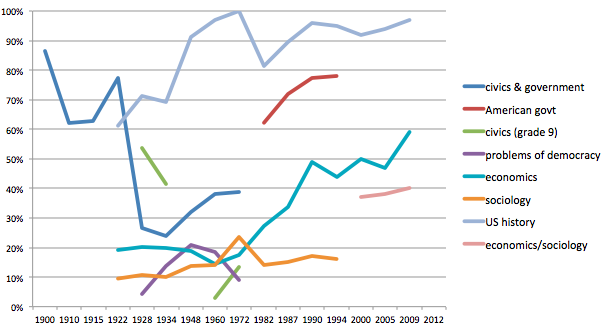
Each of these objectives has been pursued for a long time. John Dewey, for example, was a great proponent of news media literacy. To get a rough sense of what has been taught over time, consider this graph of the percentage of American students who’ve had various courses on their transcripts:

Screen Shot 2014-09-15 at 10.58.02 AM

This is a complex picture, without simple trends. I would, however, emphasize a few observations:

1) A course that truly focused on using the news media was “problems of democracy,” which typically involved having to read the daily newspaper in order to prepare for pop quizzes on current events and classroom discussions. That course had its heyday in the 1940s and is now largely gone.

2) Courses that look like college-level social science are much more common today than they were in the past.

3) American Government is a hardy perennial course. But it has to cover a wide range of material, including the history and structure of the US government. Following current events is often an afterthought, not aligned with standardized tests.

Sources: Up to 1994, Richard G. Niemi and Julia Smith, “Enrollments in High School Government Classes: Are We Short-Changing Both Citizenship and Political Science Training?” PS: Political Science and Politics, Vol. 34, No. 2 (Jun., 2001), pp. 281-287. After that, the National High School Transcript Study; CIRCLE’s 2012 survey.

The post the history of civics and news literacy education appeared first on Peter Levine.

Illinois adopting the “C3″ Social Studies framework

This is exciting news for me as a co-author of the College, Career and Civic (C3) Framework for the Social Studies, a long-time ally of the Illinois Civic Mission Coalition, and a friend of Shawn Healy:

State Superintendent of Education Christopher A. Koch has announced that he has requested a review of the state’s arts and social studies education standards. …

Another group of education partners will form a task force, led by the Illinois Civic Mission Coalition, to develop new social studies standards. The task force will consist of teachers representing various grades, as well as representatives from the disciplines of civics, economics, geography, history and sociology. The panel will review the College, Career and Civic Framework, which was published last fall by the National Council for the Social Studies, to guide its efforts. The group will also draw from the experiences of several other states that have recently embarked on a similar process.

“Strong social studies standards join the core disciplines of math, English language arts and science to help not only prepare students for college and careers, but for engagement in civic life,” said Shawn P. Healy, chair of the Illinois Civic Mission Coalition and the Civic Learning and Engagement Scholar at the Robert R. McCormick Foundation. “This is a promising step in reviving the civic health of our state.”

Other states–at least including New York, Connecticut, and Kentucky–are also using the C3 to help revise their standards.

The post Illinois adopting the “C3″ Social Studies framework appeared first on Peter Levine.

how to teach the constitution of cyberspace

Tomorrow at the American Political Science Association, I’ll be joining Hahrie C. Han (Wellesley College), Cathy J. Cohen (University of Chicago), and Joseph Kahne (Mills College) on a panel on Civic Education after the Digital Revolution Date (10:15 AM-12:00 PM, Omni Palladian Ballroom, DC).

This is one topic I’d like to discuss: Students should understand and be able to critically assess the basic rules and structure of the Internet, much as they should understand and be able to criticize the US Constitution. But the Internet is harder to grasp, for both teachers and students. How should the “constitution of cyberspace” be taught (if at all)?

The US government as an institution that students should understand in order to critically assess it. To be sure, the government is large and complex, it has changed over time, and it has both proponents and sharp critics. Yet it has one fundamental document (the US Constitution) and one impressive justification (in the Federalist Papers) that provide focal points of debate. Students can learn a lot by reading the Constitution, some of the Federalist Papers, and some critics of the Constitution and then applying their knowledge through discussions of historical and current controversies.

In contrast, Web 2.0 has no constitution and no Federalist Papers. I admire perceptive theorists of the new media landscape: Benkler (2006), boyd (2008), Castells (2000), Lessig (2000), Shirky (2008), Sunstein (2007), and others. None of these authors would claim to be the James Madison of cyberspace. They did not have the authority to write its fundamental rules, and they do not offer highly general justifications of it. Their writing is too difficult to be assigned directly in most k-12 classrooms. Their scholarship has not been digested for youth audiences, nor has it prominent expression in political discourse. If there is a Gettysburg Address for the new media environment, I have not seen it.

I do not presume that the US Constitution is preferable to the rules of cyberspace or that the framers of the Constitution are more admirable than the architects of the digital world. The Constitution requires critical evaluation; the Internet has attractive features. I would simply assert that it is harder to understand cyberspace than the US government because only the latter has an authoritative code (the Constitution) and official justifications that we can read and critically evaluate.

The post how to teach the constitution of cyberspace appeared first on Peter Levine.

a real chance to improve civics in California

I am pasting excerpts of a press release below, because I am excited about what it announces and I have been involved as a consultant on the project. It is an example of the kind of strategy we recommended in the report of the Commission on Youth Voting and Civic Knowledge, entitled “All Together Now: Collaboration and Innovation for Youth Engagement” (2013):

Sacramento, Calif., August 5, 2014 – California Chief Justice Tani G. Cantil-Sakauye and State Superintendent of Public Instruction Tom Torklakson today received the Final Report of the California Task Force on K-12 Civic Learning. The report is the culmination of a year-long process of assessing the state of civic learning in California schools, receiving input at regional meetings, and crafting research-based recommendations to ensure that all California K-12 students gain the knowledge, skills and values they need to succeed in college, career and civic life.  Both the executive summary and the full report are available online.

Members of the California Task Force on K-12 Civic Learning, co-chaired by Justice Judith McConnell and Sacramento County Superintendent of Schools David Gordon, presented the recommendations aimed at providing all students in California with the instruction, support and experiences they need to actively participate in society and succeed in the 21st century workplace.

These recommendations include:

  • revision of the California History/Social Science content standards;
  • integration of civic learning into state assessment and accountability systems;
  • improved professional learning for teachers connected to Common Core State Standards;
  • sharing of curriculum resources and best practices;
  • engaging stakeholders from local government, business, the courts, nonprofits, community organizations and parents; and
  • promoting funding in Local Control Accountability Plans (LCAP) through Local Control Funding Formula (LCFF).

The post a real chance to improve civics in California appeared first on Peter Levine.

adult civic education in the Workforce Redevelopment Act

The Workforce Investment Act of 1998 consolidated federal adult education programs. Congress just passed a re-authorization that has gone to the president for his signature. Section 201 deals with Adult Education and Family Literacy. The reauthorized section 201 “create[s] a partnership among the Federal Government, States, and localities to provide, on a voluntary basis, adult education and literacy activities.” The list of purposes for these activities begins with employment and job skills, as one would expect for a Department of Labor program. But the Campaign for the Civic Mission of Schools alerted me to section 4(b), which mentions another outcome: “acquiring an understanding of the American system of Government, individual freedom, and the responsibilities of citizenship.” Section 243 then specifically mentions “integrated English literacy and civics education.” Funds for this purpose are to be allocated–in part–on the basis of the number of newly naturalized citizens per state. Money can flow to nonprofits, state agencies, universities, libraries, etc.

Of course, everything depends on how these provisions are implemented. Civics education for new immigrants could be mere jingoistic propaganda, or it could be well-intentioned and yet poorly handled. However, as I argued in a CNN.com column last year, we can and should educate new immigrants for effective and responsible civic participation. That will be good for them as individuals, good for their communities, and good for democracy. I am enthusiastic about these provisions in the Workforce Investment Act. It is now up to us to make sure they are well implemented.

The post adult civic education in the Workforce Redevelopment Act appeared first on Peter Levine.

needed: the case method for civics

David Garvin has written, “All professional schools face the same difficult challenge: how to prepare students for the world of practice. Time in the classroom must somehow translate directly into real-world activity: how to diagnose, decide, and act. A surprisingly wide range of professional schools … have concluded that the best way to teach these skills is by the case method.”

I propose that we need cases for citizens. Of course, there are many case studies available. Participedia provides hundreds of examples of citizens’ engagement with government. Many books (including my own) tell stories of successful or failed civic efforts.

But the case method is a little different. A “case” in this context means a deliberately incomplete story. It ends at a point of decision for a character or small group. The decision is contrived or chosen to be difficult in the specific sense that it is unresolvable by any formula or algorithm. Such difficulty may arise because the situation involves conflicting and incommensurable values or because the facts and likely outcomes are uncertain–or both. These two sources of indeterminacy are extremely common. Yet we must act. Garvin writes:

“The case system, ” business school alumnus Powell Niland, now of Washington University, has observed, “puts the student in the habit of making decisions.” Day after day, classes revolve around protagonists who face critical choices. Delay is seldom an option. Both faculty and students cite the “bias for action” that results—what Fouraker professor of business administration Thomas Piper calls “courage to act under uncertainty.”

In the Summer Institute of Civic Studies last week, we discussed a case study from Harvard’s Pluralism Project. It involves an adult leader (who, coincidentally, I happen to know) who helped youth organize an interfaith event in a synagogue and who must decide, at very short notice, what to do about a sign that says, “We support Israel.” This is a case about religious pluralism, but we could also consider it a case of civic action. We need more cases like it.

By the way, if you follow the argument of Bent Flyvberg (whom we also read in the Institute), then you will conclude that all knowledge of the social world is particularistic and case-specific. The only valid knowledge comes from cases. I think that is too strong. General knowledge is also helpful. If there are no laws or algorithms that tell us what we should do, there are at least useful rules-of-thumb and principles, both explanatory and normative. Yet cases play an essential role, especially if the purpose is to educate citizens to act.

The post needed: the case method for civics appeared first on Peter Levine.

17-year-olds voted at a higher rate than their parents in Chicago

In Chicago, 17-year-olds were permitted to vote in the March primary election. Chicago is a hotbed of excellent youth civic engagement groups, and they came together to register high school students and encourage them to vote. In the coalition were frequent partners of ours, including the Constitutional Rights Foundation Chicago and the Mikva Challenge. The result of their work–and students’ own enthusiasm–was a youth turnout rate of 15%. That doesn’t sound very impressive until you learn that students beat their elders in a low-turnout primary. The same thing happened in Takoma Park, MD last year.

I have advocated lowering the voting age to 17, and our Commission on Youth Voting and Civic Knowledge recommends considering that policy. While kids are still in school, they can be taught about the voting process and the governmental system before they vote. Most are still at home at 17 and connected to family and neighborhood networks that encourage voting. A year later, many have moved away for the first time into age-segregated youth zones–college dorms or apartments populated by young workers–where turnout is low. This matters because voting is habitual. Mark Franklin even argues that making 18 the age of eligibility permanently lowered turnout in many industrialized democracies. I certainly wouldn’t raise the age, but I would strongly consider lowering it by one year.

The post 17-year-olds voted at a higher rate than their parents in Chicago appeared first on Peter Levine.

the Power of Democracy in California

(Durham, NC) For about a year, I have been assisting a task force called “the Power of Democracy” that formed in California under the active leadership of the state’s Chief Justice, Tani Cantil-Sakauye. Members have been thoughtful and dogged about promoting civic learning and civic engagement in their state, working with their state education agency, the legislature, the judiciary, and key nongovernmental organizations, discussing significant policy changes, giving awards, holding public meetings, and otherwise drawing attention to civic education. I am optimistic that real improvements will come in California.

I’m able to write all this now because the Power of Democracy has a new public face in the form of an excellent website. If you explore it, you’ll see a new article by the leader of the California Chamber of Commerce arguing that business needs better civic education; the “six promising practices” of civics (which originated at CIRCLE) used as their definition of what works; and my own analysis of California’s current civic ed. policies. But the most promising aspect of the project is the strong team that has come together to advocate for civic education in a way that emphasizes equity in opportunities and civic action as the desired outcome.

The post the Power of Democracy in California appeared first on Peter Levine.