apply for the 2019 Summer Institute of Civic Studies

The Summer Institute of Civic Studies is an intensive interdisciplinary seminar that brings together faculty, advanced graduate students, and practitioners from many countries and diverse fields of study. In 2019 it will take place from the evening of June 20 until June 28 at Tufts University in Medford, MA, and Boston.

The Summer Institute was founded and co-taught from 2009 to 2018 by Peter Levine, Associate Dean of Academic Affairs at Tisch College, and/or Karol So?tan, Associate Professor in the Department of Government and Politics at the University of Maryland. The 11th annual Summer Institute will be taught by Peter Levine alongside several Tufts colleagues. Each year, it features guest seminars by distinguished scholars and practitioners from various institutions and engages participants in challenging discussions such as:

  • How can people work together to improve the world?
  • How can people reason together about what is right to do?
  • What practices and institutional structures promote these kinds of citizenship?
  • How should empirical evidence, ethics, and strategy relate?

A provisional draft of the 2019 syllabus is shown below. You can read more about the motivation for the Institute in the Civic Studies Framing Statement by Harry Boyte, University of Minnesota; Stephen Elkin, University of Maryland; Peter Levine, Tufts; Jane Mansbridge, Harvard; Elinor Ostrom, Indiana University; Karol So?tan, University of Maryland; and Rogers Smith, University of Pennsylvania.

The seminar follows a three-day public conference, Frontiers of Democracy, which takes place in downtown Boston on June 20-22. Participants in the Summer Institute are expected to participate in the conference (free of charge) and then the Institute on June 23-28. This year, the Summer Institute also follows the American Political Science Association Institute for Civically Engaged Research (ICER), which will take place on June 17-22, with ICER participants also taking part in the Frontiers conference.

Practicalities and How to Apply

Daily sessions take place on the Tufts campus in Medford, Massachusetts. Tuition for the Institute is free, but participants are responsible for their own housing and transportation. One option is a Tufts University dormitory room, which can be rented for $69/night (single room) or $85/night (double room). Credit is not automatically offered, but special arrangements for graduate credit may be possible.

The application consists of a resume, a cover letter about your interests, and an electronic copy of your graduate transcript (if applicable). The application deadline is March 31, 2019. You can sign up here to receive occasional emails about the Summer Institute, including a notification when we begin accepting applications.

For more information contact Peter Levine, Tisch College’s Associate Dean of Academic Affairs, at peter.levine@tufts.edu.

European Institute

The fifth annual European Institute of Civic Studies will take place in Herrsching, near Munich, Germany, from July 14th to July 27th 2019. It is open to graduate students and scholars in any discipline who are citizens of Armenia, Azerbaijan, Belarus, Georgia, Germany, Kazakhstan, Kyrgyzstan, Moldova, Poland, the Russian Federation, Tajikistan, Turkmenistan, Ukraine and Uzbekistan. To apply, send a letter of interest, a curriculum vitae, and an academic transcript (if applicable) to Prof. Tetyana Kloubert at Tetyana.Kloubert@ku.de by March 31, 2019, for best consideration.

***

2019 Summer Institute Syllabus

Subject to change

June 20 (evening) to June 22 (lunchtime): Frontiers of Democracy Conference

June 23 (afternoon): Informal gathering to get to know each other; some sharing of our backgrounds and goals

June 24

I. Inspirations for civic work

9 a.m.-Noon: A “feeling of personal responsibility for the world”

II. Problems of Collective Action: Forming and Maintaining Functional Groups at Various Scales

1:00-2:00 p.m.: A simulated Tragedy of the Commons; reflections on game theory as a method of modeling interactions

2:00-5:00 p.m.: The work of Elinor Ostrom and colleagues

June 25

9:00 a.m.-Noon:  The role of social capital

1:00-3:00 p.m.: Collective action problems at scale

  • James Madison, The Federalist #10
  • Jane Mansbridge, Beyond Adversary Democracy, pp. 3-35, pp. 163-82, 290-8
  • Friedrich Hayek, The Constitution of Liberty, Chapters 1, 4 and Postscript, pp. 11-21, 54-70, 397-411.
  • James C. Scott, Seeing Like a State: How Certain Schemes to Improve the Human Condition Have Failed,Introduction (pp. 1-8), Chapter 3 “Authoritarian High Modernism”

3:30-5:00 p.m.: Public Work

  • Harry C. Boyte, Reinventing Citizenship as Public Work: Citizen-Centered Democracy and the Empowerment Gap

June 26

III. Problems of Discourse: Discussing and Reasoning about Contested Value Issues

9:00-10:00 a.m.: Deliberation

  • The Harvard Pluralism Project’s case entitled A Call to Prayer. What should the people of Hamtramck, MI do?

10:00 a.m.-Noon, 1:00-2:00 p.m.: The Frankfurt School, Habermas, deliberative democracy

  • Lasse Thomassen, Habermas: A guide for the perplexed. A&C Black, 2010, pp. 63-96, 111-130.
  • Jürgen Habermas, “The Public Sphere: An Encyclopedia Article,” New German Critique, 3 (1974), pp. 49-55
  • Jürgen Habermas, Theory of Communicative Action (selection) 

2:00-5:00 p.m.: Critiques

  • Danielle E. Allen, Talking to Strangers: Anxieties of Citizenship Since Brown, v. Board of Education, pp. TBA
  • Jean L. Cohen, “American Civil Society Talk,” in Robert K. Fullinwider, ed., Civil Society, Democracy, and Civic Renewal, pp. 55-85
  • Nina Eliasoph, Avoiding Politics, pp. 1-22
  • Lynn Sanders, “Against Deliberation”

June 27

IV. Problems of Exclusion

9:00-11:00 a.m.: Boundaries, good and bad

  • The Book of Nehemiah
  • John Gaventa, Power and Powerlessness: Quiescence and Rebellion in an Appalachian Valley, pp. 3-32
  • Dec 4: Audre Lorde, “ The Master’s Tools Will Never Dismantle the Master’s House” and Steve Biko, “Black Consciousness and the Quest for True Humanity”

11:00 a.m.-Noon and 1:00-3:00 p.m.: Gandhi

2:00-4-00 p.m.: Martin Luther King

June 28

V. Solutions?

9:00-11:00 a.m.: Community organizing

  • Mark R. Warren, Dry Bones Rattling: Community Building to Revitalize American Democracy, pp. 4-70
  • Saul Alinsky, Reveille for Radicals, 1946 (1969 edition), pp. 76-81; 85-88; 92-100, 132-5, 155-158.
  • Myles Horton and Paulo Freire, We Make the Road by Walking, pp. 115-138

Noon-2:00 p.m.: Social movements and nonviolent campaigns

  • Charles Tilly, Social Movements, 1768-2004
  • Habermas, “New Social Movements,” Telos, September 21, vol. 1981, no. 49 (1981)
  • Marshall Ganz, “Why David Sometimes Wins: Strategic Capacity in Social Movements,” in Jeff Goodwin and James M. Jasper, Rethinking Social Movements: Structure, Meaning, and Emotion (Lanham, MD: Rowman and Littlefield, 2004) pp.177-98.
  • Erica Chenoweth and Maria J. Stephan, Why Civil Resistance Works: The Strategic Logic of Nonviolent Conflict, chapters 1 and 2 

2:00-3:00 p.m. Closing reflections
an agenda for the dignity of work

Sen. Sherrod Brown’s theme of the “dignity of work” is powerful and important, for these four reasons:

1. A basic cause of unacceptable inequality is the worsening position of workers versus the owners of capital. That shows up in statistics on the share of income …

… and also in less tangible ways, such as a growing cultural and spatial distance between workers and investors and the rising deference or obsequiousness to the rich

2. Work, in the broadest sense—making things of value—is one basis of a good life for human beings. It is spoiled when work is alienated (split between decision-makers who don’t actually do anything and laborers who make no decisions) or replaced entirely by automation and AI. The availability of good work is probably shrinking and is certainly threatened by the next wave of automation.

3. The dignity of work can be a unifying theme. Yes, who has dignified work depends on gender, race, class, and age, so addressing this issue requires attention to inequality and difference. But people in very different social positions share a sense that dignified work is threatened.

4. Workers who are organized (in unions or the functional equivalents of unions) gain countervailing political power along with dignity. I’m of the school that it doesn’t matter much which policies Democratic candidates endorse, because their policy options are highly constrained once they’re in office. It matters how power is distributed. Strengthening workers’ organizations addresses the third level of power (“Who decides policies?”) rather than the first or second levels of power (What do particular people get? and “What policies are in place?”).

[For related arguments, see Harry C. Boyte, “The Shutdown Taught Us About the Dignity of Work: An Unanticipated Civics Lesson, Courtesy of President Trump” (The Nation, Jan 29) and Albert Dzur, “Teaching Citizenship” (The Boston Review, Jan. 30).]

Sen. Brown has a plan entitled “Working Too Hard for Too Little: A Plan for Restoring the Value of Work in America.” I think it’s an important contribution, but it’s mostly about raising pay per hour and improving the bargaining position of unions. We could add to his agenda, recognizing that some people just aren’t going to be unionized, that AI threatens employment for all, and that work faces crises of quality as well as pay and hours.

I can only offer vague thoughts because I am insufficiently informed, but I would consider:

  1. Federal support for associations of workers who would have a very hard time unionizing. Domestic workers are the prime case, and the National Domestic Workers Alliance is the leading example. When organized, domestic workers can advocate for favorable government policies, but they can also provide education, training, insurance, and other services for their members and speak to a range of audiences. In practice, they use their voice to advocate for their patients and clients as well as for themselves, and they demonstrate a concern for the quality of work as well as pay. I am not sure what federal policies would help them most, but possibly they should be eligible for grants for their service functions to subsidize their organizing efforts.
  2. A new look at accountability policies in a wide range of fields, from teaching and policing to medicine, to ensure that the drive to measure inputs and outcomes doesn’t ruin the quality of professional work. Often these accountability measures are driven by federal policy.
  3. A new look at the federal civil service, with an eye to making the jobs that are directly controlled by the national government as rewarding and substantive as possible.
  4. Funding for R&D that uses new technology to enhance and expand work (not to replace work).
  5. Federal programs modeled on the EPA’s now-defunct Community Action for a Renewed Environment CARE) that support a range of stakeholders who work on common problems. Typically, some of the stakeholders are paid to work full-time on these problems; others use some of their paid time to help out; and others are volunteers. For instance, in an environmental project, some participants may be government regulators, some may be local business people, and some may be unpaid activists. It’s important to see and name them all as working.

insights from the k-12 civic education System Map

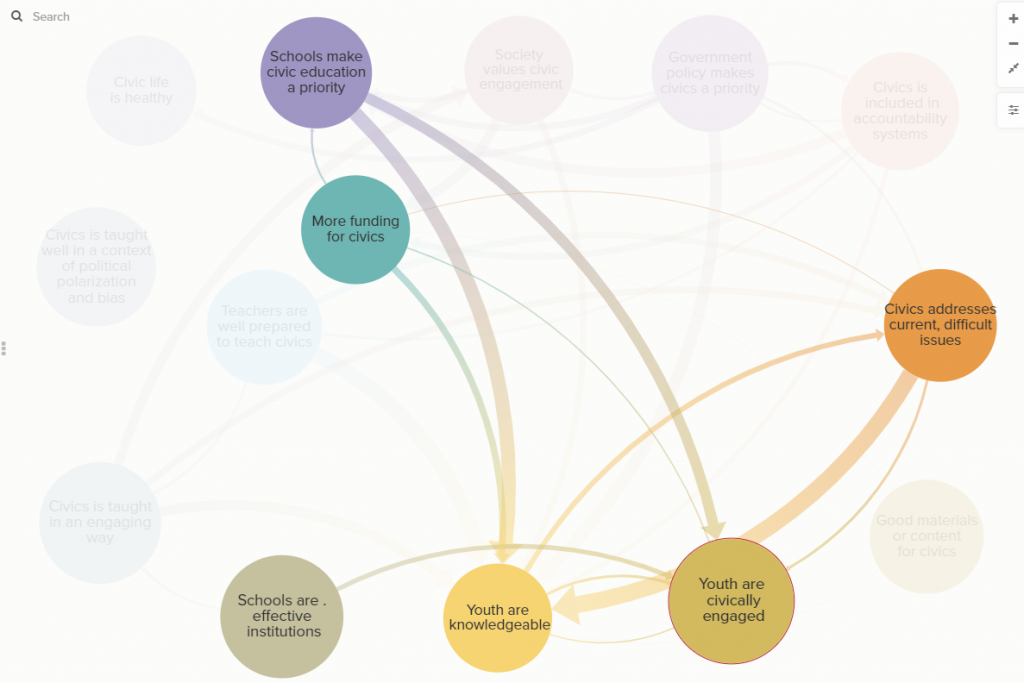
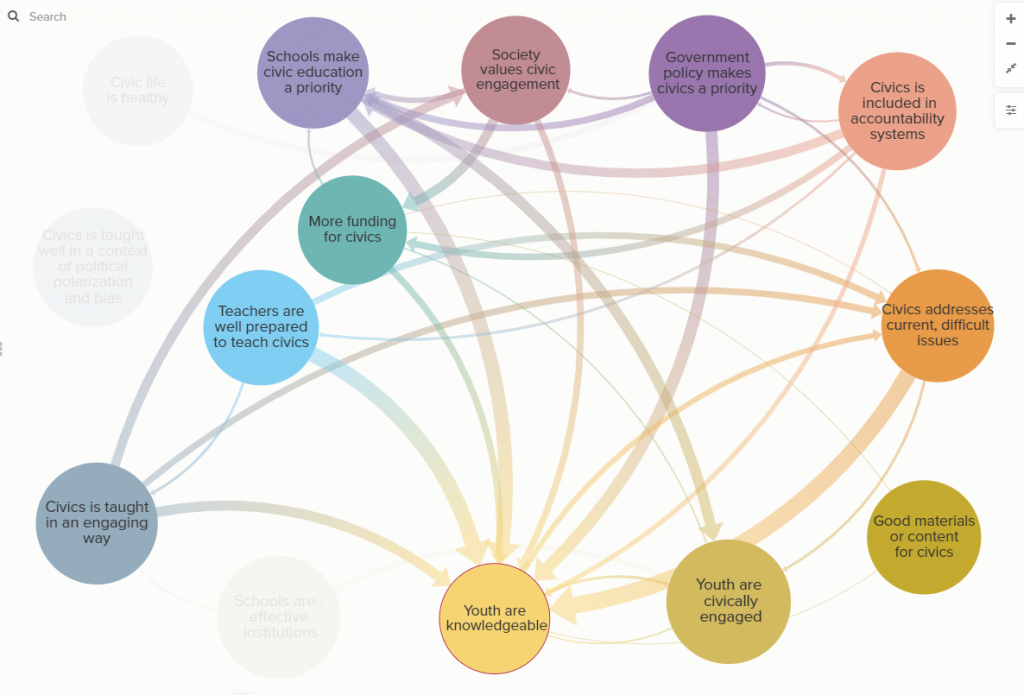
For CivXNow, we recently created a System Map of k-12 civics. Perhaps the greatest value of the map is that we didn’t decide what was on it or how things fit together. More than 7,500 people co-created it by answering survey questions. We didn’t ask them what strategy they favored but whether they thought that various specific factors influenced other specific factors, and we built a network from the results. More about the method and its rationale is here.

In this post, I would like to derive some substantive results from the map.

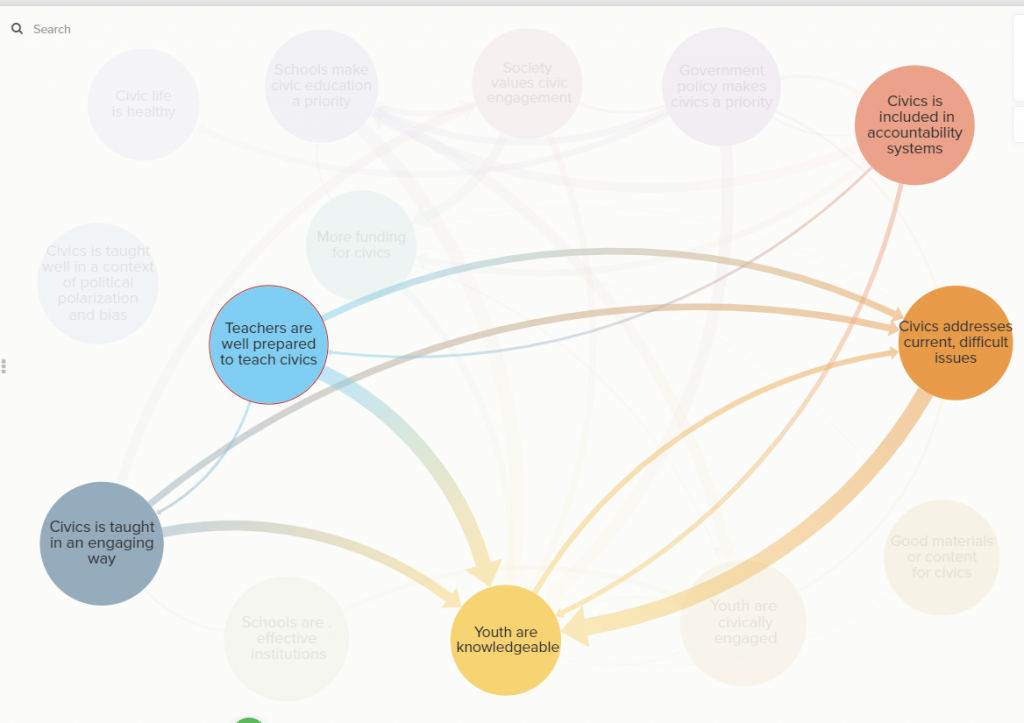
First, look at what is connected to two different possible outcomes of civic education: youth knowledge (on the left) and youth civic engagement (on the right). Almost the whole map has direct connections to knowledge; very little is connected to youth engagement. Of the causes of youth engagement, one is knowledge–which sends us back to the diagram on the left. Another cause is “schools are [generally] effective institutions,” which may seem beyond the power of the civic education community.

Overall, it appears that we have created much more of a “system” for generating youth knowledge than for empowering youth to act. To the extent that people are working on the latter goal, their efforts are not nearly as visible to our 7,500 respondents.

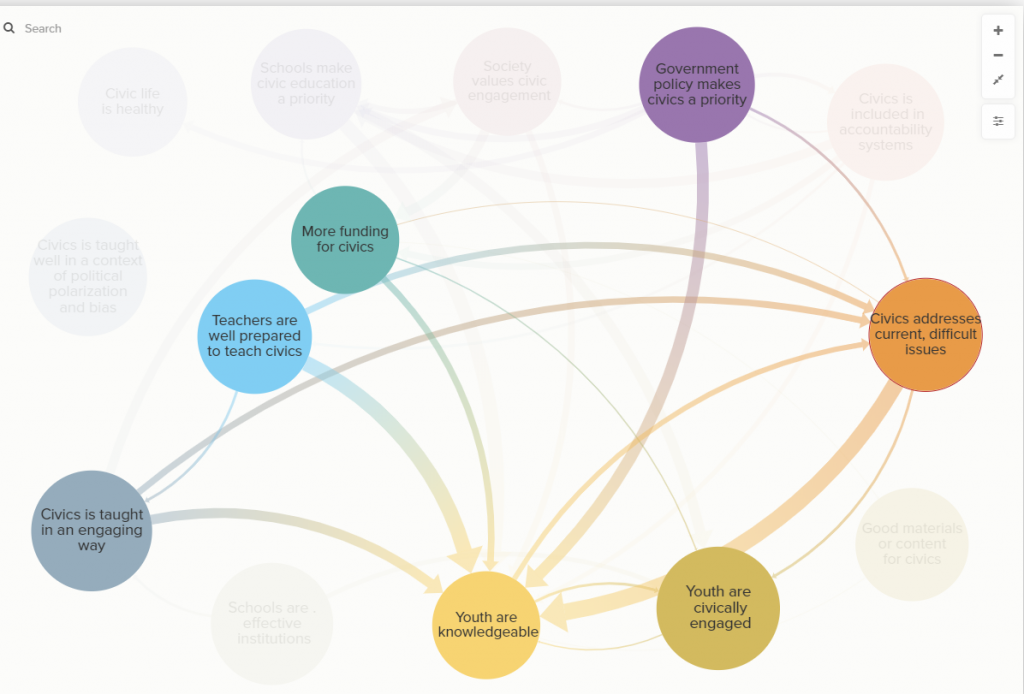
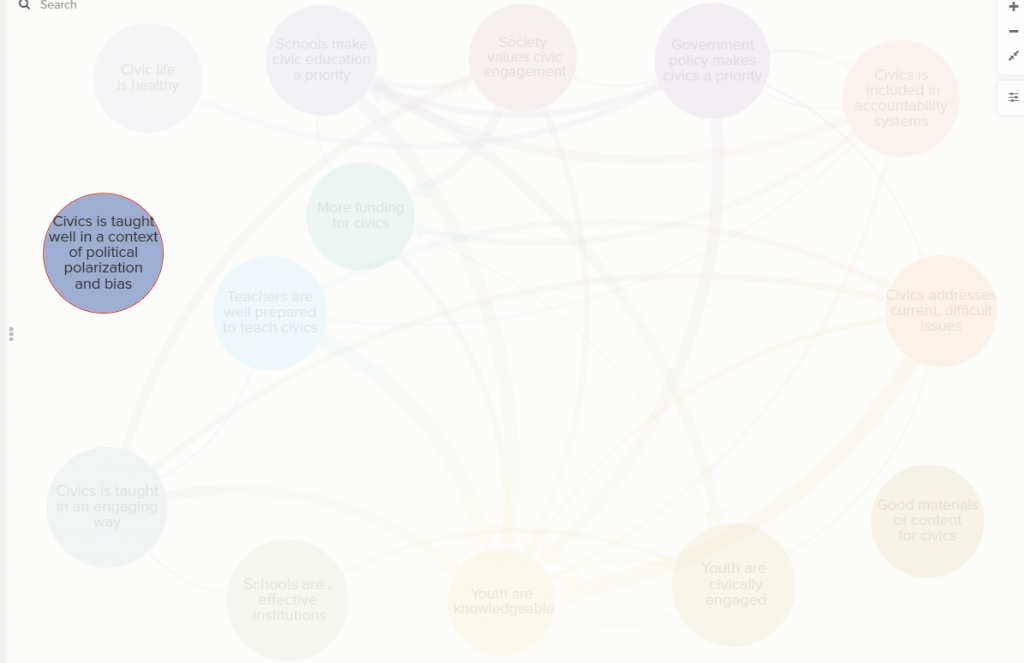
Second, compare two factors that have to do with the content and pedagogy of civics. On the left is whether civics addresses complex and current issues and controversies. On the right is whether teachers are able to present civics without bias and withstand a polarized political environment outside the classroom

Either goal may be very important. You might reasonably consider either (or both) to be your main concern. But the one on the left is highly leveraged, affecting many other outcomes. The one on the right has virtually no leverage at all. Our community doubts that if civics avoided problems of bias, then anything else would improve.

Third, take a look at funding. This was linked to more other factors than any other node on the map. I assume that is because it is relatively easy to envision that having more money would change a whole range of outcomes. We all know that money has value. (That’s why they call it “money.”)

The Role of Funding

But how would we get more money? This map rightly portrays funding as a “midstream” issue. Yes, money would help, but other factors–notably, including civics in accountability systems and making civic engagement more of a public priority–are what would yield more funding. The map suggests that even if money is an important means, it is likely not the best target for advocacy.

Now take a look at how people connected “Teachers are Well Prepared to Teach Civics” to other nodes. This is the factor that captures pre-service education, professional development, etc. Respondents did see it as a driver of more engaging pedagogy and of more current issue-discussions. But the ultimate outcome they expected was better knowledge, not more civic engagement.

How People View Professional Development

This could mean that most teacher education and PD presents student knowledge as the explicit goal, and engaging pedagogy as a means. Should it be otherwise?

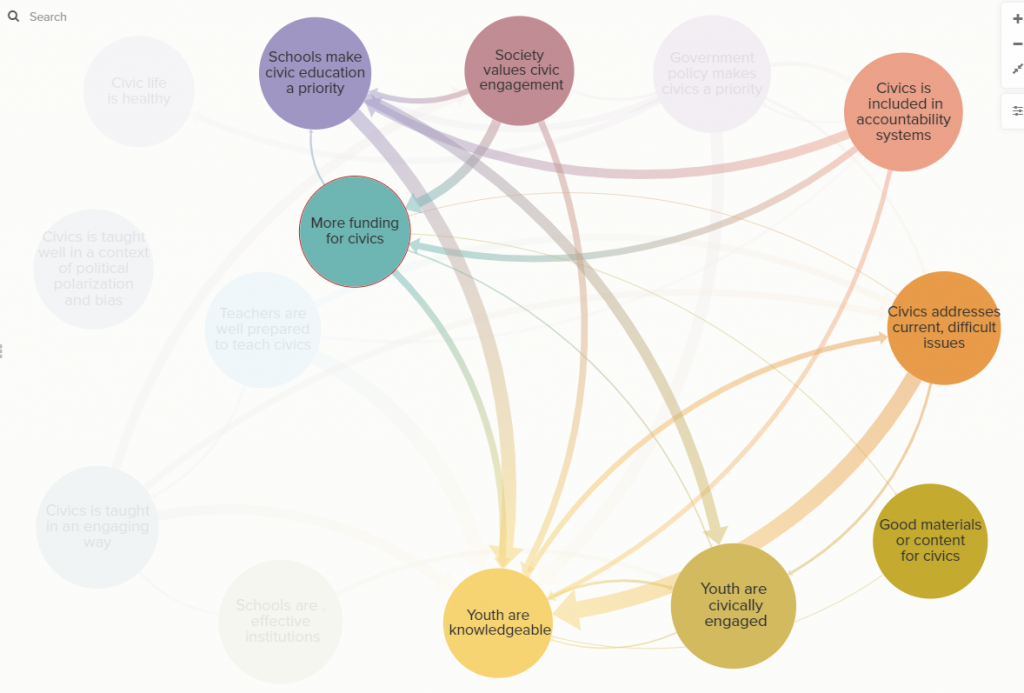
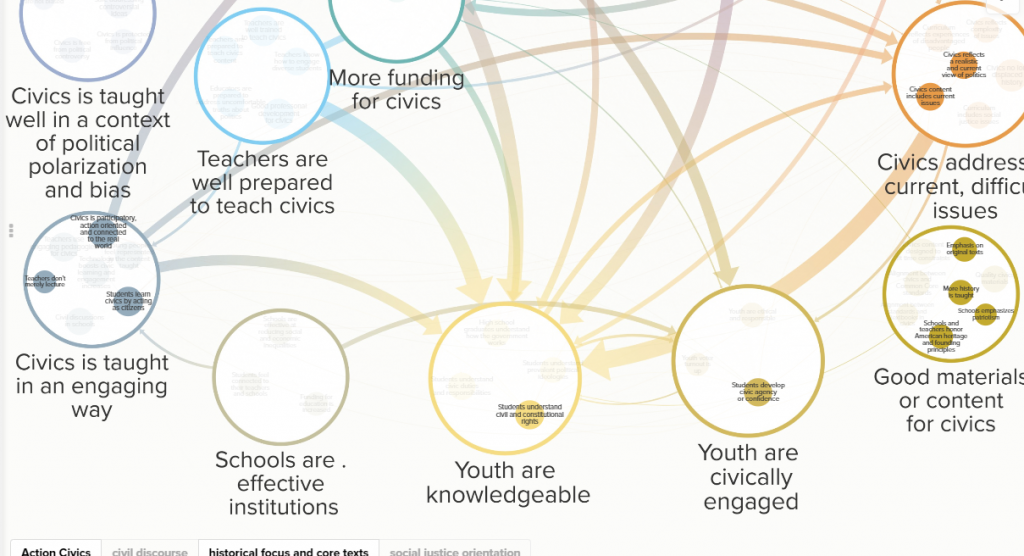
Finally, let’s zoom in for greater detail. This is a screenshot from the version of the map that displays 75 components clustered into larger factors. I have highlighted the components that may reflect a concern with history and classic texts (often coded as conservative) and those that reflect a desire for students to take action (sometimes seen as progressive).

Components Involving Action Civics and Historical Texts

The point I would like to emphasize is that these goals are not in conflict. They light up different parts of the map. It’s possible to work on both goals at once.

The American Political Science Association Institute for Civically Engaged Research (ICER) at Tisch College this summer

June 17-22, 2019

Background and Purpose

Scholars in many disciplines are grappling with how to produce rigorous scholarship that addresses significant social challenges in collaboration with communities, organizations, and agencies. They strive to learn from non-academics, to benefit from the research capacity of all kinds of groups and institutions, and to give back to communities rather than extract value from them. Although political scientists offer models of excellence in civically engaged research, relevant methods and strategies are not yet widely taught in the discipline’s graduate programs or sufficiently valued in the profession as a whole. 

Therefore, the American Political Science Association (APSA) Council has authorized an annual APSA Institute for Civically Engaged Research (ICER) to begin in summer 2019. ICER is intended for advanced graduate students in political science and political scientists at any stage of their careers who wish to shift to using civically engaged research. It is not meant for scholars who are already experienced in that approach.

Content of the Institute 

The Institute will address topics such as: 

  • Expertise: what do political scientists contribute? What are the limitations of scholarly expertise? What expertise do others have?
  • The needs of scholars as compared to community groups or political actors. Tensions and ways of addressing them.
  • The ethics of collaboration: sharing of credit, funds and overhead, IRB issues, sharing results, dealing with disagreements.
  • Communicating results: to partners, communities, the press, directly to the broad public. Dealing with controversy.
  • How to define and honor values of like neutrality, objectivity, and rigor.
  • Career issues:  publication and credit, tenure and promotion, fundraising.
  • Mapping the different and varied ways that political scientists engage.

We will explore these issues by discussing relevant readings, by analyzing specific examples of civically engaged political science research, and by considering the research plans and ideas of the participants in the Institute.

The Institute will take place on the campus of Tufts University, in the Boston area, from June 17-22, 2019. Approximately twenty participants will meet each day from June 17-20 for intensive discussions. Participants are expected to attend the Frontiers of Democracy conference with approximately 120 other scholars and practitioners from the evening of June 20 until noon on June 22 in downtown Boston.

How to Apply

Thanks to support from the APSA, participation in the Institute and the conference is free, and scholarships are available to defray costs of travel, food, and housing in dormitories on the Tufts campus. Applicants are expected to seek financial support from their home institution, but admission to the Institute for Civically Engaged Research will not be affected by financial need.

To apply, please complete this form. It will ask for 1) your name, your institution, and program of study or current employment; 2) your reasons for interest in the Institute; 3) your background in political science research and in civically engaged research; 4) your areas of special research interest; and 5) your demographics. You are also asked to upload your CV and your unofficial academic transcript if you are a current graduate student or earned a PhD within the last five years.

People

Confirmed speakers and visitors include: Valeria Sinclair Chapman (Purdue), Archon Fung (Harvard), Taeku Lee (Berkeley), Robert Lieberman (Johns Hopkins), Jamila Michener (Cornell), Amy Cabrera Rasmussen (Cal State-Long Beach), Pearl Robinson (Tufts), and Rogers Smith (University of Pennsylvania). 

Also involved with the Institute are: Amanda Grigg (APSA) and Hahrie Han (University of California Santa Barbara)

The organizer and Principal Investigator on the project is Peter Levine (Tufts’ Tisch College of Civic Life and Department of Political Science). 

Related Opportunities 

  • The 11th annual Summer Institute of Civic Studies will take place at Tufts’ Tisch College of Civic Life from June 23-28, 2019, following ICER. It is highly interdisciplinary and focused on a set of readings about how people work together to improve the world, how people reason together about what is right to do, and what practices and institutional structures promote these kinds of citizenship. Applications are due on March 30, 2019.
  • The Center on Democracy and Organizing (CDO) is seeking applications from advanced Ph.D. students and early career researchers and organizers for participation in an interdisciplinary institute focused on the study of democracy and organizing. This institute will be held from July 31 to August 2 at the University of California, Berkeley. Political scientists are encouraged to apply. The organizers of the APSA/Tufts Institute and the CDO institute will ensure that the content does not overlap substantially. 
  • The fifth annual European Institute of Civic Studies will take place in Herrsching, near Munich, Germany, from July 14-27, 2019. It is open to graduate students and scholars in any discipline who are citizens of Armenia, Azerbaijan, Belarus, Georgia, Germany, Kazakhstan, Kyrgyzstan, Moldova, Poland, the Russian Federation, Tajikistan, Turkmenistan, Ukraine, or Uzbekistan. To apply, send a letter of interest, a curriculum vitae, and an academic transcript (if applicable) to Prof. Kloubert at Tetyana.Kloubert@ku.de by March 15, 2019, for best consideration
     
  • Postdoctoral Fellowships at Tisch College:
  1. Tufts University will award a Post-Doctoral Fellowship to a scholar with expertise in American political behavior and survey data analysis for the 2019-20 academic year. The Fellowship is partly funded by a grant from the National Science Foundation and will be awarded to a scholar with a Ph.D. in Political Science or a related discipline with research interests that intersect with the Cooperative Congressional Election Study (CCES). Applicants should have completed the requirements for their Ph.D. by the time of appointment, which is planned for August 1, 2019. The post-doc will be located at Tufts University in the Department of Political Science and in the Jonathan M. Tisch College of Civic Life. More information and application materials are here.
     
  2. Tisch College will award a Postdoctoral Fellowship in Civic Science for the 2019-20 academic year (June 1, 2019 to May 31, 2020). This postdoctoral fellowship is offered in partnership with the Charles F. Kettering Foundation in Dayton, OH, and involves some work at Kettering’s offices in Dayton as well as full-time employment at Tufts in the Boston area. The Tisch College Civic Science initiative, led by Dr. Jonathan Garlick, aims to reframe how key participants—scientists, the public, the media, institutions of higher education, and other stakeholders engage the national dialogue about science issues. Civic Science is interdisciplinary, and this fellowship is open to a PhD in any relevant field. The Fellow will conduct research related to Civic Science, both independently and in collaboration with Prof. Garlick and the Kettering Foundation. He or she will teach one course to undergraduates in the Civic Studies Major. The Fellow will attend orientation and research meetings at the Kettering Foundation as requested. More information and application materials are here.

Both Postdoctoral Fellows will attend and participate in the Summer Institute of Civic Studies at Tisch College.

Brag, Cave and Crow: a contribution to game theory

Game theory models interactions by presenting the “players” as people (or organizations) who face choices, and the outcome as the result of how they each choose. In conflictual circumstances, the players can choose between the option that their opponent would prefer (cooperate) or the one that their opponent would not prefer (defect). In certain unpleasant circumstances, such as the Prisoner’s Dilemma, every player is better off defecting even though that outcome is worst for all.

Donald Trump has faced a set of conflictual games as president, with North Korea, Mexico and Canada, China, and Chuck & Nancy (among others) on the opposite side of the table. He has frequently applied the novel strategy of Brag, Cave, and Crow (Trump, DJ et al. 2019). It works like this: First declare very loudly that you will defect and the other side will be forced to cooperate, then cooperate, and then declare very loudly that the other side was the one that cooperated.

This is not as dumb as it sounds.

First, assume that you can convince yourself that you did win. Payers seek to achieve their own preferences or maximize their own satisfaction. If you talk yourself into the idea that you won even though someone might see you as having folded, your subjective feelings are fine. That’s a win. Meanwhile, the conflict is gone and does you no more damage.

Second, if you are Donald Trump, you are always more interested in another game, a popularity contest. You are appealing to an audience of consumers or voters. Insofar as you can persuade them that you won even though you folded, you do win what you wanted most. And in a world of echo chambers and partisan heuristics, often this is exactly what happens. For instance, settle for the substance of NAFTA with minor tweaks, but rename it with an acronym that has “US … A” in it, and you can Brag, Cave, and Crow (BCC) for the win.

In the immediate circumstances, it’s good that BCC pays off for Donald Trump. It’s much better that he should brag about having solved the North Korean nuclear standoff than convince himself that he must actually force North Korea to denuclearize. Likewise, if he can claim he built a wall on the southern border when he didn’t, that will save us all some money, preserve the Constitution, offend Mexico less than a physical wall would, and leave nature and landowners alone.

At this juncture, Trump’s choice is either to Crow or to go back to the Brag stage. In other words, he can declare that he won or else threaten to win in the future with a veto or a declaration of emergency. I don’t think he can both Brag and Crow at the same moment about the same thing, although the echo chamber may be hermetic enough to allow that to work to some degree.

Alas, the incentive to BCC is yet another blow to responsible and accountable governance and public deliberation.

See also game theory and the shutdown; the emperor’s new wall; and why learn game theory?

a public university as civic anchor

I’ve been at the University of Wisconsin-Green Bay, subjecting a substantial group of faculty to not one, but two, keynote talks during their professional development conference just before their semester starts.

In the first talk, I drew a link between the decline of everyday civic life and the poor state of American politics. As I noted, this is a nonpartisan framing and one that somewhat bypasses highly contested issues, such as race and class. In other contexts, I endorse more partisan and divisive diagnoses. In fact, the last time I was in Wisconsin, it was to talk to an #Indivisible group, and that meeting found its way into a Washington Post story about “turn[ing] Wisconsin back to blue.” But I also believe in the framing I gave today, and it has two major advantages for a public university. It is relatively neutral about the kinds of issues about which students and other citizens disagree, and it assigns a significant role to the university itself, as a community anchor that can support the everyday civic work of deliberation, collaboration, and forming civic relationships.

Here is the Prezi for that talk:

The second talk was about the intellectual work we need in classrooms and research programs. Just as citizens must ask “What should we do?”, so scholars should study and teach that question. But it tends to slip between the tessellation of our academic disciplines, which focus more on how and why things happen, what opinions we should form, what governments should do, or what constitutes justice. What we should actually do is constantly sidestepped.

Remedying that problem is the impetus behind Civic Studies, a small but international movement with a space in the Tufts curriculum as a major. UW Green Bay already offers a remarkable array of interdisciplinary degree programs. But those might take some inspiration and insights from the content of Civic Studies.

Here is the Prezi for that one:

Tisch College Postdoc in Civic Science

Tufts University’s Jonathan M. Tisch College of Civic Life will award a Postdoctoral Fellowship in Civic Science for the 2019-20 academic year (June 1, 2019-May 31, 2020). This postdoctoral fellowship is offered in partnership with the Charles F. Kettering Foundation in Dayton, OH and involves some work at Kettering’s offices in Dayton as well as full-time employment at Tufts in the Boston area.

The Tisch College Civic Science Initiative, led by Dr. Jonathan Garlick, aims to reframe how key participants—scientists, the public, the media, institutions of higher education, and other stakeholders—can engage the national dialogue by:

  • Redefining the role of higher education in promoting science for the public good, by teaching skills that can transform science-based information into actionable civic knowledge
  • Redefining the role of the scientist in society by training scientists to implement a participatory approach that fosters an understanding of science as relevant and accessible
  • Redefining the national conversation on divisive and complex scientific issues to create a more inclusive exchange of ideas through dialogue that connects evidence-based science to our values, beliefs, and choices.
  • Developing courses and pedagogies designed to build civic capacities on complex and controversial science-based issues of societal consequence.
  • Civic Science is interdisciplinary, and this fellowship is open to a PhD in any relevant field.

The Postdoctoral Fellow will attend and participate in the Summer Institute of Civic Studies at Tisch College from June 20-28, 2019. He or she will conduct research related to Civic Science, both independently and in collaboration with Prof. Garlick and the Kettering Foundation. He or she will teach one course to undergraduates in the Civic Studies Major. The Fellow will attend orientation and research meetings at the Kettering Foundation as requested.

Qualifications
A scholar with a Ph.D. in any relevant discipline who is not yet tenured.

Application Instructions
Applications should include:

(1) a cover letter which includes a description of your research goals during the fellowship year and the courses you would like to offer;

(2) your CV;

(3) one writing sample;

(4) three letters of recommendation which should be uploaded by your recommenders to Interfolio directly; and

(5) teaching course evaluations, if available.

February 1, 2018 and will continue until the position is filled

Questions about the position should be addressed to Tisch College Academic Dean at Peter.Levine@tufts.edu.

Non-Discrimination Statement

Our institution does not discriminate against job candidates on the basis of actual or perceived gender, gender identity, race, color, national origin, sexual orientation, marital status, disability, or religion.

Tufts University, founded in 1852, prioritizes quality teaching, highly competitive basic and applied research and a commitment to active citizenship locally, regionally and globally. Tufts University also prides itself on creating a diverse, equitable, and inclusive community. Current and prospective employees of the university are expected to have and continuously develop skill in, and disposition for, positively engaging with a diverse population of faculty, staff, and students. Tufts University is an Equal Opportunity/ Affirmative Action Employer. We are committed to increasing the diversity of our faculty and staff and fostering their success when hired. Members of underrepresented groups are welcome and strongly encouraged to apply. If you are an applicant with a disability who is unable to use our online tools to search and apply for jobs, please contact us by calling Johny Laine in the Office of Equal Opportunity (OEO) at 617.627.3298 or at Johny.Laine@tufts.edu. Applicants can learn more about requesting reasonable accommodations at http://oeo.tufts.edu.

See also: Cooperative Congressional Election Study and Tisch College of Civic Life: Postdoctoral Fellowship

Martin Luther King describes the activists for civil rights

On Sept. 10, 1961, Dr. Martin Luther King, Jr. published an op-ed in the New York Times entitled “The Time for Freedom has Come.” To the best of my knowledge, it is his most extensive description of the people who formed the Civil Rights Movement. It is neither an address to the movement nor a critique of broader social issues. It is an effort to characterize the movement’s participants for an audience that was presumably mostly white and not involved in civil rights activism (although I am sure the document also circulated within the movement).

It’s interesting that King never uses a noun like “activists” or “leaders” or “radicals” to name the people he writes about.* His topic in this article is “Negro youth,” “Negro students,” or “Negro collegians”–identities and social roles. Not all Black college student were activists (as King acknowledges), and certainly not all civil rights activists were college students. But King is interested in generalizing about members of an important social group. He believes they are characterized by “imagination and drive …, tamed by discipline and commitment”; by “maturity and dedication” along with “intensity and depth of … commitment.”

Their characteristic act is “self-sacrifice,” which is a leitmotif in King’s writing. To sacrifice something of value, in public, with clarity of conviction, is a weapon available to everyone, including the excluded.

To be so disciplined, so intense, and so eager to sacrifice sounds hard, and it is hard, but King emphasizes that “it is not a solemn life, for all its seriousness.” Humor and satire are common and useful in the movement. Participation also builds skills and dispositions that have value to the individual. King even suggests that the way to produce American workers who can “compete successfully with the young people of other lands, may be present in this new movement,” because of the way it builds “maturity.”

Throughout the article, King emphasizes the need for “both action and philosophical discussion.” He writes, “Knowledge and discipline are as indispensable as courage and self-sacrifice. … The movement therefore gives to its participants a double education–academic learning from books and classes, and life’s lessons from responsible participation in social action.”

Here we have a powerful statement that nonviolent political action can change the world (winning “spectacular and considerable” victories) while also enriching and ennobling the lives of the activists themselves. To accomplish that requires a combination of action and reflection, of passion and discipline, and it requires the joint effort of many people.

*Once, in passing, he calls them “participants in the movement.” See also the kind of sacrifice required in nonviolence; an exercise for Martin Luther King Day; Why Civil Resistance Works; no justice, no peace? (analyzing a quote from Dr. King)

game theory and the shutdown

In game theory, you model a real-world situation by simplifying it to depict a finite group of “players” who are defined by preferences and choices. You predict outcomes based on how these players will choose. The structure of the choice matters, e.g., Will they decide simultaneously or in turn? Once, or several times? (Here’s my argument that game theory is useful.)

In the case of the current shutdown, it seems that at least the following six players are relevant:

  • Donald Trump: He can choose at any time between the status quo (threatening to veto a continuing resolution, or CR, unless it includes money for a wall) or folding (saying that he would sign such a resolution). His decision-making process is simple: he does what he wants to do. He could, however, renege on a promise to sign a “clean” CR. He presumably wants: 1) the wall, 2) the ability to claim a victory, 3) higher instead of lower popularity, 4) strong support among Republican voters, to head off a primary, 5) economic growth, and 6) an outcome that will satisfy the actual opponents of immigration (who know that a wall won’t really help their cause). NB: these are not in order, because I am not sure how to rank them.
  • Chuck and Nancy: They can choose at any time between the status quo (supporting only a “clean” CR) or else folding (agreeing to fund the wall). Their decision-making process is complex since they are elected by caucuses full of diverse interests and values. They presumably want: 1) no wall, 2) a victory over Trump that is popular on the center-left, 3) Trump’s popularity to fall, 4) the Republican congressional caucuses to fracture, 5) federal workers to be paid, and 6) other policies, such as DACA, to pass. Again, these are not in order–maybe they want 6) most of all.
  • Mitch McConnell: He can choose at any time to propose a “clean” CR or some kind of win/win agreement, such as the wall plus DACA. He presumably wants: 1) this whole thing to go away, 2) conservatives in Kentucky to like him, 3) Republican Senators in diverse circumstances all to be reelected in 2020, and 4) his caucus to hang together.
  • Federal workers: They can choose at any time between the status quo (showing up to work without being paid) or some kind of civil resistance: massive absenteeism, a wildcat strike. Their decision-making is very complex. For instance, the National Border Patrol Council (a union) is right behind Trump, but perhaps its members aren’t. In general, federal workers presumably want: 1) to get paid. Their other interests–such as harming or else supporting Trump–vary.
  • Right-wing personalities and organizations: They can choose to put pressure on Trump or back off. They like the wall but differ in how much they like it. Many know that it wouldn’t actually reduce immigration and are dead-set against giving up a punitive immigration law in return for a wall that doesn’t work. But their opinions on that matter vary. They need not speak in unison, and perhaps it’s necessary to model them as several players. They presumably want: 1) less immigration, 2) symbolic manifestations of white nationalism, 3) Democrats and liberals to look bad, 4) their own audiences to stay loyal.
  • The people who are sampled in opinion polls: They can each say whether they blame Trump or the Democrats. Their decision-making process is individual choice followed by a pollster’s statistical aggregation. They want lots of things, but current polls suggest that the largest group wants: 1) no wall, 2) the government to reopen, and 3) the politicians to move onto other things. This is what they say, but the partisan heuristics with which they’d assess any specific outcome cannot be discounted.

I tend to think that Tyler Cowan is right that the federal workers will end this. Of course, their ability to act is much constrained by labor law, but they still have a range of tactics available to them. Mitch McConnell is the other player with a lot of clout–but bad options, which is why he isn’t playing so far.

The time dimension is crucial, since the status quo could be interrupted unpredictably by a disaster that needs a federal response, an economic crisis, a serious decline in Trump’s popularity, an erosion of public support for the Democrats, or a major distraction, such as a certain Special Council’s final report. Smart players must decide how to choose based on deep uncertainty about what happens next.

syllabus of Introduction to Civic Studies, spring 2019

I am about to start teaching Intro to Civic Studies with my colleague Erin Kelly. Here is our syllabus, minus the grading rules, office hours, etc.

January 17: Introduction: A case from the Pluralism project to spur discussion and raise questions about organizational types and purposes, disagreements about values, and how identities are involved.

January 22: A “feeling of personal responsibility for the world”

January 24: The citizen in a modern democracy

  • John Dewey, The Public and its Problems, Chapter 5, “Search for the Great Community.”

Problems of Collective Action

January 29: Elinor Ostrom and the Bloomington School

January 31: Ostrom Continued

  • Thomas Dietz, Nives Dolsak, Elinor Ostrom, and Paul C. Stern, “The Drama of the Commons” in Elinor Ostrom, ed., Drama of the Commons, pp. 3-26.
  • Elinor Ostrom, Governing the Commons, Ch. 1.

February 5: Ostrom Continued

February 7 and Feb 12 Social Capital

  • Robert D. Putnam, “Bowling Alone: America’s Declining Social Capital,” Journal of Democracy 6:1, Jan 1995, 65-78
  • Robert D. Putnam, “Community-Based Social Capital and Educational Performance,” in Ravitch and Viteritti, eds., Making Good Citizens, pp. 58-95
  • Pierre Bourdieu, Forms of Capital, 1986 (excerpt)

Identifying Good Ends and Means

February 14: A Deliberation

  • Pre-read the Harvard Pluralism Project’s case entitled A Call to Prayer and be ready to discuss what the people of Hamtramck, MI should do.

First group assignment (a simulation) is due

 February 19: Habermas and Deliberative Democracy

  • Jürgen Habermas, “The Public Sphere: An Encyclopedia Article,” New German Critique, 3 (1974), pp. 49-55
  • Lasse Thomassen, Habermas: A guide for the perplexed. A&C Black, 2010, pp. 63-96, 111-130.

February 26: Habermas Continued

  • Jürgen Habermas, Theory of Communicative Action (selection) 
  • Jürgen Habermas, Between Facts and Norms, pp. 17-23, 38-41

February 28:  The Conditions for Deliberation

  • Jürgen Habermas, Between Facts and Norms, pp. 359-379
  • Danielle E. Allen, Talking to Strangers: Anxieties of Citizenship Since Brown, v. Board of Education, pp. TBA

Final draft of first paper due

March 12: John Rawls

  • John Rawls, A Theory of Justice, pp. 3-19, 52-57

March 14: Testimony and Empathy

  • Lynn Sanders, “Against Deliberation”
  • Emily McRae, “Empathy, Compassion, and ‘Exchanging Self and Other’ in Indo-Tibetan Buddhist Ethics” for Handbook of Philosophy of Empathy (Routledge), edited by Heidi Maibom, 2017.

March 14: Midterm in class

March 15-25: Spring Break

Social Movements 

March 26: Social Movements 

  • Charles Tilly, “Social Movements, 1768-2004”
  • Marshall Ganz, “Why David Sometimes Wins: Strategic Capacity in Social Movements,” in Jeff Goodwin and James M. Jasper, Rethinking Social Movements: Structure, Meaning, and Emotion (Lanham, MD: Rowman and Littlefield, 2004) pp.177-98.

March 28: Exclusion and Identity

  • The Book of Nehemiah
  • Audre Lorde, “The Master’s Tools Will Never Dismantle the Master’s House.”
  • Steve Biko, “Black Consciousness and the Quest for True Humanity” 

Second group assignment due

April 2:

Identity and the Common Good

  • Lilla, Mark Lilla, “The End of Identity Politics,” The New York Times, Nov. 18, 2016
  • Todd Gitlin, “The Left Lost in Identity Politics,” Harpers, Sept. 1993 
  • Transcript of an encounter: Hillary Clinton and Julius Jones

April 4: Community Organizing

  • Saul Alinsky, Reveille for Radicals, 1946 (1969 edition), pp. 76-81; 85-88; 92-100, 132-5, 155-158.
  • Myles Horton and Paulo Freire, We Make the Road by Walking, pp. 115-138

April 9: Nonviolent Campaigns

  • Martin Luther King, Stride Toward Freedom, chapters 3, 4, and 5.
  • Erica Chenoweth and Maria J. Stephan, Why Civil Resistance Works: The Strategic Logic of Nonviolent Conflict, chapters 1 and 2 

April 11: Impure Dissent

  • Tommie Shelby, Dark Ghettos, 38-48, 252-73

April 16, 18: Nonviolence (PL)

  • Bikhu Parekh, Gandhi, Chapter 4 (“Satyagraha”), pp. 51-62;
  • Gandhi, Satyagraha (Ahmedabad: Navajivan Publishing Co., 1951), excerpts.

April 18: Gandhi continued (PL)

  • Gandhi, Notes, May 22, 1924 – August 15, 1924, in The Collected Works of Mahatma Gandhi (Electronic Book), New Delhi, Publications Division Government of India, 1999, 98 volumes, vol. 28, pp. 307-310
  • Timothy Garton Ash, “Velvet Revolution: The Prospects,” New York Review of Books, December 3, 2009 

The Person in Community

April 23: Civic Education: What all this means for what students should learn (EK)

  • Joel Westheimer and Joseph E. Kahne, “Educating the ‘Good Citizen’: Political Choices and Pedagogical Goals,” PS Online

Third group assignment due

April 25: Civic Studies at Tufts and Beyond

Draft of second paper due

May 7: Final paper due.