2020 will also be tough for Senate Democrats

In 2016, everyone thinks the Senate “map” is terrible for Democrats. Forty-two Republican incumbents don’t face an election this year, whereas Democrats must defend 24 incumbents, 10 of them in states that Donald Trump won in 2016–sometimes by very large margins. Even a Blue Wave is expected to leave the Republicans in charge of the Senate.

You would think that 2020 would have to be better for Democrats. After all, Democratic voters outnumber Republicans in national votes for the president and the House. If, by the luck of the draw, the Democrats face a bad Senate map one year, the next time has to be better–right?

Actually, 2020 looks like another pretty hard year for the Dems. According to Nathaniel Rakich in FiveThirtyEight, 22 Republican Senators will face reelection. That sounds like fertile ground for Democrats, except that only two of those 22, Cory Gardner and Susan Collins, represent states that Hillary Clinton won in 2016. Based on that information, you might expect Republicans to lose just a seat or two. Meanwhile, 11 Democratic Senators will face reelection, and two of them represent states that Trump won in 2016: Jeanne Shaheen of New Hampshire (which was close) and Doug Jones of Alabama (which Trump won by 27 points). Based on that information, you might expect the Democrats to lose Jones and maybe one or two more.  If each party loses a seat or two to the other, it will be a wash, preserving the Republican majority.

How can this be? One reason is that a harder year will finally arrive for the Republicans in 2022. Twelve Democrats and 22 Republicans will have to defend seats that year, including several Republicans in swing states: Rubio in Florida, Grassley in Iowa (if he runs again at 89), Burr in North Carolina, Portman in Ohio, Toomey in Pennsylvania, and Johnson in Wisconsin. All the Dems who are up in 2022 are in either blue or purple states.

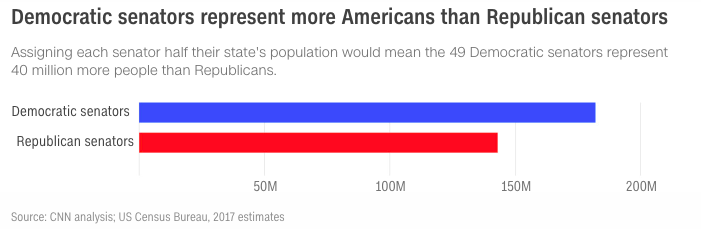
But the other reason is the extraordinary gap between the Senate and the American population. Even now, with the Senate controlled by Republicans, Democratic senators represent substantially more people:

The Constitution enshrines this imbalance. Anything in the whole document can be changed by amendment, “provided that… no state, without its consent, shall be deprived of its equal suffrage in the Senate.” This is is our only unamendable rule.

Long-term predictions are foolish, but I think you can imagine a pattern of Democratic presidents and House majorities being systematically stymied by Republican senates and the Supreme Court that the Senate has shaped. Then a significant majority of the public will be consistently blocked by an increasingly radicalized minority that is based in different parts of the country as we address climate crises, AI, and other truly profound challenges. Many people will not trace the failures of the government to specific provisions in our Constitution; they will perceive a government that’s inexplicably unresponsive and unrepresentative. And that, it seems to me, is a recipe for constitutional collapse.

See also: is our constitutional order doomed?two perspectives on our political paralysis; and are we seeing the fatal flaw of a presidential constitution?

courses that count for the Civic Studies major in spring 2019

More on the Civic Studies major at Tufts is here.

Required Introductory Course:

  • CVS 0020/PHIL 0020/PS 0020: Introduction to Civic Studies (Erin Kelly, Peter Levine) 

Thinking about Justice:

  • ANTH 140: Food Justice: Fair Food Activism and Social Movements (Alex Blanchette)
  • CVS 190/PHIL 192: Seminar: Political Philosophy of MLK, Jr
  • ECON 62: Economics of International Migration (Anna Hardman)
  • ENG 160 : Environmental Justice and World Literature (Ammons)
  • HIST 10: Colonialism in Global Perspective (Kris Manjapra)
  • MUSIC 132: Music and Ethics (Melinda Latour)
  • PHIL 195: Contemporary Political Philosophy (Lionel McPherson)
  • PHIL 25: Food Ethics (Sigrun Svavarsdottir)
  • PHIL 28: Feminist Philosophy (staff)
  • PS 151: Seminar: The Political Philosophy of Hobbes (Ioannis Evrigenis)
  • REL 08: Law, Religion and International Relations (Joseph Walser)
  • SOC 103-01: Sociological Theory (Freeden Blume Oeur)
  • SOC 94: Health, Policy, and Inequality (Brett Nava-Coulter) 

Social Conflict, Inequality, and Violence:

  • CH 0188: Health and Human Rights (Fernando Ona)
  • HIST 173: Black and Native New England (Kendra Field and Kerri Greenidge)
  • PS 108: Public Opinion and U.S. Democracy (Brian Schaffner)
  • PS 138: Democracy and Its Alternatives (David Art)
  • PSY 13: Social Psychology (Keith Maddox)
  • SOC 113: Urban Sociology: Global Perspectives on Space, Inequality and Resistance (Anjuli Fahlberg)
  • SOC 120 Sociology of War and Peace (Paul Joseph)
  • SOC 181 Seminar: War/Peace/State/Society (Paul Joseph)
  • SOC 188 Seminar: Intimate Violence (Anjuli Fahlberg) 

Civic Action and Social Movements:

  • CSHD 0034: Children, Nature, & the Ecology Movement (George Scarlett)
  • EC 117: Economics of Social Interactions and Social Networks (Yannis M. Ioannides)
  • FMS 22: Media Literacy (Julie Dobrow)
  • MUS 197: Social Justice, Advocacy and Music (Jeffrey A. Summit)
  • PS 108: Public Opinion and U.S. Democracy (Brian Schaffner)
  • PS 113: Nonprofits and Civil Society (Jeffrey Berry)
  • PS 118-02: Organizing for Social Change (Daniel LeBlanc & Ken Galdston)
  • PS 188-05: The Howard School of International Affairs (Pearl Robinson)
  • SOC 106: Political Sociology (Anjuli Fahlberg)
  • SOC 111: Making Social Change Happen (Margaret McGladrey)
  • SOC 113: Urban Sociology: Global Perspectives on Space, Inequality and Resistance (Anjuli Fahlberg)
  • UEP 278: Environmental Justice, Security, and Sustainability (Penn Loh)

Civic Skills:

  • ANTH 133: Anthropology of Journalism (Amahl Bishara)
  • CH 0188: Health and Human Rights (Fernando Ona)
  • CHEM 0094: Science and the Human Experience (Jonathan Garlick)
  • CSHD 004: Topics in Child Development: Identity, Community, and Voice (Jayanthi Mistry)
  • ED15: Social-Emotional & Civic Learning in Schools (Deborah Donahue-Keegan)
  • EE194 / ELS 109: Creating Children’s Media (Julie Dobrow)
  • ELS 109: Societal Aspects of Design: Integration, Innovation, and Impact (Ron Lasser)
  • ENG 311: Tufts 1+4 Foundation: Communicating for Change (Grace Talusan)
  • ENV 120: Introduction to Environmental Fieldwork (John de la Parra)
  • ENV 150: Environment, Communication, and Culture (Ninian Stein)
  • ENV 152: Seminar in Environmental Negotiations (Ninian Stein)
  • ExCollege: The President Has Tweeted: Official Government Communications in the Age of Trump (Nanda Chitre)
  • PHIL 24: Introduction to Ethics (Monica Link)
  • PS: Massachusetts State House Internships – Learning While Doing (State Sen. Ben Downing)
  • TBD: Project Citizen: Promoting Civic Engagement (Sherri Sklarwitz)
  • UEP 293-02: Community Practice Theory and Methods (Penn Loh)
  • UEP 294-02: Communications and Media for Policy and Planning (Penn Loh)
  • UEP 294: Teaching Democracy (Penn Loh)
  • WGSS 0185/AMER 0094: Mass Incarceration and the Literature of Confinement (Hilary Binda) 

Internship Seminar:

  • CVS 099: A required internship. This includes a weekly 2.5 hour class with graded assignments and a final project.


Capstone Seminar:

  • CVS 190/PHIL 192: Seminar: Political Philosophy of MLK, Jr.

youth vote 2018: what to expect and how to interpret the data

In The Washington Post, Amy Gardner reads some tea leaves that might foretell youth turnout in November.

On one hand, the good news: “In Pennsylvania, youth voters have made up nearly 60 percent of all new registrants, Target­Smart reported in September. The share of the electorate that is under age 30 has grown since 2017 in several key states, including Nevada, North Carolina and Florida, according to state voter registration data tracked by the firm L2. In Virginia, requests for student absentee ballots, at about 30,000, are about 50 percent higher than in last year’s gubernatorial election.”

We could add that CIRCLE’s youth polling finds much higher levels of intent to vote than we have seen recently. And these data from Texas look promising:

On the other hand, Gardner notes,

There are plenty of reasons for skepticism about an age group that typically performs dismally at the polls. In 2016, young Americans were expected to turn out heavily against Trump, but the actual share of voters under 30 who cast ballots was 43 percent of eligible voters — about the same as the previous presidential election in 2012 and lower than 2008. (Overall turnout in 2016 was 60 percent.)

Midterm performance is typically far worse: Just 16 percent of young Americans cast ballots in 2014. The highest midterm turnout among voters under 30 in the past three decades was a mere 21 percent in 1994.

And some of the tea leaves seem to foretell just a modest improvement:

In Nevada, young voters’ share of the electorate was 18.6 percent in August, up from 17.5 percent in September 2017, according to L2. In North Carolina, it was 18.3 percent in October, up from 16.7 percent in September 2017. And in Florida, it was 16.6 percent in September, up from 15.6 percent a year earlier.

Meanwhile, in Politico, Marc Caputo, Matt Dixon, and Isabel Dobrin write:

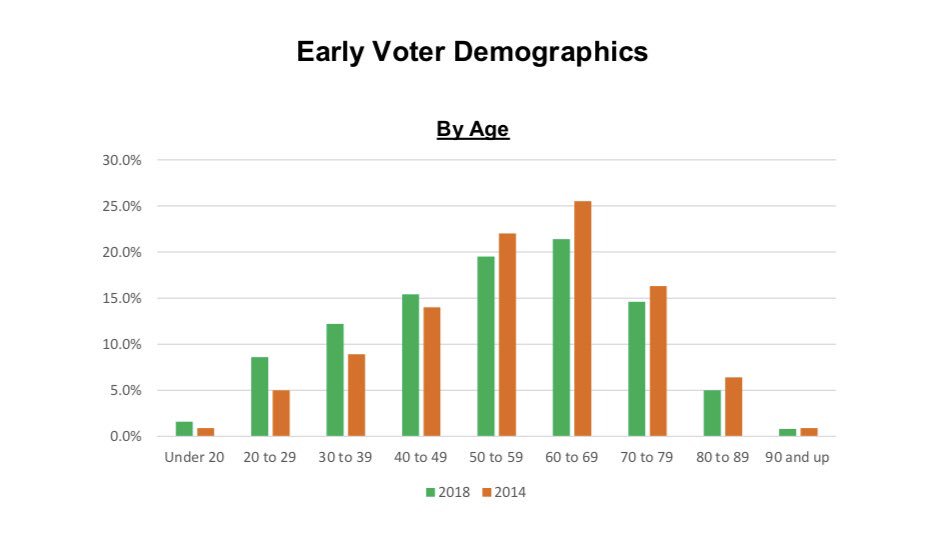
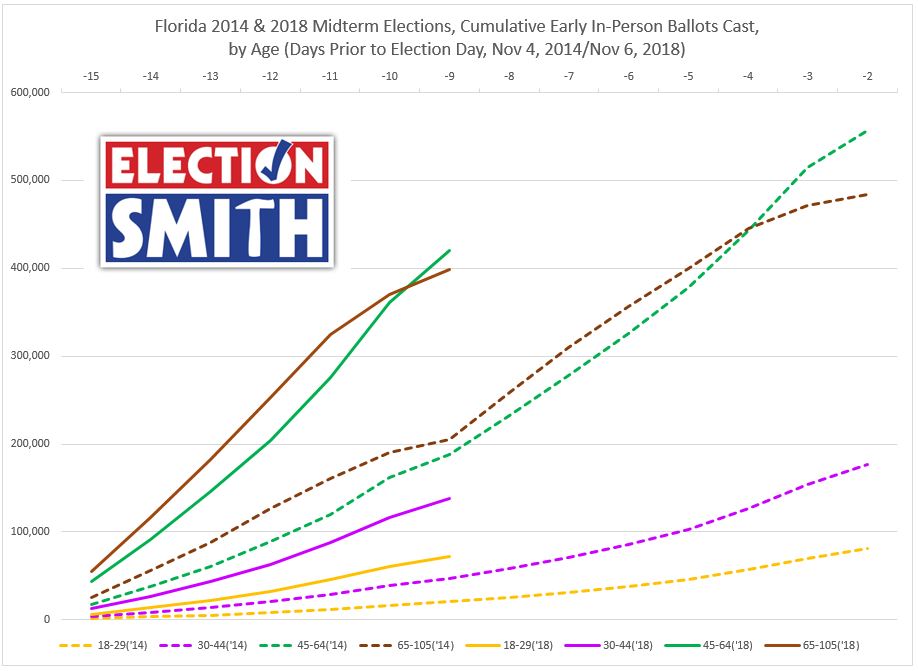
THE YOUNG PEOPLE WILL … STAY HOME? — Remember all that talk of how “the young people will win” and come out in force in Florida, especially after the Parkland massacre? So far, it’s not happening. Voters between the ages of 18-29 are 17 percent of the registered voters in Florida but have only cast 5 percent of the ballots so far. They tend to vote more Democratic. Meanwhile, voters 65 and older are 18.4 percent of the electorate but have cast 51.4 percent of the ballots. And older voters tend to vote more Republican.

Their analysis is based on Daniel Smith’s chart of the early votes so far in Florida, which shows all age groups rising but youth by the smallest amount:

A bunch of different statistics are being cited here: the number of voters or registrants in various age groups, the turnout (the percentage of eligible people in each category who actually voted), and the share of the electorate (what proportion of all voters fit in each category). These articles also cite statistics about registration, early voting, and total voting. It’s easy to get confused.

I expect turnout to rise for the population as a whole, in large part because of the actual and perceived high stakes of the 2018 election. I think youth turnout will also rise but youth will face a challenge keeping pace with the general increase. The difference between them and older voters will probably look better than in Dan Smith’s chart, because early voting seems to appeal especially to older people.

But we could still see various scenarios.

If youth turnout and share of the electorate both rise, it will be a great year for youth voting. Youth turnout could actually fall, but that would really surprise me. If youth turnout rises but no faster than–or not as fast as–the turnout of older people, then youth share will shrink. This will be reported by many news outlets as a decline. That interpretation will not be an outright error. If you want to exercise more influence on the outcome, you must increase your share of the vote. A flat or shrinking share means having no more influence. Also, if turnout rises but youth turnout rises less than average, it will pose questions about the impact of the nonpartisan and partisan efforts specifically to engage youth.

But it will also be true that more youth have voted, which will be worth celebrating if you care about youth engagement. And it will break a pattern, because historically youth turnout has been remarkably flat in midterm elections. Breaking that pattern might be a small positive step even if youth share shrinks slightly.

Center on Democracy and Organizing Summer Institute 2019

I’m posting the following announcement with my enthusiastic recommendation. The Principal Investigators of the Center for Democracy and Organizing are the extraordinarily talented and engaged scholars Lisa Garcia Bedolla, Hahrie Han, and Taeku Lee. More information here.

The Center on Democracy and Organizing (CDO) seeks applications from advanced Ph.D. students and early career researchers and organizers for participation in a summer training institute in 2019 focused on the study of democracy and organizing. The institute will be held from July 31 to August 2 at the University of California, Berkeley. This summer institute will bring together faculty and practitioners interested in developing the capacity to do engaged research in partnership. This dynamic and interactive institute will give participants—10 researchers and 10 practitioners—the chance to learn to work together on research projects that help practitioners advance their strategic goals.

The institute will focus on articulating the benefits of building research partnerships between  academics

and organizers, developing the capacities needed among both academics and organizers to work together, and creating the opportunity for researcher-organizer pairs to work directly on a project of interest. The institute seeks to reframe how graduate students and early career scholars understand their role as researchers, focus on the ways engaging with practitioners can deepen and improve their theorizing about the socio-political world, and also help practitioners and scholars develop a common language in order to engage as equal partners in the research process.

Researchers and practitioners with similar interests and goals will either be paired by CDO, or can apply as a pair.

This institute is funded thanks to grants from the Ford Foundation and Open Society Foundations. Travel (U.S. domestic economy-class round-trip airfare), food, and lodging will be covered for accepted applicants. In addition, participants will be eligible to apply for seed funding of up to $5,000 from CDO to carry out research projects conceived and developed through the institute.

Justice O’Connor and civics

I’m sorry to read that Justice O’Connor has dementia. She has devoted her retirement years to improving civics, and she has taken that objective fully seriously.

Her greatest contribution is the nonprofit organization she founded to teach civics through video games—a remarkable idea for someone her age to invent. iCivics is now the biggest provider of civic education and contributes immeasurably to the field.

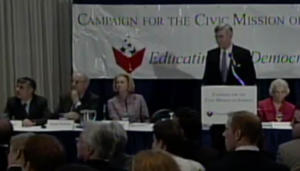
Justice O’Connor has also been a tireless advocate of policies for civics. The landmark civic education legislation in Florida is named after her, for a reason. She co-chaired the Campaign for the Civic Mission of Schools, which colleagues and I launched in 2003. She can be found on panels and ceremonies related to civics from coast to coast. That’s her, for example, to the right of David Skaggs in the picture above. (I’m doing my best to listen to the question from the audience.)

We have crossed paths in those contexts several times. She has often taken me by the hand, bored her steely blue eyes into me, and ordered me to do something—such as evaluate the impact of a national program.  I didn’t always comply but always took the obligation very seriously.

I won’t comment on her jurisprudence, if for no other reason than I haven’t studied it carefully. I have a working theory that she was especially deferential to autonomous institutions, such as universities. Whether that was wise or not is a matter of debate. Today, I’d rather celebrate her as one of the great retirees and citizens of our time.

who must be included in which meetings, committees, and movements?

At a recent meeting, we discussed people who should be encouraged to join the effort we were working on. We quickly listed demographic categories that we should pay attention to: race and ethnicity, gender and sexuality, age, class, ideology, partisanship, and religion.

I think these categories are important for outreach and recruitment–but importantly different.

Race, gender, and sexual orientation

Race, gender, and sexual orientation matter because we live in a society that is deeply unequal on those dimensions. Unless you seriously strive for equal representation, you are likely to end up with a panel or committee full of straight white men–and the more influential and prestigious the group is, the more that will be the outcome. Failing to address it preserves inequality.

A demographically homogeneous group may also lose the wisdom that comes from a wider range of perspectives and experiences, but to me, that is not an essential argument. Sometimes, adding racial or sexual/gender diversity won’t actually add relevantly different perspectives on the issue under discussion, but inclusion is still important for addressing inequality in the society as a whole. There is often also a pragmatic imperative for improving racial and gender representation. Without such diversity, a group looks illegitimate and can’t win the support it needs to move forward.

I would equate religion with race/ethnicity insofar as it’s an identity that provokes discrimination by others. As a set of beliefs about the world, a religion is more like an ideology, which I will address below.

Social class

Our society is also unequal by class, but this is different. Class is a name for social inequality. It doesn’t make sense to imagine a society with different classes that are equal to each other. If you have equality, you don’t have classes at all. However, it is not clear that a classless society can be accomplished. State communist societies produced the nomenklatura, a powerful new class or (as Trotsky thought) a caste composed of party officials and their families. According to Robert Michels, social democratic parties and unions quickly created “oligarchies” of professional organizers, notwithstanding their sincere commitments to equality. By virtue of being a union official instead of a unionized line worker, you are now part of a different class.

If you organize a meeting of people who hold a certain range of positions in society–a meeting of union leaders, or teachers, or leaders of nonprofit organizations, or college students, or miners–it will have a class “bias.” Yet surely there is value in such meetings. It wouldn’t be reasonable to argue, for example, that teachers should never organize except along with students, parents, and others. But if teachers organize, that is a middle class movement.

Therefore, it is a bit disingenuous to imagine that you can be “inclusive and diverse” with respect to class. But you can strive (1) to be inclusive of people who have various class origins and cultural markers of class, such as accents; and (2) to organize meetings and movements that engage grassroots participants, not merely leaders and experts. But (2) is hard. After, who will organize, pay for, and advertise the big meeting that is open to the public as a whole? Surely some kind of specialized subgroup will be responsible. Michels thought oligarchy was an “iron law,” and even if it’s less rigid than that, there is still a powerful tendency for people who hold certain social positions to run things. That’s what it means to have those positions.

Age

Age is different, too. We should be concerned about including younger people because we should be worried about future leadership and must create opportunities to learn and to develop power. But age equality is not like racial or gender equality. There are actual differences among people of different ages. For instance, senior managerial positions cannot be equally distributed between the young and old. It takes time to develop the experience, expertise, and connections that institutions need.

The House Democrats who will lead important committees if the party wins in November  will include Elijah Cummings, age 67, Bennie Thompson, 70, Maxine Waters, 80, Nita Lowey, 81, and Eddie Bernice Johnson, 82. These are women or men of color who have waited a long time for gavels. To be sure, the party caucus could replace them with younger leaders who were also diverse, but these people’s claims to leadership rest on seniority, and that deserves consideration. I wouldn’t oppose replacing them with younger chairs, but I would insist that age is different from, say, race. It can be legitimate to consider seniority or experience.

Ideology, partisanship, and theology

It’s worth bearing in mind that our goal is to develop the right views so that we can do what is right. The right views are not equally consistent with all ideologies, party platforms, or applications of theology.

In pursuing the right views, we must be humble. It is very likely that each of us is wrong and that others are more right. So we must be open and interested in alternative views.

I am typically a mainstream liberal, center-left. I especially benefit from being an outlier in meetings that are dominated by libertarians/neoliberals or by radical proponents of identity politics. I don’t fully align with either position but always learn from them–usually more than I learn from hanging around other people with whom I easily agree.

Learning provides a rationale for philosophical diversity–but with important caveats. First, some alternative views are more worthy than others. I seek out libertarians but not Trump-supporters to learn from. That is a judgment, and it could be wrong, but it’s my best judgment at this moment. I don’t believe that I have anything whatsoever to learn from Donald Trump himself, yet more than 60 million Americans really like him. Demographic representativeness would argue for including Trump-supporters, but my judgment about how to learn does not.

Furthermore, the value of ideological diversity depends on the purpose of a meeting or event. If I am trying to advance an agenda, I want a majority of participants to share my considered views of the topic. I may value some minority views to keep us sharp, but I’d like the majority to agree with me. I can achieve that goal either by recruiting like-minded participants or by persuading other attendees to agree. I would never treat racial or gender/sexual diversity in a similar way, trying to stack the room with people who were like me. On the other hand, if my goal is to learn, I may prefer to be one of a few participants in a meeting dominated by people who oppose my views, so that I can get a full dose of their perspective.

Conclusion

In sum, race/ethnicity and gender/sexuality make powerful claims for equal representation. Class and age are more complicated; it can be disingenuous to imagine that a meeting can be egalitarian on those dimensions. And ideological diversity is not a good in itself, but intellectual humility and striving to learn are genuine goods that sometimes provide reasons to be ideologically inclusive.

The complication is that race and ethnicity, gender, age, religion, ideology and partisanship correlate in the population. Say you want a meeting of influential people who are in a position to allocate resources, but you also demand racial diversity in your meetings. The most influential people are likely to be predominantly white. Or say you’re a libertarian who is genuinely committed to racial equality (as some are). You’re entitled to form a committee of libertarians, but it’s your problem if they all turn out to be white men.

I think these points of conflict among different kinds of diversity generate some of the hardest issues, both ethically and pragmatically.

See also: what is privilege?the rise of an expert class and its implications for democracyto what extent can colleges promote upward mobility?defining equity and equalitytwo approaches to social capital: Bourdieu vs. the American literature; and a college class on equalitywhen social advantage persists for millennia.

closing remarks at the Bridge Alliance summit

(Posted by request: my remarks at the close of the 2018 Bridge Alliance Members Summit, a convening of “more than 90 respected established organizations committed to revitalizing democratic practice in America,” Washington, DC, Oct 17.)

I’ve been asked to offer some reflections on the day’s discussion.

My first reflection is gratitude to the Bridge Alliance, its whole staff, and to all the Alliance members for all the work you do every day.

My second reflection is anxiety. I admit that in meetings like this, I am filled with anxious questions:

  • Are we big enough? Are enough people and resources here? Do we have enough people with us?
  • Are we diverse enough? The answer to that is clearly no. That is a problem that belongs to the whole network, not to the Bridge Alliance alone.
  • Are we experienced, knowledgeable, talented, and smart enough?
  • Are we unified enough? Today, I was privileged to participate in one small-group discussion in which the axis of disagreement was institutionalist versus insurrectionist: should we try to defend beleaguered institutions such as journalism, science, and the US Constitution, or seek to replace them because they were never good enough? I also participated in a good discussion about ideology: should we aim to be maximally inclusive or neutral, or rather develop a distinctively pro-democratic stance that some may support more than others do? These kinds of disagreements seem to threaten our unity.

What we know about social movements may be helpful. I have in mind two kinds of movements. One is the coalition or network that works for “healthy self-government”–in other words, the organizations that are in this room. As a group of groups, we could gain more of the “fizz” of a movement. Meanwhile, we see actual movements around us: #MeToo, #BlackLivesMatter, #NeverTrump, and the Tea Party. They could operate in ways that have more collateral benefits–and do less collateral harm–to democracy.

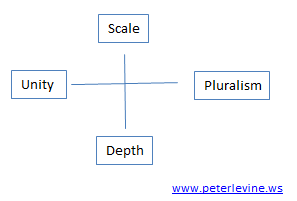
My reading of the social movement literature suggests that social movements succeed when they have four qualities:

Size: Movements need many members, organizations, and resources. Erica Chenoweth says that no nonviolent resistance campaigns in her large database have failed if they have “achieved the active and sustained participation of just 3.5% of the population—and lots of them [have] succeeded with far less than that. … In the U.S. today, this means almost 11 million people.” If 11 million people came together for a reform, it would probably happen.

Depth: Participation must develop the members’ commitments, skills, knowledge, and tactics. No group begins smart enough to win; they must learn. In Stride Toward Freedom, Martin Luther King writes, “Human beings with all their faults and strengths constitute the mechanism of a social movement. They must make mistakes and learn from them, make more mistakes and learn anew. They must taste defeat as well as success, and discover how to live with each. Time and action are the teachers.”

Unity: Social movements always present themselves as unified, because that is a source of strength. Hence the hashtags, armbands of a single color, protest songs, and mass demonstrations.

Plurality: Social movements need diverse perspectives, skills, and assets. They need both insiders and outsiders, both romantics and pragmatists. They should be demographically diverse, too, although that doesn’t always mean reflecting the demographics of the whole country. The Big Six leaders of the American Civil Rights Movement were all Black men. It wasn’t great that they were all men, but it was good they were all Black. The movement needed African American leadership and was rooted in the Black community. Still, their diversity of backgrounds, stances, and skills was essential. Randolph was a union leader, King a pastor and theologian, Lewis a youth leader, and so on.

Unfortunately, size conflicts with depth, and unity conflicts with plurality. It is very hard to have a large movement that also affects most of its members deeply, or a diverse movement that also achieves unity.

These four qualities spell SPUD, and we need more of it (even if it sounds like a lot of carbohydrates).

In interviews that Eric Liu and I conducted for “America’s Civic Renewal Movement: The View from Organizational Leaders,” Scott Reed of the faith-based PICO network said that his organization “invests lots and lots of time to connect with people and develop relations.” But “scale is what we are trying to figure out … because we are nowhere near where we want.” In short, PICO has U and D and some P, but no S. Meanwhile, Anna Galland of MoveOn acknowledged that her online organization has “tremendous scale and little depth.” MoveOn’s goal, she says, is to “move from a list of 8 million to horizontal connectivity.” MoveOn has S and U but no P or D.

SPUD is in short supply in the US as a whole. But I would suggest two reasons for hope.

First, the Bridge Alliance is not just the people in this room: organizational leaders. It encompasses all the grassroots participants in your many organizations. It is appropriate to gather organizational leaders periodically. But that strategy also has limitations–for instance, it is much harder to achieve true diversity of age and socioeconomic status when you convene the leaders of 501(c)3 organization. If we can convene our many members, we can come much closer to achieving SPUD.

Second, SPUD increases the chance of victory. It pays off. Movements that draw a diverse 3.5% of the population and build their talent and unity almost always win. Therefore, it is in the interest of the powerful movements that we see around us to cultivate SPUD. The more SPUD-ly they are, the more they are likely to win–and the more they will create diverse, empowered, deliberative groups of Americans. That should have deep collateral benefits for our republic. Because many of us are experts on group dynamics, civic education, discussion, etc., we have a lot to offer to our fellow Americans who are invested in social movements with specific agendas.

I hope this makes you less anxious than I am. We have good reasons to be optimistic.

See also: we need SPUD (scale, pluralism, unity, depth)Why Civil Resistance Worksthe power of the NRA in an age of civic desertsso, you want to strengthen democracy?; and a sketch of a theory of social movements.

youth on the brink of a watershed election

My CIRCLE colleagues are on a roll. Since October 9, they have released three reports based on their original national survey of Americans between the ages of 18 and 24:

In addition, based on an entirely separate survey conducted with Opportunity Youth United (OYU) of 1,200 youth from socioeconomically disadvantaged backgrounds, they have released:

Some highlights, for me:

It doesn’t make sense to vote as a complete individual. If 100 million others will also vote–your voice is too small. But it does make sense to vote if you see yourself as part of a group that has a voice. CIRCLE asked whether “you are part of a group or movement that will vote to express its views.”  Just 37.2% of White men said yes, versus 59.5% of young Latinas, 54% of Black men, and 46% of White women. White men were also the one group of youth who plan to vote Republican.

Women and youth of color held views that could be described as more cynical about politics and politicians. But cynicism predicted higher turnout.

We find that young people who reported feeling more cynical are actually more likely to say they are voting than those who are not: 40% vs. 26%. Importantly, being cynical about politics is not preventing young people from recognizing its importance. More than half of youth in our poll (54.8%) agree that the outcome of the 2018 elections will have a direct impact on their everyday lives, only slightly lower than 60.0% in 2016, which is remarkable given that presidential elections are generally seen as much more consequential.

These findings would suggest that young women and people of color are more energized and motivated to vote than young white men are–and that may be true overall. But the barriers to voting fall most heavily on poor youth and youth of color:

Young people, especially those from low-income backgrounds, face logistical barriers to voting, each of which may seem small, but together can make voting difficult. These barriers include having to find out where their polling place is located, not having transportation to the polling place, and having to work around their job schedule—an obstacle compounded by the fact that many have more  than one job.

… For instance, a quarter of our participants had moved within the last 12 months, but of those, only 40% had changed their voter registration address. At the same time, laws and tools designed to facilitate voter participation, such as online registration and text reminders for voting, are not widely used by low-income youth.

… Many of our participants assumed (mostly incorrectly) that a variety of minor criminal offenses and past convictions would bar them from voting. For instance, when asked if someone who has a suspended driver’s license would be able to vote, 24% wrongly believed they could not, and another 42% did not know.

Some young people are apprehensive about going to the polling place because they rarely see people there that they can identify with 74% said they don’t see poll workers that “look like them,” and 87% said they do not see young people working at the polls. Relatively few actually experienced harassment at the polls, but 59% do not believe that election officials make an effort to ensure that people like them can vote.

Overall, it looks as if youth turnout will be a contest between motivated, angry, energized young people and our sometimes inaccessible and alienating electoral systems. I predict some improvement in youth turnout compared to recent midterm elections–with lots of room to improve in future years.

two approaches to social capital: Bourdieu vs. the American literature

The phrase “social capital” is used in (at least) two very different senses and discussions.

One is an Anglophone discussion among social scientists who seem generally comfortable with a liberal market order. Important participants include James Coleman, Robert Putnam, Elinor Ostrom and (using the related phrase “collective efficacy”) Robert Sampson and Felton Earls. These social scientists understand social capital as the value that derives from collaborating and solving collective-action problems together. It’s measured by rates of joining, socializing, participating in the institutions of civil society, and trusting one’s peers. It can exist in any group, regardless of wealth and prestige. For instance, Sampson, Earls and their colleagues found that levels of collective efficacy varied greatly among Chicago neighborhoods, independent of race and class.

The central hypothesis in this literature is that higher social capital predicts better outcomes (safety, education, health, employment). This hypothesis is often proven in empirical studies. The deepest explanation is that these desirable outcomes are public goods, subject to problems of collective action, and social capital is the capacity—inherent in a group—to address problems of collective action successfully. For instance, safe streets represent a public good, and when people voluntarily maintain order, the streets are safer.

The other discourse is loosely Marxian and of Continental European origin; the most influential theorist is Pierre Bourdieu. For Bourdieu, social capital can only be understood in relation to economic capital and cultural capital. All three forms are the result of past labor, which accumulates or materializes in forms that can then be owned and by–and used to the advantage of–specific individuals or closed groups, such as firms.

Economic capital means ownership, or the ability to own, the means of production (factories, offices, farms, mines). Cultural capital means personal characteristics that you can learn in order to set yourself apart as a member of an advantaged group. For example, if you know how to dress for and behave at a corporate job interview, you have acquired cultural capital. And social capital means membership in any group that has value for those who belong.

Thus a paradigm case of social capital for Bourdieu is being connected to specific aristocrats in a way that puts you within the group known as “the nobility.” You might be a poor and boorish noble: then you would have social capital without much economic or cultural capital. Still, each of the three pays off in ways that are fundamentally economic.

For Coleman et al., the effort required to build social capital is at least partly altruistic. When you try to help others around you, it turns out that you benefit as well from the public resource of social capital. Social capital is non-rivalrous or win/win. If poor people in Chicago build more social capital, that does no harm to Lake Shore millionaires. It might even reduce their tax burdens by boosting graduation rates and cutting crime in the city as a whole.

The Bourdieuian form of social capital is competitive and maybe even zero-sum. If you form a connection to an aristocrat that gives you a leg up in society, I am less advantaged. According to Bourdieu, people build social capital to advance their own interests, strategically targeting others who have various forms of capital to add to their networks:

The existence of a network of connections is not a natural given …  It is the product of an endless effort at institution. … In other words, the network of relationships is the product of investment strategies, individual or collective, consciously or unconsciously aimed at establishing or reproducing social relationships that are directly usable in the short or long term. …

The reproduction of social capital presupposes an unceasing effort of sociability, a continuous series of exchanges in which recognition is endlessly affirmed and reaffirmed. … This is one of the factors which explain why the profitability of this labor of accumulating and maintaining social capital rises in proportion to the size of the capital. Because the social capital accruing from a relationship is that much greater to the extent that the person who is the object of it is richly endowed with capital (mainly social, but also cultural and even economic capital), the possessors of an inherited social capital, symbolized by a great name, are able to transform all circumstantial relationships into lasting connections. They are sought after for their social capital and, because they are well known, are worthy of being known (‘I know him well’); they do not need to ‘make the acquaintance’ of all their ‘acquaintances’; they are known to more people than they know, and their work of sociability, when it is exerted, is highly productive.

Although these theories are different, they could both apply in a society as a whole. After a discussion with students last week, I am inclined to the following hypotheses:

  1. Access to the highest rungs of socioeconomic advantage requires (or at least benefits from) Bourdieu-style social capital. If you want to get a seat on the Supreme Court, it seems almost necessary to attend Harvard’s or Yale’s law school, partly because of who you know as a result. Social capital may also get you into those law schools in the first place. For instance, I can think of someone who attended Law School on his way to federal judicial appointments; his mother had also been a judge, and his grandfather had attended Yale.
  2. Well-being in the middle and lower rungs depends on social capital in the Coleman/Putnam sense. If you are trying to get through high school and obtain some post-secondary education, get a job, stay out of jail, and live to the median age, it’s very helpful to be embedded in networks of cooperation and mutual support. Those networks have value even if the other members are not rich and powerful.

See also: David Brooks/Pierre BourdieuBourdieu in the college admissions officeChua and Rubenfeld, The Triple Packagesocial capital and economic mobility“social capital”: political and apolitical and when social advantage persists for millennia.
curiosities from Wikipedia (an occasional series)

From the entry on Norfolk Island, pop. 1,748, which lies 877 miles from mainland Australia:

This common heritage has led to a limited number of surnames among the islanders – a limit constraining enough that the island’s telephone directory also includes nicknames for many subscribers, such as Cane Toad, Dar Bizziebee, Lettuce Leaf, Goof, Paw Paw, Diddles, Rubber Duck, Carrots, and Tarzan.

From the entry on the Scots Language:

The results from a 1996 trial before the Census, by the General Register Office for Scotland, suggested that there were around 1.5 million speakers of Scots, with 30% of Scots responding “Yes” to the question “Can you speak the Scots language?”, but only 17% responding “Aye” to the question “Can you speak Scots?”.

From the entry on Isaac Newton:

As Warden, and afterwards Master, of the Royal Mint, [Sir Isaac] Newton estimated that 20 percent of the coins taken in during the Great Recoinage of 1696 were counterfeit. … Convicting even the most flagrant criminals could be extremely difficult. However, Newton proved equal to the task. Disguised as a habitué of bars and taverns, he gathered much of that evidence himself. … Newton had himself made a justice of the peace in all the home counties. … Then he conducted more than 100 cross-examinations of witnesses, informers, and suspects between June 1698 and Christmas 1699. Newton successfully prosecuted 28 coiners.

See also: strange livesthe European country that spoke Esperanto; and Anson Burlingame and the duel that never happened.