the “America in One Room” experiment

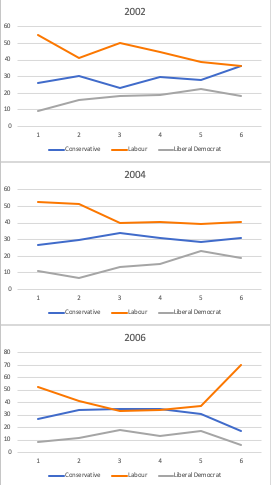
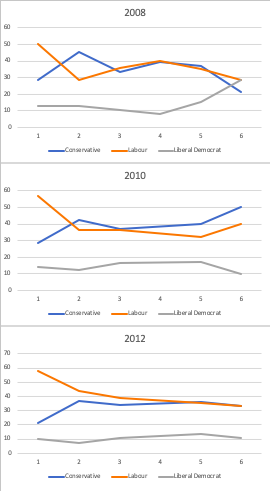
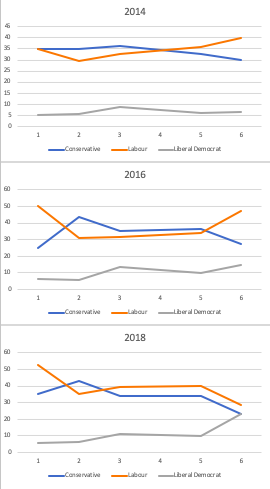
On the New York Times op-ed page today, James Fishkin and Larry Diamond report the results of convening 523 randomly selected registered voters for several days of deliberation. These voters were surveyed before and after the discussions. Their appraisal of democracy rose markedly. They also shifted their views in specific ways:

The most polarizing proposals, whether from the left or the right, generally lost support, and a number of more centrist proposals moved to the foreground. Crucially, proposals further to the right typically lost support from Republicans and proposals further to the left typically lost support from Democrats.

I have known Jim Fishkin and his work for 20 years and admire it a lot. These experiments are illuminating, and they open possibilities for reform. They also remind us that the politics we see around is the outcome of specific institutional arrangements that could be changed. For instance, we are not hard-wired to fall into two partisan camps; that is a feature of our electoral system. If we were randomly recruited into deliberative bodies, we would see very different results. If we can change something, we should consider changing it.

But I do have some worries:

  • Does the shift to moderate opinions demonstrate that deliberation is desirable? It could also be interpreted as a bias: putting people together in heterogeneous groups disadvantages the radicals and their ideas. I try to challenge myself by seriously engaging several opposing political movements with which I disagree. That is my own approach to deliberation, and it could be considered a form of moderation. But I don’t find myself shifting to centrist positions, many of which I find thin gruel and incommensurate to our problems.
  • What is the overall theory of change? If we like this alternative form of politics–much more deliberative, and also more moderate, than the status quo–how should we institutionalize it? The easy part is to invent policies that would make democratic deliberation mandatory. The hard part is figuring out who would fight for those policies, and why. More people are motivated by political agendas and identities than by procedural ideals, and especially procedures that favor the center.
  • What about people who are not invited to deliberate, or who don’t like the results of the deliberation? Do we see them as worse qualified to express themselves?
  • Is this experiment a form of civic education that teaches people to value interactions that are civil, professionally organized, calm, and “invited”–thereby implicitly devaluing such forms of politics as social movements, strikes, competitive elections, and litigation? If that is the lesson, is it an acceptable one?

See also: John Gaventa on invited and claimed participation; civic engagement and the incarceration crisis; saving relational politics; why study real-life deliberation?

why I am optimistic about the impeachment process

I find myself less anxious than most friends and commentators. Here are my largely sanguine responses to several current concerns about the impeachment process:

It’s a mistake to focus on one specific scandal. Congress should persuade the American people to condemn a whole pattern of corruption in the administration. (See David Atkins, for example).

Congress can focus on one or two articles of impeachment in order to handle those charges well. (The best current guess is that the articles will involve: 1. Trump’s interaction with Ukraine, and 2. the administration’s obstruction of Congress across many issues.) Meanwhile, the press, presidential candidates, pundits, social movements, and regular citizens will inevitably conduct a wider inquiry and debate. I don’t think the big picture will be lost just because the articles in Congress are precise and narrow.

The Ukraine story also implicates Hunter Biden, and hence (in some way) Joe Biden. That either means that it’s a poor choice of a scandal for the Democrats to use in an election year, or that it’s bad for the public, because both parties will end up defending crony capitalism.

Joe Biden has an opportunity to make a case that he is truly blameless in the Ukraine matter. If he is persuasive, fine. If he fails to persuade, then it’s better that he should fail now, rather than during the general election. Meanwhile, Elizabeth Warren has every incentive to broaden the issue to encompass crony capitalism writ large. Her voice (and others’, too) will ensure that the whole Democratic Party is not soft on corruption.

Impeachment will drown out the Democratic primary campaign, overwhelming an important debate about our future.

During the primary season, a party wants its own faithful to pay attention to the rival proposals, critiques, counter-arguments, endorsements, gaffes, etc. It’s generally fine if other voters pay little attention until a nominee emerges to address the whole public. With vast attendance at primary campaign events and a lively debate online, there is little chance that core Democratic voters will tune out the primary. The intended audience is paying attention.

The impeachment debate will arbitrarily affect the outcome of the Democratic primary.

If it takes Joe Biden down, he was doomed anyway. If he turns it to his advantage, it will reinforce his best argument: his electability. If Warren benefits because she makes the sharpest critique of corruption–well, she is raising a real issue. And if someone else (say, Kamala Harris during a Senate trial) uses the impeachment effectively, it’s evidence of that candidate’s skill.

The Speaker seems to want a short, narrow impeachment process. That will not persuade the American people of the deeper problems with Trump. Pelosi is resigned to an unpopular process and doesn’t understand that impeachment hearings could change Americans’ opinions.

Don’t take what Speaker Pelosi says precisely at face value. I’m not saying that she’s lying; she would genuinely prefer a shorter and tighter process. But she knows that impeachment is likely to extend and expand. She wants unconvinced voters to believe that Democrats are trying to make this quick so that they can move onto other matters. She is also putting mild pressure on her caucus to move things along. I would be very surprised if things actually do wrap up by Thanksgiving, or if she believes that they will.

(By the way, I am continually surprised by strong partisans’ assumption that when someone on their side says something conciliatory about the other side, that person really means it. Do you really think Nancy Pelosi’s main reaction to this situation is to be “heartbroken and prayerful,” as she told ABC News? Are you sure Joe Biden actually believes the Senate Republicans are reasonable? It is not only the other side that sometimes doesn’t say exactly what they think.)

The Senate will acquit, Trump will survive, and as a result, not only will impeachment be further weakened as a tool for accountability, but Trump’s electoral prospects will improve.

Yes, the Senate is overwhelmingly likely to acquit, and Trump will still hold office on Election Day in 2020. But the American people should by then have a clear account of his criminality, which should weigh, at least mildly, against his reelection prospects. That is a sanction. Subsequently, he may face a federal jury on related charges.

If anything, I would have some qualms about actually removing him less than a year before the election. Who would the GOP nominate? What kind of mandate would a Democratic president hold? My ideal outcome might be for the House to impeach, a majority of US Senators to vote to remove Trump, for him to hang on because fewer than 67 Senators voted against him, and for the American people to finish the job in November.

Impeachment creates (at best) a tough vote for Democrats in districts that voted for Trump. Why “punish” the president by giving his party a boost in the congressional election?

This matter has received vast amounts of attention. My tentative takeaway is that any electoral impact will be small and may be a wash–a few Democrats losing in conservative districts and states (like Alabama), but a few Republican Senators facing very tough votes as a result of impeachment. There is a long tail of possible outcomes in either direction, but the best bet is a limited effect.

It’s a mistake to give many House committees a role in impeachment. One committee should handle it.

Pelosi is trying to build support by giving several leaders and groupings within her caucus a stake. Also, one of the articles is likely to be obstruction, and the Administration has obstructed several committees.

The Democrats grandstand amateurishly in hearings. They don’t know how to cross-examine and build a case.

True. And there’s a reason for it: individual politicians want to talk on camera, even though the inquiry would be much better handled by professional counsel. This problem is worth worrying about, but surely the Democrats will finally get it together now ….?

only in America!

When informed that the Lord Mayor of Dublin, Ireland, was Jewish, Yogi Berra exclaimed, “Only in America!”

I was in the jury pool in Middlesex County, Mass. a couple of weeks ago. Of the dozen cases before the court that morning, 11 were settled with pleas, and one proceeded to a bench trial because the defendant waived his right to a jury.

The judge came out to thank us for our service, explaining well that our presence in the jury chamber was a reminder to both sides that they could face a panel of citizens. Warming to his theme, he informed us that only in the United States do we have a right to a trial by jury.

Actually, the number of countries in which juries play important roles is about fifty. Even in the USA, we have juries because England has required them since 1215. Some seminal American jury trials took place while Massachusetts was still a British colony: the libel case against John Peter Zenger, the Boston Massacre Trials.

The jury pool in a diverse American city is a beautiful thing: people come together from all walks of life and all nations of the earth to deliberate as equals. The instructional video was appropriately inspirational, showing diverse Massachusetts citizens at work as jurors. In the video, they even wear varied costumes in the jury box: a guy in a hardhat, an athlete in uniform, etc. It’s a symbol of equity + diversity.

But why the impulse to defend democratic and liberal institutions as unique to the USA? The most common claim of this type is that we are uniquely a nation of immigrants. By my calculation, the US ranks 67th in the world in the percentage of its people who were born overseas, just behind Germany and far behind the republic just to our north (which also uses juries).

Can’t something be good even if it also happens in other countries? What anxiety underlies this urge to claim exceptionalism? Could it be in the back of the judge’s mind that the US ranks below all comparable countries in both public safety and incarceration?

If patriotism depends on the empirical claim that we perform better than everyone else, it is a thin reed. One response is to assume that our form of government is literally unique: only in America! Then no empirical comparisons are needed. But that’s not a viable response, because often many other countries do the same thing. The right response is to be proud of the good things–like jury trials in Massachusetts–and to work to change the bad things (like racial bias in Massachusetts’ criminal justice). That is patriotism that isn’t contingent on exceptionalism.

See also: American exceptionalism and anxieties about American exceptionalism.

community engagement and student success in college

You can now get the recording and associated slides for the AAC&U webinar entitled “The Confounding Promise of Community: Why It Matters More Than Ever for Student Success.” I was a bit of an outlier because I talked about college students’ learning in social movements, taking as my text a 1961 article by Martin Luther King, Jr. on that topic. My comments were based on my article, “Another Time for Freedom? Lessons from the Civil Rights Era for Today’s Campuses.” For me, “community” meant social movements that may target institutions for change.

The excellent other presenters mainly discussed projects that are based in their colleges and engage the communities around them: Ventura County, CA, San Diego, Newark, NJ, and Queens, NY. I thought they demonstrated that their institutions are components (or even “anchors”) of those communities. So instead of saying that their students “go into” communities, we might conclude that their students belong to communities and learn beyond the classroom.

for Irina

Little Irina Antonovna, six,
Took it upon herself to write to her aunt,
Laboriously addressing it to:
"Region of Petrograd, Max Heltz factory."

Why did she write this letter? Well, her father:
Ten years in the camps for being a scholar,
Dead by now. Her mother: dead. Neighborhood:
Wall fragments, smoke, equipment shards, Nazi bombs.
Grandfather: died of rickets while walking
Irina to safety. Grandmother: same.

The letter worked; Irina lived. Married
Dmitri, who never asked her opinions,
But did write Number Nine for her and maybe
Heard her when he wrote the gentle cello drone
That supports the opening. Or the polka--
Why couldn't that frenzied part be Irina?
Why assume she was always soft, helpful?

A young, diverse American quartet
Exhumes Dmitri and Irina for us,
His black notes crisp on their iPads, their bows
Vibrating like cicadas, their eyes flashing
Recognition, assent: one to the other.

They are pillowed in layers of safety.
A clean, bright stage, a tidy concert hall,
An audience that has heard it before
And knows just when to leap up for applause:
White-haired burghers of this college and town.

Irina's professor father would have fit
Right in, if he hadn't been starved or shot.
Little Irina would have liked to hide
Beneath that concert grand, so solidly framed.
A campus cop waits, unworried, outside.

This place is not real. What's real is in the notes.
They know starvation, midnight knocks on doors,
Cities murdered from the sky, orphans' fears,
They know, too, the terrors of the audience,
Shrunken in their seats, nervous to drive home.

Phones still ring with sad news; death sentences
Come in biopsy results. And beyond this room
A billion new Irinas plead to be spared.

See Stephen Harris, “Quartet Number Nine,” “Interview of Irina Shostakovich by Alexandre Brussilovsky,” and also “voices,” and “a poem should.”

college student turnout more than doubled in 2018

My colleagues at the Institute for Democracy and Higher Education here at Tisch College have released their national report on the 2018 election and sent detailed specific reports to each of the roughly 1,031 colleges and universities that participate in our National Study of Learning, Voting, and Engagement (NSLVE). This research is based not on surveys (which have errors in sampling and self-reporting), but on official voting records for about 20 million people.

As reported in today’s Washington Post, the headline is that college student turnout more than doubled between 2014 and 2018 (the last two midterm elections). It’s true that everyone’s turnout grew in 2018, but college students far surpassed the national trend. My favorite statistic is that turnout rose on 99% of all the NSLVE campuses. Now that is a significant pre-/post- change.

The full report has much more detail on demographic groups, profiles of selected colleges, and suggestions for maintaining the momentum. As always, the actual result (40% of college students voted in 2018) remains too low, but the only way forward is by raising engagement one step at a time, and doubling it is a good step.

Elizabeth Warren in a tradition of radical American progressivism

A lively and valuable debate is underway about whether Senator Sanders or Warren should carry the flag of the left. Considering that Sanders calls himself a “socialist,” and Warren says she’s pro-“market,” it’s worth thinking about what each means by these words and how their words relate to their policies and their political strategies or theories-of-change. For instance, if both use the New Deal as a positive reference point–Sanders to illustrate socialism and Warren to show how capitalism can be saved–then maybe the difference is merely semantic. Or maybe not.

I would contribute one observation. Elizabeth Warren may belong in a specifically American tradition of progressive politics that is distinctive from socialism and that lacks a crisp name of its own, so far as I know. But it has these features:

  1. Enthusiasm for truly competitive markets that are free of monopolies. Competition is supposed to lower profits to minimal levels and make companies accountable to consumers and prospective workers. For instance, Louis Brandeis argued in 1912 that “our people appreciate better than they did before, the great economic truth which was embodied in the Sherman Law”: “the value of competition.” “The Democratic position … is that private monopoly in industry is never permissible; it is never desirable, and is not inevitable; competition can be reserved, and where it is suppressed, can be restored.”
  2. An understanding of the public as consumers. In 1912, the Progressive thinker Walter Weyl wrote that the office of “consumer is most universal, since even those who do not earn wages or pay direct taxes consume commodities. In America to-day, the unifying economic force, about which a majority, hostile to the plutocracy, is forming, is the common interest of the citizen as a consumer of wealth” (The New Democracy, New York, 1914, pp. 248-50)
  3. Related to the last point, a preference for universal identities over special interests and particular identities.
  4.  An ideal of the government as the protector of consumers. Robert M. La Follette said in 1906: the “welfare of all the people as consumers should be the supreme consideration of the Government.” Often this is extended to workers as well.
  5. Related to the last point, a defense of democracy (with reforms like referenda and publicly finance campaigns) as the system that makes government most accountable to all the people, not to special interests.
  6. A theory that citizens should mainly monitor their own rights and choose leaders and officials to protect them. For their part, prospective leaders should offer detailed proposals for solving problems. “I have a plan for that” is exactly this approach.
  7. A belief in transparency and access to information as tools of reform, captured in Brandeis’ famous line that “sunlight is the best disinfectant.” Brandeis also wrote that the Sherman Antitrust Act would remain inadequate without stronger enforcement, better “administrative machinery,”and “comprehensive, accurate, complete knowledge” of the behavior of businesses (mandatory transparency).

Note that this is not socialism. That word can be defined in many ways, but surely it would stretch the term to use it for a political philosophy that prizes competition and consumer identities.

But it can be radical, and it’s a deeply American tradition. Roger Taney, while Secretary of the Treasury under Andrew Jackson, said, “it is proper that [banking] should be open as far as practicable to the most free competition and its advantages shared by all classes of society.” A century-and-a-half later, Ralph Nader also championed deregulation of selected industries, consumer rights, transparency, and popular sovereignty.

To illustrate Senator Warren’s adherence to this tradition, I would cite (for example) her interview with Franklin Foer in The Atlantic:

I believe in markets and the benefits they can produce when they work. Markets with rules can produce enormous value. So much of the work I have done—the Consumer Financial Protection Bureau, my hearing-aid bill—are about making markets work for people, not making markets work for a handful of companies that scrape all the value off to themselves. I believe in competition.

Or consider her endorsement of school vouchers in The Two-Income Trap: Why Middle-Class Parents are Going Broke (2003):

Warren’s specific position on vouchers has changed, but not her deeper philosophy.

Her stance deserves very serious consideration, and a case can be made that it is the best path forward for the American left. But I would raise these questions:

Should the consumer identity satisfy us? What about criticisms (cultural, environmental, and spiritual) about consumerism? Would it be better to see us all as producers? And what about other identities that differentiate Americans, such as race and ethnicity?

Should the implicit role left for citizens satisfy us? Is our job to critically evaluate candidates’ plans for solving our problems, or must we take deeper action?

Do competition and transparency work? (I think Warren herself would say: only sometimes.)

(Most quotes from my book The New Progressive Era. See also: citizenship in the modern American republic: change or decline?; transparency is not enough

The National Commission on Civic Renewal, A Nation of Spectators

In 1997, the National Commission on Civic Renewal published its report, A Nation of Spectators: How Civic Disengagement Weakens America and What We Can Do About It. The Commission was partly a response to Robert Putnam’s 1995 article, “Bowling Alone.” The Pew Charitable Trust funded and convened it, and Bill Galston directed it, with me as the research director. My main contribution was an Index of National Civic Health (INCH), which is one ancestor of today’s Civic Health Index.

There may have been an echo of the report in George W. Bush’s Inaugural Address: “I ask you to be citizens. Citizens, not spectators. Citizens, not subjects. Responsible citizens, building communities of service and a nation of character.” (Quoted without comment on what followed.)

One of the recommendations was a research center on youth civic engagement, which we founded in 2001 as CIRCLE.

In 1997, the Internet was up and running, and we maintained a website for the Commission and its report. But that is long gone and the report is hard to find. So here it is, scanned as a PDF, as one record in the history of professional efforts to strengthen civic engagement in the USA.

we should be debating the big social and political paradigms

[The following post is inspired by Rogers Smith’s recent APSA presidential address, and I believe is consistent with it, but I incorporate some additional elements.]

Consider a sample of articles about politics, or society more generally. One might be an interpretation of some remarks by Thomas Jefferson. Another reports an experiment in which people are more likely to vote when contacted one way rather than another. A third is a critique of a prevalent word (say, “security”) from the perspective of Michel Foucault. A fourth shows that rational agents in a certain situation are better off when rules are externally imposed on them.

Each of these articles presumes, and contributes to, a larger paradigm that combines values, causal theories, and methods. Perhaps the interpreter of Jefferson believes that the United States is still founded on its written Constitution and that the intentions of the founders matter today. The experimentalist presumes that voting in a regime like the modern USA is a consequential act, and it would be good to increase voting by several percentage points if possible. The critic of “security” sees a world of pervasive injustice sustained by ideology, in the sense of distorting views that preserve the status quo. The rational-choice modeler thinks that all (or many) institutions can be analyzed as the interactions of utility-maximizing individuals.

(For the sake of space, I have omitted a classical Marxist, a deep feminist, a post-colonial theorist, a Prospect Theorist, a radical environmentalist, and many others who deserve places on the list.)

In these articles, you will not see much about their larger paradigms, worldviews or schemata. Their paradigms may not even be mentioned. Instead, you will see evidence in support of the specific claims of each article (whether in the form of statistics, quotations, or equations).

Of course, journals offer limited space, and there may not be room to present a whole paradigm. In addition, citing your scheme may only hurt you in the review process. Reviewers who happen to oppose your overall paradigm may be alienated, when they would have been persuaded by your detailed findings if presented alone.

For instance, imagine that you discover that texting people increases their turnout more than emailing them. That is more persuasive as a bare finding than as part of an argument for the significance and value of voting in a mass democracy within a capitalist market economy.

A certain form of positivism (or verificationism, or empiricism) is still widely influential. It holds that facts can be verified directly. Larger mental constructs are fashioned by us and are only valid to the extent that they match all the facts. If big, general ideas influence our beliefs, they are sources of bias. Therefore, we may need to disclose our paradigms as caveats, but we don’t want to focus on them.

Some people would hate to be described as positivists but end up in a similar place for a different reason. They presume that they have a right to their fundamental views as a matter of identity. “As a migrant from the global south, I explore the colonization of indigenous spaces …” This is not a disclosure of bias, nor a defense of a thesis; it is a claim to be recognized as a member of the scholarly community. To disagree is to deny the author’s place in the community.

I believe that the really important task is to select our worldviews, our big normative/conceptual schemes. It matters which of the available choices we adopt, and maybe we can create better ones. Therefore–as I think Rogers Smith argued–it is a real weakness in any intellectual community if the paradigms are implicit or merely stated, rather than explained, justified, and put into competition.

Within political science, many contrasting worldviews are available. You can walk down the hall of the APSA Annual Meeting past rooms in which everyone accepts the basic normative principles of contemporary electoral democracy, and other rooms in which people are quoting Slavoj Žižek about ideology.

It is hard to compare such worldviews or paradigms, because they have different normative, epistemic, and sometimes metaphysical premises. A finding within one paradigm does not disprove a different paradigm. A certain kind of relativism interferes with comparative assessment.

However, we can consider a whole body of specific findings along with their shared overall claims. We can ask whether this whole literature is coherent, whether it generates persuasive specific findings by its own lights, whether it informs practice in any useful way, whether it makes sense of other literatures, how it handles criticisms and rival views, whether it is responsive to new evidence and events, and whether its normative implications are defensible when fully articulated. Each paradigm has points of relative strength and weaknesses.

It would be helpful if people had that discussion in print, instead of always only writing within paradigms (at least for journal articles.)

See also trying to keep myself honest, how philosophy is supposed to work

AAC&U Webinar: Sept 19 2019

“The Confounding Promise of Community: Why It Matters More Than Ever for Student Success,” September 19, 2019; Online, 2:00-3:00 p.m. (ET)

In this webinar, I’ll be discussing my recent article in Liberal Education entitled, “Another Time for Freedom? Lessons from the Civil Rights Era for Today’s Campuses.” Other authors in the same special issue of Liberal Education will also share their work.

Webinar Registration
Cost: Free for AAC&U members; $99 for nonmembers
Check your institution’s membership status here

What is the role of community—as a concept, an outcome, and an entity—in a liberal education, and how can community contribute to student success? How do students experience community, on and off campus? This webinar will examine emerging definitions of community, ongoing efforts to create inclusive pathways for engagement, and ways community-based practices can advance inclusive excellence. From multiple institutional perspectives, presenters will explore how a collective understanding of community can shape a commitment to equity and student success.

All webinar registrants will be eligible for a 20% discount on copies of the new issue of Liberal Education, which fully explores the webinar topic. In this issue, authors—many of whom are webinar presenters—share research findings, commentary, and recommendations on the confounding promise of community. 

Moderator

Ashley Finley
Senior Advisor to the President and Vice President for Strategic Planning and Partnerships
AAC&U

Presenters

Geoffrey Buhl
Professor, Mathematics and General Education Chair
California State University Channel Islands

Leeva Chung
Professor, Communication Studies
University of San Diego

Marta Elena Esquilin
Associate Dean, Honors Living-Learning Community
Rutgers University-Newark

Jason Leggett
Assistant Professor of Politcal Science and Criminal Justice
Kingsborough Community College

Peter Levine
Associate Dean of Academic Affairs and Lincoln Filene Professor for Citizenship & Public Affairs
Tufts University’s Jonathan Tisch College of Civic Life