on gaffes as evidence of sincere beliefs

Among the many millions of words that Barack Obama and Hillary Clinton uttered over the past decade are these two statements. Obama: “They get bitter, they cling to guns or religion …” Clinton: “you could put half of Trump’s supporters into what I call the basket of deplorables.” These remarks are widely interpreted as evidence of the politicians’ authentic, private opinions about millions of Americans who are rural, white, lower-income, and tend to vote conservatively.

This method of analysis is practiced across the spectrum. In the midst of a long forum in Iowa, Joe Biden recently said that “poor kids” are “just as talented as white kids,” apparently revealing a hidden worldview in which poor = people of color and success = whiteness.

Michael Kinsley famously defined a “gaffe” as “when a politician tells the truth – some obvious truth he isn’t supposed to say.” Kinsley later clarified that the gaffe reveals “the truth about what he or she is really thinking” (not the truth about the world).

If you are trained to think in terms of representative samples, this method seems invalid. Take a large random sample of, say, Barack Obama’s public comments, and you will not find any pejorative comments about rural Americans. The “cling-to-guns” remark is constantly quoted because it is a statistical outlier. As Kinsley asked (criticizing his own concept): “why should something a politician says by accident — and soon wishes he hadn’t, whether true or not — automatically be taken as a better sign of his or her real thinking than something he or she says on purpose?”

In fact, there is a plausible theoretical reason to interpret gaffes as evidence of sincere beliefs. Let us assume that many individuals hold stable private beliefs about important topics, such as white rural voters or children of color. They realize that some of these beliefs are best kept to themselves. What they believe is unpopular and likely to be condemned. So they exercise mental discipline to block themselves from saying what they believe–most of the time. The problem is that we also have a tendency to state what we do believe. That tendency sometimes defeats the individual’s self-censorship, and out pops a gaffe.

You would not expect a sincere but impolitic belief to be common in the speaker’s discourse. It would not appear with statistical frequency, because self-censorship is pretty effective. But an anomaly is revealing. Why did Biden utter his remark about poor kids and white kids unless, in his private thoughts, poor = minority?

I summarize this theory because I think it can be valid in some cases, and I would not rule out the practice of pouncing on gaffes. But it is worth considering some alternative theoretical frameworks:

Perhaps in addition to some stable private beliefs, we also hold many unstable beliefs–ideas that come and go, that we half-believe or only occasionally believe, that we believe even though we also believe their opposite, that we adopted habitually early on but have sincerely rejected since then, or that we believe until we consider their logical implications, at which point we drop them.

Perhaps there are other common speech acts besides stating a sincere belief or not stating that belief. For example: trying out an idea that you’re not sure is true, saying something that you disbelieve by pure accident, saying something purely for its rhetorical affect, or saying something that you half-believe because you’re trying to make some other point that is salient for you at the time.

Perhaps what we believe is rarely stable because we are strongly influenced by the immediate context, by what we happen to notice at the moment from amid the Jamesian “blooming, buzzing confusion” of the world.

Perhaps conversation is highly relational, so that often what we’re doing when we talk is responding to a discussion partner. Responsiveness can turn into hypocrisy when we say one thing to one audience and a different thing to a different audience, just to win their favor. But responsiveness is also a virtue. Particularly if you consider a topic that isn’t politically or ethically loaded, it can be praiseworthy to be able to say different things to different people, just because you care about them.

To the extent that these theories obtain, deriving information from a gaffe is invalid.

See also character understood in network terms; stability of character; responsiveness as a virtue; marginalizing odious views: a strategy.

conservative engaged scholarship

For the sake of argument, let’s define “engaged scholarship” as …

The organized production of knowledge by groups that include some professional academic researchers and some people who are not academics and belong to the communities, populations, or organizations being studied.

I don’t have a representative sample of projects of engaged scholarship, but I would venture these generalizations:

  1. Often the topics are issues that are priorities on the left or center-left, such as health disparities, access to government services, or environmental damage.
  2. Often the communities that participate in the research lean left: low-income urban neighborhoods, migrant farmworkers, etc. (In 2004, I met with Penn State faculty interested in community-based research and observed that most did not work in their surrounding communities–conservative central Pennsylvania–but drove to Philadelphia to do their engaged research.)
  3. Yet some of the underlying values of this approach can be seen as conservative: a preference for the local and the nonprofit/voluntary sector over Big Government, deep appreciation for local traditions, and a tendency to do something directly about problems rather than trying to win elections to change laws. I’ve even argued that the most authentically Burkean conservative field in the US today is the field that connects universities with communities through service, community-based research, and other partnerships.

Especially given the third point, you’d expect to see conservative engaged scholarship. The academic researchers might vote Republican instead of Democratic or Green, they would work in and with communities that preferred Trump over Clinton, and they would study issues like taxes, regulation, zoning, and abortion (as problems).

But I am hard pressed to find any examples. There are cases in which conservative adolescents conduct research on issues of their choice and scholars support them. But in those cases, the scholars’ focus is usually on the kids and their learning, not the issue that the students have chosen to address.

Why the dearth of conservative engaged scholarship? I can imagine five answers:

  1. It’s not missing; I just haven’t found it. Here is one program at Ashland University that might qualify, and maybe there are more.
  2. Conservatives are simply scarce in the social sciences and relevant humanities (especially in fields like public health and education, in which applied work is most common), and this scarcity explains why not many conservatives do engaged scholarship.
  3. Conservatives have found other rich veins to mine: quantitative economic modeling, Austrian School economics (which is not at all quantitative but is favorable to libertarian principles), constitutional law, and some domains of intellectual history. They’re busy there.
  4. Despite not liking government as much as (some) liberals do, conservatives are more aware of its power, including at the local level. Therefore, they are skeptical that working with a local nonprofit on a research study will make nearly as much difference as, say, running for office or advocating ideas that win elections.
  5. Principled conservatives haven’t yet figured out that they should embrace engaged scholarship. They should develop experience and exemplary cases that strengthen conservative voices in engaged scholarship.

I hope that the last point is true, because it would be good for the gatherings and networks of engaged scholars if they included more conservative concerns, populations, and thinkers.

See also: America’s authentic conservative movement; the left has become Burkean; ideology in academia and elsewhere; trying to keep myself honest; scholarship on engaged scholarship; engaged political science; loyalty in intellectual work; the state humanities councils, connecting the public to scholarship;

Garret Hardin and the extreme right

Garret Hardin’s 1968 Science article entitled “The Tragedy of the Commons” has been cited more than 40,000 times. It is appropriately influential, since the problem he analyzed is pervasive and profound. The example of global warming could kill us all, as could the example with which he began his article: the nuclear arms race.

Hardin saw ubiquitous “tragedies,” situations defined by the “solemnity of the relentless working of things,” “the inevitableness of destiny,” and “the futility of escape” (quoting Alfred North Whitehead). That stance provoked Elinor Ostrom and her colleagues to identify solutions. In place of the tragedy of the commons, Ostrom observed a drama that may end as either a comedy or a tragedy, depending on how we act. I find her response to Hardin extraordinarily important.

Several recent articles have explored Hardin’s apparent connection to radical anti-immigration campaigns. These articles have been prompted by the El Paso murderer’s writings (which have environmentalist echoes) plus the recent death of John Tanton, the founder of the Federation for American Immigration Reform (FAIR). Tanton was inspired by Hardin, who served on the FAIR board. See, for example, Matto Mildenberger, “The Tragedy of the Tragedy of the Commons (subtitled: “The man who wrote one of environmentalism’s most-cited essays was a racist, eugenicist, nativist and Islamaphobe—plus his argument was wrong”) and Alexander C. Kaufman, “The El Paso Manifesto: Where Racism and Eco-Facism Meet.”

I don’t have extra insights into Hardin and have not directly evaluated the charges in these articles. But I have long wondered about the strange normative claims in the “Tragedy of the Commons” article.

For instance, at one point, Hardin considers whether a system of private property plus legal inheritance is just. He answers that it is not, because “legal possession should be perfectly correlated with biological inheritance–that those who are biologically more fit to be the custodians of property and power should legally inherit more.” Instead, in our system, “an idiot can inherit millions,” which we “must admit” is unjust, although it does help to prevent a tragedy of the commons by protecting property rights (p. 1247).

Hardin says that this conclusion about justice follows from his training as a biologist. But biology cannot demonstrate that the biologically fittest deserve the most property. Biology should not yield normative conclusions at all. From the perspective of science–the study of nature–there is no justice, not even a reason to prefer environmental sustainability over a tragedy of the commons.

One reason that some people try to derive ethics from biology is naturalism: they posit that there can be no truths about right and wrong, only truths about nature that science uncovers. Therefore, we should replace any ethical claims with scientific ones. In my view, this is misguided, but it isn’t necessarily pernicious; plenty of people who hold decent values are naturalists, in this sense of the word.

A different reason is some kind of enthusiasm for Darwinian nature, understood as a realm of power and selection-of-the-fittest, in contrast to our debased societies that coddle the weak. This is not naturalism but evil. Reading “The Tragedy of the Commons” many times, I always assumed that Hardin was a naturalist, but now I wonder if he was at least tinged by evil.

See also: Seeing Like a Citizen: The Contributions of Elinor Ostrom to “Civic Studies”; against inevitability; is all truth scientific truth?; and does naturalism make room for the humanities?.

CIRCLE’s “growing voters” framework

CIRCLE has released its framework for “growing voters” (as an alternative to mobilizing people just in time to vote one way or the other in an election). This short slide deck is a summary; much more information is here.

Google Translate is not good at classical Greek

Aeschylus, Prometheus Bound, lines 19-35, in my amateur translation:

Prometheus, you will always suffer under 
One tyrant or another, uncomforted:
That’s the price of befriending people.
A god, you didn’t fear the rage of gods
When you gave mortals the forbidden gifts.
The penalty: you’ll always guard this rock,
This awful rock. No sleep, no rest; you can’t even
Move your leg. You just sing out your anguish
To no effect. Prometheus, it is a hard thing
To change the mind of the king of the gods.
For every new ruler is harsh and cruel.

And according to Google TranslateTM:

Arthovoulos Themidis absolutely, 
Nearby of dissolvable copper
I use human ice cream
It is neither the voice nor the brute form
Light, constant flame retardant
you have to pay for flowers. Tied up
lei a variety of hidden hides,
thunderstorms if the sun again:
This is a bad thing
bury you: à à à ù ù ù

this is what I give to the philanthropic way.
God forbid, not even for the balloons
Honorable Mention I Am Out Of Trial.
There are no stone guards here
Arthostadin, Cleft, the knee flexor:
a lot of good people and good people.
Type: Two grams of unpleasant brakes.
You left me alone in the new hold.

American civics versus socialism?

Announcing his reelection campaign, Senator Ben Sasse (R-NE) made two claims about civic education:

1) “What’s at stake in 2020 is nothing less than a choice between American civics and socialism,” Sasse said. ‘”Those are the stakes.”

2) Sasse drew a direct connection between American teenagers not knowing civics and the fact that polling data today suggests that nearly 40% of Americans under 30 believe the First Amendment might be harmful.”

Sasse also quoted Reagan to the effect that “freedom is always one generation away from extinction. [It] is not passed along in the bloodstream—it has to be taught.” The main theme of his reelection launch was civics, at least according to his website.

The Post’s Jennifer Rubin thinks this is just another example of a Republican politician debased by Donald Trump. She calls Sasse’s speech a “pathetic spectacle” and thinks he should know better. Perhaps, but my style is to take people seriously, and Sasse is generally a serious thinker.

Besides, he is not alone in arguing that countering a socialist revival (presumably embodied by a few junior members of the House of Representatives and a presidential primary candidate) is a reason to restore civic education. Such arguments will affect those of us who work for civics, changing the political context for our efforts.

We also confront claims that what is at stake in 2020 is nothing less than a choice between American civics and Donald Trump. One (or conceivably both) of these arguments might be right, but both raise partisan sensitivities in their opponents and thereby complicate the politics in state legislatures and elsewhere.

We can all agree with Sen. Sasse that principles of freedom must be taught and that low support for the First Amendment is troubling. The most alarming evidence of decline comes from Yascha Mounk, although I raise some doubts about his study here.

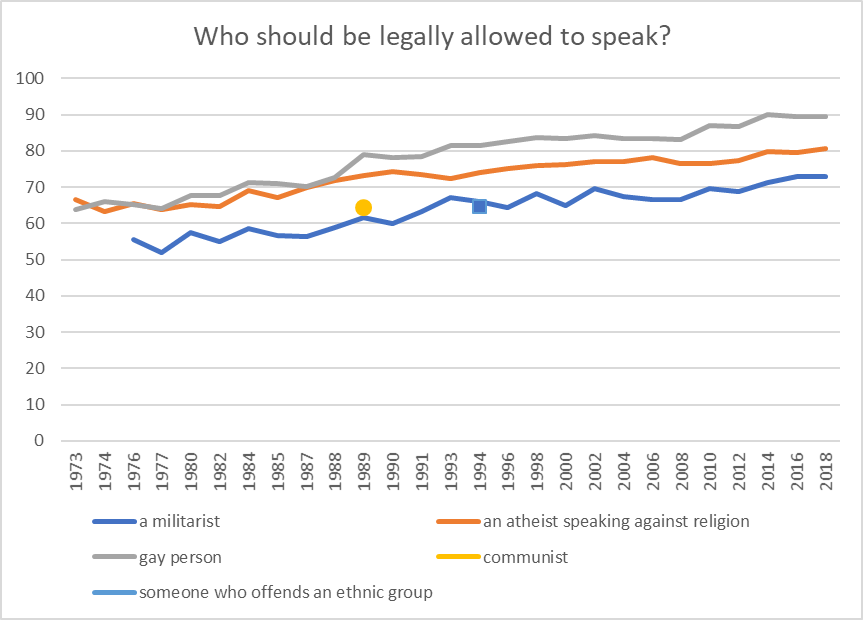
The General Social Survey has asked Americans whether various categories of people “should be allowed to speak.” The trends have generally risen over time. Americans have never been consistent supporters of the First Amendment, but they have generally become more willing to tolerate various categories of disfavored speakers. In 2019, Knight found that 58% of college students favored legally permitting “hate speech.” Perhaps this result reflects too little support for the First Amendment, but a similar proportion of adults in 1994 wanted to permit speech that (merely) offended another ethnic group. I think free speech requires constant attention, but I don’t see evidence of decline.

The controversial part of Sasse’s statement is not his support for the First Amendment or other civil liberties. It’s his contrast between “American civics” and “socialism.” That contrast raises the question of what those two categories mean. Sasse seems to suggest that support for the First Amendment and socialism are incompatible, but that is definitely not true; there is a long tradition of socialists who have also been strong supporters of free speech.

“Democratic socialism is committed both to a freedom of speech that does not recoil from dissent, and to the freedom to organize independent trade unions, women’s groups, political parties, and other social movements. We are committed to a freedom of religion and conscience that acknowledges the rights of those for whom spiritual concerns are central and the rights of those who reject organized religion.”

Where We Stand,” Democratic Socialists of America

On one view, socialism is about economics, and it’s a matter of degree. Perhaps the metric is the proportion of GDP managed by the state (between 15% and 25% in the USA ever since 1955). The US is more socialistic than it was in 1900 and a bit less so than Germany is today. But then one must decide whether the political economy established by the New Deal and the Great Society–since it is somewhat socialist–is compatible or not with the ideas that we should impart in “American civics.”

James Ceasar has distinguished between “civic education,” which by definition supports a regime, and “political education,” which aims to change the regime. For him, the educational reforms of the Progressive Movement, multiculturalism, and global education are three examples of political, not civic, education, because they have aimed to change what he identifies as the American regime. (Here “regime” doesn’t have a negative connotation; it just means the core features of a political order.)

My question is why our regime must be defined by the dominant constitutional theory of 1900. I’d read our current regime as (more or less) a multicultural welfare state, in which case an education that promotes the American regime should favor those values. Education that aims to delegitimize the welfare state is political, not civic, in the 21st century. It is a form of politics with a reactionary intent. Maybe the education that John Dewey and other Progressives promoted was political in their own time, but because they won victories as political reformers, now their ideas have become the civic ones (in Ceasar’s sense)–the ideas that bolster the present system. And if the present system is partly socialist, then “American civics” is partly socialist.

On a different view, socialism is something that we have never seen in America. It refers to policies that are more radical than, say, Social Security or the Environmental Protection Act, because these laws have passed constitutional muster and have become part of the American tradition. Some socialists would concur that Social Security and the EPA are not socialistic to a satisfactory degree; they want a lot more. (But such people are scarce in the USA.)

Sometimes in this debate, people say that students should learn to prize “limited” government. I would only observe that governments that are avowedly socialist can be very careful about limits–constitutional, legal, and democratic. The Scandinavian democracies are excellent examples. They endorse the idea of the Rechtsstaat (a government under law) even as they tax and spend at relatively high rates.

Moreover, the limits set by the US Constitution can be compatible with much more socialism than we have today. No one disputes, for example, that Congress has the constitutional authority to raise income tax rates by a lot and to spend a lot more on social welfare programs. So limits per se aren’t really the issue; the question is what policies we should choose.

A third view might be that civic education, properly understood, encourages students to be less individualistic, less acquisitive, and more concerned with the common good than they would be otherwise. Therefore, it may strengthen support for the kinds of policies that strong conservatives like Sen. Sasse would call socialistic. In that case, civics and socialism are not opposed; they go together. To argue this point well, I think you would have to define “socialism” very broadly, so that it encompasses Great Society liberalism, Christian and other faith-based communitarianism, and mild social-democratic reforms as well as more radical proposals.

On yet a different view, students should not be taught any substantive political views in public schools. Schools should be committed to impartiality and should respect the individual rights of students to form their own opinions. (Impartiality is also a safeguard against the regime’s propagandizing in its own favor.) Students should learn about socialism, libertarianism, constitutional originalism, feminism, critical race theory, environmentalism, and other doctrines and should be equipped to make their own choices.

The problem here is that schools inevitably impart values, and probably should instill the values that create and sustain a fundamentally decent regime. Even studying a range of political ideologies reflects a political stance (some form of liberalism). So, if we must teach values, then are the values of democratic socialism opposed to the legitimate American regime, or part of it now, or better than the regime–or is this all a matter that students should debate?

My own view, for what it’s worth, is that socialism names a basket of policy options that have been part of the American political debate since the 188os and that students should critically assess as part of their civic educations. They may also reflect on the other traditions, apart from socialism, that have animated the American left. And certainly they should understand and asses various forms of conservative thought. The values that Donald Trump represents have equally deep (or deeper) historical roots in America, but some of his values are contrary to the fundamental aspirations of the regime and should be marginalized in “American civics” worthy of the name.

See also civic education in the year of Trump: neutrality vs. civil courage; Bernie Sanders runs on the 1948 Democratic Party Platform; the Nordic model; What is the appropriate role for higher education at a time of social activism?

Moral Foundations theory and political processes

Moral Foundations theory is an important body of research that has generated significant findings. It belongs to a somewhat larger category of research about morality that has these features:

  • Many individuals are asked for their moral judgments of hypothetical or historical cases. (See this test, for example.)
  • The data from these individuals is analyzed to identify latent factors that statistically predict many people’s specific answers. Respondents may not be aware of the latent factors or even endorse them when they hear them, yet these factors are said to explain (statistically, and maybe causally) their actual judgments.
  • Some factors are found to be common across cultures and to have adaptive value for human beings as a species that evolved through natural selection. These factors are named “foundations.”
  • Variation among human beings depends on which of the foundations are more important for different groups. This is a structuralist theory, akin to Claude Levi-Strauss or Noam Chomsky. For structuralists, surface-level diversity results from variation in a finite set of underpinnings.
  • In ambitious versions of this method, morality is the list of foundations. Morality is what we think it is because of how we evolved. To debate the value of the various foundations or to argue for a different principle is pointless. There is no way to know the truth of moral claims, but science can reveal the foundations of our moral psychology, so those alone are real.

Despite my interest in learning from the specific findings of Moral Foundations research, I harbor many objections, summarized here. In this post, I would like to elaborate on one concern.

We human beings make individual judgments about cases and decisions. That’s what the data-collection of Moral Foundations Theory models. But we do many other things that also shape values. For instance, we buy things, which causes more of those things to be made and sold. We participate in bureaucratic institutions that manage themselves through chains of command, policies, and files. We join and quit groups. And we govern by making laws and policies at all levels.

As Owen Flanagan writes in The Geography of Morals (2016), “Moral stage theory conceives moral decision-making individualistically. The dilemmas are to be solved by singleton agents. This is ecologically unrealistic. Committees at hospitals decide policies on organ allocation; government agencies deliberate about monetary policy; officers deliberate about costs and benefits of military operations; and friends talk to friends about tough decisions.”

I’ll focus on political decisions, although we should also consider markets, bureaucracies, friendships, scientific disciplines, and other social forms.

People make laws and other rules to prohibit, regulate, tax, subsidize, and mandate various behaviors. These rules directly influence how we act and may also affect our values, if only because many of us display the Moral Foundation of “Authority.”

One might think that rules and laws are made by people who implement their moral judgments, which are influenced by their individual Moral Foundations. Laws would then simply be aggregated Moral Foundations.

Not so, for these reasons:

  1. An important determinant of the actual law is the choice of who gets to make it. That choice is often made by people other than those who do the governing. Millions of voters choose a president. A president plus 51 US Senators decides who sits on the Supreme Court (one opening at a time, spread over decades). In making these choices, people are not focused on the specific cases or controversies that come before the Court. Top of mind for a president may be finding a justice who can be confirmed, who impresses the electorate, and who is young enough to serve for a long time. These are different considerations from moral judgments about cases, but they shape the actual law. (Here I use a democratic example, but a dictator is also chosen, often by a military junta or by party cadres.)
  2. When multiple people make laws, they don’t do so by judging in isolation and then aggregating their votes. A secret vote may mark an important moment in a political process, but it is almost never the only moment. It usually follows argument, persuasion, and mobilization; and sometimes groups decide without voting at all. Communication plays an important role. But when we communicate, we are not merely expressing our moral judgments of concrete cases. We may be doing many other things: trying to go along with the group, trying to stand out, trying to look (or be) impartial or moderate, trying to waste time on a point of disagreement to prevent attention to a different topic that we fear (filibustering), trying to set a precedent for other topics, supporting someone else so she’ll help us later (logrolling), saying something to irk someone in particular, enjoying the sound of our own voices, and so on. Our moral judgment of concrete issues may be an input, but only one among many.
  3. The procedures for making collective decisions influence the outcomes. For instance, almost all procedures favor the status quo because it takes energy and agreement to shift it. Therefore, a group can live with a law or policy that every individual would prefer to change. This is common and it implies that law often fails to reflect the private opinions of the majority–even when everyone has an equal say, which is vanishingly rare.
  4. One way that laws and policies shift is that subgroups successfully advocate for changes, based not on abstract judgments but self-interest. I don’t think that attitudes toward sexual orientation changed over the past half century because the broad public decided to reconsider their views. I think sexual minorities felt compelled to take their struggles into the streets, the ballot booth, and the courts and won some significant victories. The resulting policies then began to change attitudes. (A different kind of example: girls’/women’s sports got a huge boost from Title IX, which originated when Congress rejected a mischievous amendment to exclude sports from civil rights legislation–a backdoor way to enact a policy that has changed everyday attitudes toward gender.)
  5. Often the subject of political or legal debate is not whether individuals should do specific things: marry, steal, take drugs. It is about our collective stance toward social constructs: the United States (or Russia), Christianity, the family, a forest. These things have histories, they are complex and internally inconsistent, and they reflect laws or norms that people have formed over time. Often we are not asked to assess concrete actions but big abstractions that embody, among other things, many previous concrete actions taken by many people for many reasons. A major question is what story we should tell about a large construct.

For these reasons, empirical moral psychology cannot stand on its own without institutional/political analysis. Moral Foundations Theory is strongest when it aims to predict how people will individually react to a situation that raises issues so general that it resembles the problems that confronted our prehistoric ancestors on the savanna. The theory is least helpful for explaining why the same group of people might change its stance toward a specific topic, as we see with sexual orientation since 1969.

See also Jonathan Haidt’s six foundations of morality; an alternative to Moral Foundations Theory; moral thinking is a network, not a foundation with a superstructure; and against methodological individualism.

forecasting the UK parliamentary elections

The celestial bodies have aligned to put British politics in that rare situation: a first-past-the-post electoral system with multiple viable parties.

Usually, when a legislature consists of the top vote-getters in all the districts, it evolves (or degenerates?) into a two-party system, because supporters of any other party worry that their votes would be “wasted.” However, due to the turmoil of Brexit, plus the strength of regional parties, several parties will be competitive in the next UK election if it happens soon.

That makes the result extraordinarily difficult to predict. In theory, a party with well under 50% support could come in first in more than half the constituencies and dominate the Commons. You can’t tell how any party will perform just by examining national polls, because it depends on where its votes are concentrated. Britain could have the most socialist government since 1979, the most Thatcherite government since 1990, the first English-nationalist party in its history, or the first Liberal-led parliament since 1922, all depending on the quasi-random question of where the votes lie.

I cannot assess Max Baxter’s Electoral Calculus site, but I don’t see an alternative, and it seems sophisticated. The change that he finds over recent months certainly seems plausible.

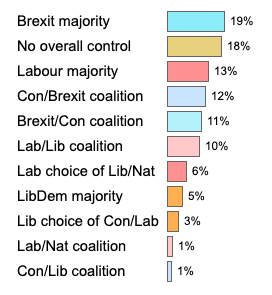
In May, many divergent outcomes had fairly similar probabilities. The most likely outcome was a Brexit Party majority, but that was less than a 4-1 bet. The combined odds of either a Labour government or a Labour/Liberal coalition were a bit higher, at 23%.

(“Nat” refers to the Scottish Nationalists plus Plaid Cymru from Wales)

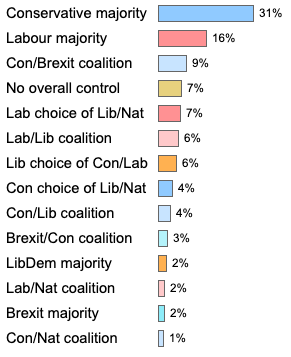
Since then, Brexit voters have shifted to the Tories because Boris Johnson is now the PM. That makes a Conservative government considerably more likely and almost wipes out the chance of a Brexit Party government. (Why vote for them when you can have Boris?) Since the Brexit Party was the most likely to form a government in May, the Tory leadership contest has been very consequential. Here are the current odds, again per Max Baxter:

In national polls, the Tories lead Labour by only about 4-5 percentage points and don’t reach 30% support. But they could still capture a majority of seats in a four-way contest.

I think Boris Johnson faces a bit of a dilemma. If he calls a snap election, he has a 31% chance of being able to govern without any coalition partners, an attractive option considering that 60% of voters are against him. He also has a 52% chance of being able to form some kind of government, with or without partners. To maximize his odds, he must continue to take all the votes away from the Brexit Party, which means a hard-line stance on Europe.

On the other hand, he already leads a government, and if he calls a snap election, he faces about a 48% chance of losing control to the opposition. That makes an election a pretty big risk, a coin-toss. But if he steams ahead with the current parliament, I can only see things getting much, much worse as Brexit hits. A 51% chance of forming a new government now is better than his likely odds any time after October.

On that basis, I think he will call an election and not budge an inch on Brexit until it’s over.

the oscillation between dictatorship and parliamentary institutions (a game theory model)

Abstract: Sometimes despots have incentives to convene representative bodies that govern with them. And sometimes the leaders of republics have incentives to rule unilaterally. Changes in the incentives explain the oscillation between authoritarianism and republicanism. Today’s incentives are pushing in the wrong direction.

Imagine that a leader (a king, tyrant, dictator, general) possesses the only effective, loyal, well equipped military force in an area. That person—Mancur Olson called him a “stationary bandit”—can use the threat of violence to extract money from the population to pay for and motivate the army plus a bureaucracy that identifies, counts, and organizes the society’s wealth.

It may help if the ruler has some perceived legitimacy (an anointed monarch instead of a usurper or dictator, for example) and offers benefits to the people, such as safety from foreign enemies. Those factors may reduce dissatisfaction that can breed resistance. But the main pattern is a monopoly of power that serves to extract resources to fund the power itself. This situation can be self-reinforcing.

But how to get to that situation if you don’t start with a loyal and effective army and bureaucracy? And how to get back to that situation if you lose it due to defections or diffuse resistance?

One way is to convene many of the leaders of the society who already have the capacity to collect resources: nobles or other great landlords who are succeeding at extracting rents, senior clergy who collect tithes or control endowments, and municipal leaders who represent commercial interests. These people can agree to generate the resources to pay for the state if they see advantages for themselves. Someone with a claim to leadership (say, a king) can convene them, negotiate with them, and end up as a ruler who shares power.

This is a way for parliamentary institutions to emerge from despotism, as they did across Europe in the middle ages. A medieval parliament almost always represented the nobility, the church, and the towns in separate houses or estates.

Now let’s say that the system is rolling along, and the monarch actually has a well-equipped, loyal military force and a bureaucracy funded by taxes. It becomes possible for that monarch to dismiss the parliament and use the state to extract taxes, rents, military service, and labor by force, perhaps legitimized by some theory of divine right.

This is a way for parliamentary government to shift into monarchical absolutism, as occurred in many European countries around the 17th century (plus or minus).

But let’s say the king gets into debt, or faces insubordination, or is attacked by a powerful foreign threat, or simply sees low levels of compliance. He may need to call a parliament again so that key stakeholders can voluntarily agree to coordinate their efforts to raise money. And if the parliament can organize itself effectively, it can threaten the monarch’s power and even his safety.

This is how the English parliament gained the authority, after 1688, to make all laws. The monarch still embodied the executive branch and could make many discretionary decisions of a broadly managerial type. Since that was too big a job for any individual to do alone, monarchs governed through ministers, often holders of offices that dated back to the middle ages.

Technically, the monarch could place anyone in these offices and could intervene in any issue directly by proclamation. However, since the power of the purse had shifted to parliament (and money can buy an army), the monarch was vulnerable. Charles I has lost his head; James II, his throne. Many subsequent British monarchs preferred to govern through ministers supported by parliament. And once parliament had divided into parties, this meant selecting ministers acceptable to the majority party. George I even discovered that it was convenient to make the leader of the majority–the Whig MP Robert Walpole—an effective chief minister who would chair a cabinet that he (Walpole) chose. Walpole served in this role for 20 years, resigning only when he no longer led a majority in the House of Commons.

In this way, parliamentary cabinet government and the office that we now know as the Prime Minister evolved from the underlying situation. The premiership was not created, like the US presidency, when a person or group conceived the idea and wrote it down in a constitution or law. It emerged from Walpole’s experience serving the King with the Commons’ support. But one could explain both the British premiership and the US presidency as a result of the same underlying needs.

Some subsequent monarchs pushed back by naming ministers of their own choice who lacked parliamentary support. There was not always a prime minister all. In 1783, the politician Charles James Fox reacted to the prospect that George III might name a prime minister without the confidence of parliament:

[If] a change must take place, and a new ministry is to be formed and supported, not by the confidence of this House or the public, but the sole authority of the Crown, I, for one, should not envy that hon. gentleman his situation. From that moment I put in my claim for a monopoly of Whig principles.

The last sentence simply means that Fox would seek to legislate a requirement that the cabinet receive parliamentary support. But the first sentence is more interesting. A prime minister who couldn’t win a majority in the House would stand in an unenviable situation even if he continued to serve, because he could not govern effectively without the parliament behind him.

Meanwhile, the governments of the Netherlands and England (at least) had learned that they did not have to rely solely on taxes, rents, and loans from bankers. They could also borrow from their own people, who would voluntarily buy state securities as long as they trusted the government to spend the money in what they considered the public interest. The middle class gained that confidence because they dominated the parliaments of these countries (versus the weakened nobility and the disenfranchised poor). As a result, these countries could raise huge sums and field substantial navies and armies, which, in turn, created economic benefits for the middle classes.

As a result, governments with parliaments became far more powerful on the international stage than absolute monarchies. Republican France could field an army of 1.5 million based on taxation, conscription, and bond sales. Although Napoleon overstepped, France threatened to dominate all of Europe. Absolutism recurred after 1815 and held on in places like Russia a lot longer, but it was the long-term loser in the Darwinian struggle for fitness among nations.

In this way, republican forms of government tended to prevail, except that the vast systems of state power that republics underwrote could also break free of parliamentary oversight. I don’t think that Germany could have built a massive state apparatus between 1871 and 1932 without a Reichstag to represent the public and make taxation and conscription reasonably popular. But once that apparatus existed and Hitler controlled it, he could dismiss the parliament and rule by fear. The story was perhaps a bit different in the USSR and China, both of which had long traditions of monarchical despotism and only brief parliamentary rule before their communist dictatorships. But all twentieth-century authoritarianism echoed baroque-era absolutism (with a larger dose of terror).

Then, around 1989, most of the authoritarian regimes crumbled in the face of republican popular movements. I think this was simply a recurrence of the despot’s traditional vulnerability, his need for widespread compliance. Authoritarian regimes sagged under the weight of corruption, stagnation, and obsolescence and couldn’t draw on their publics for resources—money, talent, or enthusiasm–to fix their problems. The reasons for the original rise of parliamentary government recurred.

The problem now is that the cost of dominating a population and extracting resources from the people has fallen. You don’t need a vast conscript army if you have drones and cruise missiles. You don’t need an army of bureaucrats if you can scrape data from electronic records. If you have a monopoly on the legitimate use of force within your territory, you can rule with just a few supporters.

William the Conqueror destroyed the Anglo-Saxon elite and governed England (with a population of at least 1.1 million) with about 8,000 men. Thanks to his victory on the battlefield and the dread power of knights, he was not forced to share authority but could keep 8,000 people behind them by distributing plunder. That is an example of a single leader possessing the resources to dominate, much as modern authoritarian states do. William’s descendants saw that advantage slip away and were forced to convene parliaments–but the road to democracy was long and slow.

Dewey was wrong that “the current has set steadily in one direction: toward democratic forms.” Instead democracy and despotism have oscillated, depending, in part, on how easy and affordable it is for a small number of people to dominate the population. Unfortunately, domination has lately grown cheaper and more effective.

See also: Dewey and the current toward democracy; why post-modern nation states do not need mass support; why autocrats are winning (right now); Dubai, Uganda, and today’s global political economy; and what does it mean to say democracy is in retreat?

less than a penny a year for grassroots civic organizing

(DC) The Foundation Center’s database and analytic website entitled Foundation Funding for US Democracy is full of interesting information and worth detailed exploration.

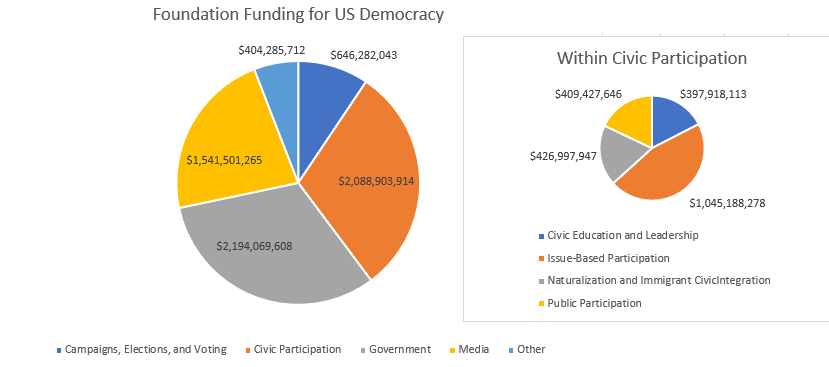
Drawing on tax forms, the site categorizes $5.5 billion in grants made to strengthen democracy in the USA since 2011.

The ideological range is wide: the DeVos and Mercer foundations are in the database, along with Open Society and many more.

This is the distribution of grants by very broad categories, with a somewhat more detailed look at the pie slice devoted to “civic participation” (which interests me most).

My graphs based on Foundation Center data

I estimate that $1.73 billion of the $5.5 billion (31%) has gone to nonprofits headquartered in DC or the surrounding counties in Maryland and Virginia. With some exceptions, these are professional organizations without a grassroots membership base.

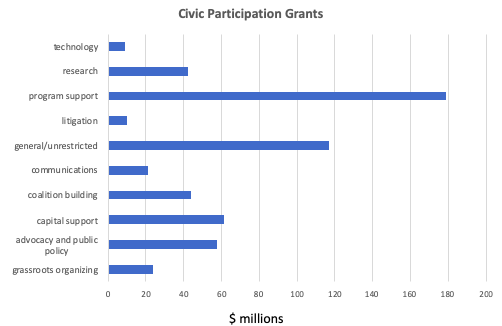
Within the category of “civic participation,” $2.1 billion has been distributed for the following purposes. These categories are non-exclusive; a grant can serve more than one purpose.

A total of $23 million–.0.43% of all democracy funding and a little less than one cent per American per year–has been spent on grassroots organizing for civic participation. I think that marks a major deficit.