draft syllabus of a course on Dr. Martin Luther King, Jr.

This spring, I will be teaching a capstone seminar on the life and thought of Dr. Martin Luther King, Jr. The draft syllabus is below (minus grading rubrics, policies, etc.). At this stage, I welcome suggestions!

Summary In this seminar, we will study Martin Luther King Jr. as a political thinker. The whole class will read major works by King and excerpts from biographies and historical documents. Additional readings will be distributed among students, who will contribute insights from their assigned texts to the seminar discussions. The additional readings will include works that influenced King, writings by some of his contemporaries, and interpretations from a recent volume, To Shape a New World: Essays on the Political Philosophy of Martin Luther King, Jr., edited by Tommie Shelby and Brandon M. Terry. We will investigate King’s understanding of the Civil Rights Movement—why it was necessary and what it aimed to achieve. Specifically, we will study his ideas about the political and economic organization of white supremacy, the impact of racial ideologies, and the importance of racial integration and the right to vote. We will investigate King’s philosophy of civil disobedience and nonviolence as well as a set of values he relates to that philosophy: dignity, sacrifice, self-reflection, self-improvement, love, faith, and freedom. We will relate these values to King’s understanding of justice. Criticisms of King will also be considered. Studying King and his critics will provide a window into post-WWII American political thought.

Syllabus

Wednesday, January 15: Introductions and overview

1. Predecessors and Early Influences

Monday, January 20:  Major African American political thinkers, 1885-1940

Students choose one of these authors and be prepared to discuss the author as well as the readings. 

  1. Booker T. Washington, “Letter to the Editor” (1885); “Atlanta Exposition Address” (1895); “Speech to the National Afro-American Council” (1895); “Letter to President Roosevelt” (1904); “Speech to the National Negro Business League” (1915); “My View of Segregation Laws” (1915); “The Talented Tenth” (1903).
  2. W.E.B. DuBois, “The Evolution of Negro Leadership” (1901); “Declaration of Principles” (1905); “The Crisis” and “Agitation” (1909); “Race Relations in the United States” (1928); “Marxism and the Negro Problem” (1933); “Pan -African and New Racial Philosophy” (1933); “The [NAACP] Board of Directors on Segregation” (1934); “A Negro Within the Nation” (1935).
  3. A. Phillip Randolph: “Lynching: Capitalism Its Cause; Socialism its Cure”; editorials on “Racial Equality” and “The Failure of the Negro Church,” “The Negro Radicals,” “Segregation in the Public Schools: A Promise or a Menace,” “Negroes and the Labor Movement,” “The Negro and Economic Radicalism,” and “The New Pullman Porter.”
  4. Another modern Black thinker of your choice likely to be influential in King’s early milieu. E.g., Ida B. Wells, Marcus Garvey …

(Unless otherwise noted in the PDFs, these readings are scanned from Gary D. Wintz, ed., African American Political Thought 1890-1930 (M.E. Sharpe, 1996).)

Wednesday, January 22: Theological Influences

Students choose one of these authors and be prepared to discuss the author as well as the readings

  1. Howard Thurman, Jesus and the Disinherited, pp. 7-35.
  2. Reinhold Niebhuhr, Moral Man and Immoral Society, pp. xv-xvii and 231-277
  3. Walter Raushenbush, A Theology for the Social Gospel, pp. 57-109

Monday, January 27: Biblical echoes

Students will choose one of these, read it, and also read a bit online about the context:

  1. Book of Exodus, Chapters 1-3, in the King James Version (click “next page” to read all three chapters)
  2. Book of Amos, Chapter 2, in the King James Version
  3. Book of Micah, in the King James Version (click “next page” to read the whole book)
  4. Book of Matthew, Chapter 26, in the King James Version

Wednesday, January 29: Precursors–Gandhi

Everyone will read:

  • Ramachandra Guha, Gandhi: The Years that Changed the World (2018), chapter 16 (“The March to the Sea”)

Choose one of these:

  1. Bikhu Parekh, Gandhi, Chapter 4 (“Satyagraha”), pp. 51-62;
  2. Gandhi, Satyagraha (Ahmedabad: Navajivan Publishing Co., 1951), excerpts; and Gandhi, Notes, May 22, 1924 – August 15, 1924, in The Collected Works of Mahatma Gandhi (Electronic Book), New Delhi, Publications Division Government of India, 1999, 98 volumes, vol. 28, pp. 307-310
  3. Karuna Mantena, “Showdown for Nonviolence: The Theory and Practice of Nonviolent Politics,” in Shelby and Terry, pp. 78-110
  4. Martha Nussbaum. “From Anger to Love: Self-Purification and Political Resistance,” in Shelby and Terry, pp. 114-135

Monday, February 3 – no class (instructor is away)

Wednesday, February 5: Precursors–African American campaigners against segregation

  • Everyone watches Episode 1 of Eyes on the Prize, “Awakenings, 1954-1956”

Choose among:

  1. Charles Payne, “Ella Baker and Models of Social Change“; and Ella Baker, “Developing Community Leadership
  2. Danielle McGuire, At The Dark End of the Street: Black Women, Rape, and Resistance–A New History of the Civil Rights Movement from Rosa Parks to the Rise of Black Power.
  3. James L. Farmer Jr., Lay Bare the Heart: An Autobiography of the Civil Rights Movement (excerpts)

2. Montgomery

Monday, February 10: What Happened?

Choose between:

  1. David Garrow, Bearing the Cross: Martin Luther King, Jr., and the Southern Christian Leadership Conference (1986), pp. 105-205.
  2. Taylor Branch, Parting the Waters: America in the King Years, 1954-63 , pp. 11-82.

Wednesday, February 12: How Does King Present What Happened?

  • Martin Luther King, Stride Toward Freedom, chapters 3, 4, and 5.

Wednesday, February 19: Theory of Social Movements

  • Charles Tilly, “Social Movements, 1768-2004
  • Marshall Ganz, “Why David Sometimes Wins: Strategic Capacity in Social Movements,” in Jeff Goodwin and James M. Jasper, Rethinking Social Movements: Structure, Meaning, and Emotion (Lanham, MD: Rowman and Littlefield, 2004) pp.177-98.

3. Albany and Birmingham

Thursday, Feb 20 (makeup day): What Happened?

Students will choose between:

  1. Episode 4 of Eyes on the Prize, “No Easy Walk: 1961-1963”
  2. David Garrow, Bearing the Cross: Martin Luther King, Jr., and the Southern Christian Leadership Conference (1986), 173-286.
  3. Taylor Branch, Parting the Waters: America in the King Years, 1954-63 , pp. 524-561; 673-802

Monday, February 24: How Does King Present What is Happening?

  • Martin Luther King, Jr., Letter from Birmingham Jail

Wednesday, February 26: More Analysis of the Letter

  • Martin Luther King, Jr., Letter from Birmingham Jail

Monday, March 2: King’s version versus the Supreme Court’s

4. March on Washington, Selma

Wednesday, March 4: Protest and Politics

Everyone reads:

Monday, March 9: Selma to Montgomery

Everyone watches/listens and/or reads the text of:

Students will choose between:

  1. David Garrow, Bearing the Cross: Martin Luther King, Jr., and the Southern Christian Leadership Conference (1986), pp. 357-430
  2. Taylor Branch, Pillar of Fire: America in the King Years, 1963-65 , pp. .

5. Issues During the “Heroic Moment” of the Civil Rights Movement

Wednesday, March 11: What Should be the Goal? 

Choose among:

  1. Martin Luther King, “The Ethical Demands for Integration” (1962) and Danielle Allen, “Integration, Freedom, and the Affirmation of Life,” in Shelby and Terry, pp. 155-169
  2. Stokely Carmichael, “Toward Black Liberation,” The Massachusetts Review, Autumn 1966
  3. Derrick Darby, “A Vindication of Voting Rights,” in Shelby and Terry, pp. 170-83

Wednesday, March 25 – midterm in class

Monday, March 30: Change from Below or from Above?

  • Patrick Healy and Jeff Zeleny, “Clinton and Obama Spar Over Remark About Dr. King,” The New York Times, Jan 13, 2008
  • Garth E. Pauley, “Presidential rhetoric and interest group politics: Lyndon B. Johnson and the civil rights act of 1964,” Southern Communication Journal, vol. 63, no 1 (1997), pp. 1-19
  • Original text of the Civil Rights Act of 1964

April 1: Martin Luther King and Malcolm X

Everyone reads these primary texts:

  • King’s remarks on Malcolm X in 1965 (from a Playboy Magazine interview)
  • Malcolm X., “Message to the Grass Roots” (Nov 9-10, 1963) in Malcolm X Speaks: Selected Speeches and Statements (Grove Press 1990), pp. 3-17.
  • Malcolm X, “The Ballot or the Bullet,” 1964 (audio and/or text)

Choose among:

  1. Episode 7 of Eyes on the Prize, “The Time Has Come: 1964-66
  2. August H. Nimtz, “Violence and/or Nonviolence in the Success of the Civil Rights Movement: The Malcolm X–Martin Luther King, Jr. Nexus.” New Political Science 38.1 (2016): 1-22.
  3. Clayborn Carson, “The Unfinished Dialogue of Martin Luther King and Malcolm X” (1998)

6. Later Writings and Issues

Monday, April 6: The North and Poverty

Everyone watches:

Episode 8 of Eyes on the Prize, “Two Societies:  1965-68”

Choose from:

  1. Tommy Shelby, “Prisons of the Forgotten: Ghettos and Economic Injustice,” in pp. 196-213

Wednesday, April 8: War

Listen to audio and/or read the text:

Monday, April 13: The end

Everyone watches/listens to:

21st-Century Appraisals

Wednesday, April 15

Peniel E. Joseph, “Waiting till the midnight hour: Reconceptualizing the heroic period of the civil rights movement, 1954–1965

[April 20: Patriot’s Day, no class.]

Wednesday, April 22: The right and the left of King after his death

Choose among:

  1. Glenn C. Loury, “Achieving the ‘Dream’; A Challenge to Liberals and to Conservativesin the Spirit of Martin Luther King, Jr
  2. Ronald R. Sundstrom, “The Prophetic Tension Between Race Consciousness and the Ideal of Color-Blindness,” pp. 136-154
  3. Cornel West, “Hope and Despair: Past and Present,” in Shelby and Terry, pp. 334-346

Monday, April 27: Reading King in the light of 21st-century concerns

  1. Shatema Threadcraft and Brandon M. Terry, “Gender Trouble: Manhood, Inclusion, and Justice, in 214-244
  2. Brandon M. Terry, “Requiem for a Dream: The Problem-Space of Black Power,” in Shelby and Terry, pp. 299-333
notes from India

My family and I were in Delhi and Rajasthan over the winter break, and I cannot resist some notes. I offer them with intellectual humility, understanding that India is a vastly complex place, our experience was superficial, and I cannot grasp many aspects of Indians’ experience, starting with what it’s like to live on $616/year (a plausible, although dated and contestable, estimate of the median per capita income).

Furthermore, we were tourists, often following a paid guide, riding in a van with a professional driver, or staying in a nice hotel. These are colonial experiences, almost literally; some of the hotels where we stayed had been residences for British authorities. Modes of interaction still harken to colonial days. When I dropped a tissue as I tried to say namaste to a hotel employee, he leapt to pick it up faster than I could have moved my hand downward.

I fully recognize how problematic all of that is, although my (debatable) justification goes as follows: We are already deeply tied to India, already affecting it with the goods we buy and the carbon we pump into the air—and in many other ways—and there is something to be gained by getting at least a bit closer. But there is also a risk of overestimating one’s own learning. A little knowledge is a dangerous thing; hence the need for serious humility.

(By the way, as a side-note on tourism: relatively few European sightseers are visible in India, except at the most famous locations. Almost everyone from the United States is visiting the homeland for a family function. This is not a country overwhelmed by global tourism, and developing the industry more may be beneficial. But you do see many Indian travelers and sightseers—crowds visiting temples and other holy places in relatively traditional ways, youth taking selfies outside of historical monuments, and large, affluent, multigenerational family parties speaking Hinglish.)

Politics

India is experiencing substantial protests against a set of policies introduced by the Modi Government that threaten India’s secularism and the equal standing of its Moslem citizens. We saw no signs of actual protests but did avoid certain parts of Delhi that we would otherwise have visited. I tried to follow local news and the commentary of Indians I respect, such as the excellent Ramachandra Guha. In general, I have nothing to add to their analysis and would question my right to express political opinions about India. But I will comment on one experience.

Our guides, to the extent that they were open to discussing politics, were all pro-Modi BJP voters. They identified strongly with specific kshatriya castes. They presented the history of India as the story of a Hindu “we” that has been conquered by waves of outsiders, including Moslems. In Mogul sites, they emphasized the Hindu temples that had been destroyed to build the visible mosques or mausolea. They complained about affirmative action. They blamed the current protests on Modi’s opponents for “politicizing” his proposals. They presented the Prime Minister as strong and effective and as finally addressing issues never before touched since Independence. (They may have been referring to corruption, but I suspect they also meant Hindu nationalist issues.) They romanticized the Rajput rulers of Rajasthan and their close relationships to British imperialism. They implied that Moslem invaders had wounded India but that Hindu feudalism and British colonialism were colorful episodes. One should adjust for possible politeness to white visitors, but I thought their “saffronisation” was sincere.

For what little it’s worth, I stand on the opposite side of all these issues. I think Islam is an integral part of India’s richness; caste is a problematic inheritance; affirmative action is appropriate (if it works, which I don’t know); and Modi’s India risks losing its character as a “sovereign socialist secular democratic republic” with “liberty of thought, expression, belief, faith and worship;” “equality of status and of opportunity”; and “fraternity” among all its people.

But our guides were also nice people—striving to raise good kids and to play constructive roles in their communities; kind to strangers. It was a little like spending time among solid #MAGA voters in the USA (except that Modi is much more competent than Trump, the left alternative is less credible in India, and there are ways of understanding Modi’s rise that make it seem almost inevitable—see Taylor Cowen).

It’s always smart to hold two thoughts in your mind. First, we should strive to identify justice and injustice. For instance, I think that BJP-style Hindu nationalism is unjust; it puts 200 million Indian Moslems at serious risk. Second, people who do not understand justice as I do are still complex, ambivalent, sensitive, fellow human beings, conditioned as I am by their circumstances and usually trying to do their best.

Streetscape

The following is a composite, based mainly on Jaipur and Bundi. It could be more accurate if I’d taken ethnographic notes, or even snapshots as reminders. But the ethics of that degree of scrutiny bothered me a bit, so I chose to just absorb and write much later from stored impressions.

I’m in a narrow but busy street in the town center, as opposed to one of the back alleys that are more residential.

It would be misleading to describe this spot as crowded—say, compared to a street in downtown Boston. The number of people per square mile is probably much lower in an Indian town, because the buildings average 2-3 stories and there is plenty of space among the people whom you can see outdoors. They are not pressed together. But the mix of activity is astonishing.

In the street itself: men working on small-scale industrial or mechanical tasks—banging on metal, for example—or women in saris squatted by vegetables for sale. Almost always, several dogs are sound asleep on their sides, oblivious to the traffic that navigates around them. A cow, ambling along, browsing on the garbage. Maybe a small bristly pig with piglets. A constant parade of motorcycles and scooters, with the occasional auto-rickshaw, and rarely a car or van. Almost every vehicle honks as it passes. Often the motorcyclist is a solo young man, but sometimes you see a pair of women in saris, or two men with a child between them, or an old man with a long white beard, curled mustache, and turban.

Parked motorcycles here and there; an open sewer along one side of the road. People walk up and down, some on cell phones, some with small children, some in traditional Rajasthani clothes, fabulously colorful, and some looking like they bought their wardrobes in an outlet mall.

Moving up: small stores selling food, drinks, and specialty items. Professionally printed signs announce the names of the businesses in English or Hindi. One proprietor is a Moslem man in a scullcap. A Jain temple with flags might be visible a little further down. 

Some of the addresses are empty except for rubble or partial construction. A family of black-faced monkeys lopes along a wall. A German shepherd that must be a true family pet looks down from a balcony, barking at the street dogs below. Signs and advertisements are posted at various levels. A relief of Ganesh, covered in silver foil and daubed with yellow.

Higher up: small, square colorful kites, flown from rooftops. A cloudless sky with a thin haze. Sounds of horns, drumming and singing, the Call to Prayer.

Environment

We arrived in Delhi after the really bad smog season had ended for 2019. Yet the air was thick enough that you could easily see it even inside well-constructed modern buildings like the airport or the Marriott, swirling around the lighting.

Amartya Sen once argued that the average Indian should use more carbon. That will be necessary for such major life-improvements as full-sized apartments constructed of concrete, refrigeration, and heating in the chilly winter. Clearly, for each Indian to consume more carbon either means even deeper cuts in the developed world or a technological deus ex machina.

But the level of particulate emissions in Indian cities (not only Delhi; the air was just as bad in Jaipur) is a health crisis for residents, and local cuts are required to address that problem. In that sense, the global benefits of reducing emissions in India are consistent with local needs, not in conflict with them. The same is true of planting trees to lower local temperatures, which the Government is doing. You do see solar panels in the countryside—far fewer than in Europe, but quite a few.

In a small town like Narlai, Rajasthan, which appears to be subsidized (by tourism, remittances, or the major temples, I am not sure which) you can also see the local benefits of environmental investment. There, most of the sewers are covered and there is relatively little trash. Townspeople still live interspersed with street dogs, cows, pigs, and monkeys, but everything feels healthier. Narlai may be sanitized in some problematic way that I do not understand, but I think it is the result of spending more money per capita than in many other towns and cities.

Preserving heritage

Narlai is said to have 350 temples. Some are just roadside shrines, but there are several massive ones, including a stunning Jain building. Inside, its immaculate white surfaces are entirely covered in bas-reliefs and rococo architectural ornamentation, the whole making a peaceful and harmonious impression.

In a place like this, my own ignorance is deep. I am not even sure what language the signs are in, let alone their meaning. I know almost none of the iconography, I have the barest understanding of etiquette, and I cannot guess the history of the structure. Nor did I find any informative scholarly writing online about the Jain temple of Narlai.

But it seems that it dates from the 14th century. Many of the lovely and idiosyncratic reliefs are a bit weathered because they are seven centuries old. At the same time, the whole interior is as bright and symmetrical and perfect as if it had been constructed yesterday. And one can see that, in fact, new reliefs and ornaments are being carved and installed here and there right now. The 14th-century temple is at least partly a work of the 21st century—perhaps mostly so.

In a country like Britain or Italy, sophisticated viewers would recoil at this “restoration.” An old building should be left alone or restored only to the point of stability, with any additions clearly marked so that a viewer can see what is old and what is new. A massive renovation would be seen as destroying the historical record. That’s what Europeans used to do in the 1800s, dramatically reconfiguring buildings like Notre-Dame de Paris to meet their sense of what medieval buildings should look like. We don’t do that any more.

In India, too, the law forbids this kind of renovation. But that law appears not to be enforced, and the Jain community of Narlai—with evident wealth and influence—holds different values.

For my own part, I regret the loss of the 14th-century interior but am also a bit relativistic about the clash of values. After all, the Jains want their temple to look perfect and resplendently new for the same reason that 19th-century Europeans wanted to improve their gothic cathedrals. They believe. For believers, a religious structure is not a record of the past; an artistic style is not the mere expression of its time and place. The structure is a home for god; the style is right and good. If that’s the case, why not fix the building to make it look as good as possible? To turn it into a museum is to deny its intended meaning.

It is no coincidence that the countries that are most concerned about historic preservation are also the most secular; and in a way, the past is not at all conserved. We turn places like churches into something entirely new even as we strive to make them look as they did originally.

Perils of sentimentality

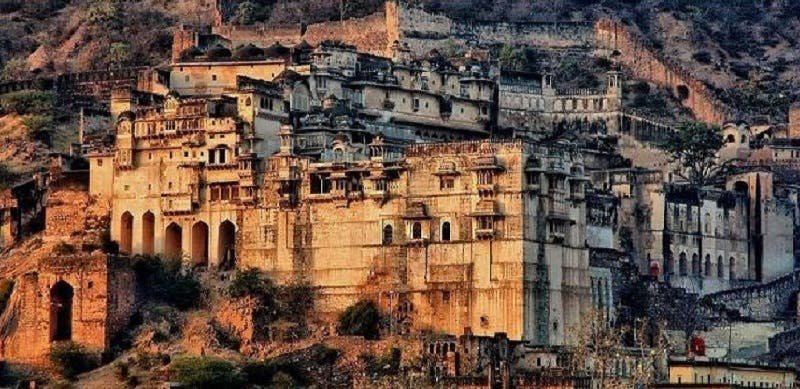
The Rajasthani town of Bundi is dominated by a great fortified palace built into a steep mountainside. With many layers of arches, doors, porticoes, terraces, and battlements, it looks like a background shot from the movie of The Lord of the Rings. Kipling said it must have been built by goblins, not men.

Its ownership has been tied up in a court case filed in 1984, so essentially no one holds property rights to it right now. Much of the vast and multistoried interior has been given over to bats and monkeys. But near the top is a well-preserved maharajah’s harem, with gardens, exquisite miniature paintings of Hindu texts on all the walls and ceilings, and elaborate mosaic inlays. In one small room, almost touching each other, are the henna handprints of five or six ladies with slender fingers. We were told that they placed these prints as they left for sati, to be burned alive on the funeral pyre of their deceased husband.

That is a touching sight in a place saturated with both beauty and subjugation. What did these women think as they pressed their hands to the wall? What did they expect after death? What did they think of the lives they were about to leave?

And yet, what are we doing here, listening to this story about sati (which may or may not be true), we four white people from Boston? The supression of sati was a major justification for British imperialism in India. In 1943, the British let 2.1 million-3 million Bengalis die by starvation. Why are we thinking about five possibly sacrificed princesses instead of millions of definitely sacrificed Bengalis? Why are we paying an Indian guide to tell us this story in this place? Why are we in India at all?

I think those are good questions, but I am definitely glad we went, grateful to all the gracious Indians who made the trip so easy, and hopeful to return. I would recommend that anyone go who can.

job openings in youth civic engagement

This is the latest in an occasional series …

CIRCLE (The Center for Information & Research on Civic Learning & engagement here at Tisch College) is searching for a Project Manager. They are looking for someone with advanced project management skills (and ideally a project management certificate) and a commitment to equality, but no prior knowledge of civic engagement is required.

The nascent Center for Equity on Health, Wealth, and Civic Engagement at Tufts University (whose Principal Investigators are Jennifer Allen, Thomas Stopka and I), seeks a part-time Program Coordinator. Our long-term goal is to build a durable center for the study of equity that integrates research from across Tufts, attracts external funds for ambitious projects, generates groundbreaking research, affects the national and global understanding of equity, and offers educational opportunities for Tufts students and others. This work is distinctive in its interdisciplinary breadth, its focus on equity as an ideal rather than inequality as a narrowly defined problem, and its connection to policy, practice and public discussion. We seek a part-time Program Coordinator to oversee implementation of study plans and who will be a key liaison between faculty members, students, and community stakeholders. Under the supervision of the Principal Investigators, the Program Coordinator will coordinate all center activities. Contact me for more information.

Tisch College seeks a VISTA Campus Recruiter— a part-time position recruiting for national service opportunities in partnership with the Corporation for National and Community Service (CNCS). The Recruiter will primarily focus on AmeriCorps VISTA. The Recruiter will create and enact a comprehensive work plan that presents VISTA service opportunities to students at Tufts University. To apply or for more information please contact Sherri Sklarwitz (sherri.sklarwitz@tufts.edu) by December 20th. Please include the job title (VISTA Campus Recruiter) in the subject line.

Discovering Justice seeks a new Executive Director. Each year, Discovering Justice works with K-8 students and teachers in more than 19 districts across Massachusetts. Discovering Justice provides teachers with civics curriculum, training, and professional development, and also offers experiential field trips and after school programs all designed to provide young people with the knowledge, tools, and resources they need to participate in democracy and extend civic learning into their own neighborhoods and communities.

The  American Academy of Arts & Sciences program on Society and the Public Good seeks a program officer.

political reform in Massachusetts

This is the video of me presenting our study entitled MassForward: Advancing Democratic Innovation and Electoral Reform in Massachusetts at the Boston Foundation in November, with discussion by Jay Kaufman, a former state representative and Founder and President of the Beacon Leadership Collaborative; Beth Lindstrom, former Executive Director of the Massachusetts Republican Party; Laurie Nsiah-Jefferson, Interim Director of the Center for Women in Politics & Public Policy at UMass Boston; and Pavel Payano, an at-large city councilor in Lawrence.

The report was covered in MassLive WGBH , WBUR CommonWealth NEPR WPRI SouthCoast Today, and The Salem News (an editorial) 

education and political party support in the UK

A common pattern in the 21st century involves much of the working class shifting from a broad center-left political party toward the right.

One way to measure class is by educational attainment. In Germany, the Social Democrats have lost much of the working class to the right, and the highly educated professions have migrated to the Greens. In the US, where third parties have a much harder time, highly educated people are unlikely to exit the two big parties. Instead, they use their effective voices to dominate at least one party. Recently, the most educated groups have voted Democratic. At one point during the 2016 election, Hillary Clinton led college-educated whites by 5 points, but she trailed Trump among whites who don’t have college degrees by 39 points: 62% to 23%. Democrats would be in big trouble except that race is at least as important as class in the USA, and people of color of all educational backgrounds also tend to vote for Democrats.

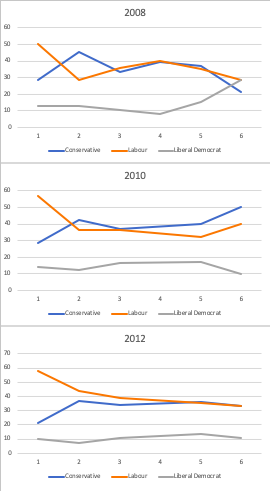
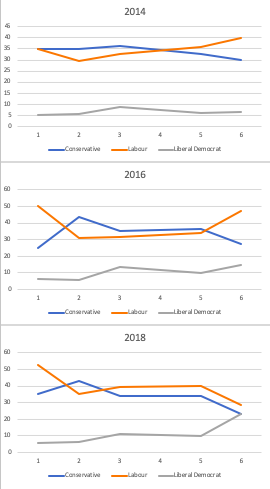
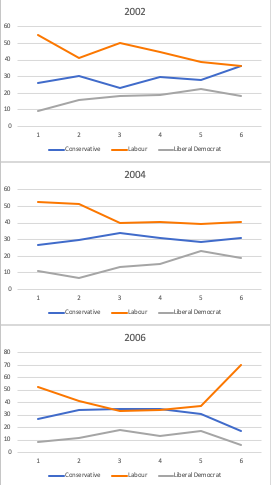
What about the UK? Much has been written about the demographics of voters in the recent British elections, but I also like a time-series from the European Social Survey that asks which party people feel “closest” to. This question is asked regularly in even years. It gives you a trend that’s less tied to candidates and specific campaigns.

Above, I show support for Labour, the Conservatives, and the Liberal Democrats for six educational strata, from less than secondary education to doctoral degrees or the equivalent. The education question changed in 2010, so I have done my best to keep the categories consistent.

In 2002, Labour’s support correlated negatively with education; the Tories did better with people with more education. The Liberals were far behind but drew best from people with university degrees (teachers and other “knowledge workers,” I would guess).

Fr0m 2004-2008, that pattern continued, with the very important change that the Liberals battled Labour for the support of the most educated, who oscillated between those two parties.

In 2012, the classic pattern recurred, with Labour receiving smoothly declining support with educational levels. In 2014 and 2016, Labour did much better with the best educated. In 2018, the most educated voters essentially shifted to the Liberals.

Based on what we know from constituencies’ demographics, it seems that since 2018, many working class English voters switched from Labour to the Tories or stayed home.

Brexit: a personal reflection

(Fremont, CA) I’m saddened by Brexit for personal reasons that I’ll relate below. But first I should offer three caveats.

First, Brexit is not about me. It will affect the residents of the UK and EU; my feelings don’t really matter.

Second, the “remain” side is not self-evidently right, either ethically or practically. There are democratic arguments in favor of withdrawing from the EU. “Leavers” are not simply bigoted or victimized by propaganda. Both of the biggest parties have been divided by the issue. The EU has served some Britons better than others.

And third, the UK election is about much more than Brexit. Austerity is the main policy that has won.

Having said all that, I’ve had a deep, lifelong commitment to European integration–and to a Europe that has Britain in it. My family spent almost half of my first 15 years in London. My primary school, Prior Weston, was situated immediately next to a weedy lot that was still empty because of the bombs of 1940. That was a powerful reminder of the cost of European division.

Britain had entered the European Economic Community by then, and my Christian-Socialist-oriented state primary school embraced the ideal of the EEC. We studied the culture of each EEC member country in turn. I recall the teachers making some prejudiced remarks. Germans ostensibly had no sense of humor, for example. (This is false.) But the overall message was one of interconnection and shared fate.

London was a global city, anyway–a great entrepot. We knew many, many immigrants. The largest share had come from former colonies in the Global South, but many were Europeans. What made London great was its cosmopolitanism, and that has been true since the medieval days of Lombard bankers and Flemish weavers.

When I was a young teenager, now attending a much more conservative independent secondary school, most of my English friends would have denied that they were European. The continent was a foreign place to them, and basically inferior, in their eyes. My English friends would have identified more with the global Anglophone sphere created by British imperialism, and especially with the white-majority countries of Canada, Australia, and New Zealand.

But I wasn’t British, or European–I was an American in London. And from my perspective, the UK clearly belonged to Europe. Although the little islands had been spared from invasion since 1066 because of a narrow strait, they had participated in all the cultural, economic, diplomatic, technological, sociological and even biophysical developments of the continent as a whole. Even then, I thought it was basically ignorant to distinguish between Britain and Europe.

Years later, sitting by a summer ice cream stand outside of Oslo and watching school children on a field trip, I felt palpably how much the whole scene resembled my childhood in London: the ice cream novelties, the buildings and the park’s layout, the way the kids interacted. If you travel from London to, say, Tuscany, you have changed your milieu. But from London to Oslo or Rotterdam is no distance, culturally.

To build one Europe has always seemed to me a humane and creative project (even though we should acknowledge the barriers around the EU’s perimeter and the often technocratic tendencies in Brussels). Britain–and specifically, England–belongs in the project. It has been more open, more sophisticated, and more humane because it’s been part of “Europe.” And it has shared its own worthy ideals with its European partners.

After today, the EU will go on, but it will be somewhat worse without Britain in it. It’s also hard to imagine the United Kingdom staying united for long. I find this very sad.

what does the word civic mean?

I use the word “civic” every day. It is in the title of my college (The Tisch College of Civic Life) and the major that I direct (Civic Studies) and in the names of many topics and fields that I work on, from civic education to civic media.

But what does it mean? In my own mind, “civic” has certain associations and resonances, although I rarely articulate them. During a recent conversation with colleagues, I realized that most don’t hear the same meanings I do. I don’t blame them; there is no agreement about the definition, and the word has been used in many ways. I’ll turn to its history below.

Today, some people hear in the word “civic” a disciplinary intention, an effort to draw a boundary around respectable and approved behaviors (the “civic” ones). Sometimes it is almost synonymous with “civil.” In turn, “civility” sometimes means almost the same as “politeness.” People may use “civic” to identify approved behaviors, or else they may oppose the word as too restrictive and controlling.

Others want to make the word strictly empirical, rather than a value-laden adjective. Then “civic” may refer to a list of activities, from voting to marching in a protest–regardless of the participants’ values and goals. For example, a march would be civic whether the marchers were members of the Southern Christian Leadership Conference or Mussolini’s Brown Shirts. (But if we take this approach, why are certain activities on the list, and others not?)

I’d like to make space for a more inspiring use of the word that has deep historical roots. My dictionary-style definition would go something like this:

Civ’-ic. adj. 1. Of or pertaining to a group of relatively equal self-governing people. Hence, 2. virtues, values, or skills for self-government, e.g., civic courage, civic knowledge. 3. Assets belonging to or created by self-governing people, e.g., a civic forum. 4. Activities or other phenomena related to self-government, e.g., civic engagement, civic dialogue, civic education.

By a “self-governing people,” I mean to include all the citizens of any republican country, but not only such groups. A town or city within a larger country can have self-governing power. So can a voluntary association or even some kinds of firms; and they may be self-governing even if the states in which they operate are authoritarian. Thus, institutions of various types and scales can be civic.

The history of a word helps explain how it has accrued its diverse definitions and resonances.

The English word “civic” derives from Latin civicus, which primarily refers to relations among fellow members of the same city. In turn, the classical city (the polis or urbs) was self-governing: not usually egalitarian, but quasi-autonomous and governed by a deliberative assembly. So civicus always had echoes of a deliberative forum.

“Civic” enters the Romance languages to translate Latin texts. According to the Oxford English Dictionary (OED), the very first use in English (1542) refers specifically to the ancient Roman oak-leaf-and-acorn garland awarded to men who had saved fellow citizens in war.

A kind of garland was its only meaning in English until the time of the Commonwealth, when Parliament overthrew the monarch and declared a republic. During this period, the Company of Mercers of the free city of London put on a pageant entitled “Charity Triumphant,” parading a female allegorical figure through the streets of the city. Edmund Gayton (“considered a hack writer” and then imprisoned for debt), published a long descriptive and celebratory poem about this pageant, including the sentence, “I cannot here set forth the reason of the late extinguishing these Civick Lights, and suppressing the Genius of our Metropolis, which for these Planetary Pageants and Pretorian Pomps was as famous and renouned in forraign Nations, as for their faith, wealth, and valour.”

Gayton probably deserves his obscurity, but he does seem to coined the word “Civick” in one of its important senses: “of, belonging to, or relating to a citizen or citizens; of or relating to citizenship or to the rights, duties, etc., of the citizen; befitting a citizen” (OED).

In his time, the English were enthusiastic about self-governance and the ideal of a commonwealth, itself a translation for “republic,” meaning the good that a people makes and owns together. Of course, this was also the period of Puritan self-governance in New England and the invention of important activities that we now naturally call “civic”: town meetings, local elections, and civic education, which Massachusetts had required in 1642.

Just one year later, in 1656, Blount’s dictionary defines “Civick” as “pertaining to the city.” Since then, one of its meanings has always been akin to “urban,” as in “Civic Center” for the name of a city’s convention hall. But I think that “the city” had a different original meaning. Now we think of large, dense municipalities. Originally, an urbs or polis was any autonomous community. For instance, the whole Massachusetts Bay Colony was meant to be a City on the Hill.

By 1747, “civic” was used to modify “virtue.” By the end of that century, the word “civique” (with similar associations) had become influential in France. According to the Constitution of 1791: “The Civic Oath (le serment civique) is: ‘I swear to be faithful to the Nation to the law and to the king and to preserve with all my power the Royal Constitution, decreed by the National Constituent Assembly for the Years 1789, 1790 and 1791.‘”

Across the Channel, Edmund Burke denounced the French revolutionaries who would overthrow traditional values and institutions, including religion. He added:

These enthusiasts do not scruple to avow their opinion, that a state can subsist without any religion better than with one; and that they are able to supply the place of any good which may be in it, by a project of their own—namely, by a sort of education they have imagined, founded in a knowledge of the physical wants of men; progressively carried to an enlightened self-interest, which, when well understood, they tell us will identify with an interest more enlarged and public. The scheme of this education has been long known. Of late they distinguish it (as they have got an entire new nomenclature of technical terms) by the name of a Civic Education.

Burke, Reflections on the Revolution in France

According to the OED, this was first use of the word “civic education” in English. It referred to a radically republican, secular, and patriotic project to which the author, Burke, was hostile. To bring civic education to England would be “the most dangerous shock that the state ever received.”

Thus the first English use of the phrase “civic education” was a denunciation. Yet the ideals that animated the French Revolution–self-governance, commitment to the common good–have deep resonances in England and the USA.

By the way, the word “civics” is a noun, in my opinion: short for “civic education.” It is often used adjectively in the phrase “civics education,” but I think that’s a grammatical mistake. In any case, “civics” is strictly American, and its first attested use is in the Boston Daily Advertiser in 1885: “Henry Randall Waite, Ph.D., president of the American Institute of Civics, was the next speaker… The use of the word civics for political science was explained.”

In short, “civic” has many meanings, but some of the oldest and most recurrent ones refer to a republican ideal: concrete communities of people should decide and act together and develop the rules, values, resources, and habits necessary to succeed.

participatory action research in the City of God

Equipe Construindo Juntos (The Building Together Research Center) is based in Rio de Janeiro’s City of God neighborhood, made world-famous by the 2002 film. One of the key team members is my Tufts colleague Anjuli Fahlberg, a sociologist. She works as a close colleague with Ricardo Fernandes, Mirian Andrade, Jacob Portela, and about 20 Research Assistants, all from the neighborhood.

Among their projects is an elaborate survey of residents from 989 City of God households. Characteristically, the study began with open-ended discussion groups that chose the questions. The data was collected by fifteen trained and paid residents. To summarize the findings for neighbors, the research team produced “3,000 colorful pamphlets,” made presentations at local nonprofits, and earned press coverage in the major Rio newspapers.

This is an exemplary case of Participatory Action Research. Tisch College is proud to support it.

See also Participatory Action Research as Civic Studies; and nonviolent civic work under conditions of extreme violence (also on Anjuli Fahlberg’s research).

give to grassroots organizing for civic participation

(Philadelphia) On Giving Tuesday, I am reluctant to name specific organizations to contribute to, other than my own employer (Tisch College) and the grant-seeking organizations on whose fiduciary boards I sit: Street Law, Discovering Justice, Everyday Democracy, and the Civic Series. But I do want to make a general argument that might influence your choices. As I showed in this post, “A total of $23 million–.0.43% of all democracy funding and a little less than one cent per American per year–has been spent on [nonpartisan] grassroots organizing for civic participation.” This kind of work should be a priority, especially for the small donors who form the grassroots base of democracy.

how have political science and k-12 civics diverged?

It’s risky to generalize about k-12 civics. In the USA, there are no national standards for civics, state standards tend to be incoherent and not firmly enforced, and textbooks divide the market. Some teachers in some classrooms present highly critical accounts of US politics. Others are committed to American exceptionalism and celebratory narratives. The whole woke-to-MAGA spectrum is represented.

Many k-12 teachers try to avoid adopting positions in the classroom by presenting only hard facts about the constitutional process or by organizing deliberative discussions in which many perspectives are honored. Yet even an ostensibly neutral approach must reflect choices about the most important questions, topics and themes.

It is also risky to generalize about the discipline of political science, which encompasses more heterogeneous subfields than most disciplines. Whole subcultures of political scientists strike me as pro-regime, while others are radical. (See this post for some observations about the balkanized profession.)

But I’d still tentatively hypothesize that the center of gravity in political science stands apart from the center of gravity for k-12 civics, especially if we look at mass-market textbooks and state standards documents for evidence about civics. And I’d suggest that these are the three main gaps:

  1. Political science has haltingly recognized a wider range of perspectives on American political history and institutions, giving more attention to women and people of color as political thinkers and critics. That has meant more attention to critiques of the US system, but also alternative ideals and visions of progress. Again, this generalization ignores woke high school teachers and conservative or traditionalist political science professors, but I’d still venture the generalization.
  2. Political science has widely embraced versions of the New Institutionalism. I have written a primer on that movement, but in essence, it finds that institutions rarely operate as intended because they have their own logics and incentives. This means that it is unlikely that the US government would work as its authors planned. James Madison was an early and brilliant institutionalist who designed constitutional provisions to prevent certain kinds of corruption and failure. But the New Institutionalism has vastly expanded the list of threats, and few political scientists would argue that the US Constitution’s design addresses all these threats in a satisfactory way. Much of the high school curriculum is designed to teach students why the framers designed our system to work as it does. Many political scientists would emphasize that it does not, and could not, work as intended but rather faces serious perils. By the way, here I am not referring to intended “features” of the original Constitution, such as white-male dominance. I am referring to unforeseen “bugs.”
  3. Political science has experienced the behavioral revolution. Human beings evolved to make decisions without full consideration of relevant facts and information, employing heuristics and biases and rationalizing our biases with cherry-picked reasons. It’s common in civics curricula to present a model of the citizen as an independent thinker who decides on the best policy and chooses the candidates who come closest to those views. At least according to political scientists like Achen & Bartels (Democracy for Realists, 2016), this model is a myth. Citizens inevitably join up with large groups and vote to demonstrate loyalty to their groups.

The solution to this gap is not to move k-12 civics all the way to the center of gravity of professional political science. For my taste, the professional discipline is too cynical, not sufficiently normative or interested in problem-solving. Exposing students to cutting-edge political science is unlikely to make them more active and efficacious citizens. A big dose of New Institutionalism plus Behaviorism could kill anyone’s interest in politics unless the insights of those movements can be combined with some creativity and optimism.

At the same time, to ignore the findings of modern political science is increasingly untenable. We need new combinations.

See also: don’t let the behavioral revolution make you fatalistic; the New Institutionalism, deliberative democracy, and the rise of the New Right; on teaching the US Constitution; is our constitutional order doomed?; we should be debating the big social and political paradigms; and constitutional piety.