beauty worn of promise

Consider these points, made in the last 48 hours by scholars of color:

In the last weeks, there have been unprecedentedly large protests against police violence and systemic racism. The grievances are familiar. … But this time seems different. The costs of protesting are higher, and grievances are more intense, as I’ll explain below. Partly as a result, policymakers appear to be doing more to address protesters’ concerns. …

I find that legislators are 44 percent more likely to vote in favor of black protesters’ demands than white protesters’ demands. They are 39 percent more likely to vote in support of Latino protesters’ demands than white protesters’ demands. Legislators are 32 percent more likely to vote in favor of low-income protesters than more affluent protesters. And they are 10 percent more likely to vote in support of in-person protests, like marches or rallies, versus online protests, like online petitions or social media posts.

[She explains that protest by disadvantaged people is more costly, and costly protests have more political impact.] Legislators’ greater support of costly protest exists even when evaluating protests of equal size, disruptiveness and media attention. …

To be sure, the costliness of the protests is not the only factor in these rapid actions. Black Lives Matter has been shifting public opinion for several years now, and the Floyd protests have dramatically increased that shift, so that a majority of Americans now say they support the protesters’ claims. But given the dangers — the costs — of protesting during a pandemic, massive unemployment, widely circulated stories of brutality, and an election year, officials realize that the grievances are intense — and that black people and their allies are likely to punish officials at the polls if they don’t take action now.

LaGina Gause, “Black people have protested police killings for years. Here’s why officials are finally responding“

The change is coming “at a speed that I don’t think we’ve seen before in American politics,” said Dorian Warren, president of Community Change, a nonprofit that works with grassroots groups in low-income communities around the county. …

“You can’t argue with the facts that you’re seeing, or wish them away, or make up an alternative story, because it’s 8 minutes, 46 seconds.”

Moreover, the Floyd video came on the heels of years of organizing by Black Lives Matter activists, as well as movements like the Women’s March and, further back, Occupy Wall Street, Warren said. It also came after the killings of Ahmaud Arbery and Breonna Taylor, young black Americans whose deaths also sparked outrage. Activists have been drawing attention to issues of police violence and race, gender, and class inequality for years, and those issues have only grown more urgent in recent months.

“One way to think about this metaphorically is like an earthquake,” he explained. Organizing by Black Lives Matter and other groups moves slowly, like tectonic plates: “and then all of a sudden they collide.”

Warren is quoted by Anna North in “White Americans are finally talking about racism. Will it translate into action?“

The massive, multiracial coalitions that have taken to the streets to raise their voices against police brutality are replenishing springs of solidarity, nourishing the roots of a future social compact that we must now all get on with the business of making. We will do that most effectively with a common purpose in mind.

A common purpose is not some airy-fairy thing. It is a practical tool that allows people to achieve something together. It is a map marked with a destination, a guide that permits collaborative navigation. A common purpose is perhaps the most powerful tool in the democratic tool kit, particularly in a crisis, because it can yield the solidarity that induces people to do hard things voluntarily rather than through authoritarian compulsion. Yet the tool has been disintegrating from disuse.

Our common purpose is liberty and justice for all. We have rediscovered it. It’s time to build on that discovery.

Danielle Allen, “We seek reforms to policing. But something even deeper needs repair“

Anger, shame, and fear are appropriate emotions right now, but the emotional palette should be richer than that. And it is richer for many scholars of color (and others) who were already deeply aware of injustice, but for whom the news is the power of the popular response.

History unfolds gradually, painfully, without evident purpose–until suddenly people break it open, allowing a better future to appear like a flash of light. Many such ruptures close again, but some do not. Pessimism (a habit ingrained by ordinary history) blocks the light. An inward turn, even if it is meant to be self-critical, can turn you away from solidarity. To take advantage of an opening, you must be receptive to hope, boldness, and even joy in the opportunity for solidarity and collective purpose.

See also: the kind of sacrifice required in nonviolence; taking satisfaction from politics in the face of injustice; notes on Hannah Arendt’s On Revolution; the prophetic mode in the Civil Rights Movement and in everyday politics; on the phrase: Abolish the police!; Martin Luther King as a philosopher.
on the phrase: Abolish the police!

Abolish the police! opens vistas of a radically different world. Such prophetic visions are important in the midst of social movements.

Abolish the police! sends a message of conviction and solidarity and indicates a rejection of compromise. Such rhetorical moves can help keep a movement coherent.

Abolish the police! prompts a discussion of possible alternatives, including public safety by unarmed citizen groups. Even if the actual recipe includes policing, these alternatives are valuable to consider.

Abolish the police! is a strong opening position in a negotiation with a police union. It basically says: “We would rather do without you than settle for the status quo, so how far are you willing to move?”

Abolish the police! means changing the responsibilities of the police and moving funds from one governmental department to another–a classic example of policy reform. Note that policing uses a total of about 6% of local budgets, so shifting half of their money from police to other purposes would mean changing 3% of a city’s budget. Christy E. Lopez writes that this “is not as scary (or even as radical) as it sounds,” but it does mean literally abolishing that “aspect” of policing that involves “the unjustified white control over the bodies and lives of black people.”

Abolish the police! will be understood as: “No more police at all” (not even in your bourgeois neighborhood where the police are generally helpful). It will thus be used in advocacy against police reform, whether successfully or not.

Abolish the police! serves as a label for radical ideas, giving moderate politicians cover for incremental change. “I’m not for abolishing the police–some of my best friends are police officers–but we should definitely assign mental health crises and traffic patrol to a civilian agency.”

During mass movements and tumultuous moments in history, phrases suddenly spread from smaller groups to the society at large and are used in many contradictory ways, promoted by both their supporters and their opponents: “No taxation without representation!” “All power to the Soviets!” “Hell, no, we won’t go!”

There is no point in thinking, “This slogan will be misunderstood and will cause a backlash.” The messaging is not really under anyone’s control. I think the most important move is to try to create spaces within a movement for relatively wide-ranging conversations. In this case, those who literally want to abolish the police should continually exchange ideas with those who want to reform the police. This discussion need not include people who deny white supremacy; it need not represent the whole population demographically. But it should bring together different streams of thought to generate the best ideas as circumstances evolve.

(By the way, although my information is entirely anecdotal, I do think such conversations are happening right now.)

See also: the value of diversity and discussion within social movements; insights on police reform from Elinor Ostrom and social choice theory; practical lessons from classic cases of civil disobedience; Habermas with a Whiff of Tear Gas: Nonviolent Campaigns and Deliberation in an Era of Authoritarianism; Why Civil Resistance Works; and notes on Hannah Arendt’s On Revolution.

things to read about the protests against white supremacy

But as an historian of black social movements, my view is that as widespread and destructive as the 1968 rebellions were, neither their size nor the challenge they posed to the American political system approached what the U.S. has seen over the past two weeks. …

More than the number and size of the protests, though, what makes the 2020 uprisings unprecedented are the ways that they have pulled together multiple currents within the U.S. protest tradition into a mighty river of demand for fundamental change in American society. …

The point is not, as others have argued,* that it is the level of involvement of whites in the protests that distinguishes them from previous high points of anti-racist protest. There is in fact a long history of white support for, and participation in, black protest movements. …

[What is distinctive is the reform agenda.] Despite, or perhaps because of the protests’ decentralized and leaderless nature, they have managed to put on the table the broadest and most comprehensive set of social and economic reforms since the Poor People’s campaign that followed on the heels of Martin Luther King’s assassination in 1968.

Matthew Countryman, “2020 uprisings, unprecedented in scope, join a long river of struggle in America“

I want to emphasize that I think white Americans have gone through quite radical changes in their attitudes, and that we’re talking about a more likely 25 percent of Americans who are hardcore racist, but I think most Americans have quite decent views about race.

But sociologists have argued that while some whites may have liberal views, a lot of them are not prepared to make the concessions that are important for the improvement of black lives. For example, one of the reasons why people have been crowded in ghettos is the fact that housing is so expensive in the suburbs, and one reason for that is that bylaws restrict the building of multi-occupancy housing. These bylaws have been very effective in keeping out moderate-income housing from the suburbs, and that has kept out working people, among whom blacks are disproportionate, from moving there and having access to good schools. Sociologists have claimed that while we do have genuine improvement in racial attitudes, what we don’t have is the willingness for white liberals to put their money where their mouth is.

Orlando Patterson, “Why America can’t escape its racist roots” [Not a good headline, because his piece is quite optimistic]

The situation is dire. The causes for personal anger many. In my own case, incandescent rage has blocked my capacity to think for several days. For me, prayer helps.

There is something we can do.

First, choose peace. Revolution never succeeds unless it rides on the back of a deeper commitment to the process of constitution. The goal has to be to build. These things can be done only on the basis of a commitment to peace. We need a better normal at the end of this. Not a new normal, a rinse and repeat of the old but with face masks. We need peace. …

Second, choose self-government. Societies can resolve their problems through only one of two mechanisms: authoritarian decision or self-government. Self-government delivers the sturdier foundation for human flourishing — a foundation that permits people to craft their own life courses and develop their full potential. To choose self-government, however, means to choose the institutions of collective decision-making. Voting, running for office, working through committee processes to identify and implement policy solutions. …

Third, channel the energies of protest directly into governance even through our imperfect institutions. We need a transformed criminal-justice system. Yes, it is good that the officer who knelt on George Floyd’s neck has been criminally charged. But the problems we face are not solved one case of police violence at a time. We need a systems-level goal.

Here is what we should choose: reduce our reliance on incarceration from 70 percent of the sanctions imposed in our criminal-justice system to 10 percent. This is not utopian. …

No justice, no peace, we often say. It’s also true, though, that without peace, there is no justice.

Danielle Allen, “The situation is dire. We need a better normal at the end of this — and peace”

*including me, on Saturday evening, during a 5-minute interview on KCBS-San Francisco.

See also: Everyday Democracy: racism, policing, and community change; insights on police reform from Elinor Ostrom and social choice theory.

learning from Memphis, 1968

This clip from Eyes on the Prize* shows the first and only moment in the career of Dr. Martin Luther King, Jr. when a march that he led involved violence. He had to be ushered away in a car and left Memphis. When he returned, he gave perhaps his greatest speech, “I’ve Been to the Mountaintop” (April 3, 1968) in which he prophesied his own death.

In this, his final speech, he describes the historical moment: “The nation is sick, trouble is in the land, confusion all around. That’s a strange statement. But I know, somehow, that only when it is dark enough can you see the stars.”

He decries media coverage of the movement:

Let us keep the issues where they are. (Right) The issue is injustice. The issue is the refusal of Memphis to be fair and honest in its dealings with its public servants, who happen to be sanitation workers. [Applause] Now we’ve got to keep attention on that. (That’s right) That’s always the problem with a little violence. You know what happened the other day, and the press dealt only with the window breaking. (That’s right) I read the articles. They very seldom got around to mentioning the fact that 1,300 sanitation workers are on strike, and that Memphis is not being fair to them, and that Mayor Loeb is in dire need of a doctor. They didn’t get around to that. (Yeah) [Applause]. Now we’re going to march again, and we’ve got to march again

He lays out a strategy that includes boycotting white-owned companies and “strengthen[ing] black institutions.” He says, “I call upon you to take your money out of the banks downtown and deposit your money in Tri-State Bank.”

And he makes the case that a massive nonviolent protest movement–in which the sheer number of nonviolent protesters overwhelms both the police and any citizens who use violence–is powerful. It is not (I would say) powerful in the sense of being moving and rhetorically effective, like a “powerful” song or speech. It is powerful in the sense that it seizes the ability to determine outcomes. The Birmingham movement compelled the Civil Rights Act; Selma compelled the Voting Rights Act. “And there was a power there which Bull Connor couldn’t adjust to, and so we ended up transforming Bull into a steer, and we won our struggle in Birmingham.”

King gave this speech in the evening of April 3, despite a thunderstorm and his own deep qualms about speaking in Memphis. The next day, he was murdered. Riots, uprisings, insurrections (or whatever you want to label them) began across the country. And on Nov. 5., 1968, Richard M. Nixon won a national election that has been attributed to white backlash.

A few observations:

– The backlash was in no way the responsibility of the Civil Rights Movement. The causes included King’s assassination, the police and the FBI, media frames, and a racially biased majority. In Memphis and elsewhere, the Civil Rights Movement was doing what it had to do. To take a phrase from the “Letter from Birmingham Jail,” blaming the protesters for the backlash would be “like condemning a robbed man because his possession of money precipitated the evil act of robbery.” As King wrote in The Atlantic in 1967, “Let us say it boldly that if the total slum violations of law by the white man over the years were calculated and were compared with the lawbreaking of a few days of riots, the hardened criminal would be the white man.” We must “keep the issues where they are”: on the injustice, not responses to it. On the other hand, 1968 was a year of defeat, and it’s important to strategize about how to win instead of losing.

– Mass nonviolent movements are miraculous. They defy predictions about human behavior based on self-interest, limited information, and powerful emotions. They are also fragile–easy to disrupt with agents provocateurs, misinformation, and violent responses. King fully grasped that a mass nonviolent uprising is a kind of rupture in ordinary history. It is a moment when a better future suddenly becomes visible in the present. That is why delaying it can easily kill it. In the “Letter,” he writes that time can be made “an ally of the forces of social stagnation.” Therefore, “We must use time creatively, in the knowledge that the time is always ripe to do right. Now is the time to make real the promise of democracy and transform our pending national elegy into a creative psalm of brotherhood.”

– 2020 seems similar to 1968, yet different in important ways. Nixon was a far more skillful than Trump at exploiting backlash. He made the maintenance of racial hierarchy appear respectable by acting like a sober statesman. Trump is the face of white supremacy but happens to be grievously wounded by the pandemic, which would have been a threat to him even if he hadn’t grotesquely bungled it. (Sheer chance often determines outcomes in human events.) The country has also become more diverse: whites constituted 88% of the US population in 1970 versus 72% in 2020. On the other hand, the virus does make it harder to sustain nonviolent protests that are big enough to marginalize the police and violent individuals. People who would be relatively likely to maintain nonviolent discipline are also relatively likely to stay home to avoid the pandemic. Finally, the media landscape is far more fragmented, so that some Americans can see police rioting against innocent protesters while others see a nation devolving into crime. It is hard even to assess who is seeing what, let alone change the balance.

*Shearer, J. Stekler, P. (Director). (1990). The Promised Land [Video file]. PBS. Retrieved June 3, 2020, from Kanopy.

the shrinking field of vocational education

Before you look at the graph …

What subjects do you think have become more or less prevalent in US high schools since the late 1980s?

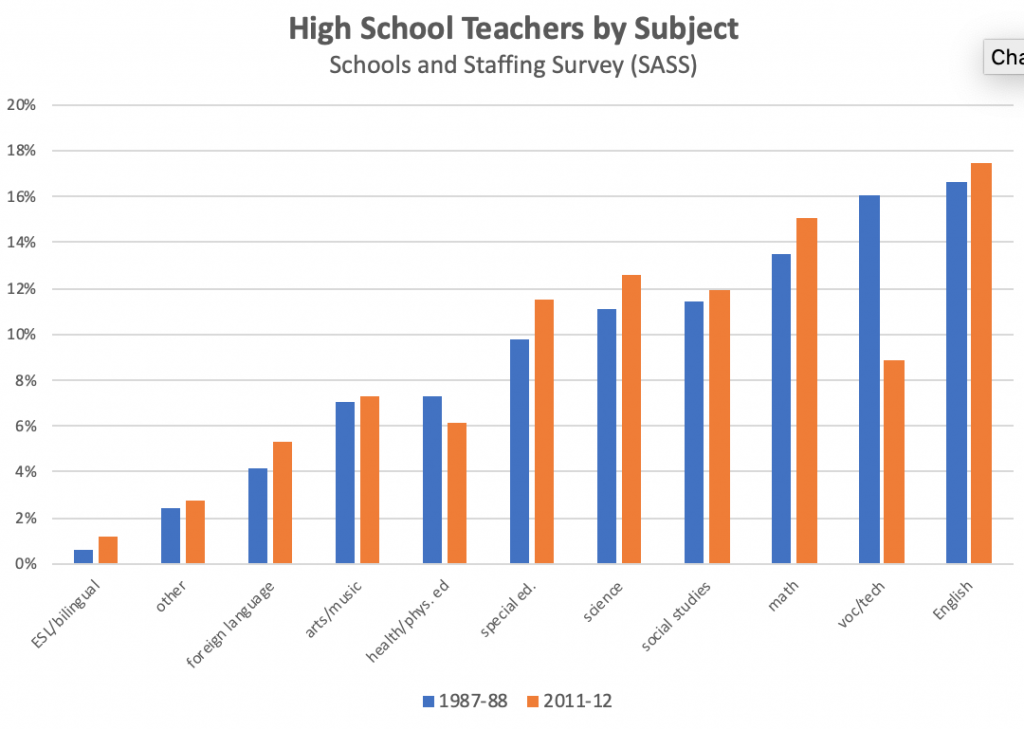
If we measure the percentage of all high school teachers who are assigned to each major subject, this is the pattern:

Almost all the subjects were similar in 1988 and 2012, except that vocational education dropped a lot and health/physical education shrank by a bit. The other subjects all gained about the same amounts at the expense of those two.

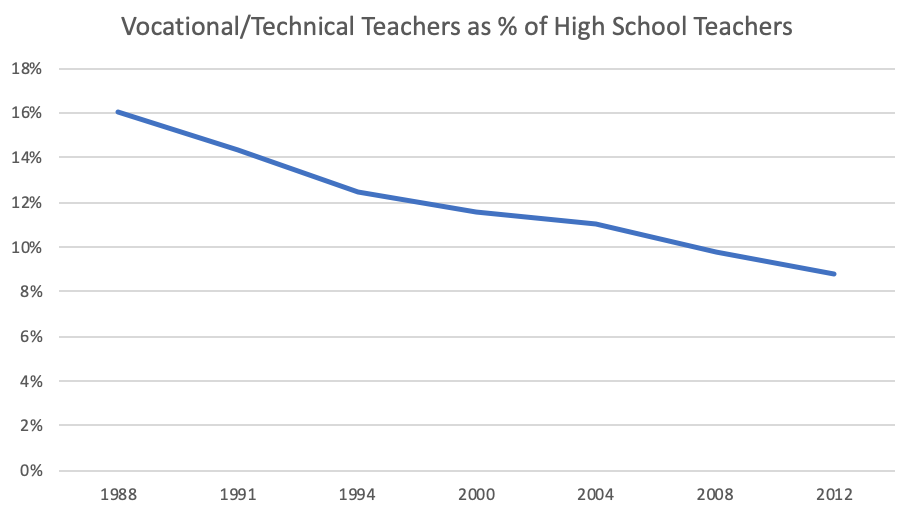
It isn’t worth showing the trends for most of those subjects by year, because the lines would be pretty flat. But here is the proportion of vo-tech teachers for all the years in the survey.

Posted without a comment, except to say that this may surprise people who think that some of the arts and sciences have expanded at the expense of others.

My analysis of U.S. Department of Education, National Center for Education Statistics, Schools and Staffing Survey (SASS), “Public School Teacher Data File,” 1987-88 through 2011-12; “Private School Teacher Data File,” 1987-88 through 2011-12; and “Charter School Teacher Data File,” 1999-2000.

a civic silver lining?

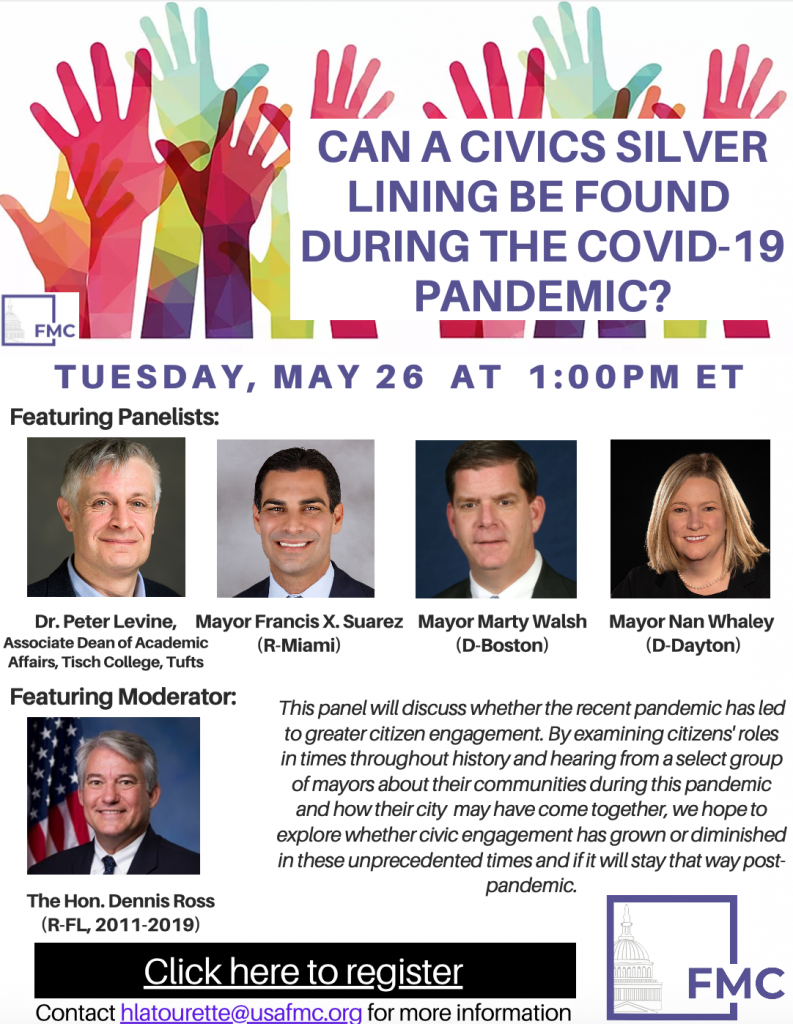
Thanks to the Former Members of Congress Association, I joined Former Member Dennis Ross (R-FL) and mayors Nan Whaley (D-Dayton), Francis Suarez (R-Miami) and Marty Walsh (D-Boston), for a discussion of civic engagement during the pandemic.

I particularly appreciated Mayor Walsh’s eloquence about respecting poorly-paid work. His point expanded into a broader discussion of how to get everyone involved in the “public work” of rebuilding our community and country. On that topic, see “War Is a Poor Metaphor for This Pandemic” by Harry Boyte and Trygve Throntveit in Yes!.

I learned a lot from the mayors. I ended up thinking that the attitudinal effects of the pandemic may well be positive. We may care more about each other and feel more motivated to work together on public goals. The fact that the crisis is widely (although inequitably) shared will provide an opportunity to bring Americans together. However, the economic impact on civic life is very worrying.

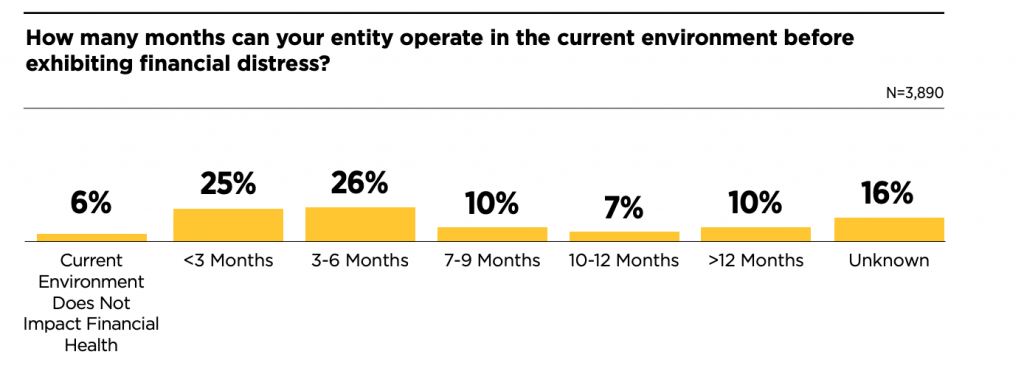
To that last point, the Federal Reserve system recently surveyed a mix of local organizational leaders (two thirds of them from nonprofits) about the impact of the pandemic. “Nearly 2 out of 3 respondents (66%) indicated demand for their services has increased or is anticipated to increase, and more than half of the respondents (55%) noted a corresponding decrease or anticipated decrease in their ability to provide services.”

This chart from the Fed. paper is particularly significant:

See also: the Coronavirus information commons; a Green recovery; “Educational Equity During a Pandemic“; trends to watch in civil society; why the relatively good US numbers for COVID-19 mortality?; effects on civil society will be mediated by the economy; and COVID-19 is not a metaphor.

the Coronavirus information commons

In Wired, Natalie Chyi offers an excellent list of ways that people are fighting misinformation–and promoting reliable and useful information–during the pandemic:

Neighborhoods are creating Slack groups and communities are coming up with mutual aid spreadsheets to coordinate aid and support each other. … Local geographies have been reconstructed in online spaces, most notably as students are rebuilding their universities within Minecraft. … . Volunteers on Wikipedia have been working tirelessly to ensure that the site serves reliable and up-to-date information, especially surrounding the virus. Students are compiling master lists of summer internship updates, cancellations, and opportunities across various industries. Groups are creating crowdsourced libraries of resources tailored to the unique needs of everyone from mourners to remote workers to policymakers. New online platforms have been created for specialists like doctors, engineers, and scientists to find and contribute their expertise to ongoing relief projects. Thousands of Covid-19 related open-source projects are popping up, with the source code and documentation freely available to enable their use. Some focus on software, like code for a hospital impact model developed by the University of Pennsylvania; others on hardware, like instructions for 3D printing medically-approved masks and other critical supplies.

Finally, knowledge previously locked behind paywalls or intellectual property protections has been made available to the public for the purposes of fighting the pandemic.

Chyi credits Elinor Ostrom and Charlotte Hess for the idea of an information commons (itself an application of Lin Ostrom’s ideas to the special case of information), and she cites me to the effect that “this form of collective action and participation of place-based knowledge strengthens communities by giving them a shared sense of identity, understanding, and trust.” Incidentally, the whole book by Ostrom and Hess, Understanding Knowledge as a Commons (2007) in which my chapter appears is–fittingly–online and free.

See also my new chapter on Elinor Ostrom and Civic Studies; the legacy of Elinor Ostrom and the Bloomington School; Elinor Ostrom, 1933-2012; understanding knowledge as a commons.

Navigating the Pandemic webinar series

Tisch College of Civic Life is launching an eight-part weekly webinar series this summer aimed at supporting students, including the Class of 2020—and the Tufts community generally—during the COVID-19 pandemic.

Navigating the Pandemic: Knowledge, Resilience, Civic Purpose and Engagement will be offered on Wednesdays, 11 a.m. to 12:30 p.m. ET, starting June 10. It draws on the expertise of Tisch College faculty and staff, Tufts faculty in a variety of academic disciplines, and experts from Boston-area universities, hospitals, and community nonprofit organizations.

“We have developed this webinar series to help mitigate the sense of isolation and unsettledness many students are experiencing,” said Deborah Donahue-Keegan, Tisch College senior fellow and Department of Education faculty member. She is leading the effort with Tisch associate dean Peter Levine.

“We are offering a way for students to stay connected to the university community and to each other over the summer,” she said. “We also want to help students acquire more knowledge and skills in order to navigate conflicting information and misinformation regarding COVID-19.”

“The pandemic is confusing and unpredictable,” said Levine. “For some, it can be isolating, damaging, and even tragic. As a major research university, Tufts offers a wealth of resources to learn about the disease and its social impact and how to take care of ourselves, help others, and be civically engaged during the pandemic.”

Webinar topics will include:

  • emotional resilience in the face of trauma and uncertainty
  • civic engagement and voting
  • dispelling COVID-19 misinformation with science
  • the public policy and economic implications of the pandemic
  • physical health and nutrition
  • building and maintaining connections

The weekly seminars for undergraduate and graduate students are free. Those who attend at least six of the sessions and submit responses to questions at the end of each session attended will qualify for a certificate of completion. The panel discussions will be broadcast via Tisch College’s YouTube channel and will be recorded to ensure access for the entire Tufts community.

“This effort reflects Tufts’ commitment to promote social emotional resilience and well-being skills across the university,” said Donahue-Keegan. “This webinar series is one of many ways we strive to foster the development of such skills in service of fostering civic purpose, agency, and ethical civic engagement.”

For more information and to sign up, go to https://tischcollege.tufts.edu/navigating-pandemic-knowledge-resilience-civic-purpose-and-engagement.

the pivotal significance of reparations for the American left

About one in four Americans supports reparations for slavery. There is a racial split on that question, with up to three in four African Americans–but only 15% of whites–in favor.

If you think that justice demands reparations, you should support them. You might not make reparations your main criterion for choosing candidates in a given political contest, because you might vote on other grounds, but you should endorse proposals that you believe are just.

Here I want to address a different issue. I’ll offer an explanation (not a justification or a critique) of the importance of reparations in the mentality of left-leaning Americans.

I think that many Americans on the left are torn between two political positions, each coherent on its own but in tension with the other:

1. A strong version of New Deal/Great Society liberalism and/or social democracy, in which the nation-state intervenes assertively in the economy to promote equity and environmental sustainability. This stance is compatible with enthusiastic support for voting and democratic processes. It requires a lot of trust in the state and a willingness to entrust state actors with the ability to, for example, investigate how much wealth (not just annual income) you have, which schools your kids will attend, and which health treatments will be paid for, given data about your body.

Martin Luther King, Jr., provides a classic statement of this view when he recalls the launch of the Great Society: “A few years ago there was a shining moment in that struggle. It seemed as if there was a real promise of hope for the poor — both black and white — through the poverty program. There were experiments, hopes, new beginnings.”

2. A deep suspicion of the United States government as white-supremacist, patriarchal, and colonialist: as a continuous entity that has played a leading role in genocide, enslavement, and apartheid, in part because those policies have sometimes been popular among the white majority of the country.

It’s debatable what positive program follows from the second position, but in practice, it can mean support for local initiatives, nonprofits, women- and minority-owned businesses, and autonomy at the neighborhood level. Malcolm X provides a classic text for this view:

The white man, the white man is too intelligent to let someone else come and gain control of the economy of his community. But you will let anybody come in and control the economy of your community, control the housing, control the education, control the jobs, control the businesses, under the pretext that you want to integrate. 

… we haven’t had sense enough to set up stores and control the businesses of our community. … But the political and economic philosophy of black nationalism…the economic philosophy of black nationalism shows our people the importance of setting up these little stores, and developing them and expanding them into larger operations. Woolworth didn’t start out big like they are today; they started out with a dime store, and expanded, and expanded, and expanded until today they are all over the country and all over the world and they getting some of everybody’s money. …

So our people not only have to be reeducated to the importance of supporting black business, but the black man himself has to be made aware of the importance of going into business. And once you and I go into business, we own and operate at least the businesses in our community. 

Note that this position is compatible with certain forms of libertarian thought but not with social democracy.

It is not embarrassing to be drawn to two incompatible views. The social world is complicated, and there are good reasons in favor of many positions. However, when you feel the pull of two incompatible ideas, a deciding factor becomes very important.

Reparations play that role for the American left. If the United States government were to pay reparations, that would tilt many left-leaning people from the second position to the first: from Malcolm to Martin, if those labels are helpful. The impact would be especially strong if Congress and the president decided to pay reparations of their own volition–not by grudgingly negotiating with a social movement–and if the payment were substantial.

The underlying theory here is similar to Homer-Dixon et al (2020). An ideology is a complex system that consists of numerous ideas with logical links among them. It cannot be described adequately by placing it on one left/right spectrum, nor even several such continua at once. It is not a point in logical space but a structure of ideas.

In complex systems, we frequently see multiple equilibria, and specific nodes have surprisingly large impact because of their location. A single node can tilt the system from one equilibrium to another.

My conjecture is that reparations plays such a role in the system of the ideology of the American left. Left-leaning people may not rate it as the most important issue. They may not even endorse it whole-heartedly. But it (perhaps uniquely) can tilt them from a libertarian equilibrium to a social-democratic equilibrium.

This is an empirical conjecture for which I do not have data. To test it, we would have to explore the epistemic network of left-leaning Americans, either by analyzing large bodies of text or by surveying individuals about their ideas and perceived connections among their ideas.

See also: on Hillary Clinton and Julius Jones of #blacklivesmatter; ideologies and complex systems; and unveiling a systems map for k-12 civic education (for a methodological analog).