
a simulation to teach civic theory and practice

My book entitled What Should We Do? A Theory of Civic Life will be released in April 2022. It summarizes the concepts and ideas that I believe are most useful for people who want to improve their communities and the world. It is based on many years of teaching undergraduates and advanced graduate students and seasoned practitioners, while studying and promoting civic education in K-12 schools.

Obviously, my list of concepts and how I think about them are completely debatable. But what if we wanted to teach many people some set of such concepts without explaining them all (as in a book or a series of lectures)? Could we teach these ideas experientially, so that students consulted manageable bites of theory as they worked together on civic problems? And could we make the learning scalable, so that students could experience it in many schools, colleges, and community settings?

I am thinking about an online simulation along these lines. …

The setting would be a fictional community–maybe a smallish US city with a declining industrial base and a diverse population. (Other versions could be built with different settings). Players could consult summary statistics about this community at any time, such as its unemployment rate, the ratio of arrests by race, or the number of people using its main park. Those statistics would be affected by the players’ choices and behavior–as well as by random factors beyond their control.

Each player would simulate a fictional character who would have personal characteristics, values, and goals; various roles (e.g., a parent of a child in the public schools; the mayor of the city); some money; and the ability to make menu-driven choices at any moment. These choices would sometimes be affected by other players’ actions. Examples might be expanding or contracting one’s own business, voting for various candidates in a mayoral election, or attending a protest, among others.

There would also be organizations: governmental agencies (such as the school board), private associations, and media platforms.* Players would have roles in these organizations, such as a member, a leader, or a subscriber. They would be able to start new associations and media platforms. Governmental agencies would be able to create new agencies under certain circumstances.

Each organization would be able to make choices, such as how to allocate its resources and govern its assets. It would have rules for making these choices, for determining who belongs and holds various roles, and for changing its own rules. For instance, the members of the school board might be elected, they might make decisions regarding the schools by majority vote, but only the city government could change these rules. Meanwhile, a private association might be structured so that anyone could join and might simply be a space for conversation, with hardly any rules.

Players would not be able to communicate with each other at will. True, in a real city, it might be possible for anyone to get any official’s email address and contact that person. But a senior official is unlikely to give a random person much attention–if any. To simulate the friction and inequality of communication in the real world, players would only be able to contact others through organizations, and each organization would have rules for interaction. For instance, members of the school board would be able to message each other freely. When they were together in a group chat, their messages would be open for anyone to read (simulating a public meeting). They could message all parents on a one-way basis. And they could maintain a message board where parents could post comments for them to read. A protest group or a newspaper would have different rules for communication. This means that if you wanted to influence the mayor, you might have to join an association in which the mayor is active, or persuade the newspaper to cover your issue and hope that the mayor reads messages from the newspaper.

The game would start with characters already holding memberships in organizations, and organizations already having rules. Characters might even have drafts of messages ready to send that would start the business of the community. (For instance, the editor of the newspaper would have almost everyone as a subscriber and would have a draft message ready to send to solicit news tips.) Once the game got underway, characters would begin to change their status in many ways and communicate with each other. As a result of all their choices, the community’s statistics would gradually shift.

Finally, each player would have a student page for work outside the game, such as short written assignments that could be graded. Here the student would also see links to accessible summaries of concepts relevant to current events in the game. For instance, if your character is dealing with a good (such as green space or public safety), you would see a link to a wiki-like entry on types of goods, drawn from Elinor Ostrom, that could inform your behavior and give you material to write about. If your character faces a conflict, you would see a short reading on negotiation. If your character is involved in a protest, you would see an entry on social movements.

I can also imagine a hybrid version, with face-to-face meetings of characters plus “meta-discussion” of issues that arise in the game occurring during class time.

*The organizations would not include for-profit firms or markets. My instinct is that fully simulating an economy would make the game too complex, even though the economy is certainly relevant. The focus would be civil society and the state, with the market somewhat to the side. However, individuals and organizations would have economic choices to make, and some characters would have disproportionate economic influence as business owners or investors. Getting them to make helpful individual choices would often be an important strategy for shifting the community’s outcomes.
three big questions relating to knowledge

I know that the sky is dark and wet today because of input from my senses to my brain. But I know that the earth moves around the sun and that the earth is warming because people have taught me. My sources didn’t use their own senses to learn these things by themselves; they, too, were taught by people–usually mediated via texts or images. This communication often takes places in organized venues like classrooms, books, and newspaper articles. In short, most knowledge is the output of institutions. In turn, institutions are organized, funded, led, regulated, rewarded, interconnected, and governed or self-governed in various specific ways.

I am interested in the following big questions about the social aspect of knowledge:

  1. Knowledge/Power: Because knowledge comes out of institutions, it is naive to think that we can know important truths without the influence of power. At the same time, it is possible to learn truths that are inconvenient to the powerful. Discoveries sometimes alter the distribution of power. And power is not necessarily bad: a democratic people exercises appropriate power when it decides to pour resources into a particular kind of medical research. We should be glad we have capacity to understand our world, and “capacity” is almost synonymous with power. Yet power is not innocent. How does it structure knowledge, and how should it be configured?
  2. Facts/Values: The Logical Positivists held that there were facts, which could be demonstrated; and there were values, which were mere matters of opinion. This distinction is still widely taught and believed, even though it has been shredded by a century of criticism from various angles. The facts we know result from our choices about what to study, which are based in values. It is very hard even to state a factual claim without also making value-claims, if only because the names we use are often loaded. The domains of fact and value are so interconnected that it may be impossible to distinguish them, yet people mix them up in harmful ways, e.g., by claiming that pro- and anti-vaccination positions are equally valid (because they both reflect values), or that police shootings do not exhibit racism because Blacks are not more likely to be shot. What are good ways to bring facts and values together?
  3. General/Particular: We cannot truly grasp the idea that the earth is warming without understanding abstract ideas like the carbon cycle and the greenhouse effect, not to mention more fundamental abstractions like temperature, change, and the idea that the earth is a sphere in space. At the same time, we cannot develop abstractions like the carbon cycle without lots of concrete data. Especially when we are studying human beings, generalities are problematic because they cover up individuality and particularity. But there are no particular facts without more general frameworks. How can we wisely combine the general and the particular?

See also: the progress of science; vaccination, masking, political polarization, and the authority of science; mixed thoughts about the status of science; what must we believe?; new special issue of The Good Society on reintegrating facts, values, and strategies; etc

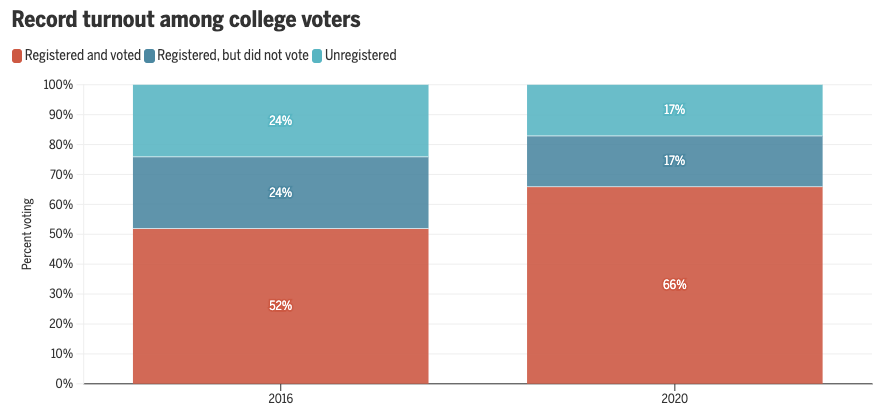
college student voting up 14 points in 2020

My colleagues at Tisch College’s Institute for Democracy and Higher Education have released their national report on the 2020 election, which is based on voting records of students enrolled at about 1,050 colleges and universities in the United States. As IDHE director Nancy Thomas says in the front-page Boston Globe feature, the turnout increase was “quite stunning.” It was also quite consistent across different types of institutions, fields of study, and demographic groups. For instance, white men, black men, social science or history majors, business majors, students at private liberal arts colleges, and students at public PhD-granting universities all showed increases of between 14 points and 17 points.

The whole report is here.

a conversation with Farah Stockman about American Made: What Happens to People When Work Disappears

I really enjoyed my conversation yesterday with Farah Stockman, whose new book is moving, insightful, and even suspenseful. She tells the life stories of three workers who were laid off when the Rexnord factory in Indianapolis was shut down, just as Donald Trump was winning the 2016 election.

I asked her versions of these questions:

You recall that your parents used to argue about race. When a waitress was rude, your Black mother would suspect she was being racist; your white father “thought she must be cranky after a long day on her feet.” You say, “I always wondered which one was right. That is why I became a journalist, to talk to the waitress.” I read that sentence as a metaphor for the whole book, and especially for sections like the one where you have a four-hour conversation about race with John—the Trump-voting union guy–after you learn that he displays a Confederate flag in his garage. Can you say more about your impulse to talk to people like the waitress and John? What are you trying to accomplish?

John sees the world in terms of workers vs capitalists. He hates talk of white privilege because he feels oppressed as a worker. He works to make the union fight the company, and he votes for Trump. His wife is more favorable to management. On that basis, he describes her as a “liberal.” He is also surprised when a Republican politician doesn’t seem to favor US workers. Does he see today’s capitalists as the liberals? What is making him feel that way?

Wally is a black man. You say that the first time he gave a “structural” explanation for injustice was when he criticized how the city condemned houses owned by Black people and sold them to white developers. Otherwise, instead of giving structural explanations, he talks about his own responsibility and how he’ll benefit from a positive personality and hard work. I believe in structural explanations, but I can see how they don’t offer much to Wally. He doesn’t have many ways to address structural problems in the society, but he sometimes benefits–precariously — from his own hard work and niceness. Am I understanding him right? And do you think he would have been better off if he had thought more politically and structurally?

College really doesn’t seem to benefit anyone in the book. Several people enroll and rack up debt without getting degrees, or earn degrees that don’t lead to good jobs. They resent college-educated people who are set over them. Shannon says, “I am not a Democrat or a Republican. I’m for the one who will keep good-paying jobs here for us un-educated people that build the parts that make them rich.” Is college good? How could it work better for all?

The book is full of moving moments of solidarity, like when a Mexican worker who will take Shannon’s job pulls her aside and apologizes (233), or when John worries that he might be taking a position away from a Black co-worker, Marlon (289), or when Wally physically embraces a man he has caught sabotaging equipment (214), or—most moving to me—when Wally and his new girlfriend Stacie pray and weep together over his challenges. Factory work can offer solidarity. Unemployment destroys it. Do you see ways to build solidarity, especially across race?

You explore the differences among Shannon, John, and Wally, but also their shared circumstances and culture. And you depict how different their culture is from that of a Harvard-grad reporter who lives in Cambridge, Mass. You are critical of your group (which is also mine) for being out of touch, pretentious, and soft. What should highly educated elites learn from working class Americans?

Dr. Kenann McKenzie to lead the Generous Listening and Dialogue (GLAD) Center at Tisch College

Happy news, per our official release:

Tufts University’s Jonathan M. Tisch College of Civic Life today announced that Dr. Kenann McKenzie, an accomplished educator, researcher and civic leader, will direct the newly created Generous Listening and Dialogue (GLAD) Center.

Designed to be a global center of excellence to promote authentic dialogue and generous listening across differences, the GLAD Center will serve as an educational resource for Tufts and beyond. The Center defines generous listening broadly, encompassing the art of listening to ourselves, to nature, and to others—especially when people disagree or when they confront differences of power and status.

Dr. McKenzie, who will join Tufts on November 1, 2021, has worked for two decades in the higher education sector as an academic counselor, researcher, lecturer, policy analyst and administrator. She currently serves as Director of the Aspire Institute, which supports the preK-12 educational sector with professional development based in a social justice framework and community engagement. In addition, she currently teaches at Wheelock College and serve d as the Educational Leadership & Policy Studies’ faculty representative to the college’s Equity, Diversity & Inclusion Committee.

“Working with Tufts students—the next generation of civic leaders—is a wonderful opportunity, and I’m thrilled to join Tisch College in building and sustaining a community of robust dialogue and truly generous listening,” said Dr. McKenzie. “This work challenges us to hear each other and ourselves, and to commit to considering big questions and big issues together.”

Housed at the Tisch College of Civic Life, the GLAD Center will collaborate with schools and departments across the university and with external partners, building on the expertise of Tufts’ faculty, research centers and civic engagement programs. Its programming, research, and interdisciplinary initiatives will help people at Tufts and beyond to develop skills and awareness, address hard issues, and generate new knowledge. The GLAD Center was launched in the spring of 2021 in collaboration with the Vuslat Foundation. Dr. McKenzie will be joined on the Center’s leadership team by Dr. Deborah Donahue-Keegan, Associate Director, Tisch College Senior Fellow and Lecturer in the Tufts University Department of Education.

“We look forward to welcoming Dr. McKenzie to Tufts and Tisch College,” said Dayna Cunningham, the Pierre and Pamela Omidyar Dean of the Tisch College of Civic Life. “Her leadership of the GLAD Center could not come at a better time. To grapple with the challenges that confront our students, our university and the world—from systemic racial injustice to the existential threat of global climate change—we need to flex every civic muscle we have, including the skills of listening and dialogue.”

Dr. McKenzie has a BA in Africana Studies from Cornell University, M.Ed. from the University of Virginia in Social Foundations of Education, and a Ph.D. in Politics and Education from Teachers College, Columbia University. In her civic life, she serves on the Beverly, Massachusetts School Committee and as VP III and education chair of the North Shore Branch of the NAACP. She is most proud of being a mother to amazing children who inspire her work everyday.

Newhouse endowment for the CIRCLE directorship

The Samuel I. Newhouse Foundation has made a $1.5 million gift to endow the directorship of the Center for Information & Research on Civic Learning and Engagement (CIRCLE), the leading research center on youth civic education and engagement at Tufts University’s Jonathan M. Tisch College of Civic Life.

This endowment is the most recent gift from Elyse Newhouse, J82, and her husband Michael Newhouse, A82, who have long been generous supporters of Tisch College and Tufts University. The gift will advance CIRCLE’s mission to understand and eradicate the barriers that keep some young people from participating in civic life. It will ensure that CIRCLE, a consequential anchor institution in the fields of civic education and engagement, will continue to have extraordinary impact on diverse young people’s ability to have a voice in our democracy.

[See the whole press release here.]

This announcement is doubly meaningful for me. First, the director is my close colleague and successor Kei Kawashima-Ginsberg, who richly merits an endowed position as a national leader in the field of youth civic engagement. CIRCLE is intensely collaborative, and the whole team deserves credit for all of its work, yet this is a moment to celebrate Kei. The gift reflects her accomplishments and excellence.

Second, the endowment vindicates our initial vision for CIRCLE. Founded in July 2001, CIRCLE began as strictly grant-funded project, albeit with the ambition of becoming a permanent institution that would help create a new field of research and practice. We moved from University of Maryland to Tufts in 2008 because of Tufts’ commitment to civic engagement and research. I proudly turned over the leadership to Kei in 2015. Tufts has supported CIRCLE in many ways, of which the Newhouse endowment is the newest–and one of the most significant–examples. We can now be sure that CIRCLE will be active and influential for a long time to come.

ghosts as a metaphor for past injustice

In Ghost Stories for Darwin, Banu Sabramaniam recalls:

Trained in evolutionary biology, I saw a field of morning glories and asked about flower color variation. I did not ask why it was the most obvious question. The landscapes in Southern California provoked me to ask questions about native and foreign species, without questioning the blurry distinctions between the native and the alien and the histories of the plants. The problem of women in the sciences elicited strategies to increasing their numbers, without any questioning of the gendered and racialized expectations of science.

Years later, I look at the same fields and see the ghostly apparitions of a eugenic past—the many mutilated, tortured, imperiled, and dead bodies, the stigmatized, contained, disciplined bodies of communities and nations of color, the poor, those deemed mentally incompetent, inferior, the many lives deemed not worth living. In tracing the genealogy of variation, all these histories came tumbling out.

Sabramaniam derives this use of a ghost metaphor from Avery Gordon and others. One example in her book is eugenics, which was widely endorsed and taught, closely linked to the development of population biology, genetics, and even statistics, and embraced across the political spectrum. In turn, eugenics is rooted in racism and sexism.

A defender of science would say: eugenics was a mistake, but now it has passed thanks to the self-correcting methods of scientists. A deep critic of science would say: the institution is still the same one that produced eugenics. I take the ghost metaphor to mean something between those two views. The institution is not eugenics; it is science. However, science is haunted by eugenics and racism, just as we might imagine a house to be haunted by ghosts. Likewise, Sabramaniam’s question about color variation was not racist; the flowers really were colorful, and it was good that she enjoyed them. However, once Sabramaniam had explored the history of scientific inquiry into variation–which was important work–she was no longer able to see the wildflowers without also seeing specters of the past.

A house and a ghost are distinct. We can imagine an effective exorcism or another solution to the problem presented by a ghost. Yet we are not actually banishing the ghosts that haunt us.

This metaphor resonates for me. I am not interested in blowing up the institutions around me, partly because I am not convinced that we would be better off without them, and partly because I actually admire aspects of them. But they feel haunted, and the more necessary work we do to understand their pasts, the more haunted they seem.

See also: pseudoscience and the No True Scotsman fallacy; media literacy and the social discovery of reality; the progress of science; mixed thoughts about the status of science etc.

open position at Tisch College, supervising student researchers

Program Manager, Student Research – Tisch College-(21001763)

(This is a part-time position, working 17.5 hours per week.)

The full listing and a link to apply are here.

The Program Manager will lead a team of paid student researchers who function like a research consultancy, conducting projects in support of Tisch College faculty and research groups housed within Tisch College, such as CIRCLE, the Institute for Democracy and Higher Education, the Center for State Policy Analysis, the Tufts Community Research Center at Tisch College, the Tufts Priority Research Group on Equity, and others. Periodically, the team may also study or evaluate Tisch College programs. Projects may involve survey research, analysis of existing data, interviews, focus groups, observations, literature reviews, and other methods. Given the mission of Tisch College, research will almost always involve civic engagement as a topic.
 
The Program Manager selects students for the research team and organizes them to work effectively together. Criteria for selecting students should include some prior coursework in research methods and/or prior experience with research. Therefore, teaching fundamental research methods is not a responsibility of this position. However, students may require additional training and support for particular projects.

The Program Manager consults closely with Tisch College professional researchers to identify appropriate projects and to determine the methods, timelines, deliverables, etc. for each project.

The Program Manager works with the student team to accomplish all aspects of each research project, including—when appropriate—research design, Institutional Review Board (IRB) approval, data collection, analysis, and communication of results. The Program Manager is responsible for the quality of the research as well as the learning opportunity for the student researchers.

The Program Manager will be responsible for the supervision of all program staff and students, financial and administrative oversight, and budget management.

Qualifications

Basic Requirements:

  • MA degree with 3-5 yrs. experience in area of research.
  • Direct prior experience with all major aspects of social science research.
  • Experience teaching or leading groups of undergraduates.
  • Experience working on collaborative research.     

Preferred Qualifications:

  • Ph.D. or coursework completed toward a PhD.
  • Both qualitative and quantitative research methods and experience.
  • Experience producing research that is meant for a public audience or for practitioners (not just academic publication).
  • Knowledge of aspects of civic engagement as a research topic.

Peter Beinart interview on anti-Semitism and Middle East politics

This is the video of yesterday’s conversation with Peter Beinart at Tufts:

I asked him:

  • What do you think is the relationship (if any) between rising anti-Semitism and rising criticism of Israel?
  • When is criticism of Israel anti-Semitic, and when isn’t it?
  • Is it important that we have dialogue about Israel/Palestine in places like Tufts? Why? What would be trying to accomplish?
  • In Jewish Currents in July, you wrote, “In mainstream American discourse, the word ‘anti-Palestinian’ barely exists. It is absent not because anti-Palestinian bigotry is rare but because it is ubiquitous. It is absent precisely because, if the concept existed, almost everyone in Congress would be guilty of it, except for a tiny minority of renegade progressives who are regularly denounced as antisemites.” Can you expand on that statement and talk a little more about why you focus on anti-Palestinian prejudice here, apart from Islamophobia or anti-Arab prejudice?
  • What should non-Jews know about Judaism to engage appropriately in civic life?
  • What is your own position on Israel/Palestine now, and how did you get there?
  • What would a one state solution look like? How would the state be organized?

rationales for private research universities

The Atlantic’s Emma Green begins her interview with Princeton president Christopher Eisgruber by asking, “Why should Princeton exist?” He answers by talking about “talent.” He says, “the idea of a place like Princeton is that you can identify young people who have extraordinary talent and will benefit from an intensive academic experience. Over the space of years and decades, they will blossom in ways we can’t even predict, and they will be able to address problems that matter.”

In order to accept this rationale, you would have to accept some version of four controversial premises: 1) Princeton attracts talent, as opposed to various forms of capital (financial, social, cultural). 2) Talented people learn more at Princeton than they would at less selective institutions; they do not merely receive credentials with high market value. 3) Graduates of Princeton are trustworthy and accountable to other human beings. And 4) Social change depends on small numbers of talented people.

Persuasive evidence for these claims cannot be anecdotal. Eisgruber cites Justice Sotomayor, who is genuinely talented, probably learned a lot at Princeton (she talked about it when she visited Tufts), serves the public good, and wields influence as a Supreme Court justice. But one example does not make the case. What is the net impact of Princeton on society? (For instance, what is the impact of one Sonia Sotomayor minus one Ted Cruz?)

I would offer a different justification, cautiously because I think it only goes so far. You could call it “one cheer for Princeton.”

Justice is extraordinarily important. It is a contestable concept and it should be complex, encompassing various values that may not fit together comfortably. For instance, it should probably encompass both individual freedom of choice and also equity. Regardless of how you define justice, highly selective and fabulously endowed US universities are not likely to be consistent with it. That is why they should face constant pressure from democratic institutions as well as competition from public higher education and from other entities here and abroad.

But I don’t think that justice is the only good. Here I would also mention truth and beauty. Highly selective and well-funded universities generate a lot of those goods–and not only for their own members. As Eisgruber notes, five of this year’s Nobelists have Princeton connections, and their research is in the public domain. David Card’s work on the minimum wage is research that should promote both truth and justice. He conducted it with Alan Krueger while they were both at Princeton, which is a good example of the benefits of concentrating expertise. Princeton also produces beauty in the form of natural science and scholarship. At Tufts, we add a school of fine arts.

Although highly selective private institutions generate truth and beauty, they don’t–and shouldn’t–monopolize those functions. For one thing, public universities produce a vast amount of the same goods. (But US public universities are often effectively private institutions.) More importantly, truth must come from beyond the academy.

Indeed, universities have weaknesses as producers of knowledge and beauty (apart from their questionable impact on justice). They are not particularly good at valuing the ideas and insights that come from the margins of society. My job is to try to address that problem at Tufts and in some national networks. Whether I succeed is a different question, but I work on it every day. I think my underlying motivation is the belief that by combining the kinds of knowledge that come from places like Tufts and Princeton with very different kinds of knowledge, we might be able to enlighten and empower people beyond our walls.

See also how to keep political science in touch with politics; the weirdness of the higher ed marketplace; a way forward for high culture