the student

A Victorian house on a stately street,
Formal, ornate. The bell breaks the silence.
Would a gift have been wise--something to eat? 
When to shift from pleasantries to science?
A ticking clock, long rows of serious books,
China, polished wood, a distant dog barks.
Pay attention, this might have some value.
It's rude to seek help without taking advice.
Now say what you've really come for, shall you?
Then: time to go? Did our talking suffice?
Not for years now have I been the visitor.
This is my parlor and I am the grey one,
The host, the ear, the kindly inquisitor.
How can it be that it's my turn to play one?

See also: Midlife.

Andrei Rublev by Andrei Tarkovsky

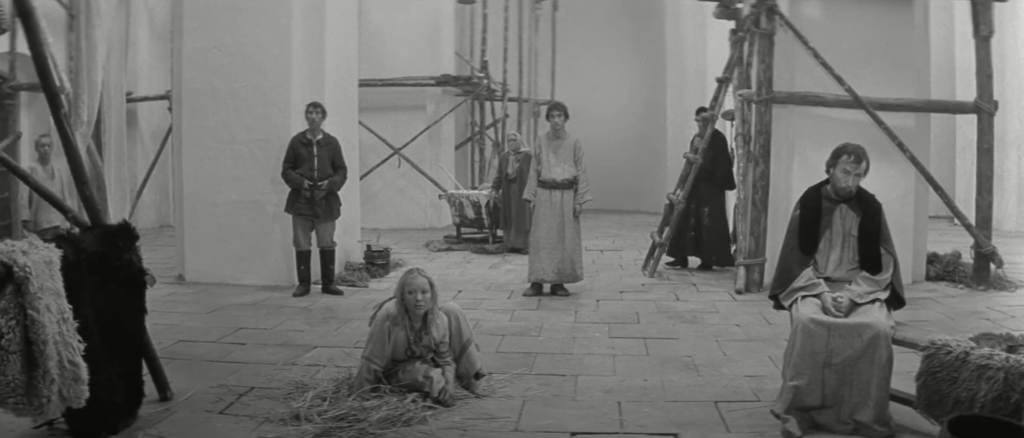
In the Guardian, Steve Rose called Andrei Rublev by Andrei Tarkovsky (1966) “the best arthouse film of all time.” When I had a day alone recently, I watched its three hours. Here are some notes that don’t duplicate anything I can find in English on the Internet. They do contain plot spoilers.

The setting is Russia in the first decade of the 1400s. The people are beset by Tatars, oppressive rulers, and plagues. The landscape often looks like an environmental catastrophe. Tarkovsky uses many long takes, panoramic shots, and set-pieces in which the actors are positioned like figures on a stage or in a painting.

Rublev is a monk and icon-painter. Despite being the moral focus of the film, he is on screen not much more than three other monks. Maybe it was just me, but I found it challenging to keep track of individuals from one scene to another. That task is easier in a written text, because narrators typically use names and may inform us when we have already encountered a given character. Tarkovsky seems content to present life in the confusing way that it actually unfolds.

In the opening scene, a man makes a solo hot-air balloon ride, rising next to an unfinished Orthodox cathedral and then across a river dotted by small boats. Some people help him while others try to bring him down. Although the balloon is anachronistic, it looks suitably medieval. It closely resembles the great bell that is cast in the final scenes of the film–for the same cathedral–and raised from its subterranean mold across the river to the belfry. The balloon and the bell have similar sizes, shapes, and trajectories. The balloon-ride appears to be a stunt that fails, whereas the bell is a spiritual and aesthetic success accomplished by the people, working together.

The second third major scene opens with a man being tortured in the public square as someone cries out that he might be innocent. The artist-monk Kirill walks past this execution and into the cool interior of a church, where he meets another icon-painter, Theophanes the Greek. They discuss the project that will involve Rublev and become his masterpiece. Back outside, we see the dead man’s bloody body.

In several key scenes, the Russian folk are shown in authentic rituals or celebrations–enjoying a jester mocking the Boyar nobility, enacting the Passion of Christ, or engaging in a midnight pagan orgy. (Compare Natascha’s dance in War and Peace.) In several scenes, they are cruelly crushed by Russian nobles, Tatars, or a conspiracy of both.

Observing these events, Rublev develops a populist and antinomian Orthodox theology. He feels he cannot complete his commission to paint the cathedral because it would require an image of the Last Judgment to terrify the people. Inside the bare cathedral, an apprentice reads 1 Corinthians 11 while the mute girl Durochka, a “holy fool” with long blond hair, watches in fascination:

“If a woman does not cover her head, she should have her hair cut off; and if it is a disgrace for a woman to have her hair cut or shaved off, she should cover her head. A man ought not to cover his head, since he is the image and glory of God; but the woman is the glory of man. For man did not come from woman, but woman from man …

Rublev gets an idea: “They are celebrating. It’s a holiday! They are not sinners. Nor is she [Durochka], even if she doesn’t wear a cover.” He will paint joyous scenes for the people.

The interior of the church immediately after Rublev has announced his plan, showing the Holy Fool and the monk Daniil, who had commanded the reading of Corinthians.

Muteness is a motif. The jester has his tongue cut out. Durochka cannot speak. Andrei takes a vow of silence and refuses to paint after he kills a man to save Durochka. The new bell almost fails to ring–and if it never works, the Grand Duke will have its caster flogged to death.

Andrei has several foils, starting with the man in the balloon ride. Another is Kirill, who betrays the jester to the authorities and later quits holy orders, decrying monkish hypocrisy but seeking worldly gain for himself.

An important foil is Boriska, the young son of a bell-caster who died–with the whole family–of the plague. Boriska claims to know his father’s professional secret. With passionate intensity and perfectionism, he leads a crew to make a great bell, using the melted plate of the Grand Duke. He has lied about the secret, but he turns to God for help. Whether the bell will work is genuinely suspenseful. Foppish Italian visitors observe the young artist with pity: “il povoro regazzo” is bound to die a Russian’s death, tortured by a tyrant, because the bell won’t work. Their foreigners’ chatter is interrupted by the bell sounding sonorously. Boriska confesses his lie to Andrei, who says, “Let’s work together, you casting bells and me painting icons.” He then paints the cathedral’s interior in resplendent colors that we see in the epilogue, after three hours of monochrome.

how to keep political science in touch with politics

On the last day of the American Political Science Association’s Institute for Civically Engaged Research (ICER), Rogers Smith visited. As APSA president, he had played a major role in launching and inspiring ICER. Rogers offered original and thoughtful remarks to this year’s cohort. Some of what he said reminded me of his APSA Presidential Address, which is available on YouTube.

In that address, Rogers defines civically engaged research as “research done through respectful partnerships with social groups, organizations, and governmental bodies in ways that shape both our research questions and our investigations and answers.” Civically engaged research is not fieldwork or other qualitative or quantitative research about communities.

He justifies civically engaged research as a way of keeping in touch with important trends and movements in the real world:

While there are dangers, we modern political scientists have probably done too little civically engaged research, not too much. The work we have done has also been skewed toward groups with which researchers have strong ideological affinities. Though such rapport can be productive, as a discipline, we must learn from all segments of our societies. If more of us had been attending to the diversity of Black organizers in the 1960s, to anxious fundamentalists as well as assertive LGBTQ advocates in the 1970s, and to angry farm and factory workers in the early 21st century, we might have perceived sooner many major changes in American politics. And if more of us had actively worked with these groups to help them address their concerns and helped them in ethically defensible ways, then Black communities, conservative religious groups, gay activists, and workers and farmers might feel less suspicion and disdain toward academics than many do in the US today. The same may be true in other regions of the world. Intellectual honestly means I can’t guarantee that more civically eengaged research would have helped in these ways, but I know we didn’t do much, and in the light of where we are today, it is worth trying to do more.

I would add two points from my own perspective.

First, there is value in engaged research with (and not only about) right-wing communities and dominant communities. But this does not mean that individual scholars are obliged to conduct such research.

In practice, a disproportionate number of civically engaged social scientists identify with oppressed groups outside the academy, and that is why they feel compelled (as well as motivated) to work with these groups. Often scholars of color, they offer profound insights about the communities that they both study and belong to. No one should expect them to study right-wing whites (unless they want to). Instead, they offer insights from the perspective of the oppressed. For instance, I presume that scholars who are closely engaged with Asian-Pacific Islander groups knew about burgeoning anti-Asian hate well before it made headlines.

Yet we have much to learn from research conducted with conservative and/or demographically dominant groups. Years ago, I visited a prominent land-grant university to meet with the faculty who practiced “community-based” research. This university is located in a largely white and rural part of its state, but the faculty were driving to the nearest big city to do their engaged scholarship in urban neighborhoods that they admired more than their own geographical community. I thought that research about and with neighbors was a gap that should somehow be filled.

Second, the idea that an academic discipline must engage with movements and institutions challenges its self-understanding as a science.

In a simple model of science, facts result from good methods and data. You needn’t engage with planets or atoms in order to understand how they work; you can observe them or otherwise collect data about them. Within pockets, a similar approach to social science works well enough. You needn’t engage in a given election to crunch voting data and generate valid and useful findings about the election. But the human world is different from nature in two relevant ways–it is shot through with values, and it is influenced by intentional human agency.

Social scientists can choose to study many topics. Which questions to focus on is fundamentally a value-judgment, an assessment of what counts as an important issue or problem. Individual scholars are entitled to form their own opinions about priorities, but we are always wiser when we reason about values with other people. If our ears are open, we can learn about new injustices, new opportunities, and even new rights that we did not see before. In that sense, staying in touch–yet always critical–is essential for setting a wise research agenda about the human world.

Society is also unpredictable in a particular way. Human beings are aware of current trends and patterns. They can use their understanding of how things are going to make things look different in the future. They can invent, and no one can foresee a true invention until it arises.

Often, social scientists identify the central tendency in data, but data always come from the past. While we observe society, participants are busy working to disrupt it. History involves ruptures as well as continuities, and statistical social science is relatively badly suited to understanding the breaks. Sometimes, we can see substantial change coming better when we are closer to the action.

On a spectrum from a physicist who studies the eternal laws of the universe to a newspaper reporter who writes what happened yesterday and what it portends for tomorrow, a political scientist stands somewhere in between. History has long arcs but also many contingencies.

As Rogers Smith notes, the behavioral revolution has transformed political science. It presumes that political behavior has regularities that can be understood in a detached way. I believe that behavioral social science has yielded important insights. Yet this research reflects the Zeitgeist; it does not stand outside of history.

Today’s mainstream model of voters and democratic institutions is rather jaundiced. Data show that people lack the motivation and capacity to make well-informed judgements about public issues. But these data come from recent decades, when many organizations and institutions that inform and organize people’s thinking have become old and weak. If it were true that human beings never want reliable information about matters distant to their own private interests, then it would have been impossible to build professional journalism, or civic education in public schools–or even robust political parties that generate social analysis. While those institutions were being built up, the academic discussion of democracy was quite optimistic. (See: Dewey, John.) Now that those same institutions are in decline, the empirical evidence suggests that voters are incapable of forming thoughtful and independent opinions. This whole research paradigm reflects its context, and the context can change. But change requires engagement.

See also: don’t let the behavioral revolution make you fatalistic; why political science dismissed Trump and political theory predicted him, revisited; methods for engaged research; civically engaged research in political science #APSA2019; we should be debating the big social and political paradigms; Participatory Action Research as Civic Studies.

Tufts University Equity Research Symposium on June 30

Please join us for presentations highlighting recent findings focused on equity in the US as related to discrimination, COVID-19, substance use, and environmental health, as well as a discussion on future research directions for The Tufts Equity in Health, Wealth, and Civic Engagement Research Group.

Registration Link: https://tufts.zoom.us/webinar/register/WN_5US1YaaHSf2BBAdNcd-5bQ

Agenda: Equity Research Symposium, June 30, 2021, 2-4 p.m.

2:00 Equity Conceptual Model: Peter Levine

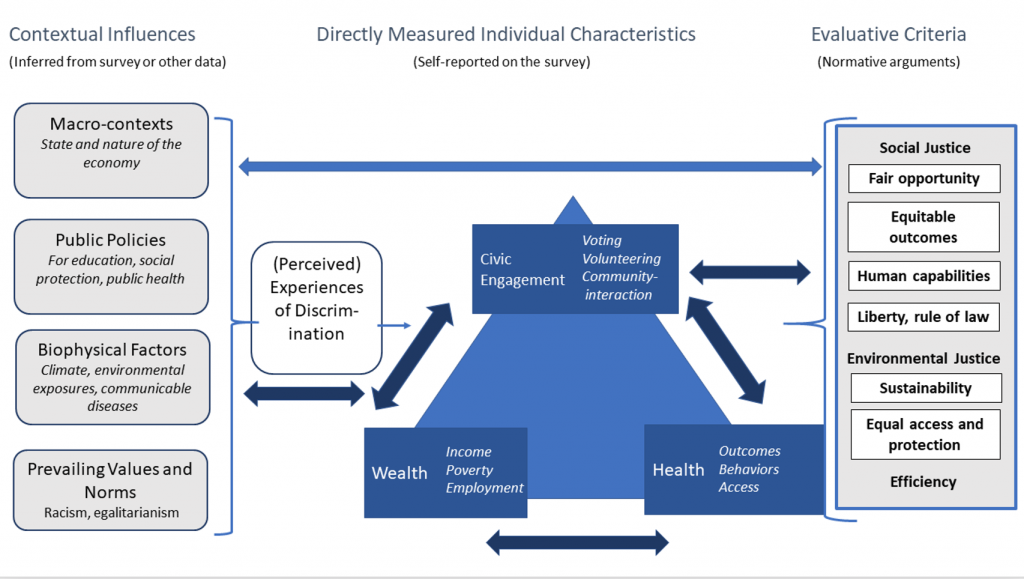
Spoiler alert: this is a version of our working conceptual model. Join the symposium to learn more.

2:05 Equity Survey Methods: Tom Stopka

2:15 Identity, discrimination, and civic engagement: Deborah Schildkraut, Jayanthi Mistry

2:30 COVID-19 Vaccine Hesitancy: Jen Allen

2:45 Environmental exposures and COVID-19 morbidity and mortality: Laura Corlin

3:00 Substance Use and COVID-19: Andrea Acevedo

3:15 Voting preference, health status, and preventive behaviors for COVID-19: Thalia Porteny

3:30 Open discussion and suggestions for future research

4:00 Adjorn

Horace against the Stoics

Horace wrote his first book of Satires (meaning “medley” rather than “satire” in the modern English sense) no later than 33 BCE. In a passage in the Third Satire, he criticizes the Stoic doctrine that justice has its basis in nature. He suggests that rules are conventions that allow us to prevent conflict with minimal cruelty.

Nothing about his position is unique, but his language is luxuriant: “cum prorepserunt primis animalia terris / mutum et turpe pecus, glandem atque cubilia propter / unguibus et pugnis …” In my version …

When the animals crawled from the new* earth,
That mute and ugly herd fought for a nut 
Or a place to rest--with nail and fist, 
Then with clubs, then with tools they’d designed for war,
Until they came upon words to mark out sounds 
And sense, and names. From then on, war waned. 
They walled towns and wrote laws so that no one
Should be a thief, a thug, or an adulterer.
For even before Helen, sex** was a vile 
Cause of conflict, but those are forgotten 
Who died chasing it, like the bull in the herd, 
Cut down by someone more fit than he is.
You have to admit, if you really search the files,
That laws were contrived in fear of injustice, 
For nature can’t distinguish just from unjust
As she makes some things safe and others best to shun,
Nor can reason convince us it is just as bad--
And bad in the same way--to step on someone’s 
Garden plant as to steal a holy relic 
By cover of night.*** Let there be a standard 
To tell the right penalty, so the cruel lash 
Isn’t used when a regular beating would suffice.

Horace, Satires. 1.3.99-119, my translation

*Literally, “first earth.” **Actually a vulgar, sexist word. *** I’m surprised he doesn’t say: reason can’t convince us it is worse to steal the sacred object.

See also some thoughts on natural law; “The Wedding of Peleus and Thetis“; pragmatism and the problem of evil

public opinion has moved against mandatory vaccination

Using Ipsos’ KnowledgePanel, the Tufts University Research Group on Equity in Health, Wealth, and Civic Engagement surveyed representative samples of Americans in 2020 and 2021. Among many other questions, we asked whether authorities should be able to mandate vaccination. Most respondents said no both times. Support declined from 42.6% to 34.5% from 2020-2021. Biden supporters were more favorable than non-voters, who were more favorable than Trump supporters. However, both Biden and Trump voters moved against mandatory vaccinations. Possibly, Trump supporters have become less likely to favor vaccination mandates now that the federal government is led by a Democrat, but that wouldn’t explain the decline among Biden supporters.

I report these results without a strong value-judgment. I think I would support mandates (with appropriate exemptions), but that's just an opinion. I don't have expertise or fixed views.

Some caveats: In 2020, we asked about vaccinations in general. In 2021, we asked about the COVID-19 vaccines. In 2020, we asked whether people would vote in the next November election--and if so, for whom. In 2021, we asked whether and how they did vote in the prior election. Too few people admitted they didn't vote; our turnout estimate is inflated by over-reporting.

See also: Despite Similar Levels of Vaccine Hesitancy, White People More Likely to Be Vaccinated Than Black People.

methods for engaged research

We are in the second day of the American Political Science Association’s Institute for Civically Engaged Research (ICER), hosted by Tisch College but held online this summer. Twenty excellent engaged political scientists are the participants, and they are interacting with the directors and visitors.

One issue for discussion is the relationship between methodology and civically engaged research. Is engaged research a method? Does it favor one or more methods over others? Or is it methodologically neutral?

I won’t try to characterize the other ICER participants’ views, except to note that they hold diverse and thoughtful opinions on questions like this. For myself, I’d want to resist a tendency (outside of ICER) to equate engaged research with qualitative methods.

I have a biographical reason not to endorse this distinction. My own background is in philosophy, and I succeeded Bill Galston (a political theorist) as the second director of CIRCLE until 2015. CIRCLE is well-known for quantitative research: its own surveys plus analysis of federal data and voting records. Yet CIRCLE has always employed full-time experienced professionals whose main focus is building partnerships and capacity in its partner organizations. I see CIRCLE as a deeply civically engaged research center, in the sense that Amy Cabrera Rasmussen, Robert Lieberman, Valeria Sinclair-Chapman, Rogers Smith, and I propose in a forthcoming article in PS:

Civically How people govern themselves. Engaged  research teams are self-governing  collaborative groups (composed of  community organizations, government  actors, social movements and others); their  research strengthens self-governance for  others.
engaged Collaborative, in partnership, with benefits  and substantive roles for both political  scientists and non-academics in the same  projects.
research Any organized, rigorous production of  knowledge, including empirical, interpretive,  historical, conceptual, normative, and other  forms of inquiry.
political science A pluralist discipline with a central focus on  questions of power, politics, and governance.

Given my background, I’ve always found it natural that engaged research can involve any method, from big-data analytics to randomized field experiments to philosophical inquiry. I would acknowledge a debt to the atmosphere at the University of Maryland in the 1990s, when people like Galston, Steve Elkin, Gar Alperovitz, Linda Williams, and others comfortably combined political theory with empirical research and civic engagement. I also found inspiring models in Elinor Ostrom and Jane Mansbridge.

Meanwhile, I observe that community partners of various kinds are drawn to the full range of methods. Some groups are very comfortable with robust and explicit debates about normative issues. They may connect more easily to the methods of philosophy, political theory, and theology than to qualitative social science. Other groups have big datasets and are already quite good at crunching numbers but would like to collaborate with people situated within universities. Some run interventions and are quite happy to randomize treatment and control groups. Certainly, some are not comfortable with any of those methods, but that doesn’t mean that interviews and focus groups will suit them best.

If anything, engaged research seems an invitation to mix methods and to develop methodological pluralism. Positivism may be an obstacle to engaged research, but “positivism” doesn’t mean quantitative research methods or the application of statistics. Positivism in the problematic sense is a philosophy that sharply distinguishes facts from values, scientists from subjects, and knowledge from power. Qualitative researches can be naive positivists, while number-crunchers can hold nuanced and productive ideas about epistemology.

See also civically engaged research in political science #APSA2019; we should be debating the big social and political paradigms; how to present mixed-methods research; what gives some research methods legitimacy? etc.

The New Hampshire Institute for Civic Education’s William W. Treat Lecture Series

How can we renew faith in our institutions and in our neighbors? That is theme of the following public events:

the UK in a polycentric Europe

I’ve had deep connections to the UK since childhood and have always been committed to the idea of Britain in Europe. I believe that the UK has been much better off as a part of the EU, while the EU could benefit from particular British perspectives and institutions. For those reasons, Brexit saddened me.

However, I also believe in polycentricity. As a descriptive theory of the world, it says that there are (almost) always many centers of power, and they need not stack up neatly, with smaller, weaker units inside bigger and stronger ones. Jurisdictions and roles usually overlap and interrelate in complex ways.

As a reform agenda, polycentricity says that things work better when power is divided into many parts that partially overlap. Over-centralization is generally unwise.

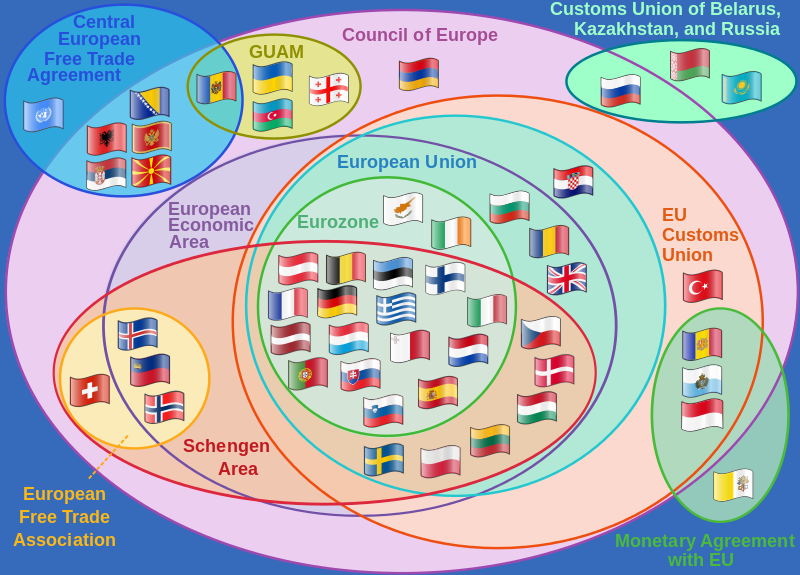
“Europe” is already polycentric in this sense. Here is one person‘s diagram of important treaties among European nations. The treaty groups overlap in a classic polycentric way.

“Euler Diagram of Europe” from https://www.reddit.com/r/europe/comments/2etvpz/euler_diagram_of_europe/

This diagram is useful but far from complete. In addition to treaty arrangements, one could add other partnerships among nations, cities, companies, labor unions, universities, parties, professional groups, and more. Also, the image presents each nation as a unit, when many EU member states are federal or otherwise decentralized.

The picture is a little dated; the Union Jack will have to move outside of several circles where it appears above. However, the UK will not move outside of the polycentric network of Europe. Like it or not, Britain is “in.”

To British people who favor European integration, I would say: Brexit was bad. But you are still in Europe. The path forward is to encourage as much participation as possible in a wide range of cooperative ventures, whether among nations or among other kinds of entities. These cooperative activities should extend across Europe but not always be limited to the European continent.

To people who aspire to a federal Europe, I would say: Federalism, as implemented in republics like the USA, Germany, and Brazil, is one approach to combining centralization with decentralization. It assumes a Westphalian sovereign state that has ultimate power and attracts the deepest allegiance from all its citizens, with a neat tessellation of smaller and weaker units inside it that resemble each other and have similar relationships to the whole. This is by no means the only approach to making something large out of many smaller components. In the European context, federalism may have outrun its mandate and potential, at least for now. So everyone who wants to see Europe integrate should be willing to experiment with other overlapping associations.

To Euroskeptic Britons, I would say: You’re in Europe. You always have been, at least since prehistoric French people helped build Stonehenge. Sovereignty is an oversimplification, since power is always polycentric. By overestimating the importance of the national level of government, you have reaped a bunch of unnecessary problems and foreclosed some beautiful solutions, such as a borderless Ireland within the EU. Nevertheless, you and your children and your children’s children must belong to numerous networks and partnerships that cross the Channel. You should be working on making these partnerships work.

See also: Brexit: a personal reflection; modus vivendi theory; avoiding a sharp distinction between the state and the private sphere; British exceptionalism 2: the unique nature of the aristocracy; a range of federalism options for Israel-Palestine.

explore equity and inequity in the USA

On the Tufts Equity Research website is a user-friendly tool that allows anyone to explore data from our May 2021 national survey. The tool requires no specialized background or vocabulary to use. You can just select pairs of variables and see the results.

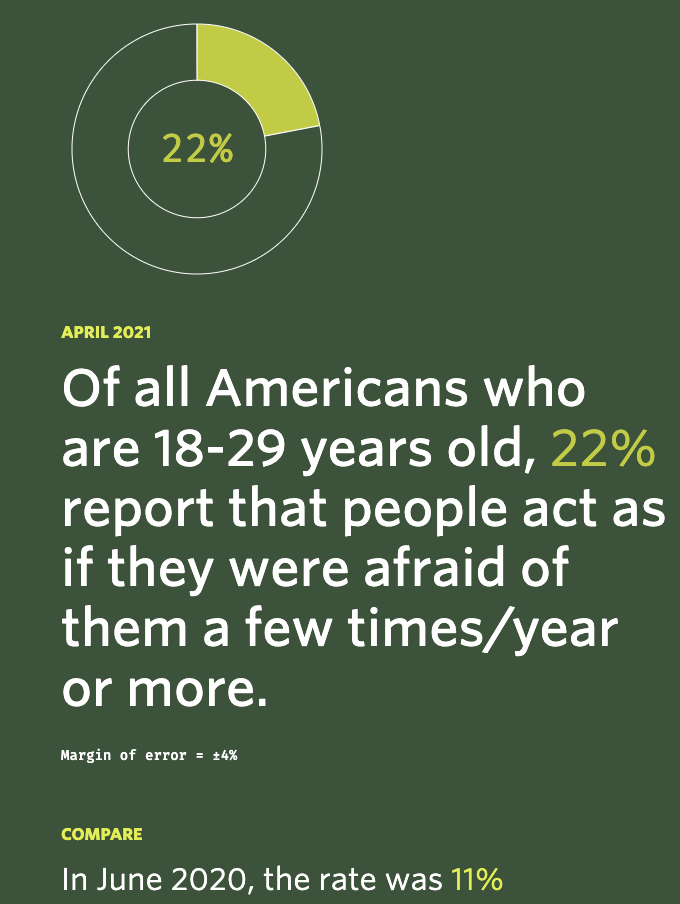
For instance, I looked at the proportion of Americans who report that other people act afraid of them because of their identity. The graphic shows the result for the whole population. The rate has doubled since last year, and I suspect that’s because we have feared each other during this year of pandemic and political conflict.

One can also look at differences by demographic category. For instance, 33% of Black Americans–versus 15% of whites–believe that they are feared because of their identity.

You can explore hundreds of other combinations on the site.